

2 Guys And A Chainsaw - A Horror Movie Review Podcast· Folge 492
The Curse
Donnerstag, 11. Juni 2026 · 55 min
Kapitelklicken springt direkt hin
Shownotes
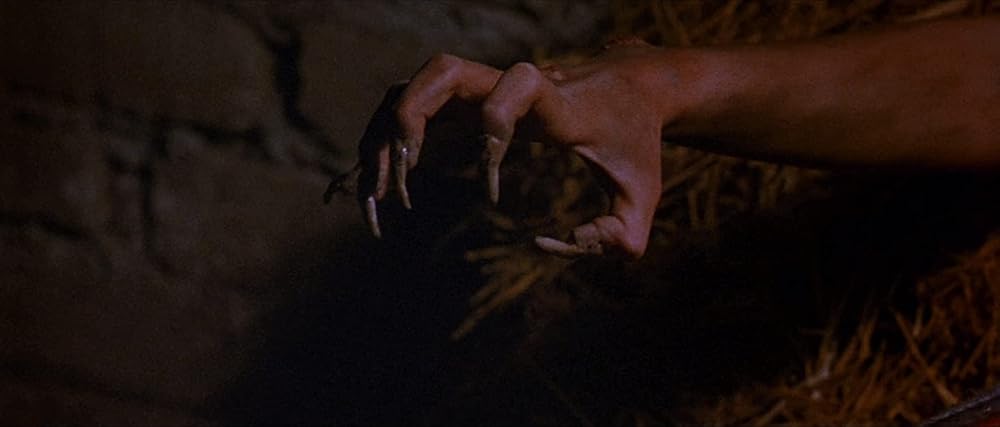
This week we tackle 1987’s The Curse, an Italian-made, sequels-in-name-only entry starring Wil Wheaton and loosely adapting H.P. Lovecraft’s “The Color Out of Space” with a Reagan-era farming backdrop.
We dig into the film’s infamous behind-the-scenes stories—David Keith’s chaotic directing, Lucio Fulci’s debated influence, and Wheaton’s accounts of mistreatment on set—though we don’t endorse any of it.
Then we break down the movie’s slow build, scattered subplots, and the core story of a meteor contaminating well water, triggering grotesque practical effects and a family’s unsettling transformation. We debate what still works (the gore, the mother’s progression, the score) versus what feels padded or underdeveloped, and we compare it to later adaptations like the 2019 Nicolas Cage film.
chainsawhorror.com/wp-content/uploads/sites/13…
Expand to read episode transcript
Automatic Transcript
The Curse (1987)
Episode 492, 2 Guys and A Chainsaw Horror Movie Review Podcast
Todd: Hello, and welcome to another episode of Two Guys and a Chainsaw
I’m Todd. And I’m Craig. Craig, this week it was your turn, and you picked a movie. I’m really happy you picked it because I never saw it before, but I pass by it on the shelves all the time. It has a very iconic cover art. It’s got, like, this big demonic hand coming up through farm fields holding, like, a farmhouse in it with the lightning striking around it and the…
I don’t know, it just looks really freaky, like some demonic forces are taking over some small town, and it has Wil Wheaton in it. This is 1987’s The Curse. We did The Curse Part II, and there’s a Curse Part III and a Curse Part IV. All of them are made from, uh, by Italians, including this one, and none of them are really related to each other.
No. They’re just sequels in name only to capitalize on the apparent success and popularity of the original.
Craig: Cult success, yeah.
Todd: Yeah. The first time I had seen it, but I know you have seen this one before, right?
Craig: Yeah. I grew up watching this. I don’t know which of my memories are real and which ones are constructed, but I seem to remember watching this with my cousins, Nick and Steve, some summer.
We always rented tons of horror movies back in the day when you just said, “Yeah, my dad said it was okay,” and they’d, you know, hand you R-rated movies over the counter or whatever.
Todd: Those were the days.
Craig: And our dads really did say… I know. It- those were the days. And our dads really did say it was okay, but it was a different time.
And of course, I was just drawn to horror movies in general, but I was a big fan of Wil Wheaton’s, because this came out just, I think, a year after or a year or so after his big breakout in Stand by Me, which is, remains one of my-
Todd: Mm …
Craig: favorite movies, uh, of all time. I, I think it’s a great movie, and I think that he’s fantastic in it.
So, you know, seeing him… And of course, this movie, which was shot on a, a much smaller budget, i- is, is not nearly as good and does not showcase his skills nearly as much, but- … seeing him on, on the box certainly drew me to it. Oh, boy. And, you know, I was a fan of it then, and I know that I’ve seen it since. I think I, you know, pull it out or, or pull it up some, from somewhere every once in a while and, and watch it, but I haven’t seen it in a really long time.
And again, you know, you and I sometimes mention how watching these movies, you know, on our own just for fun is kind of a different experience than watching them for the podcast. Like, we really do try to kind of watch more closely and with a more critical eye and try to look at the different components of it and stuff.
Todd: Mm-hmm.
Craig: And so doing that this time- It’s far from perfect.
Todd: Yeah.
Craig: There,
Todd: there’s- Uh, Wil Wheaton himself is not a fan. I don’t even think he… I think he refuses to sign materials related to this movie when he’s at conventions.
Craig: He does, and the movie is interesting because it’s, it’s an adaptation of-
Todd: H.P.
Lovecraft …
Craig: H- H.P. Lovecraft’s The Color Out of Space, which I haven’t read, but I hear is Lovecraft’s own personal favorite of his short stories. They Americanized the story and, and have some social commentary on the economic stuff that was going on with farmers in, un- in the Reagan area, era at the time.
So it’s inspired by the story, and the key elements of the story are there, but it’s, it, it’s definitely an adaptation. Really, what goes on behind the scenes is kind of more interesting than the movie itself.
Todd: Hmm.
Craig: The movie was directed by David Keith, who is an actor. He was in An Officer and a Gentleman, and he was in, like, Major League and, and some other stuff, and he’s continued to work since then.
But the studio that made the movie, and I don’t remember what it was, had signed him on to star in another movie, and when that fell through, they offered him this as his directorial debut. And Wil Wheaton said that he was just awful, that he was… You know, he had a, a big ego, you know, coming off of his acting career.
But he had never directed before, didn’t know what he was doing. Said he was coked out all the time and just chasing skirt all the time, like was not a good director at all. And on top of that, like, Wil Wheaton didn’t even wanna do the movie. He didn’t like the script, you know. Stand by Me had done so well, and he had gotten so much, you know, great critical response, not just the film itself, but him specifically.
Todd: Mm-hmm.
Craig: Um, and, and he didn’t wanna do this dumb horror movie, but his mother… And he doesn’t… You know, in the stuff that I saw, he doesn’t talk extensively about his parents, but they don’t sound great because I guess his mom kind of arranged this meeting with the producers and the filmmakers without his agent present.
And they kind of strong-armed him into taking the movie. His, his parents, I guess, were enticed… Th- they were gonna pay Wheaton $100,000 for the role, which I guess was big for him at the time, even though I also read that he only ended up, he himself only ended up making 15 cents on the dollar for that.
Todd: Wow.
Craig: So, a big salary for him. They did the outdoor photography on David Keith’s farm. It was initially- … supposed to be, it was initially supposed to be filmed in Los Angeles, but he, Keith, had just bought a big ranch in Tennessee, and he’s like, “No, let’s just shoot it on my ranch.” So they did. So the outdoor stuff was all filmed there, but the, the, all of the interior shots were shot in Rome.
So the whole family was also gonna get a free trip to Rome, and they were gonna give Wil Wheaton’s real-life little sister, Amy Wheaton, a role in the film.
Todd: Mm-hmm.
Craig: So that was a real sweet deal according to his parents, and they kind of strong-armed him into signing it And apparently it was just a nightmare from beginning to end.
You know, he- Wil Wheaton says that he and his sister both were both physically and verbally and mentally abused on the set. He says that he was touched inappropriately by two adults in the production and that he didn’t feel protected by any of them. Ironically enough, the person that he felt most protected by was the guy that played the creepy older brother character in the movie-
who he said in real life was very gentle and loving and was really kind of one of the only people who stepped up to protect him and his little sister, Wil and his little sister.
Todd: Man.
Craig: And, and not only that, but after… They filmed all of the outdoor photography first in America, but then they sw- moved production to Rome and completely ignored all American child labor laws.
So he and his sister were working 12-hour days with no breaks five days a week, a- again, being physically abused. One of the most shocking things that I read, there’s a scene in the …
