

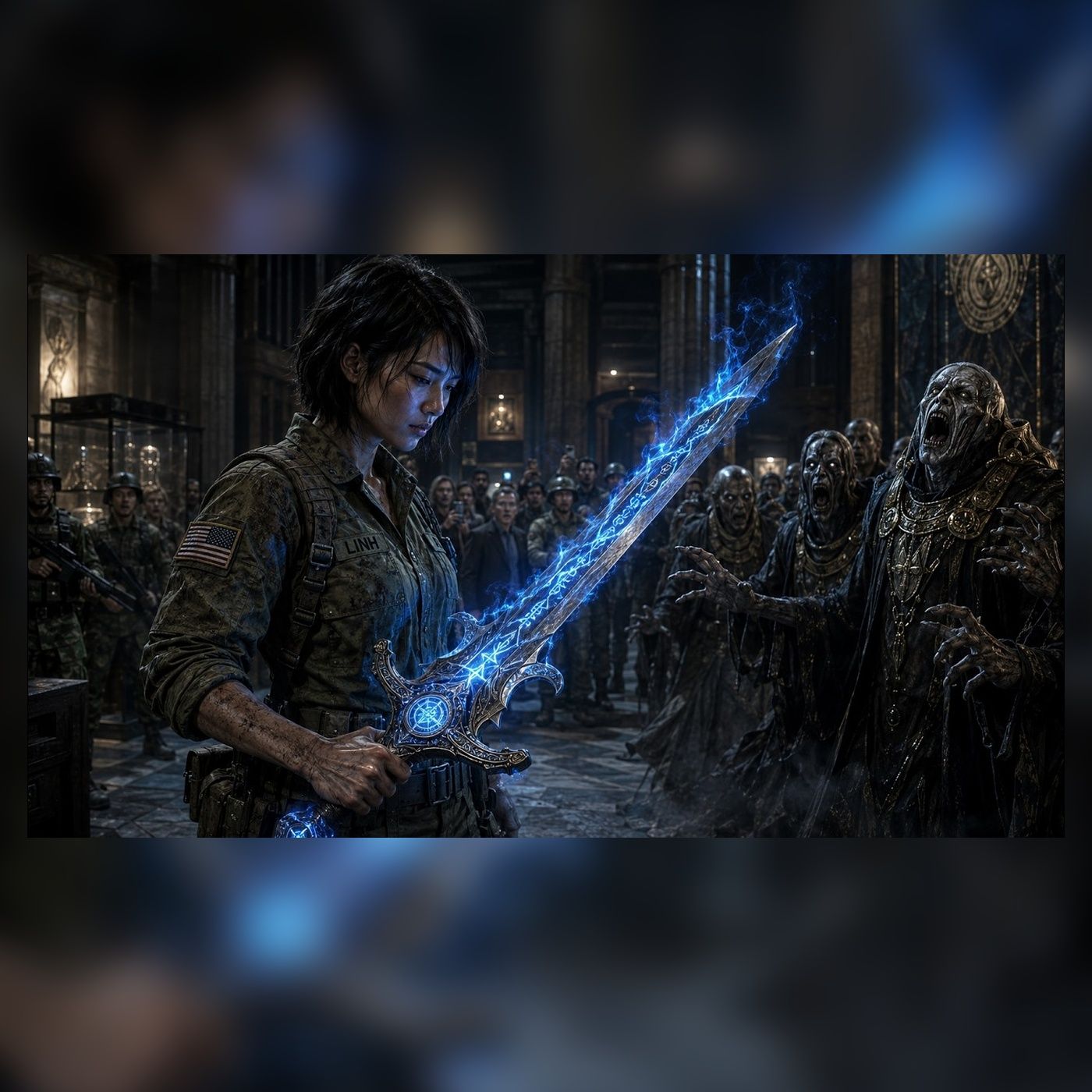
Apex Humans | Sci-Fi HFY Stories· Folge 4
Aliens Feared a 500lb War Blade… Human Cadet Lifts It | Sci-Fi HFY Stories
Freitag, 2. Oktober 2026 · 55 min
Kapitelklicken springt direkt hin
Shownotes
When an elite galactic combat academy displays an ancient weapon thought too heavy for any mortal warrior, a human cadet casually picks it up like a training toy. The alien instructors watch in disbelief as Earth biology proves far stronger and denser than anything in the known galaxy. Explore this thrilling humanity first sci-fi tale highlighting the unseen power of humans among the stars. Subscribe for more thrilling science fiction adventures. #HFY #SciFiStories #HumanityFuckYeah #SpaceOpera #SciFiAudiobook
This episode includes AI-generated content.
Transkriptvom Podcast bereitgestellt · Zeitmarken springen hin
The alarm in the training hall cut off mid-tone, and every cadet in the room froze. Instructor Draven Kesh stood at the front with his arms crossed, his gray-plated skin catching the light from the display cases behind him. Nobody in combat history class ever moved when Kesh went silent like that. Silence from him meant something was about to go wrong for somebody. I am Alira Vantoth, and on that day I was sitting three rows back, watching a human cadet named Ethan Cole lean back in his chair like the tension in the room meant nothing to him.
Every other student sat straight, eyes forward, hands folded. Ethan had his boots crossed at the ankle, and a ration bar half unwrapped in his lap. He looked like he was waiting for a bus, not sitting in front of the most feared instructor on the station. Keshe finally spoke. and his voice carried the weight of a hundred graduating classes behind it. Today, you will not read about history.
You will hold it. He turned toward the display wall behind him, a long case of reinforced glass that ran the length of the room. Inside it rested weapons from a dozen worlds, some so old the metal had turned the color of dried blood, others so pristine they looked freshly forged. Every cadet knew that case. Nobody touched that case.
It was the kind of thing you looked at and lowered your voice near, the same way you would in a place where the dead were buried. Kesh pressed his palm to a panel, and the case hissed open. He reached inside with both hands, the way you would lift something that could break if you breathed on it wrong, and drew out a long curved blade. The metal caught the light in a way that made half the room lean forward without meaning to. This blade fought in the Ashvale campaign, he said. It has taken more lives than every person in this room combined. It is older than the academy itself. When it is passed to you, you will hold it the way you would hold a sleeping predator, with respect, with fear. He began walking the room, placing
the blade into the waiting hands of each cadet in turn. I watched them one by one. A thrassy cadet named Sorix went pale and nearly dropped it before catching himself. A Vel'Khori girl named Mira held it flat across both palms like an offering, and did not breathe until it was gone from her hands. Even Noah Whitfield, the human sitting closest to me, who I had never seen rattled by anything, took the blade with a kind of stiff caution, like he was afraid the weapon could sense hesitation. Then it reached Ethan Cole. He set down his ration bar, wiped his hand once on his uniform, and took the blade from Kesh, with the same casual grip you might use to pick up a hammer from a toolbox. No ceremony,
no held breath. He turned it once in his hand, checking the edge with his thumb, then flipped it and gave the hilt a small, testing shake, the way a person tests a chair before sitting in it. The room went quiet in a different way now, not reverent quiet, waiting quiet. Ethan frowned, turned the blade again, and shifted his grip lower on the hilt. Huh. he said. Why is this so badly balanced? For a moment, nobody moved.
I am not sure anyone in that room had breathed since he spoke. Keshe's jaw shifted, the plates along his neck tightening, a sign every student learned to recognize within the first week of class. It was the sign that meant you had said something he did not expect, and he had not yet decided whether to be furious or curious.
Say that again, cadet, Keshe said, his voice low. Ethan did not seem to notice the danger in the tone, or if he did, it did not change anything about how he answered. He held the blade out slightly, turning it so the edge caught the light. The weight's all wrong, he said. Center of mass is too far up near the tip. Whoever swung this thing would have had to fight the blade every time they turned their wrist, not just fight whatever was in front of them. It's a good-looking weapon, it's just not a smart one. A ripple went through the room. Somewhere behind me, Sorex made a small sound like he had swallowed wrong. Mira's eyes had gone wide, flicking between Ethan and the instructor like she was watching two vehicles about to collide. Kesh took two
slow steps forward until he was standing directly in front of Ethan's desk. This blade, he said, each word deliberate, is a relic of the Ashvale campaign. It ended the long siege. It is displayed in three separate museums across two systems when it is not here for instruction. Historians of six species have written about its craftsmanship. Ethan nodded slowly, like he was actually considering this, not backing down from it. Sure, he said, and it's still badly balanced. Those two things aren't opposites. Something can be famous and important and still built wrong. Happens all the time. A few cadets actually gasped.
I felt my own throat tighten, because in my culture, and in most of the cultures represented in that room, you did not question a weapon of history. You did not question the great smiths, the chosen makers, the traditions passed down through blood and ceremony. A blade like that was not just metal. It was identity. It was memory given shape. Kesh's hand twitched at his side, and for one terrible second, I thought he might actually strike the desk in front of him. Instead, he asked the question that changed everything that happened next. And how, Cadet Cole, would you know that just by holding it? Ethan looked up at him, and for the first time since he had walked into the room that day, he did not
look bored anymore. He looked interested. Because I've held a lot of bad weapons, he said, and a lot of good ones. You learn to feel the difference pretty fast when the bad ones get people hurt. Nobody in the room said anything. Somewhere outside, an alarm chirped once and went silent again. some routine maintenance signal, but in that moment, it felt like the whole station was holding its breath along with us. Kesh studied Ethan for a long moment, his expression unreadable behind the hard plates of his face. Then, slowly, deliberately, he reached out and took the blade back from Ethan's hand, turning to face the rest of the class. Explain, he said.
Right now, to everyone. I sat forward in my seat, and I was not the only one. Whatever was about to happen, I understood, without knowing exactly why, that it was going to be something none of us had heard in a combat history lecture before. Ethan stood up from his desk, brushing crumbs from his ration bar off his uniform, and looked around the room like he was seeing all of us clearly for the first time. All right, he said, let's talk about why this thing is built wrong. And that was the moment the lesson actually began. Kesh set the blade down on the instructor's table between them, edge facing away, the way you would set down something you still were not fully sure you wanted touched again. He
gestured at it with one clawed hand. Show them, he said. Do not just tell them. Show them what you mean. Ethan walked to the table and picked the blade back up, this time holding it out flat across his palm, balanced right where the hilt met the guard. See this spot right here, he said. pointing with his other hand. This is where the weight should sit if you want quick turns, close to your hand. That's called the center of balance.
On a good blade, it sits maybe a hand's width past the guard, sometimes less. That way, when you flick your wrist, the blade moves with you instead of fighting you. He shifted his fingers a few centimeters up the blade, and it tipped forward on his palm, the tip dipping toward the floor. But on this thing, the balance point is way out here, almost a third of the way up the blade. That means every time you swing it, you're not just moving your arm, you're wrestling extra weight out at the tip. Fine if you're doing one big overhead cut. Terrible if you need to change direction fast, block something, or fight more than one person at a time. Sorex, the Thrasi cadet who had nearly dropped the blade earlier,
raised a clawed hand halfway before, seeming to remember he he did not need permission to speak in this class. He asked anyway, out of habit built by years of formal training. But it won a war, he said. Doesn't that mean it worked? Ethan tilted his head, considering the question honestly, instead of brushing it off. Maybe, he said, or maybe the person holding it was just stronger, or faster, or better trained than everyone else on the other side, and won, in spite of the weapon, instead of because of it. Good fighters can make bad gear work. That doesn't mean the gear was good, it just means the fighter was better than their equipment. The room had gone very still again, but it was a different kind of
stillness now, not the frozen, waiting stillness from before. This was the stillness of people actually thinking, turning something over in their minds that had never been turned over before. Mira, the Valkori cadet, spoke next, her voice quieter than Sorix's had been. We are taught that the chosen smiths who forged our blades could not be questioned, she said. Their work was considered finished the moment it left the fire.
To say a blade of theirs was wrong would be considered deeply disrespectful where I come from. Ethan nodded slowly, and for once there was no mockery in his face at all, only something closer to curiosity, maybe even a little sympathy. I get that, he said, but where I'm from, if a weapon got somebody killed because it was built wrong, nobody cared how respected the guy who made it was.
They fixed it, or they built a new one. Nobody back home ever thought a weapon was finished. Ever. Keshe. who had been standing silently at the edge of the table through all of this, finally spoke again, and his voice had lost some of its earlier hardness. In its place was something that sounded, to my ears at least, uncomfortably close to interest. Explain that, he said. What do you mean nobody ever thought a weapon was finished? Ethan set the blade back down on the table, gently this time, no longer treating it like a museum piece, but not treating it carelessly either. He looked around the room at all of us, aliens from a dozen worlds who had grown up believing their weapons were perfect the day they
were made, and something in his expression shifted, like he had just realized how different his own history really was. That, he said, is kind of a long story. Kesh folded his arms and leaned back against the table, the closest thing to relaxed I had ever seen him look in front of a class. We have time, he said. Sit down, all of you. Cadet Cole is going to tell us why humans have never once believed a weapon was finished.
Nobody argued. Nobody even shifted in their seats. Every eye in the room was fixed on Ethan Cole, waiting. He took a slow breath, glanced once more at the old, badly balanced blade lying on the table between them, and began to speak. Back on Earth, Ethan said, we never had one Smith who made the perfect weapon and then everybody just used that forever. We had thousands of smiths, in hundreds of countries, all competing against each other at the same time, all trying to build something better than the guy down the street. He walked slowly along the front of the room as he spoke, the way Kesh usually did during lectures, except there was nothing rehearsed about it.
He was just thinking out loud, and the rest of us were leaning in to catch every word. There were entire guilds built around blade-making, he said, Groups of smiths who trained for years just to earn the right to stamp their mark on a finished sword. And even then, getting into the guild wasn't the end of it. Once you were in, you spent your whole life trying to make something better than the smith who trained you. If you didn't, nobody bought your work, and you starved. Mira raised her hand again, and this time there was no hesitation in the gesture at all. You are saying weapons were made for profit, she said. and there was something almost scandalized in her voice, as if the idea itself was strange to hear out loud. Not for honor, not
as gifts from your gods, but for money. Ethan shrugged, not offended by the question, just matter of fact about the answer. Sometimes both, he said. A smith could be proud of his work and still need to sell it to eat. Those things aren't opposites either. But yeah, if your sword was garbage, word got around fast, and nobody wanted to buy the garbage sword when the guy three streets over made a better one for the same price.
That kind of pressure does something to craftsmanship. It doesn't let you get comfortable. Ever. Sorix leaned forward, his claws tapping lightly against the edge of his desk, a habit I recognized as a sign he was working through something difficult in his head. On my homeworld, he said slowly, the first bladesmiths were chosen by the old gods themselves.
According to legend, their weapons were considered divine gifts, not tools. To alter the pattern they set down would be considered an insult to the gods who guided their hands. So the pattern never changed. Not once. In over a thousand years, the room went quiet again, but I understood this silence too.
It was the silence of realization, the kind that settles over you slowly, like cold water rising past your ankles before you notice you're already standing in it. A thousand years, Ethan repeated, and I could hear something shift in his tone. Not mockery, something closer to disbelief. No offense, but that's kind of wild to me. On Earth, a design that stayed exactly the same for even a hundred years would be considered ancient history. Outdated, something you'd see in a museum, not something you'd actually hand to a soldier and expect them to survive with. Kesh, who had been quiet for a long stretch- finally spoke again, and this time there was an edge to his voice that had nothing to do with anger. Give us an example, he said. Show
us how quickly your weapons actually changed. Ethan nodded and moved toward a data panel mounted on the side wall, one that instructors use to pull up training diagrams during lessons. He tapped it a few times, clearly familiar with the interface from other classes, and an image appeared, a simple two-dimensional timeline stretching from left to right. Okay, he said.
Real quick version. On Earth, armor and weapons were basically in a constant argument with each other for thousands of years. Somebody makes a better sword, so somebody else makes better armor to stop that sword. So somebody makes an even sharper sword, or a heavier one, or one shaped differently to get around the new armor. Then the armor gets thicker, or lighter but stronger, or changes shape to deflect the new sword angle, and on and on, back and forth, for centuries. Neither side ever got to just relax and say, this is good enough, we're done here. He tapped the panel again, and the timeline scrolled forward, showing rough shapes of blades changing generation by generation, thinner, then curved, then
straight again, then shorter, then paired with different kinds of guards and grips. Every single one of these changes happened because the last version got somebody killed in a way it shouldn't have. he said. Somebody survived a fight because their gear held up, and somebody else died because theirs didn't, and everybody paying attention learned from that. Nobody wanted to be the person still using yesterday's weapon. I found myself gripping the edge of my own desk without realizing I had done it. Something about the way he described it, so plainly, so practically, made the old sacred weapons displayed in that case behind Kesh suddenly feel less like relics and and more like unfinished drafts, frozen the moment somebody
had decided they were good enough to stop trying. Noah Whitfield, the other human in the room, spoke up for the first time since the class began, and I realized I had almost forgotten he was there, quiet through the whole exchange. It wasn't just swords either, he said. Guns went through the exact same thing, just faster. Every war produced better versions of whatever the last war used, because the people who didn't improve their weapons usually didn't survive long enough to complain about it. Keshe's plated brow shifted, the closest thing his face had to an expression of surprise. You are saying this pattern continued even after you developed advanced technology, he said. I had assumed such rapid iteration was a
symptom of primitive toolmaking, something that would stop once true engineering began. Ethan actually laughed at that. A short, surprised sound. Not unkind. Just genuine. If anything, it got worse, he said. Faster. More competitive. Once you had entire countries funding weapons research, instead of just one guild in one city, the pace basically exploded. You'd get a new rifle design, and within a few years somebody else had already built something to counter it, and then somebody built something to counter that.
Nobody in human history ever got the luxury of thinking they'd finished the job. The moment you stopped improving, somebody else caught up and passed you, and depending on the century, that could get an entire army wiped out. I looked around the room at the other cadets, and I could see the same thing happening on every face. Sorex looked almost pale beneath his plating, his earlier pride in his world's divine, unchanging weapon pattern curdling slowly into something closer to doubt. Mira's hands were folded tightly in her lap, her eyes fixed on the old blade still resting on the instructor's table, as if seeing it for the first time.
I felt it too, if I am honest. My own people carried ceremonial blades passed down through bloodlines, each one forged once, blessed once, used for generations without a single alteration to the design. I had always been taught that this continuity was a strength. proof of wisdom passed down correctly the first time. Sitting there, listening to Ethan describe centuries of relentless, restless improvement, I felt something uncomfortable settle in my chest, a question I had never once thought to ask about my own family's blade. Kesh walked slowly back toward the display case behind him, running one clawed finger along the glass without opening it this time. We keep these weapons behind protective glass, he said. mostly to himself,
though the whole room heard it. We display them like sacred objects, untouchable, perfect. It never once occurred to me to ask whether they were simply the last version somebody happened to make before deciding they no longer needed to try harder. Ethan didn't respond right away to that. He looked at the case too, at all the different weapons resting inside it, blades and spears and strange curved instruments from a dozen different worlds, each one representing, I now understood, not the peak of that culture's ingenuity, but the point where that culture had simply stopped asking questions. That's kind of the thing about humans, he finally said, quieter now, less like a lecture, and more like something he actually believed.
We never had a moment where we felt safe enough to stop improving. Every time we thought we'd built something good enough, something else came along and proved us wrong. Eventually, that just became how we did everything. Not because we're smarter than anybody else, just because we got scared enough, often enough, that we never let ourselves get comfortable. Keshe turned back to face the class, and something in his posture had changed. the rigid, commanding stance replaced by something more open, more curious, the posture of someone genuinely reconsidering something he had believed his entire career. Show us more, he said. Bring out every historic weapon in that case, and tell us honestly what you see, not to disrespect them,
to understand them. A murmur went through the room, some students exchanging uncertain glances, others leaning forward with open excitement. I felt my own pulse quicken, some mixture of nervousness and anticipation I could not fully explain. Ethan looked at the case, then back at all of us, and for the first time since the lesson began, I saw something like hesitation cross his face, not because he doubted himself, but because he seemed to understand, finally, just how much what he was about to say might change how every alien in that room saw their own history. All right, he said slowly. Let's go through all of them. Kesh opened the case fully this time, the glass sliding back with a soft hiss, revealing every weapon inside at once,
and the room held its breath together as Ethan stepped toward it. The first weapon Ethan lifted from the case was long and slightly curved, made from a dark metal that seemed to drink in the light instead of reflecting it. Kesh identified it before Ethan could ask. his voice carrying a note of quiet pride. That belonged to a Vel'Khori war chief, he said, three centuries old, recovered from the Salt Coast conflicts. Ethan turned it over in his hands, testing the grip, tilting it slightly to feel where the weight settled. Grip's actually not bad, he said. Whoever shaped this handle understood how hands work. But look at this edge geometry here, where it curves near the tip. That angle is going to catch on anything it strikes, instead
of sliding through cleanly. You'd feel that on impact, this little jolt back through your wrist, every single time you connected with something. Over a long fight, that adds up. Your grip loosens. You get tired faster than you should. Mira, who I now understood was Valkori herself from the careful attention she paid to this particular blade, sat very still, watching Ethan's hands move over the weapon, like she was watching someone examine a photograph of her own ancestor. That flaw, Ethan continued, almost gently now, like he sensed how close this one might be to her. That's an easy fix, actually.
If you softened this curve here, even slightly, you'd keep the same striking power, but lose most of that recoil. Somebody could have fixed this generations ago without changing much else about the design. Mira's voice came out quieter than before. Why do you think nobody did? Ethan set the blade down carefully, thoughtfully, before answering. Probably because it worked well enough, he said. And once something works well enough, and the guy who made it is respected, and there's no outside pressure forcing anybody to do better, most cultures just stop pushing.
That's not a flaw in your people specifically, that's just what happens anywhere, nothing forces you to keep improving. Keshe reached into the case again, this time drawing out something entirely different. a short, heavy weapon with a wide, flat blade and a grip built for two hands. Therazi Warhammer, he said, glancing toward Sorix as he said it. Ceremonial and functional both. Used in formal combat trials for over 600 years, Sorix straightened in his seat as Ethan lifted the weapon, clearly bracing himself for whatever verdict was about to come. This one's actually pretty solid, Ethan said, and I watched the tension visibly drain out of Sorix's shoulders. Heavy, but the weight's distributed close to the grip, which makes
sense for something meant to crush through armor instead of slice. You're not fighting the weapon here, you're just fighting the size of it, which is honestly a smart trade-off if you know you're facing armored opponents. He hefted it once, testing the swing arc with a careful, contained motion, nothing close to a full strike, just enough to feel the mechanics of it. Only real issue is here, near the base of the handle. No real stopping guard. In a real fight, if your grip slips even a little, especially if your palms get slick, this thing could slide right out of your hands at the worst possible moment. Simple fix.
A ridge, a wrap, something to catch your grip before it fails completely. But that's a small thing on an otherwise well-built weapon. Sorix let out a breath I don't think he realized he had been holding. and something like pride crept back into his posture, tempered now with a kind of thoughtful humility that had not been there at the start of class. Kesh moved down the case, weapon after weapon, and Ethan examined each one in turn, never rushing, never performing for the room, just honestly working through what he saw. A spear, from some world I did not recognize, earned praise for its balance, but criticism for a grip that would slip in wet conditions. A curved dagger from another culture earned nearly full approval, with Ethan noting only
that the pommel could be slightly heavier to improve the counterbalance during fast reversals. A massive two-handed blade, clearly ceremonial and never meant for real combat, drew a longer pause from Ethan before he set it down with something almost like respect in his voice. This one I actually can't judge fairly, he admitted. It's too big and too heavy to have ever been a real fighting weapon. This was built to be looked at, not used. And honestly, for that purpose, it's beautiful. No complaints there. The room had settled into something different by then, a kind of collective focus that had replaced the earlier tension entirely. Cadets leaned forward openly now, some even whispering quiet questions to each
other about their own homeworld's traditional weapons. wondering aloud whether the same kinds of flaws might exist in blades their own families had carried for generations. Then Kesh reached into the very back of the case and drew out a weapon I recognized instantly, because it was displayed more prominently than any other piece, resting on its own velvet stand at the center of the collection. A long, elegant dueling blade, the metal a deep silver-blue, the hilt wrapped in a material I had never been able to identify. This, Kesh said, and for the first time all class, his voice carried something that sounded almost like nervousness, is a Cathir Honor Blade, forged during the Reconciliation Era, when my people ended six
generations of civil conflict. It represents the moment my ancestors chose unity over division. It is, without exaggeration, the most sacred object in this collection. The room went utterly silent. Even Sorix and Meera, who had grown comfortable enough to whisper between themselves moments earlier, went completely still. I understood why.
Everyone in that room knew, without needing to be told, that whatever Ethan said next about this particular weapon would matter more than anything he had said about any of the others. Kesh held the blade out, and for the first time all class, his hand did not move to pass it over immediately. He held it a moment longer than necessary. as if some part of him was reconsidering whether this particular weapon should be subjected to the same scrutiny as the rest. Ethan seemed to sense this too.
He waited, hands at his sides, until Kesh finally, deliberately, placed the blade into his grip. The silence stretched as Ethan turned it slowly in his hands, testing the balance the same way he had tested every other weapon that day, but slower this time, more careful, more deliberate. He tilted it, Watching the light travel down the length of the blade, he shifted his grip near the hilt, then further back, testing how the weapon settled at each point. Nobody breathed. This, Ethan finally said, is actually really well made. The tension in the room broke all at once, a ripple of quiet exhales moving from cadet to cadet. Keshe's shoulders, which had been rigid throughout the entire exchange, dropped slightly. The
balance point sits almost exactly where it should, Ethan continued, turning the blade once more, clearly warming to the subject, now that he had found something worth genuinely praising. Close to the hilt, but not so close that you lose striking power. The taper along the blade is smart too, thinner, near the tip without sacrificing strength, which means fast recovery between strikes, without the weapon feeling flimsy. And the grip, he added, flexing his fingers slightly around the wrapped hilt.
This material actually improves with sweat and pressure instead of getting slicker. Whoever designed this understood that a fight isn't clean. Hands get wet. Grips fail. This one was built to handle that. Kesh's expression was, usually locked behind the hard plating of his face, had shifted into something I had genuinely never seen from him before. Something close to relief, mixed with a kind of cautious pride. You are certain, he said, his voice quieter than I had ever heard it in a classroom. As certain as I can be just holding it, Ethan said honestly. If I actually fought with it, I could tell you more. But from what I can feel right now, This is one of the best balanced blades I've picked up in this whole case.
Somebody who actually used weapons designed this, not somebody who just wanted it to look impressive. A murmur of quiet astonishment moved through the room, and I felt something loosen in my own chest that I had not realized was tight. There had been an unspoken fear building through the entire lesson I understood now. a fear that everything sacred to every species in that room was about to be dismantled piece by piece by a human cadet who did not seem to understand the weight of what he was saying.
But this moment proved something different. Ethan was not tearing everything down indiscriminately. He was simply being honest, weapon by weapon, praising what deserved praise and criticizing what deserved criticism, with no regard for how old or how celebrated something happened to be. Kesh took the blade back from him with something almost like reverence returning to his movements, though it was a different kind of reverence than before, less about blind tradition, and more, I thought, about genuine respect for the ancestors who had actually built something worth keeping. Then, unexpectedly, a new voice cut through the room, sharp and skeptical, from the back row where a cadet named Talix Orn
had been sitting silently through the entire lesson. He was Kothir himself. like Kesh, and unlike the rest of us, he did not look impressed. It is easy to praise something with your hands, Talak said, standing slowly from his seat. Anyone can hold a blade and guess at its balance. Words are simple. If this human is so certain he understands weapons better than the smiths who built them, let him prove it. Let him actually fight with one. The room shifted instantly, the earlier calm replaced by a fresh current of tension. Kesh turned toward Talix, and for a moment, I thought he might dismiss the challenge outright. Instead, something in his expression sharpened, curiosity overtaking caution. That, Kesh said slowly,
turning back toward Ethan, is not actually a bad idea. Ethan glanced between Kesh and Talix, and for the first time since the lesson began, I saw something flicker across his face that looked almost like genuine excitement, the casual boredom from the start of class, completely gone now, replaced by something sharper, more alert. Fine by me, he said.
Which blade do you want me using? Keshe's eyes moved slowly across the open case, considering every weapon inside it, before finally settling on the one Ethan had criticized most harshly at the very start of the lesson, the ancient, badly balanced relic from the Ashvale campaign. still resting exactly where he had left it on the instructor's table. That one, Kesh said, the one you called badly built. Let us see if your criticism holds up when the blade is actually in motion. A slow, sharp grin spread across Ethan's face, and beside me, I heard Mira whisper something under her breath that sounded remarkably like a prayer. This, I realized, watching Ethan roll his shoulders and step toward the practice
mat at the center of the room was about to become the most important demonstration any of us had ever witnessed in combat history class. Kesh moved quickly once the decision was made, calling two attendants from a side room to prepare the practice mat and pull the safety systems online. A soft blue light traced the edge of the circular training area as the field engaged, the kind of containment shielding that would stop a strike before it caused real harm, allowing full contact sparring without real risk. Every cadet in the room stood and moved toward the edges of the mat, forming a loose ring, nobody willing to miss whatever was about to happen. Talix stepped forward from the back row, rolling his shoulders, and I realized with a jolt that
he intended to be the one facing Ethan himself, not simply the one who issued the challenge. I will fight him, Talix said to Kesh, his voice carrying an edge of confidence that bordered on arrogance. With a modern training blade, Let us see if his theories about balance mean anything once someone is actually trying to hit him. Kesh studied Talix for a long moment, then nodded once. Standard rules, he said. First to three clean touches, safety field active throughout, no strikes to the head or throat, even with the field engaged. Are both of you prepared? Talix moved to the equipment rack along the wall and selected a modern academy training blade, sleek, lightweight perfectly balanced by design built
specifically for cadets learning proper form he tested its weight with a few sharp practice swings clearly comfortable clearly confident ethan walked to the instructor's table instead and picked up the ancient ashvale blade the same weapon he had criticized at the very start of class he turned it once in his hand testing the grip the way he had before then shifted his stance adjusting his footing on the mat You're really going to use that thing, Noah called from the sidelines, disbelief clear in his voice. After everything you just said about it, Ethan glanced over, a faint smile pulling at the corner of his mouth. That's kind of the point, he said. Anybody can win with good gear.
Let's see if what I said actually matters, or if I was just talking. Keshe raised a hand. signaling both fighters to their marks. The room fell into that same held-breath silence from the very start of class, except now it carried a different weight entirely, tight with anticipation instead of shock. Begin, Kesh said. Talix moved first, fast and precise, closing the distance between them in two quick steps, his training blade snapping forward in a strike aimed at Ethan's shoulder.
It was a clean, well-drilled motion, the kind of textbook form that came from years of formal instruction. Ethan did not meet the strike head-on. Instead, he shifted his weight sideways, letting the blade pass just wide of him, and I understood immediately what he was doing. He was not fighting the weapon's poor balance. He was working around it, using footwork instead of forcing his wrist to compensate for weight that was never meant to move quickly. Talix recovered fast, spinning into a second strike almost immediately, testing whether the first miss had thrown off his opponent's rhythm. Ethan brought the old blade up to intercept it, but instead of meeting the strike with brute force, he angled the parry,
letting the heavier tip of the ancient weapon do the work of redirecting Talix's blade away from center rather than blocking it directly. The clash of metal rang out across the mat, and Talix's blade skidded wide, his own momentum carrying him half a step past where he meant to be. The room let out a collective sound, somewhere between a gasp and a murmur, as Talix caught his balance and turned back toward Ethan, his earlier confidence visibly shaken. That was clever, Kesh said quietly, mostly to himself, though I heard it clearly from where I stood at the edge of the mat. He is not fighting the weapon's flaw, he is using footwork to remove the flaw from the equation entirely. Talix pressed forward again, faster this time, chaining
two strikes together in quick succession, clearly trying to overwhelm Ethan before he could adjust further. The first strike came in low, aimed at Ethan's leg, and the second followed almost immediately, higher, aimed at his ribs. Ethan stepped back from the first, letting it pass beneath him, then pivoted on his back foot instead of retreating further, using the heavy tip of the old blade like a counterweight, to swing his body around faster than his stance alone would have allowed. The second strike caught only air where Ethan had been standing a half second earlier. Talix spun to face him again, breathing harder now, his earlier precision replaced with something more urgent. Ethan, for his part, looked completely calm,
his eyes tracking Talix's movement with the same careful, analytical focus he had shown while examining the weapons in the display case, like this was simply another problem to solve. rather than a fight to win. He's not even trying to win yet, Mira whispered beside me, her eyes wide. He's still figuring the weapon out. She was right. I could see it now, the way Ethan moved, testing different grips between exchanges, shifting his stance slightly with every clash, adjusting for the weapon's imbalance the way a person adjusts their walk on uneven ground. Small corrections, constant and instinctive.
Talak's again, a wide diagonal cut meant to catch Ethan off guard while he was still adjusting his grip. This time Ethan did not dodge or parry at all. Instead, he stepped directly into the strike, closing the distance so quickly that Talix's blade passed harmlessly over his shoulder. too close to build any real force behind it, and in the same motion, Ethan brought the flat of the ancient blade up against Talix's chest. The safety field flared with a soft blue pulse, marking the touch. One, Kesh called out.
Talix stepped back, clearly startled, resetting his stance with visible effort to steady himself. The confidence from the start of the match had drained from his posture entirely, replaced by something more careful, more respectful. I underestimated the reach on that thing, he muttered, more to himself than to anyone else.
They reset, and the second exchange began more cautiously, both fighters circling rather than closing immediately. Talix tested the distance with a few short probing strikes, clearly trying to draw Ethan into overextending with the heavier weapon. Ethan refused to take the bait, keeping his movements small and controlled, letting the old blade's momentum work for him only when he chose the moment, never letting it dictate the fight on its own. When the opening finally came, it happened fast.
Talix committed to a strike aimed at Ethan's side, and Ethan let the blade's natural forward weight carry his own counter through in one smooth arc, catching Talix across the ribs before the Kathir cadet could fully recover his stance. The field flared again. Two, Kesh called. a ripple of astonished whispers moved through the surrounding cadets. I found myself leaning forward without meaning to, my hands gripping the edge of my own sleeve, completely absorbed in what was unfolding in front of me. Talix reset a final time, and something in his expression had changed completely now, the arrogance from the start of the match replaced by genuine focus, the look of someone who understood, finally, that he was
facing something he had not expected at all. This time, Kesh called the reset himself, watching closely, his earlier hard, unreadable expression completely gone, replaced by open fascination. The final exchange was faster than either of the first two. Talix came in with a combination clearly meant to end things quickly, three strikes chained together with barely a breath between them, each one aimed at a different angle, clearly testing every possible opening at once. Ethan met the first with a parry, the second with a step back that let it pass wide, and on the third, instead of defending at all, he simply moved inside the arc of the strike entirely, closing the distance so completely that the training blade's length became useless,
and brought the pommel of the ancient blade lightly against Talix's shoulder in a controlled, deliberate tap. The field flared a third time. Three, Kesh announced, matched to Cadet Cole. For a moment, Nobody in the room moved. Then the silence broke all at once into a wave of stunned conversation, cadets turning to each other, some laughing in disbelief, others simply staring at Ethan with expressions I did not have names for in any language I knew. Talix lowered his training blade slowly, breathing hard, and after a long moment, he did something I had not expected from him at all.
He extended his hand toward Ethan, palm open, a gesture of respect used across several of the warrior cultures represented in that room. You used a flawed weapon and still won, he said, his voice carrying none of its earlier arrogance. How? Ethan set the old blade down gently on the practice mat, treating it with more care now than he had shown it even during his initial critique, and took Talix's offered hand.
I didn't fight the weapon's flaw, he said. I just stopped trying to force it to be something it wasn't. Bad tools don't have to lose, not if you understand exactly why they're bad and work around it instead of pretending the problem isn't there. Kesh stepped onto the mat then, and for the first time since the class had begun, I saw something on his face that looked entirely unguarded, no hardness left in it at all, just quiet, genuine astonishment.
You have just demonstrated something in ten minutes, he said slowly, that I have spent thirty years teaching without ever fully understanding myself. Ethan looked up at him, and for once, even he seemed a little surprised by the weight in the instructor's voice. Kesh turned to face the rest of the class, his gaze sweeping across every cadet gathered around the mat, and when he spoke again, his voice carried further than it needed to in the quiet room. Sit down, all of you, he said. There is more to discuss, and I suspect none of us are finished learning something today.
Nobody sat down right away. The mat was still humming faintly with the last traces of the safety field powering down, and Talix stood at its edge, still catching his breath, still staring at the ancient, badly balanced blade lying where Ethan had left it. It was strange, watching a room full of cadets who had spent the entire lesson either defending their traditions or quietly doubting them now simply standing still, unsure of what to do with everything they had just witnessed.
Kesh finally gestured toward the seats, and slowly, one by one, everyone returned to their desks. Ethan remained standing near the mat a moment longer, retrieving the old blade and carrying it back to the display table himself, setting it down with a care that had nothing to do with fear now and everything to do with something closer to understanding.
When he finally sat back down, Kesh remained standing at the front of the room, his hands clasped behind his back, his earlier rigid posture replaced by something more thoughtful, almost hesitant. I have a question, he said, and Cadet Cole, I want an honest answer, not a performance for the room. Ethan nodded, all traces of his earlier casual boredom completely gone now. Go ahead. Why, Kesh asked slowly, do humans never believe anything is finished? not just weapons. You spoke earlier of guilds competing endlessly, of armor and blades locked in argument for centuries, of soldiers who trusted nothing simply because it was old. Every species in this room, myself included, has traditions we consider complete, perfected, sacred. Where does that
certainty come from in your people, and why does it seem to be entirely absent? The room went quiet again, but this silence felt different from every other silence that had come before it. It was not shock, and it was not tension. It was simply attention, focused and patient, waiting. Ethan was quiet for a long moment before he answered, and when he did, his voice had lost the last of its casual edge entirely. I think it's because we never had a moment where we felt safe enough to stop, he said. Every time somebody on Earth thought they'd built something perfect, something else came along and proved them wrong, usually in the worst possible way. A better weapon. A smarter tactic. A trick nobody saw coming. And when that
happens enough times, across enough generations, you stop trusting the idea that anything can ever really be finished. You start assuming that whatever you have right now is just the current best guess, not the final answer. He paused, glancing briefly at the old blade resting on the table beside him.
The moment you believe something is perfect, he continued, is the moment you stop looking for its flaws, and the moment you stop looking for flaws is the moment somebody else finds them for you, usually at the worst possible time. Humans learned that lesson so many times, in so many different ways, that eventually it just became how we think about everything, not just weapons, everything. Mira spoke up softly from her seat, her earlier hesitation completely gone now, replaced by something more open, more curious. That sounds exhausting, she said, never allowing yourself to feel satisfied, never allowing anything to simply be enough. Ethan considered this seriously, not dismissing it the way I half expected him to. Yeah, he admitted,
it kind of is, honestly. There's something nice about your way of doing things too, treating a design as sacred, trusting it completely, never having to second guess whether the thing in your hand is going to fail you. I get why that feels better, but the trade-off is, if that thing you trust completely actually does have a flaw, you might never find out until it's too late to matter.
Keshe moved slowly toward the display case, running his hand once more along the glass, and when he spoke again, His voice carried a weight that silenced even the quiet murmurs that had started to build among the cadets. Perhaps, he said, both approaches have their place. Trust allows a people to move forward together, united, without endless doubt eroding their confidence. But doubt, it seems, prevents complacency from becoming a weakness nobody notices until it costs them everything. Cadet Cole has shown us today that questioning something does not have to mean disrespecting it. It can simply mean caring enough to make certain it deserves the trust we place in it. He turned back toward the class, his gaze
moving slowly across every face gathered there, human and otherwise. I have taught this course for thirty years, he continued. I have shown that display case to hundreds of cadets, and every single time, I told them the same thing. Approach these weapons with reverence. Approach them with fear. Never once did I tell a class to approach them with honesty.
I believe that was a mistake on my part, one I intend to correct starting today. He walked to a small panel beside the display case, one used for updating the informational placards that accompanied each weapon, and began entering something into it. After a moment, a new plaque flickered to life beside the ancient Ashevale blade. the one Ethan had criticized at the very start of the lesson, the one he had just used to win a sparring match against a cadet who had underestimated him completely. I leaned forward to read it along with the rest of the class.
It was simple, only a few lines, but it landed with more weight than anything else displayed in that case. This blade carries flaws that were never corrected, though generations of warriors carried it into battle believing it beyond question. A cadet once held it, found the flaw within moments, and still won a fight with it, because understanding a weakness matters more than pretending it does not exist. Ask a human before you decide anything is finished. A few cadets actually laughed softly at that last line, a release of tension that had been building across the entire lesson, and even Keshe's mouth curved into something that might have been the beginning of a smile, an expression I had genuinely never seen on his face in all my time
at the academy. The lesson continued a while longer after that, though it felt less like a lecture now and more like a genuine conversation. Cadets asking questions freely, comparing stories about their own homeworld's weapons and traditions, some defending their culture's approach to craftsmanship, others admitting openly, for the first time, that they had never actually questioned whether their sacred blades were truly as perfect as they had always been told.
Sorix asked Ethan, near the end of the session, whether he thought the Thrasy Warhammer's flaw could realistically be corrected without disrespecting the tradition it came from. Ethan considered the question seriously, the same way he had considered every question that day, and told him honestly that fixing a flaw was never disrespect, it was simply finishing what the original maker had started, the same work continued forward, instead of frozen in place. By the time the session finally ended, the room felt entirely different from how it had felt at the beginning. The reverent, fearful hush that had once surrounded the display case had been replaced by something more alive, cadets crowding around the open glass, examining weapons with genuine
curiosity now instead of quiet dread, several of them asking Ethan direct questions about balance points and grip angles as if he had suddenly become the foremost authority on subjects none of them had ever thought to study before. I found myself standing beside him as the room slowly emptied, watching him examine one final weapon from the case, a small ceremonial dagger from a species I did not recognize, turning it over thoughtfully in his hands. You didn't mean to start all this, did you? I said. It was not quite a question. Ethan glanced up at me and shrugged, a familiar casual gesture that felt oddly reassuring after everything that had happened. Honestly, no, he said. I just noticed the thing was badly balanced, didn't think it would turn
into an entire afternoon. I found myself smiling despite everything the day had stirred loose inside me, all the quiet doubts about my own family's ceremonial blade, questions I now knew I would carry home with me, and ask people who had never expected to be asked them. News of what had happened in combat history class spread through the academy faster than I would have believed possible. By the following morning, I overheard two separate instructors from entirely different departments quietly discussing whether they ought to invite Cadet Cole to examine their own prized historical displays, their voices carrying an odd mixture of curiosity and dread, as if they both wanted his honest opinion and feared exactly what it
might reveal. I do not know how many more sacred weapons, armors, or traditions Ethan would go on to examine during his time at the Academy. or how many more instructors would find themselves quietly rewriting the placards beneath their own proudest historical relics. But I understood something clearly by the end of that first lesson, something I suspect every cadet in that room carried with them long after we left, something that had nothing to do with balance points or grip angles at all. Reverence, I had learned, was not the same thing as understanding, and sometimes the greatest respect you could show something ancient and celebrated was not to leave it untouched behind glass, but to pick it up, turn
it over carefully in your hands, and ask, honestly, whether it could still be made better. Ethan Cole never seemed to think he had done anything remarkable that day. To him, it had simply been an ordinary observation, spoken without any intention of overturning centuries of quiet, comfortable tradition across a dozen different worlds. But sitting there afterward, Holding my own thoughts about the blade my family had carried unquestioned for generations, I understood that some of the most important lessons never arrive wrapped in grand speeches or dramatic declarations. Sometimes they arrive as a single, quiet, honest sentence spoken by someone who simply refuses to pretend that anything, no matter how
old or how sacred, is ever truly finished.
