

Kapitelklicken springt direkt hin
Shownotes
<p>In this episode of the Barbell Medicine podcast, Dr. Jordan Feigenbaum discusses the risk of biceps tendon rupture during deadlift, as well as the relevant anatomy, mechanism of injury, risk factors, and practical management </p><p><a href="barbellmedicine.supercast.com/"; rel="nofollow">Become a Barbell Medicine Plus Member Today</a></p><p><strong>New Stuff:</strong></p><ul><li><a href="eventbrite.com/e/barbell-medicine-seminar-san-…; rel="nofollow">Seminar Sign-up</a></li><li><a href="barbellmedicine.com/shop/supplements/whey-prot…; rel="nofollow">WheyRx</a></li><li><a href="barbellmedicine.com/blog/the-grip-problem/"; rel="nofollow">The Grip Article</a></li></ul><p><strong>Papers</strong>:</p><ul><li><a href="pmc.ncbi.nlm.nih.gov/articles/PMC9054453/"; rel="nofollow">Szewczyk 2022</a> </li><li><a href="pubmed.ncbi.nlm.nih.gov/26063401/"; rel="nofollow">Kelly 2015</a> </li><li><a href="pmc.ncbi.nlm.nih.gov/articles/PMC8237209/"; rel="nofollow">Kapicioglu 2021</a></li><li><a href="pubmed.ncbi.nlm.nih.gov/35733124/"; rel="nofollow">Lappen 2022</a> </li><li><a href="pubmed.ncbi.nlm.nih.gov/21813298/"; rel="nofollow">Jarrett 2012</a></li><li><a href="pubmed.ncbi.nlm.nih.gov/12070236/"; rel="nofollow">Hersh 2002</a></li><li><a href="pubmed.ncbi.nlm.nih.gov/21669137/"; rel="nofollow">Del Buono 2011</a></li><li><a href="pmc.ncbi.nlm.nih.gov/articles/PMC5206906/"; rel="nofollow">Kanayama 2017</a></li><li><br></li></ul><p>Resources Page: barbellmedicine.com/resources/</p><p&… Quiz: barbellmedicine.com/template-quiz/</p>&l… pain and need a professional who understands you lift? Or, do you need an experienced coach to help you get the most out of your training? Contact us at support@barbellmedicine.com</p><br/><br/>Our Sponsors:<br/>* Check out Cometeer and use my code BBM for a great deal: cometeer.com<br/>* Check out Cometeer and use my code BBM for a great deal: cometeer.com<br/>* Check out FIGS and use my code FIGSRX for a great deal: wearfigs.com<br/>* Check out Factor and use my code factormeals.com/bbm50off for a great deal: factor75.com<br/>* Check out Quince and use my code BBM for a great deal: quince.com<br/><br/><br/>Adv… Inquiries: <a href='redcircle.com/brands'>https://redcircle…;
Transkriptvom Podcast bereitgestellt · Zeitmarken springen hin
[SPEAKER_00]: Welcome back to the Barbell Medicine podcast. [SPEAKER_00]: I'm Dr. Jordan Feigenbaum, hope you've had a great week so far. [SPEAKER_00]: In this podcast, I wanted to talk about the risk of rupturing a biceps tendon in resistance training, specifically while deadlifting with a mixed grip.
[SPEAKER_00]: For people who have spent a lot of time around the gym where people do a lot of deadlifts, you may have either seen this happen firsthand or heard about a fellow gymgoer who, quote, tore their biceps while deadlifting. [SPEAKER_00]: In this episode, I'll review the anatomy of the biceps, the mechanism for this type of injury, as well as its risk factors, and make some practical recommendations for what kind of grip to use while deadlifting.
[SPEAKER_00]: But before that, I do have a few announcements. [SPEAKER_00]: Right now, we are running our annual July fourth sale. [SPEAKER_00]: From now until the end of the day, Sunday, July sixth, take twenty percent off all of our training programs and a peril. [SPEAKER_00]: We also have further markdowns on a peril up to seventy-five percent off for some of our close-out stuff.
[SPEAKER_00]: No coupon code is needed just head to the website barbellmedicine.com, grab a new program or some VBM merch and get twenty percent off your purchase. [SPEAKER_00]: We also have a live two-day health and performance seminar where myself, Dr. Baraki, Lea Lutz, and Tom Capitelli [SPEAKER_00]: will provide in-depth lifting instruction and education on a variety of topics ranging from cardiovascular health and sarcopenia to nutrition and programming.
[SPEAKER_00]: The seminar will be held in San Antonio, Texas on September twenty and twenty first. [SPEAKER_00]: Click the link in the description to get your ticket today. [SPEAKER_00]: Alright, let's start off with the anatomy of the biceps. [SPEAKER_00]: We'll hop a ride with Miss Frisol on the Magic School Bus and we'll head to the anterior or front compartment of the arm.
[SPEAKER_00]: In this area, there are three muscles. [SPEAKER_00]: Superficially, we'll find the biceps brachiai, and deep to this muscle is the corcal brachialis that's near the shoulder and the brachialis, which starts down by the elbow. [SPEAKER_00]: In Latin, biceps means two-headed muscle and brachiai means arm.
[SPEAKER_00]: Therefore, the biceps brachiai is the two-headed muscle of the arm, whereas the biceps femoris is the two-headed muscle of the leg. [SPEAKER_00]: You may also know that as your hamstring or part of it. [SPEAKER_00]: Now the shorthead of the biceps brachii start from the quirkoid process of the scapula, which is the bird's beak-like projection coming off the front of the scapula.
[SPEAKER_00]: Meanwhile, the longhead of the biceps brachii originates from just above the shoulder socket, which is called the glenoid fossa. [SPEAKER_00]: Someone intuitively, the area of the bone that the longhead of the bicep starts is called the super-glenoid tubercle, meaning it's above the glenoid fossa and tubercles just at bony prominence.
[SPEAKER_00]: Now, around the middle of the upper arm, both the short and long heads of the biceps form a single common muscle belly. [SPEAKER_00]: In the forearm, the biceps breakiei attaches to the radial tuberosity. [SPEAKER_00]: Again, that's a bony feature on the radius bone in the forearm. [SPEAKER_00]: And the biceps breakiei also attaches to the fascia of the forearm by way of the laceratis fibrosis.
[SPEAKER_00]: Now if you're paying attention, you may note that I always say biceps and never the singular bicep. [SPEAKER_00]: And that is because there are in fact at least two heads to the biceps. [SPEAKER_00]: I say at least two heads to the biceps because there is some data showing that a number of individuals have more than two biceps heads.
[SPEAKER_00]: In one study of just over a hundred human arms, about a quarter of them had three heads. [SPEAKER_00]: where a handful had four or even five heads. [SPEAKER_00]: These so-called accessory heads can arise from the deltoid near the shoulder or the pectoralis major muscles and or bones like the scapula and the humerus.
[SPEAKER_00]: Interesting stuff for sure not really sure what it means, but I did find this stuff pretty interesting. [SPEAKER_00]: To summarize the anatomy, the biceps brachiai muscle has a short and a long head, both originated from different spots on the scapula. [SPEAKER_00]: The two heads come together to form a single muscle belly in the arm and then they attach to the forearm.
[SPEAKER_00]: Because the biceps crosses both the shoulder and elbow joints, it performs actions at both joints. [SPEAKER_00]: The biceps is the strongest supinator of the forearm that's turning your palm towards the sky, but it also plays a role in elbow flexion like when you're doing curls. [SPEAKER_00]: At the shoulder, the long head of the biceps contributes to stability of the glino-humero joint, which is fancy anatomy speak for the shoulder joint.
[SPEAKER_00]: And in more nerdy anatomy stuff, by convention, the things that connect muscles to bone we call those tendons and the biceps tendon near the shoulder is called the proximal biceps tendon, whereas the tendon connecting the biceps to the forearm is called the distal biceps tendon. [SPEAKER_00]: This anatomy is going to be important for later, so put that into your brain.
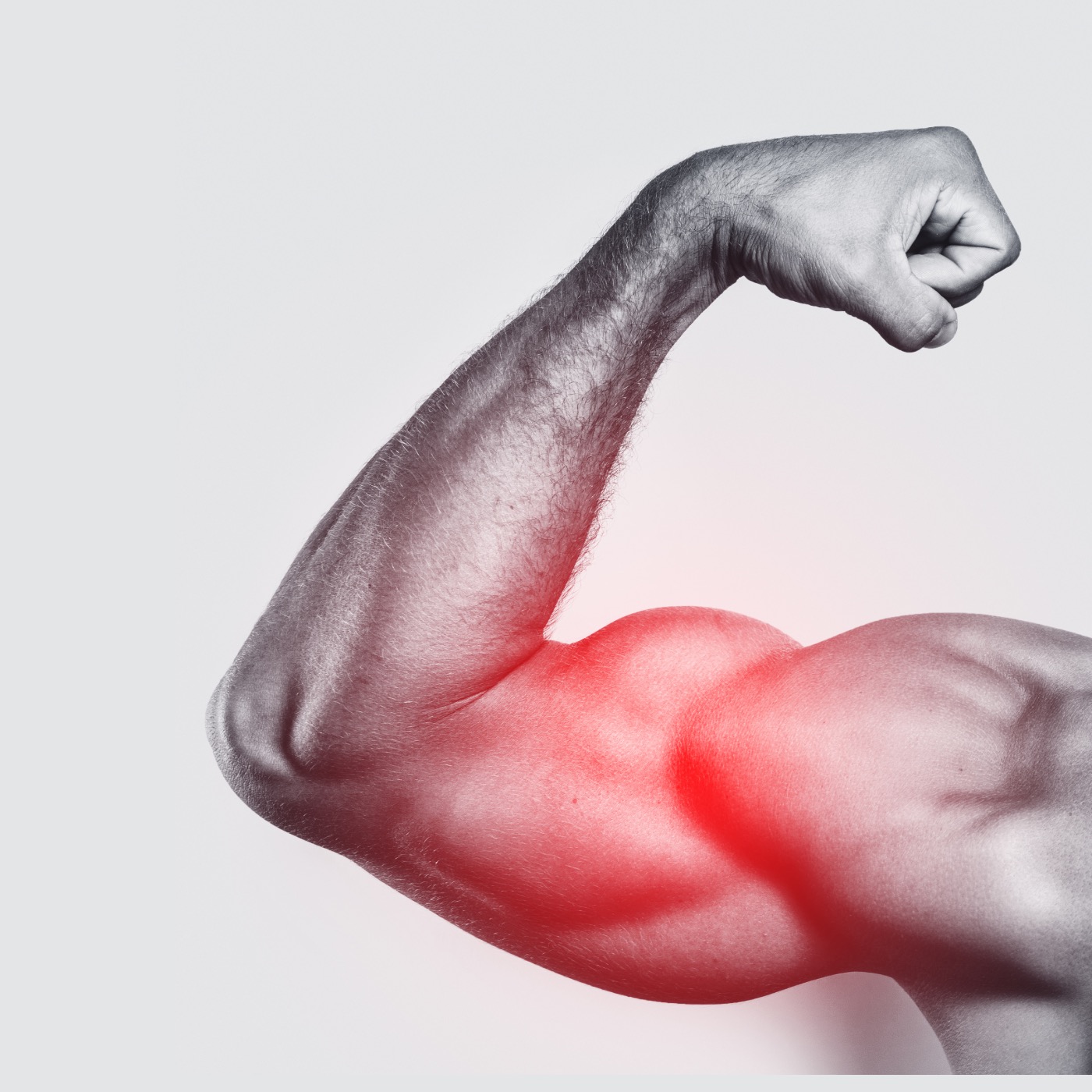
[SPEAKER_00]: All right, let's now hop off the magic school bus and talk about the two major biceps tendon injuries. [SPEAKER_00]: Now, over ninety percent of biceps tendon ruptures involve the long head near the shoulder. [SPEAKER_00]: That's the proximal or long head biceps tendon. [SPEAKER_00]: Now, when you rupture this, this can produce what's known as a papai deformity.
[SPEAKER_00]: As the upper part of the muscle belly is clearly visible under the skin and the patient's arm looks like papas. [SPEAKER_00]: For the youth that are listening to this podcast, they may not be familiar with Popeye, but Popeye the Sailor Man was a cartoon character that had huge balloon-shaped forearms, actually, not biceps.
[SPEAKER_00]: Now, anatomical accuracy aside, a Popeye's deformity is visible when the proximal tendon is ruptured, and the muscle rolls down lower into the arm. [SPEAKER_00]: This type of injury generally does not require surgical treatment to restore full function, but people may choose to get surgery anyway for cosmetic reasons.
[SPEAKER_00]: Now, down near the elbow, we find the distal tendon of the biceps. [SPEAKER_00]: Now, if the tendon ruptures here, the muscle belly may retract upwards higher in the arm, producing a, you guessed it, reverse papai's deformity. [SPEAKER_00]: An animus really seemed to love papai for some reason, I guess.
[SPEAKER_00]: Now, a rupture of the distal biceps tendon is kind of a misnomer because it's not like the tendon itself is really tearing into two different pieces, whether partial or full, but rather it's an evulsion, which means that the tendon itself, for the most part, is still in one piece, but it pulls off a piece of bone from a forearm, in this case, the radius.
[SPEAKER_00]: In contrast to a proximal biceps tendon rupture that happens up near the shoulder, well, with that's more common in older individuals, a distal biceps tendon rupture occurs more commonly in younger individuals. [SPEAKER_00]: But it's relatively rare, accounting for just about three percent of biceps ruptures overall.
[SPEAKER_00]: And it has an incidence of about two point five cases per hundred thousand persons per year, mostly again an active middle-aged men and in the dominant arm. [SPEAKER_00]: Now, with a distal biceps tendon rupture, treatment can be nonoperative or surgical, depending on the patient's age, their activity demands the chronicity of the tear and the degree of tear.
[SPEAKER_00]: Generally speaking, older, more sedentary individuals where function isn't a big concern may choose to forego surgery, though they do tend to lose a considerable amount of supination and grip strength. [SPEAKER_00]: For younger, more active individuals, as long as the surgeries performed shortly after the injury, usually with a few weeks at most, well, they're likely to be better candidates for surgery.
[SPEAKER_00]: For the rest of this podcast, we'll focus on distal biceps tendon ruptures, as this is the type of biceps tendon injury that occurs during the deadlift, which is what we're here for. [SPEAKER_00]: When we come back from this break, we'll discuss how this injury occurs, its risk factors, and how to avoid it.
[SPEAKER_00]: All right, welcome back to the barbell medicine podcast where we're talking about biceps tendon injuries in resistance training, specifically what is the actual risk of a distal biceps tendon rupture when deadlifting with a mixed grip. [SPEAKER_00]: As far as the mechanism of injury goes, it is thought that rupturing the distal biceps tendon occurs when excessive forces [SPEAKER_00]: are placed upon the biceps during an e-centric or lengthening contraction.
[SPEAKER_00]: In other words, the distal biceps tendon ruptured thought to be the result of the elbow going from a flexed to an extended position with a high amount of force. [SPEAKER_00]: Specifically to lifting, [SPEAKER_00]: Deadlifting with a mix group is one exercise where there is a concern for rupturing the distal biceps tendon on the underhand or supinated side.
[SPEAKER_00]: When deadlifting with a mix group, the underhand side often has some amount of bend or flexion in the elbow, and when someone goes to pull a heavy weight, there may be enough force to pop the distal biceps tendon. [SPEAKER_00]: Some speculate that keeping the elbows perfectly straight, all but eliminate this risk, though new data seems to challenge this theory.
[SPEAKER_00]: At least two papers have been published that have reviewed YouTube videos of distal biceps tendon ruptures that happen while people were lifting weights. [SPEAKER_00]: In all but one of these witnessed distal bicep tendon ruptures, the arm was supinated or underhand. [SPEAKER_00]: Now, when broken down by exercise, yep, the most common exercise being performed was, in fact, the deadlift with a mixed grip, though one biceps tendon rupture occurred during the deadlift when it individual was using a double underhand grip, which is strange because almost nobody does that.
[SPEAKER_00]: Don't do that. [SPEAKER_00]: Now for completeness, the second most common injury, which one of these distal biceps tendon ruptures occurred was the biceps curl, and the third most was arm wrestling. [SPEAKER_00]: All but one of these injuries were in men. [SPEAKER_00]: Now, when it comes to elbow flexion, however, about seventy-five percent of the ruptures that occurred during the deadlift with the mixed grip, well, the elbow was actually extended, and only a quarter of them, while the elbow had a slightly flexed position.
[SPEAKER_00]: Based on this data alone, it would seem that deadlifting with a mixed grip is inherently risky when it comes to suffering a distal biceps tendon rupture. [SPEAKER_00]: Even if the lifter keeps their elbows perfectly extended, but allow me to offer a slightly nuanced perspective. [SPEAKER_00]: It is likely true that dead lifting using a mixed grip does increase the relative risk of distal biceps tendon rupture compared to using the hook grip or a double overhand grip.
[SPEAKER_00]: However, the absolute risk is still quite low because distal biceps tendon ruptures are just not that common at all, especially in the gym. [SPEAKER_00]: For example, consider the fact that the studies looking at YouTube videos were a biceps tendon rupture occurred could only find about sixty total examples, despite YouTube being around for over twenty years and people doing a lot of dead lifts.
[SPEAKER_00]: Of course, many distal biceps tendon ruptures that happen in the gym probably didn't make it to YouTube, but even then, think about how many deadlifts are done every single day with a mixed grip. [SPEAKER_00]: If the absolute risk were that high, we would expect distal biceps tendon ruptures to be way more common.
[SPEAKER_00]: We would also expect him to occur at nearly every powerlifting or strong man competition, yet that is decidedly not the case. [SPEAKER_00]: Now, in reality, distilled biceps tendon ruptures occur to rate of about two point five to three per hundred thousand people per year. [SPEAKER_00]: Of course, any increase in risk of an injury that is likely to need surgery may be deemed unacceptable, especially for an individual who is not competing in a barbell sport, but rather lifting for health and work cosmetic purposes.
[SPEAKER_00]: I'll get into some practical recommendations here in just a moment, but I briefly wanted to talk about the risk factors that may predispose an individual to a distal bicep tenor rupture while exercising. [SPEAKER_00]: Now, the major risk factors for a distal bicep tenor rupture, and really any tendon injury in general, are overuse, smoking, and corticosteroid use.
[SPEAKER_00]: Over use of the tendon via too much training load for the individual can lead to pain, tendonopathy, and subsequently increase the vulnerability of the tendon to rupture. [SPEAKER_00]: If presented with the need to withstand a high force, and that may be too much to ask of the tendon that's already kind of out kicked its coverage, if you will.
[SPEAKER_00]: Smoking is another significant risk factor for tendonopathy because it reduces blood supply, subsequently affecting the integrity of the tendon itself. [SPEAKER_00]: Similarly, corticosteroids reduce tendon strength by reducing the activity of fibroblast, the cells that produce and maintain the tendon itself.
[SPEAKER_00]: Now other risk factors include obesity is up to two-thirds of all distal biceps tendon ruptures are seen in individuals with obesity. [SPEAKER_00]: It is thought that obesity-related inflammation and reduced immune system response to stresses that have placed upon the tendon may increase the risk of rupture.
[SPEAKER_00]: Finally, antibiotics derides are also thought to be a risk factor due to the relatively rapid increase in strength, along with potentially some tendon stiffening and maybe a decrease in tensile strength of the tendon compared to the rapid increase in strength. [SPEAKER_00]: people just get too strong and their tendons are kind of too late to the party as far as adaptation goes.
[SPEAKER_00]: To summarize, anything that compromises the normal function and the adaptability of the tendon to loading likely increases the risk of rupture, but as I've said a number of times, the overall risk is low. [SPEAKER_00]: Cannot make that clear not the overall risk of distilled biceps tendon rupture is low.
[SPEAKER_00]: However, making decisions about what grip to use in the gym when you're deadlifting depends on who you are and what your goals are. [SPEAKER_00]: Now, if you're a barbell sport athlete, that is your participating in Olympic weightlifting. [SPEAKER_00]: In strong man in powerlifting or CrossFit, well, you're going to need to train your grip specifically for your sport.
[SPEAKER_00]: For Olympic weightlifters, that means primarily training with the hook grip for the snatch, the clean and jerk, and their variants. [SPEAKER_00]: Now, when it comes time to deadlifting, and any of those can be controversial amongst Olympic weightletters, like, do you deadlift or do you not?
[SPEAKER_00]: Let's just assume you're doing some deadlifts or overload poles. [SPEAKER_00]: Well, I would recommend continuing to use the hook grip for sports specificity, or using straps when you're needed, whether your hands are chewed up with your grip strength is fatigue, straps would then be preferred to using the mixed grip in this particular setting.
[SPEAKER_00]: I just don't see a benefit to training a mixed grip in this situation. [SPEAKER_00]: Again, that's for a competitive Olympic weightlifters. [SPEAKER_00]: In contrast, a competitive powerlifter who goes to meats, well, they're going to have to find a viable grip for the deadlift. [SPEAKER_00]: It is unlikely that even a person with an impressively strong grip will be able to deadlift maximal weights with a double overhang grip, which then leaves two choices, the hook grip or the mix grip.
[SPEAKER_00]: Now I would recommend trying to use the hook grip first. [SPEAKER_00]: Yes, many people find it uncomfortable initially, but this type of grip offers a competitive advantage by reducing the range of motion in the deadlift slightly. [SPEAKER_00]: The bar sits a little bit lower in the hand.
[SPEAKER_00]: and because the bar is easier to keep on the legs during the pull. [SPEAKER_00]: Plus, let's not forget the moral superiority and admiration of dudes everywhere because you're using the hookrip. [SPEAKER_00]: Now, copious use of chalk and a single layer of tape placed around the thumb may make the hookrip easier to get the hang of, but for some, no matter what the amount of training or practice with the hookrip and just won't be able to make it work.
[SPEAKER_00]: Now for these folks, and this is the category that I personally fall into, the mixed grip is the grip of choice. [SPEAKER_00]: Most people will prefer the dominant hand to be overhand and the non-dominant hand to be underhand, although personal preference predominates here. [SPEAKER_00]: Like other desirable musculoskeletal adaptations, we want the body to get used to the tasks that it has to perform.
[SPEAKER_00]: Now for this reason, I do not recommend alternating which hand is supinated and which hand is pronated. [SPEAKER_00]: Rather, I recommend keeping it the same and gradually increasing the training load over time. [SPEAKER_00]: Now, here's where it gets interesting. [SPEAKER_00]: For general strength conditioning for both health and non-barbel sports performance, I think that a case could be made for judicious use of straps when deadlifting.
[SPEAKER_00]: While it is true that grip strength specific to the deadlift is likely to remain untrained, this has effectively no consequences for health or sports performance. [SPEAKER_00]: Unless your sport has deadlifts in it, in which case this advice doesn't apply to you. [SPEAKER_00]: You can rewind a couple seconds to figure out what I recommended for barbell sport athletes.
[SPEAKER_00]: Now, as a health metric, grip strength is not a great proxy for total body strength because grip strength does not tend to improve proportionally with total body strength. [SPEAKER_00]: We're just measuring the muscular force production of the intrinsic muscles of the hand. [SPEAKER_00]: It doesn't necessarily correlate to how much you could squat, how much you can deadlift, how much you can bench press.
[SPEAKER_00]: Oh, and by the way, it's not granular enough to identify those who are at risk of disease or losing their independence due to low muscular strength before it's too late. [SPEAKER_00]: So for these folks, I'd say you straps. [SPEAKER_00]: Of course, there's going to be people out here that fall into this demographic who are highly motivated and they really want to deadlift heavy sands any accoutrements.
[SPEAKER_00]: Well, in that case, do the hook grip. [SPEAKER_00]: I recommend they use the hook grip again. [SPEAKER_00]: There's maybe some performance advantage and I think there's effectively zero risk of a distal biceps tendon injury. [SPEAKER_00]: In fact, the biggest risk here is that you might rip some skin off your thumb.
[SPEAKER_00]: but I would just prefer either using straps or the hook grip in this particular situation. [SPEAKER_00]: Of course, if somebody is willing to accept a very small, but non-zero risk of biceps tendon rupture during the deadlift, then they can, of course, use a mixed grip. [SPEAKER_00]: But they'd be totally fine using straps exclusively for the deadlift if they wanted to.
[SPEAKER_00]: We discussed this in far more detail in an article on our website called, what grip should you use in the deadlift, which I've linked in the show notes below. [SPEAKER_00]: Okay, that's it for this episode of the Barbell Medicine podcast. [SPEAKER_00]: If you like this episode, share it with a friend and leave us a five-star review.
[SPEAKER_00]: Thanks for listening.
