

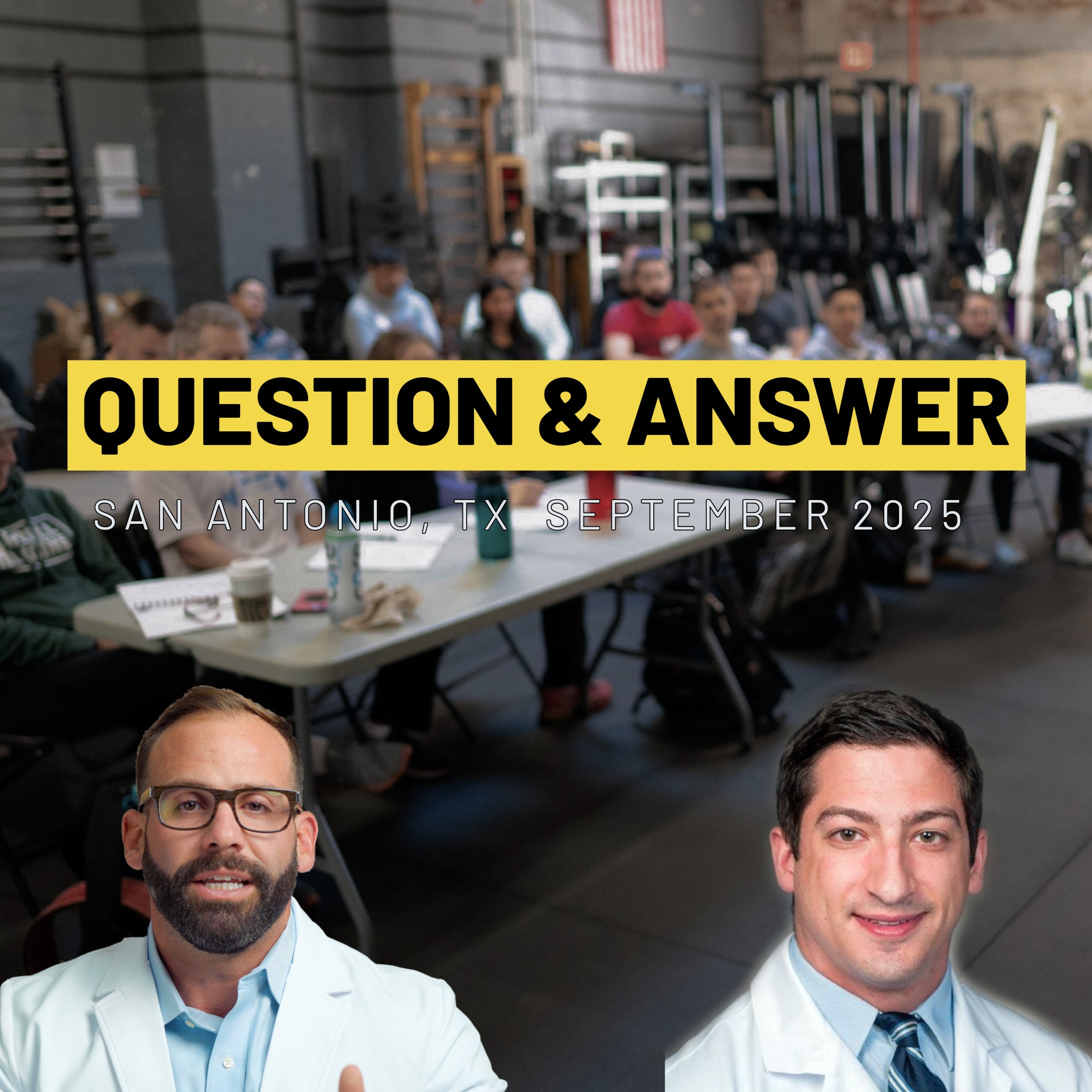
Episode #371: Q/A- Optimal Fitness Standards, GLP-1s, "Race-Based" health metrics, and More!
· 51 min
Kapitelklicken springt direkt hin
Shownotes
<p>This episode features the full Q&A from our first live seminar in over a year, recorded at Watchdog Strength in San Antonio. We field questions from the audience on a wide range of topics in health and fitness.</p><p>Listen in as we discuss the "optimal" metrics for strength, cardiorespiratory fitness, and body composition; whether osteoporosis can be reversed with exercise alone; and the physiological downsides of "grazing" (constant eating) on muscle protein synthesis and insulin resistance.</p><p>We also dive into how GLP-1 agonist medications interact with diet and exercise, practical strategies for learning motivational interviewing , how to navigate challenging clients who present with "learned helplessness", and the critical distinction between knowing enough to coach movement versus giving dangerous medical advice. Finally, we tackle the complex discussion around "race-based" medicine and how it applies to waist circumference and BMI cut-offs.</p><p><a href="barbellmedicine.supercast.com/"; rel="nofollow">Become a Barbell Medicine Plus Member Today</a></p><p><br></p><p><strong>Timestamps:</strong></p><ul><li><strong>()</strong> Q1: Is there an optimum balance of strength, cardio capacity, and body composition?</li><li><strong>()</strong> Q2: Can older adults reverse bone loss (osteoporosis) with exercise alone?</li><li><strong>()</strong> Q3: Why is "grazing" (frequent eating) bad?</li><li><strong>()</strong> Q5: How do you teach a coach motivational interviewing (MI)?</li><li><strong>()</strong> Q6: How do you handle clients with "learned helplessness" or a "diagnosis identity"?</li><li><strong>()</strong> Q7: When do I "know enough" to start coaching others?</li><li><strong>()</strong> Q8: How long does someone need to be in the "maintenance phase" until their risk of relapse is eliminated?</li><li><strong>()</strong> Q9: How should we view "race-based" differences in waist circumference cutoffs?</li></ul><p><br></p><p><br></p><p><strong>Resources</strong></p><p>Resources Page: barbellmedicine.com/resources/</p><p&… Quiz: barbellmedicine.com/template-quiz/</p>&l… pain and need a professional who understands you lift? Or, do you need an experienced coach to help you get the most out of your training? Contact us at support@barbellmedicine.com</p><br/><br/>Our Sponsors:<br/>* Check out Cometeer and use my code BBM for a great deal: cometeer.com<br/>* Check out Cometeer and use my code BBM for a great deal: cometeer.com<br/>* Check out FIGS and use my code FIGSRX for a great deal: wearfigs.com<br/>* Check out Factor and use my code factormeals.com/bbm50off for a great deal: factor75.com<br/>* Check out Quince and use my code BBM for a great deal: quince.com<br/><br/><br/>Adv… Inquiries: <a href='redcircle.com/brands'>https://redcircle…;
Transkriptvom Podcast bereitgestellt · Zeitmarken springen hin
[SPEAKER_00]: This is our first seminar in about a year and a half. [SPEAKER_00]: We held it at Sal's Jam, Watch Dogs, Strengthy and San Antonio, Texas. [SPEAKER_00]: Thank you guys so much for joining us. [SPEAKER_00]: This is our Q&A. [SPEAKER_00]: Obviously, you guys submitted the questions. [SPEAKER_00]: Austin picked out his personal favorites, so if yours wasn't picked.
[SPEAKER_00]: it's his fault. [SPEAKER_00]: DM him. [SPEAKER_00]: I can also give his address you can send him personal mail for that. [SPEAKER_02]: Some of them will actually receive direct responses because they might have needed more information or they might be something that you just need to consult for, not something that would be appropriate to discuss here depending on the jerk, depth of medical.
[SPEAKER_02]: aspects. [SPEAKER_02]: All right. [SPEAKER_02]: So you'll read the questions. [SPEAKER_02]: I'll read the question. [SPEAKER_02]: And I will just sit here like a work. [SPEAKER_02]: Okay. [SPEAKER_02]: Good. [SPEAKER_02]: Number one, is there any evidence that looks at the optimal balance of strength, cardiovascular capacity and body composition?
[SPEAKER_02]: For example, squat one and a half times body weight, or deadlift double body weight, VO2 max, over 50 body fat, 13 to 15 percent, etc. [SPEAKER_02]: I'm interested in what metrics you guys would use as measures in each of these as goals for a quote-unquote all around or optimal fitness.
[SPEAKER_00]: You've looked into this a bit. [SPEAKER_00]: Yeah, you know, if I'm understanding the question, it'd be like what sort of metrics for each individual parameter and I think that's more, I mean, this is an answerable question, just whether or not we actually have the technology and have the data to answer it as desired.
[SPEAKER_00]: So if we break all those things apart, like what's optimal for strength and how do I think about either measuring and then categorizing somebody's, oh, you're strong enough, you need to gain more strength or you need to gain a lot more strength. [SPEAKER_00]: uh... yet the evidence on a particular strength threshold we wrote about this on our up-to-date uh... article on uh... strength training primary care it looks like somewhere between one and a half to two x body weight uh... for one rep max leg press [SPEAKER_00]: For men, we extrapolated some data out on how strong women tend to be relative to men and that looks like it's like 1.2, 1.5x Body weight, leg press for women For bench press, it's close to 1.5x, body weight, the machine chest press, so we think it's like 1, 1.1x for women That's like a strength to strength cut off As far as how confident I feel in those
[SPEAKER_00]: not confident, but I think it does highlight broader point that. [SPEAKER_00]: actual improvements in strength while important that we probably need to get less strong than most strength training enthusiasts think you should be in order to like optimize your health trajectory as far from a strength perspective.
[SPEAKER_00]: So I'm thinking like if a guy can squat his body weight on the bar that may actually be strong enough like lower body wise to be like yeah you're checking your check in the box. [SPEAKER_00]: I don't know that to be true. [SPEAKER_00]: Maybe that's a little light, but I think there are both direct benefits of continuing to engage in resistance training even if you're not really gaining much strength, much longer, but you need to get a two-assert level of strength.
[SPEAKER_00]: I just don't really know what that is. [SPEAKER_00]: I think those leg press and chest press parameters are reasonable targets and just to be on the safe side, I'd probably go a little bit more than that. [SPEAKER_00]: from a cardiovascular standpoint, VO2 Max. [SPEAKER_00]: This is going to vary based on age and gender over time.
[SPEAKER_00]: But yeah, VO2 Max greater than 50 for a guy that's 35 to 55 would be great. [SPEAKER_00]: But I think higher would be better still. [SPEAKER_00]: And I don't know that there's an upper limit to that. [SPEAKER_00]: You just kind of run out of view to max improvement that's going to happen.
[SPEAKER_00]: So yeah, for women it's going to be about five to ten less less than that. [SPEAKER_00]: But I just don't think there's an upper limit. [SPEAKER_00]: The average view to max in the United States right now I think is like... [SPEAKER_00]: for adults is like 35 or 36 for dudes, which is relatively untrained.
[SPEAKER_00]: So if we could get most people to about 40 or mid 40s, I'd be stoked and then higher than that obviously takes more training to get there, but I'd be a big fan of that as well. [SPEAKER_00]: And then for body fat, that gets even more challenging, mainly because there's these individual fat thresholds that where I think disease tends to become a higher and higher probability of occurring, and I don't feel confident being like, do [SPEAKER_00]: Stay under 20% body fat.
[SPEAKER_00]: You'll avoid that most of the time. [SPEAKER_00]: Women stay under, you know, 28 or 30% body fat. [SPEAKER_00]: You'll avoid that most of the time. [SPEAKER_00]: It just seems to be a little bit more variable than that. [SPEAKER_00]: So I think actually the waste or conferences are kind of where I would default to.
[SPEAKER_00]: If I had to make a population wide, sort of, you know, checklist like. [SPEAKER_00]: Make sure you can lay press twice your body weight or there about, make sure you can machine chest press your body weight if you're a woman or about one and a half times body weight if you're a dude, make sure that you have less than a, you know, 37 inch wacer conference if you're a guy, less than 31 inches if you're a woman, and that your VO2 Max is, yes, highs you're willing to give it.
[SPEAKER_00]: As high as you're willing to get it, yeah, I mean, do you find any that like terribly [SPEAKER_02]: not objectionable. [SPEAKER_02]: I mean, I think that in practice day to day, I see the negative effects of insufficient muscular strength every day. [SPEAKER_02]: But that's also the bias of my practice setting being mainly in like inpatient care and hospital where it's like this person is not strong enough to get out of bed.
[SPEAKER_02]: So I am constantly faced with insufficient physical strength and the complications and consequences and poor physical reserve when people get ill and things like that. [SPEAKER_02]: But at the other end of the spectrum, it's harder to like observe, for example, the benefits of higher and higher and higher strength levels for me to be to feel confident that though, because this person's can bench 315 instead of 290, that their health status is markedly better and the reason I'm talking about just observation here is because [SPEAKER_02]: we don't have great research onto this.
[SPEAKER_02]: There's so much more historical evidence base in the rum of cardiovascular respiratory fitness and aerobic adaptations and things like that. [SPEAKER_02]: Then we do with strength and muscle mass and power. [SPEAKER_02]: We have tons of this cross-sectional correlational data where it's like, yeah, we know, strike higher hand grip strength, associates with less disease mortality, more more appendicular lean mass, more muscle mass associates, and there's so many other reasons why somebody at the low end of that spectrum is going to die more.
[SPEAKER_02]: and somebody who can maintain higher levels might survive longer, even outside of the muscle itself or the strength itself. [SPEAKER_02]: So interpreting that stuff is challenging, right? [SPEAKER_02]: But where we do have more evidence and more data is in this realm of cardiovascular respiratory fitness and things like VO2 Max, caveats, if interpreting VO2 Max, notwithstanding we can feel more confident that pushing that up higher will provide a ongoing benefit, although like everything else diminishing benefits over time.
[SPEAKER_02]: Whereas we suspect that the benefits of further strength improvements plateau probably earlier and certainly earlier than we would like. [SPEAKER_02]: Given how much time we've spent training, the idea, not that we did it all for health certainly to reach the levels that we did but knowing that it probably got tapped out pretty early on as far as [SPEAKER_02]: health outcomes go assuming you're able to sustain that long term.
[SPEAKER_02]: So yeah, that's why we feel that a lot of folks who are inculcated in the strength and power community are probably under-conditioned when it comes to health outcomes. [SPEAKER_02]: Or at least we try to make sure they're not under any illusions that just continuing to add more and more and more strength is going to add more and more health indefinitely for them.
[SPEAKER_02]: Even if it would be cool for them if that were true, not as confident. [SPEAKER_00]: You know why, you know why we out of this cardio stuff and none of this resistance training stuff, why is that? [SPEAKER_00]: Dr. Kenneth Cooper of the Cooper Institute. [SPEAKER_00]: comes up, in the 80s, big cardio focus, a robex hits the scene.
[SPEAKER_00]: Nobody's interested in getting jacked anymore. [SPEAKER_00]: Yeah. [SPEAKER_00]: No, shout out to Kenneth Cooper. [SPEAKER_00]: That's the stuff, all right. [SPEAKER_00]: Two. [SPEAKER_02]: Yeah, you want to hear this? [SPEAKER_02]: I got it. [SPEAKER_02]: Yeah. [SPEAKER_02]: Can older adults reverse bone loss with exercise alone after being diagnosed with osteoporosis?
[SPEAKER_02]: I'm going to start. [SPEAKER_02]: Yeah, sure. [SPEAKER_02]: I want to point out just one thing up front here that osteoporosis, while it is a diagnosis, it is a variable condition, this heterogeneous. [SPEAKER_02]: There's a variety of different degrees of it, severity, and there's also a variety of different underlying causes and contributors to it.
[SPEAKER_02]: So for example, you can have a parathyroid related disease that if we just treat that, [SPEAKER_02]: which can involve a simple surgery in some cases. [SPEAKER_02]: Boom, your bone loss will bounce back. [SPEAKER_02]: Sometimes even so quick that there's other complications that can happen with your blood calcium levels and things like that because of how fast you can bounce back from that kind of thing.
[SPEAKER_02]: So there's the upfront point I want to make here is not all osteoporosis is the same. [SPEAKER_02]: And so I don't want to over-generalize and say, oh, yeah, everybody with osteoporosis can build. [SPEAKER_02]: bone mass and restored because each situation while it might have the same diagnostic label based on a bone density measurement.
[SPEAKER_02]: There might be different causes, contributors, things like that that might respond differently, for example, to a diet intervention or a training intervention. [SPEAKER_02]: athlete. [SPEAKER_02]: If we are dealing with, quote, unquote, common kind of postmenopausal osteoporosis that's not due to one of these other underlying causes, the degree to which the bound loss can be reversed is, I would say, two things.
[SPEAKER_02]: One, relatively modest. [SPEAKER_02]: if it is going to be possible. [SPEAKER_02]: But be also variable between people. [SPEAKER_02]: There are some folks who I have seen or worked with or even members of my family who might have been diagnosed with osteopenia, for example, and they train and they train and maybe their numbers don't tend to look much better over time.
[SPEAKER_02]: and they get very frustrated by this until I have a much more empathic and detailed conversation with this person to point out that the number on your report is not the problem here. [SPEAKER_02]: The number on the report is a component of your overall risk and we care about preventing the bad things from happening.
[SPEAKER_02]: You don't feel your bone density. [SPEAKER_02]: but you feel if you have a fracture. [SPEAKER_00]: We hope not, right? [SPEAKER_02]: And if you are training and improving your general health and your function and your ability to control your body and reducing your risk of a fall and likely also reducing your risk of a fracture, even independent of the bone density measurement, that's a win, that's preventing the thing that I mainly care about.
[SPEAKER_02]: If I can get a little bone density increase on a reliable measurement over time, that's awesome. [SPEAKER_02]: If it's staying relatively stable in that postmenopause osteoporosis situation, sometimes [SPEAKER_02]: because it's not declining precipitously, right? [SPEAKER_02]: So I often end up kind of like our pain and rehab conversation end up reframing that discussion to put the emphasis on the thing that matters that I'm trying to prevent falls and fractures and things like that and trying to shift a little bit of focus away from over fixation on the number itself, right?
[SPEAKER_02]: Because the number itself is not the disease. [SPEAKER_02]: It's part of the diagnostic criteria, but what we care about is the complication. [SPEAKER_02]: So that's kind of where I put my emphasis. [SPEAKER_02]: And then of course, we can disquestion specified with exercise alone, but it doesn't have to be with exercise alone.
[SPEAKER_02]: We also have, [SPEAKER_02]: various medications of different classes that can further support those efforts to either mitigate for stall the decline as time goes on or potentially there are some anabolic agents that can actually help build bone mass. [SPEAKER_02]: But that's kind of how I end up framing it is anything that is mitigating our risk of falls and fractures in the actual bad things is the most important and if I can slow down the rate of decline, that's also when if it keeps it stable, that's also a win and if it goes up, that's also a win.
[SPEAKER_02]: That would be the way I would have this conversation. [SPEAKER_00]: All right, I have a question for you. [SPEAKER_00]: To A, if you will, okay? [SPEAKER_00]: Because we know that bone mineral density, bone mass tends to peak particularly in women. [SPEAKER_00]: Uh, 30-ish, right? [SPEAKER_00]: So the idea is start early, get that peak real real high, and then, you know, yes.
[SPEAKER_00]: Don't fall off. [SPEAKER_00]: You get a 30-year training period, all right? [SPEAKER_00]: And it's either from 20 to 50, or it's from 40 to 70, all right? [SPEAKER_00]: In women, which group would you predict to have less falls and fractures in their sixth decade? [SPEAKER_02]: That's an interesting hypothetical.
[SPEAKER_02]: If I could choose which are going to, which are going to drain, probably the latter would be the one that I would prefer. [SPEAKER_00]: Oh, really? [SPEAKER_00]: Just because they're more actively training at that time, so likely they'd have better functional scores, despite perhaps a little bit of a loss.
[SPEAKER_02]: If they were going to stop after 30 years, yeah, that would probably buy my preference and that I think is heavily informed by my bias of most of the patients that I end up seeing are in those older demographics and are not active and are not functional. [SPEAKER_02]: And the decline ends up being super rapid, whereas it would be pretty responsive to training.
[SPEAKER_02]: Yeah. [SPEAKER_02]: So there's the debate between you want the higher peak of bone mass early in life and you want to keep training to keep it as high as you can, even if it's going to gradually decline. [SPEAKER_02]: So you're, you know, the essence of your question is would you rather have the highest peak possible, even if you let it decay later on, or would you rather maybe not reach as quite as high a peak, but do everything you can to try to forestall the decline.
[SPEAKER_02]: That's an interesting hypothetical. [SPEAKER_02]: But yeah. [SPEAKER_02]: Fortunately, we don't have to choose between those two. [SPEAKER_02]: You're okay to list those. [SPEAKER_02]: Yeah. [SPEAKER_02]: No, that's a, that's a, that's a good one. [SPEAKER_02]: Okay. [SPEAKER_02]: Number three, with respect to dietary patterns, why is grazing bad, which I'll let you define as well?
[SPEAKER_02]: Does it interfere with muscle protein synthesis or what's the problem of grazing? [SPEAKER_00]: Yeah, grazing, if we can define it as just instead of having discrete meals where their periods are actually eating food, and then longer periods where you're fasting in between meals. [SPEAKER_00]: So if you're grazing and that you never get any prolonged period of fasting between meals, which I would define as greater than [SPEAKER_00]: Yes, it does compromise muscle protein synthesis, generally speaking, the machinery that drives muscle protein synthesis needs to be reset between bouts of being elevated or periods of being elevated.
[SPEAKER_00]: So you eat a meal, muscle protein synthesis rates go up, they peak, depending on the protein source, about an hour to an hour and a half after you're [SPEAKER_00]: I have finished your meal and they go back down to baseline and then you can do that again about three hours after you've finished a meal.
[SPEAKER_00]: Now if you never finish a meal because you're always eating, you never get to reset that machinery. [SPEAKER_00]: So we think there's less muscle protein synthesis. [SPEAKER_00]: This is also known as like a muscle full effect. [SPEAKER_00]: Atherton, I believe, described this. [SPEAKER_00]: And so yeah, we think there's less muscle protein synthesis.
[SPEAKER_00]: The muscles become a little more anobolically resistant with persistent grazing, especially if it's in an environment where you're getting food through a tube and you're sitting hanging around. [SPEAKER_00]: There's also some evidence that increases rates of insulin resistance as well. [SPEAKER_00]: You want these periods of fasting in between without food, so your body can kind of use, store and get that energy out of, [SPEAKER_00]: the bloodstream, such that you're ready for the next meal.
[SPEAKER_00]: And so the problem with this evidence is that we don't have a ton in a free living society where you would control the total amount of energy intake and the macronutrient intake and say, look, these people ate pretty continuously throughout the day. [SPEAKER_00]: You know, over a 12 hour or 16 hour window and these people had three discrete meals separated by five hours at a time.
[SPEAKER_00]: Same calories, same macronutrient, same dietary pattern, overall, [SPEAKER_00]: You would want to see that study just to feel super confident in this, but when it comes to dietary patterns, with respect to meal frequency. [SPEAKER_00]: I don't think grazing is the best choice. [SPEAKER_02]: Yeah.
[SPEAKER_02]: My concerns with grazing, though, to be clear, are not at all pit years later to concern the over muscle protein synthesis. [SPEAKER_02]: That's not, or I'm like worried about it. [SPEAKER_02]: My bigger concern with grazing is that, yep, we're not meant to be constantly post-prandial, which means always in a fed state for a variety of reasons, and my concerns relate more to the insulin resistance aspect that can happen with being continuously fed, and also that with cardiovascular risk, [SPEAKER_02]: So, if you're eating things that contribute to basically what are circulating particles in our blood, like blood lipids and some cholesterol related things and triglycerides and things like that, we always have these, you know, post meal like remnants that are circulating around all the time.
[SPEAKER_02]: We never clear that from our bloodstream, all of that increases the risk of cardiovascular disease and things like that as well. [SPEAKER_02]: So, these things that, [SPEAKER_02]: We eat, we absorb, go into our blood, ideally they get cleared, spend a bunch of time cleared from our blood before the next meal rather than constantly being around all the time, which I think is probably the bigger problem with grazing than people not getting jacked as enough from their muscle protein responses.
[SPEAKER_00]: Yeah, I think it's just more points to the body's general response to always being fed. [SPEAKER_00]: So not only is it not good for the majority of your organ systems, but by way of insulin resistance, but yeah, the muscles become a little resistant to. [SPEAKER_00]: Interestingly, this is that sort of data, maybe one of the impetus, one of the impetus or driving forces behind the popularity of intermittent fasting, kind of making a big push, where they're like, look, if you eat all the time, [SPEAKER_00]: bad stuff's going to happen to you.
[SPEAKER_00]: So let's do it intermittently. [SPEAKER_00]: Let's have extended periods of fasting, which would be a fine way to eat. [SPEAKER_00]: I timer-stricted feeding can be a viable option for folks. [SPEAKER_00]: I don't think that people get better results from using that particular approach.
[SPEAKER_00]: Save four folks who already have some demonstrable insulin resistance. [SPEAKER_00]: They have [SPEAKER_00]: matching up their meal intake with the daylight hours tends to be a little bit better than eating most of the calories at night. [SPEAKER_00]: So it's kind of intermittent fasting but in reverse eat most in the morning in the afternoon and in early evening and then be fasting when it's darker outside and have a prolonged fasting period overnight.
[SPEAKER_00]: Other than that though. [SPEAKER_00]: Yeah, I don't I'm more worried about grazing from the insulin resistance thing and then also just from over Yeah, yeah All right, number four. [SPEAKER_02]: How do the effects of GLP one agonist medicine's change when they're when they are combined with diet and exercise Compared with when they are not combined with diet and exercise [SPEAKER_00]: We talked about this a little bit on our podcast.
[SPEAKER_00]: I think it was the lean mass loss in dieting. [SPEAKER_00]: I think it was 233 or 233, I feel what you have. [SPEAKER_00]: So just crazy. [SPEAKER_00]: That's like a 130 episode to go. [SPEAKER_00]: Also crazy that it's still in my brain. [SPEAKER_00]: Anyway. [SPEAKER_00]: Yeah, there's a few studies out there on this.
[SPEAKER_00]: I know one of them with Laraglutide, which is not typically used or favored for a GLP one for weight loss, but an Africa with the other one has been used. [SPEAKER_00]: But either way, the results are the same, and it's exactly how you would predict. [SPEAKER_00]: Individuals who are dieting, using diet and exercise with the addition of a GLP1, they tend to lose more fat mass than those who are taking the placebo.
[SPEAKER_00]: That said, the individuals who are taking the GLP1 receptor agonist also seem to be able to gain strength. [SPEAKER_00]: And there's no difference in strength gains between the placebo group and the GLP1 group. [SPEAKER_00]: And there are no changes in the amount of lean mass that is either that is a gain or loss in this application.
[SPEAKER_00]: Which is interesting because you would expect well if they lost more fat mass They would also lose more lean mass, but it's laggly tied so it's not what not the most potent not the most potent So what I would predict if you set up a trial or they people were using a zepound so it's a zepatide Monjaro, which is probably one of the better agents that we have right now [SPEAKER_00]: One group was getting that at Mac Stos, the other group was getting a placebo, and both were getting dietary and exercise interventions on top of that.
[SPEAKER_00]: I wouldn't predict any sort of strength change outcome differences. [SPEAKER_00]: They would both gain strength and response to exercise. [SPEAKER_00]: I would predict more lean mass accumulation in the lifestyle only group with the placebo, mainly because they won't have lost as much fat mass as the Zephyne group.
[SPEAKER_00]: Um, but I would predict way more fat mass loss in the, the Zepound group and total weight loss as well. [SPEAKER_00]: Um, yeah, I think they're powerful. [SPEAKER_00]: Uh, the other thing I want to mention here is that the existing data we have here on people who get prescribed, GLP1 receptor agonists and their physical activity habits is that they actually tend to increase compared to placebo.
[SPEAKER_00]: Now whether it's not whether or not that's because people feel like it's working I'm losing weight I'm losing and it's like a positive feedback loop or somehow they figured out they were actually in the study arm and they were like well I should add some exercise to this to get the most out of my time here I can't speak to that but I do find it interesting when people say oh yeah people are just taking these drugs they don't have to exercise [SPEAKER_00]: like well it actually makes them on average exercise more every week and to that point like do you care like how these people achieve the end goal or do you simply care that they get better because I fall in that ladder category yes I prefer everyone to exercise yes I prefer everyone who is able to to eat a health-roading dietary pattern but I care more about that than people being lessening a risk factor for a lot of different diseases that are a burden
[SPEAKER_02]: Yeah, I've talked about this with you. [SPEAKER_02]: Talk about on the podcast with several people who are here this weekend that I wish maybe we'll, you know, at some point spend the time to sit down and pull the best data we have, which we do have in some of our lectures on the effectiveness of the diet and exercise alone for various outcomes and it's impact on health, then the effectiveness of the GLP ones, maybe without necessitating or requiring some lifestyle intervention and then maybe with.
[SPEAKER_02]: And then blinding people to what is what and saying, which would you pick? [SPEAKER_02]: The one that gives you this chance of sustaining clinically-significant weight loss at 20 years, the one that gives you this chance of sustaining clinically-significant weight loss at 20 years, and then the one that causes you to have less heart attacks, GLP ones, the one that causes you to have less heart failure, GLP ones, the ones that cause you have less chronic kidney disease progression, less and less and less of all these bad things that we're discovering now.
[SPEAKER_02]: And then using the tools that we have available to us to get people the best health [SPEAKER_02]: If they're willing and able to do that exercise in addition to that, that's great, but if they're not. [SPEAKER_02]: Should we be keeping this and say, well, you don't deserve these benefits from these things?
[SPEAKER_02]: Or do I just care that, you know, I would encourage you and I'm going to do the motivational interviewing and I would also prefer that you die less by using these types of things. [SPEAKER_02]: You can't cheat. [SPEAKER_00]: So the outcomes are more what we care about. [SPEAKER_00]: No, you can't use tools to help.
[SPEAKER_00]: In fact, we should ban fitness coaches until someone has failed trying it on their own multiple times and only then are going to get a fitness coach and if you fail fitness coaching, then you can get drugs. [SPEAKER_02]: Okay, number five given that the best way to learn motivational interviewing is to practice Motivational interviewing like specificity of adaptation set the imposed demands.
[SPEAKER_02]: Yeah How would you try to teach a coach or provider how to do motivational interviewing? [SPEAKER_02]: That's question one a five a we'll come back to the second one. [SPEAKER_00]: Okay, uh, outside of practicing it [SPEAKER_02]: How would you try to teach somebody how to do it? [SPEAKER_02]: Oh, maybe just telling them to practice.
[SPEAKER_02]: Maybe they don't know where to start or how to go about it, but to do. [SPEAKER_00]: Yeah, I mean, I think that's more of like requires a self-inventory, like, okay, what is your general approach to getting somebody to change their diet now? [SPEAKER_00]: Because if it's just an assessment, you take that assessment, and then you come up with a plan in isolation, and you deliver to them, that'd be one strategy.
[SPEAKER_00]: But I'd also be wondering about like, well, what are your success rates with that? [SPEAKER_00]: Because if it's great with your population, I got it. [SPEAKER_00]: Yeah, learning motivational interviewing is a great skill, but like, I don't know that you need me to tell you what to do if you're already getting great success.
[SPEAKER_00]: So, I think... [SPEAKER_00]: looking at what somebody an individual is doing and then figuring out where does the conversation go when it comes to actually developing the plan? [SPEAKER_00]: I think most coaches that I've interface with, they tend to ask a person what would they like to do, what are they willing to do and what they're currently doing right now and that's all some form of motivational interviewing whether or not it's effective or not like yeah I don't even know that most coaches are doing that.
[SPEAKER_00]: Yeah, with a lot of them are just like, here's the plan. [SPEAKER_00]: Yeah, yeah. [SPEAKER_00]: So, I mean, if that is, in fact, the case, then I think maybe formula changing from this more like patriarchical relationship, or it's like, you ask me what to do, I will tell you what to do.
[SPEAKER_00]: That is a way to go about giving someone recommendations, but I think having a more collaborative approach would be the idea. [SPEAKER_00]: So, asking a person, okay, great. [SPEAKER_00]: So, we're up for change, love that. [SPEAKER_00]: What would you like to do? [SPEAKER_00]: What are your preferences?
[SPEAKER_00]: What are your what obstacles do you feel like you're going to be facing? [SPEAKER_00]: How do you think you're going to navigate them? [SPEAKER_00]: I mean, now you're just opening the door to have these conversations about tailoring the plan. [SPEAKER_00]: So you don't have to project your own preferences on to the person.
[SPEAKER_00]: And I feel like it's likely to be more successful because you don't run into any like. [SPEAKER_00]: anything like, oh, why did you tell me to go buy a bunch of brown rice? [SPEAKER_00]: I told you I hate brown rice. [SPEAKER_00]: And you're like, well, actually, I never asked you if you like brown rice or not, you know, for example.
[SPEAKER_00]: So I think that kind of intermediate step between assessment and the plan is a perfect time to start practicing. [SPEAKER_00]: asking about preferences, what somebody's willing to do, what they're perceived barriers are. [SPEAKER_00]: And then whatever, once you do that a few times, you'll kind of run into a few awkward moments.
[SPEAKER_00]: And those would be the points I would focus on. [SPEAKER_00]: Okay, why did I run out of things to say? [SPEAKER_00]: Like, I don't know the phrasing or did I get surprised by the answer or something like that? [SPEAKER_00]: I think those are a good teaching points, but yeah, I don't know.
[SPEAKER_00]: I'd be really interested to know what coaches are doing if they're not asking any sort of, [SPEAKER_00]: questions to the individual. [SPEAKER_00]: You could do mock interviews with another coach, another person, but if you're actively coaching somebody, I do wonder how you end up coming up with the plan without actually talking to the individual.
[SPEAKER_02]: Yeah, as someone who does teach clinicians how to do this kind of thing, a lot of it comes down to some combination of modeling and mentorship. [SPEAKER_02]: So, and if that is not something that's easily accessible to you, then pursuing formal training, I think, would be the best strategies.
[SPEAKER_02]: Self-teaching this in the absence of any like resources is going to be quite challenging. [SPEAKER_02]: Because you're going to be sitting there, you're going to be like, am I doing it? [SPEAKER_01]: Is this motivation? [SPEAKER_02]: When did I start doing the motivational interviewing part?
[SPEAKER_02]: And there's not a discreet you're doing it now, it is ultimately, you know, I don't go into like, oh, I'm in like motivational interviewing mode. [SPEAKER_02]: It's just in, you know, imbued in my conversation with the patient throughout and it's just a back and forth. [SPEAKER_02]: And so a lot of times I will, like if I'm happening to do it in the hospital setting, I'll bring one or more of my learners with me, might be a student or an intern.
[SPEAKER_02]: come watch this hang out in the corner if they've never seen it before or I might have them pull up a chair and introduce them to the patient just so that they can be present and potentially involved in the conversation and I will do it and then maybe sometimes I'll like. [SPEAKER_02]: give them a little, you know, lay up something that they can participate in and try to jump in, and then I'll like, might take back over if they need some help or something like that.
[SPEAKER_02]: So that is, obviously like, significant guided mentorship and time and effort. [SPEAKER_02]: I might have them purely observe me do it. [SPEAKER_02]: I might have them purely do it and observe them and always debrief afterwards and talk about, how do you think that went? [SPEAKER_02]: So then I'm doing this conversation with the learner.
[SPEAKER_02]: What did you struggle with when did you feel like you were tripping up here's what I saw How did you feel during that moment and then that's coaching and here's how I might have phrased this here's how I might have said that But that's not easy to find Do you think do you think the main takeaway from that mentorship thing is mostly like what to say when you don't know what to say Do you understand like potentially a lot of saying what [SPEAKER_02]: But you need to run into those uncomfortable situations enough that you are able to handle them smoothly.
[SPEAKER_00]: Yeah, why, I think. [SPEAKER_02]: That's just like you put your foot in your mouth enough times, or you get stumped, or maybe you say something, and you feel like, oh, the tension in the room just went the wrong way, or I just said something. [SPEAKER_02]: Uncomfortable or bad, and then you, I'm going to never do that again, because you'll wake up at three in the morning, like five years from now.
[SPEAKER_02]: And think about that one time when you said that thing, that pissed off the whole family. [SPEAKER_02]: Yes. [SPEAKER_02]: speaking for a friend on that one, yeah. [SPEAKER_02]: The juicy booty effect. [SPEAKER_02]: The second part of that one was at what point should we actually educate the client about what's effective, scientific, and evidence-based, so like when should we actually tell them these things, for example, so they don't just use stretching as a singular plan for their rehab.
[SPEAKER_00]: Yeah, I mean, I think this comes back to like just how you go about communicating the plan or developing the plan actually even before that is you want to come up with a shared plan. [SPEAKER_00]: The shared plan is based on your expertise, right, and how what you would want this person to do if given no restrictions.
[SPEAKER_00]: and then the individuals communicating to you their preferences, not only for outcomes, but also what sort of limitations that they have, real or perceived or otherwise, and you're developing this plan together. [SPEAKER_00]: And I think if you approach creating a plan together, you actually don't really run into this problem as much.
[SPEAKER_00]: They may say, and this example of like an exercise plan or rehab plan, they're saying, oh, should I be doing stretching? [SPEAKER_00]: Right, and instead of being like actually stretching to the low-shown, the decrease pain, so like whatever, the actually, and you have to have glasses on and push them up and before you say anything.
[SPEAKER_00]: Instead of saying that, you could, if you had time to unpack that, uh, yeah, tell me what you know about stretching. [SPEAKER_00]: And if somebody was like, oh, yeah, look, every time I've done this before, it's made me feel better, I actually enjoy it. [SPEAKER_00]: great at that point that might change my mind to be like let's actually include some straight they like it they got time go for it if they were like i've told that i can only stretch by a previous pt because if i do any sort of exercise this time i'm very vulnerable to injury at that point you'd want to provide some sort of direct feedback there but ultimately having the more motivational here for you and really uh to to come up with some sort of uh recommendation but i think if you approach this from a shared plan building
[SPEAKER_00]: You tend to have these direct pushbacks less often. [SPEAKER_00]: They more just kind of come up at surprisingly. [SPEAKER_00]: And then you're like, do I really need to push back against this? [SPEAKER_00]: Or can I kind of reshape the recommendation? [SPEAKER_02]: Yeah. [SPEAKER_02]: Ultimately, this comes down to like, why is the person talking to you?
[SPEAKER_02]: what are they there for? [SPEAKER_02]: I do they care about your opinion and your advice and your recommendations and your thoughts on this or do they not? [SPEAKER_02]: And if they do then that should get infused into your recommendations as part of that shared plan. [SPEAKER_02]: If they are there for some other reason and they're not particularly interested in what your thoughts and recommendations aren't then you might never get to that point where you say well here's what I would recommend.
[SPEAKER_02]: I don't know what they're there for, then, and you'd have to, you know, engage them on that level or maybe build some more rapport before you're ready to actually make recommendations to them if they're not ready to hear your recommendations yet. [SPEAKER_02]: Maybe they're in the, I'm not looking for solutions.
[SPEAKER_02]: I just want somebody to listen, which is a thing that, you know, sometimes happens. [SPEAKER_02]: I expose both in personal relationships and professional relationships where you're not at the problem solving phase yet. [SPEAKER_02]: You're just there to listen. [SPEAKER_02]: So that's okay.
[SPEAKER_02]: So you have to be able to sense that and know when is when is the right time. [SPEAKER_02]: Cool. [SPEAKER_02]: All right, I think we have a couple more. [SPEAKER_02]: All right, so we've spoken a lot on self-efficacy versus helplessness and touched on those who've almost formed an identity based on a diagnosis that they might have received.
[SPEAKER_02]: In the gym and the clinic, I feel one of the most challenging populations are those who have this learned helplessness, not necessarily from their own exposure to negative stimuli, but from continued confirmation from others. [SPEAKER_02]: Seems they almost enjoy having a diagnosis, an ailment, or a reason that quote allows them to not have to change, challenge, or improve themselves.
[SPEAKER_02]: There's a lot there. [SPEAKER_02]: Do you have any tips for quote converting this person to one of self-efficacy and versus when to cut ties? [SPEAKER_02]: Jordan's important, more to fact. [SPEAKER_00]: I mean, yeah, how much time we got? [SPEAKER_00]: Like, what do we, uh, yeah, this is interesting.
[SPEAKER_00]: Um, I mean, [SPEAKER_00]: I don't know that I'm thinking about a personal trainer in a gym with somebody who's got a particular medical condition, I'm just envisioning this, and then that person has no desire to engage in either a particular type of exercise or intensity of exercise because they're like, oh, I've got, I don't know, aphib, or something like that, I don't [SPEAKER_00]: I think, generally speaking, if you have a personal training client who every time you interface with them, there's a black cloud that hangs over you for the rest of the day, you should fire them.
[SPEAKER_00]: And not because they're a bad person, but because you guys are a bad match. [SPEAKER_00]: You are. [SPEAKER_00]: That person is a bad match for you, and that's totally valid reason to ultimately move on. [SPEAKER_00]: You should not leave them high and dry, recommend them to somebody else, and ideally they are better match.
[SPEAKER_00]: It's not worth your mental health to keep persisting with this. [SPEAKER_00]: Obviously people have ulterior motives, usually financially, the base, so I get that, but like, [SPEAKER_00]: life's too short, I think, to have clients that make you want to ask questions like this. [SPEAKER_00]: I do think that may be true.
[SPEAKER_00]: As far as what to do about it, I mean, you could consider some ways that would ultimately violate their expectations, right? [SPEAKER_00]: They're like, I can't do this type of exercise because I have a herniated disc from, you know, whatever. [SPEAKER_00]: And it's like, and maybe the exercise is dead lifts, right?
[SPEAKER_00]: And you're like, well, we can maybe do a shorter range of motion hinge where [SPEAKER_00]: holding a light kettlebell there, and whatever you need to do to get your foot the door. [SPEAKER_00]: And they do it and they're like, oh, good, you're conting. [SPEAKER_00]: Starting there. [SPEAKER_00]: That's one way to do that.
[SPEAKER_00]: If a person is able to start there and progress, they kind of unlearn their, quote, learn helplessness. [SPEAKER_00]: Great. [SPEAKER_00]: I don't have a great answer for this overall because it seems like this question come from a place of, I've tried everything that I think and I still can't get my foot in the door.
[SPEAKER_00]: I'm like, well, look, if the person's paying you for your professional opinion and not listening to it, [SPEAKER_00]: It seems like a bad match to me, you know, and I don't want to say give up on the person, but it's like, I don't know that I have an easy answer here. [SPEAKER_00]: Try there.
[SPEAKER_02]: Yeah, these are super complex situations. [SPEAKER_02]: I would push back on the idea that these folks enjoy having a diagnosis. [SPEAKER_02]: That is generally not the case. [SPEAKER_02]: I do think that there can be a strong kind of social identity that forms around having a diagnosis, particularly, you know, say you're in this support group and interacting with others.
[SPEAKER_02]: And then maybe you've had a bad experience with the healthcare system, so then like, [SPEAKER_02]: doctors become the them who are like not listening or not doing a job and then you are with your tribe, your social group of people who maybe have a diagnosis or maybe think they have a diagnosis that may or may not be accurate.
[SPEAKER_02]: So yeah, I would not jump to the assumption that they enjoy it, but rather that there can be this strong social incentive, strong social value [SPEAKER_02]: in which we have some degree of social value. [SPEAKER_02]: And so I come back to the question of like, why is the person talking to you?
[SPEAKER_00]: Yeah, that's what I'm saying, right? [SPEAKER_02]: And sometimes you can just ask not why are you talking to me, but like, [SPEAKER_02]: Why are you here? [SPEAKER_02]: You know, what are you looking for? [SPEAKER_00]: How can I help you? [SPEAKER_00]: Can you imagine? [SPEAKER_02]: Yeah, why are you talking?
[SPEAKER_02]: So, but sometimes you need to ask that. [SPEAKER_02]: And maybe you think that they might be there for a different reason that might be actually different than what they're actually therefore. [SPEAKER_02]: Right? [SPEAKER_02]: And so trying to meet them where they're at and these folks need a lot of time and patience and listening and rapport, rapport, rapport, rapport, rapport so that they actually trust you rather than thinking that if you is me, right?
[SPEAKER_02]: I trust my doctor rather than coming in with an antagonistic relationship up front of coming in, expecting that the doctor is not going to listen to me, right? [SPEAKER_02]: That's something that can often happen and then they get like super surprised when like, oh, you did listen to me.
[SPEAKER_02]: And it's like they almost don't know how to react to that sometimes. [SPEAKER_02]: You know what I mean? [SPEAKER_02]: Okay, let's do maybe our last three here. [SPEAKER_00]: Well, you hand with that one away. [SPEAKER_02]: When do I quote no enough to start trying to teach or coach others?
[SPEAKER_02]: When do I cross over the quote knowing just enough to be dangerous phase? [SPEAKER_00]: Wow, that's actually a really good question. [SPEAKER_00]: I mean, because I started doing personal training in 2007. [SPEAKER_00]: So yeah, some number of years ago, I hit the no enough to be dangerous phase, 2007.
[SPEAKER_00]: No, no, I think, I think. [SPEAKER_00]: most people who have some background not only in training themselves, but also in helping others out, or at least giving some advice, or shadowing somebody out, like you can start with that a minimal fund of knowledge, but you have to have had experienced it on some level, like I think that is kind of a criteria in order to get your foot in the door.
[SPEAKER_00]: Um, and then obviously you'll need some sort of certification, so there'll be some minimal fund of knowledge. [SPEAKER_00]: I think that's generally fine, because you've got to learn most of these skills after you've already started training people, especially the soft skills. [SPEAKER_00]: The no just enough to be dangerous thing, that's more of an attitude thing to me and like failing to look inward repeatedly, like, [SPEAKER_00]: People get overconfident about a lot of things very quickly, and that happens a lot in the fitness space, and I think at any level of knowledge you can become, you know, just enough to be dangerous.
[SPEAKER_00]: I would argue that you and I know some things about some things, but I think our actual confidence in a lot of our recommendations have gone gotten softer. [SPEAKER_00]: at least specific recommendations for the most part, which I think is it's proportional to our knowledge, like as you learn more, you're less like you have to squat this way for this many reps and this many times for a week and you're like, hey, you actually don't really need to do like a back squat, if you want to, you could do it on a machine, you could do it, a dumbbell, you could use bands, more important that you're thinking about squat and I hope you do it, so things get softer.
[SPEAKER_00]: I think we need more people to be in the trenches, coaching others, working with them on behavior change, supporting that behavior change by keeping them accountable, helping them progressively load properly for talking about training. [SPEAKER_00]: I just think that no matter where you're at on your educational journey, [SPEAKER_00]: just remaining humble and trying to not be overconfident about what you know because I promise you the more you learn it that you'll look back and you'll cringe harder and harder and harder and that's just a experience that I have I have there unfortunately I think it'd be challenged to almost be dangerous here.
[SPEAKER_00]: That I mean there are people in space that make make recommendations that are our dangerous But I find that to be more of a very vocal minority rather than like this person doesn't know how to coach a squat properly I'm like well, that that's true Yeah, the reason I disagree is because you without maybe without explicitly saying you're realizing it You are living in yourself to the context of training [SPEAKER_02]: Yeah, yeah.
[SPEAKER_02]: I've exercised and a lot of these folks will start to veer outside of that and maybe they give confident nutrition, dietary recommendations including clinical nutrition for like people who have medical problems or even worse actual medical advice or trainers who are like bring me your labs and we'll talk about them.
[SPEAKER_02]: Yeah, that's dumb. [SPEAKER_02]: No, you should not be doing that with lacking formal training in these things. [SPEAKER_02]: Having, you know, listen to some bro podcasts where they talk about biomarkers and health optimization does not mean that you are qualified to interpret labs, which is very complex.
[SPEAKER_02]: And even if you take labs and you put them into an AI model as I recently, you know, not blaming the patient because they're seeking information, but they put it in thinking, [SPEAKER_02]: and gave him a summary and just almost led to a panic attack that you know I ended up having to you know chat calm down like this is incorrect interpretation of this advice I'll talk to you in a few days once once we have some some more data and some time and I'm not at nearly as concerned as the AI is and I have been doing this for longer than the AI has not to say that that's my main [SPEAKER_02]: I see this, I deal with this daily.
[SPEAKER_02]: For the past decade, I'm confident that you will be OK from this right now. [SPEAKER_02]: And so trainers who start veering into the clinical medical aspects is where you can be exceedingly dangerous. [SPEAKER_02]: But as far as like teaching somebody to move some weights around or prescribe some conditioning, yeah, I'll have great concerns about that.
[SPEAKER_00]: Yeah. [SPEAKER_00]: No, now that you think about it, I... [SPEAKER_00]: You know, why do people care what trainers think about vaccines, you know, like why, or like, you know, medication regimens, like no, there's no expertise. [SPEAKER_00]: Okay. [SPEAKER_00]: Yeah. [SPEAKER_00]: I mean, why do people think care what human has to say about these things?
[SPEAKER_00]: No expertise. [SPEAKER_00]: This is tricky. [SPEAKER_00]: I keep going. [SPEAKER_00]: More hot takes. [SPEAKER_00]: Why do people care what Rhonda Patrick has to say about these things? [SPEAKER_00]: No expertise. [SPEAKER_00]: Yeah. [UNKNOWN]: Yeah. [SPEAKER_02]: All right. [SPEAKER_02]: I think our last two here.
[SPEAKER_02]: All right. [SPEAKER_02]: So in the trans-theoretical model of behavior change, are there studies of how long someone has to be in the maintenance phase until their risk of relapse, significantly decreases or is eliminated completely? [SPEAKER_00]: I won't say that there are no studies on this.
[SPEAKER_00]: Well, I do not know of any studies on the average length of time here. [SPEAKER_00]: The trans-threatical model was created by smoking sensation in the 70s by Prachaska, I think with the lead author. [SPEAKER_00]: There have been subsequent follow-up studies on this again in more smoking cessation stuff and exercise participation.
[SPEAKER_00]: There may be additional studies using this model or a similar model to it on, okay, on average if a person's in the maintenance phase for this about a time, this percentage or proportion of folks move on to termination or versus this many [SPEAKER_00]: I'm just not aware of that data, so that's kind of where I fall on that.
[SPEAKER_00]: That said, even with that knowledge, that'd be more of like, [SPEAKER_00]: I guess setting expectations for yourself with a particular individual, rather than being useful for them, because when I use that model, I don't actually explain all these different stages. [SPEAKER_00]: I'm just like, what I'm hearing from you is that you're ready to start now.
[SPEAKER_00]: You've already taken some steps for that. [SPEAKER_00]: We just need to refine the plan. [SPEAKER_00]: Maybe make it a little easier for you to stick to this and also maybe help you get some better results. [SPEAKER_00]: accurate that's kind of where I start that. [SPEAKER_00]: But I never say it sounds like you're in the contemplation phase or pre-contemplation phase.
[SPEAKER_00]: And further from that, if I do correctly identify what somebody's saying, I don't give them the explicit goal. [SPEAKER_00]: And my goal now is to move you from the action phase to the maintenance phase. [SPEAKER_00]: More so that what my discussion hinges around are, what it would be limiting from moving them to the next phase.
[SPEAKER_00]: That's in my brain. [SPEAKER_00]: And I do discuss relapse quite often with folks, especially when it comes to weight loss, mainly to try to, again, set the expectation that this is unlikely to be linear, we're not just going to start here, and then just I give you this plan, it's going to work magically and you're going to be great in a few months, but more so just setting the expectation on here's what I would like to see happen in the next few months, here's my expectation, and then we'll go from there, but I very rarely discuss anything else outside of like just relapse, and I'm going to go to the next few months, I'm going to go to the next few months, I'm going to go to the next few months, I'm going to go to the next few months, I'm going to go to the next few months, I'm going to go to the next few months, I'm going to go to the next few months, I'm going to go to the next few months, I'm going to go to the next few months,
[SPEAKER_00]: and barriers to moving forward on that. [SPEAKER_02]: Yeah, I'm not aware of any data on this either. [SPEAKER_02]: I would say that the risk of relapse probably just decreases in graded fashion over time, the longer the person's able to go, but I would not expect risk to ever be eliminated completely.
[SPEAKER_02]: Yeah, yeah. [SPEAKER_02]: Nor would I trust data that suggested it was. [SPEAKER_02]: because each person's situation is unique here, right? [SPEAKER_02]: The other aspect here, though, is that that risk of relapse is not purely related to the person. [SPEAKER_02]: The person is situated in an environment.
[SPEAKER_02]: And so, depending on the environment that they are in, that itself may also impact the risk of relapse. [SPEAKER_02]: Depending on the behavior that we're talking about, and you can imagine. [SPEAKER_02]: various situations. [SPEAKER_02]: Potentially, you know, you mentioned white loss, a ton of my conversations around this relate to alcohol use, as an example, or other forms of drug use, or various other topics that might lead somebody to seek behavior change, and somebody might be have been in maintenance for a long period of time, but that might have been through.
[SPEAKER_02]: what I'll call heroic efforts on their part individually, personally, and maybe based on changing their environment. [SPEAKER_02]: But under the right circumstances, if that environment were to relapse, perhaps that would markedly increase their risk of relapse against. [SPEAKER_02]: So it's not all just the individual factor, but the interaction between the individual and their environment and things like that.
[SPEAKER_02]: So [SPEAKER_02]: I don't know how useful it is to think about this other than just a great a decrease and then just leaning into all the things that are facilitating maintenance as much as possible for the person so. [SPEAKER_02]: Yep. [SPEAKER_02]: All right, last question is a bit more medical, but is one we've not actually talked about before.
[SPEAKER_02]: I think so there's been a large push to eliminate quote race based medicine. [SPEAKER_02]: So things like glomerular filtration rate GFR, so measurement of people's kidney function historically there have been different cutoffs based on race. [SPEAKER_02]: or people's lung function calculations or different medicines we might use for patients who identify as one particular race or another.
[SPEAKER_02]: That's been a push to move away from that. [SPEAKER_02]: Based on the concept that race is actually a pretty poor proxy for their genetics, which is actually correct. [SPEAKER_02]: How should we view the differences in waste or conference cutoffs in light of this? [SPEAKER_02]: Wow. [SPEAKER_00]: It's a really good question.
[SPEAKER_00]: I've never thought about this before. [SPEAKER_00]: So now I'll think about it. [SPEAKER_00]: So right now, there are ethnic specific waste circumference cut points. [SPEAKER_00]: And the thought is that what you're capturing there are geographic locations and their predisposition have certain skeletal structures.
[SPEAKER_00]: Most specifically, how big their skeleton is. [SPEAKER_00]: The bigger your skeleton is, both height and then thickness wise. [SPEAKER_00]: influences your lean body mass carrying capacity. [SPEAKER_00]: So I'm going to muscle you can carry and so individuals of like South Asian descent tend to have smaller skeletons and have lower muscle mass carrying capacity.
[SPEAKER_00]: That's why there be a my cut points are less for overweight no obesity. [SPEAKER_00]: That's why their waist or conference cut points are a little bit less as well. [SPEAKER_00]: There are, I know, sub-Saharan African cut points. [SPEAKER_00]: You're a boy cut specific cut points for waste or conference.
[SPEAKER_02]: I feel like South Asian tends to be the one that's talked about the most, because they tend to see higher incidence of metabolic disease at lower BMIs. [SPEAKER_00]: Yes. [SPEAKER_00]: And so... [SPEAKER_00]: I mean, ultimately the where I would fall on this is like my opinion is that wherever the data takes us, as far as like, look, our ideas because generally speaking, people of South Asian descent have smaller skeletons.
[SPEAKER_00]: We predict them to have less muscle mass, and so it will lower BMIs. [SPEAKER_00]: They're likely carrying enough fat mass to be at risk of atoposty-based chronic disease. [SPEAKER_00]: If you've got robust data showing that, I'd like to use it. [SPEAKER_00]: with these cut points. [SPEAKER_00]: If we find out that actually know this idea was based on an expert consensus panel not based on any hard evidence and we were wrong.
[SPEAKER_00]: great at less numbers for me to have to remember we'll just have to update our position here but in any case I would want to use evidence to guide us here and to my knowledge the south Asian descent waste cut points are based on actual hard evidence from those populations it's going to get more interesting as there's more mixing in different areas and so at that point there's going to be additional criteria to figure out will do I technically qualify for [SPEAKER_02]: I already get those questions a lot from you know folks that I work with I like do I count which cut off should I use and sometimes I'm like [SPEAKER_02]: I don't know.
[SPEAKER_02]: Yeah. [SPEAKER_02]: Yeah, it's challenging. [SPEAKER_02]: And so instead, maybe I'm going to, instead of interpreting it on an ethnic or a broader population level, I'm just going to interpret on an individual level. [SPEAKER_02]: It's like, do you have high blood cholesterol? [SPEAKER_02]: Do you have high blood pressure?
[SPEAKER_01]: Yeah. [SPEAKER_02]: Well, maybe worth trying to lower that waste measurement. [SPEAKER_02]: And so I think to your point, the more mixing, that happens from an ethnic basis, the more it's going to end up needing to target more on an individual level than on those kind of categories. [SPEAKER_02]: But I agree, following data on this stuff.
[SPEAKER_02]: I mean, some of the stuff with respect to what race based medicine, like with kidney [SPEAKER_02]: led to some pretty problematic unintended consequences, because some of those calculations were used to determine, for example, when and who would be eligible for kidney transplantation. [SPEAKER_02]: And so for patients, you know, self-identify as black that had certain cutoffs because of assumptions about the monomusylmastic, et cetera.
[SPEAKER_02]: and that led to influences on how kidney function measurements were interpreted, leading to people qualifying or being eligible for things like kidney transplants at different times and therefore different rates of death because maybe they didn't get a kidney transplant until later compared with sooner when maybe they should have as an example.
[SPEAKER_02]: if we're to see evidence of like harm from using lower waste measurement cutoffs for certain populations or for example worst outcomes for Caucasian who have maybe a little bit more liberal see how that harm than maybe that needs to be tightened up and adjusted in an in a different way.
[SPEAKER_02]: So yeah, I don't have any allegiance to anything in particular here outside of what the best evidence we have. [SPEAKER_02]: But would [SPEAKER_02]: suggest that we do. [SPEAKER_02]: And regardless of any of that, I'm still going to be assessing it on an individual basis. [SPEAKER_02]: So if somebody tells me my waste measurement is 36, but I have diabetes and hypertension, other kind of things.
[SPEAKER_02]: I'm like, well, you're below the waste measurement cut off. [SPEAKER_02]: It might be worse still trying to get that down while we do these other things to include, maybe the use of medicines and other sorts of things to see if we can make progress, because I'm treating you as an individual instead of as this broader category.
[SPEAKER_00]: Yeah, I think the BMI is probably the one that's probably the next target for, like, to eliminate any sort of race-based bias. [SPEAKER_00]: Mainly because we don't have a lot of, we don't have complete evidence across all different ethnicities, all different age groups. [SPEAKER_00]: And so we have to extrapolate, unfortunately, and it is true that, you know, different genetics will lead to different body fat distributions, different risk profiles.
[SPEAKER_00]: eliminating people or reducing access to care based on having. [SPEAKER_00]: You're beingized too high for this procedure. [SPEAKER_00]: And that's disproportionately affected some groups. [SPEAKER_00]: And so, yeah, if you were going to complain about BMI, like the biggest problem with BMI's, yeah, it underdiagnosis obesity in the population, and also we have incomplete data, despite it being around for a long, long time.
[SPEAKER_00]: Which you could solve with getting more data, [SPEAKER_00]: But people are like, no, I hate BMI. [SPEAKER_00]: Let's get a new metric that has no data right now. [SPEAKER_00]: And let's start the process all over again. [SPEAKER_00]: You could pick that if you feel like you could finish that project sooner, but yeah, we'll be interested to see what happens over the next few years, expect to BMI, waste your conference and other sort of metrics of body composition.
[SPEAKER_00]: I think we did it. [SPEAKER_00]: That it. [SPEAKER_00]: Thanks guys. [SPEAKER_00]: Thank you guys so much for coming to our seminar.
