

Episode 379: Menopause Myths, Cortisol Belly, & The Truth About IUDs
· 1 h 06
Kapitelklicken springt direkt hin
Shownotes
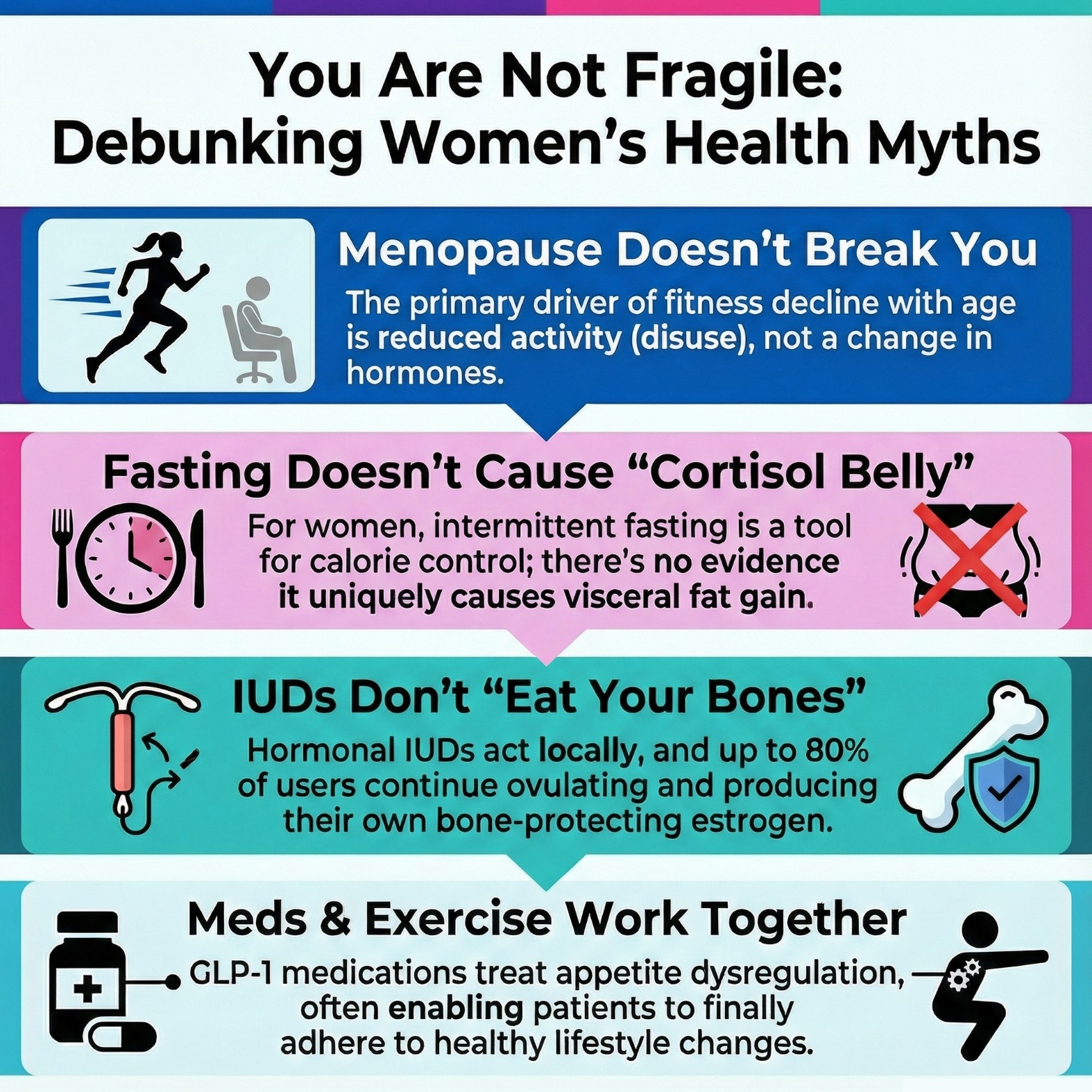
<p>The wellness industry wants you to believe that menopause renders you fragile, fasting creates "cortisol belly," and birth control is silently destroying your skeletal health. These claims aren't just scientifically inaccurate; they act as "nocebo" barriers that scare women away from effective training and healthcare.</p><p><br></p><p>We brought in the heavy artillery—Dr. Lauren Colenso-Semple, Dr. Loraine Baraki, and Dr. Spencer Nadolsky—to dissect the physiology behind these viral fears. Discover why your body remains resilient through hormonal transitions and why lifestyle or GLP-1s is a false dichotomy, </p><p><br></p><ul><li>Dr. Colenso-Semple: @drlaurencs1</li><li>Dr. Loraine Baraki: @loraine_barbellmedicine</li><li>Dr. Spencer Nadolsky: @drnadolsky</li></ul><p><br></p><p><strong>Key Learning Points</strong></p><p><br></p><ul><li><strong>The Menopause "Cliff" Myth:</strong> Menopause does not destroy your ability to recover or adapt to exercise.1 While aging may require programming adjustments, your muscles do not stop responding to tension and progressive overload simply because estrogen levels change.</li></ul><p><br></p><ul><li><strong>Cortisol Fear-mongering:</strong> There is no evidence that intermittent fasting or skipping breakfast causes pathological "cortisol belly" or visceral fat storage in women. Fasting is simply a tool for Calorie restriction, not a hormonal wrecking ball.</li></ul><p><br></p><ul><li><strong>IUDs & Bone Density:</strong> Levonorgestrel IUDs (hormonal) work primarily via local action on the uterus, not systemic suppression. Contrary to viral claims, they do not "eat your bones," and most users continue to ovulate and produce protective estrogen.</li></ul><p><br></p><ul><li><strong>The "Masking" Fallacy:</strong> Amenorrhea (lack of period) on an IUD is a known, harmless side effect of a thinned uterine lining. It is rarely "masking" a dangerous underlying condition like premature ovarian insufficiency.</li></ul><p><br></p><ul><li><strong>Birth Control & Performance:</strong> Population-level data shows that hormonal contraceptives do not clinically impair strength or athletic performance. While they increase SHBG and lower <em>free</em> testosterone, women are not "little men" dependent solely on testosterone for performance.</li></ul><p><br></p><ul><li><strong>GLP-1 Agonists (Ozempic/Mounjaro):</strong> Using medication to treat the appetite dysregulation of obesity is not "cheating." Muscle loss on these drugs is primarily a function of the Caloric deficit, not the drug itself, and can be mitigated with resistance training.</li></ul><p><br></p><p><strong>Get More Value: Exclusive Content and Resources</strong></p><p><br></p><p>Want to support the show and get early, ad-free access to all episodes plus exclusive bonus content? Subscribe to <a href="barbellmedicine.supercast.com/"; rel="nofollow">Barbell Medicine Plus</a> and get ad-free listening, product discounts, and more. Try it free for 30-days.</p><p><br></p><p>Unsure which training plan is right for you? Take the free <a href="barbellmedicine.com/template-quiz/"; rel="nofollow">Barbell Medicine Template Quiz </a>to be matched with the ideal program for your goals and experience level.</p><p><br></p><p>For media, support, or general questions, please contact us at support@barbellmedicine.com</p><p><br></p><p><strong>Clinical Pearls & Takeaways</strong></p><ul><li><strong>Programming for Menopause:</strong> Stop treating menopause as a disability. Continue to lift heavy (RPE 6-9) and perform conditioning. If recovery lags, adjust volume (sets/reps) before blaming hormones.</li></ul><p><br></p><ul><li><strong>Protein Simplified:</strong> Ignore the complex "ideal body weight" math. Aim for ~1.6g/kg of total body weight, or simply add one extra serving of protein (like a shake) to your current daily intake.</li></ul><p><br></p><ul><li><strong>Medical Decisions:</strong> Do not remove an IUD or avoid birth control solely due to social media fear-mongering about bone density or "low T." These choices should be based on your contraceptive needs and symptom management (e.g., PCOS, endometriosis).</li></ul><p><br></p><p><strong>Timestamps</strong></p><ul><li>00:00 Intro: The "Fragile Female" Narrative</li><li>01:00 Does Menopause Destroy Recovery?</li><li>11:00 Muscle Fiber Types: Fact vs. Fiction</li><li>24:00 Fasting, "Cortisol Belly," and Visceral Fat</li><li>34:00 Protein Intake: Survival vs. Optimal</li><li>41:40 Dr. Lorraine Baraki: Do IUDs Cause Bone Loss?</li><li>50:00 Birth Control, Acne, and Athletic Performance</li><li>59:00 Dr. Spencer Nadolsky: The Truth About GLP-1s & Muscle Loss</li><li>01:05:00 Final Verdict: You Are Not Fragile</li></ul><p><br></p><p><strong>References</strong></p><ul><li>Thomas, Ewan et al. “The effect of resistance training programs on lean body mass in postmenopausal and elderly women: a meta-analysis of observational studies.” Aging clinical and experimental research vol. 33,11 (2021): 2941-2952. doi:10.1007/s40520-021-01853-8 TWO</li><li>Roberts, Brandon M et al. “Sex Differences in Resistance Training: A Systematic Review and Meta-Analysis.” Journal of strength and conditioning research vol. 34,5 (2020): 1448-1460. doi:10.1519/JSC.0000000000003521</li><li>Khalafi, Mousa et al. “The effects of exercise training on body composition in postmenopausal women: a systematic review and meta-analysis.” Frontiers in endocrinology vol. 14 1183765. 14 Jun. 2023, doi:10.3389/fendo.2023.1183765</li><li>Staron, R S et al. “Fiber type composition of the vastus lateralis muscle of young men and women.” The journal of histochemistry and cytochemistry : official journal of the Histochemistry Society vol. 48,5 (2000): 623-9. doi:10.1177/002215540004800506 </li><li>Hunter, Sandra K. “The Relevance of Sex Differences in Performance Fatigability.” Medicine and science in sports and exercise vol. 48,11 (2016): 2247-2256. doi:10.1249/MSS.0000000000000928</li><li>Nuzzo, James L. “Narrative Review of Sex Differences in Muscle Strength, Endurance, Activation, Size, Fiber Type, and Strength Training Participation Rates, Preferences, Motivations, Injuries, and Neuromuscular Adaptations.” Journal of strength and conditioning research vol. 37,2 (2023): 494-536. doi:10.1519/JSC.0000000000004329</li><li>Verdell, J. Tyler MD; Acker, Matthew MD. Does the LNG-IUD decrease BMD in adolescent females?. Evidence-Based Practice 23(4):p 10-11, April 2020. | DOI: 10.1097/EBP.0000000000000601</li><li>Jäger, Ralf et al. “International Society of Sports Nutrition Position Stand: protein and exercise.” <em>Journal of the International Society of Sports Nutrition</em> vol. 14 20. 20 Jun. 2017, doi:10.1186/s12970-017-0177-8</li><li>Tan, Yimei et al. “Effect of GLP-1 receptor agonists on bone mineral density, bone metabolism markers, and fracture risk in type 2 diabetes: a systematic review and meta-analysis.” <em>Acta diabetologica</em> vol. 62,5 (2025): 589-606. doi:10.1007/s00592-025-02468-5</li></ul><p><br></p><p><br></p><br/><br/>Our Sponsors:<br/>* Check out Cometeer and use my code BBM for a great deal: cometeer.com<br/>* Check out Cometeer and use my code BBM for a great deal: cometeer.com<br/>* Check out FIGS and use my code FIGSRX for a great deal: wearfigs.com<br/>* Check out Factor and use my code factormeals.com/bbm50off for a great deal: factor75.com<br/>* Check out Quince and use my code BBM for a great deal: quince.com<br/><br/><br/>Adv… Inquiries: <a href='redcircle.com/brands'>https://redcircle…;
Transkriptvom Podcast bereitgestellt · Zeitmarken springen hin
[SPEAKER_01]: Welcome back to the Barbell Medicine podcast, I'm Dr. Jordan Feigenbaum. [SPEAKER_01]: Two weeks ago, in Part One, we started dissecting a five-hour viral series from the diary of the CEO that racked up millions of views. [SPEAKER_01]: We debunked Cycle Sinking and the idea that Zone2 Cardio was brocians.
[SPEAKER_01]: But today, today we're getting into the really scary stuff. [SPEAKER_01]: In Part Two, we're tackling claims that menopause basically destroys your ability to recover. [SPEAKER_01]: That fasting somehow gives women belly fat and perhaps most concerning that your birth control is eating your bones and ruining your athletic potential.
[SPEAKER_01]: I'm joined again by Dr. Lauren Colenzo Sumpel and this time we're bringing in the heavy artillery. [SPEAKER_01]: Dr. Lorraine Baraki helps us navigate the fear mongering around IEDs and Dr. Spencer Nodolsky ways in on the GLP1 conversation. [SPEAKER_01]: We watch this so you don't have to.
[SPEAKER_01]: Today let's get started with the claim that if you're a woman over 40 you're basically fragile. [SPEAKER_06]: We talk about high intensity during our reproductive years. [SPEAKER_06]: You can pretty much get away with whatever you want to do during your reproductive years because you have the benefit of our hormones working for us.
[SPEAKER_06]: We start getting into a parry menopause and we start getting into menopause. [SPEAKER_06]: This is where we have to really carefully look at volume versus intensity. [SPEAKER_06]: So that means if we're doing lots of stuff or are we doing really purposeful high intensity versus low intensity?
[SPEAKER_06]: Because we're trying to create what we call a polarization of the training so that when we hit high intensities we're actually hitting the intensities we need to create change. [SPEAKER_06]: But on the other side of it, we want to hit really low intensity so that we can have recovery. [SPEAKER_06]: It gets harder to recover as we get older, regardless of your male or female.
[SPEAKER_06]: But in Perry, menopause, we don't have the benefit of estrogen supporting anti-inflammatory responses. [SPEAKER_06]: So we have to be very cognate that we need more recovery. [SPEAKER_03]: Well, I think recovery is very individualized. [SPEAKER_03]: And again, it goes back to how much volume are you doing.
[SPEAKER_03]: And so there will be a point at which we are having recovery issues because we're just overdoing it. [SPEAKER_03]: And that point will vary for different people. [SPEAKER_03]: The fitter you are, probably the more that you will be able to handle. [SPEAKER_03]: If you're just starting exercise, then we need to kind of get over that initial hump before of just getting used to it, making sure that we're not having a ton of sorness [SPEAKER_03]: Um, so if we're just going to say menopause, then that's missing the mark about who again, who are we talking to and what kind of exercise are they doing and what is their fitness level?
[SPEAKER_03]: Because we're going to have a different conversation, you know, based on those parameters. [SPEAKER_03]: But there's nothing, uh, and there are, there are in some cases, um, recovery issues that [SPEAKER_03]: Experience of the menopause transition where maybe you're having some symptoms and then there's poor sleep, and then that's all kind of factoring in, but there's nothing to say because you are at menopause or post menopause or because you have hit a certain age.
[SPEAKER_03]: Here's your volume cut off right like you you can't do high volumes of exercise and we know that because there are amazing masters athletes of both sexes, so you can just look to that and say, hey, if you're fit and you continue to stay active, then you will continue to you will continue to adapt in an exercise specific manner.
[SPEAKER_03]: but the reason why a lot of older people might have what we could say are recovery issues because you end up with some pre-existing pain or injury history going into an exercise program that then you're trying to account for. [SPEAKER_03]: So maybe if that's the angle then then I can [SPEAKER_03]: But I don't know.
[SPEAKER_03]: If you're saying older people might have more joint pain, broadly speaking. [SPEAKER_03]: And therefore, we might want to consider that in how we're developing an exercise program. [SPEAKER_03]: OK, but as soon as we start getting beyond that, then I don't know what we're doing here other than just [SPEAKER_01]: Yeah, it's just a no-sebo straight up.
[SPEAKER_01]: They're just like, look, if you're older, you're going to be harder to recover. [SPEAKER_01]: And it's like, well, maybe, depends. [SPEAKER_01]: This is person like a lifelong athlete, right? [SPEAKER_01]: Or they've been trained, or they've been training, you know? [SPEAKER_01]: They just start training, and now they're more trained.
[SPEAKER_01]: And so therefore, like, their recovery status, they've accommodated to the training look, like, [SPEAKER_01]: to the training load. [SPEAKER_01]: That's what happens. [SPEAKER_01]: You get better at recovering. [SPEAKER_01]: The more trained you get. [SPEAKER_01]: Now, as people get older, a number of things can happen.
[SPEAKER_01]: One, you can develop medical conditions. [SPEAKER_01]: So if you're saying, look, people, older people generally have more medical co-morbidities that can compromise their not only ability to participate in exercise as much as they want, but also maybe limit. [SPEAKER_01]: some of their adaptations, their recovery, sleep can be a huge issue, psychosocial stress, there's a whole bunch of stuff that tend to accumulate as people get older.
[SPEAKER_01]: And so broadly speaking, sure, there can be more variability and more volatility in how people recover. [SPEAKER_01]: But the idea that just because somebody's getting older, their recoveries worse, their training tolerance is worse, all other things being equal. [SPEAKER_01]: And I am buying it and I don't think that's supported by of it and it's either and this whole other thing about discussion around menopause is like there's these women are these special creatures when they go through menopause they don't respond as well to exercise somehow the you know that they need to be handled very carefully.
[SPEAKER_01]: And again, all of this is just putting up obstacles barriers into my mind and like how you know if you're hearing this and you're a woman you're pairing menopause or you're like should I. [SPEAKER_01]: I don't know, man, like, I don't know that I should be exercising. [SPEAKER_01]: It's kind of like when you tell a person with osteoarthritis, you're trying to explain to them the pathophysiology of the condition.
[SPEAKER_01]: You're like, oh, it's just wear and tear on your joints. [SPEAKER_01]: And they're like, oh, the sounds bad. [SPEAKER_01]: Doc, what should I do for it? [SPEAKER_01]: And you're like, you should exercise. [SPEAKER_01]: Cause it's actually, it's good for you. [SPEAKER_01]: And it proves all sorts of outcomes.
[SPEAKER_01]: You're like, well, you just told me, there's wear and tear on my joints. [SPEAKER_01]: But you're asking me to load and put more wear and tear on the joints with the exercise. [SPEAKER_01]: It's like you're telling people, these women, like, yes, you need to exercise. [SPEAKER_01]: It's beneficial for you.
[SPEAKER_01]: But also, but look, if you have menopause, like whoa, whoa, whoa, whoa, whoa. [SPEAKER_01]: It'd be very careful, you know? [SPEAKER_01]: I don't know, it doesn't, doesn't square with me. [SPEAKER_03]: Yeah, I think it's another example of reducing you to your hormone profile, right? [SPEAKER_03]: So that we're just translating the cycle syncing into a framing it differently for a different age group.
[SPEAKER_03]: And it also doesn't really square that we're saying, we need to really really focus on recovery here. [SPEAKER_03]: but everyone should be doing sprint interval trainings. [SPEAKER_03]: But sprinting is one of the most damaging type of exercises you can do. [SPEAKER_03]: So arguably, I would say if you're going to start doing a bunch of sprinting, make sure that you are recovering appropriately.
[SPEAKER_03]: But I mean, after you account for the fact that, do you know how to sprint? [SPEAKER_03]: But how are both of these things true? [SPEAKER_03]: That recovery is so important and is something that we really, really need to be mindful of. [SPEAKER_03]: But we want to be going as hard as possible and we need to be lifting heavier because we are older or doing more high intensity work.
[SPEAKER_03]: So that is, I'm trying to wrap my mind around the broader recommendation. [SPEAKER_03]: And it's just not the puzzle isn't fitting together for me. [SPEAKER_01]: Again, I don't think that she does exercise prescription on a regular basis for people. [SPEAKER_01]: And so like, because again, when you try to put all these ideas together to try to generate the the Stacy Sims program, you'd be like, this doesn't make sense.
[SPEAKER_01]: I can't even create a program from what you're saying, but just just one more little beat on this on this menopause thing, there's this assumption that Perry menopause will win and somehow lose their like, [SPEAKER_01]: musculoskeletal plasticity, like you just don't respond as well to exercise anymore, and so what you would then expect to find in a research investigating how to post-metapausal women respond to resistance training, for example, compared to pre-metapausal women.
[SPEAKER_01]: You would expect way less hypertrophy, way less strength gain, because again, their adaptive capacity has been somehow attenuated by being in the hormonal milieu created by menopause. [SPEAKER_01]: That's not what the research shows. [SPEAKER_01]: It's not what the research shows. [SPEAKER_01]: And like, look, if there were these special nuances that we could get very technical and detailed about and come up with proprietary recommendations, I would love that.
[SPEAKER_01]: Do you understand the marketing engine behind that and how we could so it'd be great. [SPEAKER_01]: It'd be great, it looks specific recommendations. [SPEAKER_01]: I can get ultra nuanced here. [SPEAKER_01]: But instead, I gotta say something less sexy like, look, I think you should lift weights a few times a week.
[SPEAKER_01]: I'll hit all the major muscle groups, most, you know, do for a few sets that make you feel kind of uncomfortable, but not maximal. [SPEAKER_01]: And then you should do conditioning throughout the week also. [SPEAKER_01]: And you should get your heart rate up kind of to the point where you feel like you can't speak in complete sentences or sing a song.
[SPEAKER_01]: And you should do that for a couple hours a week too. [SPEAKER_01]: And they're like, well, that's the, that doesn't feel very individualized. [SPEAKER_01]: I'm like, well, no, that's for the broad public. [SPEAKER_01]: I need to know your goals, and you know your current fitness level, your preference is your resources, all sorts of stuff to make you an individualized program, but just because you're going through menopause doesn't mean that you need a special program, and doesn't mean that you're not going to respond as well to program.
[SPEAKER_01]: That's not what the evidence says, the latest men analysis 101 studies by 101 Dalmatians. [SPEAKER_01]: And investigating this, it's like, please, I understand that having worked with professionally, women experiencing menopause, I understand and can empathize that a lot of things are changing.
[SPEAKER_01]: But it does not mean that your exercise response is blunted or that you need specific exercise to deal with that. [SPEAKER_01]: Again, reducing somebody down to what's happening more evenly, I think misses a lot of what's going on with the patient. [SPEAKER_01]: you know, to use a buzzword.
[SPEAKER_01]: You would think root cause people holistic people would just reject this. [SPEAKER_01]: They'd like what just hormones come on. [SPEAKER_03]: I think when we look at whether this conversation went and the kind of deep dive into explaining it in a way that is really hard to follow. [SPEAKER_03]: You know, there was a discussion about muscle fiber type differences and myocides.
[SPEAKER_03]: I'm like, why are we talking about myocides? [SPEAKER_01]: Yeah, look for the group for receptor, I'm like, but don't get it wrong, though, if you're going to go into the weed, don't get it wrong, because nerds like us are going to find you. [SPEAKER_03]: Yeah, and I think it's harmful to then spin this rhetoric as if [SPEAKER_03]: It ignores the abundance of knowledge we have about muscle adaptations.
[SPEAKER_03]: It also ignores all of the stuff we don't really know and the complexity of the individual contributions. [SPEAKER_03]: Like how are all of these interacting with each other? [SPEAKER_03]: What if an is a myocine? [SPEAKER_03]: And do we even have we identified all of the specific functions of them in humans?
[SPEAKER_03]: No. [SPEAKER_03]: So, that's an interesting discussion, but it is the next thing out of your mouth going to be, and here's my Myokine specific training program. [SPEAKER_01]: That's excellent. [SPEAKER_01]: Okay, before we rate this on the BS and the harm scale, I did, I have to point these two things out.
[SPEAKER_01]: They did talk about muscle fiber types first, Dr. Vondarai claim that lighter loads only build endurance, and that she's also doing tempo work now to replace the explosive muscle fibers that she's lost. [SPEAKER_05]: because people have to remember what we're what we're training for now.
[SPEAKER_05]: It's different than I had a woman recently say, I was taught to do biceps curls, five pounds, 30 times. [SPEAKER_05]: Well, after 30 times, not only are you bored, but you probably could be that failure, 30 times. [SPEAKER_05]: That will build endurance. [SPEAKER_05]: I am training to be as strong as possible, and when I have strength down, then I start playing with tempos so that I could replace some of the explosive muscle fibers that I'm going to lose over time.
[SPEAKER_01]: So to be clear, pretty much any sort of resistance training, it almost any intensity can build strength, but sure. [SPEAKER_01]: If you want to say that maximal strength development happens at higher intensity, higher load lifting, somewhere above 65%, 70% of your 100 max, greater than like a 15 to 20 rep max load, sure.
[SPEAKER_01]: We would not disagree. [SPEAKER_01]: We would say yep, that's squares, but to say that like lighter load only builds like strength endurance or endurance period It's just not consistent like blood flow restriction training would like a word One two just there's other studies where people are literally using you know 30% 50% and there's still some strength gain and it's like Well, how did that happen?
[SPEAKER_01]: It's like well? [SPEAKER_01]: It turns out the body is relatively sensitive to mechano-transduction. [SPEAKER_01]: Like you make the muscles do stuff, and we readily adapt. [SPEAKER_01]: Yeah, did you want to say anything more on the explosive muscle fiber replacement theory in a help right here?
[SPEAKER_03]: This implies that there is some optimal distribution of fiber type that we should be striving for, right? [SPEAKER_03]: So, you know, if you, and is it 50, 50? [SPEAKER_03]: I don't know. [SPEAKER_03]: But let's let's say it's 50, 50, and that's really what we want. [SPEAKER_03]: What we know is if you are a high level endurance athlete, you're a marathoner runner, you're probably going to have a distribution that looks quite different from somebody who's a high level Olympic weightlifter because you are training in a sports specific way and there are different adaptations associated with those very unique training styles.
[SPEAKER_03]: So that doesn't mean [SPEAKER_03]: In that context, who has a bad distribution, skewed fiber-type distribution, that's not a thing. [SPEAKER_03]: It's just a sports-specific adaptation, and so we shouldn't be worrying about this first of all, because if there are differences, they're quite small.
[SPEAKER_03]: We're talking about [SPEAKER_03]: It's roughly 50-50 and maybe it's skewing a few percentage points in one direction or the other, but it also depends what muscle are we measuring, and what type of analysis are we doing, and are we accounting for hybrid fibers, which many analyses do not, and so we can go deep down into the rabbit hole of why I'm not even comfortable making the claim that there are definitive [SPEAKER_03]: But even if there were, it wouldn't change my recommendation that you should be doing goal-oriented training because there's no evidence that your muscle fiber type distribution is somehow predictive of your long-term health.
[SPEAKER_01]: No, no, if anything, if it's predictive of anything, it's what sport you might end up selecting into, right, like you select the sports based on the muscle fiber type distribution, but yeah, Sims says men have more fast switch muscle fibers than women who have more slow switch muscle fibers.
[SPEAKER_01]: Again, insinuating that not only is this a large difference, but also there's an important difference to take into consideration. [SPEAKER_01]: We're all born with a [SPEAKER_01]: And then men tend to get much bigger due to puberty, right? [SPEAKER_01]: And that's why that's why men are being stronger.
[SPEAKER_01]: It's not because they have more fast twitch or slow twitch. [SPEAKER_01]: It's not because the muscle fibers, the specific tension that the muscle fibers themselves can produce, women don't have dysfunctional muscles. [SPEAKER_01]: Women do not have dysfunctional muscles compared to men, men just on average have more muscle mass.
[SPEAKER_01]: That's the big difference. [SPEAKER_01]: And so if Sims straight-up said that, [SPEAKER_01]: That'd be one accurate, and two, we could ignore this entire thing about muscle fiber type. [SPEAKER_01]: Like, why does this matter? [SPEAKER_01]: It does not determine training, does not determine health of an individual, and then she gets it wrong, too.
[SPEAKER_01]: Because again, when you look at the data again, as you mentioned, depends on the muscle that you measure, how you measure this sort of stuff. [SPEAKER_01]: But generally speaking, the difference is, or either not there, or very, very small, and the methodology really kind of influences this.
[SPEAKER_01]: But men and women generally have the same muscle fiber type distribution. [SPEAKER_01]: men tend to be stronger than women, but it's not because women have a dysfunctional muscle, it's just men have more muscle mass. [SPEAKER_01]: That's it. [SPEAKER_01]: Just say that and move on. [SPEAKER_03]: And if we have any evidence that there might be some connection between fiber type and health, it's the hybrid fibers might be the problematic ones because it's sedentary disease [SPEAKER_01]: You should exercise.
[SPEAKER_01]: Yeah. [SPEAKER_01]: Yeah. [SPEAKER_01]: In fact, there is a case report. [SPEAKER_01]: It was, they've identified the highest fiber type distribution in favor of fast-witch muscle fibers. [SPEAKER_01]: This person was 71% while the one muscle that they investigate was 71% type 2 fast-witch.
[SPEAKER_01]: And it was a woman, international Olympic weight lifter. [SPEAKER_01]: And it's like, there you go, well, what's put that in your pipe and smoke it? [SPEAKER_01]: No, it's just, uh, this is, uh, it was just annoying to listen to because again, why are [SPEAKER_03]: And it's something that nobody can measure and nobody can track over time.
[SPEAKER_03]: So in that way, it's like, you don't even know whether it's the thing that you're supposed to be doing to fix this problem that doesn't even exist is working because what are you doing? [SPEAKER_03]: Like, if there's no way for you to assess it. [SPEAKER_01]: All right, let's rate the muscle fiber type, the menopause discussions, all this muscle centric stuff on the BS.
[SPEAKER_01]: I'm gonna give it a five out of five again on the BS, mainly because, again, almost everything set around this, relating to exercise and reducing things down to hormone is wrong. [SPEAKER_01]: So like, just the straight up is just wrong and muscle fiber type thing was also wrong. [SPEAKER_01]: So like, I don't know how you go lower than a five, but do you feel differently?
[SPEAKER_03]: No, it was all the only thing that I liked about it was, no, I didn't like anything about this section. [SPEAKER_01]: Wow. [SPEAKER_01]: Okay, what are you giving this on the harm scale? [SPEAKER_03]: This is just as harmful as a lot of the other sections in my mind because again, all [SPEAKER_03]: confused.
[SPEAKER_03]: I'm more confused after this than I was in the previous section, because now I thought I was supposed to do sprint interval training and lift weights, but now... [SPEAKER_03]: everything is changing it, menopause, you can't really understand why I need to focus on recovery and there's all of this really complex stuff going on in the muscle that I don't understand, you're using words that I don't understand.
[SPEAKER_03]: I wouldn't, you know, referencing random [SPEAKER_01]: Don't look at me. [SPEAKER_01]: I have no idea. [SPEAKER_01]: I have no idea what these people are talking about. [SPEAKER_01]: I watch a twice, probably collectively, all the way through, like in pieces and such. [SPEAKER_01]: I don't get it.
[SPEAKER_01]: I don't like, I was trying to put myself as like a lay person just watching this and I'm like, is this compelling or like interesting or entertaining? [SPEAKER_01]: And I think I suspect if you were a woman and you're watching this and like the initial sort of thing that locked you in, Lord you and hooked you was like, a lot of people are just missing women's symptoms and experiences.
[SPEAKER_01]: I get that. [SPEAKER_01]: I get that, but man, didn't you sat through another like five hours of the shit? [SPEAKER_01]: I just, like, hats off to you for the commitment to the bit, but like, I don't understand the, yeah, I'm going to give it up. [SPEAKER_03]: I'll tell you, I'll tell you, because I was on Simon Hills podcast recently and he, as he has had Stacey on, and so there were definitely a lot of Sims fans in the comment.
[SPEAKER_03]: And the criticism of me was that I sound less knowledgeable. [SPEAKER_01]: Well, yeah, because you don't say definitive things that we can't say definitively. [SPEAKER_03]: And also I don't speak in a way that is going to go over people's heads because I think that's poor science communication.
[SPEAKER_03]: So, although I could do that, I could make it sound as complicated as possible to make myself feel what smart because I can use a big word, cool. [SPEAKER_03]: I don't see the utility in doing that, you're just confusing people. [SPEAKER_03]: If we can say it in a clearer way, let's do it.
[SPEAKER_03]: So the it's like the sciencey speak coupled with the I have a secret that you couldn't possibly know that apparently no one else knows either in this scientific community or the medical community. [SPEAKER_03]: Yeah. [SPEAKER_03]: That it that's it's marketable. [SPEAKER_01]: Perhaps because it doesn't exist.
[SPEAKER_01]: Yeah, I'm going to give it three and a half out of five on the harm scale mainly because I think when they were talking mostly about hormones and mechanisms and glute four and myocines and fiber type. [SPEAKER_01]: I think most people perhaps like they're doing now their eyes just glazed over and they were like, I don't know what you're saying.
[SPEAKER_01]: So like, so all it was just a waste of time, like, right? [SPEAKER_01]: And then further, because none of it made sense, then there's no like actionable item there. [SPEAKER_01]: The only reason I'm given it such a high harm scale is because this idea about focusing on recovery during menopause.
[SPEAKER_01]: And I'm like, so the biggest change that happens during menopause with respect to exercise and subsequent exercise adaptations that people exercise less. [SPEAKER_01]: So like, then if the message that you take away is focusing on recovery, I'm like, [SPEAKER_01]: I think focusing on exercising as much as you possibly can to the extent that you can tolerate it physiologically and so on and so forth.
[SPEAKER_01]: But yeah, I'm going to get my three and a half out of five on a harm scale. [SPEAKER_03]: Yeah, just think menopause misinformation is having a moment and that is unfortunate because we have the data on muscle loss with age and pretty similar whether you're a man or a woman and it's not accelerated in the menopause transition and that's true for metabolism as well and we have a lot of studies on older people who start lifting weights.
[SPEAKER_03]: in their 80s, and they are even gaining muscle, which is so cool, and that's a really positive message. [SPEAKER_03]: But instead of harnessing all of this into saying, you know what, resistance training is always effective, and it's never too late to start. [SPEAKER_03]: We then say, you are a woman, it's massively complicated, menopause is slowly destroying you from the inside out, and here's a random, and therefore [SPEAKER_01]: Yeah, yeah, exactly.
[SPEAKER_01]: It was straight legs though. [SPEAKER_01]: You have to lie with straight legs. [SPEAKER_01]: Okay, so we've established that your muscles don't stop working just because you hit menopause. [SPEAKER_01]: But the podcast didn't stop at training. [SPEAKER_01]: They pivoted to diet, specifically the idea that women are so hormonally fragile that skipping a few meals might give them a cortisol belly.
[SPEAKER_01]: Here's Dr. Sims take on fasting and why Dr. Clens O'Sumple and I think it misses the force for the trees. [SPEAKER_08]: I've had an evolution with the way I think about fasting. [SPEAKER_08]: When I first kind of was stepping out of the box and what's happening in menopause and why was my body composition?
[SPEAKER_08]: I didn't know what to call it back then, but what was all of this going on that was new and all my patients were having it as well. [SPEAKER_08]: These were my girlfriends. [SPEAKER_08]: I worked in a small town with a big university and these were PhDs and we're running marathon, so we're doing all this stuff and everyone's kind of complaining of the same thing.
[SPEAKER_08]: And so fasting seemed to be helpful in my girlfriends were trying, we all kind of did this fasting thing and I was like super excited about it. [SPEAKER_08]: Everybody felt better, blah, blah, blah, blah, blah. [SPEAKER_08]: Okay. [SPEAKER_08]: So fast forward. [SPEAKER_08]: I'm learning more about hormones, body composition, protein intake, all of these needs and suddenly as I'm counseling my patients, I'm realizing I can't meet my own protein goals if I'm trying to fast at the same time.
[SPEAKER_08]: And I quickly realize, if we're looking at health span, if we're looking at body composition, there may not be a lot of room for fasting for these patients, you know, or for my girlfriends, you know. [SPEAKER_08]: And it is really difficult for my patients to reach their nutrition goals, so never at the expense of meeting your basic nutrition goals and your calorie needs.
[SPEAKER_08]: And it is really, really hard to do while fasting. [SPEAKER_08]: So you may get a short term benefit with weight loss, but there really doesn't now, [SPEAKER_06]: decisions can get into the nitty gritty of all, you know, at the basic idea of fasting, if we want to use the term fasting, we have to look at it as, are we talking about intermittent fasting or time restricted eating?
[SPEAKER_06]: So intermittent fasting is kind of like, you know, your water fast, your five day, two day, all that kind of crazy stuff, which for the most part, men can get away with and have a positive impact on body composition, but women can't. [SPEAKER_07]: It's typically about 12 hours of eating in 12 hours or not.
[SPEAKER_07]: So you're trying to follow that circadian rhythm and work with your hormones. [SPEAKER_07]: It can also, when we do have that period of time, which maybe that sounds very intuitive, but a lot of people are eating at 10 p.m. they're snacking on foods and they're trying to go to bed and then they're getting up.
[SPEAKER_07]: When you give your body a little bit longer, so at 12 hours' time is when your body will really, [SPEAKER_07]: efficiently be using up all your glucose, really dropping some of those insulin levels, but it's not so much that it's stressful. [SPEAKER_07]: And we're using stress very generically here, but on a cellular level, long periods of fasting for women, specifically, can be very stressful to the body.
[SPEAKER_07]: And that's why if you think about Stacey's example of what happened in two fasting periods to, you know, a man and a woman, different things are going to happen to your body. [SPEAKER_07]: If it thinks it's being in starvation, [SPEAKER_02]: Men can, you said that men can do longer fast.
[SPEAKER_07]: Yeah, and they can do longer fast, and it can show to actually, you know, be something that might be advantageous for them for how their body is made, might increase their focus, and some other metrics. [SPEAKER_07]: But for women, these longer periods are actually going to promote more visceral fat storage and become pro and flammatory.
[SPEAKER_07]: And you said it a little casually, but disrupting your hypothalamus and shutting off your hormone system will cause a low [SPEAKER_01]: Let's start with this cortisol situation because I just had a, I had this had an argument, this is a discussion. [SPEAKER_01]: The woman in my gym, very kind, very nice.
[SPEAKER_01]: And I would consider reasonably intelligent. [SPEAKER_01]: Her coach had her do this full hormone work up when they started. [SPEAKER_01]: So she got her cortisol tested in addition to like testosterone, a bunch of weird thyroid labs. [SPEAKER_01]: And by the way, her coach is not a physician or a healthcare professional in any, but you know, that details.
[SPEAKER_01]: And she, this woman's like, I'm not drinking coffee because my court is all side. [SPEAKER_01]: And I was like, who told you your court is all side? [SPEAKER_01]: She's like, well, I had a measure. [SPEAKER_01]: And I'm like, when did you have a measure? [SPEAKER_01]: She's like, well, it was in the morning, and I got one lab draw, and I was like, yes, so that's not how we test for hypercordas all this and when it's not how we assess quarters all levels.
[SPEAKER_01]: It's more complicated than that. [SPEAKER_01]: There's no current consensus on how to do it, but usually like a 24 hour year in collection, you can do a dexamethism, there's a bunch of different ways. [SPEAKER_01]: We have a whole series on this. [SPEAKER_01]: It's more complicated than that.
[SPEAKER_01]: I can't tell from your lab value that you have hypercordas all in all by the way, I'm not worried about what coffee does to your quarters all all level. [SPEAKER_01]: This is not, court is all not the thing to focus on for you. [SPEAKER_01]: I feel confident in saying that anyway. [SPEAKER_01]: What is that?
[SPEAKER_01]: What the hell is all this fasting stuff about and being hyper focused on cortisol? [SPEAKER_01]: Like, is there any chance that people who are doing either intermittent fasting, where they skip breakfast, don't eat till lunch, or they do some other sort of time restricted feeding window, where, you know, more calories in the, in the early parts of the day, and then they fast overnight, you know, whatever?
[SPEAKER_01]: Is there any chance that this is increasing people's cortisol to a level that is pathological? [SPEAKER_03]: We have no data to support that claim or the claim that somehow you're going to store more visceral fat in a calorie deficit, no less. [SPEAKER_03]: So the fasting literature is quite clear that it's not magic and that it's a tool you can use to create a calorie deficit and it can be an effective tool for people, you have a shorter eating window, you end up eating less, you've created the calorie deficit and [SPEAKER_03]: So if there was somehow a connection between this and visceral fat, people were increasing their visceral fat over 16 weeks of time restricted feeding, then that would be shocking, but we would have that data in return.
[SPEAKER_03]: Like it's effective weight less strategy if you're using it appropriately. [SPEAKER_01]: Yeah, yeah, it's just another tool to create a calorie deficit. [SPEAKER_01]: Does not appear to be advantageous in so far as either more people are able to achieve clinically significant weight loss with it, or otherwise adhere to it, but if it's somebody's preference, fine with it, this idea that women respond somehow differently to this, and their cortisol levels go crazy.
[SPEAKER_01]: And then that is the cause of, [SPEAKER_01]: apparently findings that have never been documented in humans. [SPEAKER_01]: You know, it's interesting because because intermittent fasting is often billed to be like this inflammatory, reducing sort of practice, you know, autophagy like increases, um, you're breaking down more cells that nerds are sent us in and you want to get rid of them and all these good things.
[SPEAKER_01]: does that, but now it also increases cortisol and is pro and flammatory apparently to increase this rule at a post tissue. [SPEAKER_01]: And to be clear, I think both of those claims, it's all well, I think it's all BS, like it's just the stuff that happens short term for Mona Lee, generally speaking to me is uninteresting from a human outcome standpoint.
[SPEAKER_01]: I feel that way about pre-training hormonal milieu. [SPEAKER_01]: I feel that way about post-training hormonal milieu. [SPEAKER_01]: I feel that way about when people are fasting for short periods of time. [SPEAKER_01]: I'm more concerned about what happens long-term. [SPEAKER_01]: I think that's where most people should spend their attention.
[SPEAKER_01]: That's where they should focus their attention. [SPEAKER_01]: But this, it's just the last claim and get you to weigh in on this. [SPEAKER_01]: The idea that if you were woman and you do intermittent fasting, [SPEAKER_01]: Well, you're at a high risk, Dr. Crawford said this. [SPEAKER_01]: You're a high risk of not eating enough.
[SPEAKER_01]: The idea that low energy availability is going to, and it's like, well, if most people, if more people don't lose weight on intermittent fasting compared to any other sort of dietary practice, if that's what the data says, then how is there an increased risk of low energy availability or insufficient nutrient consumption?
[SPEAKER_03]: Again, I think, I don't understand why we're kind of borrowing from the low energy availability literature, which is a true problem that some people have, but that's, we're seeing this in athletes who are doing a lot of exercise and who are probably not feeling to support that level of activity or maybe they are trying to stay at a low body fat or low weight for performance related [SPEAKER_03]: the population that is typically affected by this.
[SPEAKER_03]: Now, the idea that most women are affected by low energy availability is just insane. [SPEAKER_03]: Because if that were true, then we wouldn't have any overweight women. [SPEAKER_03]: First of all, we can say long-term fasting, [SPEAKER_03]: does increase cortisol levels. [SPEAKER_03]: We can say that if you are doing a ton of exercise and not eating at all, then that is probably not a good idea overall for your health, for your daily nutrient needs, for performance, for a variety of reasons, right?
[SPEAKER_03]: we can say if you are somebody who does have chronically elevated court is all levels and you have been diagnosed with cushions that maybe you are having some changes in your body composition and we're seeing more weight around your mid-section and that's your court is all belly and maybe there's like that kernel of of truth [SPEAKER_03]: But we're now packaging this in by borrowing from all of these scenarios that are irrelevant to most people.
[SPEAKER_03]: And then we're saying, and therefore, no fasted training. [SPEAKER_01]: Right, doesn't make sense. [SPEAKER_01]: It's not evidence based. [SPEAKER_01]: It just like every time the intermittent fasting has been investigated, effectively, just rebuts everything that's being said about it.
[SPEAKER_01]: Even like the late one of these more recent meta-analysis on this show that fasting didn't have any effect on estrogen, pro-locked in levels, can add a trope and another recent study show that it actually didn't really affect cortisol as much as we would otherwise predict. [SPEAKER_01]: I mean, it just, it could just dynamic.
[SPEAKER_01]: There's a lot of stuff going on here. [SPEAKER_01]: this rejecting it. [SPEAKER_05]: So the RDA recommendations of 0.8 grams per kilogram is survival doses of protein, like sitting on a chair like a mushroom, preventing malnutrition is the goal of it. [SPEAKER_05]: Yeah, it is not bearable.
[SPEAKER_05]: It is not bear active people. [SPEAKER_05]: It is not for living your best life people. [SPEAKER_05]: 0.8. [SPEAKER_05]: The recommended daily intake is 0.8 grams per kilogram of lean body mass. [SPEAKER_05]: supports, easily supports. [SPEAKER_05]: Let's use pounds. [SPEAKER_05]: Point 0.86 grams per pound for lifting people.
[SPEAKER_05]: I recommend over a gram for ideal pounds. [SPEAKER_01]: Dr. Vandarite talked about protein intake. [SPEAKER_01]: She said that you shouldn't be eating the RDA, recommend a protein intake, because it's made for people who are sitting on a chair like mushrooms. [SPEAKER_01]: Just the first time I heard that saying, so add that to the lexicon.
[SPEAKER_01]: She recommended one gram of protein per pound, and then later said, when all it's one gram of protein per pound, ideal body weight, how much protein do people need? [SPEAKER_03]: If we're talking to the general public, then I think everybody agrees, the RDA is a little bit too low, so that point eight.
[SPEAKER_03]: But when we bump it up to 1.2, 1.3, that seems to be helpful. [SPEAKER_03]: There's a benefit there. [SPEAKER_03]: What does that mean? [SPEAKER_03]: For most people, eat protein with each meal. [SPEAKER_03]: Maybe throw in a protein shake if you're struggling [SPEAKER_03]: If we're starting to quibble about 1.6 or 1.8 grams per kilogram, by the way, not talking pounds, then you can say, oh, perhaps a slightly higher level is better if you're somebody who's really trying to maximize muscle growth.
[SPEAKER_03]: Maybe. [SPEAKER_03]: But the idea that we would need more protein to fuel our activity because we are physically active. [SPEAKER_03]: We're doing our four sprint interval a couple times a week. [SPEAKER_03]: We're not using protein as fuel. [SPEAKER_03]: So the just completely misses the point about what is the purpose of dietary protein and how are we using it in physical activity?
[SPEAKER_03]: But we're not. [SPEAKER_01]: Yeah, yeah, I mean, again, who is this advice to and like, what's the application right? [SPEAKER_01]: I mean, if you look at most data we have on protein consumption in the United States for adults, it's it's higher than the RDA as it is right now. [SPEAKER_01]: Depending on who you're read could be anywhere between 0.9 to 1 1.1 grams per kilo per day But we just need a lot of protein mostly unfortunately through the way of like processed foods which not not great So if you tell somebody just increase their dietary protein most people will take that to me and like okay More chicken more egg more just these generally minimally processed or unprocessed foods which can be useful for displacing Process foods and and and other things that tend to be more energy dense and so on and so forth that said strictly speaking
[SPEAKER_01]: Most people don't need that much more protein. [SPEAKER_01]: To your point, it's an extra protein shake a day. [SPEAKER_01]: And in fact, if I was making this public recommendation, it's like, yeah, you look, you need to lift weights a few times a week, all the major muscle groups of the body.
[SPEAKER_01]: Make sure that you take a few sets for each muscle group to somewhere that feels kind of uncomfortable, you need to do two and a half hours of conditioning per week, whatever modality you prefer, it should be kind of hard, but not so challenging where you can't speak in short sentences, and you should have an extra protein shake every day.
[SPEAKER_01]: And it's like, well, I just wrapped up five and a half hours of nonsense into something that is not only accurate, but also like, you know, public facing, so yeah, most people would benefit from like an extra protein shake or extra serving of protein per day to the extent that taking protein up higher is would be better is either from displacing, again, ultra-process foods for people who are currently eating a dietary pattern is rich in those.
[SPEAKER_01]: or for very active, very lean, hard training and individuals, sure, higher than that, but they're not listening to this freaking podcast about protein intake anyways. [SPEAKER_01]: So like, you know, and how high can you go much higher? [SPEAKER_01]: But saying a gram per pound, it's already a little high.
[SPEAKER_01]: And then a gram per pound ideal body weight without defining what ideal body weight is. [SPEAKER_01]: And further, when the none of the evidence on protein intake is about ideal body weight, it's just total body weight. [SPEAKER_01]: Where is the data on that? [SPEAKER_01]: Like, if you wanted to say that because somebody maybe is an individual with obesity, for example, and their body weights quite high, and you wanted to make some sort of recommendation, I get that, but saying that that's like the general wreck for everybody, like this inconsistent with the evidence.
[SPEAKER_03]: Well, it's also not a very practical recommendation because most people don't have access to that number. [SPEAKER_01]: We got to make it. [SPEAKER_01]: You got to get a deficit. [SPEAKER_01]: If you want to work together, you got to get a deficit scan first, and only then, and a view to max, and we got to get your cortisol level tested too, because that's how we're going to dial you in.
[SPEAKER_03]: you brought up an interesting point earlier that a lot of this discussion around hormones really leads to a lot of unnecessary hormone testing done by people who don't really understand why or how to interpret the results or the huge [SPEAKER_03]: influence of measurement technique, like the assay that you're using, it might just make it kind of a garbage assessment, like testosterone for women, but by measuring more things and making it more complicated and presenting it as like we have this sort of secret sauce where if we have more data than we can be more granular in our recommendations, [SPEAKER_03]: Kind of misses the mark on tracking metrics that we actually do know are important.
[SPEAKER_03]: Like, if you want to track your progress in the gym to make sure that you are progressively overloading, then that's good. [SPEAKER_03]: If you're trying to eat fewer calories, then perhaps tracking your calories at least for a short period of time can be an effective strategy. [SPEAKER_03]: But there are obvious things that [SPEAKER_03]: we might want to encourage people to measure and worrying about these acute or day-to-day hormone fluctuations, whether it's menstrual cycle or longer-term menopause transition or even shorter-term with court is all, we're focusing on the wrong things.
[SPEAKER_01]: Yeah, yeah, I agree. [SPEAKER_01]: It does sound sexy. [SPEAKER_01]: It does sound compelling, especially to the lay public. [SPEAKER_01]: It's like, oh, this is Dr. [SPEAKER_01]: Speak. [SPEAKER_01]: I'm interested in Dr. [SPEAKER_01]: Speak. [SPEAKER_01]: And that, you know, look, I mean, medical dramas and TV show that's very, they're very popular.
[SPEAKER_01]: So I, there's something there. [SPEAKER_01]: I get it from a marketing standpoint, but yeah, I agree. [SPEAKER_01]: Missing, missing the forest for the trees, and in some cases, the trees are actually not trees at all. [SPEAKER_01]: They're just mistaking them for trees. [SPEAKER_01]: Just kind of a weird thing.
[SPEAKER_01]: We're going to shift gears now. [SPEAKER_01]: Up until this point, the misinformation has mostly been about wasting your time in the gym or stressing you out about meal timing. [SPEAKER_01]: But now, we're moving into medical advice that could actually cause harm by scaring women away from effective health care.
[SPEAKER_01]: The viral episode made some terrifying claims about IUDs and birth control causing bone loss and essentially, quote, shutting down a woman's system. [SPEAKER_01]: Now to address this, I tagged in Dr. Lorraine Baraki to look at the specific claims regarding IUDs and the birth control pill.
[SPEAKER_07]: Certainly circumstances where that is the right thing to do. [SPEAKER_07]: We've had IUD's impact this for a really long time for the majority of this. [SPEAKER_07]: We were only placing them in women after they had given birth at least once because of their size and being able to pass them through the cervix.
[SPEAKER_07]: Now we have different options and we are offering them to women younger, which is wonderful however. [SPEAKER_07]: When we're putting IUDs and the uterus of women who are really young, sometimes the progesterone dose in them is so high that it is preventing ovulation. [SPEAKER_07]: And we are seeing young women who are not ovulating and they are not making estrogen therefore.
[SPEAKER_07]: And they don't even really realize it because [SPEAKER_07]: That's not disclosed as one of the main mechanisms of a progesterone IUD because it doesn't happen in enough people to effectively prevent conception that way. [SPEAKER_07]: It works through the inflammation, the cervical mucus changes.
[SPEAKER_02]: And why does that matter? [SPEAKER_07]: Because if you are [SPEAKER_07]: are not ovulating and you're not making estrogen. [SPEAKER_07]: You are going to have low libido, low energy, you're not going to build your bones during critical years. [SPEAKER_07]: Let's say that you do less five to seven years.
[SPEAKER_07]: You're 18 to 25. [SPEAKER_07]: These are some of the most critical years in your mental health, your bone, health, your cardiac health, and being low estrogen during that time. [SPEAKER_07]: is going to set you up on a different risk trajectory for your entire life. [SPEAKER_07]: And the worst thing here about the progesterone IUD is that because of the progesterone which will thin the lining, many women just say, I don't have my period because my lining is so thin and that's the side effect of the IUD.
[SPEAKER_07]: If that same woman was not ovulating and came to me [SPEAKER_07]: and I knew she was low estrogen and not ovulating were highly concerned about her health, but because she has an IUD, what happens? [SPEAKER_07]: Well that's a side effect of that IUD, IUD, IUD, no big deal. [SPEAKER_04]: I'll start by saying that the claims made regarding the Leverner gestural IUD show a fundamental misunderstanding of how these devices work.
[SPEAKER_04]: The claim I'm referring to is that the IUD shuts down estrogen and therefore stops bone building. [SPEAKER_04]: This is taken from what we just listened to to quote specifically. [SPEAKER_04]: Sometimes the progesterone dose is so high that it is preventing ovulation. [SPEAKER_04]: We're seeing young women who are not ovulating and they are not making estrogen.
[SPEAKER_04]: Therefore, you're not going to build your bones during critical years. [SPEAKER_04]: And so just to put this in a bit of context, I will say that the key to understanding the mechanism of the protester on IUD is its local action. [SPEAKER_04]: The IUD releases a very low dose of the hormone leave on our gestural, and it releases it directly to the uterine lining.
[SPEAKER_04]: The hormone concentration in the rest of your body, or the systemic level, remains extremely low. [SPEAKER_04]: How is ovulation affected by this? [SPEAKER_04]: Well, the IUD's primary job is to create changes in the uterine lining and cervical mucus to prevent sperm from fertilizing an egg.
[SPEAKER_04]: The majority of women up to 80% who use the Levornogestral IUD continue to ovulate and produce their own natural systemic estrogen and progesterone. [SPEAKER_04]: It's also worth noting that estrogen, primarily estradiol in our bodies, continues to be produced by the ovaries during the use of ovulations suppressing hormonal contraceptives, though at lower levels than in ovulatory cycles.
[SPEAKER_04]: Studies showed that during active use of combined oral contraceptives, for example, which consistently suppress ovulation and contrast to this IUD, which only occasionally suppresses ovulation, estradiol levels are significantly suppressed compared to natural cycles, but they are measurable.
[SPEAKER_04]: They do persist and that reflects ongoing, though diminished, molecular activity. [SPEAKER_04]: So it's a bit misleading to paint a picture that is all or none in this case with the production of estrogen. [SPEAKER_04]: Now let's address the topic of bone health and women using the leave on our gestural IUD.
[SPEAKER_04]: Because ovulation typically persists, natural estrogen production continues, which protects the bones. [SPEAKER_04]: The studies on labor and industrial IUDs have overwhelmingly found no clinically significant reduction in bone mineral density, even in young women in their critical bone building years, as referenced before, the ages of 18 to 25.
[SPEAKER_04]: The uterus localized actions of the labor and industrial IUD differ a systemic form of [SPEAKER_04]: which reliably suppresses ovulation and nearly all users and is associated with temporary though typically reversible bone mineral density loss. [SPEAKER_04]: The key here is systemic progesterone inhibiting ovulation and estrogen production without concurrent exogenous estrogen as in combined birth control pills, which is protective to the bones.
[SPEAKER_04]: The next claim that I wanted to address is that the IUD could mask a serious health problem. [SPEAKER_04]: And the quote that this claim comes from is, the worst thing here about the progesterone IUD is that because of the progesterone, many women just say, I don't have my period if that same woman was not ovulating and came to me and said I have it had my period in seven years, were highly concerned about her health.
[SPEAKER_04]: The reality here is that this point is only a partial truth. [SPEAKER_04]: The contributor in this case fails to differentiate between two very different situations that are worth pointing out. [SPEAKER_04]: The first situation would be amenorrhea or the absence of a period with a progesterone IUD.
[SPEAKER_04]: In this case, the IUD's local hormone intentionally thins the uterine lining, which is why most users have much lighter bleeding or no bleeding, also referred to as a menoreal, like I mentioned. [SPEAKER_04]: When a woman with an IUD doesn't have a period, we know why. [SPEAKER_04]: It is an expected side effect of a device releasing a low dose [SPEAKER_04]: The other situation to differentiate from the first would be A-Mineria with no-known cause.
[SPEAKER_04]: The example speaker gives a woman who hasn't had a period in seven years or an unknown reason. [SPEAKER_04]: I.e. [SPEAKER_04]: does not have an injury-eater in device that is leading to this. [SPEAKER_04]: to the lack of a period is entirely different potentially detrimental scenario. [SPEAKER_04]: That lack of a period signals an underlying issue, like low energy availability, excessive training, or premature ovarian insufficiency, which occurs in one to three percent of women that warrants prompt investigation.
[SPEAKER_04]: The concern that the IUD is masking a serious rare condition like premature ovarian insufficiency is small when weighed against the massive benefit of the IUD's extremely high effectiveness for preventing pregnancy or its use in treating pathological life disrupting menstrual symptoms. [SPEAKER_04]: In short, counseling should acknowledge the masking risk, but it should not be used as a reason to forego one of the most effective contraceptive methods available.
[SPEAKER_04]: The second clip we're going to watch relates to the use of hormonal contraceptives, including birth control pills, as well as other forms. [SPEAKER_07]: the birth control pill can prevent ovulation, therefore prevent someone from being in terrible pain. [SPEAKER_07]: If you have PCOS, they're often handed out like candy.
[SPEAKER_07]: One reason is because it will regulate your cycle so that you don't have these prolonged irregular periods, but also will decrease testosterone levels, which is sometimes a good side effect of the pill for women who have PCOS back to a normal. [SPEAKER_07]: Yeah, but if you don't have PCOS or the regular person, a lot of times your body tissues are not responding to synthetic estrogen and progesterone, the same way it does to natural.
[SPEAKER_07]: I think that's a very important point. [SPEAKER_08]: So my niece, who competes at a national level and she's 14, started suffering from where she was going through her adolescence, her acne got. [SPEAKER_08]: outrageous, and she's a 14-year-old girl 13 and started 12 and a half. [SPEAKER_08]: And of course, she goes to the dermatologist and they're trying some topicals.
[SPEAKER_08]: And then finally, as you go down, the algorithm for how we treat acne, one of the off-label uses is birth control pills. [SPEAKER_08]: We'll lower the testosterone and their skin can clear up. [SPEAKER_08]: So her father, a little concern, comes to me. [SPEAKER_08]: Her mom passed her step mom had passed away, so you didn't have the mom in the [SPEAKER_08]: For the first time, I immediately thought of her athletic performance.
[SPEAKER_08]: Thank you, Dr. Sims. [SPEAKER_08]: And I thought she wants to go to the Olympics. [SPEAKER_08]: There's no way I'm going to let her just ask her in-levels drop. [SPEAKER_08]: Like, we're going to throw everything topical at this. [SPEAKER_08]: And we finally found the right combination of her skin looks great.
[SPEAKER_08]: She's super happy. [SPEAKER_08]: But like the next logical thing was to put this 14-year-old, you know, on birth control mode, it get her acne under control, which is the in-result. [SPEAKER_08]: But what no one's thinking of is her athletic performance. [SPEAKER_08]: How is it going to affect?
[SPEAKER_08]: her training years leading her training years like this is critical for her 16 is when the next trials are up for her yep so that's two years from now so we were able to get her acne and her control avoid the birth control pill but that was nothing I'd ever thought of before. [SPEAKER_04]: Let's tackle some of the common claims we hear about hormonal contraception especially for [SPEAKER_04]: The idea that birth control is inherently detrimental to performance, bone health, or hormonal health, is widespread, as we just heard.
[SPEAKER_04]: But the evidence tells a more nuanced story. [SPEAKER_04]: The first myth to us, so to speak, would be that hormonal contraception ruins performance. [SPEAKER_04]: The claim from this clip was that the next logical thing was to put this 14-year-old on a birth control pill, but what no one's thinking of is her athletic performance.
[SPEAKER_04]: And the reality is that hormonal contraception does not substantially impair or enhance sports performance at a population level. [SPEAKER_04]: The overwhelming scientific evidence shows that starting hormonal contraception does not confer a performance downgrade. [SPEAKER_04]: That being said, individual responses and side effects should be considered in counseling and training plans.
[SPEAKER_04]: However, it's not enough to just look at the science we should also consider contextual factors that can influence others, including adolescents in their sports performance. [SPEAKER_04]: Coaches, parents, trainers would do well to avoid the no-sebo effect when it comes to this topic. [SPEAKER_04]: If you tell a young woman her performance will suffer because of the pill, she might believe it and her performance could in fact drop, regardless of the physiology.
[SPEAKER_04]: So I'd say that it's best to be supportive and set positive expectations, especially in the absence of any compelling data that would imply otherwise. [SPEAKER_04]: The next myth to address here is that bone density will diminish or disappear in women taking birth control pills. [SPEAKER_04]: And this has taken from the claim that it's no wonder I have 20 and 30 year olds with no bone density.
[SPEAKER_04]: This is a major exaggeration. [SPEAKER_04]: Estrogen is crucial for bone health as it helps to maintain and build bone. [SPEAKER_04]: Combine hormonal contraceptives, which contain estrogen, generally have a neutral or even mildly beneficial effect on bone density in adult. [SPEAKER_04]: For adolescents, the nuance is important.
[SPEAKER_04]: And that is that starting combined hormonal contraceptive soon after menarkey or the first period may temporarily slow the speed at which the body builds peak bone mass, but to suggest that healthy women are left with no bone density is fear-mongering, and it is not supported by data. [SPEAKER_04]: consistent training, adequate nutrition, and avoiding gonadotoxins like cigarette smoke and certain drug regimens are the biggest drivers of long-term bone health in fact.
[SPEAKER_04]: And the next topic to address are myth to bust, is that combined hormonal contraceptives shut off testosterone. [SPEAKER_04]: The combination of claims that this came from were first, there's no way I'm going to let her testosterone levels drop. [SPEAKER_04]: That was in reference to the adolescent niece.
[SPEAKER_04]: And we're gonna shut off our testosterone because it makes us feel better. [SPEAKER_04]: In reference to women who take hormonal contraceptives, presumably to reduce symptoms of hyperindrogenism, such as acne and excessively oily skin, that is a presumption as that speaker referenced PCOS, specifically.
[SPEAKER_04]: And the reality is that these claims are misleading, because it confuses total testosterone with bio-available or free testosterone. [SPEAKER_04]: So let's talk about what combined hormonal contraceptives actually do. [SPEAKER_04]: The estrogen in these combined hormonal options increases a protein called sex hormone binding globulin.
[SPEAKER_04]: That's made in our liverse. [SPEAKER_04]: Think of sex hormone binding globulin as a taxi service for hormones. [SPEAKER_04]: The result is when you have more sex hormone binding globulent texis. [SPEAKER_04]: They pick up the free testosterone in your bloodstream. [SPEAKER_04]: This means that you have less unbound testosterone available to interact with tissues like muscle, bone, and skin.
[SPEAKER_04]: This is why doctors prescribe combined hormonal contraceptives for conditions like severe acne. [SPEAKER_04]: Since unbound testosterone affects the skin [SPEAKER_04]: and acne. [SPEAKER_04]: So what is the impact on performance? [SPEAKER_04]: Well, when women taking combined hormonal contraceptives have less free testosterone, studies actually do not show a clinically significant pact on strength or sports performance.
[SPEAKER_04]: We cannot simplistically apply male performance models to female physiology, specifically that we will run faster or lift more weight linearly [SPEAKER_04]: women are not little men, and our bodies respond differently to changes in androgens. [SPEAKER_04]: Pivoting away from myth-busting of some of the claims made on this podcast, I'd like to emphasize the importance of focusing on the individual.
[SPEAKER_04]: Beyond the science, we have to consider the lived experience of the athlete in this case. [SPEAKER_04]: And I would maintain that quality of life is a significant performance factor. [SPEAKER_04]: If an adolescent is suffering from severe acne, this can have a detrimental impact on self-worth and confidence.
[SPEAKER_04]: If an adolescent is suffering from heavy or irregular periods, it can be difficult or impossible to train or compete at all, due to pain, hygiene needs or flooding, which refers to bleeding through one's clothing. [SPEAKER_04]: Combine hormonal contraceptives can be a tool that allows them to fully participate in their sport and life without distraction.
[SPEAKER_04]: The care we provide to adolescents and adults alike must be informed by evidence and prioritize the individual's goals and priorities of all else. [SPEAKER_01]: huge thanks to Dr. Lorraine Baraki for clearing that up. [SPEAKER_01]: Finally, we couldn't review a modern health podcast without touching on the elephant in the room.
[SPEAKER_01]: Uzampic, Manjaro, and GLP1 Agnith. [SPEAKER_01]: The viral clip framed these drugs as a potentially scary way out or scary alternative to the gym, talking about muscle loss, bone loss, and when they would actually take patients off of these medications. [SPEAKER_01]: So we asked vineyards, Dr. Spencer Nadolsky, a lipid and obesity expert, toy in on these claims.
[SPEAKER_02]: So if you give them the exam pack, but they still don't go to the gym, they still don't do anything else. [SPEAKER_07]: And we'll stop giving it to you. [SPEAKER_07]: They won't be healthy. [SPEAKER_00]: Music Okay, I want to stop there. [SPEAKER_00]: She says that we're going to stop giving them the medicine.
[SPEAKER_00]: Imagine if you have type two diabetes, insulin dependent type two diabetes, where you're so insulin resistant. [SPEAKER_00]: that you need insulin on top of a GLB1 receptor agonist and other medicines. [SPEAKER_00]: And because they are not following some sort of lifestyle plan that you give them, you say, I'm gonna stop giving you your insulin.
[SPEAKER_00]: That's the same analogy. [SPEAKER_00]: or if a patient is on a statin drug or whatever other chronic disease medicine drug and they are not following through with some sort of lifestyle plan you go, I'm going to keep in with hold this really efficacious medicine that's going to help you regardless of lifestyle because you're not doing the lifestyle that I prescribed.
[SPEAKER_00]: That's that's that's bad medicine. [SPEAKER_02]: Well, when I hear that, it's gonna help me lose weight. [SPEAKER_02]: And I've got two options. [SPEAKER_02]: I can go out and lift all these weights, stay see, and I can watch you know, one day I don't, yeah, it's hard, isn't it? [SPEAKER_02]: Go to the gym after all, but shoes are all these things, or I can take this injection.
[SPEAKER_06]: And lose all your muscle and lose your bone and end up like the little floating figure in Wally movie that I've talked about before, right? [SPEAKER_06]: And that's my fear of just blanket people use your also, [SPEAKER_07]: Whether you mean to or not, giving the illusion that willpower is all you need to lose weight by what you said, right?
[SPEAKER_07]: I can either do these hard things or I can choose this medication which appears to be the easier way out. [SPEAKER_07]: And two things can be true at once. [SPEAKER_07]: People can work extremely hard, maybe they don't understand exactly what they should be doing and that's part of what we're trying to change the discussion on.
[SPEAKER_08]: In our clinic, it is an hour long, now they're coming [SPEAKER_08]: of risk benefits, side effects, protein intake, resistance training, mandatory. [SPEAKER_08]: We will follow your bone density. [SPEAKER_08]: We will follow your bone mass. [SPEAKER_08]: I mean, your muscle mass. [SPEAKER_00]: I love what Dr. Crawford is saying right here because she's pointing out this false dichotomy that you can either go this easy way out with those nambick or other GLB one receptor agonists or you can do it the hard way which is lifting weights.
[SPEAKER_00]: Dr. Stacey is saying, oh, you're going to lose all your bone and muscle if you take the easy way out. [SPEAKER_00]: You got to do it the hard way. [SPEAKER_00]: It's a false dichotomy. [SPEAKER_00]: If course, you can use both together. [SPEAKER_00]: And I'd like to point out though. [SPEAKER_00]: that the issue with obesity is appetite dysregulation where these medicines really help not normalize and resolve that or at least minimize the appetite dysregulation and improve the appetite regulation that makes it difficult to actually do the things that people know what to do they just have troubles doing them such as [SPEAKER_00]: eating a healthier lifestyle, dietary pattern, and actually doing the exercise, especially when they're thinking about food all the time, and they have a lot of weight, and maybe it's difficult to do that exercise.
[SPEAKER_00]: So I like that Dr. Crawford really pointed out right here. [SPEAKER_00]: I was like, hey, this is a false dichotomy. [SPEAKER_00]: People need these medicines to be able to do the activities that you're discussing. [SPEAKER_00]: It's not an either or. [SPEAKER_00]: I want to go into this idea of bone loss with the GLP1 receptor Agnes.
[SPEAKER_00]: This has been studied pretty well and in fact, there's some data that some of the new GLP1 slash GIP receptor co-agnes may actually have protective effects on the bone. [SPEAKER_00]: So there's no data to show that people are losing massive amounts of bone from using these medicines. [SPEAKER_00]: That's a concern from losing a lot of weight in general.
[SPEAKER_00]: but there may be something protective about this co-receptor agonism that we see with at least true zepatide and maybe some of the newer drugs. [SPEAKER_00]: There's nothing specifically about the GLP1 by itself that seems to be catabolic about bone other than the calorie deficit. [SPEAKER_00]: So we don't hear people getting really upset about people that just diet without exercise.
[SPEAKER_00]: They're saying it specifically about these medicines, which is a form of weight by recommendation and C. [SPEAKER_00]: I love what Dr. Crawford's saying here as well. [SPEAKER_00]: I do think we need comprehensive care around GLP-1 receptor prescriptions. [SPEAKER_00]: We should be touching base with people, making sure they're not losing weight too quickly.
[SPEAKER_00]: Making sure that if we can, helping them exercise, but we shouldn't also gatekeep if they can't exercise, we won't, we're not willing to exercise as I mentioned before. [SPEAKER_00]: If people take GLP-1 receptor agonists, and they are a good indication for them, and they don't lift weights or eat in a way that we want them to, they're very likely, in fact, they're most likely, almost 100% going to improve their health.
[SPEAKER_00]: So they're not going to become unhealthier from taking [SPEAKER_00]: one of these amazing efficacious medicines with a poor lifestyle, if they don't do the lifestyle that we recommend them, they will still get healthier and, indeed, glycemic improvements, weight loss, of course, improvements in obstructive sleep apnea, liver health, and even cardiovascular nature of the drug.
[SPEAKER_00]: will help them reduce risk of major adverse cardiovascular events. [SPEAKER_00]: So I don't like this posing like if you don't do the lifestyle that we promote and you just take the drug you're not going to get healthier in fact you're going to get unhealthy that's not true. [SPEAKER_00]: We want to promote healthy lifestyle but the reality is not everybody is going to do it and so that's behavior change and the issues with behavior change.
[SPEAKER_00]: I will say anecdotally I noticed that patients once you give them medicine they are able to do [SPEAKER_01]: And that is a wrap on our review. [SPEAKER_01]: Look, the reason we spent two episodes breaking this down isn't to be haters. [SPEAKER_01]: It's because when you mix valid science terms like myocines or cortisol with fear-based storytelling, like imperialized people.
[SPEAKER_01]: If you take one thing away from this episode, you are not fragile. [SPEAKER_01]: Metapause does not mean you stop adapting to exercise. [SPEAKER_01]: Your IUD is not eating your bones, and if you're a woman, you can fast and not get cortisol belly. [SPEAKER_01]: If you want to support evidence-based content that empowers rather than scares, leave us a review and share this episode.
[SPEAKER_01]: Her doctor Lauren cleans a sample, the Baroque's, and Dr. Nodolsky. [SPEAKER_01]: I'm Dr. Jordan Fyghembaam, see you next time.
