

Episode #383: Scientific Populism vs. Consensus - The 2026 Food Pyramid
· 1 h 16
Kapitelklicken springt direkt hin
Shownotes
<p><br></p><p>In this episode, Dr. Jordan Feigenbaum and Dr. Austin Baraki dissect the federal government’s 2026 Food Pyramid Reset and its radical shift in nutrition policy. They explore the history of industry lobbying that shaped previous guidelines and evaluate whether the new emphasis on protein and animal fats aligns with current clinical evidence. Finally, the doctors provide the framework for the Barbell Medicine Dietary Guidelines, offering a practical, evidence-based framework for managing the modern food environment.</p><p><br></p><p><strong>Timestamps</strong></p><ul><li>00:00 - Introduction: The 1992 Food Pyramid vs. the 2026 Reset</li><li>03:11 - A History of Lobbying: From the McGovern Committee to the USDA</li><li>09:44 - Big Food and Big Tobacco: How the American pantry was engineered</li><li>17:15 - The Good: Protein floors and the official war on ultra-processed foods</li><li>27:13 - The Bad: Saturated fat, beef tallow, and the dairy hall pass</li><li>44:02 - The Ugly: The 25-gram fiber gap and the retreat on alcohol guidelines</li><li>54:10 - Economic barriers and the Healthy Eating Index scores</li><li>01:06:18 - The Barbell Medicine Dietary Guidelines: A practical framework</li></ul><p><br></p><p><strong>Next Steps</strong></p><p>For evidence-based resistance training programs: <a href="google.com/search?authuser=2&q=https%3A%2F…; rel="nofollow">barbellmedicine.com/training-programs</a></p><p>For individualized medical and training consultation: <a href="google.com/search?authuser=2&q=https%3A%2F…; rel="nofollow">barbellmedicine.com/coaching</a></p><p>Explore our full library of articles on health and performance: <a href="google.com/search?authuser=2&q=https%3A%2F…; rel="nofollow">barbellmedicine.com/resources</a></p><p>To join Barbell Medicine Plus and get ad-free listening, product discounts, exclusive content, and more: barbellmedicine.supercast.com/</p><p&… Learning Points</strong></p><ol><li><strong>Environment over Willpower:</strong> Weight gain is an emergent process caused by an engineered food environment that adds nearly 500 passive calories to the average American's daily intake compared to 1977.</li><li><strong>The New Protein Floor:</strong> The 2026 Reset finally acknowledges that the old 0.8g/kg RDA was a "survival dose." The new range of 1.2–1.6g/kg is a victory for skeletal muscle health, though doesn't really change intake for many (if they even read the guidelines).</li><li><strong>Incoherent Fat Logic:</strong> There is a fundamental conflict in guidelines that recommend beef tallow and butter while simultaneously advising that saturated fat stay below 10% of total calories.</li><li><strong>The Fiber Gap:</strong> By emphasizing animal proteins over legumes, the new guidelines risk widening the already massive fiber deficiency in the U.S.</li><li><strong>The 10:1 Rule:</strong> For better metabolic health, aim for a carbohydrate-to-fiber ratio of 10:1 (acceptable) or 5:1 (elite).</li></ol><p><br></p><p><strong>References</strong></p><p><strong>Barbell Medicine Guidelines Coming Soon! </strong></p><ul><li>youtube.com/watch?v=inCEbKyWYwg (Trial of Big Food)</li><li><a href="pmc.ncbi.nlm.nih.gov/articles/PMC12027923/"; rel="nofollow">pmc.ncbi.nlm.nih.gov/articles/PMC12027923/<…; </li><li><a href="meatscience.org/docs/default-source/publicatio…; rel="nofollow">govinfo.gov/content/pkg/CPRT-95SPRT98364O/pdf/…; </li><li>pubmed.ncbi.nlm.nih.gov/31462476 </li><li><a href="journals.plos.org/plosmedicine/article?id=10.1…; rel="nofollow">journals.plos.org/plosmedicine/article?id=10.1…; </li><li><a href="pubmed.ncbi.nlm.nih.gov/6841553/"; rel="nofollow">pubmed.ncbi.nlm.nih.gov/6841553/</a>; </li><li><a href="pubmed.ncbi.nlm.nih.gov/7068846/"; rel="nofollow">pubmed.ncbi.nlm.nih.gov/7068846/</a>; <a href="pubmed.ncbi.nlm.nih.gov/6841553/"; rel="nofollow">pubmed.ncbi.nlm.nih.gov/6841553/</a>; </li><li><a href="pubmed.ncbi.nlm.nih.gov/7068846/"; rel="nofollow">pubmed.ncbi.nlm.nih.gov/7068846/</a>; </li><li><a href="pmc.ncbi.nlm.nih.gov/articles/PMC10552423/"; rel="nofollow">pmc.ncbi.nlm.nih.gov/articles/PMC10552423/<…; </li><li><a href="pubmed.ncbi.nlm.nih.gov/26980437/"; rel="nofollow">pubmed.ncbi.nlm.nih.gov/26980437/</a>; </li><li><a href="pubmed.ncbi.nlm.nih.gov/26843151/"; rel="nofollow">pubmed.ncbi.nlm.nih.gov/26843151/</a>; </li><li><a href="pmc.ncbi.nlm.nih.gov/articles/PMC10552423/"; rel="nofollow">pmc.ncbi.nlm.nih.gov/articles/PMC10552423/<…; </li><li><a href="pubmed.ncbi.nlm.nih.gov/26980437/"; rel="nofollow">pubmed.ncbi.nlm.nih.gov/26980437/</a>; </li><li>pmc.ncbi.nlm.nih.gov/articles/PMC6124841 </li><li><a href="pubmed.ncbi.nlm.nih.gov/28889851/"; rel="nofollow">pubmed.ncbi.nlm.nih.gov/28889851/</a><… href="ers.usda.gov/data-products/chart-gallery/chart…; rel="nofollow">ers.usda.gov/data-products/chart-gallery/chart…;). </li><li><a href="ers.usda.gov/data-products/food-price-outlook/…; rel="nofollow">ers.usda.gov/data-products/food-price-outlook/…;. </li><li><a href="pmc.ncbi.nlm.nih.gov/articles/PMC4733413/"; rel="nofollow">pmc.ncbi.nlm.nih.gov/articles/PMC4733413/</…; </li><li><a href="pubmed.ncbi.nlm.nih.gov/26843151/"; rel="nofollow">pubmed.ncbi.nlm.nih.gov/26843151/</a>; </li><li>barbellmedicine.com/blog/how-to-eat-a-healthy-… </li><li>barbellmedicine.com/resources/macronutrient-ca… Sponsors:<br/>* Check out Cometeer and use my code BBM for a great deal: cometeer.com<br/>* Check out Cometeer and use my code BBM for a great deal: cometeer.com<br/>* Check out FIGS and use my code FIGSRX for a great deal: wearfigs.com<br/>* Check out Factor and use my code factormeals.com/bbm50off for a great deal: factor75.com<br/>* Check out Quince and use my code BBM for a great deal: quince.com<br/><br/><br/>Adv… Inquiries: <a href='redcircle.com/brands'>https://redcircle…;
Transkriptvom Podcast bereitgestellt · Zeitmarken springen hin
[SPEAKER_00]: The 1992 food pyramid is probably the most recognizable image in the history of public health in America. [SPEAKER_00]: It's the poster we all remember from our elementary school cafeterias and it continues to define how we talk about nutrition today. [SPEAKER_00]: Interestingly, many people treat the pyramid as the current standard, even though it was actually replaced by my plate back in 2011.
[SPEAKER_00]: While my plate tried to simplify things, the original pyramid remains the shorthand for where we believe our metabolic health went off the rails. [SPEAKER_00]: The standard story is that the Pyramid's low-fat advice is what made the country sick, but the data shows a much more complicated reality.
[SPEAKER_00]: The low-fat marketing of the 90s essentially gave the food industry a green light to flood our environment with hyperpalitable, ultra-processed calories. [SPEAKER_00]: Since 1977, the average American didn't just change the type of fuel they were using. [SPEAKER_00]: They added nearly 500 calories to their daily total.
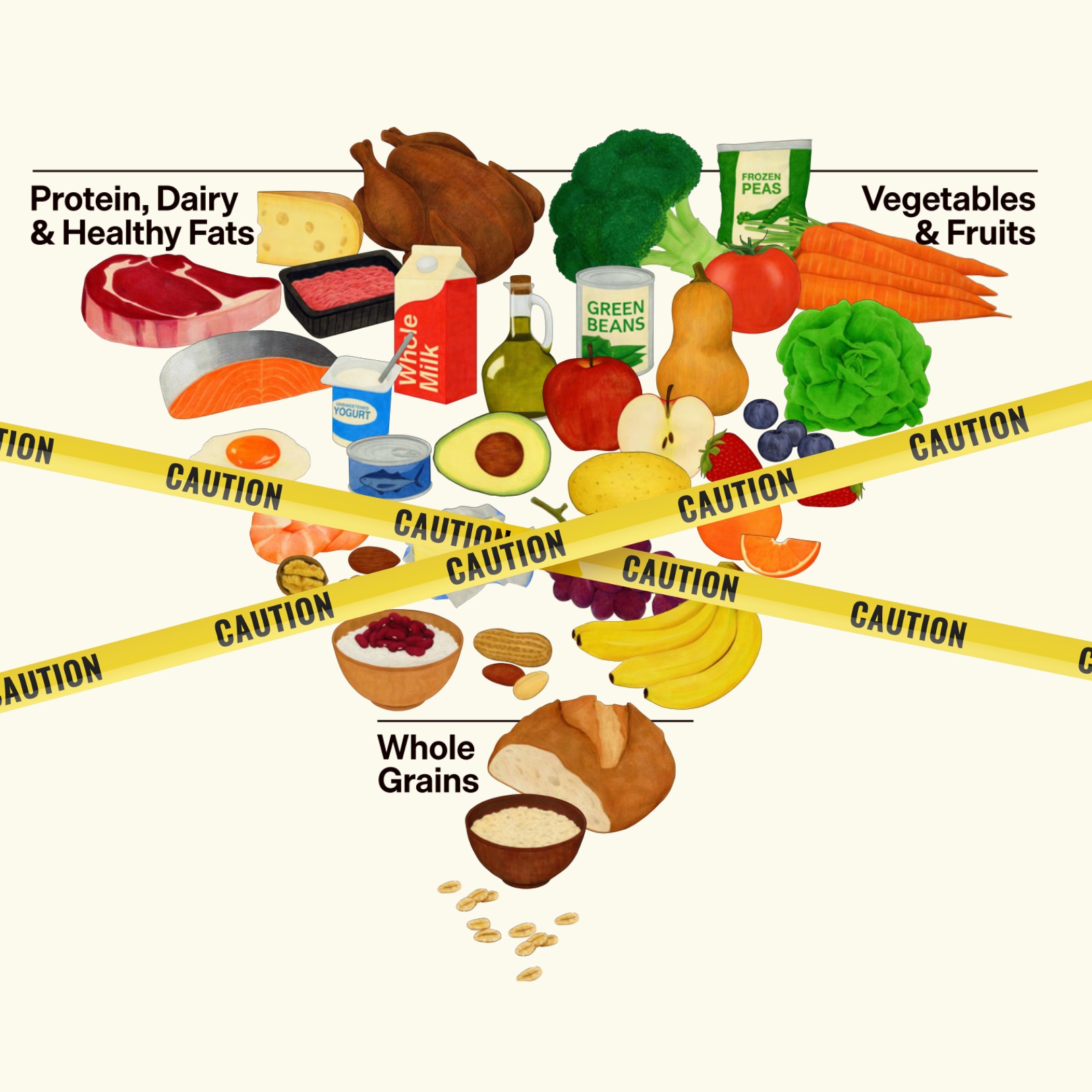
[SPEAKER_00]: We ended up in a health crisis because we followed an engineered environment to a massive calorie surplus. [SPEAKER_00]: Now, in January 2026, the map has officially been redrawn again. [SPEAKER_00]: The federal government's 2026 food pyramid, or reset, is a radical departure from everything that came before it.
[SPEAKER_00]: For the first time we're seeing a protein floor, specifically aimed at increasing dietary protein, and there's an explicit war on ultra-processed foods. [SPEAKER_00]: At the same time, we're witnessing a populist rebellion that is effectively flipped the pyramid upside down, crowning red meat and butter as health foods while dismissing decades of cardiovascular research.
[SPEAKER_00]: Depending on who you follow, this reset is either a biological miracle, or a cardiovascular ticking time bomb. [SPEAKER_00]: Now Barbomedicine, we're not interested in the political theater of the reset, we just care about the biology of the people who are going to follow it. [SPEAKER_00]: I'm Dr. Jordan Feigambam, and today we're going behind the curtain of the 2026 guidelines.
[SPEAKER_00]: We're tracking the lobbyist influence, we're dissecting the actual evidence behind these new recommendations, and we're asking if this shift represents a return to real-time American health. [SPEAKER_00]: And to help me unpack all of this, we have the second most handsome Dr. North America, Dr. Austin Baraki.
[SPEAKER_00]: Now Austin, when you look at this new inverted pyramid with stake at the top and bread at the point, what is the first thing that comes to mind? [SPEAKER_00]: Does something different stand out or is it just take you back to that poster? [SPEAKER_00]: We all had on our elementary school cafeteria walls in the 90s.
[SPEAKER_01]: Yeah, a few things. [SPEAKER_01]: I mean, I remember growing up, seeing that image on the side of whether cereal boxes or milk cartons or things like that more recently. [SPEAKER_01]: I believe it was about maybe two years ago or so. [SPEAKER_01]: There was a South Park episode that actually featured the lab hot take of like, let's take the pyramid, flip it upside down.
[SPEAKER_01]: So this has been foretold as they tend to be quite visionary on that show. [SPEAKER_01]: Looking at this graphic, [SPEAKER_01]: I'm honestly not terribly excited about it. [SPEAKER_01]: I think that much like prior guidelines that people didn't do a great job of following. [SPEAKER_01]: I'm not sure that they're much more likely to follow these.
[SPEAKER_01]: There's certainly been a lot of hot takes and this course around this. [SPEAKER_01]: These new guidelines at the moment that I know we're going to be getting into today. [SPEAKER_01]: But those are just some of my initial takes. [SPEAKER_01]: I don't think it's very likely to have dramatic impacts on people's behavior, which is the main thing that we care about, of course.
[SPEAKER_00]: Yeah. [SPEAKER_00]: Yeah. [SPEAKER_00]: So I think to understand like how we got here and like it's so it's going to fix on dietary behaviors and practices, we need to go back. [SPEAKER_00]: We can't understand why this 2026 reset is happening and unless we understand why the 1992 food pyramid is original inception was doomed from the very first draft.
[SPEAKER_00]: And so we got to go back to 1980, which is when we published our first dietary guidelines and the rumor [SPEAKER_00]: Senator George McGowan, he had this committee on nutrition and human needs. [SPEAKER_00]: It was originally formed to end hunger in America, but that committee pivoted towards the rising epidemic of heart disease.
[SPEAKER_00]: Now to understand why that happened. [SPEAKER_00]: Eisenhower had a heart attack in office in 1955, and cell keys, researcher just released his seven countries study that connected saturated fat intake to heart disease in the 1970s, and so all of this is leading to some pressure about, oh my gosh, we got this epidemic of heart disease, we got to do something about it.
[SPEAKER_00]: And so that committee released a set of dietary goals for the United States in 1977. [SPEAKER_00]: So predating the first dietary guidelines that were ever widely published, [SPEAKER_00]: And in those dietary goals, they say to reduce processed sugars by half, so that about 10% of the dietary intake reduced fat intake to 30% from its current state at 40% particularly animal fat reduced fat, reduced saturated fat to less than 10% of daily calories increased, polyunsaturated in monoinsaturated fats, reduced dietary cholesterol intake, reduced sodium intake, and increased fruits and vegetables.
[SPEAKER_00]: That's 1977. [SPEAKER_01]: Yeah, and that's, you know, at a time when if you graph out the incidence of cardiovascular disease and in particular cardiovascular disease death rates were extremely high in the middle of the kind of from from 1900 to the year 2000, like in the early-to-mid part of that century, the like per capita risk of cardiovascular mortality was extremely high.
[SPEAKER_01]: And so now even though you still hear us say things like [SPEAKER_01]: leading cause of death worldwide. [SPEAKER_01]: The overall number of events is still quite high. [SPEAKER_01]: That is mostly at this point driven by the fact that the population is so much higher. [SPEAKER_01]: But if you correct that per capita, like by just for the growth of the population, we have made huge progress on the risk of cardiovascular death.
[SPEAKER_01]: Like the sudden death from a heart attack is far less common now compared to where it was, say, in like 1960s. [SPEAKER_01]: Now people are living with more chronic cardiovascular conditions, things like heart failure and things like that. [SPEAKER_01]: But it's interesting to see these dietary suggestions.
[SPEAKER_01]: I mean, I think you could quibble about some of them, but overall it's like, yeah, this would be a net improvement on what it sounds like the diet was before that even going back to the 70s. [SPEAKER_00]: Yeah. [SPEAKER_00]: Yeah. [SPEAKER_00]: So that's 1977. [SPEAKER_00]: And ultimately that led to the development of the 1980 guidelines.
[SPEAKER_00]: And this was a pamphlet. [SPEAKER_00]: It wasn't. [SPEAKER_00]: There was no food pyramid at this time. [SPEAKER_00]: It wasn't like a 400 plus page scientific consensus on, you know, nutrition that we currently get with each iteration of the current guidelines, which is a little pamphlet.
[SPEAKER_00]: Although, if you want to look at it, I'd link it in the show notes. [SPEAKER_00]: It looks pretty good. [SPEAKER_00]: Very vintage. [SPEAKER_00]: Now, the 1977 sort of guidelines [SPEAKER_00]: pamphlet that was released, had been watered down. [SPEAKER_00]: So effectively, the committee said decrease the consumption of meat, but the cattle industry was pretty chuffed about that, and so the final wording in the 1980 guideline said, [SPEAKER_00]: choose meets poultry and fish which will reduce saturated fat intake.
[SPEAKER_00]: So it moved from eat less meat to eat lean meat. [SPEAKER_00]: The original goal of the 1977 dietary goals was to reduce sugar consumption by 40%, but after heavy lobbying from the sugar industry, the 1980 guidelines were softened to the vague avoid too much sugar. [SPEAKER_00]: So there are two recurring themes here.
[SPEAKER_00]: We're going to see throughout the different iterations of the dietary guidelines, including the current ones. [SPEAKER_00]: Number one is industry influence. [SPEAKER_00]: That's probably number one. [SPEAKER_00]: And two, vagueness leading to unintended consequences. [SPEAKER_00]: So we fast forward to 1992.
[SPEAKER_00]: The food pyramid is born. [SPEAKER_00]: This is the first time that graphic appeared in public and the reason why they pivoted to this graphic is because again, we had previously had a pamphlet. [SPEAKER_00]: Nobody understood them. [SPEAKER_00]: And so the thought was, well, if we just have a graphic, [SPEAKER_00]: people will understand that and buy large eat that way.
[SPEAKER_00]: So the USDA hired a nutrition expert named Luis Light to lead the team to develop this graphic. [SPEAKER_00]: Now the original food guide and subsequent pyramid looked very different. [SPEAKER_00]: Light's recommendation was to make the base of the pyramid vegetables and fruits. [SPEAKER_00]: And grains were a small sliver, like two to four servings, and they also had to be whole grains.
[SPEAKER_00]: Now when the draft went up the chain, the grain lobby represented by the big cereal and flower companies went to work. [SPEAKER_00]: They argued that if people only ate two servings of grains, the agricultural economy would collapse. [SPEAKER_00]: And so the USDA overwrote the scientists.
[SPEAKER_00]: They flipped the pyramid, put grains at the bottom, and increased the recommendation to a staggering six to eleven servings a day. [SPEAKER_00]: Oh, and by the way, they didn't differentiate between [SPEAKER_00]: whatever type of grain 6 to 11 servings of them per day. [SPEAKER_01]: Yeah, I mean, I think that it's some interesting back story of what may have happened behind the scenes there, although there is some probable distinction between the image and what it conveyed and to the extent that somebody even used that to kind of inspire their dietary habits or choices, which, again, as we'll make the case, most people don't really gravitate towards the use of those tools when making these decisions.
[SPEAKER_01]: You know, if somebody's habitual diet contained, say, six servings of whole grains a day as to proper defined by a serving, that is most likely to be completely fine for a large fraction of the population and may even be health promoting or beneficial, but if it is kind of mixed in with or not clearly delineated between refined grains, which to be clear, even those guidelines were not recommending, like, hey, you should consume up to 11 servings per day, including of [SPEAKER_01]: refined grains, things like that, then I think you'd certainly run into more problems, but that's also not what they were explicitly advising.
[SPEAKER_01]: And so you do hear some more of the kind of conspiratorial minded, which understanding that there is some undercurrent here of like nefarious influence and things like that here and there, but the idea that the [SPEAKER_01]: as a result, the government put forth this clear message of everyone ought to be consuming tons of grains irrespective of whole grain versus not is not exactly what those things held even even at the time.
[SPEAKER_00]: Yeah, that wasn't certainly wasn't the advice, although yeah, you could make an argument, although I don't know the strong one, that people, if they just looked at the graphic, yeah, maybe that's what they took away, or if they just heard eat six to eleven servings of grains a day without the, you know, complex caveat, [SPEAKER_00]: perhaps that might have led to this dietary pattern.
[SPEAKER_00]: But to me, the real nefarious undercurrent here is what these guidelines, these 1992 food period of the subsequent dietary guidelines sort of incentivized. [SPEAKER_00]: So while the USDA was telling us what to buy, to other giants, we're figuring out how to make it so we could never stop eating.
[SPEAKER_00]: Now in our one of our previous podcasts on Big Food, the American pantry was bought by Big Tobacco in the 1980s and they didn't just bring money, they brought the same scientists who spent decades optimizing nicotine delivery and rate of absorption. [SPEAKER_00]: They applied that to our food supply.
[SPEAKER_00]: Now, we've evolved as a species to seek calories in order to survive. [SPEAKER_00]: These companies turn that survival instinct into profit margins and expanding waste lines for us. [SPEAKER_00]: Over the last 50 or so years, we didn't get hungrier or subsequently lose willpower as a species, but we did start 80 to about 500 more calories on average.
[SPEAKER_00]: This is like a passive overconsumption, because of these engineered foods, they don't give us the same stop signals as less processed options. [SPEAKER_00]: And so the thought here is that these ultra-process foods came into prominence due to market pressures. [SPEAKER_00]: The food pyramid had this base of grains, and to keep them shelf stable and cost efficient, industry leaned into refined flowers and starches and away from whole grains.
[SPEAKER_00]: and also we had this advice to reduce fat. [SPEAKER_00]: That was everywhere. [SPEAKER_00]: So the food industry capitalized and made more of their foods low fat or fat free to get the healthy label and the fat free or low fat label, but to maintain taste and texture, mouth feel, etc. [SPEAKER_00]: they added sugar, sodium, and other additives, which ultimately reduced satiety or feeling a fullness and added some calories.
[SPEAKER_00]: Now, ultra-process foods make up about 70% of the U.S. food supply and yeah, between 1977 and the early 2000s, the average American didn't just get hungry or we got hacked, we're eating way more calories. [SPEAKER_00]: So to me, it's easy to look back at 1992 in the food pyramid and blame the lobbyists, but the scientific community wasn't silent at the time.
[SPEAKER_00]: When the USDA was printing millions of these posters, researchers at Harvard led by Walter Willett he's the same guy who came up with the eat Lancet diet, which is pretty good, sound in the alarm. [SPEAKER_00]: They pointed out that there was a fundamental flaw in the pyramid's design. [SPEAKER_00]: The pyramid created all carbohydrates as equal, and biologically speaking it didn't distinguish between a Cheerio and a steel cut out.
[SPEAKER_00]: Now if you read the fine print, if you read the scientific consensus it says, oh no, no, we want complex carbohydrates, but that's not what the graphic really showed. [SPEAKER_00]: Food Pyramid called the 2026 Reset with its protein floors and the inversion of the old food pyramid. [SPEAKER_00]: I'm starting to hear some very similar sounding alarms from the scientific community.
[SPEAKER_00]: Do you think we're finally getting it right or are we watching history repeat itself once again by failing to heed the warnings of experts? [SPEAKER_01]: Yeah, it's an interesting question. [SPEAKER_01]: I don't think that we are with this revision getting closer to truth. [SPEAKER_01]: I think it is a spectacle.
[SPEAKER_01]: In particular, if you look at the fact that these heavily criticized 1992 food pyramid is now getting inverted. [SPEAKER_01]: There's like something intrinsically symbolic and provocative about that, right? [SPEAKER_01]: It's about the spectacle and kind of the show of, you've been lied to and we're flipping everything on its head and things like that.
[SPEAKER_01]: Of course, as we and others have pointed out many times, the food pyramid hasn't been used for well over a decade. [SPEAKER_01]: Quite quite a bit longer. [SPEAKER_01]: There was this intermediate, you know, evolution that happened. [SPEAKER_01]: The my plate system that did not actually rely on the food pyramid, nor did it continue to reflect that like broad base of Indiscriminate grain may be implications graphically, even though, again, the text did not advise people consume that much of like processed or non [SPEAKER_01]: complex carbohydrates sources and things like that.
[SPEAKER_01]: So I do think that there's almost more of an emphasis on like making this a spectacle and it's almost performative in a sense without being a thing that is likely to either radically, you know, transform behavior or be much more accurate than existing guidelines that we've had if anything.
[SPEAKER_01]: I've seen a fair amount of criticism that these actually make certain things more ambiguous, more nebulous, more controversial, especially from the scientific perspective, but at the same time that's not too surprising once you get a sense of how these guidelines actually get drafted, there is the scientific committee of experts and who are extremely familiar with the literature and they put an enormous amount of time and effort into formulating [SPEAKER_01]: But from there, for that consensus to get translated into the actual guidelines and then subsequently into policy, there's an additional layer of filtering that happens.
[SPEAKER_01]: And that happens through HHS as well as the USDA. [SPEAKER_01]: And that's what's kind of tricky here is when you think about the USDA Department of Agriculture, it's like, well, are they charged fundamentally with a primary interest in promoting the health of Americans or are they charged with a mandate relating to?
[SPEAKER_01]: agriculture in the United States. [SPEAKER_01]: And so there's almost like an intrinsic conflict of interest there that makes things trick complicated and a little bit problematic that they are significantly involved in this process at all. [SPEAKER_01]: It's not to say that just the scientists would do a phenomenal job of being able to formulate guidelines because even though scientists are great at science and it coming up with committee statements, they are not great oftentimes at public [SPEAKER_01]: And so I shutter to think about what the product might look like if it was just left up to, you know, the scientist to come up with a very compelling kind of public message on this.
[SPEAKER_01]: I think you do need some level of additional, you know, skill, filter interpretation there. [SPEAKER_01]: But the actual process that this goes through, that's why you see, for example, some of that softening of language that you described where their scientific committee and consensus might explicitly advise [SPEAKER_01]: certain things, for example, say to reducing red meat and take or something like that, whereas after it goes through that USDA filter and things like that, you might end up with that softening of language or making things a little bit more vague, a little bit more permissive, and then it leads to less clear, less concrete guidelines in the end that are often less compatible with the current scientific consensus as established by the original committee.
[SPEAKER_01]: That's kind of what I see this evolution as. [SPEAKER_01]: It's almost more performative and for show, then it is something that is more closely approximating truth that is likely to materially advance the health of our population. [SPEAKER_00]: Yeah, it does kind of seem like the USDA is in a conflicted spot to say the least.
[SPEAKER_00]: It's kind of like the same company that's charged with reducing lung cancer rates in America is also selling you cigarettes and you're like, [SPEAKER_00]: I don't understand what your primary interest is, what's your major incentive? [SPEAKER_00]: So yeah, some maybe predictable outcomes in a way as far as like softening language, in addition to just science communicators getting a hold of this insane.
[SPEAKER_00]: Look, we can't talk about the polyunsaturated to saturated fat ratio in technical terms, but maybe we can just say reduce saturated fat, for example, that previously was in the guidelines. [SPEAKER_00]: But, [SPEAKER_00]: The way I want to come at the 2026 food pyramid, the updated guidelines is through this cinematic reference, the Clint Eastwood at the helm.
[SPEAKER_00]: We're going to talk about the good, the bad, and the ugly. [SPEAKER_00]: We're going to start off with the good. [SPEAKER_00]: And for me, there are two major victories, increased protein, and the acknowledgement that ultra-process foods are a problem. [SPEAKER_00]: So let's start out with protein.
[SPEAKER_00]: For years, the RDA for protein was set at 0.8 grams of protein per kilogram body weight per day. [SPEAKER_00]: This is a number designed simply to prevent nitrogen deficiency in a otherwise inactive person. [SPEAKER_00]: So this 2026 reset the new food pyramid finally established with their calling a protein floor.
[SPEAKER_00]: of 1.2 to 1.6 grams of protein per kilogram bodyweight per day for adults. [SPEAKER_00]: Don Laman, Dr. Laman was one of the advisors there and, you know, he's one of the best there is in this space. [SPEAKER_00]: So it seems like they're keeping up with the evidence. [SPEAKER_00]: So on paper, yeah, raising the protein recommendation to 1.2 to 1.6 grams of protein per kilogram bodyweight per day seems like a massive victory for supporting muscular health.
[SPEAKER_00]: particularly in adults who are lifting weights or exercising and older adults who are at risk of sarcopenia. [SPEAKER_00]: So you can think about like protein as a building block, you know, if you're building a skyscraper that is constantly under renovation, the old guidelines were like sending a brick, you know, one truck of bricks per week, just enough to keep the building from being condemned and falling down.
[SPEAKER_00]: But if you're actually living in that building or trying to renovate it through resistance training, [SPEAKER_00]: of delivery trucks to keep up with the pace of construction. [SPEAKER_00]: So the new guidelines could theoretically increase the supply of bricks or building blocks, making the renovation process easier and more successful.
[SPEAKER_00]: However, there's a catch here. [SPEAKER_00]: Recommendation, as it sits, probably doesn't make that much of a difference. [SPEAKER_00]: Not just because people don't read the guidelines or follow them, which we'll get to, but because it's not that much different than the current protein intake amongst most adults in the United States.
[SPEAKER_00]: Most adults eat way more protein than the RDA in the US, the typical adult consumes about 1.07 grams of protein per kilogram bodyweight per day. [SPEAKER_00]: Now, obviously, there's variation there. [SPEAKER_00]: Some people weigh less, some people eat way more. [SPEAKER_00]: So between you and I, we're probably bringing up the average and other people are bringing down the average.
[SPEAKER_00]: So to me, it's kind of like a paper recommendation. [SPEAKER_00]: It's like, well, look, [SPEAKER_00]: It is higher, but I don't know how much it would actually change if people were just meeting the numbers. [SPEAKER_00]: Perhaps the good that comes out of this is with this emphasis on eating more protein, potentially that extra protein could displace other foods that were ultra-process foods or otherwise high calories.
[SPEAKER_00]: that drove that 500 calorie surplus that we've talked about in the last episode and out in this episode. [SPEAKER_00]: That's all theoretical, but I guess we could count this as a win. [SPEAKER_00]: What do you think about the new protein recommendations? [SPEAKER_00]: Specifically with respect to like health outcomes such as [SPEAKER_01]: Yeah, I would push back a little bit on the idea, on narrowing the scope to sarcopenia and frailty, because that's not what these guidelines are for, right?
[SPEAKER_01]: These guidelines are general dietary guidelines for Americans. [SPEAKER_01]: And probably one area in my own thinking, as far as nutritional guidelines has gone over the years, is softening definitely the, what I would consider in terms of protein recommendations for the general public.
[SPEAKER_01]: I think that if, [SPEAKER_01]: You know, a lot of people are hanging around 1.2. [SPEAKER_01]: That's already probably more than enough for most folks. [SPEAKER_01]: We know, or at least feel relatively confident, that higher levels than that among training populations, or those who are very antibiotic resistant, may confer some additional benefit, I think, as with most things, there tends to be pretty significantly diminishing returns to that.
[SPEAKER_01]: And so pushing the whole population to try to hit 1.6, [SPEAKER_01]: when we think that there are pretty substantially diminishing returns as you approach that level, and certainly if you exceed it, I don't know that that's going to be making a huge difference in population health. [SPEAKER_01]: Even when it comes to people with sarcopenia, their fundamental issue way more often tends to be some combination of disuse atrophy, in other words.
[SPEAKER_01]: insufficient physical activity they're not training and maybe they have advanced medical conditions that are also contributing to it that could maybe be better managed But maybe not right. [SPEAKER_01]: It's really hard to get big and strong and jacked when you have advanced Parkinson disease or heart failure COPD Cerosis, you know cancer, things like that when it comes to management of sarcopenia and frailty I am much much much more strongly in favor of getting people active and training [SPEAKER_01]: compared with jacking up their protein intake.
[SPEAKER_01]: I think as much less likely to have a big big impact on their health outcomes. [SPEAKER_01]: So ultimately, I'm kind of a shrug in this. [SPEAKER_01]: It's like my, you know, in years past my, you know, about a very barbell training oriented self would have been strongly in favor, but that's also limited to that context of [SPEAKER_01]: Somebody who wants to get the biggest outcomes out of their training.
[SPEAKER_01]: Yeah, you can probably benefit by pushing it up to that say 1.6 In certain situations even higher, but when I'm saying oh, this is for the entire country You know whether you're training not training young old Sarkopini at not [SPEAKER_01]: I'd be fine with just like calling it 1.2 and saying most of the population on averages about there.
[SPEAKER_01]: And if somebody is clearly eating and nutritionally depleted diet or nutrient deficient diet, then yeah, we want to get them up to that level. [SPEAKER_01]: But calling 1.6 a floor for the population, I would actually not be in favor of that. [SPEAKER_01]: I think. [SPEAKER_00]: Yeah. [SPEAKER_00]: Yeah.
[SPEAKER_00]: I agree. [SPEAKER_00]: All right. [SPEAKER_00]: So let's just say by sheer publicity and, you know, fanfare around the new inverted food pyramid. [SPEAKER_00]: There's a 10% sec section of the population that now has increased their dietary protein intake, right? [SPEAKER_00]: So that's scenario one.
[SPEAKER_00]: 10% of the population jacks up their protein to 1.6. [SPEAKER_00]: Now to be clear, neither of us are saying, like if you go above that much or at that level, you don't live like bad things are gonna happen to you, it's just like you're probably not seeing benefits. [SPEAKER_00]: All right, so that's scenario one.
[SPEAKER_00]: or you take the same portion of the population 10%, it's currently not exercising. [SPEAKER_00]: And instead they start meeting the physical activity guidelines to include conditioning and lifting weights. [SPEAKER_00]: Which do you predict would have a greater impact on health outcomes?
[SPEAKER_01]: Absolutely no question, the latter. [SPEAKER_01]: Getting that portion of the population more active is gonna have a way bigger impact than bumping up their protein intake. [SPEAKER_00]: Yeah. [SPEAKER_00]: Yeah. [SPEAKER_00]: So, so you know, I'm trying to be charitable to these guidelines, because I don't want to be like, well, they're all bad, because it's not not necessarily the case.
[SPEAKER_00]: In fact, they're not really that changed comparatively to some weird kind of nuances. [SPEAKER_00]: They decided to pick that are seemingly at odds with the current scientific consensus. [SPEAKER_00]: But look, if increasing protein or the advertisement that that's in the guidelines convinces somebody to read the guidelines great, what I think they missed an opportunity to do is say, and by the way, this would be maximally leveraged if you lifted some weights.
[SPEAKER_00]: Okay, so if we're calling that a win which sure if people chose to increase their protein intake and, you know, that led to increase exercise or displacement of other foods that are higher calorie, let's probably a win, but for most folks, maybe shoulder shrug emoji. [UNKNOWN]: Yeah. [SPEAKER_00]: The second win here, which I actually think is maybe a bigger win, is we've announced on an official war on ultra-process foods.
[SPEAKER_00]: So like for the first time, seemingly a federal document explicitly identifies highly processed foods as a primary driver of chronic disease, right alongside physical inactivity. [SPEAKER_00]: That's right in the opening page of this. [SPEAKER_00]: And they're not just blaming sugar, they're looking at the food matrix, they recommend avoiding ultra-process foods.
[SPEAKER_00]: They also give a little decoder ring type thing. [SPEAKER_00]: They're like, look, avoid foods if they've got some syrup in there or it ends with OSE, like, oh, it's a glucose or something like that for added sugars. [SPEAKER_00]: And to their credit, they don't mention Nova a single time in these guidelines.
[SPEAKER_00]: That's just this classification of food processing. [SPEAKER_00]: Now, this is also in the scientific consensus. [SPEAKER_00]: If you read that, it's a 400-something-page document. [SPEAKER_00]: They talk about how ultra-process foods may lead to poor health through food matrix disruption.
[SPEAKER_00]: One of these things is like bio-availability. [SPEAKER_00]: So industrial processing breaks down the physical structure of food that's the matrix, which can make nutrients like starch and sugar of too much faster by the body, potentially leading to not only higher glycemic responses, but also over-consumption, basically cutting the brake lines.
[SPEAKER_00]: There's no stop signal here over consumption and higher calorie intake. [SPEAKER_00]: We talked about that on the last podcast. [SPEAKER_00]: So, gotta give it some credit here. [SPEAKER_00]: They also don't condemn functionally process foods. [SPEAKER_00]: So things like Greek yogurt, for example, or frozen fruits or vegetables, which are technically processed.
[SPEAKER_00]: But yeah, they don't call those out, which is, which is nice. [SPEAKER_00]: So, I don't know. [SPEAKER_00]: I view that as sort of a win. [SPEAKER_00]: as far as implementation. [SPEAKER_00]: I have my skepticism there, but yeah, what do you think about about that? [SPEAKER_00]: Because it's the first time I've seen that in dietary guidelines other than to say like, you know, avoid refined carbohydrates.
[SPEAKER_00]: But that's usually packed in the consensus and not like, [SPEAKER_00]: the actual document that people might read. [SPEAKER_01]: And it has been appropriately demonized thing, I think, for a fair amount of time, the problem with the processing conversation as you've alluded to here and we've talked about before is just one of definitions.
[SPEAKER_01]: And certainly, if it's going to come to policy because policy requires definitions. [SPEAKER_01]: And there are two dates, remains a lack of a clear, [SPEAKER_01]: consensus definition on what is a processed or an ultra-processed food that is neat and tidy and does not have some combination of both false positives and false negatives.
[SPEAKER_01]: In terms of foods that we would all recognize as not being ideal for health that failed to meet certain criteria and others that clearly, as you mentioned, like Regulbert, for example, that are maybe technically processed in some ways that [SPEAKER_01]: might otherwise meet certain criteria even though it shouldn't be.
[SPEAKER_01]: So it's problematic and I think that having clear definitions on this is going to be needed for anyone to be able to actually implement policy, especially knowing that we're feeling confident that, hey, if this pisses off the wrong person, there's going to be legal challenges and then you're just going to hold mess at that point.
[SPEAKER_00]: Yeah. [SPEAKER_00]: Yeah. [SPEAKER_00]: I was trying to predict like what if any sort of industry influence that this document and you know, would maybe have, right? [SPEAKER_00]: Kind of similar to what happened in the 90s when the food pyramid came out and you know, they were like, look, we got to be low fat and look at the base of the pyramid is grains and so we need to make these affordable.
[SPEAKER_00]: So, you know, some unintended consequences there. [SPEAKER_00]: What are the unintended consequences here? [SPEAKER_00]: can't think of anything that comes from these maybe the good side of the of the guidelines. [SPEAKER_00]: So now it's time to get into the bad. [SPEAKER_00]: There are some things in here that have a lot of scientists and clinicians, including us deeply concerned.
[SPEAKER_00]: And so we spent the last 20 something minutes talking about how these guidelines respect the biology of the gut and the muscle. [SPEAKER_00]: But while fixing the metabolic engine, the guidelines might have decided to ignore the plumbing. [SPEAKER_00]: So the guidelines still recommend keeping saturated fats under 10% of total calories, particularly in the little pamphlet.
[SPEAKER_00]: It's also in the scientific consensus. [SPEAKER_00]: And they acknowledge that 82% of Americans already exceed this, and that there are no biological requirements for saturated fat intake. [SPEAKER_00]: Yet, the messaging here is complicated because they're saying, oh yeah, you can use things like butter and beef tallo and eat more red meat.
[SPEAKER_00]: And to me, that is crazy. [SPEAKER_00]: Austin, when you saw that the guidelines recommended butter and beef tallo as well as leaning into animal-based proteins, what was your immediate reaction? [SPEAKER_00]: Are we finally freeing the public from the failed lipid heart hypothesis or are we watching a populist rebellion [SPEAKER_01]: So I think that this is going to be an area where some people inevitably are going to just have strong opinions and disagree.
[SPEAKER_01]: I just fundamentally don't think that we have been dealing with a failed hypothesis of heart disease. [SPEAKER_01]: Again, if you look at the actual statistics on risk of cardiovascular death, it has been steadily dropping. [SPEAKER_01]: It's actually plateaued in the last few years, but over the course of the last 70 years we have managed to put [SPEAKER_01]: a huge dent into the risk of cardiovascular death through combinations of things.
[SPEAKER_01]: I will recognize combinations of less smoking, better blood pressure control, lipid lowering, therapies, better treatments of acute heart attacks, so they don't, they're less likely to kill people immediately and things like that. [SPEAKER_01]: But when we survey the entire body of evidence on nutritional interventions, [SPEAKER_01]: and things like that.
[SPEAKER_01]: There is overall a relatively consistent directionality to it. [SPEAKER_01]: And we have not been just like steadily marching in the opposite direction up until this point where they've like inverted things and set the course more more correct. [SPEAKER_01]: So I, you know, part of my problem with this is that it's just kind of incoherent in the sense that if you're advising people to crank up the butter and beef talo, yet also to keep their saturated fat and take less than 10% of calories, that's.
[SPEAKER_01]: quite challenging right it you know meeting that guideline is going to necessarily require you to opt for generally quite lean sources of protein if you're going to be relying on animal derived sources if you end up going with fish or other things then that's great and that's arguably even better and in a lot of ways but it it's just if you think that guidelines drive [SPEAKER_01]: You claimed that the old guidelines caused the obesity epidemic.
[SPEAKER_01]: Now we have these new guidelines that you are a big fan of and I should expect will fix the obesity epidemic. [SPEAKER_01]: Please set some explicit outcomes that you will be looking for. [SPEAKER_01]: What will you be measuring? [SPEAKER_01]: What time point do you expect this to happen by?
[SPEAKER_01]: And then we will assess at that time point. [SPEAKER_01]: The caveat will be, we need to make sure that the outcomes that we observe are not better explained by the use of GLP1 agum system, right? [SPEAKER_01]: That's been my hot take to this point is, if you think this is going to radically improve outcomes, for example, when it relates to heart disease risk, [SPEAKER_01]: show me your predicted outcome and what you're looking for.
[SPEAKER_01]: Basically, pre-register your hypothesis. [SPEAKER_01]: That's like a fundamentally scientific principle. [SPEAKER_01]: That's how a lot of studies when they get pre-registered. [SPEAKER_01]: It says, here's our hypothesis. [SPEAKER_01]: Here's what we think is going to happen. [SPEAKER_01]: And you say in advance, if this happens, our hypothesis will be supported, if this happens, well, I'll have to reject my hypothesis.
[SPEAKER_01]: The problem is that people don't operate this way. [SPEAKER_01]: People who are fans of beef tallow are going to be fans of beef tallow, no matter what happens over the long term, no matter what I say, no matter what you say. [SPEAKER_01]: That's just the tough thing here. [SPEAKER_01]: But my issue, again, is just the incoherence of it.
[SPEAKER_01]: And the fact that I don't think that most people are going to be able to, even if they wanted to use these guidelines, design a coherent diet that [SPEAKER_01]: leans into butter, beef, talo, and you know, high and takes a red meat while also meeting the 10% saturated fat guideline. [SPEAKER_01]: One of those things is going to fail.
[SPEAKER_00]: Yeah, yeah, I agree. [SPEAKER_00]: And it is interesting. [SPEAKER_00]: This is like the start of the disconnect between the scientific consensus. [SPEAKER_00]: Again, this 400 page review of the current evidence to date by a panel of experts. [SPEAKER_00]: Right, many experts and millions of dollars spent to do that.
[SPEAKER_00]: They acknowledge that look, the primary contributors of saturated fat and the current American diet are burgers and sandwiches, desserts and sweet snacks, you know, and make other mixed dishes. [SPEAKER_00]: And they also acknowledge that reducing butter, red meat, whether it's process or unprocessed, and replacing them with plant-based sources.
[SPEAKER_00]: That lowered cardiovascular disease risk. [SPEAKER_00]: You should encourage beans, peas, lentils, etc. [SPEAKER_00]: And mono-insaturated and polyunsaturated fats. [SPEAKER_00]: You know, they go through all this evidence, right? [SPEAKER_00]: So they're saying in one hand, like, we should probably reduce beef talo, butter intake and red meat intake, just generally speaking and shifting towards this other type of dietary pattern.
[SPEAKER_00]: The pyramid is like, not dog, I got this watch instead of like making a case for why using beef talo and butter would be health promoted, it seems like an add-on. [SPEAKER_00]: Like the rest of that whole section reads very similar to the consensus, which is like, yeah, we should probably avoid this stuff, limit saturated fat, choose these other options.
[SPEAKER_00]: And instead they're like, no, no, no, but you can also have beef talent putters, like, to your point. [SPEAKER_00]: Incoherent, because like, how do you, how do you square that, you know? [SPEAKER_01]: Yeah, I think that this is the result of what will call post processing. [SPEAKER_01]: After emerging from the scientific committee, the post processing of this by the subsequent actors in this space who have certain biases and preferences and motivated reasoning and they like beef and steak and aggression and manliness and things like that, all these kinds of ideas that they want to make into their guidelines as part of this whole kind of performative thing for spectacle.
[SPEAKER_01]: That's my perspective on it. [SPEAKER_00]: Yeah. [SPEAKER_00]: Yeah. [SPEAKER_00]: There's another interesting kind of wrinkle here. [SPEAKER_00]: It's like this dairy hall pass. [SPEAKER_00]: The committee found some moderate evidence that substituting red meat for dairy reduces heart disease risk.
[SPEAKER_00]: But it seemingly made its way to the food new food pyramid in a very interesting way by pushing full fat dairy, specifically whole milk and cheese. [SPEAKER_00]: I got a big concern that this may increase calorie density unnecessarily without significantly improving [SPEAKER_00]: Um, satiety markers.
[SPEAKER_00]: So just how full people get like people just going to eat way more calories and also full fat dairy can be more rewarding than lower fat options. [SPEAKER_00]: So [SPEAKER_00]: We both know that the literature on full-fat dairy is pretty messy. [SPEAKER_00]: There's just a ton of confounding variables, so like socioeconomic status, who buys low-fat or fat-free dairy, who consumes whole-fat dairy, and more.
[SPEAKER_00]: Still though, when the food pyramid tells people to go full-fat for dairy, are they ignoring the fact that whole milk essentially provides a high-reward potential calorie bomb that might exacerbate the 500 calorie surplus that we're trying to fix? [SPEAKER_01]: I think it's a maybe it's just something that's like I'm open to seeing kind of what what happens.
[SPEAKER_01]: Again, I don't think people are going to use these guidelines for their behaviors. [SPEAKER_01]: They're going to pick what they pick regardless of what these things advise. [SPEAKER_01]: But there may be some sort of like cultural shift. [SPEAKER_01]: I fully recognize like when we were growing up that [SPEAKER_01]: You know, things were definitely leaning towards the skim milk direction more heavily.
[SPEAKER_01]: And so if there's a broader shift in the public conception, then yeah, that might impact behavior. [SPEAKER_01]: You're right that there's going to be an energy, uh, an overall calorie impact on that. [SPEAKER_01]: The dairy's whole topic is pretty interesting. [SPEAKER_01]: We've talked before about how most forms of dairy, including full fat forms with the exception of butter.
[SPEAKER_01]: Don't actually tend to be, especially harmful in the context of say blood lipids and cardiovascular disease and things like that, [SPEAKER_01]: that turns it into butter has some impact on the chemical composition, and then that has some downstream impacts that are kind of net harmful on blood lipids and cardiovascular risks.
[SPEAKER_01]: So we'll have to see what happens on that front, but I agree there's a non-significant difference in calorie density, which seems to be a pretty major problem that we're trying to deal with. [SPEAKER_01]: The reward aspect, yeah, I mean, no doubt that drinking a glass of whole milk is pretty thick and rich and heavy and tasty when it goes into a milkshake much more so than [SPEAKER_01]: Then skim, you know, you also wonder to the extent that a person is sensitive to satiety signals Is there some kind of compensatory effect?
[SPEAKER_01]: We know that doesn't tend to happen with other forms of like liquid calories. [SPEAKER_01]: Does it happen a bit more with milk? [SPEAKER_01]: Maybe I have less strong opinions about this in general compared with some of the other areas of the guidelines though. [SPEAKER_01]: What do you think?
[SPEAKER_00]: Yeah, I think if they said look there is generally good. [SPEAKER_00]: I'd be like, yeah [SPEAKER_00]: I agree, but the idea of pushing the full fat variety in particular to seeing, yeah, I'm just like, why, like, yeah, my prediction is that it would either have a neutral effect on body weight management or a negative one, not likely a positive that seems highly improbable to me.
[SPEAKER_00]: I think also, you know, recognizing that it's seemingly dairy, [SPEAKER_00]: seems to be pretty neutral, perhaps even beneficial on blood lipids. [SPEAKER_00]: Yeah, I'm all for dairy. [SPEAKER_00]: Let's do it. [SPEAKER_00]: But I just think explicitly trying to recommend full fat versions.
[SPEAKER_00]: It just doesn't really make sense to me. [SPEAKER_00]: I think it's almost like the pendulum swung too far the other way. [SPEAKER_00]: It's like, look, we've been doing low fat, fat free, and a majority of the low fat, fat free products that were, you know, designed in the 90s ended up having added sugars and stuff like that.
[SPEAKER_00]: I think most people who were in this space [SPEAKER_00]: Generally not good. [SPEAKER_00]: People over eat those things, but I don't think we have to apply that specifically to dairy. [SPEAKER_00]: And, you know, we have hopefully functioning synapses and can like discern between two different cases and you would have hoped for better considering how many people are, you know, taking in this information.
[SPEAKER_00]: But, and again, nothing surprises me anymore. [SPEAKER_00]: Yeah. [SPEAKER_00]: Yeah. [SPEAKER_00]: And finally, I suspect you won't care about this, but we're going to see. [SPEAKER_00]: Once again, the guidelines do not mention anything about dietary cholesterol. [SPEAKER_00]: Now, I didn't expect them to mention the P2S ratio.
[SPEAKER_00]: This was the ratio of polyunsaturated fat intake to saturated fat intake. [SPEAKER_00]: But dietary cholesterol is still like a hot button. [SPEAKER_00]: People, again, if we're talking about a dietary pendulum, before it was like minimize dietary cholesterol intake and then it was like, nah, it doesn't matter.
[SPEAKER_00]: cholesterol is more complicated, which is true. [SPEAKER_00]: But like, [SPEAKER_00]: There's nuance there. [SPEAKER_00]: So we've covered this before, uh, believe a podcast episode called five nutrition controversies. [SPEAKER_00]: Science tells us that the impact of saturated fat intake and dietary cholesterol will doesn't happen in a vacuum.
[SPEAKER_00]: If your ratio is high, meaning that you're taking in a lot of polyunsaturated fatty acids and dietary fiber, your body tends to handle the dietary cholesterol pretty well. [SPEAKER_00]: Blood lipoproteins like LDL don't seem to change much in response. [SPEAKER_00]: But the typical Western diet or standard American diet, which to be clear is different than the guidelines.
[SPEAKER_00]: When people say the standard American diet, they're not referring to guidelines type dietary patterns. [SPEAKER_00]: It's just what people normally eat. [SPEAKER_00]: Well, that P2S ratio is really low. [SPEAKER_00]: Mainly because we consume a lot of saturated fat relative to polyunsaturated fat.
[SPEAKER_00]: The current ratio is about 0.5, and we're really aiming for one or even two. [SPEAKER_00]: But when that ratio is low, dietary cholesterol can increase blood lipids quite a bit. [SPEAKER_00]: And now, with the recommendation that beef talo and butter are fine, this could be an even bigger problem without any comment on dietary cholesterol.
[SPEAKER_00]: Austin, what do you think? [SPEAKER_00]: Is the, you know, no mentioning of dietary cholesterol, a big issue, or you're just like a look, no one reads the guidelines anyway, and no one would care, so it's fine. [SPEAKER_01]: I do feel like I keep coming back to saying, nobody's been reading these or acting upon them and I do continue to stand by that.
[SPEAKER_01]: My issue with the idea that maybe we should have mentioned something like that is also a broader concern about how guidelines should be communicated to the public should it be on one hand in terms of foods or should it on the other hand be in terms of nutrients. [SPEAKER_01]: So when you tell a person, [SPEAKER_01]: or the general population who you should assume are not highly educated in this space, that you should consume less saturated fat.
[SPEAKER_01]: That is completely meaningless to people out there. [SPEAKER_01]: So that is a nutrient-based dietary recommendation that nerds bodybuilding [SPEAKER_01]: But the general population does not operate on a kind of nutrient-based model of diet of nutrition. [SPEAKER_01]: That is not where their understanding comes from.
[SPEAKER_01]: And so I don't think that public health, dietary guidelines should be rooted in nutrient-based communication to say things like sodium or saturated fat or cholesterol or P2S ratios or things like that. [SPEAKER_01]: But rather, it should be fundamentally, I think, food-based. [SPEAKER_01]: eat less of these foods ideally eliminate these foods.
[SPEAKER_01]: Part of the problem, though, is even if the scientific committee were to establish statements like that in their statement to say that these foods should be prioritized. [SPEAKER_01]: These should be reduced. [SPEAKER_01]: These should be eliminated. [SPEAKER_01]: There's still, again, that subsequent layer of filtering that these go through before their [SPEAKER_01]: various actors and industry influence and USDA and things like that have an opportunity to either soften some of that language or shift it actually to some of this nutrient-based labeling or kind of recommendations that kind of give them more space to operate here.
[SPEAKER_01]: So it makes it so that for example food industry might then be able to [SPEAKER_01]: Reformulate their food product to meet something that is more nutrient-based while still being a food that Probably shouldn't be eating right or they might give them kind of a little bit longer leash to operate in that space compared with if it was just like hey Probably shouldn't eat this food.
[SPEAKER_01]: Yeah, that might have a more dramatic impact on their bottom line [SPEAKER_00]: Yeah, I think if I had to buy my brothers, the phrase that you love that I say, you know, there are like various pages in this food pyramid and you know, it'll start out with like energy and then it goes to protein and then it goes to fruits and vegetables and so to your point, I agree, the majority of what's on that page should be eat this eat more of this, this eat less of that and then it should ideally be accessible for most people whether high-income, low-income, and everything in between.
[SPEAKER_00]: I would prefer that the top of that page or the very first bullet point to have some sort of like, maybe it's not science sounding, but like just discrete statement. [SPEAKER_00]: So for example, in the fat section, we should limit saturated fatty acid intake. [SPEAKER_00]: Eat more of these foods, eat less of these foods, and here's some like fringe cases.
[SPEAKER_00]: Mainly to like make it clear, and ultimately you're trying to increase the skill set of the people who are consuming this information of navigating a label in our current environment. [SPEAKER_00]: or at least just having some fun of knowledge stuff so where they could assess something that's not immediately clear to them.
[SPEAKER_00]: Well, this has a high amount of saturated fat with the food. [SPEAKER_00]: God wants to do the same thing about saturated fat, so I'm kind of like up a creek. [SPEAKER_00]: I mean, obviously that's a relatively rare case, the person read the food, pyramid, and the guy, and then they're ultimately making this, having this question.
[SPEAKER_00]: Yeah, that's just in my perfect world that's how it would look like. [SPEAKER_01]: Yeah, I think it's a reasonable take. [SPEAKER_01]: The art of public health communication is complex. [SPEAKER_01]: And there's a lot of those implicit decisions that need to be made. [SPEAKER_01]: And it can be challenging if you don't have active knowledge or expertise in this space because you might be like, well, I understand this stuff really well.
[SPEAKER_01]: And here's how I would communicate it. [SPEAKER_01]: And that might not land at all with the person in front of you or with the broader public. [SPEAKER_00]: Yeah, I'd be very curious to know how this was like workshoped like they had a focus group after focus group after focus group and at the end the focus group is like we get it we beef tallo I'm taking a bathroom All right, so we've talked about the good we've talked about the bad and now we got to talk about the ugly we went into the weeds of lipidology talking about all sorts of stuff related to PDS ratio, saturated fat, et cetera, but maybe there's a hidden cost to this saturated fat endorsement that goes beyond the cholesterol panel
[SPEAKER_00]: When the cultural narrative shifts so aggressively towards red meat and animal fats, it could create a retreat from plant-based foods. [SPEAKER_00]: Now we know that meat has exactly zero grams of dietary fiber, and we also know that only 6% of Americans currently meet the recommended intake for dietary fiber.
[SPEAKER_00]: By prioritizing meat for protein, the guidelines could be contributing to a massive fiber intake delta. [SPEAKER_00]: And this may be like a sort of substitution trap. [SPEAKER_00]: In 1992, the original food pyramid, we substituted fat for refined grains. [SPEAKER_00]: In the new guidelines, we seem to be encouraging people to ignore great sources of fiber that were prominent in the previous guidelines, like beans, peas, lentils, et cetera.
[SPEAKER_00]: And instead, choose more calorie dense, zero fiber animal proteins. [SPEAKER_00]: Austin, are we watching the government repeat the exact same mistake of 1992, where they focus so hard on one variable, protein. [SPEAKER_00]: that he inadvertently created a whole new public health crisis in the form of a 25 gram per day fiber gap.
[SPEAKER_01]: I don't know that they're going to be creating a new public health crisis as a result of a fiber, you know, insufficient fiber intake because most people are already consuming insufficient amounts of this fiber in their diet. [SPEAKER_01]: There would be, you know, certainly a strong case to be made for potential health benefits by significantly increasing that intake from a variety of plant-based food [SPEAKER_01]: reflects probably the most substantial change in like my own habitual dietary pattern in recent years yours as well to set to some extent.
[SPEAKER_01]: More strongly leaning into a lot more plant-based sources of all sorts of nutrients including protein and fiber and things like that, just based on our understanding of the evidence. [SPEAKER_01]: kind of where it's been, and these are not actually based on new findings either, but just kind of becoming more familiar with this whole body of evidence.
[SPEAKER_01]: So to I don't know that these guidelines represent a clear shift away from high fiber foods, more so like insufficient prioritization of those that would represent. [SPEAKER_01]: good sources of dietary fiber, because they're not recommending against the consumption, for example, of legumes or lentils.
[SPEAKER_01]: But if you look, it's like it might be implied that they're not placed as high on this inverted pyramid now, with the base being at the top oddly. [SPEAKER_01]: And so this is in the face of pretty abundant [SPEAKER_01]: available evidence that we have in terms of food substitutions that substituting, you know, super fatty cuts of meat for some of these plant derived food sources has a host of health benefits on people.
[SPEAKER_01]: And they, in fact, do not become acutely protein deficient or chronically protein deficient by making such a substitution a lot of things stand to improve. [SPEAKER_01]: So, [SPEAKER_01]: Again, fundamentally, people aren't reading or listening or paying attention to the guidelines to make their decisions.
[SPEAKER_01]: If they were, I still don't know that this is going to be like, you know, open up this new health crisis as a result of poor fiber intake because most people aren't consuming enough anyway. [SPEAKER_01]: Would I prefer, and I think you would, as well, that the shift and the nudge and the encouragement have gone in the other direction of, you know, more people would stand to benefit from the inclusion of these foods on a regular basis in their diets, recognizing [SPEAKER_01]: You know, super culturally prominent in some parts of the world and not terribly so in the US and we would actually stand to benefit by, you know, increasing their prevalence in our habitual diets for, for a lot of reasons.
[SPEAKER_01]: Yeah, I think we'd both prefer that for a lot of potential health benefits. [SPEAKER_01]: That's not the way that they went. [SPEAKER_01]: I again, my pre-registered hypothesis here is that that, um, [SPEAKER_01]: That choice is unlikely to make a hugely deleterious impact just as I would predict that if they had emphasized it more, I'm still not sure it would have had a hugely beneficial impact either.
[SPEAKER_00]: Yeah, you imagine though, so they bump the protein intake up right and let's say they made this pyramid and were that stake in that cheese nugget in the chicken. [SPEAKER_00]: It's just a big bean instead like look, we want you to eat more protein, [SPEAKER_00]: like eat more edamame. [SPEAKER_01]: Yeah.
[SPEAKER_00]: They, you know, we're you're taking a subgroup of vegetables and you're combining to a subgroup for protein foods and like ultimately the increased fiber would be generally good. [SPEAKER_00]: Uh, did you ever watch the Netflix series Travelers? [SPEAKER_00]: The Travelers? [SPEAKER_00]: All right, so, you know, no spoilers here on the barbell medicine pockets, we don't do any spoiling.
[SPEAKER_00]: But basically, people from the future come back and they try to prevent the end of the world, right? [SPEAKER_00]: And they're like, yeah, the stance standard story and something I would definitely watch. [SPEAKER_00]: You would, you would like this series. [SPEAKER_00]: Interestingly, they're all vegans in the future.
[SPEAKER_00]: And they come back. [SPEAKER_00]: And the idea, they look around. [SPEAKER_00]: There's one saying they're looking around everyone's eating meat. [SPEAKER_00]: And they're like, this is barbarian. [SPEAKER_00]: Yeah. [SPEAKER_00]: But I think that kind of, that kind of touches on just most people who go down this, you know, help, fitness, wellness, sort of rabbit hole, particularly with formal education.
[SPEAKER_00]: And, you know, review of the evidence. [SPEAKER_00]: You tend to shift. [SPEAKER_00]: towards having more plant-based food in your diet. [SPEAKER_00]: It doesn't mean you necessarily switch to a vegetarian or vegan, but you include more because it's overwhelming. [SPEAKER_00]: You just can't ignore it.
[SPEAKER_00]: Like, even with the moat, I'm good at rationalizing. [SPEAKER_00]: I am excellent at it. [SPEAKER_00]: But I cannot rationalize away all of that evidence. [SPEAKER_00]: And so, yeah, that would have been interesting if the food pyramid is like, we've lit the upside down. [SPEAKER_00]: It looks like a piece of pizza.
[SPEAKER_00]: But the top corner, this is huge being, yeah, out of an interesting. [SPEAKER_00]: So also this ignores anything about planetary health, which we are not experts in, but like to the extent that this changes that at all, some concerns, some concerns there. [SPEAKER_00]: All right. [SPEAKER_00]: So we're still in the ugly section here.
[SPEAKER_00]: There's some non-nutrative sweetener hate here, which [SPEAKER_00]: Why? [SPEAKER_00]: Like, I think, you know, there are issues with the evidence on non-nutritative sweeteners mainly because when you look at it by and large, they do not discriminate between where that not, there's non-nutritative sweeteners are coming from.
[SPEAKER_00]: Meaning like, there are many ultra-process foods that, again, low, not very filling, high in calories contain a bunch of stuff, you probably don't want, you're going to, oh yeah, by the way, you're going to eat too much of it. [SPEAKER_00]: That have non-nutritative sweeteners in their artificial sweeteners or naturally occurring, [SPEAKER_00]: Uh, sweners that still don't have any calories, and so if you compare somebody using a lot of those to somebody using none of those, you're like, see non-nutrious sweeteners, terrible for you.
[SPEAKER_00]: Instead, if you just restrict your analysis to people that are eating foods with added sugars or consuming drinks, sugar sweeten beverages, being the most prominent. [SPEAKER_00]: They're replacing those with non-nutrious sweeten beverages. [SPEAKER_00]: there's an improvement. [SPEAKER_00]: And so it just seemed weird.
[SPEAKER_00]: Again, this is a pretty short document. [SPEAKER_00]: Why even waste the text on this? [SPEAKER_00]: There's so many other things. [SPEAKER_00]: Like it just seemed like a weird line in the sanded draw and not accurate also. [SPEAKER_01]: Yeah, I think, you know, anybody who's taking an honest look at the overall body of evidence and about these in particular, but also about like the state of public health in general is going to have a hard time making a case that the use of non-nutritive sweeteners in general, or any one of them in particular is like contributing to a large fraction of like public morbidity or premature mortality or something like that.
[SPEAKER_01]: So I agree that I wouldn't waste my time worrying about these. [SPEAKER_00]: Yeah, in fact, out is on the opposite. [SPEAKER_00]: More diacokes. [SPEAKER_00]: Sure. [SPEAKER_00]: Yeah. [SPEAKER_00]: Let's do it. [SPEAKER_00]: Then this other weird thing that falls definitively in the ugly sort of category.
[SPEAKER_00]: There's this retreat on alcohol. [SPEAKER_00]: It went from two drinks for men, one drink for women, which admittedly is not great because like what is a drink? [SPEAKER_00]: There was no like this inner drink, but whatever guidelines. [SPEAKER_00]: And now it's to a to a vague consume less, because apparently it's a social lubricant.
[SPEAKER_00]: While the less is better, that's certainly true. [SPEAKER_00]: This shift towards vagueness is like a classic policy pivot. [SPEAKER_00]: It's lip service that avoids holding the industry accountable while leaving the consumer without a concrete target. [SPEAKER_00]: Just less. [SPEAKER_00]: Again, I would prefer it say like generally speaking, alcohol is not health promoting.
[SPEAKER_00]: as little as possible. [SPEAKER_00]: Like that'd be fine. [SPEAKER_00]: It'd probably, you know, anger some people that sure help me contribute to the development of these guidelines, but it would also have the benefit of being accurate. [SPEAKER_00]: Yeah, and also Dr. Oz wouldn't be like the meme right now, so like so bizarre.
[SPEAKER_01]: Yeah, it's honestly it's like, what is your job? [SPEAKER_01]: What are you being asked to do? [SPEAKER_01]: What are you charged with? [SPEAKER_01]: You are not here to be the secretary of [SPEAKER_01]: social lubrication policy that right if you if right if you if you if you were then that would be your primary charge of finding all the things that you know confer that suppose it benefit.
[SPEAKER_01]: uh, almost independent of their potential risks and then you can state your case and you can be part of a committee, then you're like, well, I'm here, you know, from the standpoint of social lubrication and here's a beneficial thing and then you can debate with people from the other side who just like not, but, uh, it also leads to increased risk of all sorts of downstream health consequences and problems and then you can hash it out and see which, you know, has the greater net benefit or net harm, which I think is not a controversial thing for anybody taking it on us.
[SPEAKER_01]: Look at these. [SPEAKER_01]: So this is just an example of that kind of, [SPEAKER_01]: you know going from the scientific committee level to the field post processing the filtering how language can get weakened and massaged a little bit based on the stakeholders and who's involved in that decision making to make these guidelines ultimately a bit impotent by the end just to you know less it's like yeah a lot of people get told that they should probably drink less this is often not used to them in in many of these situations.
[SPEAKER_01]: But that's not with a purpose of these guidelines and nor are the guidelines intended to help, you know, socialize the population. [SPEAKER_00]: Yeah. [SPEAKER_00]: Yeah. [SPEAKER_00]: Yeah. [SPEAKER_00]: Look, there's a department for social lubrication. [SPEAKER_01]: I'm trying to hear here for it.
[SPEAKER_00]: Well, I'm here for that in Space Force. [SPEAKER_00]: Like, I'm signing up for both. [SPEAKER_00]: All right, so the other ugly part, and perhaps the most interesting to you, Dr. Baraki, is the uptake and the potential for that. [SPEAKER_00]: So first off, what do these guidelines actually do?
[SPEAKER_00]: The most people think that these guidelines are just a pamphlet for doctors' offices or something to like post up in the school cafeteria, but in reality, they are the budgeting blueprint for billions of dollars in annual federal spending. [SPEAKER_00]: So we got that National School Lunch Program, 30 million children feeds every day.
[SPEAKER_00]: You got the the WIC program. [SPEAKER_00]: You've got snap supplemental nutrition assistance program, military rations and VA hospitals. [SPEAKER_00]: This could theoretically affect a lot of actual meals going in actual bodies every day. [SPEAKER_00]: To the extent, this changes. [SPEAKER_00]: So now like all of the French [SPEAKER_00]: Or like, you can't get diet soda anymore because non-nuchative sweeteners generally bad.
[SPEAKER_00]: Again, what? [SPEAKER_00]: Some of this is hyperbole, but it's like the same amount of hyperbole from the other side of the coin. [SPEAKER_00]: I shutter to think what these changes would actually have on the national school lunch program, because if the current budget is X, right? [SPEAKER_00]: This amount of money.
[SPEAKER_00]: And now, where protein's got to go up, specifically from animal sources, which are generally more expensive. [SPEAKER_00]: Oh, by the way, no non-nutrients, we can use any of those. [SPEAKER_00]: And we're going to cook in beef, talo, and butter, and it's like, so it's gotten way more expensive and less health promoting, doesn't seem like a win to me.
[SPEAKER_01]: I'm gonna come back to my hot take from earlier. [SPEAKER_01]: Tell me what outcome you're hoping to impact by making this change, right? [SPEAKER_01]: Here's the outcome that I'm looking for. [SPEAKER_01]: Here's what I expect is gonna happen. [SPEAKER_01]: Here's how long I expect it's gonna take for this to manifest wholesale, right?
[SPEAKER_01]: I expect to see, you know, child children's health improve in this way, I wanna see children's blood pressure come down, their BMI's, or their, you know, they're kind of, [SPEAKER_01]: growth charts that the fall back onto a healthy part of the growth chart childhood obesity will go down.
[SPEAKER_01]: These are all the things that I'm expecting will happen as a result of me switching to cooking fries and beef talo and these other sorts of things in schools. [SPEAKER_01]: If that happens by this date that will reinforce my hypothesis, I'll pat myself on the back and we'll carry on. [SPEAKER_01]: Okay.
[SPEAKER_01]: If it does not happen, I'll be forced to reject my hypothesis and we will alter the plan going in a different direction. [SPEAKER_01]: Test and alternative hypothesis or river it back to what we were doing before. [SPEAKER_01]: They won't do that. [SPEAKER_01]: No, people will not pre-register their hypothesis like this.
[SPEAKER_01]: But that would be how I would charge them with these kinds of things. [SPEAKER_01]: If they are put into positions of power with the ability to impact these policies, then that's what I'm looking for. [SPEAKER_01]: That's what I want to hear. [SPEAKER_00]: Yeah. [SPEAKER_00]: And that's just like federally subsidized uptake.
[SPEAKER_00]: What about the actual uptake in the public? [SPEAKER_00]: To me, this also raises just the price point of eating a guidelines type diet. [SPEAKER_00]: You know, they talk about protein floor and moving away from shelf stable refined grains. [SPEAKER_00]: They're making a massive assumption that the American consumer can't afford to participate.
[SPEAKER_00]: if you got time to prep real food and a budget for 1.2 grams of protein per kilogram body weight per day of high quality animal protein like you're in. [SPEAKER_00]: You're in the club. [SPEAKER_00]: Whereas most vulnerable populations are in low socioeconomic status brackets, these guidelines don't look like a map at all.
[SPEAKER_00]: They look like a wall. [SPEAKER_00]: Now the previous my plate guidelines, it was estimated that this would cost about $1,200 a month for a family of four. [SPEAKER_00]: That's a previous guidelines, right? [SPEAKER_00]: would definitively be cheaper than these current guideline recommended of foodstuffs.
[SPEAKER_00]: The food budget, on the other hand, for the average middle income family in America's $518 a month. [SPEAKER_00]: For low income, it's $322 a month. [SPEAKER_00]: This is a budgetary crisis, protein, animal sources in particular, that the prices are forecasted to rise. [SPEAKER_00]: Plant product prices have been relatively stable price-wise.
[SPEAKER_00]: Also, ironically, [SPEAKER_01]: 100% like yeah there's there's a lot of you know special specialized niche or unique scenarios that are not addressed here they're just like fundamentally excluded or. [SPEAKER_01]: uh... not recognized and that's honestly where skilled dieticians are so valuable is by recognizing and having solutions and and and ways to improve the you know nutrition and health of these selected situations that people have maybe socioeconomic in nature maybe medical in nature and you're right that many of them are just not at all addressed by the guidelines you're just kind of like out of the club unfortunately yeah that's all right that's yeah [SPEAKER_00]: Yeah, thanks for playing.
[SPEAKER_00]: And then finally, again, probably your favorite part of this entire podcast. [SPEAKER_00]: No one follows the guidelines. [SPEAKER_00]: Researchers often use this metric called the healthy eating index to measure adherence to dietary guidelines on a scale from 0 to 100. [SPEAKER_00]: The average American score has hovered around 56 to 58 per decades.
[SPEAKER_00]: Interestingly, since about 1999, these healthy eating index scores have actually improved slightly, readings slightly more whole fruit and fewer empty calories just a little bit. [SPEAKER_00]: Yet obesity and metabolic disease have increased significantly since that time frame. [SPEAKER_00]: Data shows, on average, only about 10% of the population follows the guidelines with any consistency.
[SPEAKER_00]: Now, this is based on surveillance data from questionnaires. [SPEAKER_00]: They're not following people around and like, oh, you ate that. [SPEAKER_00]: So this is self-reported, by the way. [SPEAKER_00]: It's probably like the physical activity guidelines. [SPEAKER_00]: It's probably half that if that.
[SPEAKER_00]: So maybe 5% sharedably for the other 90 or 95% the guidelines are just background noise in a food environment that's screaming at them to eat more and eat stuff that's not on the food pyramid anyway. [SPEAKER_00]: So like, I don't know how many millions of dollars you're spent to formulate this thing.
[SPEAKER_00]: But like, [SPEAKER_00]: the two potentially good things compared to the bad and the ugly. [SPEAKER_00]: I'm like, it feels like that money could have been better allocated. [SPEAKER_00]: You know, like an exercise promotion one. [SPEAKER_00]: If RFK junior and the Maha movement was like, we gotta exercise and we're gonna take all this money and do this.
[SPEAKER_00]: We might not agree with the implementation, but we'd find a lot less to be like, look, and you did this wrong too, I think. [UNKNOWN]: Yeah. [SPEAKER_01]: Yeah. [SPEAKER_01]: I have little else to add at this point beyond pay attention to the trends, the trajectories, the outcomes, adjust for the impact of biomedical innovation, science, GLP1, agonist things like that, and then be prepared to change your opinion if things do not go in the direction that you expect in the coming years to decades.
[SPEAKER_01]: That's a long enough time horizon that, you know, by the time it becomes a abundantly clear whether this is working or not, people have forgotten this saga anyway. [SPEAKER_01]: So I continue to lack a great deal of optimism on that front either, but I wish that there was more kind of intellectual honesty, logical consistency.
[SPEAKER_01]: You know, there's other areas of these guidelines that, for example, criticize the use of [SPEAKER_01]: And so just the logical incoherence and inconsistency of it, I think is what is probably most frustrating because I know it's not going to get better. [SPEAKER_00]: Yeah. [SPEAKER_00]: Yeah.
[SPEAKER_00]: I think there's some argument here that these guidelines are kind of a form of policy lip service by providing this like what to eat framework. [SPEAKER_00]: The government places the entire burden of health on individual choice. [SPEAKER_00]: If you get sick, the government can say, well, we told you to eat all the protein and avoid the ultra-process food is not our fault, your fault.
[SPEAKER_00]: This of course ignores the upstream policies that dictate what food is available, and the new food pyramid doesn't fix the farm bill that just changes the educational advice, educational doing a lot of heavy lifting in that phrasing. [SPEAKER_00]: So Austin, we're looking at nearly $100 billion policy shift here, but when we look at the HCI scores, we see that the average American is basically failing a nutrition test every single day.
[SPEAKER_00]: Is the new food pyramid actually designed to change the American diet or is it just a political rebrand that allows the government to look busy while the underlying food environment, the subsidies and the ultra-process food availability remain completely untouched. [SPEAKER_01]: I don't actually know that the underlying food environment is going to be completely untouched.
[SPEAKER_01]: It may be the case that some incentives change realign there might be some food reformulation. [SPEAKER_01]: I hope not, but maybe even to more align with some of the stuff of like, you know, there's some of these restaurants like you look at, I think it was Shake Shack or something it said like now 100% beef talo, but it's taking tries and stuff like that, there's they can shake, sorry, don't, don't sue us whoever, whoever says, yeah, and so there's, you know, there's some impact on things.
[SPEAKER_01]: I, it's just hard to predict what the impact is going to be when historical uptake of these guidelines has been relatively poor. [SPEAKER_01]: You're right that, you know, as we've talked about on our last podcast as well. [SPEAKER_01]: the availability of calories and the way that those calories are packaged and delivered are surrounding food environment dictates way more of our routine, habitual food related behaviors than our eating behaviors, much, much, much more than any graphic, any guideline, any label that's slapped onto the side of a, you know, cereal box or milk carton as we learned when we were kids too.
[SPEAKER_01]: And so I, this is ultimately a bit of a shrug for me. [SPEAKER_01]: I, you know, I think [SPEAKER_01]: There's just a lot of moving parts here between guidelines, how that impacts policy, the biomedical space, and our best attempts to fight back against these things, we're trying to hold back the doors with our meager tools, like, you know, Tresepotide and things and things like that.
[SPEAKER_01]: So ultimately, where it all shakes out, is going to obviously remain to be seen, and then, you know, in another five years, who knows who's going to be in power, writing these guidelines, designing these guidelines, and we might be, I don't know, back to square one again. [SPEAKER_00]: Yeah, I'll be curious if there's any impact on these new guidelines, a new food pyramid on that, you know, big food trial that we talked about.
[SPEAKER_00]: And this podcast is like, do they enter this as evidence? [SPEAKER_00]: Like, look, even the government admits this is problematic. [SPEAKER_00]: That would be interesting and the subsequent downstream effects from that were even upstream like as far as policies related to subsidized crops and such, but then there's more complicated food insecurity so on so forth.
[SPEAKER_00]: To me, I don't know, and this is maybe a little more hokey so you can really realize if you like or maybe maybe you agree. [SPEAKER_00]: I think if you put the American public in a room, you somehow got them all in a room and you said, look, what do we agree on with respect to nutrition?
[SPEAKER_00]: Everyone would agree, look, if you live here, you should have the opportunity to eat a health promoting dietary pattern. [SPEAKER_00]: We want our food supply to generally be healthy. [SPEAKER_00]: We don't want too many restrictions because it's the land of liberty, so we want to be in charge.
[SPEAKER_00]: But we also want our basic food supply and water supply and everything else to be healthy, especially for children and vulnerable populations. [SPEAKER_00]: I think everybody would be on board for that. [SPEAKER_00]: There might be one straggler who's like, nah, make it unhealthy. [SPEAKER_00]: It's like South Park, you know, rotters for example.
[SPEAKER_01]: I think you're less likely to have people who say, no, make it unhealthy. [SPEAKER_01]: But more so people who are like, no, I'm not willing to pay for it to be healthy. [SPEAKER_00]: Yeah, yeah, yeah. [SPEAKER_00]: We would achieve that. [SPEAKER_00]: And that's where people would start to disagree.
[SPEAKER_00]: But if this food pyramid came out and was like, look, [SPEAKER_00]: how we think that should be laid out and here's how we're going to do about it. [SPEAKER_00]: Yeah, people would disagree perhaps on the implementation, but there's this opportunity for cohesion and unification. [SPEAKER_00]: Like, look, we're all in this together, let's work together.
[SPEAKER_00]: But instead, they chose violence. [SPEAKER_00]: They're like, now, we're going to lean into this heavily meat-focused thing. [SPEAKER_00]: We're going to make some strange choices about saturated fat intake and ignore, you know, mountains of research on fiber and legumes and such like that.
[SPEAKER_00]: just seems like missed opportunity. [SPEAKER_00]: And also, like, one mention about exercise, I don't know. [SPEAKER_00]: It just could have done better. [SPEAKER_00]: That to me, we could have done it. [SPEAKER_01]: Well, I mean, always could do better. [SPEAKER_01]: These things are going to continue to evolve with time.
[SPEAKER_01]: I think, you know, whether this ends up being a more consistent trend, or whether this ends up being a blip kind of depends on, you know, how we vote in a couple of years. [SPEAKER_01]: So ETVD. [SPEAKER_00]: TVD. [SPEAKER_00]: All right. [SPEAKER_00]: So what I did, we've talked about the [SPEAKER_00]: You know, new food pyramid and old food pyramids and everything else I thought, well, what if we were tasked with coming up with some our own version of a dietary guideline, you know, like no, we don't have a multi-million dollar budget to recruit the best interdisciplinary team available to help us out.
[SPEAKER_00]: Then again, the new food pyramid seemed to ignore most of their experts anyway, so we could just be in the clear. [SPEAKER_00]: Instead, yeah, we've taken the latest evidence surrounding dietary practices and boiled it down to the barbell medicine dietary guidelines for Americans, particularly adults, our philosophy is pretty simple.
[SPEAKER_00]: Dietary behavior isn't a matter of willpower. [SPEAKER_00]: It's an emergent process. [SPEAKER_00]: It happens when you're genetics and your subconscious appetite regulation collides with the food environment that's been engineered to be frictionless. [SPEAKER_00]: first off for starting with energy and the environment.
[SPEAKER_00]: This needs to be a reality check. [SPEAKER_00]: Again, this is an emergent process like how much food we eat and so we need to to the extent it's possible to modify our micro environments. [SPEAKER_00]: What happens at home? [SPEAKER_00]: What happens at the office? [SPEAKER_00]: So on and so forth.
[SPEAKER_00]: we would like to make those foods rich in either minimally processed foods or processed foods that don't have added sugar in them or are hyper palatable, very tasty, and have a lot of calories. [SPEAKER_00]: So the extent we can do that, that would be awesome. [SPEAKER_00]: We would also want to make sure that folks are eating in a way that's not distracted.
[SPEAKER_00]: So no screens at the table, and oh yeah, by the way, ideally at a table if you can. [SPEAKER_00]: We think that should result in a better amount of energy intake or calorie intake by default, meaning that you don't have to weigh and measure every single thing, log everything into an app.
[SPEAKER_00]: But if you wanted a calorie target, there are opportunities and resources for that. [SPEAKER_00]: We have our own calorie calculator. [SPEAKER_00]: You could use if you want. [SPEAKER_00]: For protein, [SPEAKER_00]: 1.2 grams of protein per kilogram of total body weight per day is fine.
[SPEAKER_00]: That can go up to 1.6 grams per kilogram body weight. [SPEAKER_00]: That's fine for most. [SPEAKER_00]: It can be higher if you train hard or if you prefer a higher protein intake. [SPEAKER_00]: Nothing really bad is going to happen. [SPEAKER_00]: It's just going to cost more money. [SPEAKER_00]: And further, where we deviate from the new food pyramid is that the source doesn't really matter as much as the total number.
[SPEAKER_00]: We do agree. [SPEAKER_00]: You should prioritize lean protein, particularly unprocessed sources. [SPEAKER_00]: So chicken breast, fish, legumes, Greek yogurt, tofu, etc. [SPEAKER_00]: And yeah, we would lean heavily into more plant-based proteins, particularly because the fiber intake also relatively cheap, comparatively.
[SPEAKER_00]: Next, moving on to fruit and vegetable. [SPEAKER_00]: The current guidelines say, look, get at least three servings of vegetables and two servings of fruit per day. [SPEAKER_00]: We wouldn't disagree with that. [SPEAKER_00]: We would just say, try to have more if you can. [SPEAKER_00]: And it doesn't matter if it's frozen or fresh, just have more.
[SPEAKER_00]: And very them as much as possible. [SPEAKER_00]: We want folks to target at least 30 to 40 grams of fiber per day, which I think is another thing missing from the current guidelines. [SPEAKER_00]: Just put it out there. [SPEAKER_00]: It's a number, but some people would be interested in seeing that.
[SPEAKER_00]: Whole fruit is better than fruit juice. [SPEAKER_00]: You could blend it if you want to, because that preserve the fiber of a juicing removes the pulp. [SPEAKER_00]: It can be frozen fruit as well if you wanna do this. [SPEAKER_00]: For carbohydrates, [SPEAKER_00]: Two rules of thumb that Austin talked about in a recent fiber, the biology, both comparing the grams of carbohydrates to the grams of fiber, and those two ratios are 5 to 1 and 10 to 1.
[SPEAKER_00]: If a food has a ratio of 5 to 1, grams of carbohydrates to grams of fiber, that makes it unalete choice. [SPEAKER_00]: We're talking about things like lentils, raspberries, non-starchy vegetables. [SPEAKER_00]: If a carbohydrate source has 10 grams of carbohydrates to at least 1 gram of fiber, that is acceptable, likely a processed food or a starchy carbohydrate, both of those can help you meet your health goals.
[SPEAKER_00]: For fat intake, we would recommend to reduce the fat intake from red meat and also butter, also beef tallow if we're being explicit here. [SPEAKER_00]: Yeah. [SPEAKER_00]: If someone is looking for a numerical target, it would be less than 10% of total calories from saturated fat. [SPEAKER_00]: You don't need to micromanage and specifically count milk or yogurt if you don't want to.
[SPEAKER_00]: In fact, I think most people shouldn't be micromanaging their saturated fat intake. [SPEAKER_00]: We would also advise to limit dietary cholesterol if you're at high risk for heart disease and focus on increasing the intake of polyunsaturated and mono insaturated fats from like olive oil, fish, nuts, etc.
[SPEAKER_00]: With respect to ultra-process foods, we would agree with the current guidelines to limit them, particularly foods with added sugar, so you can look on the label for cerebs, things that end in OSE and so on, particularly liquid foods that have added sugar like sodas, for example. [SPEAKER_00]: So soft drinks, also sweetened cereals, instant soups, frozen pizzas, check out the label.
[SPEAKER_00]: On the other hand, we disagree that people should inherently limit non-nutriative sweeteners, especially when we're talking about liquid foods. [SPEAKER_00]: So replacing sugar-sweeten beverages like sodas with the diet versions can be useful, but ultimately we're going to keep coming back to the same thing.
[SPEAKER_00]: Your diet probably shouldn't be that sweet. [SPEAKER_00]: Overall. [SPEAKER_00]: Moving on to alcohol and sodium, I think the recommendation of limiting alcohol intake to one to two standard drinks per day or abstain is fun. [SPEAKER_00]: It increases the reward value of food. [SPEAKER_00]: Provides non-filling or non-saciating liquid calories.
[SPEAKER_00]: So you'd want to balance that against any perceived benefits. [SPEAKER_00]: But ultimately, if somebody's not drinking already, I don't think there's a health benefit to starting drinking and generally speaking less alcohol is better. [SPEAKER_00]: For sodium intake, we would recommend to attack this by reducing intake of ultra-process foods, especially those that have a lot of sodium.
[SPEAKER_00]: And then that's the primary source of excess sodium in the diet as well as an increased calorie intake. [SPEAKER_00]: So you come in at both of those ends, eating less calories overall based on a better dietary pattern that defaults to a more correct energy intake and also reduction in ultra-process food intake reduces sodium intake.
[SPEAKER_00]: That doesn't apply to athletes. [SPEAKER_00]: Their sodium needs are highly variable, and that's outside of what would be the dietary guidelines for Americans. [SPEAKER_00]: That'd be dietary guidelines for athletes, for example. [SPEAKER_00]: We have a hydration podcast. [SPEAKER_00]: We can refer you to on that.
[SPEAKER_00]: And finally, for supplements, now you look, you're like, look, these are dietary guidelines for Americans. [SPEAKER_00]: Why the heck you talking about supplements? [SPEAKER_00]: Come on, man. [SPEAKER_00]: We'll look 75% of Americans take dietary supplements every year. [SPEAKER_00]: It's a $35 billion a year market.
[SPEAKER_00]: And we want to make sure that people are doing so responsibly. [SPEAKER_00]: So a few things. [SPEAKER_00]: One, you'd want to make sure that your supplement that you're taking is third party tested. [SPEAKER_00]: The biggest sort of players in the space are NSF informed for sport that's who we use, USP.
[SPEAKER_00]: This is going to be on the label somewhere. [SPEAKER_00]: If it's not on the label, and you still have questions, you can search these databases to make sure that they are third party tested. [SPEAKER_00]: You'd also want to make sure that your supplement [SPEAKER_00]: is certified for current good manufacturing processes should also be on the label.
[SPEAKER_00]: It appears as a CGMP sort of shield type thing most of the time and then after meeting those two criteria, there should be good evidence for not only safety, but as well as efficacy. [SPEAKER_00]: Does it do the thing that you're taking it for? [SPEAKER_00]: If a supplement meets all of those, we're probably in favor of you doing.
[SPEAKER_00]: So if you want to spend the money, fortunately, you're unfortunately depending on what your perspective is here. [SPEAKER_00]: Not a lot of supplements fit all those. [SPEAKER_00]: So your supplement bill will be maybe less than you think. [SPEAKER_00]: But on the other hand, if you own a supplement company, you probably didn't like that section.
[SPEAKER_01]: Yeah, I think that's fair. [SPEAKER_01]: That's my similar take on the approach to supplements is like there should be a concrete benefit that I'm looking for. [SPEAKER_01]: that for some reason is applicable to me, and I want to feel confident that it is going to deliver that to me, and that it is going to be safe in doing so.
[SPEAKER_01]: And I don't know, there are very, very few supplements that meet those criteria. [SPEAKER_01]: I even kind of shrug at taking creatine myself, not much more beyond your brain health. [SPEAKER_01]: Yeah, sure. [SPEAKER_00]: You're going to come on. [SPEAKER_00]: How are you so smart without creatine?
[SPEAKER_01]: There are certainly, you know, some supplements that have maybe some more benefit for unique scenarios that don't necessarily apply to me that, you know, I'd be open to discussing with somebody on a case by case basis, but you know, over all these guidelines are reasonable. [SPEAKER_01]: I think that they reflect a lot of how you and I both tend to eat.
[SPEAKER_01]: I would say, you know, more plants, more training less sugar, less alcohol. [SPEAKER_01]: Yeah, I'd be at even even simpler way to distill things down for a lot of people that would have like a net benefit on the on population health. [SPEAKER_01]: I would feel more confident that if I said like those four things that there'd be a bigger shift in population health if they were to uptake it.
[SPEAKER_01]: Then by leaning harder into beef tallo, but that's my hot take for this one big bean energy. [SPEAKER_01]: Yeah. [SPEAKER_00]: All right. [SPEAKER_00]: Well, as we wrap this up, I'm struck by a sense of deja vu. [SPEAKER_00]: In the 90s, we were given a map that ignored the biological reality of refined grains because was more convenient for the economy.
[SPEAKER_00]: Now, we're being given a new map that corrects the protein error, but seems to ignore the reality of lipidology, fiber, and food practices of the American public in general, all while creating division in the public. [SPEAKER_00]: The realities of the new food pyramid is mostly the same, it's mostly fine, and it likely won't change how people eat in America.
[SPEAKER_00]: are born from the existing evidence base and are experienced in the field. [SPEAKER_00]: We focus on things that actually move the needle if people were to do them. [SPEAKER_00]: So things like environmental mastery, a protein recommendation that supports muscle and training, a fiber to carb, ratio that protects the gut and a P to S ratio that guards the heart.
[SPEAKER_00]: Now if you want to take a deeper look at the Barbol medicine dietary guidelines, we've put together a comprehensive resource on our website that will be available soon. [SPEAKER_00]: They'll be in the show notes as soon as it's ready. [SPEAKER_00]: If you found this episode helpful, please share it with a friend or a family member, the best way to combat a rigged food environment is through community and shared evidence.
[SPEAKER_00]: While you're there, leave us a five-star rating and a review. [SPEAKER_00]: It really helps drive traffic to our podcast so we can keep bringing you all the latest nuance and health and fitness. [SPEAKER_00]: Special shout-out to Dr. Austin Barakki for joining us. [SPEAKER_00]: I'm Dr. Jordan Faganbaum.
[SPEAKER_00]: We'll catch you next week and every week right here on the Barbell Medicine podcast.
