

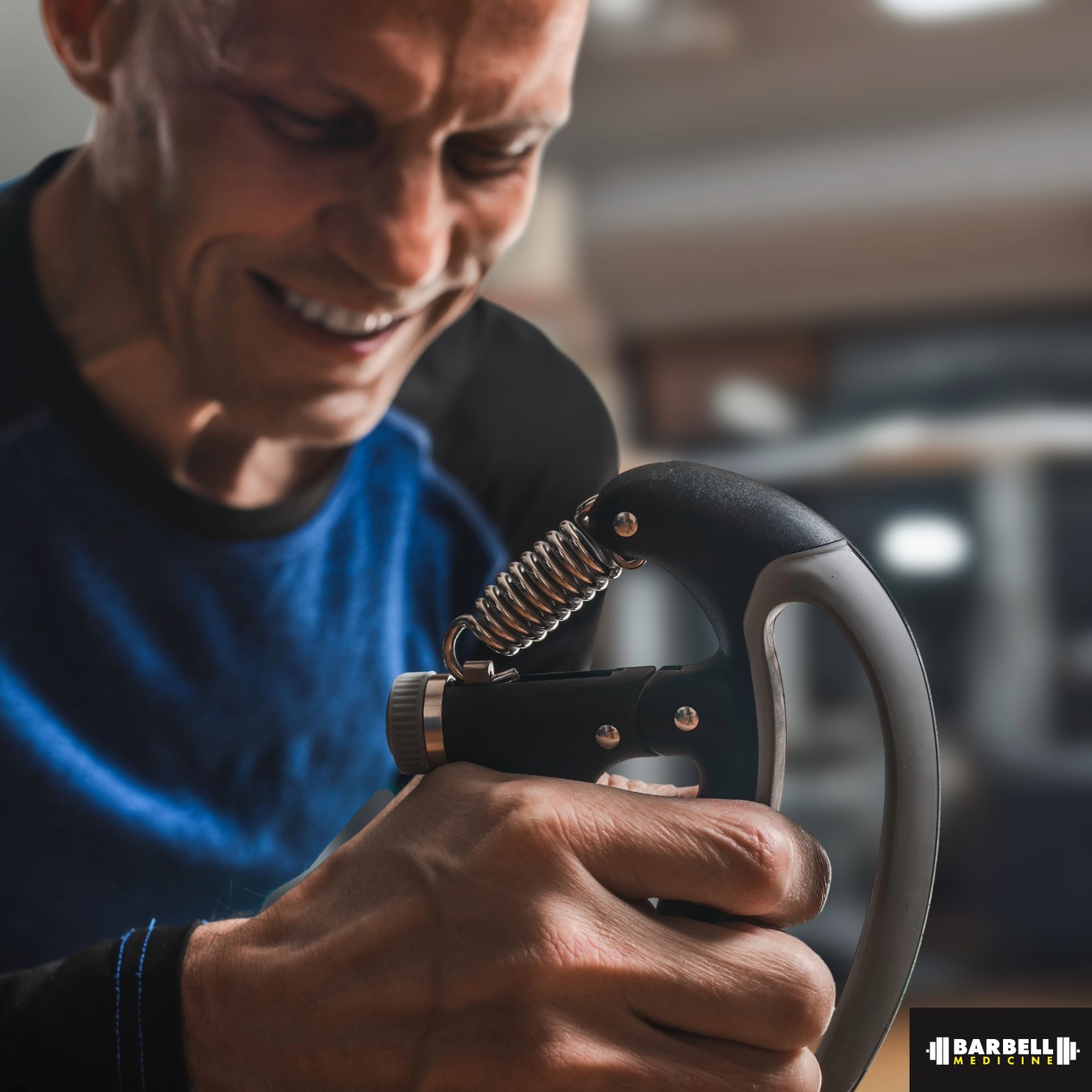
Episode #385- Why Grip Strength Predicts Death (And Why You Shouldn't Train It)
· 53 min
Kapitelklicken springt direkt hin
Shownotes
<p>Can a simple one-second squeeze predict your risk of cardiovascular disease, cognitive decline, and all-cause mortality? Dr. Jordan Feigenbaum and Dr. Austin Baraki explore why grip strength has become the go-to metric for the longevity industry and why most people are interpreting the data incorrectly.</p><p><strong>Timestamps:</strong></p><ul><li><strong>[]</strong> Intro: The Longevity Industry’s Thermometer Error</li><li><strong>[]</strong> The Neuro-Axis: Anatomy of a Maximal Squeeze</li><li><strong>[]</strong> The 35-3-5 Rule: Biomechanics of Grip</li><li><strong>[]</strong> Asymmetries and Clinical Red Flags</li><li><strong>[]</strong> Dynapenia vs. Sarcopenia: Why the Hand Fails First</li><li><strong>[]</strong> Normative Data and the PURE Study Statistics</li><li><strong>[]</strong> Genetics, Lean Body Mass, and Predictive Power</li><li><strong>[]</strong> Absolute vs. Relative Grip Strength (The Metabolic Signal)</li><li><strong>[]</strong> Bro-Science Beatdown: Neural Jitter and Training Readiness</li><li><strong>[]</strong> The Extensor Training and "Grip Maxing" Myth</li><li><strong>[]</strong> Programming: Systemic Training vs. Indirect Grip Work</li><li><strong>[]</strong> The Straps Debate: Are You Killing Your Gains?</li><li><strong>[]</strong> Final Verdict: Hierarchy and Health Priorities</li></ul><p><br></p><p><strong>Key Takeaways:</strong></p><ul><li><strong>Grip is Systemic:</strong> Handgrip strength tests the integrity of the entire system, from the <strong>motor cortex</strong> in the brain down to the tendons and bones. It is a proxy for overall <strong>muscular quality</strong> and neurological health.</li><li><strong>Predictive Power:</strong> According to the <strong>PURE study</strong>, for every <strong>5 kg decrease</strong> in grip strength, there is a <strong>17% increased risk</strong> of cardiovascular death and a <strong>7% increased risk</strong> of non-cardiovascular death.</li><li><strong>The Sarcopenia Floor:</strong> Clinical "red zones" for probable sarcopenia are <strong><27 kg for men</strong> and <strong><16 kg for women</strong>.</li><li><strong>Relative Strength Matters:</strong> <strong>Relative grip strength</strong> (Grip Strength ÷ BMI) is a more accurate predictor of <strong>hypertension, diabetes, and dyslipidemia</strong> than absolute grip strength alone.</li><li><strong>Don't Chase the Test:</strong> Direct grip training (crushers, etc.) obscures the predictive power of the test. To improve health, focus on <strong>indirect systemic resistance training</strong> (training the whole body) rather than "gaming" the thermometer.</li></ul><p><br></p><p><strong>Next Steps</strong></p><p>For evidence-based resistance training programs: <a href="google.com/search?authuser=2&q=https%3A%2F…; rel="nofollow">barbellmedicine.com/training-programs</a></p><p>For individualized medical and training consultation: <a href="google.com/search?authuser=2&q=https%3A%2F…; rel="nofollow">barbellmedicine.com/coaching</a></p><p>Explore our full library of articles on health and performance: <a href="google.com/search?authuser=2&q=https%3A%2F…; rel="nofollow">barbellmedicine.com/resources</a></p><p>To join Barbell Medicine Plus and get ad-free listening, product discounts, exclusive content, and more: barbellmedicine.supercast.com/</p><p&… href="europepmc.org/article/med/1538102"; rel="nofollow">europepmc.org/article/med/1538102</a>; </li><li><a href="pubmed.ncbi.nlm.nih.gov/12188074/#/"; rel="nofollow">pubmed.ncbi.nlm.nih.gov/12188074/#/</a>; </li><li><a href="pmc.ncbi.nlm.nih.gov/articles/PMC6322506/"; rel="nofollow">pmc.ncbi.nlm.nih.gov/articles/PMC6322506/</…; </li><li><a href="pmc.ncbi.nlm.nih.gov/articles/PMC10777545/#/&q…; rel="nofollow">pmc.ncbi.nlm.nih.gov/articles/PMC10777545/#/&l…; </li><li><a href="pmc.ncbi.nlm.nih.gov/articles/PMC6322506/#/"; rel="nofollow">pmc.ncbi.nlm.nih.gov/articles/PMC6322506/#/<…; </li><li><a href="journals.plos.org/plosone/article?id=10.1371%2…; rel="nofollow">journals.plos.org/plosone/article?id=10.1371/j…; </li><li><a href="pubmed.ncbi.nlm.nih.gov/31499496/#/"; rel="nofollow">pubmed.ncbi.nlm.nih.gov/31499496/#/</a>; </li><li><a href="pubmed.ncbi.nlm.nih.gov/25982160/#/"; rel="nofollow">pubmed.ncbi.nlm.nih.gov/25982160/#/</a>; </li><li><a href="sciencedirect.com/science/article/pii/S2095254…; rel="nofollow">sciencedirect.com/science/article/pii/S2095254…; </li><li><a href="pubmed.ncbi.nlm.nih.gov/27701433/#/"; rel="nofollow">pubmed.ncbi.nlm.nih.gov/27701433/#/</a>; </li><li><a href="pmc.ncbi.nlm.nih.gov/articles/PMC5517526/#/"; rel="nofollow">pmc.ncbi.nlm.nih.gov/articles/PMC5517526/#/<…; </li><li><a href="pubmed.ncbi.nlm.nih.gov/18271028/#/"; rel="nofollow">pubmed.ncbi.nlm.nih.gov/18271028/#/</a>; </li><li><a href="pmc.ncbi.nlm.nih.gov/articles/PMC7344191/#/"; rel="nofollow">pmc.ncbi.nlm.nih.gov/articles/PMC7344191/#/<… href="pmc.ncbi.nlm.nih.gov/articles/PMC7244054/#/"; rel="nofollow">pmc.ncbi.nlm.nih.gov/articles/PMC7244054/#/<…; </li><li><a href="sciencedirect.com/science/article/abs/pii/S138…; rel="nofollow">sciencedirect.com/science/article/abs/pii/S138…; </li><li><a href="pubmed.ncbi.nlm.nih.gov/25653226/#/"; rel="nofollow">pubmed.ncbi.nlm.nih.gov/25653226/#/</a>&… href="pmc.ncbi.nlm.nih.gov/articles/PMC6306785/#/"; rel="nofollow">pmc.ncbi.nlm.nih.gov/articles/PMC6306785/#/<…; </li><li><a href="pubmed.ncbi.nlm.nih.gov/27619723/#/"; rel="nofollow">pubmed.ncbi.nlm.nih.gov/27619723/#/</a>; </li></ul><br/><br/>Our Sponsors:<br/>* Check out Cometeer and use my code BBM for a great deal: cometeer.com<br/>* Check out Cometeer and use my code BBM for a great deal: cometeer.com<br/>* Check out FIGS and use my code FIGSRX for a great deal: wearfigs.com<br/>* Check out Factor and use my code factormeals.com/bbm50off for a great deal: factor75.com<br/>* Check out Quince and use my code BBM for a great deal: quince.com<br/><br/><br/>Adv… Inquiries: <a href='redcircle.com/brands'>https://redcircle…;
Transkriptvom Podcast bereitgestellt · Zeitmarken springen hin
[SPEAKER_01]: Right now, there's a good chance that your doctor is missing the most important vital sign you own. [SPEAKER_01]: Imagine, walk into a clinic and instead of just wrapping a cuff around your arm to check your blood pressure, the physician hands you a small metal device and says, squeeze this as hard as you can.
[SPEAKER_01]: In that one second effort, we can often predict your risk of cardiovascular disease, your rate of cognitive decline, your overall risk of all-cosm mortality more accurately than almost any other single test in the building. [SPEAKER_01]: But here's the problem. [SPEAKER_01]: The longevity industry is confusing the signal with the system.
[SPEAKER_01]: The treating your grip strength gets the heater, when in reality it's just the thermometer. [SPEAKER_01]: If you train your grip to quote live longer, you're essentially holding a match under that thermometer to make the room feel warmer. [SPEAKER_01]: You might see a higher number on the dial, but the house is still freezing.
[SPEAKER_01]: Today, we're moving past the squeezes spring mentality and looking at the grip strength for what it actually is. [SPEAKER_01]: A high fidelity thermometer for many of the most important systems in your body. [SPEAKER_01]: We're deconstructing the biomechanics, the predictive power of hand grip strength and disease, and all the nuance in between.
[SPEAKER_01]: And to help us get into it, I'm joined by the second most handsome Dr. North America doctor Austin Baraki, what's going on dude? [SPEAKER_00]: Hey, feeling alright. [SPEAKER_00]: No complaints today. [SPEAKER_00]: My grip strength is intact and normal bilaterally. [SPEAKER_00]: So how do you get into it?
[SPEAKER_00]: I guess that's right, if I did manual muscle testing on myself, testing my grip strength with one hand onto the other, I could potentially trick myself, I don't know. [SPEAKER_01]: Well, it's kind of like measuring your blood pressure at home. [SPEAKER_01]: You know, theoretically you could do it if you had a validated device and you did it with the correct procedure and everything else.
[SPEAKER_01]: This is true. [SPEAKER_01]: We need the same sort of setup for grip strength. [SPEAKER_01]: And we'll get into that. [SPEAKER_01]: But first, let's talk about what is grip strength. [SPEAKER_01]: And to understand why the grip is such a powerful diagnostic, we got to look at the anatomy first.
[SPEAKER_01]: Most people think that the power that we create or the force you create for grip strength is in the hand, but really it's kind of like a wireless terminal for a motor that's located much further upstream. [SPEAKER_01]: Now, Austin, you've done this a few times, but now we get to do it for real.
[SPEAKER_01]: I want to double click on that wireless concept. [SPEAKER_01]: To set the stage for why hand grip strength is getting so much airtime in the health and longevity spaces, I want you to walk us through the entire pathway. [SPEAKER_01]: From the moment the motor cortex sends the command down through the spinal cord all the way until the muscles actually contract, what has to go right for that signal to result in a maximal squeeze.
[SPEAKER_00]: Yeah. [SPEAKER_00]: It's an interesting pathway and one that I outlined in, I would say, a mild amount of detail in our last mystery case where we had the individual who had the foot drop scenario. [SPEAKER_00]: This is something that comes up a lot clinically when a patient is experiencing some form of, you know, ideally objective weakness that there is for us to evaluate in a particular area of the body.
[SPEAKER_00]: I'm not going to go through every detail of the neuroanatomy involved for, you know, the sake of our audience, but, you know, the movement starts up in the brain. [SPEAKER_00]: There's this combination of, well, there's the, like, intent, the volitional aspect of deciding to make a movement to the extent that we ever decide anything.
[SPEAKER_00]: But there are also involuntary ways by which movement can be generated that we do not volitionally choose. [SPEAKER_00]: And all of this is originating. [SPEAKER_00]: Yeah, well, it's a most of it that I can even think of some exceptions. [SPEAKER_00]: They're up and up in the brain. [SPEAKER_00]: And so there are a few different kind of converging pathways in the brain.
[SPEAKER_00]: Multiple different areas. [SPEAKER_00]: The volitional aspects, the sub-cortical or sub-conscious aspects that kind of integrate come together and then their signals travel down. [SPEAKER_00]: through the brainstem down into the spinal cord and then emerge from the spinal cord at a particular spinal root and then that turns into a motor nerve and that nerve sends it signal down to the end of the nerve called a neuro muscular junction where some neurotransmitters are released.
[SPEAKER_00]: Those trigger, they muscle to have some kind of we'll call it some electrical changes and some ions shift around and that leads to what's called depolarization of the muscle and then there's some chemical signals that proceed from there that lead Proteins within the muscle cell to interact leading them to link up contract the muscle shortens and then muscles and in tendons that cross joints and so when that muscle shortens [SPEAKER_00]: and it tugs on that joint it leads to movement of the body.
[SPEAKER_00]: And so from start to finish, that is the pathway that we think about for a normal force production in a particular area. [SPEAKER_00]: And if someone is telling me subjectively that they feel like an area is weak or objectively on exam, I am determining that they are weak in an area. [SPEAKER_00]: My job is to try to figure out where along that entire pathway could something be going wrong.
[SPEAKER_00]: We narrow that down based on the history, the timing, whether there are also sensory versus just motor alone, whether it's symmetrical on two sides of the body or just one or multiple different areas of the body. [SPEAKER_00]: There's all sorts of ways that we can try to narrow down where could this problem be using history, using exam, and then using forms of imaging and things like that as well.
[SPEAKER_01]: Yeah. [SPEAKER_01]: Yeah, I think outlining that whole, you know, we'll call it a new axis or in the myel axis. [SPEAKER_01]: If you want to get, you know, real technical and how those things converge together, it is is important for understanding, like kind of what has to go right for you to actually do a hand grip strength test or really squeeze a barbell, dumbbell, person.
[SPEAKER_01]: But the main takeaway here is that all of these cool command centers are outside of the hand. [SPEAKER_01]: So for example, if you're brain, if there's an issue there, you're not going to get the signal to the muscles that actually responsible for making a grip, that's not going to fire.
[SPEAKER_01]: And then further, once that signal actually gets down to the level of the arm, the primary force producers for a hand grip strength test are outside of the hand. [SPEAKER_01]: We call these extrinsic hand muscles. [SPEAKER_01]: Mostly these are the forearm flexors, the real motors of the system here.
[SPEAKER_01]: So [SPEAKER_01]: Flexor Digital Room, Superficialis, and Profondis, if you remember from your anatomy days, these just, you know, big sheets and muscles with really long tendons. [SPEAKER_01]: Yeah, but those aren't working isolation. [SPEAKER_01]: There are muscles on the other side that have to create force to stabilize the wrist joint and then obviously, [SPEAKER_01]: Muscles within the hand, we call those intrinsic hand muscles, have to be functioning for you to, you know, fine tune that and make sure you're gripping the right thing and everything else.
[SPEAKER_01]: But yeah, the other big thing to note here is that the forces transfer through these high-tensal tendons. [SPEAKER_01]: And everyone's familiar with the tendon, you know, connects a muscle to a bone to exert force on the bone and pull it closer. [SPEAKER_01]: Usually, you know, that's the idea here goes through the carpal tunnel, the flexor retinacculum, these are more anatomy turns you don't need to know, but effectively if anything goes wrong in this system.
[SPEAKER_01]: grip strength is going to be compromised or if you applied this logic to another muscle strength overall would be compromised. [SPEAKER_01]: And so when you're doing a hand grip strength test, you're not just testing fingers strength. [SPEAKER_01]: You're testing the integrity of this entire system from the brain to the bone and position, well position of the hand and the wrist that is also matters.
[SPEAKER_01]: So for example, [SPEAKER_01]: To the extent this is a role or more of just like something to think about, it means that when you are trying to test somebody's grip strength or your grip strength, the wrist has to be in extension. [SPEAKER_01]: Approximately 35 degrees. [SPEAKER_01]: This is like a self-determined extension position.
[SPEAKER_01]: So like when you're bench pressing or pressing, you don't need to get out the goaniometer and be like, is my 35 degrees? [SPEAKER_01]: It's just going to happen naturally when you squeeze as hard as you can. [SPEAKER_01]: But if you were to try to test grip strength with a flexed [SPEAKER_01]: you get what's called active insufficiency.
[SPEAKER_01]: Effectively pre-shortens some of the muscles and prevents optimal sort of cross bridging. [SPEAKER_01]: You talked about the proteins in the muscle, they have to link up and if they don't link up in a nice way, force production or strength is compromised. [SPEAKER_01]: And so in addition to that degree of wrist extension, trying to bend your wrist back towards the forearm, there's also some thought that you need to be in three to five degrees of onar deviation.
[SPEAKER_01]: And if you're in anatomical position with your palms facing forward, pinkies towards the inside or medial aspect of your body, if you were to try to deviate your wrist or move your wrist towards your body, that's onar deviation. [SPEAKER_01]: Again, you don't need to consciously think about this stuff.
[SPEAKER_01]: When you just go to squeeze something real real hard, it just sort of happens. [SPEAKER_00]: Yeah, well, I'm actively testing this under my desk as you describe it, and I can definitely feel stronger and weaker positions if my wrist is flexed a little bit forward, or if it's a little bit more radially deviated, for example, and listeners can even test this out for themselves at home, just squeeze your wrist as hard as you can, but then try to put it into flexion and you'll feel like, oh, [SPEAKER_00]: I'm not actually able to squeeze quite as hard in this position, it just feels awkward to do it this way.
[SPEAKER_00]: So yeah, interesting. [SPEAKER_01]: Yeah, when I tried to teach the overhead press to people, for example, when we talk about the grip, and then like, what should I do, especially if somebody's really into it, which I can appreciate as a fellow nerd, game recognized game, I tell them, put your hands out in front of you, kind of like your Frankenstein, and then just make as tight of a fist as you can and watch what happens to your wrist, and it extends and it tends to deviate towards [SPEAKER_01]: So that's one of the positions that matters.
[SPEAKER_01]: Another thing that's not really positional, but more of it's a quirk in feature of the hand grip strength test, there's this thought that there is a 10% difference on average between the dominant limb and the non-dominant limb. [SPEAKER_01]: So you'd have differences inside to side. [SPEAKER_01]: And so this was thought to only be at that level.
[SPEAKER_01]: The hand and then people found it well. [SPEAKER_01]: No, actually the whole arm, particularly in untrained individuals. [SPEAKER_01]: That asymmetry tends to narrow when people are trained. [SPEAKER_01]: However, when you look at the research on this, left-handed individuals tend to not actually have this asymmetry, it tends to be one-one, which I thought was interesting, is it because we're forcing left-handed people to operate in a right-handed environment where they only testing surgeons and are like, look, we don't have any left-handed instruments, it's only right-handed instruments.
[SPEAKER_01]: That's kind of interesting, though. [SPEAKER_00]: Yeah, it is interesting. [SPEAKER_00]: I mean, there was certainly a long time where people who are lefties were forced into a right-handed world. [SPEAKER_00]: And I think these days, this is less and less of a thing that tends to happen.
[SPEAKER_00]: I know that Lorraine is a, is a, is a lefty who actually is quite dexterous, both literally and, you know, she's able to do a lot of things with her right arm, just as well, sometimes even even better. [SPEAKER_00]: So there's some interesting adaptability. [SPEAKER_01]: Yeah, but so if somebody saw, if you saw an asymmetry testing somebody's hand grip strength side to side of 10% or whatever, this wouldn't be abnormal, especially if they're right-handed.
[SPEAKER_01]: Anyway, if they're left-handed and you see a slight asymmetry side to side, again, not really a cause for alarm, where we think there's sort of like this line in the sand where you're like, hmm. [SPEAKER_01]: that is odd and I want to investigate that further is when there's a 20% difference side to side.
[SPEAKER_01]: There's a thought that that is a kind of red flag clinical sign where look there could be a pathology to level the neck, whether it's a discharneation of fracture, nerve root issue, maybe in the brachial plexus, it's this big bundle of nerves that serves your upper extremity or a local nerve sort of issue because it's just a greater than predicted difference side to side.
[SPEAKER_01]: Now of course, based on what Austin's talked about so far, [SPEAKER_01]: That assumes everything else in the system is good. [SPEAKER_01]: Brain's working good, tendons working good, bones working good, you know, there's no other issue. [SPEAKER_01]: But yeah, that's just sort of some of the quirks and features of the hand grip strength here.
[SPEAKER_01]: There's other stuff like, if somebody has a smaller or larger hand for example, and the handle on the hand grip strength test, it's this little handheld device, which you guys have probably seen. [SPEAKER_01]: If it's too far away or too close, that can compromise your reading, if the texture, [SPEAKER_01]: on the actual handle is slippery, for example, back and compromise the output.
[SPEAKER_01]: And so there's a lot of interesting stuff to do this correctly, not dissimilar to blood pressure testing. [SPEAKER_01]: For example, people are like, oh, just take your blood pressure and it's like, well, it's the cuff, the right size, it's in the right position. [SPEAKER_01]: Do you have to pee or you in pain?
[SPEAKER_01]: Like all sorts of stuff, you know? [SPEAKER_00]: Well, an interesting caveat or I don't know if I'd call it a correction is when you say like to do it, quote unquote correctly. [SPEAKER_00]: And it's not to say that doing it in any of these other ways is incorrect. [SPEAKER_00]: The issue more so is just, is it something that on which you can use our established criteria, right?
[SPEAKER_00]: So all of the ways that we establish our cutoffs for healthy resting blood pressure are based on it being measured in a particular way. [SPEAKER_00]: And so if you want to use those cutoffs, you should measure it similarly. [SPEAKER_00]: The same thing would apply here, [SPEAKER_00]: that these hand grip strength quote unquote cutoffs were determined be it using a maybe a particular device oriented in a particular way with a particular texture.
[SPEAKER_00]: If you want to use those cutoffs, you need to measure it similarly. [SPEAKER_00]: It's not to say it's like wrong if you were to measure it in a different way, but rather that you would need [SPEAKER_00]: a new set of cutoffs established on that right so if the original studies on blood pressure were all done in people who had to pee and were standing up probably 120 over 80 would not be considered the normal blood pressure we would just have a different set of cutoffs and then anytime we wanted to measure somebody's blood pressure would have to make sure they're standing up and had to pee.
[SPEAKER_00]: Yeah, exactly. [SPEAKER_01]: Yeah, so I can envision a scenario like if you went into a clinic, maybe a predatory clinic, I don't think this exists, but you know, whatever, human's never failed to disappoint, and they were like, we're going to make sure this guy has a low grip strength, we're going to cut him down the size, and they're like, hey, um, so to test your grip strength, we're going to have you, your elbow is going to be at 90 degrees, you're going to be seated, like you should, uh, and then, uh, flex your wrist as much as possible, and then grab onto this thing, and they're like, see, you're low, you need to start TRT, and you're exactly.
[SPEAKER_00]: much like testosterone clinics that send you to get your labs done at 5 p.m. you know after a meal and a and a poor night of sleep, yeah, they set you up for failure there. [SPEAKER_01]: Yeah. [SPEAKER_01]: So ultimately all of these things need to be, quote, correct, in order to get an accurate measurement, to use the data that we have and, you know, there's a bunch of different things that can be altered, like if your wrist is flexed, if the handle is slippery, if the distance to squeeze is odd, well, you can get a weak movement, but that doesn't necessarily mean you have true sort of weakness based on this test.
[SPEAKER_01]: So now that we understand the mechanical chain, we need to look at what happens when the chain starts to reflect systemic failure. [SPEAKER_01]: So, often from a clinical perspective, we see grip strength used as a test for sarcopenia as seen in the recent guidelines. [SPEAKER_01]: Could you talk about the distinction between dynapeania and sarcopenia and why the signal and the hand often fails before the muscle itself actually disappears?
[SPEAKER_00]: Yeah, I think we both have thoughts on this. [SPEAKER_00]: And even if the guidelines might describe the use of grip strength as a diagnostic test for soccer painting, I personally don't use it for a variety of reasons. [SPEAKER_00]: Practical limitations as well as kind of like when we talk about the use of waste measurement in practice.
[SPEAKER_00]: It's a great measure when it's done properly, but there's a lot of ways that people can mess up a waste measurement. [SPEAKER_00]: And similarly, as you've laid out so far, a lot of ways that a grip string test even using a supposedly, you know, validated dynamometer can be done in a way that limits the validity of the data that you get in terms of how do I apply it to the to the cut off.
[SPEAKER_00]: So I personally tend to use other assessments when I'm when I'm evaluating somebody for this, but. [SPEAKER_00]: Yep, it's a very popularly discussed tool in the context of Sarkopenia. [SPEAKER_00]: This other term that you mentioned, DynaPenia is one that is, I think, a less well-appreciated, maybe we're doing our part in bringing it more to the forefront these days, because it is more our interest in that DynaPenia refers more specifically to strength and power.
[SPEAKER_00]: Much more so than Sarkopenia traditionally, what's thought of as just muscle mass. [SPEAKER_00]: as we started to realize that health outcomes and things like that were better correlated with strength and power than with muscle mass, they tried to fold in muscle mass and strength into the term sarcopenia, which is how you'll often find it, but then I think it's just been split off to this other term dynapenia.
[SPEAKER_00]: So some of the differences [SPEAKER_00]: As I've laid out so far, there's more than just muscle mass that relates to people's ability to produce force. [SPEAKER_00]: Obviously, having the muscle present is a key component, it is part of that, we'll call it a final common pathway to force generation, because it's at the end of that chain.
[SPEAKER_00]: But there's a lot of stuff that happens beforehand, at least as much, if not more, that has to happen beforehand. [SPEAKER_00]: Starting from the brain all the way down, that spinal cord, that spinal nerve down to depolarize that muscle. [SPEAKER_00]: And as you have laid out well in some previous content, including in our Sarkopini podcast episode, that itself is a neurological event.
[SPEAKER_00]: And so there are neurological changes that happen that can limit the ability to produce force, strength, and power. [SPEAKER_00]: kind of disproportionate to the changes in muscle mass that happened. [SPEAKER_00]: And then the last thing to consider here is that not all muscle mass is the same.
[SPEAKER_00]: It's kind of like when people criticize BMI and they say, Well, BMI doesn't accurately capture, you know, my level of muscularity versus body fat. [SPEAKER_00]: And it's like, okay. [SPEAKER_00]: Well, if you wanted to use a similar sort of analogy or argument, if you just quantitate somebody's muscle cross-sectional area, that itself doesn't necessarily distinguish the muscle quality.
[SPEAKER_00]: How much of that cross-sectional area is comprised of lean contractile tissue versus how much of it has fat infiltration into it. [SPEAKER_00]: Versus how much of it involves fibrosis or scarring that is non-contractile. [SPEAKER_00]: in nature, but still contributes to the overall muscle bulk or muscle size.
[SPEAKER_00]: And so there are various other factors that can impact the apparent size of the muscle that might not directly contribute to force production. [SPEAKER_00]: So these are all kind of interesting caveats and limitations and why dynapedia is a really interesting way to think about things. [SPEAKER_00]: Muscle strength muscle power it integrates that neurological component that may be a bigger factor than just muscle size being lost alone.
[SPEAKER_01]: Yeah, yeah, we talked about this a lot on a park opinion podcast where it's like it's not just the age-related loss of muscle in fact it's more so the age-related loss of muscular function in this case strength or power. [SPEAKER_01]: I also prefer create opinion, which is the loss of muscle power or the inability to produce forced rapid ones on which derivative you're you're taking of the creative force with action.
[SPEAKER_01]: Yeah. [SPEAKER_01]: So yeah, that's the whole point is that when you use one of these functional tests and you could use other stuff I timed up and go, sit to stand testies or other sort of functional tests for sarcopene, which would probably be rebranded as dynepene or my favorite great opinion.
[SPEAKER_01]: You're getting a more accurate sort of picture of like does this person have this condition? [SPEAKER_01]: versus just a loss of muscle mass, which, you know, you can see people whose muscle cross-sectional area decreases, like you said, from a loss of intramuscular fat. [SPEAKER_01]: You know, this is my osteotosis, for example.
[SPEAKER_01]: And you're like, we're muscle that smaller, but it works better, so am I concerned or not? [SPEAKER_01]: The point that we'll, we'll reason we're talking about hand grip strength is because we often hear that it predicts how long you live, but we need to be precise about the data and we're, let's start off with some normal grip strength levels.
[SPEAKER_01]: So like body mass index or BMI, there's no single sort of cutoff that applies to everyone. [SPEAKER_01]: There are ethnic and geographic differences, also age-related differences. [SPEAKER_01]: And normative data does exist. [SPEAKER_01]: But you kind of have to go through that with the fine tooth comb.
[SPEAKER_01]: What's the population you're talking about? [SPEAKER_01]: And how do they uh, uh, deriving or creating these, this normative data? [SPEAKER_01]: So for like sarcopenia, for example, the latest guidelines suggest that [SPEAKER_01]: if a man has a hand grip strength of less than 27 kilograms, that's like indicative of that person as high risk for sarcopenia and as less than 16 kilos for women.
[SPEAKER_01]: But that's kind of like pathology. [SPEAKER_01]: So what is normal? [SPEAKER_01]: And I think it's helpful to kind of understand this as like an ever-changing or dynamic sort of metric kind of like bone mineral density it changes over the course of someone's life it peaks in early adulthood there's some like maintenance phase towards midlife area that's sort of timeline it declines from midlife onwards in most folks particularly individuals who are not remaining active so for example in a large cohort in the United States so understanding that that's our population [SPEAKER_01]: Men between ages 29 to 39, that's where they saw their peak value, which was 51 kilos, almost double the sarcopenia cutoffs, and it was 31 kilos for women between ages 26 and 42.
[SPEAKER_01]: Now, after that, the hand grip strength seems to decline at a rate of approximately 1% per year after age 40, and it accelerates even more than that after age 65. [SPEAKER_01]: This can be slowed with resistance training. [SPEAKER_01]: We're going to talk about the specifics of that later.
[SPEAKER_01]: It tends to be better, meaning that exercise tends to have a better effect when it's heavy, so at least 60% of an individual's one-rette max. [SPEAKER_01]: There are smaller effects of resistance training on grip strength performance when it's indirect, meaning you're not someone's not actually doing straight up grip strength training.
[SPEAKER_01]: one of their crushers, whether it's plate pinches, hold, whatever, and you get larger effects on how you train. [SPEAKER_01]: So theoretically, you could get somebody to go into the gym, and maybe they were a, quote, grip maximer, and they were like, look, I got to get my grip strength up to that.
[SPEAKER_01]: Who is the guy you just climbed the skyscraper? [SPEAKER_01]: Alexander? [SPEAKER_00]: Yeah. [SPEAKER_01]: Yeah. [SPEAKER_01]: Watched it. [SPEAKER_01]: I have a picture of him on my phone with the hand grip strength, uh, test any squeeze in it. [SPEAKER_01]: It says 94 kilos. [SPEAKER_01]: I mean, yeah, I buy it strong, but trying to achieve that is unlikely to improve your sort of health trajectory.
[SPEAKER_01]: And that's going to be recurring theme throughout this podcast. [SPEAKER_01]: So if you want to turn it off now, look, you got to get the gist of it and you can just turn it off. [SPEAKER_01]: But we hope you don't, because there's more interesting stuff here. [SPEAKER_01]: So my thought here, kind of leave you on a little cliffhanger, is acing the test, the goal, or should just be sort [SPEAKER_01]: So there's some interesting data here.
[SPEAKER_01]: Why does group strength actually matter? [SPEAKER_01]: One of the biggest studies that come out in recent times is the perspective urban rural epidemiology study. [SPEAKER_01]: Also known as the pure study. [SPEAKER_01]: This is a large longitudinal population study designed to assess health outcomes across diverse economic and socio-cultural settings.
[SPEAKER_01]: So about 140,000 people aged 35 to 70 from 17 different countries, and they were followed for an average of four years to track mortality. [SPEAKER_01]: health events like developing various diseases. [SPEAKER_01]: Notably, grip strength was found to be a stronger predictor of all cause and cardiovascular mortality than systolic blood pressure.
[SPEAKER_01]: That's the top number. [SPEAKER_01]: For every five kilos, decrease in grip strength, there was a 17% increased risk of cardiovascular death and a 7% increased risk of non cardiovascular death. [SPEAKER_01]: That's the headline. [SPEAKER_01]: That's what you read in the newspaper online.
[SPEAKER_01]: I don't know that anybody reads newspapers anymore. [SPEAKER_01]: Now interestingly, this was usually not reported. [SPEAKER_01]: There was no significant association between hand grip strength and incident diabetes, fractures or injuries from a fall. [SPEAKER_01]: other evidence on this.
[SPEAKER_01]: There are a handful of things that are highly suggestive or highly correlated to hand grip strength like Holocaust mortality, about a 28% risk reduction for those in the highest sort of quartile or segment of hand grip strength compared to the lowest. [SPEAKER_01]: for cardiovascular disease mortality.
[SPEAKER_01]: So death from heart disease about 16% risk reduction. [SPEAKER_01]: If you have the highest, you're in the highest cohort, highest group of group strength compared to the lowest, and this is particularly true in folks without pre-existing heart disease. [SPEAKER_01]: And then the risk of disability goes down by about 24% for those that are in the highest bracket of hand group strength compared to the lowest.
[SPEAKER_01]: There were weak or absent associations in a lot of other things, including maybe some things that would surprise you, Dr. Barackie. [SPEAKER_01]: So leg power, not really associated with it, walking speed, not really associated with it, inability to balance, hospital admission, hip fracture, cancer mortality, all weak to absent sort of correlations.
[SPEAKER_01]: So to me, there seems to be this complicated relationship between hand-grip strength and health on the one hand, unintended, seems to be a very good test of how the musculoskeletal and neuromuscular systems are working. [SPEAKER_01]: There's obviously a lot of overlap between the health of those two systems and others, like the heart, for example.
[SPEAKER_01]: On the other hand, pun intended again, it doesn't seem to correlate with health outcomes like cancer, but what's most interesting is that it doesn't seem to correlate well with strength and function of the body overall, as noted by the findings on leg power, walking speed, balance, brisk of falls, and so on.
[SPEAKER_01]: What do you make of that? [SPEAKER_00]: Gosh, it is an interesting observation and it illustrates I think some of the areas where there's utility to this measure, as well as areas where there are limitations to it. [SPEAKER_00]: I like the way you described it as kind of like an integrator of neuromuscular function in a similar way to how popular VO2 max measurements have been in recent years.
[SPEAKER_00]: of not just cardio respiratory and like oxygen delivery physiology, but also an integrator of maybe some degree of genetic predisposition, and then also an integrator of to the extent you have trained it. [SPEAKER_00]: It is something that necessitates some degree of training to build up to very, very high levels in most people.
[SPEAKER_00]: So the use of these tools as integrators is, I would say, interesting. [SPEAKER_00]: There's some differences between these two again in terms of like, say, [SPEAKER_00]: I'm more confident that there are likely to be some health benefits as a result, whereas if you train varied pointedly towards hand-grip strength improvements, I'm less confident that there are going to be tons of downstream health benefits to it.
[SPEAKER_00]: But yeah, we know that, or we would expect there to be some correlation, for example, between hand-grip strength and the amount of overall muscularity and lean body mass that someone has, and that itself is something that is partially [SPEAKER_00]: Influenced by genetics, much like how I mentioned VO2 Max is.
[SPEAKER_00]: It is an integrator of other things, general health, endocrine, hormone status, things like that, and to the extent that somebody is well trained. [SPEAKER_00]: There can be some impact there. [SPEAKER_00]: But as far as teasing a part why do we see this like variation between hand grip strength as a metric and all of these different health outcomes.
[SPEAKER_00]: I think it's going to be very difficult to have a clear confident explanation for why this and not that. [SPEAKER_00]: There's obviously some combination of how good a metric is hand grip strength in general. [SPEAKER_00]: And then how much of this is like statistical and like study based noise.
[SPEAKER_00]: If you analyze the data in a different way, if you did the study again, maybe you do find a slight signal in this direction or that direction for something like that. [SPEAKER_00]: Ultimately, what we're looking for is one of these things that can be used ideally as a metric that can give us very confident assessments in our patient's current state of health.
[SPEAKER_00]: And gosh, it would be nice, also, if like VO2 max, for example, if we train towards it that we would feel confident that somebody's health status is improving. [SPEAKER_00]: I think kangaroop strength probably falls a bit short on that, on that end, and I suspect we'll get more into that here in a little bit.
[SPEAKER_01]: Yeah, I tend to agree and the way I came at this was like, well, if there's this sort of disconnect, is it a function of the test itself? [SPEAKER_01]: It's just not actually capturing what we think it is, maybe something else and I kind of went down a rabbit hole and found some interesting stuff.
[SPEAKER_01]: So as you predicted and as you, you know, intuited the biggest factor affecting baseline hand [SPEAKER_01]: So, a bigger car needs a bigger engine, in that case, we're talking about muscle cross-sectional area, and so consequently total body lean body mass, the cross-sectional area of the muscles, is a single strongest predictor of absolute hand grip strength.
[SPEAKER_01]: It's plenty more variants than age or height. [SPEAKER_01]: Well, this is presumably why it's used for sarcopenia, if you're like, look how much muscle does a person have. [SPEAKER_01]: Squeeze. [SPEAKER_01]: And it also happens to capture function, which is quite nice. [SPEAKER_01]: So, you know, gold star for hand-grit strengths so far.
[SPEAKER_01]: Interestingly, hand-grit strength is highly influenced by genetics, as is the amount of muscle mass that people carry. [SPEAKER_01]: And there's a lot of overlap between the two. [SPEAKER_01]: Genomewide Association Studies show that roughly 50 to 60 percent of the genetic influences that affect your lean body mass, also affect your hand grip strength.
[SPEAKER_01]: We're talking about genes like ACTN3, the quote sprint, gene, and those that regulate the act in myusin bridge. [SPEAKER_01]: Those are the contractile proteins in your muscle that have to link up to produce force. [SPEAKER_01]: Also, genes involved in neural development and subsequent rate of force production, genes regulating insulin-like growth factor that's IGF1 and myostatin signaling, which are all involved in muscular hypertrophy muscular growth, but heredability estimates for hand grip strength range between about 50 to 65%.
[SPEAKER_01]: This means that roughly half of the difference in grip strength between individuals is attributable to their genetic makeup rather than their training. [SPEAKER_01]: The fact that hand grip strength is genetically mediated and correlated with lean body mass, suggests that increasing hand grip strength via training creates a sort of divergence or separation in predictive power depending on how that strength is acquired.
[SPEAKER_01]: So it's highly predictive when untrained, particularly directly trained when people do a bunch of grip strength training, because it does capture genetics, health status, and physical activity habits overall. [SPEAKER_01]: It tends to be less predictive when it is trained directly, again, direct grip strength training, because that tends to obscure genetics, health status, and other physical activity that doesn't really train towards the test, but trains the body in a systematic way.
[SPEAKER_01]: So imagine if a person was diagnosed with sarcopenia, [SPEAKER_01]: And they just did grip strength training. [SPEAKER_01]: They're like, I'm going to max out this test. [SPEAKER_00]: Yeah. [SPEAKER_01]: Thank you. [SPEAKER_01]: Missing it. [SPEAKER_01]: So Austin, is this another case of sort of it matters how you got there?
[SPEAKER_00]: Yeah, I really like how you phrase that where training created a divergence in predictive power. [SPEAKER_00]: That's like a nice phrase. [SPEAKER_00]: And the image that it generated in my mind is going to draw back to a legendary story in the power lifting world. [SPEAKER_00]: And don't know if this is accurate or not, but it serves to illustrate the point.
[SPEAKER_00]: I, you may be able to speak to this a little bit better than I, than I can, but I recall hearing for example that like Ed Cone, who's one of the most well-known power lifters of all time. [SPEAKER_00]: Like the first time he went to like Deadlift away, he pulled like 405 or something like that, as like a probably, you know, mid teenager or something like that.
[SPEAKER_00]: That is similar to the situation you describe where [SPEAKER_00]: hand grip strength having a high predictive power when it is untrained. [SPEAKER_00]: So him as an individual showing up untrained, pulling that deadlift off the bat, pretty predictive of him being a total genetic freak very favorably set up and sure enough he ended up becoming one of the best power lifters of all time.
[SPEAKER_00]: that that level of performance, however, is not terribly remarkable upfront. [SPEAKER_00]: In other words, if you compared the fact that him untrained, pulling 405, compared with, once somebody spends a decade of their life training to achieve a 405 deadlift, there's a similar divergence in that predictive power.
[SPEAKER_00]: The person who trained towards that for a decade. [SPEAKER_00]: just to achieve that same level of performance, it's like, yeah, that doesn't tell me nearly as much, and if anything, it might tell me that you're worse off comparatively speaking. [SPEAKER_00]: So that's kind of the image that that that description brought to mind for me.
[SPEAKER_01]: Yeah, also we can see the same thing with like people new to resistance training. [SPEAKER_01]: They're very hyper-focused on how strong can I get in like, you know, two months, three months, four months, and they're like, I have to achieve these [SPEAKER_01]: arbitrary benchmarks look I get it you want to get stronger but to me your response initially to training does not tell me how far you're going to go it really just tells me like do you like this or not?
[SPEAKER_01]: Yeah. [SPEAKER_01]: Yeah. [SPEAKER_01]: So I think maybe this brings into some nuance to hand grip strength. [SPEAKER_01]: I'm not going to throw the baby out of the bathwater here, but perhaps a better predictor would be a sort of relative grip strength or what's your grip strength divided by your BMI or your body weight because size matters.
[SPEAKER_01]: Kind of like a power to weight ratio here and there's some evidence here. [SPEAKER_01]: So for cardiometabolic health, this may be better than absolute grip strength. [SPEAKER_01]: As relative grip strength goes up, the risk of metabolic syndrome goes down. [SPEAKER_01]: It is a significant predictor of hypertension, diabetes, dyslipidemia, so elevated cholesterol levels were as absolute hand grip strength was not correlated in this large sample size.
[SPEAKER_01]: And I think that's because it eliminates the obesity paradox here. [SPEAKER_01]: Individuals with obesity tend to carry more lean body mass than their relatively lead counterparts. [SPEAKER_01]: The idea that obesity is sort of a disease of inadequate musculature while it is repeated by some people in this space is definitively untrue and directly investigated that is definitively false.
[SPEAKER_01]: And so we think that people who have like a low relative grip string, they might actually be carrying too much body fat, for example, or their muscles may be sort of dysfunctional relative to their size. [SPEAKER_01]: They might have some fatty infiltration to that myostiotosis. [SPEAKER_01]: For example, so the way I'm coming out this is that absolute strength kind of predicts if you might die from a cardiovascular Relative to like genetics and and your other sort of habits capturing all that stuff whereas relative grip strength might predict why you're developing the disease It's sort of like a metabolic sort of signal [SPEAKER_01]: So if you only track absolute number, you may miss that sort of check engine light for metabolic disease.
[SPEAKER_01]: This is speculative as far as like, what should you target? [SPEAKER_01]: What sort of grip strength? [SPEAKER_01]: Because we have normative data on absolute grip strength. [SPEAKER_01]: So less data on relative grip strength. [SPEAKER_01]: But there's a thought here based on that same data in the United States that men should be targeting a ratio greater than 0.5.
[SPEAKER_01]: And women should be targeting a ratio greater than 0.4. [SPEAKER_01]: There's also some thoughts to using like grip power, so the rate of force production, like how quickly can you produce max force, which if you think about it, it would reflect a look. [SPEAKER_01]: How many type two motor units do you have still hanging around?
[SPEAKER_01]: Whereas sarcopenia is a loss of those nerves. [SPEAKER_01]: So it'd be interesting to use that. [SPEAKER_01]: But Austin, what do you think about using relative grip strength versus absolute hand grip strength for a clinical tool? [SPEAKER_01]: Is this like BMI alone versus BMI plus wacer conference to you or something else?
[SPEAKER_00]: I think it's interesting and the thought that comes to mind is that I recall years ago our friend Gregg Knuckles having a lot of pieces that he wrote at the time around the use of something called alometric scaling as a tool to kind of index strength performance for body size. [SPEAKER_00]: And so whether this idea of relative grip strength as the absolute strength divided by BMI or by body surface area or by body weight or I don't have strong feelings about any of those, I feel like that is much more a question for just like big data and a statistician.
[SPEAKER_00]: Determine, if you're faced with these data and these outcomes, [SPEAKER_00]: Find us the analytical method that gives us the best predictive power, and that's a job for, you know, a statistical analysis to determine which performs the best. [SPEAKER_00]: Now, if you're going to try to translate, hey, let's use an automatically scaled grip strength in clinical practice.
[SPEAKER_00]: It's like, nah, like there's, you would need to have a standardized reliable way to obtain the data and then have your EMR auto calculated or something. [SPEAKER_00]: And then it's like, what do you, what do you do with that? [SPEAKER_00]: So, [SPEAKER_00]: I think still, we'd come back to kind of like what you mentioned with BMI and Wester Conference.
[SPEAKER_00]: It's like, yeah, great tool when it's done properly. [SPEAKER_00]: I still have concerns about practical deployment of this in the clinical setting. [SPEAKER_00]: And so that's why, you know, I think that some degree of formal training for clinicians is necessary if you want to be able to use something like this.
[SPEAKER_00]: But still, it's just like, what are you going to do with that? [SPEAKER_00]: information and you want the practical like quote unquote bedside test to be pragmatic to minimize the potential sources of error to maximize the reliability of it things like that. [SPEAKER_00]: And so even though there are still caveats with a, you know, sit to stand or a timed up and go or something like that, I still prefer that over requiring somebody to carry around a handheld dynamometer and to expect them to be able to do these tests reliably and practice to get these types of data so that then [SPEAKER_00]: Yeah, you should probably exercise more.
[SPEAKER_00]: I'd like a lot of you know to be so it's it's very interesting in in a lot of ways to the extent that people might be a little bit more motivated by something like this or that might be data nerds or for like research purposes and things like that totally worth determining what is the best kind of indexing method of grip strength to what variable of body surface area mass BMI element any of these things but I still as a clinician who does this [SPEAKER_00]: in the real world.
[SPEAKER_01]: Yeah, you would want to test four muscular strength to identify something that no other test is able to do so and do it in a way where it is predictive before the thing you're trying to stop happens. [SPEAKER_01]: And it's like, is the eyeball test just not gonna work here? [SPEAKER_00]: Most of the time, my history and my eyeball test tells me enough, but I'm also deliberately looking for these things in patients where it's not everyone is.
[SPEAKER_01]: Yes. [SPEAKER_01]: I imagine like a, you carry around like a digitally instrumented squeeze ball, like just in your, in your, in a long white coat or whatever, like a squeeze this thing and it comes out and it's like either green yellow or red and you're like, okay, that's like a, you know, it's just another point to like consider maybe.
[SPEAKER_01]: All right, we're going to pivot here after the commercial break to a bro science beat down. [SPEAKER_01]: We're going to address some of the bro science stuff around hand grip strength. [SPEAKER_01]: We return. [SPEAKER_01]: All right, we're back. [SPEAKER_01]: It is the time for bro science beat down.
[SPEAKER_01]: There's a lot of stuff going around about hand grip strength and we need to push back, respectively. [SPEAKER_01]: First off is this phenomenon that you can see when testing people's hand grip strength called neural jitter. [SPEAKER_01]: So when you squeeze a hand grip strength dynamometer, and not just looking for the high score, the number, you're looking for the quality of the signal.
[SPEAKER_01]: So if that signal isn't smooth, but instead it's oscillating or waxing and waning, that can be the brain trying to tell us something. [SPEAKER_01]: Sometimes you can see this with pathology, there's a bunch of research on this in different neurodegenerative diseases like Parkinson's and Alzheimer's, where they have this sort of non-smooth signal when they're trying to do a hand grip strength that with this occurs years before other sort of physical symptoms do such as like gate issues or tremors.
[SPEAKER_01]: So effectively, a person would not be able to smoothly coordinate their contractions to put together a max hand grip strength test, also very evident post stroke, but you would kind of expect that anyway. [SPEAKER_00]: And just to point out that those are also problems not with muscle mass, but also, but those are issues mostly up in the brain.
[SPEAKER_00]: where, you know, Parkinson's is a complex pathology, but, you know, if you wanted to oversimplify it down to issues in that kind of central sub-cortical signaling and similar with, with Alzheimer's, there can certainly be associations with other things that can affect things more peripherally, but that's kind of primarily where those diseases, quote unquote, live.
[SPEAKER_01]: Yeah, yeah, that's a, that's a good point and there's also some thought that, you know, because that happens in these medical conditions that maybe this is also like a signal that you should use in your training to predict when you're cooked when you're red line when you're over fatigued, there's a thought that look if your hand grip strength goes down by like 10% day to day, that means you're at your cooked you should back off training.
[SPEAKER_01]: It's the this thought make everybody at home should have a hand-grip strength dynamometer to squeeze before you go on the gym and I'll tell you what to do a couple problems with that one. [SPEAKER_01]: There's no human date on this at all Like just never never been investigated to the equipment limitations So to do a proper hand-grip strength you need a relatively pricey instrument [SPEAKER_01]: I think the Jamar digital hand-grip strength dynamometers like the kind of the gold standard here, it tests like its frequency of sampling is very high and that's why it's expensive.
[SPEAKER_01]: Whereas the thing you can buy that's like mechanical or whatever is much lower as far as it's granularity. [SPEAKER_01]: So some equipment limitation. [SPEAKER_01]: But look, there are rich influencers out there and rich maybe grip maxors that could potentially of where this and get it.
[SPEAKER_01]: But the point is there, [SPEAKER_01]: What are you comparing that to? [SPEAKER_01]: Because begins really hasn't been investigated in humans. [SPEAKER_01]: So Austin to you, is this like a, trying to derive a training readiness score, like strain or something like that that some of these other wearables try to give people to affect their training?
[SPEAKER_01]: You're trying to predict performance and like training tolerance ahead of time but this time with an even cruder metric? [SPEAKER_00]: Yeah, it's like this odd combination of both being crude while also being overly focused at the same time. [SPEAKER_00]: Like I would never use a tool like this over just like, [SPEAKER_00]: an overall subjective metric of like, hey, how you feeling?
[SPEAKER_00]: And if somebody's like, I'm not sure yet, then it's like, okay, well, why don't we get started and see how it goes? [SPEAKER_00]: You know, so I don't see myself ever using a tool like this to preemptively make training decisions because it is way too myopic and simultaneously way too crude.
[SPEAKER_01]: Yeah, the other thing is like imagine, even if it was like maybe not as crude or whatever, you were satisfied with like all right, this kind of does tell you what you want. [SPEAKER_01]: So what? [SPEAKER_01]: The idea would be that it modifies training in such a way where it improves your sort of training related outcomes.
[SPEAKER_01]: Compared to just going, you know, doing what you're supposed to do and auto regulating it based on your performance and how you feel and everything else. [SPEAKER_01]: We see the same thing with like HRV, our rate variability and whatever. [SPEAKER_01]: It's like, [SPEAKER_01]: to the extent that it's test is relatively accurate, but still doesn't seem to be better than just like, okay, we're kind of going on vibes here and trying to achieve the general goal of the workout each time and not skipping workouts.
[SPEAKER_01]: And if anything, you'd use HRV and maybe this for like an extra workout, like, oh, you're feeling awesome, maybe you should train more. [SPEAKER_00]: I suppose, yeah, I'd be interested if there's data out there looking at, for example, HRV, which is admittedly a bit better established in terms of telling us some potential useful information.
[SPEAKER_00]: But what proportion of the time is it drastically discordant with the person's subjective self-assessment? [SPEAKER_00]: And I would say that the greater that proportion of time is where HRV and subsequent performance end up actually being poor compared with the person saying that they felt awesome.
[SPEAKER_00]: maybe there's some utility there, but I actually don't think that that is likely to be the case, but yeah, that's a separate topic. [SPEAKER_01]: Yeah, I agree. [SPEAKER_01]: All right, continue on our bro science beat down. [SPEAKER_01]: The next one is extensor training. [SPEAKER_01]: The claim is that, look, you got to train finger extension to balance out the flexion, all the flexing, all the gripping, all the crushing that you're doing on the barbell, the dumbbell, the machine.
[SPEAKER_01]: So you got to train in isolation, finger extension to prevent carpal tunnel, uh, various ten and apothees, particularly at the level of the elbow. [SPEAKER_01]: So you got to, yeah, isolate, trace, isolated training of the finger extensors with like these little rubber bands. [SPEAKER_01]: Pretty much entirely unsupported by any clinical evidence, especially in healthy populations, though it can play a role in certain rehab settings.
[SPEAKER_01]: So somebody's got a gripping issue overall from something else where there's a fall trauma, something like that can be useful. [SPEAKER_01]: But yeah, it's kind of like relegated to the use in like the rehab world. [SPEAKER_01]: Um, and just FYI, the extensors are heavily active when you grip anything anyway, that's how your wrist stays stable and prevents active insufficiency.
[SPEAKER_01]: What do you think those muscles on the backside of your arm are doing? [SPEAKER_01]: It's not like they're just hanging out waiting to do something. [SPEAKER_01]: They're active. [SPEAKER_01]: What do you think about extensor training, Dr. B? [SPEAKER_00]: I've used it a bit in, as you mentioned, a rehab context.
[SPEAKER_00]: I'm still not convinced it was absolutely necessary for a successful rehab, but has a bit of a role there. [SPEAKER_00]: I agree there's like no real role for this in kind of routine training in healthy asymptomatic people unless for whatever reason they really geeked out on this. [SPEAKER_00]: It kind of falls back to that general myth of muscles need to be quote unquote balanced, like on one side to the other.
[SPEAKER_00]: You say your quads and your hamstrings, which if they were truly one to one balanced, you would be horribly dysfunctional in your life circles, not very athletic, if your hamstrings were just as strong as your quadriceps, that'd be pretty puzzling. [SPEAKER_00]: So yeah, nonsense. [SPEAKER_01]: Yeah, agreed.
[SPEAKER_01]: And the last part of this bro science beat down is grip maxing. [SPEAKER_01]: Again, people are like, look, I got to get my grip strength up. [SPEAKER_01]: I have to directly train it because I got to have a higher grip strength. [SPEAKER_01]: And it's like, oh, you're a climber and they're like, oh, no, I just need a higher grip strength.
[SPEAKER_01]: And you're like, wait, do you have a grip strength issue with like the deadlift or you a strong man competitor? [SPEAKER_01]: You do in farmers walks like whatever, like, no, no, I just want to get a better test. [SPEAKER_01]: Like, what do you think about that? [SPEAKER_00]: I mean, if you want to, go for it.
[SPEAKER_00]: I think the idea of again, using it because of how popular it is as like a mortality predictor, that as we have established at this point is kind of, [SPEAKER_00]: misguided, if somebody just wants to, for example, there are people who, at like to enter those, like, captains across grip competitions, which cool, go for it.
[SPEAKER_00]: Like, that's, you know, if that gets you going, I still think you probably ought to be training the rest of your body, just to sub-extend. [SPEAKER_00]: But yeah, I wouldn't blow that out of proportion for a, like, health benefits of directed grip training, aside from general training. [SPEAKER_01]: Yeah, that's the thing.
[SPEAKER_01]: It's like, if you're doing it just because you want a stronger grip for some sort of functional purpose or just to like impress people, you want to bend nails, you want to rip foam books, how you want to, you know, arm wrestling, whatever. [SPEAKER_01]: That seems reasonable. [SPEAKER_01]: There's a task specific reason you're training grip strength and that seems like you should dedicate some training resources that way.
[SPEAKER_01]: But if it's for mortality, I would do more conditioning. [SPEAKER_01]: Yeah, or more cooking, or like, more sleeping, or something else, all of those things would have been more effects. [SPEAKER_01]: Which brings us into our next section, what do programming wise? [SPEAKER_01]: Talk about hand grip strength.
[SPEAKER_01]: What do you do about it if you feel like you're at risk of low hand grip strength you have, low hand grip strength, your client does something like that. [SPEAKER_01]: We've established that the grip is kind of like a thermometer measuring the temperature of the room and but to fix the temperature in the room.
[SPEAKER_01]: the body. [SPEAKER_01]: We got to look at the heater. [SPEAKER_01]: That's the whole system. [SPEAKER_01]: So we have to do some systemic training. [SPEAKER_01]: There's some good evidence here that if a person has a sort of low grip strength and they do indirect resistance training, this is particularly true in individual of the sarcopenia that their hand grip strength improves.
[SPEAKER_01]: which is exactly what you would expect. [SPEAKER_01]: It prevents further loss of type 2 motor neurons, so kind of stops sarcopenia cold in its tracks. [SPEAKER_01]: If somebody does resistance training, again, for the whole body, not just for the grip. [SPEAKER_01]: It also improves their function, generally speaking, and you see a modest improvement in hand grip strength.
[SPEAKER_01]: Um, so that's kind of like the cohort or group of people that have a active pathology, what about for healthy individuals who have a normal grip strength? [SPEAKER_01]: What happens to their grip strength when they do resistance training that's not focused just on specific grip training?
[SPEAKER_01]: There was also pretty mixed. [SPEAKER_01]: Some studies show a modest improvement in grip strength, other studies show no improvement in hand grip strength, but they all come back to the same sort of caveat here. [SPEAKER_01]: The said principle, the specificity of adaptation to imposed a man, which is a fancy way of saying, look, how you train is going to determine the types of adaptations that you get.
[SPEAKER_01]: If you do not directly train your grip, we would not expect or predict your grip strength to improve. [SPEAKER_01]: It might do so just as by nature of the exercise that you're doing, for example, if you deadlift and your deadlift's gone up, you know, 400 pounds over the course of your training career, I can tell you that your hand grip strength has improved, particularly in the context of a deadlift, same thing with farmer's walks, farmer's carries, so on and so forth, chin up, strength, if you were a climber and you climb more stuff like that.
[SPEAKER_01]: The point is that you're not going to get as much of an improvement in grip strength that compare to if you trained it directly, which goes back to the point. [SPEAKER_01]: We just said, why are you training it directly? [SPEAKER_01]: If you just want to carry on, but I don't think it has effect on sort of health trajectory or otherwise predicting how you're going to do.
[SPEAKER_01]: It kind of increases the divergence of the predictive power for the hand grip strength. [SPEAKER_01]: So that's training. [SPEAKER_01]: I think we would both agree and [SPEAKER_01]: Most people, if you're concerned with strength, generally speaking. [SPEAKER_01]: probably don't isolate it to group strength training.
[SPEAKER_01]: Probably just train the whole body. [SPEAKER_00]: That would be the totally not unless that's a very specific targeted goal that gets you excited. [SPEAKER_00]: But otherwise, not necessary for the vast majority. [SPEAKER_00]: And even if it does get you excited, please, please, please train the rest of your body.
[SPEAKER_00]: Yeah, please, please, please, please. [SPEAKER_01]: You don't think that needs to be said, but yeah. [SPEAKER_01]: Yeah. [SPEAKER_01]: And then the last part here is straps, because people will say, look, if you're trying to get stronger and we know the hand group strength is so important, can't you straps?
[SPEAKER_01]: Straps will eliminate all of the benefits that you're going to get from resistance training [SPEAKER_01]: how does that work? [SPEAKER_01]: Like the grip is still working, thing one. [SPEAKER_01]: Like it's not like you can just take your hands off the bar and just let the straps do the work.
[SPEAKER_01]: I suspect if you had hooks, you could potentially do that. [SPEAKER_01]: But then, but then, you would have to figure out a way by which loading the body in a systemic way confers no adaptations from exercise. [SPEAKER_00]: Yeah, outside of competitors, I actually encourage people to use straps all the time because it just doesn't matter that much.
[SPEAKER_00]: And if their grip is limiting, how much load they can lift more generally, I would rather them, be able to provide a stronger stimulus overall with loading that is not limited by say the intrinsic muscles of the hand. [SPEAKER_01]: For example, so unless you have competitive as an eclonical evidence, it's been eclonical evidence, that's not the thing.
[SPEAKER_01]: If anything, the use of straps is going to increase the training load, which we suspect is going to increase fitness related adaptations and subsequent health related adaptations. [SPEAKER_01]: But yeah, if you have a specific task that you need to be able to perform without straps, you got a powerlifting meet coming up, your climber or whatever.
[SPEAKER_01]: You're going to need to specifically develop that adaptation with at least some training without straps. [SPEAKER_01]: But doing all of your training without straps just because you're like, I'm going to get more hand grip strength out of this. [SPEAKER_01]: It's like, I think you're missing the force for the trees because you actually have to be strong first for this to matter.
[SPEAKER_01]: Yeah. [SPEAKER_01]: So Austin, if a trainee sees their grip strength falling into that sort of medical red zone, so less than 26 kilos for men, less than 16 kilos for women. [SPEAKER_01]: Those are the [SPEAKER_01]: What should their primary clinical priority be? [SPEAKER_01]: Do they need to go see a hand specialist or is it a broader metabolic and neurological workup?
[SPEAKER_01]: Or is it just a, you need to look some weights? [SPEAKER_00]: What do you do? [SPEAKER_00]: Well, if they're already a trainee, I think this is an exceedingly unlikely scenario because honestly, those grip strength cutoffs for medical risk are very low in terms of your actual strength. [SPEAKER_00]: So most people who are actually trainees who are doing some form of regular exercise, I don't think are terribly likely.
[SPEAKER_00]: to see this happen. [SPEAKER_00]: Now, if despite training, it's falling into a medical rhythm. [SPEAKER_00]: Yeah, I have some medical questions and concerns. [SPEAKER_00]: Be it about their metabolic or even some neurological type concerns, especially if it's asymmetric, if it's one side that is limited versus if it is more more symmetric.
[SPEAKER_00]: Now, more often the type of sarcopenia, dynapedia, [SPEAKER_00]: types of concerns are going to be in people who are definitively not training, have never trained, don't train, and who maybe have already accumulated some degree of medical comorbidities and things like that in which case, yeah, we need to attack those things through directed medical intervention to the extent that it is appropriate for them, as well as just generalized training.
[SPEAKER_00]: And the generalized training will look like the training that we've been talking about for years here. [SPEAKER_00]: Generally, guideline can [SPEAKER_00]: training and then the more they're willing and able to do kind of the better from there. [SPEAKER_00]: So, yep, I think that a competent clinical evaluation would be useful here to differentiate because there are certainly some, you know, like red flag type features that I would identify of, hey, I have like grip weakness on one side that is, um, [SPEAKER_00]: dropping things and stuff like that that would get most people's attention, but that's treated and viewed very differently compared to more generalized and then it is it is it happening despite people's best efforts to exercise or is it happening and somebody who's never been an exercise or just the gradual progressive condition in the context of like overall poor health and things like that.
[SPEAKER_00]: So those would be the big things I would think about everybody should be training regardless though. [SPEAKER_01]: Is there a peptide that you recommend for low hand grip strength or [SPEAKER_01]: Generally not. [SPEAKER_01]: Not at this time. [SPEAKER_01]: All right. [SPEAKER_01]: So we've covered the mechanics, the diagnostics, and the exercise programming.
[SPEAKER_01]: So let's bring this home or land the plane with the final verdict on how to use this information. [SPEAKER_01]: Your grip strength is one of the most sophisticated readouts of your biological age and systemic integrity, but you have to remember the hierarchy. [SPEAKER_01]: First, the absolute number is just a number, and you can think of this as your survival floor.
[SPEAKER_01]: If someone is below that 26 kilogram mark for men or 16 kilogram mark for women, that is a red flag that is consistent with sarcopenia and increased risk of disease, but you didn't need a hand grip strength dynamometer. [SPEAKER_01]: Tell you that. [SPEAKER_01]: Second, your relative grip strength might actually be more of like a metabolic ceiling.
[SPEAKER_01]: Being strong for your size is a proxy for muscle quality and, as recent data suggests, perhaps cardiovascular metabolic health. [SPEAKER_01]: More research is needed here, but it's certainly interesting. [SPEAKER_01]: Third, direct grip training is probably not beneficial for health compared to indirect training training, the whole system or the whole body.
[SPEAKER_01]: We need to strengthen everything and not [SPEAKER_01]: All right, that's it for this podcast on Barbell Medicine. [SPEAKER_01]: Special shout out to Dr. [SPEAKER_01]: Awesome Rocky for joining me. [SPEAKER_01]: I'm Dr. Jordan Fuygenbaum. [SPEAKER_01]: But before you guys go anywhere, please leave us a five star rating and a review.
[SPEAKER_01]: It really helps drive traffic to our podcast. [SPEAKER_01]: So we can keep bringing you all the latest nuance and health and fitness. [SPEAKER_01]: Remember everyone here at Barbell Medicine. [SPEAKER_00]: We'll catch you next week and every week right here on the Barbell Medicine podcast.
