

Barbell Medicine Podcast· Folge 417
Where did the advice to not lift heavy weights come from?
· 57 min
Kapitelklicken springt direkt hin
Shownotes
<p>Nearly every warning you've heard about lifting weights was written down before anybody checked it. We trace where those warnings came from, starting with a Harvard student in 1854 and ending with a curve on a graph that's being used today to argue you can lift too much.</p><p>Along the way: the men who built themselves with barbells and then sold the public five-pound dumbbells, because iron was expensive to mail and a booklet cost pennies. The muscle-bound myth, which nobody could define when a graduate student surveyed 45 physiologists about it. The 1961 report that took the deep squat out of every branch of the American military, measured with a device its author built himself and never validated. The claim that lifting stunts a child's growth, which no professional body ever actually made. And the argument women got, which was never about injury at all.</p><p><br></p><p>Timestamps:</p><ul><li>0:00 Intro</li><li>2:33 2,500 years of people picking up heavy things</li><li>7:24 George Windship and the Health Lift</li><li>10:56 Blaikie's truck horse and the muscle-bound myth</li><li>14:59 Bernarr Macfadden</li><li>19:39 Charles Atlas and Dynamic Tension</li><li>27:01 Carl Klein, a homemade device, and the parallel squat</li><li>30:57 Thomas Delorme and three sets of ten</li><li>35:20 Kids, growth plates, and where the stunting idea came from</li><li>41:43 Women, "you'll get bulky," and Dudley Sargent in 1912</li><li>50:05 Pregnancy, from 1949 to a 2025 barbell study</li><li>53:40 The pattern, and the curve on next week's graph</li></ul><p><br></p><p>Resources:</p><p>Buy the book, <em>Signal</em>: barbellmedicine.com/shop/learning/signal/</… href="barbellmedicine.com/shop/training-templates/en…; rel="nofollow">New Barbell Medicine Hybrid 5K and 10K Run + Lift Programs</a></p><p><br></p><p>Barbell Medicine coaching and templates: barbellmedicine.com</p><p><br&g…. Downs DS, Chasan-Taber L, Evenson KR, Leiferman J, Yeo S. Physical activity and pregnancy: past and present evidence and future recommendations. Res Q Exerc Sport. 2012;83(4):485-502. doi:10.1080/02701367.2012.10599138. PMID 23367811.</p><p><br></p><p>2. McMurray RG, Mottola MF, Wolfe LA, Artal R, Millar L, Pivarnik JM. Recent advances in understanding maternal and fetal responses to exercise. Med Sci Sports Exerc. 1993;25(12):1305-1321. PMID 8107536.</p><p><br></p><p>3. Smith KM, Campbell CG. Physical activity during pregnancy: impact of applying different physical activity guidelines. J Pregnancy. 2013;2013:165617. doi:10.1155/2013/165617. PMID 23476778.</p><p><br></p><p>4. American College of Obstetricians and Gynecologists. Physical activity and exercise during pregnancy and the postpartum period. ACOG Committee Opinion No. 804. Obstet Gynecol. 2020;135(4):e178-e188. doi:10.1097/AOG.0000000000003772. PMID 32217980.</p><p><br></p><p>5. American Academy of Pediatrics Committee on Sports Medicine and Fitness. Strength training by children and adolescents. Pediatrics. 2001;107(6):1470-1472. doi:10.1542/peds.107.6.1470. PMID 11389279.</p><p><br></p><p>6. Stricker PR, Faigenbaum AD, McCambridge TM; Council on Sports Medicine and Fitness. Resistance training for children and adolescents. Pediatrics. 2020;145(6):e20201011. doi:10.1542/peds.2020-1011. PMID 32457216.</p><p><br></p><p>7. Gardiner EN. Athletics of the Ancient World. Clarendon Press; 1930:54. See also Gardiner EN. Olympia: Its History and Remains. Clarendon Press; 1925.</p><p><br></p><p>8. Heffernan C. The Bybon stone and ancient strength. Physical Culture Study. 2021. Accessed September 2026. physicalculturestudy.com.</p><p>&l…. Pausanias. Description of Greece. 6.14.5. Jones WHS, trans. Loeb Classical Library. Harvard University Press.</p><p><br></p><p>10. Quintilian. Institutio Oratoria. 1.9.5. Butler HE, trans. Loeb Classical Library. Harvard University Press.</p><p><br></p><p>11. Heffernan C. Milo of Croton and the invention of progressive overload. Physical Culture Study. 2026. Accessed September 2026. physicalculturestudy.com. See also H.J. Lutcher Stark Center for Physical Culture and Sports, University of Texas at Austin, Milo Bar-Bell Company holdings.</p><p><br></p><p>12. Liddell HG, Scott R. A Greek-English Lexicon. 9th ed. Clarendon Press; entry γυμνάσιον. Thucydides. History of the Peloponnesian War. 1.6. Crawley R, trans.</p><p><br></p><p>13. Tomlinson RA. Gymnasium. In: Oxford Classical Dictionary. Oxford University Press; 2015. doi:10.1093/acrefore/9780199381135.013.2963. See also Stavrou D. The Greek Gymnasium [thesis]. University of Leicester; 2016:38.</p><p><br></p><p>14. Xenophon. Constitution of the Lacedaimonians. 1.4. Marchant EC, trans. Loeb Classical Library. Harvard University Press.</p><p><br></p><p>15. Plutarch. Life of Lycurgus. 14. Perrin B, trans. Loeb Classical Library. Harvard University Press.</p><p><br></p><p>16. Ollier F. Le Mirage Spartiate. Vols 1-2. Boccard; 1933-1943. Discussed in Rahe PA. The Grand Strategy of Classical Sparta. Yale University Press; 2016. See also Christesen P. Utopia on the Eurotas: Economic Aspects of the Spartan Mirage. In: Powell A, Hodkinson S, eds. Sparta: The Body Politic. Classical Press of Wales; 2010.</p><p><br></p><p>17. Pausanias. Description of Greece. 5.16. Jones WHS, trans. Loeb Classical Library. Harvard University Press.</p><p><br></p><p>18. Scarborough J. Galen and the gladiators. Episteme. 1971;5:98-111.</p><p><br></p><p>19. Tipton CM. The history of "Exercise Is Medicine" in ancient civilizations. Adv Physiol Educ. 2014;38(2):109-117. doi:10.1152/advan.00136.2013. PMCID PMC4056176.</p><p><br></p><p>20. Vegetius FR. De Re Militari (The Military Institutions of the Romans). Book I. Clarke J, trans. 1767.</p><p><br></p><p>21. Surviving halteres: a catalogue. EXARC Journal. 2017;(3). Accessed September 2026. exarc.net.</p><p><br></p&…. Talaga M. Physical culture in the Middle Ages: revisiting the disappearance thesis. Cogent Arts Humanit. 2025. doi:10.1080/23311983.2025.2482388.</p><p><br></p><p>23. Rawcliffe C. Health and the environment in the medieval hospital. History. 2022. doi:10.1111/1468-229X.13238.</p><p><br></p><p>24. Elyot T. The Boke Named the Governour. 1531. Croft HHS, ed. Kegan Paul; 1883:171.</p><p><br></p><p>25. Campillo P, Caballero D. Girolamo Mercuriale and the art of gymnastics. Hektoen International. 2020. Accessed September 2026. hekint.org.</p><p><br></p…. Todd T. The myth of the muscle-bound lifter. NSCA J. 1985;7(3):37-41. Citing Van Doren C. Benjamin Franklin. Viking Press; 1938.</p><p><br></p><p>27. Galen. Exhortation to the Study of the Arts (Protrepticus). Chapters 9-14. Walsh J, trans. Medical Life. 1930;37:507-529. See also Xenophontos S. Galen's Exhortation to the Study of Medicine. In: Bouras-Vallianatos P, Xenophontos S, eds. Greek Medical Literature and Its Readers. Routledge; 2018:67-93.</p><p><br></p><p>28. Todd J. "Strength is Health": George Barker Windship and the first American weight training boom. Iron Game History. 1993;3(1):3-14. starkcenter.org/igh/igh-v3/igh-v3-n1/igh0301c.…. Windship GB. Autobiographical sketches of a strength-seeker. Atlantic Monthly. 1862;9(51):102-115.</p><p><br></p><p>30. US Patent 46,413. Improvement in graduated dumb-bells. GB Windship, Boston. Granted 14 February 1865.</p><p><br></p><p>31. Savage DF. US Patent 28,505. 1860.</p><p><br></p><p>32. The Health-Lift Reduced to a Science: Cumulative Exercise, A Thorough Gymnastic System in Ten Minutes Once a Day. New York: Health-Lift Company; 1875.</p><p><br></p><p>33. Blaikie W. How to Get Strong and How to Stay So. New York: Harper & Brothers; 1879:99-100.</p><p><br></p><p>34. Bryant D. William Blaikie and physical fitness in late nineteenth century America. Iron Game History. 1992;2(3):3.</p><p><br></p><p>35. Sandow E. Sandow on Physical Training. Adam GM, ed. 1894:12, 23, …
Transkriptvom Podcast bereitgestellt · Zeitmarken springen hin
[SPEAKER_00]: In 1985, the American College of obstetricians and gynecologist published its first guidance on exercise and pregnancy, and it told women to keep their heart rate under 140 beats per minute and two stop-strenuous activity after 15 minutes. [SPEAKER_00]: Those numbers were made up. [SPEAKER_00]: They were a consensus opinion of a panel of obstetricians, none of which had any expertise in exercise.
[SPEAKER_00]: One of the authors of that guidance wrote eight years later that the recommendation were based on the limited scientific data that was available and common sense, like common sense should inform restrictive guidelines. [SPEAKER_00]: The heart-receiling came out of the guideline in 1994, along with the limit, but as many of you know, people are still telling pregnant women not to exercise.
[SPEAKER_00]: Now these restrictions weren't just limited to women. [SPEAKER_00]: A 12 year old who wanted to lift heavy in the 1990s was told by the American Academy of Pediatrics to avoid competitive weightlifting, powerlifting, bodybuilding, or even just lifting maximal weights. [SPEAKER_00]: The evidence cited in this guideline was a limited number of case reports that interestingly, upon review, do not support that conclusion in my opinion.
[SPEAKER_00]: The big concern? [SPEAKER_00]: Well, that they weren't at full skeletal or sexual maturity and so look, this could stunt their growth. [SPEAKER_00]: Well, that recommendation is gone. [SPEAKER_00]: By the way, in 2020, the Academy published a new guideline for resistance training kids and put the idea that lifting stunts growth in a table of myths.
[SPEAKER_00]: This happens over and over again. [SPEAKER_00]: Somebody decides that lifting is dangerous, despite little to no evidence existing, and then later, if evidence shows up at all, and the advice has to be reversed, well, nobody apologizes. [SPEAKER_00]: It just turns up in a little footnote, and hopefully you're paying attention, especially if you were in the population of people who were being told to just take it easy.
[SPEAKER_00]: Well, today we're going back through the history, and we're going to trace it to modern times. [SPEAKER_00]: And in between are the men who made a business out of telling you not to lift heavy weights. [SPEAKER_00]: And at the end, I'll tell you the modern version of this exact same warning that's happening now.
[SPEAKER_00]: I'm Dr. Jordan Faganbaum, and this is the Barbell Medicine podcast. [SPEAKER_00]: In the museum, at Olympia, there's a block of red sandstone that weighs about £315 with a handhold cut into it. [SPEAKER_00]: The inscription, on this rock, from the early 6th century BC, says that a man named Bibon lifted it over his head with one hand.
[SPEAKER_00]: Now, nobody knows exactly how he did it, or whether he really did it at all, especially one handed. [SPEAKER_00]: But somebody lifted a £300 plus pound rock and thought it was worth carving their name into, which I understand. [SPEAKER_00]: Now, the most famous story from that world is Milo of Croton, the wrestler who supposedly carried a calf on his back every day until it grew into a bull.
[SPEAKER_00]: Milo was real and he won at Olympia 6 different times, but the calf story is probably made up. [SPEAKER_00]: The earliest version of that story turns up about 600 years after he lived in a Roman handbook on training public speakers [SPEAKER_00]: The version where Milo invents progressive overload is even newer than that though.
[SPEAKER_00]: The historian Connor Hefernan points to a publication from the Milo Barbell Company of Philadelphia in the 1920s. [SPEAKER_00]: No relation to Milo himself obviously, because this is a barbell maker that had adopted his name about 20 years before. [SPEAKER_00]: The Greeks trained in a building called the Jim Nazion, and the word comes from Jim Nose, which means naked because that's how they did it.
[SPEAKER_00]: Now, this wasn't a gym in the way you're picturing it. [SPEAKER_00]: The dictionary describes it as a place where citizens trained for the military, and by the fourth century BC, it's also where Plato taught at the Academy and Aristotle taught at the Lysian. [SPEAKER_00]: Athletics, Military Prep, and Philosophy, in one building, under one roof, with everybody naked apparently.
[SPEAKER_00]: Sparta is where this gets interesting for our purposes because Sparta was one of the only historical groups that allowed women to train, and it wasn't just an allowance of women to train. [SPEAKER_00]: It was basically a mandate. [SPEAKER_00]: The theory was that if both parents were strong that they would produce more vigorous and stronger children, which would be important for future military service.
[SPEAKER_00]: Now, the Romans kept the training but dropped most of the philosophy. [SPEAKER_00]: Galen, one of the most famous physicians of the time whose ideas ran European medicine for centuries thereafter, ran the medical care at a gladiator school. [SPEAKER_00]: And he bragged that in the years before he took the job, many gladiators died, and while he held it, none died of their injuries.
[SPEAKER_00]: He also left us something close to an intensity prescription, because for him, movement, Canada's exercise only when it was vigorous enough to change your breathing, which still holds up today. [SPEAKER_00]: There's other writings about military recruits training with wicker shields that were twice the weight of the real ones, as well as heavy wooden swords to make them strong.
[SPEAKER_00]: and Greek athletes, apparently we're doing jump training with weights called halteries. [SPEAKER_00]: Some of these have been found today, and the ones that do are some of between one to four and a half kilos. [SPEAKER_00]: So, two and a half to ten pounds. [SPEAKER_00]: So people have been lifting for a long time.
[SPEAKER_00]: What happened next? [SPEAKER_00]: Well, the story you normally hear is that the church shut it all down for about a thousand years, and it only came back until after the Renaissance. [SPEAKER_00]: Historians have mostly stopped telling it that way. [SPEAKER_00]: Why? [SPEAKER_00]: Well, there were medieval health manuals, some of them that used to circulate inside monasteries and hospitals that treated exercises one of the things you needed to do to maintain your health.
[SPEAKER_00]: So during the Renaissance period, which is 14th to 17th century, [SPEAKER_00]: There were gymnastics, books being published, again, mostly citing Galen, and even some exercise books on lifting lead-made weights, so resistance training was alive and well. [SPEAKER_00]: Then in 1786, Benjamin Franklin, who at the time was 80 years old, wrote to a friend that he drank no wine and used the dumbbell every day, which probably helped him with the kite incident.
[SPEAKER_00]: I added that last part, but it seems like for about 2,500 years, across every culture that left us records, people had been picking up heavy things on purpose. [SPEAKER_00]: And the closest thing to a warning label on any of it is from Galen. [SPEAKER_00]: Although he was mostly talking about professional athletes and his biggest complaint was their whole way of living.
[SPEAKER_00]: that they fatigued themselves to the limit, and then they ate to excess, he wrote, and they were leading a life contrary to the principles of hygiene that made them much more favorable to disease than to health. [SPEAKER_00]: And then when these athletes quit, he says, some would die shortly thereafter, while others live a little longer, but never reach old age.
[SPEAKER_00]: So Gailin might have been advocating for exercise, but it was also one of the first people giving a formalized warning. [SPEAKER_00]: Otherwise, nobody in that whole period of time wrote down that picking up heavyweights would hurt your knees or stunt your children's growth or hurt your unborn baby.
[SPEAKER_00]: Then, in about 50 years, the English-speaking world picked up the cause and decided that lifting itself was bad for you. [SPEAKER_00]: The American case against lifting starts in the summer of 1854 with George Barker Winship, a Harvard student who had entered college at age 16 at five foot tall and a hundred pounds.
[SPEAKER_00]: He found a coin-operated strength testing machine on a street in Rochester, New York, and he pulled about 420 pounds on it. [SPEAKER_00]: Then he went home to Boston, and he built a zone. [SPEAKER_00]: The machine looks something like a belt squat. [SPEAKER_00]: I'll be at crude to build it.
[SPEAKER_00]: You dug a hole in his yard and you put a barrel inside of it packed with rocks and sand and attached a rope with a handle to it that was on top of the ground. [SPEAKER_00]: We're able to platform over the whole thing so we can stand above it and pull. [SPEAKER_00]: So think of it like a deadlift on a belt squat where the weight only moved a few inches.
[SPEAKER_00]: Winship recorded his own numbers. [SPEAKER_00]: He started at 700 pounds in January of 1856, and he was looking 840 pounds by April of 1857. [SPEAKER_00]: 1200 and 8 pounds by the spring of 1860, at which point his grip gave out before his back did. [SPEAKER_00]: And so he did what any enterprise any young man would do.
[SPEAKER_00]: He carved a wooden yoke to fit across the shoulders with two chains hung off each end, and in the Atlantic Monthly he wrote that with this new method, it allowed him to lift 2,000 in 7 pounds in November of 1861. [SPEAKER_00]: Now he wasn't modest about this, he put on public demonstrations.
[SPEAKER_00]: Picture this, you're in a town hall in Brighton, Massachusetts. [SPEAKER_00]: Winship is on his machine, and there are 12 dudes standing on a platform below. [SPEAKER_00]: Every one of them heavier than he was, so about 1900 pounds. [SPEAKER_00]: Without straps, without a belt, nothing but an oak stick that would have thing he carved across his shoulders, and a couple formable looking chains.
[SPEAKER_00]: He lifts the men and the platform. [SPEAKER_00]: And in that same Atlantic article, he wrote the sentence that became the banner of the entire movement. [SPEAKER_00]: Strength is health. [SPEAKER_00]: That's slogan number one for our slogan counter this episode. [SPEAKER_00]: We're going to be highlighting those as we go along.
[SPEAKER_00]: He also patented a dumbbell you've probably used before. [SPEAKER_00]: In February of 1865, [SPEAKER_00]: The patent number 46,413 was filed. [SPEAKER_00]: For an iron shaft with flat discs that slid onto the ends and had steel pins to hold them in place, it was adjustable from 8 pounds to 101 in half pound increments and sold for $16, which is about $330 into days money.
[SPEAKER_00]: This was the first plate-loaded adjustable dumbbell. [SPEAKER_00]: then other people got a hold of it. [SPEAKER_00]: A Boston man named David Butler started franchising the thing in 1867 selling you the equipment and the system so you could open your own gym. [SPEAKER_00]: Was this the first affiliate program?
[SPEAKER_00]: The machines ran $300 for the Iron Model, which is something like $7,000 in today's money. [SPEAKER_00]: They called the room's health lift rooms, and they put them where the money was. [SPEAKER_00]: Five were in New York City. [SPEAKER_00]: There were women's rooms on Broadway and in Brooklyn, and then there's Dr. Dudley Sargent, who ran the gymnasium at Harvard, and he said that lifting machines spring up in parlors and offices and schools everywhere.
[SPEAKER_00]: The system butler sold to use them was pretty interesting too. [SPEAKER_00]: His manual says when you exercise you should do four attempts resting up to five minutes between them and then you would add five or ten pounds each time you lifted. [SPEAKER_00]: When you stall you would drop 50 or 100 pounds and then climb back up from there.
[SPEAKER_00]: then you would go for a genuine max every couple of weeks. [SPEAKER_00]: The company's headline promise was a thorough gymnastics system that you could use for 10 minutes a day, and it claimed it would double your actual strength in three months. [SPEAKER_00]: That's progressive overload with the D-load and a planned max sold to office workers in 1870.
[SPEAKER_00]: So, whatever happened to Mr. Winship, well, he died at home in September of 1876 at 42 apparently of a stroke, and as a result, his own slogan got turned around on him. [SPEAKER_00]: If strength is health, why is the strongest man in America dead at 42? [SPEAKER_00]: In 1879, a New York lawyer named William Blakey published how to get strong and how to stay so.
[SPEAKER_00]: And the source material, like many modern exercise e-books, was himself. [SPEAKER_00]: At age 17, he had worked a lifting machine of this kind a few minutes, nearly every day, for six months, and then he wrote that after taking his strength from 600 pounds to over 1,000, there came an unquestioned stiffening of the back.
[SPEAKER_00]: From that, he wrote a quote that would spearhead the muscle bound myth that would last for over a century. [SPEAKER_00]: He who does the work of the grade suited to a truck horse is far more likely to acquire the heavy and ponderous ways of that were the animal. [SPEAKER_00]: I guess people were more familiar with horses back in the day.
[SPEAKER_00]: But as you might expect, Blakey, the guy who had lifted pulled over a thousand pounds, had a system to sell you in place of it. [SPEAKER_00]: Light dumbbells weigh no more than a tenth of your body weight for sets of fives, because fives. [SPEAKER_00]: And that was also popularized by that same doctor, Dudley Sergeant.
[SPEAKER_00]: Then the first real lifting celebrity came along, Eugen Sandow, more in 1867 in what his modern day Russia. [SPEAKER_00]: Sandow was mentored by a man named Professor Attila who ran a gym in Brussels with about 300 pupils. [SPEAKER_00]: A London paper in 1889 reported that Sandow was brought to him quite underdeveloped, and that Attila undertook to make him the strongest man in the school, and in two months the pupil was stronger than the master.
[SPEAKER_00]: at the Royal Aquarium in London of October of 1889. [SPEAKER_00]: Against a strong man called Cyclops, Sandow pressed 220 pounds overhead with one hand, a weight that Cyclops can only handle with two. [SPEAKER_00]: and what did the strongest man in the world sell the public? [SPEAKER_00]: Five pound dumbbells.
[SPEAKER_00]: At five pounds, once you can lift it 10 times, up to a top weight of 20 pounds. [SPEAKER_00]: And two years later, he cut the top weight in the public course from 20 pounds to 10 because experience in his schools had taught him that for the majority of Ben, 20 pounds was far too heavy. [SPEAKER_00]: In his own words, confining that would be athlete to these medium sized dumbbells means no risk of injury is run.
[SPEAKER_00]: Except his 1897 book has a chapter 8 called Heavyweightlifting. [SPEAKER_00]: It is not my purpose in this book, he says, to give anything beyond general directions for lifting heavy weights. [SPEAKER_00]: Heavyweightlifting requires personal instruction, and that instruction will be given to those who may desire it at my school of training.
[SPEAKER_00]: Classic Fitness Upsell. [SPEAKER_00]: Now to be fair to stand out, his mentor Attila sold a light dumbbell course 2, 5 pound dumbbells for 50 to 100 reps. [SPEAKER_00]: Terry Todd, the Sport Historian at Texas, who also won one of the first national power listing championships, had an explanation for why the family business worked that way.
[SPEAKER_00]: postage. [SPEAKER_00]: Iron, just as is today, was expensive to mail, whereas a booklet costs pennies. [SPEAKER_00]: You can see it in the paperwork of the people who did sell iron. [SPEAKER_00]: York Barbell's business files at the Starks Center are full of railroad freight bills. [SPEAKER_00]: For the month of November of 1937, the railway express receipts added up to $446, just over 10 grand in today's money.
[SPEAKER_00]: That's what it calls to move barbells from a single company, so a lot of the best lifters in the world started selling something lighter. [SPEAKER_00]: Thomas Inch held English lifting records and sold chest expanders and wrote that a chest expander was the most suitable instrument to train with for any sport.
[SPEAKER_00]: A man calling himself Professor Titus sold elastic cables and wrote that lifting should be avoided as one would the plague because it brings on a muscle bound condition that may never be overcome. [SPEAKER_00]: Maxik, the five foot two German that Terry Todd called maybe the greatest pound for pound liftor of the era, built himself with barbells, and then wrote in 1911 that if your sport requires speed, you should avoid weightlifting as you would the devil.
[SPEAKER_00]: Every one of them got strong by lifting heavy weights usually with the barbell, but they sold something instead that fit in an envelope. [SPEAKER_00]: One of the loudest and most eclectic voices in the business was Bernard McFadden, and I'm not saying that wrong. [SPEAKER_00]: Bernard. [SPEAKER_00]: His original name was Bernard, and he changed it to Bernard, because it sounded like a lion roaring according to him, and he thought it looked more masculine on a page.
[SPEAKER_00]: Now, this dude walked barefoot through New York because he believed his souls pulled up the earth's magnetic currents. [SPEAKER_00]: And there's a photograph of him doing it in Central Park. [SPEAKER_00]: He also slipped on floors. [SPEAKER_00]: He pulled on his own hair rhythmically to exercise his hair follicles, which is where the pompador may have come from.
[SPEAKER_00]: And in the middle of a conversation, he would sometimes break into loud moving. [SPEAKER_00]: So yeah, a weird dude. [SPEAKER_00]: He also ran restaurants where food was served in its quote, natural condition, and then during the depression, he opened penny cafeterias, where each dish was a scent, and a five-course meal was a nickel.
[SPEAKER_00]: And he would end up feeding about 2,500 to 3,000 people a day on 3rd Avenue during the depression. [SPEAKER_00]: He also wanted to be president and went after the Republican nomination in 1936. [SPEAKER_00]: But then Jimmy Walker, the mayor of New York, refused to make him health commissioner.
[SPEAKER_00]: And the reason he gave is the best thing that anybody's probably ever said about him. [SPEAKER_00]: Everybody knows you can live to be a hundred by following McFadden's ideas. [SPEAKER_00]: Walker said, but New York wants to live the way I do. [SPEAKER_00]: McFadden made his money by publishing magazines.
[SPEAKER_00]: He pioneered the confession magazine, where readers were right in and honestly share sorted details of their lives, and he launched a sport magazine long before anything resembling sports illustrated had ever been thought of. [SPEAKER_00]: He also had a tabloid called The New York Evening Graphic, which is relevant because decades after his death, the company that bought McFadden holdings also happened to own the National Enquirer.
[SPEAKER_00]: But what matters for this podcast is that McFadden's first magazine was physical culture, all the way back in 1899. [SPEAKER_00]: The magazine read mainly like a modern-day muscle mag with training guides, pictures of muscular men and women and results from physique competitions. [SPEAKER_00]: It also had some bizarre health tips, as well as romance fiction, often tying physical fitness to moral purity and romantic success.
[SPEAKER_00]: I guess things haven't changed that much in the last hundred plus years. [SPEAKER_00]: And of course, he had another slogan. [SPEAKER_00]: Weakness is a crime. [SPEAKER_00]: Don't be a criminal. [SPEAKER_00]: And he meant it more literally than it sounds because he also argued that criminals are all abnormal, physically wanting, and that weakness bred crime in a man and decadence in a country.
[SPEAKER_00]: That's slogan number two, if you're keeping count. [SPEAKER_00]: In October of 1905, Anthony Comstock of the Society for the suppression of Vice-rated McFadden's offices and arrested him over two posters for a physique show at Madison Square Garden. [SPEAKER_00]: One showed the women who had won the previous year, 10 or 12 of them in white union suits with sashes, and the other showed the men's winner in sandals and leopard skin.
[SPEAKER_00]: The plan backfired completely. [SPEAKER_00]: The posters were already out and the press coverage sold to show, with 20,000 people coming. [SPEAKER_00]: And the next morning the time's noted that what all those people actually saw was a fairly tame athletic program, McFadden got us suspended sentence.
[SPEAKER_00]: So McFadden was a bit of a strange bird for sure, but one of the most revolutionary things he ever did was push for women to lift weights via his magazine, physical culture. [SPEAKER_00]: In one of the early issues, he wrote that being muscular means the possession of big knots of muscle, and to illustrate the absurdity of such a fear, one has merely to call attention to the rounded, smooth, and symmetrical development of most professional women athletes.
[SPEAKER_00]: Though, under this beauty of concert, there are muscles of steel. [SPEAKER_00]: And elsewhere, there can be no beauty without fine muscles. [SPEAKER_00]: And then he did something revolutionary with his own beauty contest. [SPEAKER_00]: He changed the rules so that you could not win just on looks alone.
[SPEAKER_00]: Every competitor had to enter eight events, including running, a high jump, and lifting using the machine that Winship created. [SPEAKER_00]: The woman who won Mary Spitzer of New Haven placed fourth in the posing. [SPEAKER_00]: She won the whole thing because she took six of the eight athletic events.
[SPEAKER_00]: And in that contest, one of the women lifted 550 pounds on the two hands lift in 1905. [SPEAKER_00]: So, Bernard McFadden did more for women's strength training in the 1900s than anyone else in America. [SPEAKER_00]: He wanted women strong so that they would produce stronger children, much like Sparta.
[SPEAKER_00]: Then things get weird. [SPEAKER_00]: In 1912, in his own encyclopedia, which is weird for even publishing. [SPEAKER_00]: McFadden wrote that weightlifting alone has a tendency to make the muscles slow. [SPEAKER_00]: In the 1930s, his magazine ran a eugenesis named Albert Wigham, who argued for forced sterilization.
[SPEAKER_00]: He also made a deal with Mussolini and personally took charge of training 40 Italian naval cadets when they came in New York. [SPEAKER_00]: And when his own infant son went into convulsions, McFadden refused to call a doctor instead opting to put the boy in a hot bath where the boy later died.
[SPEAKER_00]: Afterward, he published an editorial blaming the death on the child's mother loving him too much. [SPEAKER_00]: But wait, there's more. [SPEAKER_00]: McFadden's contests are also what made Charles Alice. [SPEAKER_00]: Charles Alice was born Angelo, Ceciliano, and in 1921 he won McFadden's photo contest, and then the in-person contest at Madison Square Garden in 1922 against 750 men.
[SPEAKER_00]: After which McFadden called the whole thing off and said, what's the use? [SPEAKER_00]: Alice is going to win every time. [SPEAKER_00]: But the man who actually built the Atlas business was Charles Roman, who worked at the ad agency that got the Charles Atlas account. [SPEAKER_00]: Four months after he started Roman owned half of the company.
[SPEAKER_00]: They incorporated in February of 1929 with the stocks split down the middle and Roman ran it for about 70 years. [SPEAKER_00]: So what did you actually get with the Atlas system? [SPEAKER_00]: Well, you'd cut a coupon out of the back of a comic book and mail it in. [SPEAKER_00]: And then letters would start showing up your house, one at a time, over the next few months, 13 in total.
[SPEAKER_00]: Each one was a lesson, typed like a personal letter, addressed to you, and signed by Charles Atlas, and it closed out with yours for perfect development. [SPEAKER_00]: It's not a book, it's not really a pamphlet either. [SPEAKER_00]: It's a guy writing to you every couple of weeks about your own body.
[SPEAKER_00]: And it was about $30 at the time, so this is early 1930s, which is around $700 today. [SPEAKER_00]: Lesson one was on exercise and it included dips between two chairs. [SPEAKER_00]: Another exercise was where you would reach overhead like you're trying to grab a rope and then use your own chest tension to provide resistance for about 20 reps, using nothing but your hands.
[SPEAKER_00]: Lesson 2 was about the diet, and it said that coffee and tea were narcotics and poisons. [SPEAKER_00]: Lesson 3 is entirely about constipation, and there was another lesson about lifestyle, which gave you a bedtime at 1030, plus a claim that two hours of sleep before midnight are worth four after.
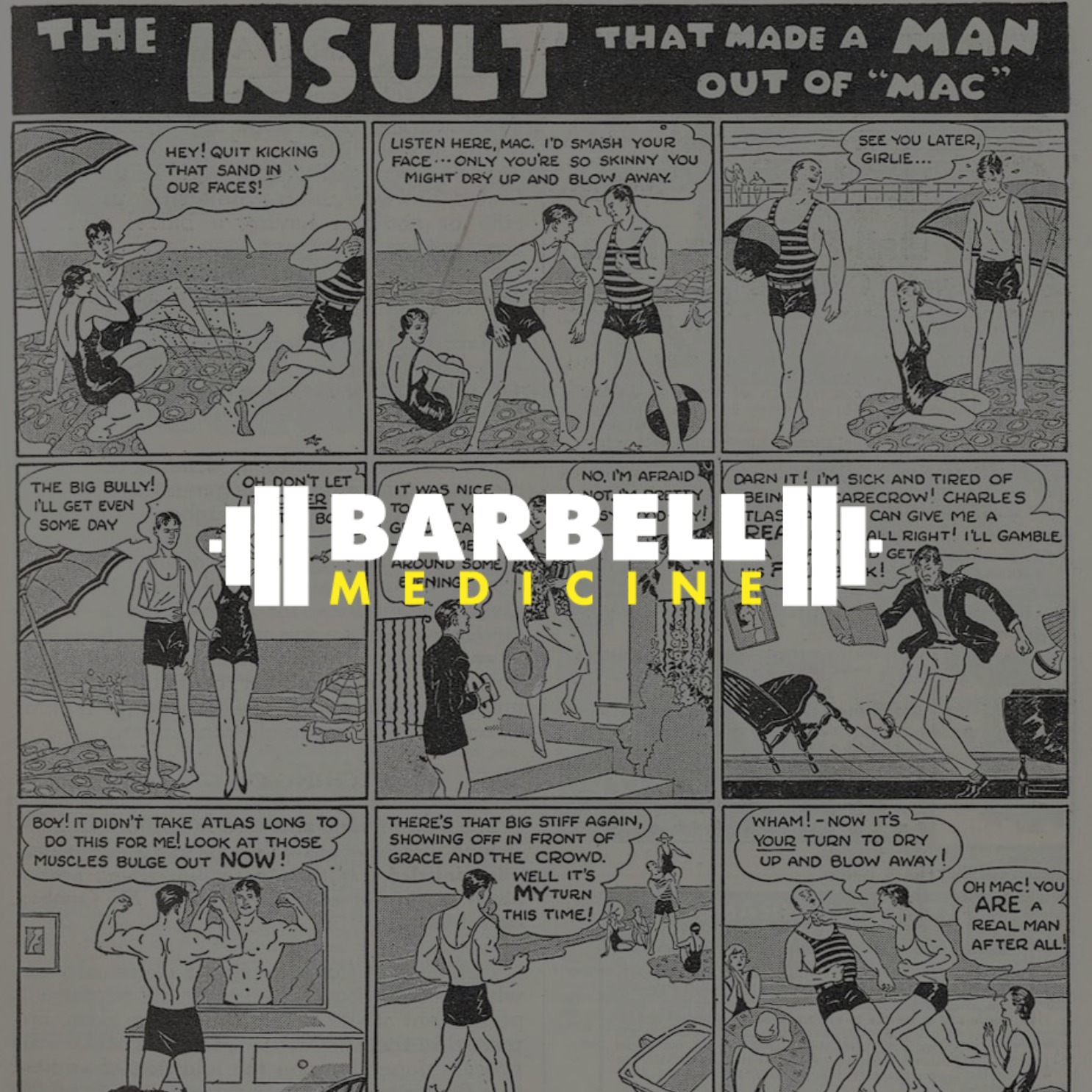
[SPEAKER_00]: You've certainly heard some of this stuff before. [SPEAKER_00]: You're also told to get out of bed the instant you wake up because that's willpower training, and there are even face exercises where you'd blow your cheeks full and push your tongue into them. [SPEAKER_00]: Perhaps the most memorable portion of the Charles Atlas dynamic tension method, which is what we just described, was the advertisement that started it all.
[SPEAKER_00]: The insult that made a man out of Mac. [SPEAKER_00]: It starts with a skinny guy on the beach with his girl when a bully kicks sand in their faces. [SPEAKER_00]: The skinny guy tells him to stop and the bully says, listen here, I'd smash your face only your so skinny you might dry up and blow away.
[SPEAKER_00]: Dejected, Max says, I'll get him some day, and he sends away for the course, comes back, Jacked, obviously drops the bully, and the last panel is the girl saying, Oh, Mac, you are a real man after all. [SPEAKER_00]: This had ran for about 50 years, and it worked. [SPEAKER_00]: Selling over 400,000 courses by 1942, 40,000 new students a year at its peak, and had ads in more than 400 publications.
[SPEAKER_00]: With 29 employees at their New York office, [SPEAKER_00]: As far as the dynamic tension method goes, Atlas said the idea came to him by watching a lion stretch at the zoo. [SPEAKER_00]: Muscle stretching habits of animals now are standing. [SPEAKER_00]: This is the same theme we've seen before and it repeats with Charles Atlas.
[SPEAKER_00]: He built his body with barbells and dumbbells but sold something else. [SPEAKER_00]: Around the same time this was happening, the term muscle bound had entered the lexicon. [SPEAKER_00]: Historian Terry Todd went through hundreds of sports and training books published between 1900 and 1960 and found that almost everyone either warned against lifting or ignored it completely.
[SPEAKER_00]: In the 1930s, a physical education student at Ohio State named John Capretta went looking for an actual definition for muscle bound. [SPEAKER_00]: He mailed a questionnaire to 45 [SPEAKER_00]: 22 wrote back with only 7 attempting to define the term muscle bound, and all 7 disagreed with each other.
[SPEAKER_00]: The only thing a majority did agree on was that it had something to do with having big muscles, which just describes who was getting accused of being muscle bound. [SPEAKER_00]: Not one of them questioned whether the condition existed, but the concern lived on nonetheless. [SPEAKER_00]: In February of 1940, the most distinguished physiologist at Springfield College, which was the most important physical education school at the country at the time, told a reporter that one of the great tasks that faces Springfield College is to fight these muscle builders.
[SPEAKER_00]: His name was Peter Carpevic, he called him Quacks and Fades. [SPEAKER_00]: There was an undergraduate there named Frazier Ferguson, who subscribed to Bob Hoffman's magazine, who was also the owner of York Barbell, and he was tired of being told in class that lifting would ruin him. [SPEAKER_00]: And he talked the student forum into inviting Hoffman to speak.
[SPEAKER_00]: So, Hoffman comes to Springfield College a few months later, bringing two of the best lifters in America at the time. [SPEAKER_00]: John Davis and Tony Terlazo, to do the Olympic lifts for the audience. [SPEAKER_00]: The campus paper notes the ease in which these men tossed around 300 plus pounds.
[SPEAKER_00]: Then, John Grimmick, the reigning Mr. America, came out and did poses. [SPEAKER_00]: And in the paper's words, he certainly appeared to be the very embodiment of the muscle bound athlete. [SPEAKER_00]: Then, they took questions, and Carpavich raises hand. [SPEAKER_00]: In Carpavich's own account of it, he said, I sweetly asked Mr. Hoffman to ask Mr. Grimmick to scratch his back between his shoulder blades.
[SPEAKER_00]: Grimmick said, but my back doesn't itch? [SPEAKER_00]: and then he scratched it from above and from below with both hands. [SPEAKER_00]: Carpavich sat down. [SPEAKER_00]: John Davis got up and did it too. [SPEAKER_00]: At which point Carpavich said the audience roared with laughter at my expense.
[SPEAKER_00]: Grimic, who was talking about this in 1993, said that once he'd done all the scratching that Carpevic wanted, he figured he'd show him who was muscle bound. [SPEAKER_00]: He dropped into a full split all the way down and then leaned forward with his leg straight until his elbows nearly touched the floor.
[SPEAKER_00]: Davis finished the afternoon doing a standing back flip with 50 pound dumbbells in his hand. [SPEAKER_00]: In 1990, the historian and powerlifting couple of referenced a few times so far, the Todd's went back to Springfield during an alumni weekend and picked five men at random who had been students in 1940.
[SPEAKER_00]: Every one of them remembered that afternoon. [SPEAKER_00]: One of them said it was like finding out that black was white and up was down. [SPEAKER_00]: Carpavitch changed his mind, and then he spent the next decade building a contraption that would test it. [SPEAKER_00]: It sort of looks like an arm-agometer.
[SPEAKER_00]: You know, one of those machines you crank with your hands, it had an automatic timer built in to detect how quickly someone was turning the crank. [SPEAKER_00]: In 1951, he and a master student named William Zorbus, time 600 young men cranking one arm through 24 full circles, half of them were lifters, and the other half had never touched a weight.
[SPEAKER_00]: the lifters were faster. [SPEAKER_00]: Mind you, this was a full 72 years after Blakey and the horse stuff. [SPEAKER_00]: Five years after that, Carpavitch co-wrote the first science-based book on weight training in America, and his co-author was Jim Murray, the editor of Bob Hoffman's magazine.
[SPEAKER_00]: Murray said afterward that Carpavitch's name on the covers what made the book acceptable as a textbook, and reassured coaches that it wouldn't hurt their athletes to lift. [SPEAKER_00]: So that settled, [SPEAKER_00]: In 1960, nine years after the test, a conditioning book from the U.S. [SPEAKER_00]: Naval Institute recommended a few wall pulley movements and no free weights at all.
[SPEAKER_00]: And in 1963, 12 years after the test, Todd interviewed Frank Madonna, the trainer at the University of Texas, who held that nobody needed more than 50 pounds in any exercise no matter how big they were. [SPEAKER_00]: The test came back and it took more than a decade to reach the people printing the books.
[SPEAKER_00]: And while that was happening, the myth moved to a new body part. [SPEAKER_00]: In 1961, Carl Klein, a professor at the University of Texas, not sure why this is all happening in Texas. [SPEAKER_00]: Well, he reported that lifters, who squatted below Parallel, had looser knee ligaments than men who didn't lift.
[SPEAKER_00]: And he recommended keeping the squat at Parallel or above. [SPEAKER_00]: Now, he measured that looseness with an instrument he designed and built himself, which was never validated to detect new laxity or changes in the ligaments of the need at all. [SPEAKER_00]: But that didn't matter much, because sports illustrated ran the story in 1962, and every branch of the American military dropped the deep squat, and parallel became the new ceiling in coaching and physical education for a generation.
[SPEAKER_00]: If you have ever been told that squatting deep will wreck your knees, this may have been where it came from. [SPEAKER_00]: Twenty-three years later, Terry Todd published a takedown in the Journal of the National Strength and Conditioning Association, the same organization that gives out the CSC residential.
[SPEAKER_00]: He went after the methodology, the measurements, and the homemade device of clients. [SPEAKER_00]: But that's not even the best part. [SPEAKER_00]: Todd had just come back to the University of U Guested, Texas, as a faculty member, and Klein was still on staff in the same department. [SPEAKER_00]: They were colleagues, imagine the break room.
[SPEAKER_00]: The day it would go on to support Todd's takedown. [SPEAKER_00]: In 1989, a study put a hundred college students through eight weeks of full or half squats and found no consistent effect on knee stability. [SPEAKER_00]: And the power lifters and weight lifters tested alongside them came out tighter with respect to their knees than the controls.
[SPEAKER_00]: In 1994, 32 professional football players did 21 weeks of heavy squats and showed no increase in knee laxate at all. [SPEAKER_00]: Over 30 years after clients initial report in the sports illustrated article. [SPEAKER_00]: So was there anyone that wasn't running a grift in these years? [SPEAKER_00]: Sort of.
[SPEAKER_00]: Bob Hoffman, the founder and owner of York Barbell, sold Barbell's weights and even versions of Iron Boots that Dr. Delorum was using in his practice. [SPEAKER_00]: But he was every bit the marketer of these other men were. [SPEAKER_00]: His protein powder was advertised as the product of a world-famous food research laboratory with chemists and doctors.
[SPEAKER_00]: And the copy said, we never leave anything to chance. [SPEAKER_00]: Hoffman's own managing editor washed him make this stuff. [SPEAKER_00]: He ordered in some Hershey's chocolate and stood there, stirring it into a drum of soybean flour with a canoe paddle, tasting it and saying, Yuck, nobody will buy that.
[SPEAKER_00]: And then subsequently he'd mix in some more Hershey's chocolate. [SPEAKER_00]: He probably should have stuck to barbells. [SPEAKER_00]: While all of that was happening in the gyms and in the coaching manuals, physicians were running physical education in America. [SPEAKER_00]: 11 of the first 12 presidents of the National Physical Education Association were doctors.
[SPEAKER_00]: In 1887, a physician at Penn wrote that exercise was by far the most important therapeutic and hygienic agency at the command of the physician of today. [SPEAKER_00]: It could be prescribed, he said, on as rational a basis as any of the drugs in the pharmacopeia. [SPEAKER_00]: That's a doctor basically saying that exercise is medicine 120 years before the public health campaign using the same slogan.
[SPEAKER_00]: By the way, if you're on slogan count, now we're up to three. [SPEAKER_00]: Strength is health, weakness is a crime, don't be a criminal, and now exercise medicine. [SPEAKER_00]: Well, two things ended this sort of physician-led physical education. [SPEAKER_00]: In 1910, Abraham Flexner inspected all 155 American medical schools, he found that most of them were businesses with no labs and no hospital affiliation, and he recommended closing 120 of them.
[SPEAKER_00]: As a result, medical training got longer and more scientific, resonancies and specialties arrived, and most of the teachings centered around preventing disease not curing it. [SPEAKER_00]: At the same time, physical education stopped being about health and started being about games, mostly because basketball arrived.
[SPEAKER_00]: So schools went on a gym building spree, and the rooms that had been full of measuring equipment, filled up with courts, and bleachers. [SPEAKER_00]: To coach a sport, you don't need a doctor, which is how a field founded by doctors ended up being staffed by coaches, but inherited their opinions of barbells from men selling chest [SPEAKER_00]: There was one doctor who went against all of this, and you're probably familiar with them if you've read our progressive overload series.
[SPEAKER_00]: Thomas DeLorm had gotten rheumatic fever as a teenager in Alabama, and while he was sick, he spent his time in bed reading a weightlifting magazine. [SPEAKER_00]: He built weights out of small train wheels when he was able to, and despite being told that his heart couldn't handle anything's strenuous, he lifted them anyway.
[SPEAKER_00]: And then he went to medical school. [SPEAKER_00]: In 1944, the Army sent him to a hospital in Chicago that had previously been a hotel before the military took it over, and it was now overflowing with wounded soldiers. [SPEAKER_00]: At the time, the standard rehab was rest, heat, and light exercise with lots of repetitions, and the soldier would typically spend six to nine months in therapy after surgery.
[SPEAKER_00]: One of the launch patients, a sergeant who had torn two ligaments in his knee after landing a parachute jump, had done all of that for more than six months, and was told, look, you're going to have to wear a brace on your knee for the rest of your life. [SPEAKER_00]: DeLorm, instead, had him lift the heaviest weight he could handle for 10 reps for 7 sets, adding weight as he got stronger.
[SPEAKER_00]: Specifically, he said, once you can master these weights, you should go up. [SPEAKER_00]: Within a month, the knee was noticeably better. [SPEAKER_00]: In 1945, after a visit from the surgeon general's office, the Army ordered all of its therapists to use DeLorm's heavy resistance protocol on orthopedic patients.
[SPEAKER_00]: Three years later, he cut seven sets of 10 down to three sets of 10, which you may be familiar with. [SPEAKER_00]: At the time, he wrote that fewer repetitions let patients train with heavier weights, and he renamed the method. [SPEAKER_00]: Heavy resistance exercise became progressive resistance exercise.
[SPEAKER_00]: And according to the historians who wrote the story, that name came from his wife, Eleanor, because she worried that physicians would probably be uncomfortable with recommending heavy weight lifting. [SPEAKER_00]: So, if a coach or a physical therapist has ever given you three sets of 10, now you know where it came from.
[SPEAKER_00]: American Medicine mandated heavy lifting across a hospital system in 1945, but the culture afterwards went somewhere else entirely. [SPEAKER_00]: In 1954, a physician named Hans Krauss and his research assistant Ruth Hirschland published the results of six past fail movements. [SPEAKER_00]: One was a sit-up with straight legs, another one was a sit-up with bent legs, another one was a leg hold where you'd lie, flat on your back with your hands behind your neck, and you'd lift your legs straight up, tend inches off the floor and hold for 10 seconds.
[SPEAKER_00]: There was another one that was upper back hold, where you'd lie face down over pillow, with your hands behind your neck, and with your feet held down, you'd lift your chest, head and shoulders off the ground, and hold that for 10 seconds. [SPEAKER_00]: There was also a low backhold and then finally a standing toe touch.
[SPEAKER_00]: Now, this test was administered to about 4,300 American school-aged children and about 2,900 school-aged children in Austria, Italy and Switzerland. [SPEAKER_00]: 58% of the American children failed at least one of the six tests, whereas only 9% of the European children did. [SPEAKER_00]: Two years later, Eisenhower created the president's council on youth fitness, and the executive order creating it refers to recent studies, both private and public, that revealed disturbing deficiencies in the fitness of American children without naming a single one of these studies by the way.
[SPEAKER_00]: But notice what nobody measured in any of these tests, which is strength. [SPEAKER_00]: How much weight could anybody actually lift? [SPEAKER_00]: In the 1950s, a British epidemiologist named Jerry Morris looked at London's double Decker buses, where the driver's saddle shift and the conductor's climb the stairs collecting fares.
[SPEAKER_00]: Among men under 50, the conductor's had about a third the rate of sudden death from heart disease. [SPEAKER_00]: In 1968, a physician named Kenneth Cooper gave Endurance exercise a name with the book called A Robix. [SPEAKER_00]: 10 years later, the American College of Sports Medicine published its first position statement on how much exercise adults needed, and it covered cardiovascular fitness, and body composition, and nothing else.
[SPEAKER_00]: The Surgeon General's report in 1996 says most of the exercise advice given to the public between 1978 and 1990 was based on that statement and that many people over interpreted as guidance for overall health. [SPEAKER_00]: Resistance training didn't get added to those recommendations until 1990, 45 years after Thomas DeLorum and his three sets of 10.
[SPEAKER_00]: The most modern example of a grouping told not to lift is kids. [SPEAKER_00]: We let a 10-year-old put on a helmet and run full speed into another 10-year-old and nobody blinks. [SPEAKER_00]: But if you suggest that that same kid could pick up a barbell with his dad standing right next to him, somebody will tell you he's too young because he's still growing and therefore it's dangerous.
[SPEAKER_00]: Both of those can't be right, so I went and looked but where this whole thing started. [SPEAKER_00]: Let's start with a now debunked myth that lifting heavy weights can stunt a kid's growth. [SPEAKER_00]: Now, there are two claims in there. [SPEAKER_00]: One is that a growing child can injure their growth plate or epiphysial plate lifting weights, which is possible and does happen, albeit rarely.
[SPEAKER_00]: The other claim is that lifting makes you shorter as an adult. [SPEAKER_00]: So let's unpack both of them. [SPEAKER_00]: As far as I can tell, no professional organization has ever said that lifting weights can stunt a child's growth. [SPEAKER_00]: In all of the American Academy of Pediatric Publications on exercise counseling and recommendations, they never even say the words stunt, stature or adult height, save for the 2020 report that put the idea in a table of common myths and misconceptions.
[SPEAKER_00]: However, 30 years beforehand, in the 1990 report, they wrote that kids are at risk of growth plate fractures with heavy weightlifting, and that they should wait until skeletal maturity, because during the growth spur, the growth plates appear to be especially vulnerable to injury. [SPEAKER_00]: They cite an orthopedic textbook as their source, which says the same, but provides no data for the claim.
[SPEAKER_00]: I'm not sure that this actually drove the popular idea that kids shouldn't lift weights, because as you all know, very few people actually read the guidelines [SPEAKER_00]: still, it probably didn't help. [SPEAKER_00]: It would be another 11 years, in 2001, where the same organization is writing that strength training programs do not seem to adversely affect linear growth.
[SPEAKER_00]: The best answer I can find on why many people believed, and in some cases, still believe, that lifting consent of child's growth, and therefore should avoid it, comes from one of my favorite researchers in this field, who also happens to have a similar last name to me. [SPEAKER_00]: In 2003, Avery Faganbaum, writing for the president's council and physical fitness, wrote that the likely origin of the concern comes from a Japanese study done in the 1960s, called obstructed growth of children's bones due to excessive labor in remote corners.
[SPEAKER_00]: It's about child manual labor in rural Japan. [SPEAKER_00]: Kids hauling loads all day every day, in places where there also wasn't a lot of food, which Faganbaum plags himself as an issue since poor diet is a big risk factor for stunt to growth. [SPEAKER_00]: Whether or not that report got picked up by the mainstream media and caused the belief that lifting stunt and growth?
[SPEAKER_00]: I don't know. [SPEAKER_00]: I'm of the opinion that the belief is much older and comes from something much simpler. [SPEAKER_00]: Most competitive weight lifters and bodybuilders are short compared to traditional sport athletes. [SPEAKER_00]: It seems more likely to me that people just assume cause and effect rather than reading obscure papers and position stance.
[SPEAKER_00]: Now, as far as growth plate injuries go, these do happen in kids and they mostly show up in case reports where there's an accident and the kid drops a weight on himself. [SPEAKER_00]: That is the most common way kids injure themselves during exercise, accidents, which we know from emergency room data.
[SPEAKER_00]: Using a national system that counts injuries treated in emergency departments in a single year, it logged almost 23,000 injuries attributed to weightlifting or weight equipment in people aged 8 to 19. [SPEAKER_00]: In this group, about 75% of the injuries are from dropping a weight on a finger or a toe or tripping over the equipment.
[SPEAKER_00]: In any case, the recommendation for children and lifting weights back in the early 2000s was that pre-adolescence and adolescents should avoid competitive weightlifting, powerlifting, bodybuilding, and maximal lifts until they reach physical and skeletal maturity. [SPEAKER_00]: In 2008, the recommendation was updated to remove competitive weightlifting from the list, and the same document says appropriate strength training has no apparent adverse effect on linear growth or growth plates.
[SPEAKER_00]: The next year, the National Strength Conditioning Association writes that injury to the growth cartilage has not been reported in any prospective youth resistance training study. [SPEAKER_00]: By 2020, the prohibition has gone completely and the claim is in the myth table. [SPEAKER_00]: Other myths that current guidelines on the resistance training address include the idea that children are unable to increase strength before puberty, noting that the strength gains have been demonstrated with low injury rates and are primarily mediated through neurological mechanisms.
[SPEAKER_00]: There's also no explicit recommendation against weightlifting, powerlifting, bodybuilding, or maximum lifting period, as the guideline states, one rep max testing can be safe in this population, and complex movements like the snatch and the clean and jerk from Olympic weightlifting can be incorporated safely too.
[SPEAKER_00]: The injury numbers were never scary in the first place anyway. [SPEAKER_00]: The available evidence puts the injury rate from resistance training in kids under two injuries per thousand hours. [SPEAKER_00]: Youth distance running is around six. [SPEAKER_00]: Soccer is higher than that, and context sports are higher still.
[SPEAKER_00]: Which puts us back on the football field. [SPEAKER_00]: The tackle football sign-up sheet starts at around age five in the US. [SPEAKER_00]: Meanwhile, most commercial gyms won't let a kid under 13 through the door. [SPEAKER_00]: Guidelines and popular beliefs aside. [SPEAKER_00]: That's the real problem.
[SPEAKER_00]: Now, on the other end of the life spectrum in older age, the advice was also to avoid lifting weights. [SPEAKER_00]: But then, in 1990, a research group put 10 frail nursing home residents with an average age of 90 through eight weeks of high intensity resistance training. [SPEAKER_00]: Nine of them finished, and their strength went up about 174% and the muscle cross-sectional area in the middle of their thighs went up nine percent.
[SPEAKER_00]: Four years later, that same research group ran a larger version, a randomized trial in 100 nursing home residents with an average age of 87. [SPEAKER_00]: Strength went up 113% in the people who trained against 3% in the people who didn't, and their walking speed and stair climbing power also both improved.
[SPEAKER_00]: In those papers, the introduction tells you where the field was at the moment. [SPEAKER_00]: Disuse and undernutrition are often cited as potentially reversible causes of frailty in elderly people. [SPEAKER_00]: And the effectiveness of interventions aimed at them had not been carefully studied.
[SPEAKER_00]: Now the problem is nobody was telling these people to exercise. [SPEAKER_00]: And it wasn't until 1990 that the exercise positions stand finally added resistance training to the American exercise prescription. [SPEAKER_00]: And even then, they say that although age in and of itself is not a limiting factor to exercise training, a more gradual approach at older ages seems prudent, which [SPEAKER_00]: OK, but this assumes that people actually read the guidelines and that we didn't have any data at the time on older individuals lifting heavy, which were those two studies I just told you about.
[SPEAKER_00]: Those people were lifting very, very heavy at very old age. [SPEAKER_00]: And now we're telling them to be prudent. [SPEAKER_00]: If anything, I'm worried about underdosing here. [SPEAKER_00]: And it took way too long to tell everyone that they needed to live weights. [SPEAKER_00]: Women got a different version of the whole don't lift too much thing, and unlike the rest, it's mostly still here.
[SPEAKER_00]: Everything we've covered so far was a claim about what your body would do and then science come in and showing that that was all wrong. [SPEAKER_00]: This one is about what would happen to women and what they'd look like if they lifted, and despite the science coming along, people still believe it.
[SPEAKER_00]: Don't lift too much or too heavy, you'll get bulky. [SPEAKER_00]: Where did that come from? [SPEAKER_00]: Remember Dudley Sargent, the physician who ran the gymnasium at Harvard, the one who popularized Blakey's light dumbbells. [SPEAKER_00]: In 1912, he wrote an article for a women's magazine called R Athletics Making Girls masculine.
[SPEAKER_00]: He said yes. [SPEAKER_00]: He wrote that a woman could not succeed at heavy gymnastics without reducing the birth of her hips and thighs, and increasing the development of her arms chest and upper back. [SPEAKER_00]: She could not succeed at rowing or at handling heavy weights without broadening the waist and her shoulders.
[SPEAKER_00]: All forms of athletic sports in his words tend to make women's figures more masculine. [SPEAKER_00]: As you probably guess, then comes the prescription. [SPEAKER_00]: All of the apparatus used and the weights lifted, he says, should be modified to meet her limitations. [SPEAKER_00]: That's the pink dumbbell thing for Tony in 1912.
[SPEAKER_00]: From a doctor who was the head of physical education or Harvard, who would already talk men into light dumbbells 30 years before. [SPEAKER_00]: 60 years later, in the 1970s, Arthur Jones invented nautilus, the selectorized machines that were designed to match the strength curve and biomechanics of humans.
[SPEAKER_00]: In his own bulletin, Jones writes that women should do almost all of the same exercises that men do and can do without the danger of building huge muscles. [SPEAKER_00]: And then says that the specific danger simply does not exist in the case of a normal woman. [SPEAKER_00]: Then he goes further, saying that the average woman could not build large muscles if her life depended on it.
[SPEAKER_00]: And yet, in the same chapter, he introduces a machine for the buttocks and the upper thigh saying that most women aren't anxious to make their thighs bigger, but he says that it's a little or no use to a man and then he writes that women should train more than men, but not as hard. [SPEAKER_00]: about 15 years later in the late 80s, somebody finally fact-checked this idea.
[SPEAKER_00]: Curitan and colleagues put men and women through 16 weeks of heavy training using the same program and measured the growth of the arm with a CT scanner, which is very accurate. [SPEAKER_00]: The relative gains in muscle size and strength came out the same in both groups, where they both increased the size of their existing arm muscles by about 20% on average.
[SPEAKER_00]: Because the men started with more muscle mass, however, the men gained more in absolute terms. [SPEAKER_00]: The physiology here is that male puberty builds a bigger skeleton with more muscle on it, so a man starts with more muscle mass and as a result adds more in absolute terms. [SPEAKER_00]: Nevertheless, when you put a man in a woman on the same exercise program, they improve by about the same percentage, women just typically start with less muscle mass.
[SPEAKER_00]: You're probably sick of me saying this by now, but you know it's coming. [SPEAKER_00]: Most people don't read academic journals, so this paper didn't up end the conventional wisdom. [SPEAKER_00]: People still thought women could get bulky if they lifted too much, and the question is why.
[SPEAKER_00]: In that era, we can start with sports. [SPEAKER_00]: Through the 1970s and 80s, women's records were basically in free fall for a lot of events, with record after record getting smashed. [SPEAKER_00]: So much so that the gap between men and women looked like it was closing, and some pundits thought that women were actually going to surpass men.
[SPEAKER_00]: Did women discover some new training technique? [SPEAKER_00]: Was this a war on men's records? [SPEAKER_00]: No, it was PDs. [SPEAKER_00]: Out of competition testing became a standard at the end of the 80s, and in some of those events where the records were smashed, they're still standing from that era.
[SPEAKER_00]: You can still measure this effect in power lifting. [SPEAKER_00]: You can compare the top untested lifters to the top tested lifters, and there, the three lift totals are about 7% higher in untested men compared to the tested men and closer to 12% higher in untested women. [SPEAKER_00]: Some of that isn't drugs to be fair because untested federations tend to use 24-hour weigh-ins, so people will compete well above the class they weighed in for, and the equipment rules also differ between the federations, and, of course, some tested lifters are using anyway.
[SPEAKER_00]: When testosterone is higher than the body's own natural level, in men or women, there's a dose-dependent relationship between it and muscle. [SPEAKER_00]: In other words, more testosterone means more muscle, but inside the normal range, it doesn't really do that because there are multiple redundant mechanisms in place that limit growth until testosterone is much higher, superficialogical levels.
[SPEAKER_00]: But drugs aren't the whole answer anyway, because you also see women who are obviously training hard, who are very muscular, but who aren't on anything. [SPEAKER_00]: That's selection bias. [SPEAKER_00]: Generally speaking, people who carry a lot of muscle mass, who are strong, or very fast, or have other, will call them unique features, and up in sport that reward these idiosyncrasies.
[SPEAKER_00]: Sport didn't make the people this way as much as it identified people with these predispositions. [SPEAKER_00]: Take basketball. [SPEAKER_00]: No one would argue that basketball makes people taller, but rather that taller people self-select into the sport for obvious reasons. [SPEAKER_00]: The average height in the NBA is six foot eight, whereas the average American man's height is five foot nine.
[SPEAKER_00]: It's six foot one for the WNBA and five foot four in the gen pop, but no one is telling women not to play basketball because it'll make them too tall. [SPEAKER_00]: Sport also tends to identify people who respond extremely well to training, which happens in women too. [SPEAKER_00]: A 2005 study from Hubble and colleagues trained one arm in 585 people, where 342 of them were women.
[SPEAKER_00]: They did it for 12 weeks, and then they measured the bicep size with MRI. [SPEAKER_00]: The change of muscle size ranged from minus 2 percent to plus 59 percent, and their strength [SPEAKER_00]: The people at the top of those ranges respond to training in a way that almost nobody else does, and those are the people who end up in sport typically, if the sport selects for that.
[SPEAKER_00]: So these freaks, which I say with jealousy and admiration, often start with more muscle than average, and they add more of it than average. [SPEAKER_00]: So when you're looking at a muscular athletic woman, you're looking at an outlier, not the typical response to lifting weights. [SPEAKER_00]: And some women who aren't outliers and aren't on anything at all still put on visible muscle from training, because that's what training does.
[SPEAKER_00]: The weird part of this whole idea is that muscle on a woman reads as masculine in the first place. [SPEAKER_00]: Throughout history, the norms of body size, shape, and aesthetic have changed. [SPEAKER_00]: For women specifically, I don't know how far back this goes, but even in the Victorian era, muscularity signal that someone was probably in the lower class at that time.
[SPEAKER_00]: I'm not sure if there was ever a time, especially in recent history, where muscles and strength on women were as celebrated as they are now, and it's still not great, unfortunately. [SPEAKER_00]: It seems unlikely that what Dr. Sargent was selling in 1912 was the first time that someone told women that muscles were masculine, but it certainly wasn't the last time, as some people still do it today, which is a real shame.
[SPEAKER_00]: And you can see the problem here by looking at how long it took the institutions to catch up. [SPEAKER_00]: Men's weightlifting was on the program at the very first modern Olympics in Athens in 1896. [SPEAKER_00]: Women's weightlifting didn't get there until Sydney in 2000 over 100 years later.
[SPEAKER_00]: And before you tell me, well, that's just how the Olympics were when it came to women. [SPEAKER_00]: Well, that's not true. [SPEAKER_00]: Women swam at the Olympics in 1912. [SPEAKER_00]: They ran track in 1928, but the two sports that held out the longest were weightlifting until 2000 and boxing until 2012, which happened to be two of the most obvious strength sports.
[SPEAKER_00]: Powerlifting did a lot better, but it is a younger sport than Olympic weightlifting, which certainly affected the timeline, but put them side-by-side in the dates are impressively bad. [SPEAKER_00]: The International Weightlifting Federation was founded in 1905, but did not have a women's world championship until 1987, took 82 years.
[SPEAKER_00]: The International Powerlifting Federation, or IPF, was founded in 1972, and women had a world championship eight years later in 1980. [SPEAKER_00]: And weightlifting's own former director general would later say that before the 1980s, the Federation's Constitution described weightlifting as a sport for men only.
[SPEAKER_00]: The National Strength and Conditioning Association didn't even publish a position stand on women and resistance training until 1989. [SPEAKER_00]: I discuss this and more in detail in the second episode of our Menopause series, which is linked in the show notes below. [SPEAKER_00]: this goes on into pregnancy.
[SPEAKER_00]: Before there were guidelines on exercise and pregnancy, there was folklore dressed as medicine. [SPEAKER_00]: The theory was that exercise would steal blood away from the uterus towards the working muscles so the fetus would have to compete for oxygen and fuel and heat which would cause growth restriction or birth defects or worse.
[SPEAKER_00]: As one review puts it, other theories were developed during this time, however, none were ever proven. [SPEAKER_00]: In 1949, the children's bureau told pregnant women they could do housework, they could do gardening, and they could do a daily walk of up to a mile, but that they should avoid sports.
[SPEAKER_00]: Textbooks in the 50s and 60s warned against violent exercise, which, naming aside, the examples of violence were tennis, horse riding, swimming, and cycling. [SPEAKER_00]: Today I learned that cycling is violent. [SPEAKER_00]: You would think with the advancement of medicine that these recommendations would go away quickly, but that's not the case.
[SPEAKER_00]: In 1985 there was a guidance that we went over at the top of the show with the heart rate limit of 140 beats per minute and the 15 minute time cap that all came from expert consensus where experts doing a lot of heavy lifting. [SPEAKER_00]: The heart rate number took about 10 years to get out of the guidelines, and it took even longer till 2002 for the duration limit to come out of the guideline, and that got switched to 30 minutes of moderate activity on most days.
[SPEAKER_00]: Today, the current committee opinion says that in the absence of complications, physical activity in pregnancy is safe and desirable, and that concerns about miscarriage, poor fetal growth, injury, or premature delivery have not been substantiated. [SPEAKER_00]: Women with uncomplicated pregnancies should be encouraged to do aerobic and strength training exercise before, during and after pregnancy, and yet it is still under-recommended during pregnancy.
[SPEAKER_00]: One study found pregnant women got canceled on exercise less often than women who weren't pregnant. [SPEAKER_00]: About 17.9% of visits versus 22. [SPEAKER_00]: And of the ones who were canceled at all, 91% were never told the specifics. [SPEAKER_00]: How often they should exercise, how hard the effort should be, and what kind of exercise they should even do.
[SPEAKER_00]: Fortunately, we have good evidence showing that exercise during pregnancy is beneficial. [SPEAKER_00]: In the trials that have tested exercise on its own, women who exercise during pregnancy were about 40% less likely to develop gestational diabetes and about 40% less likely to develop high blood pressure during pregnancy.
[SPEAKER_00]: A 2025 analysis looking specifically at lifting weights across 50 studies found less gestational high blood pressure, less gestational diabetes, fewer perinatal mood disorders and fewer incidences of macrosomia. [SPEAKER_00]: That's very large babies. [SPEAKER_00]: Now, unfortunately, the authors of that review pointed out that the programs that were studied were mostly light to moderate as far as logos or otherwise poorly described.
[SPEAKER_00]: So, in 2025, a study took 10 pregnant women through barbell squats, bench presses, and deadlifts at 90% of a 10 rep max, including a set where they deliberately held their breath under load, which is the thing that the old guidelines and many old lives tales were worried about. [SPEAKER_00]: That's the Valsalva maneuver.
[SPEAKER_00]: Fetalbraida Cardia, meaning a slowed fetal heart rate, was not observed, and fetal heart rate did not change from before to after the lifts. [SPEAKER_00]: Everyone did fine. [SPEAKER_00]: One interesting thing I noticed while putting together this episode is that people kept making claims about risks before there was any evidence to support it.
[SPEAKER_00]: In 1879, it was your back because Blakey's got stiff. [SPEAKER_00]: By the 1930s, it's that you'll be muscle bound and slow, like a horse. [SPEAKER_00]: After that, it's a generation of champion lifters who found something cheaper to male than iron. [SPEAKER_00]: And a few decades later, it's your knees because Carl Klein has a home-built device that says so.
[SPEAKER_00]: I guess that's not new because people are still doing the same thing now. [SPEAKER_00]: If your woman don't have heavy because you'll get bulky of weight training with high intensity because it'll spike your cortisol and don't do lots of barbell training, you'll hurt yourself. [SPEAKER_00]: Over a hundred years of warning people against lifting weights or lifting heavy in general and all without a shred of supporting evidence.
[SPEAKER_00]: Think about how we usually decide something is bad for you. [SPEAKER_00]: We say smoking causes lung cancer because somebody went and studied the thing. [SPEAKER_00]: Identifying that smoking causally increase the risk of tumors. [SPEAKER_00]: We say that pressure is the problem in high blood pressure because the pressure is what damages the artery causing the subsequent atherosclerosis.
[SPEAKER_00]: Somebody studied that too. [SPEAKER_00]: None of these warnings were built that way. [SPEAKER_00]: They were all based on vibes. [SPEAKER_00]: Somebody looking at lifting and decided it seems dangerous. [SPEAKER_00]: A big man looks like he'd be slow. [SPEAKER_00]: A deep squat looks like it was too much for the knees, whatever that means.
[SPEAKER_00]: A pregnant woman lifting, especially a barbell, looked alarming. [SPEAKER_00]: The evidence came after the fact, if it came at all. [SPEAKER_00]: And it mostly said the logical leaps were a step too far. [SPEAKER_00]: Which is probably why many of the corrections are not as popular as the myth.
[SPEAKER_00]: You can't retract a finding that never existed. [SPEAKER_00]: There's no paper to withdraw. [SPEAKER_00]: There's no data to reanalyze. [SPEAKER_00]: It mostly just gets discussed in academic circles, which mostly no one reads. [SPEAKER_00]: When the correction pops up too, it doesn't really change people's behaviors because the original advice worked in the sense that people took it.
[SPEAKER_00]: If you ask American adults today, do you lift weights? [SPEAKER_00]: Only about 30% will say, yes, I lift weights twice a week or more. [SPEAKER_00]: And if you try to measure it more accurately, that number goes down. [SPEAKER_00]: Now, it's okay to be risk-averse and say you have concerns when there's little data available.
[SPEAKER_00]: In this context, however, the caution only ever ran against lifting. [SPEAKER_00]: Nobody ever thought or discussed the risks of not lifting or of only lifting light weights for a lifetime. [SPEAKER_00]: So when the next caution arrives, don't ask whether it sounds plausible, ask, where's the evidence?
[SPEAKER_00]: And what are the risks from doing the thing the caution advises against? [SPEAKER_00]: Here's a relatively new one that's been showing up as a curve on a graph. [SPEAKER_00]: Everybody knows that lifting can improve health, but the new caution is that lifting too much can be risky. [SPEAKER_00]: In 2022, a group of researchers combined 16 studies on strength training and the risk of dying and found that people who lifted were less likely to die with the biggest drop being somewhere between a half an hour to an hour of lifting per week.
[SPEAKER_00]: pass that point, the curve or the benefit started to get smaller, nearly getting back to the same level as people who weren't lifting it all in those who lifted for hours upon hours each week. [SPEAKER_00]: That's next week's episode. [SPEAKER_00]: And to address it, we're going to have to revisit a concept we've talked about a few times before when discussing testosterone, the saturation model.
[SPEAKER_00]: Yeah, de here is that every benefit you get from training has a point where training more stops getting you more benefit. [SPEAKER_00]: That's real for most training adaptations, but what almost nobody does is ask where the point actually sits and for what specific benefit, because there's not just one point.
[SPEAKER_00]: And when you think about it, there are really two questions in here stacked on top of one another. [SPEAKER_00]: The first question is, how much lifting does it take to change your body, whether that's [SPEAKER_00]: The second is how much your body has to change before your health stops improving.
[SPEAKER_00]: Where's that limit? [SPEAKER_00]: Those two can have different answers, and the answers are different again for each outcome you're tracking. [SPEAKER_00]: Does it make sense that building bone and building muscle have the same saturation point? [SPEAKER_00]: That's next week, along with where the lift twice per week recommendation actually came from, which involves a single exercise on a single machine and a worry about people quitting workouts that would take too long.
[SPEAKER_00]: For everyone here at Barbell Medicine, I'm Dr. Jordan Feigabam. [SPEAKER_00]: Thank you so much for listening. [SPEAKER_00]: Catch you next week, and every week right here on the Barbell Medicine podcast.
