

Kapitelklicken springt direkt hin
Shownotes
France is caught between two powerful forces: protesters demanding that the government protect public services and social benefits and a bond market that can’t stomach the idea of France’s deficit getting any larger.
But the fight over France’s budget is also reviving a longstanding debate at the heart of the euro zone: How much control does a country really have over its economic future when it shares a currency with its neighbors? On today’s Big Take podcast, Bloomberg’s John Stepek joins host Sarah Holder to discuss the competing forces shaping France’s financial future — and what’s at stake for the rest of Europe.
Read more:
• A Turning Point for France Looks a Long Way Off (bloomberg.com/news/newsletters/2026-10-22/mone…)
• A French Accident Waiting to Happen (bloomberg.com/opinion/articles/2026-10-23/a-fr…)
• French Bond Risk Falls Most Since 2020 as Downgrade Avoided (bloomberg.com/news/articles/2026-10-26/french-…)
Further Listening:
• French Bond Markets and AI Neoclouds Feel The Pressure (swap.fm/l/GfmTa1sMYjCWjsDJYsYA)
We have a special Bloomberg subscription offer for podcast listeners at Bloomberg.com/podcastoffer. (bloomberg.com/subscriptions/podcasts)
Host: Sarah Holder; Guest: John Stepek; Produced by Julia Press and Naomi Shavin; Edited by Tracey Samuelson; Engineering by Emma Munger.
See omnystudio.com/listener for privacy information.
Transkriptvom Podcast bereitgestellt · Zeitmarken springen hin
Bloomberg Audio Studios. Podcasts. Radio. News.
The fundamental reason why French bond yields are going up is because France spends too much money. And it's not showing any signs of reining that in. And the riots on the streets are just a political indicator. They show how hard it is to get this sort of thing done in France. So you can see how bond investors look at that and they say, well, this is not a country that is able to raise taxes or, you know, raise the pension age because the people out in the streets kind of setting the place on fire.
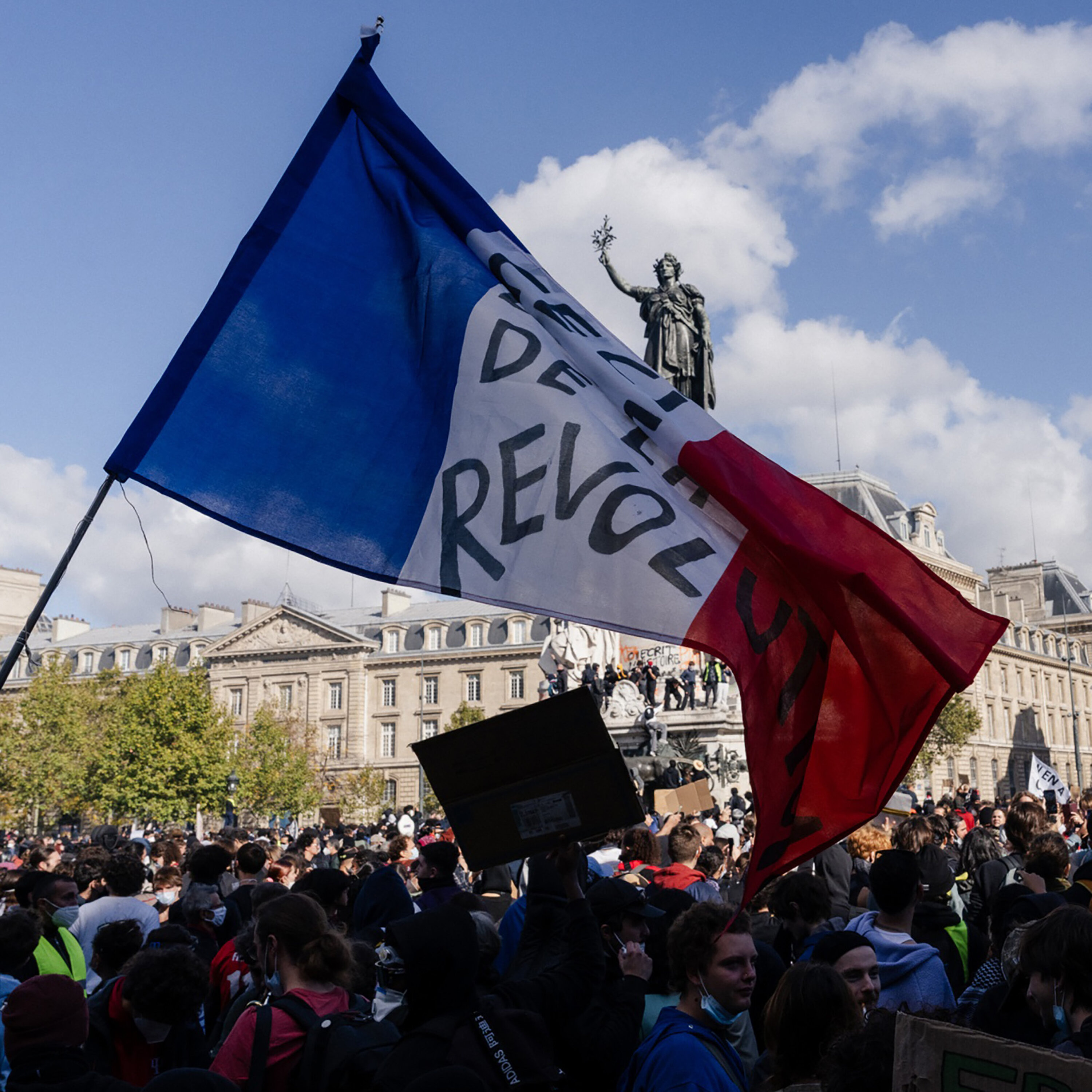
I'm Sarah Holder, and this is The Big Take from Bloomberg News. Today on the show, John Stepek, who writes Bloomberg's Money Distilled newsletter and co-hosts the Marin Talks Money podcast, on two clashing visions for France's fiscal future. Will its citizens or international investors get their way? And what does it all mean for the Eurozone? So, John, hundreds of thousands of protesters have been demonstrating across France this month.
They raised a number of issues, but a key driver is really the rising cost of living. Where is this sense of frustration coming from?
France, relative to other European countries, is kind of prone to civil disorder in a way that they relatively take for granted. Things like cars being set on fire is a kind of fairly traditional form of civil protest in France. And I don't mean that in a jokey manner. The extent to which they will go to the streets is more common than it is in, say, the UK.
Protests are a core part of the French cultural experience.
Yeah, absolutely. I mean, obviously, as their history demonstrates. But I think this time things are slightly or somewhat worse. And there are a number of reasons for that. But one of them is there's been political paralysis in France for a good few years now. France has struggled to pass budgets. Governments have fallen. And other than that, the protests are basically about the same things that everyone is upset about across the world. It's about the cost of living.
I mean, the proximate cause of these particular protests was schools. But it has kind of gone well beyond that. And I think the thing to take away is It's emblematic of France's political problems because basically voters in France don't want to pay higher taxes and they don't want the government to cut public spending. In fact, they want them to increase it. And that's very much similar to the kinds of things that voters around the world want. It's just that it's a bit more emphatic in France at the moment.
And is there an imminent concern among French voters that there will be cuts to public spending or higher taxes? Or is this more a desire for more spending?
Yeah, no, I mean, the fundamental problem is that France, you know, is it's It's not the worst sovereign debt balance sheet, but it's pretty bad. So France, the national debt is about 120% of the GDP. The deficit is about 5%, probably coming up to maybe 6% this year. So they're spending too much by European standards. The Eurozone rules kind of suggest that your deficit should be no more than 3%, so obviously we're well beyond that. So retirement age is probably... a good one to focus on because in France, you retire at the age of 62.
That's very low by developed world standards. It's pretty unusual to have that generous a retirement age. But obviously, once you have that, if taking it away is not something that most people are very happy about, so it's already been pushed back. But the point from an outside point of view, from an investor point of view, a bond market point of view, they turn around and look at this and they can see that although France obviously is a big economy, it's an important economy, it could deal with this if there was the political will and the political ability. But at the moment, all they see is, well, there isn't because the voters don't want it and the politicians essentially have their hands tied, basically.
Right. You're laying out sort of two pressures on France at the moment. There's the public who wants more government support or at least to preserve the government support they already have. And then you have investors who have become very concerned about about France's debt levels. How does France's debt, its budget deficits and the interest it's paying on that debt compared to other countries right now? Is it really that bad?
It's not, not relative to other countries. I mean, it's pretty bad. It is pretty bad, but it's not catastrophic. Let's be clear, it's pretty bad. I mean, obviously the US is unusually indebted and spending an unusual amount of money at the moment. And obviously nowhere is a problem on a debt-to-GDP basis like Japan. But Japan isn't undergoing anything like this. There are basically two fundamental issues with France that make it different. And one is the fact that it shares a currency with a load of other countries, and that means it doesn't have any control over its own currency. So it cannot adjust its monetary policy to offset the fact that it's got very loose fiscal policy.
So that's one thing. And the other issue is that Unlike a number of, if you like, kind of other problem countries in the Eurozone, like Italy is quite a good example, France shows no signs of politically changing direction such that it will cut its fiscal spending and that it will sort it out. Whereas, for example, Italy has made a lot of effort to get back on a kind of sustainable fiscal footing. And I think it's also that sense of political willingness to do so. It's very clear to people who are watching that between the riots and the political instability and the inability to keep a government for a good few years or to pass a budget, that France is not able at the moment to change direction.
The big thing that we focus on with borrowing costs within the Eurozone is the gap between the German 10-year bond yields of the Bund And the gap between the French 10-year bond yield, French ones are called OATs.
They call that Le Spread in France. Exactly.
This is called Le Spread. Forgive the accent. So the spread has blown out. So it's gone from being around about 50, 60 odd basis points to 0.6 of a percentage point. Close at the start, a couple of months ago, the all-time record was hit in the 2011 Eurozone crisis. At that point, that was all about Greece, but spreads with Germany blew out across the board. At that point, the French spread or list spread got to about 190 basis points.
And last week it went over 170 basis points. So it's getting there.
Yes, this week it got up to 170. Actually, to be fair, today it's come back a bit because Moody's on Friday actually didn't downgrade France's sovereign debt. But yeah, I mean, it's very high and it's the highest it's been since the Eurozone crisis. And it doesn't have very far to go before it actually breaches that point.
So it doesn't have the worst debt problem in the world, but France does have limited tools compared to other countries to get its borrowing costs under control. I do want to talk about why the Eurozone complicates things so much. In retrospect, it seems so obvious that this was going to be an issue, right? That every country in the Eurozone has the same currency, has the same monetary policy, but has different fiscal policy.
It was obvious at the time. Lots of people warned about this before the euro was even set up. And I think the way you have to understand it, I guess, is this push-pull factor. The eurozone is meant to be a step towards essentially full union. And that would be full fiscal union, full banking system union. It's essentially becoming the United States of Europe. But we're not there. And the euro was.
I guess, kind of a ratchet effect because now no one wants to leave the euro because that would cause all manner of financial havoc. And I think what we saw with Greece, for example, in 2011, that whole eurozone crisis was what happened. So Greece had its own way of doing things. That way was incompatible with remaining part of the euro. And fundamentally in 2015, the choice that the Greeks were given was you either vote for fiscal austerity and basically to have a depression for five years which is what they did or you can leave the euro and take your chances with the drachma again they're now doing a lot better um you know they did knuckle down and reformed an awful lot of things but it was painful i know the question is that's much
harder to do with a country like france which is so much power within the eurozone.
Yeah is france reaching a similar moment where they're where they might have to choose between those two futures, or is there a third path?
We're not there yet with the sort of chaos we saw with Greece. I think the main thing you have to watch out for is the tension and the stress in the French bond market getting to the point where it actually affects the French banking system and the insurance system, and that having a knock-on effect to other sovereigns in the Eurozone. And so far, that's not really happening. The other thing I think we have to remember is that the European Central Bank, before the Eurozone crisis, it was a more immature central bank. And it's a bit like, to be fair, it's a bit like the way the Fed.
So the Fed before 2008 did not have the power to just print money at will. You know, you had to get Hank Paulson kind of like running and begging on his knees in the front of US politicians, like, let us do this or the country's going to, you know, the whole banking system is going to collapse. And so the Fed acquired more powers. And then by the time we got to COVID in 2020, they were basically able to say, we're going to buy junk bonds. And they could just say it, you know, like Jerome Powell could just say, we're going to do what we want to stop this. The European Central Bank, through the Greek sovereign debt crisis, has effectively gathered a lot of the same powers.
There's a lot of things it no longer needs to ask permission for. And so, for example, it recently set up a mechanism called the Transmission Protection Instrument, the TPI. The whole point of this thing is that if there is a kind of tension in the bond markets that actually threatens the structure of the eurozone, or the financial system in the Eurozone, then ECB is allowed to buy as many bonds as it takes to bring yields down.
The question now is, are they going to find an excuse to use it or not? Right.
How is this more mature, more grown-up ECB weighing how and when to intervene in France right now?
Well, I mean, this is where it all comes back to the politics again, because they don't want things to blow up to the point where they have to make a big drama out of this. So really what the ECB needs, it needs the bond markets to be putting enough pressure on France to kind of, if you like, mend its ways. so that it doesn't have to weigh in and then try to get into a whole negotiation Greece style with it.
So the ECB is hoping that the bond market will do the job of reining in France for it?
I think that is a reasonable way to look at it, because the problem is you create a moral hazard. If the ECB just goes in right now and says, well, no, we can't have this. We need to buy enough French bonds to pull the kind of borrowing costs down to be the same as Germany's again. All that does is give France a kind of green card to just go ahead and keep on the kind of fiscal path that it's on. And the fiscal path that it's on is not sustainable. But the problem is if they don't step in and it does get to the point where bond yields spread out even more dramatically and it does start to become a problem for the rest of the Eurozone, then again, you have a much bigger crisis on your hands and they'd probably rather find some kind of middle.
Ground After the break, can France find a middle ground? Is it possible to control its debt without angering its residents? French voters will be electing a new president next spring. The current leading contender to replace President Emmanuel Macron is Marine Le Pen, a populist far-right candidate. Jean-Luc Mélenchon is challenging Le Pen from the left, and he's been one of the people galvanizing protesters. What are these candidates' competing visions for an economic future? And how might the election influence what kinds of actions the European Central Bank ends up taking?
Yeah, I mean... Marine Le Pen's economic vision is she has expressed concern about the size of the deficits. The problem is she has also expressed concern about the idea of raising the pension age. So there is a kind of having your cake and eat it thing going on with her and her party. So on the one hand, she sort of said we should have a rule about deficits, which is basically the same rule as the Eurozone already has.
She's doing that thing that parties do, whether it's on the left or the right, where on the right, all the savings are going to be made from magic spending cuts. So you're going to cut spending on those benefit claimants there and those immigrants there, and that's somehow going to make the sums add up. And on the left, I mean, Mélenchon has just been pretty straightforward. He's suggested that the French central bank just burn the French bonds that are outstanding from QE, basically, and reduce the debt that way. Now, obviously, just cancelling sovereign debt is not It's not a traditional fiscal option, if I can put it that way. So you can see why bond markets would be concerned about that.
I mean, the one thing I would say is that if it does end up being him versus Le Pen, she is very much the favourite. So I can see why, obviously, it's disturbing to hear a popular politician saying that they would just torch the national debt But it's unlikely that he'll end up being in charge.
Well, what options does the ECB have if France doesn't clean itself up on its own?
I guess that is then when you get to the point where you are kind of having a discussion with France as to, you know, we need to sort this out. I suspect what would happen, it would be a fudge. So what you would do is you would... Stop bonds from absolutely detonating by printing money to buy them. You'd have some kind of package, but the package would be contingent.
Because with politics, it's all about saving face. So there'd be a package of help, but it wouldn't be like the Troika mechanism with Greece, where there's these three institutions and they're telling Greece what to do. It would be like we're working with France to manage a transition towards a more sustainable fiscal path. Something along those lines.
And you're saying that would be a fudge, kind of like a fib. Yeah, absolutely. A messaging strategy that doesn't have much weight behind it.
It's got weight behind it, but the point is always about the presentation with these things. So what you need to do is have something that's a little bit more behind the scenes, a lot more diplomatic, whereby the Eurozone as a whole decides what it can tolerate. And France decides what it can tolerate, and they kind of work towards that together.
But what you're saying, John, is we're not at that moment yet.
No, we're not at that moment yet. It's worth keeping an eye out, though, because the problem is this contradiction, this flaw, this fundamental flaw, that you get a single currency, but you don't have a fiscal union, will always create these pressure points. And it will probably, I suspect that crisis by crisis, it will be a step towards ever closer union rather than completely shattering. But it does mean that the wider world also has to worry about this because obviously the Eurozone is a big economic area. And if it did splinter or the Euro did collapse, then obviously that has knock-on effects everywhere else as well.
Mm-hmm. Well, the French protest groups and unions have called for further demonstrations and a nationwide strike on November 5th. I am wondering, John, is there some way that the French government can or would, you know, concede on some of these points, like spend more on education, keep the retirement age where it is, but introduce a broader... policy of fiscal austerity or make cuts to other areas of the government? Is there a compromise path here where France can keep voters, residents and investors happier?
I mean, see, the problem is the French tax take is already 44% of GDP. So I think what's worth understanding for anyone who doesn't already know this is that France is a highly taxed and highly spending country by any developed world standard, there isn't a lot more juice to be squeezed. And certainly not to be squeezed out of...
You're always going to hurt someone who has a popular area of support. I think this is the problem. At some point, this is going to have to come down to French voters just understanding that retiring at 62 and retiring at 64... is essentially not sustainable in a society that wants to also continue to be the serious developed world economy. Now, I don't think I'm the guy to tell them that, but I do think that someone probably needs to. And I guess this is why these kinds of dramas and crises are, at one level, helpful, because they're a reality check for everyone involved. But the question is, how much pain do you have to go through before the message gets through? And to an extent, that is actually partly what If you're like the Eurozone central bank
and the authorities are mentally juggling themselves, I suspect. What kind of pressure does it take to make something happen without something going badly wrong?
This is The Big Take from Bloomberg News. I'm Sarah Holder. To get more from The Big Take and unlimited access to all of Bloomberg.com, Subscribe today at Bloomberg.com slash podcast offer. Thanks for listening. We'll be back tomorrow.
