

Kapitelklicken springt direkt hin
Shownotes
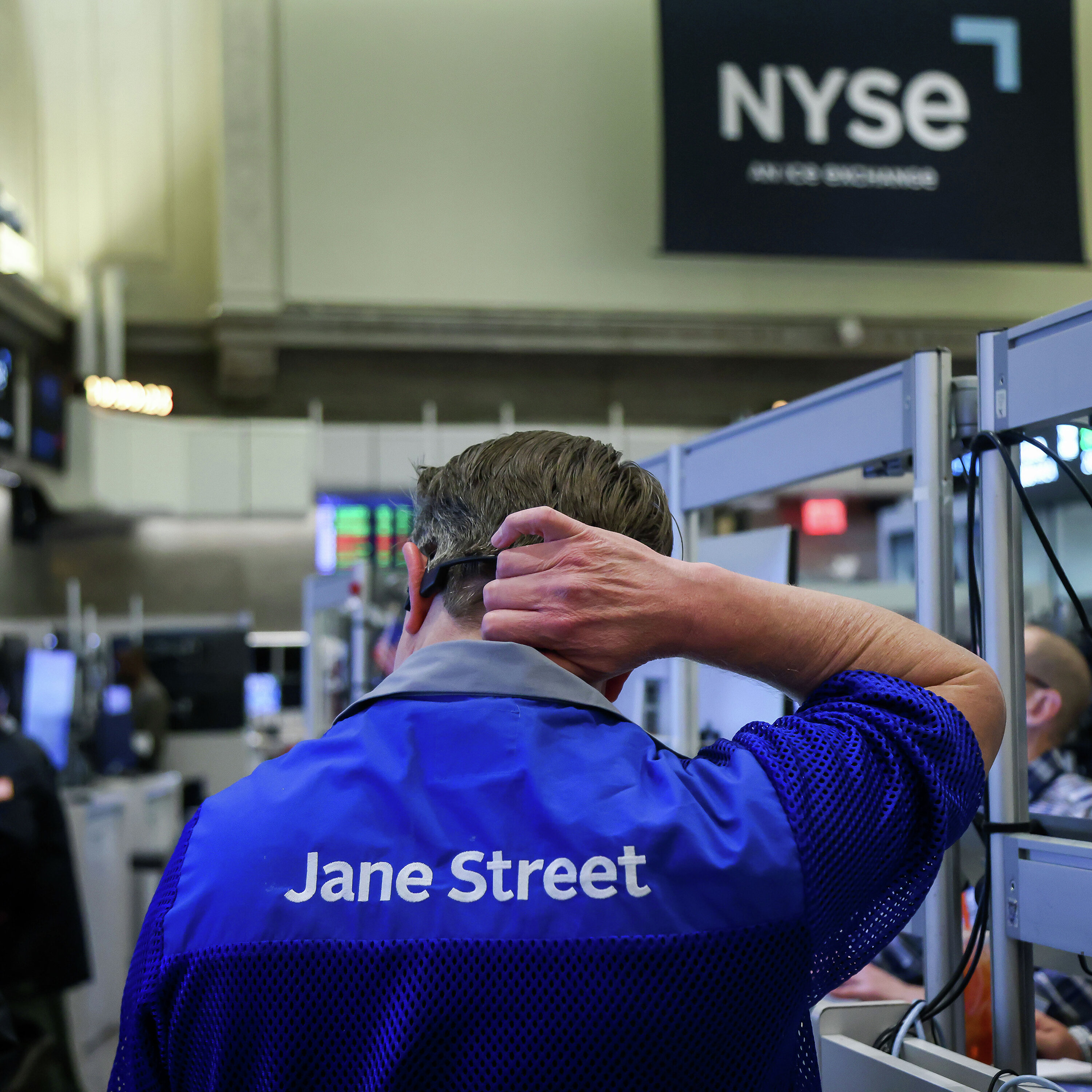
Jane Street just eclipsed Goldman Sachs and JPMorgan as the biggest trading house on Wall Street. It pulled in nearly $40 billion in trading revenue in 2025. And it’s so enigmatic that to the outside world, it’s unclear who’s even in charge.
On today’s Big Take podcast, David Gura talks to finance reporters Max Abelson and Katherine Doherty on their reporting on who’s calling the shots at the firm and why it matters to global markets.
Read more: Who’s Who at Jane Street (bloomberg.com/features/2026-jane-street-guide-…)
We have a special Bloomberg subscription offer for podcast listeners at Bloomberg.com/podcastoffer. (bloomberg.com/subscriptions/podcasts)
Host: David Gura; Guests: Max Abelson and Katherine Doherty; Produced by David Fox; Edited by Jeffrey Grocott; Engineering by Sean Carter.
See omnystudio.com/listener for privacy information.
Transkriptvom Podcast bereitgestellt · Zeitmarken springen hin
Bloomberg Audio Studios.
Podcasts.
Radio.
News. The fact that a company anywhere in the world made more money trading than J.P. Morgan, than Goldman Sachs, than Citadel, I mean, that's just, it's Bank of America, Citigroup.
I can just say honestly, it blew my mind.
This is a relatively new firm and they made more money than the companies that make more money than God.
And that made me want to know who they are.
I'm David Gurra, and this is The Big Take from Bloomberg News. Today on the show, Bloomberg Finance reporters Max Abelson and Catherine Doherty pull back the curtain on Jane Street, one of the world's biggest and most secretive trading firms.
So for those that don't know Jane Street, they are today one of the largest trading firms in all of the world, and especially in New York, where they are based.
What kind of trading does Jane Street do? What function do they serve in the market broadly?
They serve three functions. The first function is stepping in as the middleman.
If you're placing a trade, it could be buying a stock, selling a.
ETF.
There's going to be someone on the other side, and that could be Jane Street. And you're not doing this out of the goodness of your heart. You are profiting. You are taking a fee for every trade that you are executing. And you're, in many ways, doing this very fast, within milliseconds. So the more trades you do, the more money you make. That's just typical bread and butter market making.
The second version of market making is extending... your time horizon. You are holding onto positions not for milliseconds, but for minutes, hours, days, weeks, because this is a longer time horizon.
It sometimes means big risk, but also big reward.
And then you have the third version, which is investing in private companies. And that is not typical of a market-making firm, but it has become typical for Jane Street.
Max, this is a proudly secretive firm. There's a lot of mystery surrounding it. Why is it that we know so little about how it operates and who's running it?
I don't think I've ever in my journalistic career confronted a journalistic subject that was, you know, genuinely secretive the way Jane Street was. You know, I think I can't remember if I ever explicitly asked Catherine, like, OK, so who's their chief executive or like who's their chairman or like? Tell me about their like top executives. But it would have been a stupid question to ask because they.
Don't have one.
If you're a peer, if you're, you know, at a big bank or a big trading house and you call up and you say, you know, like, can you put me in touch with my counterpart?
They'll they'll say no. And if you're an insider and you're like, can I see like a partner's list? They'll say no.
And if you're a journalist. And you want a sense of who's who inside of Jane Street. You kind of had a problem, which was an opportunity for Catherine and I to report this piece.
Max, I would think that LinkedIn would be your friend here. You could go onto that social network. Surely there's a Jane Street site within it that would list a lot of these people.
David Gurra, you simple, simple man. How naive.
You go onto LinkedIn for these very, very important people, and sometimes they'll have a dot.
Like a period, you know, in their, for their job.
In lieu of a name.
In lieu, no, they'll have their name, sometimes their last name, sometimes just an initial, but, but, you know, for their, for their job, they'll have a period or they'll just really, it'll be really understated. I would say by and large, without revealing I have journalistic methods too much, I feel comfortable saying, say that the true friend, true friend that we had were regulatory records.
All right. So they don't have a CEO, but you did find a management committee, several other key players, What did you guys learn about these people in aggregate?
Jane Street has, on the one hand, very well-connected Republican donors and very important Democratic donors. Now, you could say the same of big established firms. But it's interesting to me that at a kind of a new wave and idiosyncratic kind of intellectual group, you still have the kind of political connections we're used to seeing on Wall Street. Um, speaking of idiosyncrasy, you have people here who have a pet pot bellied pigs. You have, um, you have people here who are, um, Interested in philanthropy, but, but in a different kind, um, you're familiar with, with effective altruism. Sure. Um, effective altruism is, um, woven into the lives and careers of several people at the firm. We had someone who
was a semi-finalist in the Intel competition in high school. We had math Olympians, people who write textbooks. And I would maybe summarize what I picked up from these people is that they're idiosyncratic, they're nerdy, they're prestigious, they're serious. And that's a long way of saying that this is both very unusual, but also a not entirely surprising group of serious Wall Street successes.
So broadly speaking, how did Jane Street respond?
The foundation of their response to our reporting is that, like, this is actually a misunderstanding of Jane Street. That to try to invoke a kind of power structure the way that we're used to doing on Wall Street, Jane Street very specifically basically told us, you know, not so fast.
So here's what Jane Street said.
Jane Street's unique structure fosters a culture of collaboration and shared accountability across our global team. While these individuals have represented the firm in various capacities, Bloomberg's own effort to create a conventional org chart fails to recognize leaders throughout the firm.
So how much money are these mysterious individuals making? That's after the break. Catherine, how rich are these employees of Janestreet? What insight did you get into how much money they've made.
So let's talk about the numbers.
Last year, Jane Street brought in, rounded up $ 40 billion.
$ 40 billion.
So in 2025, they doled out $ 9. 38 billion in compensation, and that was double the amount that they paid in 2024.
So in a year, they doubled compensation.
And this is a firm that today employs... let's just call it over 3,000 employees. Think about a bank like Goldman Sachs and or JP Morgan. Those banks have trading, but they also have investment banking. They have many other ways to make money and they also have many more employees.
So if you just take the trading.
And the number of employees that are dedicated to the trading business, ultimately over time what they've been able to do is trade more, make more money with less people. And the reason behind that is because a lot of their trading, they've gotten really good at automation and they're using technology so that they are very nimble.
Max, sticking with the trading strategy, I first became familiar with this firm during the Sam Bankman Freed trial, founder and head of FTX, now serving a prison sentence, but he worked at Jane Street for a few years. And there was this anecdote that we heard over and over again about the coin flip. these coin flip games that took place. And there was kind of an infamous one with him. Heads, the world gets two times better. Tails, total annihilation. And I think what he told Tyler Cowen, the economist, is I'd play every time. Just a ferocious appetite for taking an extreme risk. And it was presented as emblematic of the culture of risk-taking at Jane Street.
How does that manifest itself just in the way that this firm approaches investing today?
Yeah. Yeah, Sam Bankman-Fried got a start at Jane Street. I think he was an intern and worked there for a few years. My understanding of Jane Street's moneymaking is that historically, they have done the work of market making, which I associate with essentially matching buyers and sellers. And then they became extremely important to the creation and the spread of ETFs, exchange traded funds. And Our understanding is that if you own an ETF, and if you're watching or listening, you very well may, that there is a pretty good bet that Jane Street touched that ETF somewhere along the way. Historically, and Catherine's going to jump in if I'm wrong here, it's not like they were what I might think of as a kind of prop shop
where they're sitting and saying, the Cubs are going to win the World Series and we're going to put all of our money on the Cubs. that instead they were doing very, very, very fast work and very, very fast transactions to speed along the buying and selling of securities, of options, of commodities, stocks, and that only recently have they begun taking larger swings, taking larger bets, including, I think, stakes and very big ones in AI firms.
Max, I think that you did a wonderful job. I will pick up on the statement that you made about taking bigger swings. And by that, it's getting into the next phase of Jane Street trading style. So bigger swings, all that means is longer duration. And that means that Jane Street is taking more risk. Jane Street is using its own money, its own capital to trade. It's not like they're taking outside capital from or have to answer to investors. And so that has, in many cases, meant that they could.
High risk, high reward. They can make more money. And we've seen that.
Max mentioned kind of the third leg of the way that I think about their trading style, which is investing in private companies, almost like they're a venture capital firm. And a lot of those companies, as Max mentioned, are in the artificial intelligence space. Whether it's an Anthropic, CoreWeave is another company that they have backed. And many times they're both acting as an investor because they believe that there is value to this company and then also as a user. So Jane Street as a trading company, they operate their own data center so that they can have more capacity to trade And the whole AI ecosystem is something that they also invest their direct money in. And I would say that that is outside of typical trading activity.
This is a private firm. Why do we care who's at Jane Street, who's running Jane Street? What insight does that give us?
It's a foundationally important question. You know, why bother trying to figure all this out? As I was hearing Catherine talk about this, as I was thinking in my mind about sort of what.
Came before J.P.
Morgan and Morgan Stanley, Goldman Sachs. In the second half of the 20th century, the rise of the finance industry represented in a way a certain kind of abstracting away from the way the economy had been built, manufacturing, making stuff, this coffee cup. And instead, something called financialization became a really important part of the economy.
I think by the 1990s, maybe even a bigger part of the economy.
And I think why we care now is because Jane Street, in the same way that Wall Street isn't really on Wall Street anymore, Jane Street isn't even on Jane Street. It represents a second level of abstracting away. Now what we're talking about is money that's being made not necessarily by the business of finances as we thought about it, but it's being made in a data center in Texas.
And it's being made in high-speed connections that go to like Exurban, New Jersey. And I think that it matters because that work is work that matters to individual investors who have ETFs or stocks or anything else. It matters to economies that are now going to be impacted by the volumes of money that's being made. It matters because you can say that our economy is in the process of being transformed.
Really it's something I think a little bit broader.
I think it's more like our society is in the process of being transformed by artificial intelligence and that we don't really know who the winners are going to be and we don't know who the losers are going to be, but we do know at least the Wall Street forces that.
Are behind how it's happening and what's happening.
And I think that those things combined make for a pretty plausible case that it kind of matters who is behind this, these abstract names of these company names.
Katharine?
I wonder what the effect of Jane Street's lack of transparency means if something were to go wrong, given this company's involvement in the market plumbing that you've been talking about, or if there were big losses. Where does the buck stop? I mean, that seems like a huge issue here.
Yeah, that's a great question.
We saw a hint of this after a $ 15.
Billion loss in July.
This was the first time that they had reported a loss in July.
About a decade, I think is what we had reported.
And it was tied to the hedge fund situational awareness, which is an AI hedge fund. And the firm, as we have mentioned, has been taking private stakes in AI companies, also this AI hedge fund.
And because of.
Situational awareness and then the subsequent losses in the AI ecosystem, that hit Jane Street. So in the history of the firm, this was significant. And also that number was staggering any way you slice it. And they, at least internally, they sent around a memo across the entire firm. There was one of their leaders who basically said, look, we want to acknowledge that this was a loss, that it's making us recalibrate our risk-taking. So I think that it wasn't a very public acknowledgement in that they didn't put out a statement. They don't have to answer to investors because, again, they are not a hedge fund that has outside capital.
But at least they.
Did, in some ways, arrange messaging internally that eventually Bloomberg and others reported on because it was a really, really important moment in financial markets. And it was so important, and it continues to be, because of Everything that we've talked about in terms of the scale of this firm, the fact that, again, they made more money than the Wall Street banks, their role in markets globally, this is not just a U.S. story, has become so big that you can't ignore it.
This is The Big Take from Bloomberg News. I'm David Gurra. The show is hosted by me, Sarah Holder, and Juan Haa. The show is made by Aaron Edwards, David Fox, Jeff Grocott, Patty Hirsch, Katie McMurrin, Naomi Ng, Julia Press, Tracy Samuelson, Naomi Shaven, Alex Segura, Julia Weaver, Yang Yang, and Taka Yasuzawa.
There's much more on Bloomberg.com. Get unlimited access to all of our coverage at a special rate for listeners at Bloomberg.com slash podcast offer.
Thanks for listening.
We'll be back on Monday.
