

Kapitelklicken springt direkt hin
Shownotes
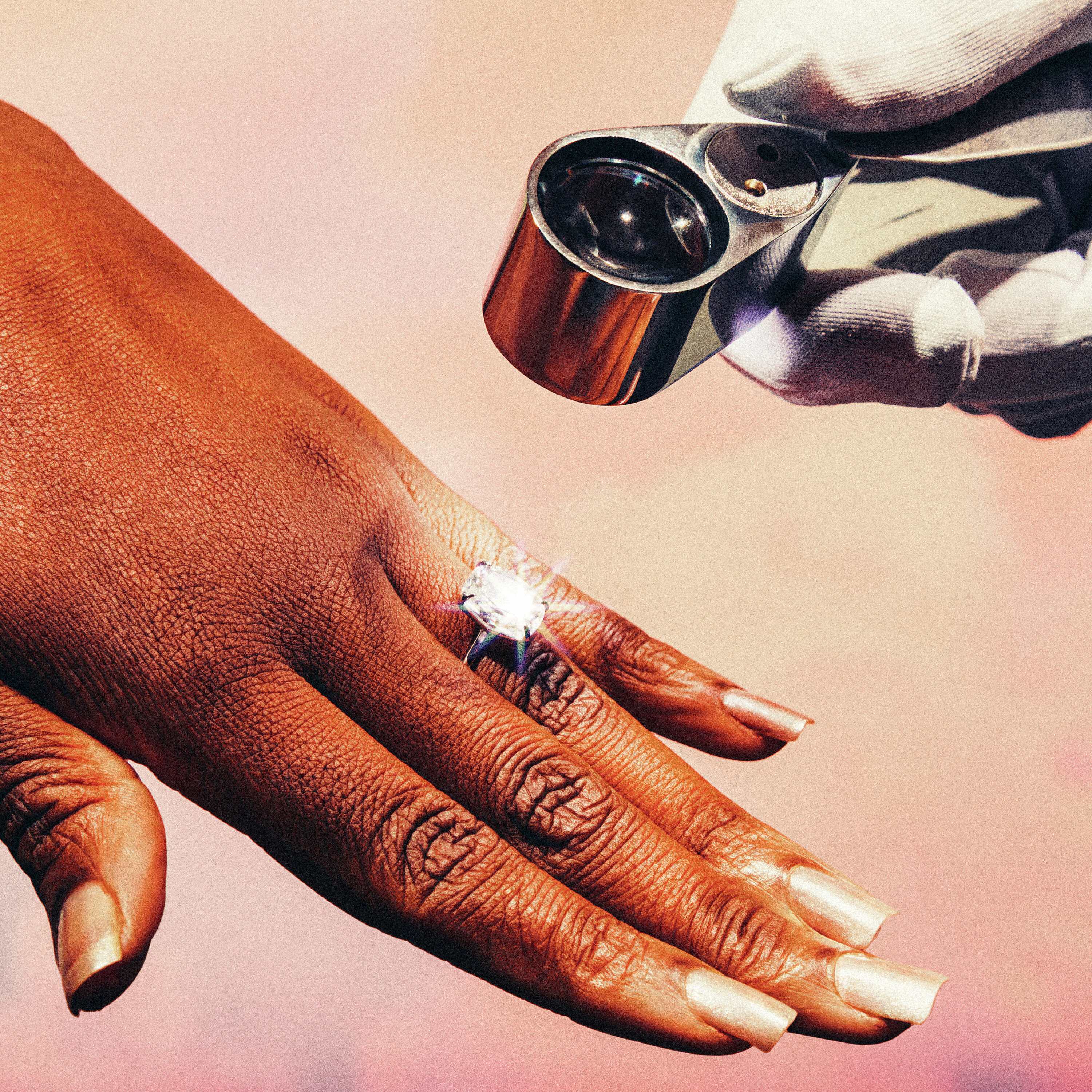
Are “natural” diamonds still worth it if you can get a near-identical alternative for a fraction of the cost? With a boost from celebrities like Sarah Jessica Parker, lab-grown competitors could be coming for the crown.
On today’s Big Take podcast, guest host Stacey Vanek Smith talks to industry insiders and De Beers Group CEO Al Cook about what $12 half-carat earrings could mean for the luxury business’ future and how the old guard is pushing back.
Read more: The Diamond Industry’s Old Guard Wants You to Buy ‘Natural’ (bloomberg.com/news/features/2026-08-18/de-beer…)
We have a special Bloomberg subscription offer for podcast listeners at Bloomberg.com/podcastoffer (bloomberg.com/subscriptions/podcasts)
Host: Stacey Vanek Smith; Guests: Al Cook, Edahn Golan, Adelle Archer; Produced by Julia Press; Edited by Aaron Edwards; Engineering by Sean Carter.
See omnystudio.com/listener for privacy information.
Transkriptvom Podcast bereitgestellt · Zeitmarken springen hin
Bloomberg Audio Studios.
Podcasts. Radio.
News.
We have a full house tonight, so thank you so much for enjoying these events and thank you.
For being here.
Colleen Rooney is an executive at Signet Jewelers Limited, which owns Jared, Kay, and Zales. She's one of a handful of speakers at a swanky Italian dinner on the Upper East Side of Manhattan. The mood is light, everyone is joking around.
This is my real hair.
It is not lab-grown.
It is all mine.
The restaurant is full of high-powered diamond industry leaders. The topic on the menu?
Many of you are fully aware of the disruption that's happened with lab-grown diamonds.
Lab-grown diamonds have caused a massive panic for the diamond industry. You can grow them in days. They're beautiful and chemically identical to diamonds that come out of the ground. They are also cheap. really cheap. It costs less than $ 20 a carat to grow a diamond. At the same time, the stigma around buying a synthetic diamond is fading away.
Even celebrities like Sarah Jessica Parker are on board. She just launched a collection of lab-grown diamonds with Astrea London.
I don't even look anymore at the collection and think, God, these are really exquisite lab-grown diamonds. I don't even see it anymore. I walked in today to see the collection in person finally. And I just thought, my God, those are beautiful diamonds.
A pair of SJP's pink lab-grown diamond earrings cost about $ 1, 300. A natural pair could run you tens of thousands. OG diamond companies have spent hundreds of millions of dollars to stay competitive with new product lines and marketing campaigns.
Every diamond is a story.
But will the story resonate with buyers as less expensive, equally sparkly alternatives flood the market? I'm Stacey Vanek-Smith, in for David Gurra and Sarah Holder, and this is The Big Take from Bloomberg News. Today on the show, with the diamond industry under threat from lab-grown alternatives, how the old guard is fighting back.
When a jewelry store sells a diamond, it's not really selling a diamond. It's selling a story, a whole package.
Idan Golan is the founder of Tenoris, a jewelry industry consultancy and data analytics company.
And diamonds had a fantastic story for literally centuries.
Diamonds formed in the Earth billions of years ago. They're made of carbon, crystallized under extreme heat and pressure. Each stone is unique, perfectly imperfect, the hardest substance on Earth. Until recent decades, there wasn't a way to replicate that process in a lab. And diamond companies like De Beers, which commands about a third of the world's mined diamonds, held a pretty firm grip on the diamond market.
De Beers, really, right after World War II, was really good at taking the idea of a diamond ring and the value of an engagement ring, putting them together in time to the idea of love and emotion.
The diamond engagement ring. How else could two-month salary last forever? A diamond is forever. De Beers.
De Beers' classic slogan, a diamond is forever, caught fire. Just a few years ago, engagement and wedding rings were responsible for about a third of Mind Diamond's sales revenue. Today, it's closer to a quarter. That's because last year, more than 60% of couples in the U.S. opted for a lab-grown ring. That's according to data from The Knot, a wedding planning website.
We're looking at about $ 6, 000 for engagement rings set with natural diamonds. versus $ 2, 200 for those set with lab rope.
Oh, so like less than half.
Yes.
And that's why I think it's a cultural change. And it's not about something valuable. It's about buying, sort of still buying into the tradition.
The technology to grow diamonds in a lab dates back to the 1950s. But for a long time, synthetic stones were mostly used for industrial products like drill bits. Jewelers often didn't stock lab-grown diamonds or hid them away. And that mattered because until 2020, almost all diamonds were bought in person. But when COVID hit, suddenly people were shopping online.
People were sitting at home and had nothing to do with their money. They're kind of having the conversation that you and I are having. We see each other from our shoulders up.
And people basically wanted Zoom-friendly bling.
At the same time, you can't really tell if they're, you know, quote unquote, real or not. And from that point on, we see a very different type of consumer demand for lab grown.
Startups jumped on this demand. I got to visit one of them, a company in Kerrville, Texas. It is growing diamonds using carbon from the ashes of people's loved ones and pets. It is called Eternova. Adele Archer is the co-founder and CEO.
We actually have diamond machines that are replicating the same growing conditions as under the earth. High pressure, high temperature, recreating the earth's crust. And we are growing real diamonds in those machines.
The machines are about the size of a refrigerator with a waffle iron looking thing in the center. That's where the diamond grows. Petrus Bothma, who helped show me around, developed the machines.
I always joke and say it's 70% science and 30% black magic, and we're still figuring out the black magic.
Archer appeared on Shark Tank in 2019 and now sells over 1,000 stones a year.
We actually just recently did a diamond for Kenny Chesney, which was really cool. And his dog's name is Ruby, so you can guess what color Ruby is. We are working on technology right now where you'll be able to scan your diamonds and have it pull up. a repository of memories, like videos and voice memos. And, you know, so you can be like, yeah, this is my dad's diamond.
And let me show you who my dad is.
Between 2022 and 2023, synthetic stone sales skyrocketed. And as the number of companies churning out these products increased, prices fell. The average cost of a one-carat lab-grown diamond dropped from about $ 3, 400 in 2020 to $ 1, 200 in 2023. Data from a Bloomberg index shows the price of mined diamonds also dropped to the tune of over 25 percent between 2020 and 2024. This is kind of.
An infliction point for the diamond industry.
Last year, Idan Golan met with some diamond industry executives about the lab-grown threat. And they asked him, how far did he think the price of stones could fall?
I mean, you know, I was thinking, how do I answer them in a way that will scare the bejesus out of them?
And I went to Walmart.
I said, let's see what's selling on Walmart.
What's selling on Walmart is a pair of half-carat diamond earrings, each about the size of a lentil. The price?
$ 12.
This is less than a burrito.
True.
How much would that have cost, like, before Labrador? Like, how much would a natural equivalent of those earrings cost?
Do you want to know how much a natural of this kind costs today?
Okay, yeah.
Let me pull it up. Average retail price in 25 is $ 512.
So why should a customer pay over 40 times more when they can get $ 12 stud earrings at Walmart? The natural diamond industry makes its case after the break. Al Cook is the CEO of De Beers. He took the job in 2023, right in the middle of the great lab-grown reckoning.
I think more and more in this age of unlimited digital replicas, unlimited fake news, unlimited synthetic products, people need to be confident in authenticity.
I asked Cook how he feels about those super cheap diamond earrings from Walmart.
If people can buy a pair of $ 40 lab-grown diamond earrings from Walmart I feel nothing but delight. You can buy something that looks beautiful for a very low price. The piece that I find disturbing is the possibility of buying exactly that $ 40 pair of Walmart diamond earrings for $ 400, $ 500 in another store where unscrupulous retailers could exploit people's lack of understanding. to make a 1,000% markup.
Cook compared this to looking at a copy of the Mona Lisa. Sure, to the average eye, it looks just like the real thing. But of course, it is no da Vinci. That is why De Beers has ramped up its technology to show consumers the difference.
So using our diamond-proof technology, you can tell in three seconds the difference between a lab-grown diamond and a natural diamond.
DiamondProof is a $ 5, 500 scanner that De Beers is selling to jewelers around the world to spot these differences. For example, mined stones have imperfections, like traces of other minerals. Lab-grown stones are pretty uniform. De Beers has also leaned into selling stones that are intentionally non-perfect. not like the diamonds you might picture when you hear diamond ring.
Last year, we launched and advertised desert diamonds. There are a whole range of colors, all of them unique, from honeys and whiskeys and chocolate browns to the traditional flawless white. And then People being interested in where is this desert that the diamond is from? Tell me a little bit about the deserts of Botswana. Tell me a little bit about the environment that this comes from in Namibia and allows us to start telling that story.
One of the prevailing stigmas around mined diamonds comes from the industry's past ties to the so-called blood diamond trade. In the 1990s, during Sierra Leone's civil war, enslaved people, some of them children, were forced to extract mined diamonds, which were sold to fund militias and often laundered into the global supply chain. Since then, the industry has established international trade rules to ensure its diamonds are ethically and responsibly mined. De Beers and other big diamond players have also leaned into promotions aimed at educating consumers about their mining practices.
I bear in mind that natural diamonds, mined according to strict standards, have brought prosperity to tens of thousands of people around the world.
That's from a documentary released by Jared Jewelers and directed by the Oscar-winning director Luke Jacquet of March of the Penguins fame. Al Cook at De Beers is hopeful that buyers, especially younger buyers, will come around to the natural diamond, inspired by the authenticity, uniqueness, and the billions of years of geology they represent.
For me as a geologist, it's just extraordinary to touch something that's that old. A billion years from now, when everything around you will have changed, the diamond on your finger, in your earrings, will look exactly the same because nothing can scratch it, because nothing's harder.
This is The Big Take from Bloomberg News. I'm Stacey Vanek-Smith. The show is hosted by Sarah Holder, David Gurra, and Juan Ha. The show is made by David Fox, Jeff Grocott, Naomi Ng, Julia Press, Naomi Chavin, Julia Weaver, Yong Yong, Aaron Edwards, Patty Hirsch, Tracy Samuelson, Sean Carter II, Emma Munger, and Alex Sugiera. Our executive producer is Nicole Beamster-Boer. If you liked this episode, please leave a review wherever you listen.
Helps people find the show. And for unlimited access to all of Bloomberg.com, we have a subscription offer at Bloomberg.com slash podcast offer. Thanks for listening. We'll be back on Monday.
