

Kapitelklicken springt direkt hin
Shownotes
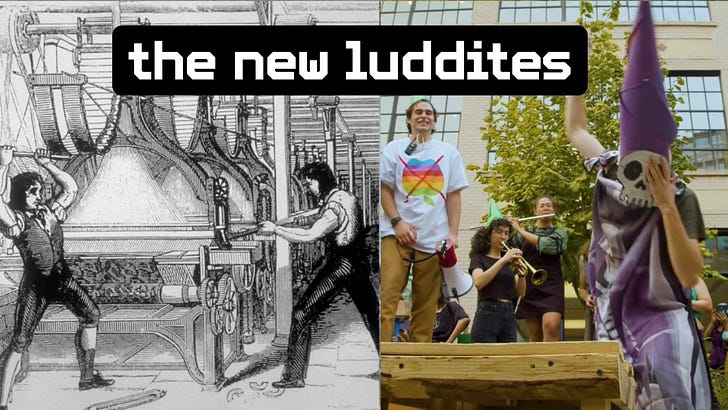
The year has been marked by the rise of open, widespread (bloodinthemachine.com/p/its-open-season-for-re…), and increasingly spirited backlash (bloodinthemachine.com/p/why-the-ai-backlash-ha…) to AI, data centers, and big tech. As such, the stage was well set for the Summer of Ludd, a series of protests, performances, talks, and meetups in New York City organized around the idea that we need to get people into the streets and break Silicon Valley’s grip over our lives.
There were mock trials of big tech, plays staged detailing the Luddites’ true origin story, marches, and teach-ins. By just about any count, it was a smashing success; the event drew favorable coverage everywhere from the Washington Post (washingtonpost.com/style/trends/2026/06/22/act…) to WIRED (wired.com/story/inside-the-luddite-festival-ha…) to the Economist (economist.com/united-states/2026/07/09/rise-of…). It was even, amusingly, transmuted into a clickbait MSN listicle (msn.com/en-us/news/technology/10-things-to-kno…) produced to maximize on-screen engagement.
I sadly couldn’t be there on the ground for the proceedings, so I did the next best thing: I invited the Luddite documentarian, organizer, and activist Amanda Hanna-McLeer, who was there for the festivities, and who directed the Luddite Recreations play that ran throughout the week in Tompkins Square Park, to give us the rundown.
Hanna-McLeer has been documenting the youth-led Luddite movement for years now (ludditeclubdoc.com); as she explains, it started with the Luddite Clubs students formed to reject social media and organize offline activities in high schools and colleges across the nation. In many ways, the Summer of Ludd is a culmination of that movement thus far.
It also, however, Hanna-McLeer notes, feels like the beginning of something else, something even bigger.
We get into all of that: the size of the crowds, the enthusiasm among so many people have for logging off and plugging in, and how the people who encounter the new Luddites are increasingly open to movements that challenge big tech.
One simple reflection of all this is the positive news coverage I mentioned above. I can comfortably say from my experience as a tech journalist, that even five to ten years ago, these kids and activists would have been mocked and scorned. Instead, most people immediately get where they’re coming from. Their message about fighting big tech, anyway, if not the gnome hats. Progress is progress.
Events like the Summer of Ludd—which not only protest big tech but proactively envision an alternative, participatory future; one grounded in community, commonality, and sociality—are dovetailing with data center protests, AI-critical labor movements, and students (and everyone else!) roundly booing AI. It does feel like the ground is shifting in some real and interesting ways, and that new spaces are opening up. Here’s to hoping.
Some related reading:
Now for some other stories about our rapidly unfolding dystopia that caught my eye this week, and about those fighting to keep it at bay. BUT FIRST, before we move on: Today’s edition of BITM is sponsored by DeleteMe (joindeleteme.com/?utm_source=influencer&ut…), whose mission is hunting down and, yes, deleting the data that brokers have hoovered up about you over the years and made available to their clients. DeleteMe is Wirecutter’s top-rated data removal service (nytimes.com/wirecutter/reviews/best-data-remov…), and I’ve used it myself, to locate and eradicate scores of sites that were listing and selling personal info like my home address and phone number. If you’re interested in taking DeleteMe for a spin, sign up here (joindeleteme.com/LUDDITES) and use the code LUDDITES for 20% off an annual subscription. OK! Onwards.
A treasury report drafted by Trump officials outlines fears of the AI bubble bursting
This is a bit of news that seemed to glance the surface without breaking through. I didn’t see this too widely reported, but thought it was pretty telling nonetheless. The report isn’t public, but was obtained by journalists; including those at NOTUS (notus.org/economy/treasury-internal-report-war…), who report that
This draft report inside the Treasury Department is set to warn of the risks posed by the artificial intelligence market, likening key aspects of it to the dotcom bubble that upended the U.S. economy when it burst in the early 2000s.
Career Treasury analysts found that AI firms are more deeply entrenched in the U.S. economy than their dotcom predecessors and pose significant risk to the entire system if financial conditions change, productivity goals are missed or various choke points stymie growth.
A downturn in the AI market would send shockwaves throughout the entire economic ecosystem, the analysts wrote.
What’s so notable isn’t really the message, which should be pretty familiar to critics of the AI bubble by now, but the way that it breaks from the narrative put forward by the Trump administration, which is, to the public, endlessly optimistic about AI’s transformational power.
Waymo called the police on teen riders who were playing with a toy gun and allegedly drinking
The Waymo stopped, detained the kids until the cops could arrive on the scene, which they did, and then approached the vehicle with guns drawn.
404 Media reports (404media.co/waymo-called-police-on-teens-san-m…):
On Monday, the San Mateo Police Department posted on Facebook (facebook.com/CityofSanMateoPolice/posts/pfbid0…): “Parents do you know where your teens are? @waymo does!”
The police department continued in the post: “Two 15 year olds up to trouble in a Waymo this afternoon were detained after Waymo reported they were drinking and shooting from the vehicle. After calling us and stopping the car, we were able to safely remove both subjects and determined they were shooting Orbeez from the car as they sipped on afternoon libations while being chauffeured around town in the driverless vehicle.”
Pretty grim stuff! And your regular reminder that Waymos are continuously surveilling both the inside and the outside of their vehicles, collecting data that is recorded and made available to authorities, and now, apparently, proactively intervening when an automated system or someone at Google decides a criminal act has occurred—and putting teens at legitimate risk of being shot for being dumb teens. It seems only a matter of when, not if, we see an interaction like this that ends more tragically.
Big data center resistance news:
The largest-ever proposed data center, a 2,100 acre, 22 million square-foot facility slated for Prince William County in Virginia, has officially been cancelled (finance.yahoo.com/technology/articles/largest-…).
The project failed after receiving sustained pushback from a local historical society—it would have been built on top of a famous Civil War battlefield and the graves of all the soldiers killed there—and a local homeowner’s association.
Meanwhile, all of Scotland is considering a “sweeping” data center moratorium.
The Guardian reports (theguardian.com/uk-news/2026/jul/07/scotland-c…):
Last Sunday the Scottish National party (SNP)’s national council passed a motion to freeze all new datacentres in Scotland (theguardian.com/uk/scotland). That motion has been sent to the Scottish government to consider.
It could apply to all datacentre projects that have not yet received planning permission…
The move emerged as …
