

Kapitelklicken springt direkt hin
Shownotes
<p>Throwback: Should you really fluid-restrict every patient with SIADH? When can IV fluids make hyponatremia better or worse? Are salt tabs actually doing enough? And what can urine studies tell you before you start treatment? Join us for a practical, physiology-driven approach to hyponatremia management, from fluids and solutes to loop diuretics and identifying the underlying cause. </p><p><br></p><p>🔹<strong>Sponsor: </strong>Search “Amazon Pharmacy Nationwide Home Delivery" in your EHR to get home delivery (often same-day). <a href="coreimpodcast.com/Amazonpharmacy"; rel="nofollow">Learn more here</a>.</p><p><br></p><p>🔹<a href="coreimpodcast.com/2022/08/03/hyponatremia-mana…; rel="nofollow"><strong>Transcript and Shownotes</strong></a></p><p><br></p><p>6:46 | Pearl 1: Key Principles</p><p>15:13 | Pearl 2: Fluids in hyponatremia</p><p>26: 03 | Pearl 3: Solutes in hyponatremia management</p><p>35:49 | Pearl 4: Lasix in hyponatremia management</p><p>40:05 | Pearl 5: Etiologies</p><p><br></p><p>Tags: CoreIM, Internal Medicine, Medical Education, SIADH, Fluid Restriction, Nephrology, Hospital Medicine, Urine Osmolality</p><br /><br />Find the best disability insurance for you: patternlife.com/disability-insurance?campid=49… Sponsors:<br/>* Check out Eko: ekohealth.com<br/>* Check out FIGS and use my code FIGSRX for a great deal: wearfigs.com<br/><br/><br/>A… Inquiries: <a href='redcircle.com/brands'>https://redcircle… & Opt-Out: <a href='redcircle.com/privacy'>https://redcircl…;
Transkriptvom Podcast bereitgestellt · Zeitmarken springen hin
[SPEAKER_03]: Checking one set of urine studies and trying to decide what's happy the patient is kind of like seeing where a planet or a star is in the sky and just deciding based on where it is at that moment, what its orbit looks like it where it's going to be. [SPEAKER_03]: Like you can't do that.
[SPEAKER_03]: Right, the management of hyponatrimia is by definition a dynamic thing. [SPEAKER_03]: Right, you're trying to predict [SPEAKER_03]: or change the behavior of a system that changes over time, and studies are kind of static. [SPEAKER_05]: That's Dr. John Wong, a hospitalist at Bellevue and an assistant professor at NYU.
[SPEAKER_05]: And this is the core IM Bive Girls podcast bringing you high yield evidence-based pearls. [SPEAKER_05]: I'm Dr. Schrecher, buddy. [SPEAKER_01]: And I'm Dr. Tim Rowe. [SPEAKER_01]: It is so great to be back with you guys and talking to usums again. [SPEAKER_01]: And I'm Dr. Quinn Lee. [SPEAKER_05]: All right.
[SPEAKER_05]: Today, we are talking all things. [SPEAKER_05]: Hypony-tremium management. [SPEAKER_01]: Yes. [SPEAKER_01]: Yes. [SPEAKER_01]: And if you haven't done so already, please make sure to take a listen to the Hypony-tremium diagnostic episode where we broke down each diagnostic test, and what it tells you about the patient's physiology.
[SPEAKER_05]: Right, and our approach to this management episode was very similar. [SPEAKER_05]: We wanted to break down each hyponeentremia management intervention that we have in our arsenal with the idea that if we can understand what that intervention is doing in hyponeentremia and why we're reaching for it, then we can be a bit more savvy with the tools we have, because in the real world, there's often multiple insults and it's not as clear cut and the better we understand what we're doing, the better we can apply.
[SPEAKER_04]: Hey, men of that Shreya, that's getting to those pearls we'll be covering in this episode. [SPEAKER_05]: Remember, the more you test yourself, the deeper you're learning gains. [SPEAKER_01]: Pearl 1, key principles in management of hyponadremia. [SPEAKER_05]: What's your approach in understanding the fluid, solute balance your patients in?
[SPEAKER_01]: Pearl 2, fluids and fluid restriction. [SPEAKER_05]: How do you gauge what type of fluid you can give an essay at age? [SPEAKER_05]: And what can you use to tell on date one that fluid restriction alone will not work? [SPEAKER_01]: Pearl 3. [SPEAKER_05]: Solutes What are the three types of solutes you can use in hyphenytremia and what are each of their drawbacks?
[SPEAKER_01]: Perl4, loop diuretics. [SPEAKER_05]: How to loop diuretics help in hypnitriamionagement. [SPEAKER_05]: Perl5, eDiology-driven management Do you really need to send off a TSH and cortisol on each patient with SIDH? [SPEAKER_05]: And what do you do when there isn't a clear cut cause? [SPEAKER_01]: Okay guys, so before we get into each of the tools that we have to manage hyponatremia, I think it might be a good idea for us to just take a step back and go over some big picture principles to play into our management.
[SPEAKER_05]: Yeah, and the first one is going to be going back to how all hypotonic hyponatremia comes down to a relative excess of three water in the body. [SPEAKER_05]: I know this is something that gets emphasized on day one on learning hyponatremia, but this is somehow something I still appreciate every time I hear it.
[SPEAKER_02]: I make them stand up, I make them shout it from the rafters, hyponectrimea is a water problem, that it's very unusual for someone who has hyponectrimea to have anything wrong, but their water balance. [SPEAKER_01]: That's Dr. Jeffrey William, a nephrologist at Beth Israel deaconess that you probably remember from our hyponectrimea diagnostics episode.
[SPEAKER_04]: And to elaborate on what Dr. William was saying, true hyponectrimea is really an imbalance between water and solutes in someone's body and the ability to excrete that water is impaired or overwhelmed. [SPEAKER_02]: Now I'm imagining how much water is going in and how much solute is going in because the solute that goes in helps to eliminate that water.
[SPEAKER_02]: And if they're not in balance, then there's a chance for water overload or the appearance of hyponetremia. [SPEAKER_05]: So if we really sit with that idea of imbalance between water and solute, we have to ask ourselves, is there too much free water because there's not enough solute to balance out the [SPEAKER_04]: Or is there just too much water because the patient is drinking too much of it, like in psychogenic polydipsia?
[SPEAKER_01]: Or maybe there's a lot of ADHD floating around, which makes the body reabsorb extra-free water. [SPEAKER_01]: And as a quick reminder from episode 1, the ADHD can either be appropriate, like in the case of a hypovalemic individual, or inappropriate like an SIEDH. [SPEAKER_02]: part of the management for me is thinking about two things separately.
[SPEAKER_02]: One is how do I manage this patient right now, which is often finding the balance between fluid and solute? [SPEAKER_02]: And how do I manage the underlying disease if there is one, if there is a reason for ADHD to be in excess? [SPEAKER_02]: I think that the most important part of it first is understanding, even if they have access ADHD, the only way they would develop hyponetremia is if they were drinking water in [SPEAKER_01]: Just listen to Dr. William describe the detective where he does to figure out what's tipping the water saw you balance in his hype when it's streaming patients.
[SPEAKER_02]: I will often ask them about their fluid intake and I make sure to include all fluids because I think there's a fallacy out there that this only applies to water whereas it really applies to all fluids and I've definitely had patients who drink pots of coffee and that's water, you know? [SPEAKER_02]: That's water, even though there's coffee in it, it's still water and juice and diet coke is a popular one.
[SPEAKER_04]: Oh boy, who would have thunk those three cups of coffee I had a day really can't have as fluids? [SPEAKER_05]: three cups, climate's only like a levity. [SPEAKER_01]: I also think you're underestimating his coffee into it for being honest. [SPEAKER_05]: Yeah, yeah, yeah, and the other fluid that I think we should be asking our patients about is Gatorade.
[SPEAKER_05]: I think especially when our patients are feeling on well, they're chucking it especially because of marketing a bit makes it seem like, oh, it's filled with all these electrolytes, but actually it's a hypotonic fluid and really mostly water. [SPEAKER_02]: And then once I have a sense of the water that's coming in from the fluids in general, I try to ask about dietary intake, just from a sense of what I would call solute, or just the things that they're eating, and how often they're eating.
[SPEAKER_05]: And Dr. William told us one quite memorable story. [SPEAKER_02]: And her son tells me all she eats are dove bars, like the ice cream with the chocolate on the [SPEAKER_02]: I think this is the T&T diet, you know, if there ever was one, you know, she's not like eating T&T but she's drinking plenty of fluids and she's eating dove bars.
[SPEAKER_02]: So clearly her fluid intake was outstripping her solid intake because she wasn't really taking in any true solid. [SPEAKER_02]: It was just ice cream and chocolate. [SPEAKER_05]: Now that I appreciate just how much a thorough ins and outs history can be in hypony-tremia, I think it's interesting how aggressive we actually get with heart failure and doing ins and outs in that, but now I'm convinced that we need to be even more hands-on with ins and outs in hypony-tremia.
[SPEAKER_01]: Uh, eyes and nose, so important, but so elusive, that actually leads in perfectly with the second big picture pain point in hyponentremium management, which is it's frustratingly multifactorial nature, because as convenient as it is for us to think about patients in these neat little buckets like SIDH or Tintose syndrome and follow the diagnostics, that's not always the way it goes in clinical practice.
[SPEAKER_05]: Yeah, and Dr. Helbert Rondon and Nephrologist at the University of Pittsburgh gave us an example of someone who had a, you know, T. and T. and T. and T. and T. and T. and T. and T. and T. and T. and T. and T. and T. and T. and T. and T. and T. and T. and T. and T. and T. and T. and T. and T. and T. and T. and T. and T. and T. and T. and T. and T. and T. and T. and T. and T. and T. and T. and T. and T. and T. and T. and T. and T. and T. and T. and T. and T. and T. and T. and T. and T. and T. and T. and T. and T. and T. and T. and T. and T. and T. and T. and T.
[SPEAKER_00]: Usually, the cutoff is not that crystal clear, 100, because sometimes you could see somebody who has low-solupt intake type on a 3-mia. [SPEAKER_00]: And the urengosmal IP is 150 or 160. [SPEAKER_00]: On the low side, but not less than 100. [SPEAKER_00]: When you as the patient, the patient, I have some nausea from drinking too much or something like that.
[SPEAKER_00]: So you see those overlapping pictures sometimes, [SPEAKER_05]: So I love this example, right? [SPEAKER_05]: Because things that are, again, are so common, right? [SPEAKER_05]: Naja, pain, different medications can really cloud the picture by releasing some inappropriate adage, causing water reabsorption, kicking up that urinasm, and clouting what we expect our urine studies to be.
[SPEAKER_04]: And the last big picture point we wanted to stress is that in the management of hyponetriemia, sometimes not doing anything as you're waiting for a data to come back is something. [SPEAKER_03]: A lot of times the urine studies, which often aren't collected in the ED, right? [SPEAKER_03]: They're collected by the overnight resident, or by us in the morning.
[SPEAKER_03]: They're collected at a very awkward time in which they're confounded by the effects of what has happened to the body over the initial 12 to 24 hours, even if the intervention is doing nothing, like nothing is something, right? [SPEAKER_03]: Like withholding beer or withholding free access to water is something.
[SPEAKER_05]: This goes back to Dr. Wong's initial point that hypony treatment is dynamic and need to figure out how this time point of urine studies fits in the overall context of what's been going in and out of the space and spotty, so we can interpret it a bit more correctly. [SPEAKER_03]: One example of this is sometimes the aeronautisms are kind of low-ish, right?
[SPEAKER_03]: They're elevated, but they're not super elevated. [SPEAKER_03]: They're like 200 or 250. [SPEAKER_03]: And the year-end sodium is kind of low, 15 or 20 or 12 or something like that. [SPEAKER_03]: And you might try to finagle that into, oh, this is hypovalenia, but an equally plausible explanation is you've collected urine studies at the moment where the body is actually correcting, right?
[SPEAKER_03]: The stimulus for the, you know, 88 release has been removed and their body is transitioning into making a more dilute urine, large amounts of the dilute urine. [SPEAKER_05]: What a great example of trying to understand where in the trajectory you're catching those urine studies. [SPEAKER_05]: What I always summarize, I think we've covered a lot of good ground.
[SPEAKER_05]: Big takeaways is that you'll be better able to manage hypony-tremia if you get a really detailed fluid and solute history and try to understand where on that water solute balance your patient falls. [SPEAKER_01]: Right, right, and not just obtain the history and forget it, but keep track of it as you try interventions while the patients in the hospital.
[SPEAKER_05]: being mindful that there's multiple insults going in and multiple things that could be going on and lastly, that doing nothing is something in the management and pipe industry me and in the of itself can impact the sodium. [SPEAKER_01]: All right. [SPEAKER_01]: So we've discussed the relative imbalance of fluids and solute that leads to hyponatremia states.
[SPEAKER_01]: So it really shouldn't come as any surprise that most of hyponatremia management is just targeting those inputs, fluid and solutes. [SPEAKER_01]: So which one of them do you want to tackle first claim? [SPEAKER_01]: Okay, so let's jump right into this. [SPEAKER_01]: You're taking care of a clearly hypervillemic patient who also has hypernatremia.
[SPEAKER_01]: The nurse is about to spike a bag of crystalloid and ask you, what do you want to use? [SPEAKER_01]: What do you think about that, Shrey? [SPEAKER_05]: A great question, right? [SPEAKER_05]: Because we could use balance fluid like lactated ringers. [SPEAKER_05]: It seems like it's a bit more kidney-protective, or normal saline, right?
[SPEAKER_05]: Normal saline has a little bit more sodium content. [SPEAKER_02]: No, as long as they're isotonic or hypersonic, it doesn't matter. [SPEAKER_05]: Ha! [SPEAKER_05]: So, maybe it'd be helpful to briefly remember how fluids help in hypotetriemia and to be specific, how to fluids help in true, hypervolimic hypotetriemia.
[SPEAKER_02]: In these situations, you're actually providing the volume, and then the volume expansion shuts off ADHD, right? [SPEAKER_02]: The expansion of the volume within the vascoature is going to, you know, turn off those bar receptor responses ADHD will shut off. [SPEAKER_02]: And that's actually what makes the serum sodium better.
[SPEAKER_02]: is as 88 shots off, your kidneys start to excrete the water. [SPEAKER_02]: That is in excess in the body, and that's how hypony treatment gets better in the setting of true hypolemia with an isotonic fluid. [SPEAKER_05]: Okay, got it. [SPEAKER_05]: So in true hypovolemia causing hypony treatment and thinking about fluid choices, it sounds like tiny differences in salt content are really negligible and don't matter as much in the grand scheme of things.
[SPEAKER_04]: Okay, but I feel like in the hospital, there's another common confusing situation I bump into, I haven't got these patients with unclear histories and oftentimes they end up having essay IDH. [SPEAKER_04]: What do we do about fluids in that case? [SPEAKER_01]: Okay, that's a little bit more tricky.
[SPEAKER_01]: And this may be a cop out, but I think I'm going to let Dr. Huang take this one. [SPEAKER_03]: It is a misconception that if you give intravenous fluid to somebody with SIDH, you will make the sodium worse. [SPEAKER_03]: That is when I teach hyponetrimium to my residence, that is just something that I start off with.
[SPEAKER_03]: And when I get a bunch of quizzical looks, that's my opportunity to then get into the explanation a little bit. [SPEAKER_04]: Oh, wow. [SPEAKER_04]: That's a plot twist. [SPEAKER_04]: I think in residency, we all get drilled into our heads that SADH is treated with fluid restriction and salt tabs, so how can fluids actually help?
[SPEAKER_02]: I'm really comparing the fluid's osmolality to the urine osmolality, and if you're giving a fluid that has a higher osmolality than the urine, then you will be able to excrete the free water or the extra water. [SPEAKER_02]: If you're giving a fluid that has a lower osmolality than your urine, then you're going to hang on to water.
[SPEAKER_04]: So the big takeaway here is that if you're going to get fluids, even an S.I.D.H. [SPEAKER_04]: just make sure that the osmons of the fluids are giving or higher than the urine osmons. [SPEAKER_05]: Yeah, it's a bit more nuanced than all isotonic fluids are bad for S.I.D.H. [SPEAKER_02]: the classic SIDH example, where you assume that the ADHD release is relatively constant, and let's just say it's creating a urinalzmalality of 600.
[SPEAKER_02]: So in this case, you would need to give a fluid that has an osmalality greater than 600 in order to improve the hyponetremia. [SPEAKER_02]: There's only a few fluids that do this and this is when we give 3% saline or hypertonic saline and it works because it has an osmolality of over a thousand.
[SPEAKER_02]: So it's going to work and you're going to excrete free water as a result. [SPEAKER_02]: You're delivering extra solute to excrete water. [SPEAKER_01]: All right, but on the flip side, if the patient has a urine osmose 600 giving a fluid with a lower osmolality like with isotonic fluid, which has an osmolality around 300 or so, would actually [SPEAKER_02]: You're creating a situation that's actually worse, where you're giving extra water.
[SPEAKER_02]: And this is even worse if you give half normal salient or defied, which are even more hypotonic. [SPEAKER_01]: And guys, if you're like me and you have a tough time memorizing the osmolality of all those different fluids, make sure you check out the infographic from our recent fluids episode, which really has it laid out very nicely.
[SPEAKER_05]: Yeah, and then one last thing to mention in the the giving fluids part of this is something that one of our reviewers Dr. Schellen Chen pointed out is at the rate with which you infuse fluids actually matters so it's a bit much to cover in this episode and if you're interested go check it out in our show notes, but [SPEAKER_05]: Basically, he lays out using the Edelman equation and shows a difference between infusing isotonic fluid at, say, 40 cc an hour in someone with S8H versus 100 cc an hour in S8H and shows that you actually get a difference in the sodium level based on how fast you infuse it.
[SPEAKER_04]: Well, I think that's going to go over my head, but I'm sure Tim is excited to read about it. [SPEAKER_04]: Don't put that on me, Clim. [UNKNOWN]: Ha ha ha. [SPEAKER_01]: All right, enough on fluids, I think. [SPEAKER_01]: We need to take a hard pivot here. [SPEAKER_01]: We talked about using fluids to treat hyponentremia, but how do you guys think about fluid restriction and the management of hyponentremia?
[SPEAKER_04]: Yeah, I'm not sure my method is that elegant. [SPEAKER_04]: I feel like I just eyeball my patient and if I make a stall through drinking too much free water, I start a fluid restriction, and then I just keep pushing it until they get mad. [SPEAKER_01]: Ugh, yes. [SPEAKER_01]: I do know that struggle, but don't worry, climb everything you do is elegant.
[SPEAKER_01]: And actually, it turns out that your approach isn't completely wrong. [SPEAKER_02]: In terms of how much of a food restriction is worth while, I guess what I would say is as much as possible, you have to drink something. [SPEAKER_02]: So let's just say they take in three liters of fluid every day.
[SPEAKER_02]: If they have hyponature, and you say, you know what, I'm gonna restrict you to one and a half liters a day, it's gonna get better. [SPEAKER_02]: Okay. [SPEAKER_04]: Amazing. [SPEAKER_04]: I love it when medicine is intuitive and the math makes sense. [SPEAKER_04]: Or as a Gen Z, say on TikTok, when the math, math.
[SPEAKER_04]: Ah, the math, math. [SPEAKER_01]: No count from that. [SPEAKER_01]: That's flat. [SPEAKER_05]: You guys are going to have to translate all of that for me. [SPEAKER_01]: No, I think sometimes it's better not to know Shreya. [SPEAKER_05]: Uh, maybe somebody can put this in the comments and let me know what that means.
[SPEAKER_05]: But anyways, fact is setting up our patients for success. [SPEAKER_05]: I think one thing the doctor William said really nicely and I think just was so great is how do we tell our patients about fluid restrictions? [SPEAKER_05]: I think too often we just kind of stick a paper on the wall saying fluid restriction and not looping in our patients.
[SPEAKER_02]: The way that you do this is you tell the patient to fill up a picture to an amount of fluid. [SPEAKER_02]: You say your restriction is 1.2 liters for today. [SPEAKER_02]: And that is the only fluid they drink the whole day. [SPEAKER_02]: And when it's done, it's done. [SPEAKER_05]: Yeah, since this interview, I've actually been getting out those great pictures from the pantries and showing it to patients.
[SPEAKER_05]: Okay, this is a leader and I've actually found patients have been just so much more attuned and falling through with fluid restriction, it's just helpful all around because I think it's just hard for everyone to conceptualize what a leader actually is. [SPEAKER_04]: Yeah, sure, I love those great pictures as well.
[SPEAKER_04]: However, not to rain under patient education parade, I'm kind of a pessimist. [SPEAKER_04]: Are we sure that fluid restriction is even going to work in the long run? [SPEAKER_00]: Rather than waiting to see full restriction will work or not, we have certain predictors that can tell us if this patient will respond to full restriction or not.
[SPEAKER_02]: So one rule of thumb is measuring the urine osmolality. [SPEAKER_02]: If this urine osmolality is really high, say more than 500, then it's telling you that most of the water that you take in is going to be reabsorbed. [SPEAKER_02]: So it's going to be very difficult for a patient to restrict enough water so that they're not going to work in their hyponectremia.
[SPEAKER_05]: The way I think of this is that if the urine awesome is so high above 500, that just means they're so much ADHD around reabsorbing free water, the fluid restriction alone won't touch it. [SPEAKER_01]: So, urine optimality of greater than 500, I think is a good general rule, but if I know in a phrologist, they've got a ratio for this.
[SPEAKER_01]: Is there any more accurate way that we can predict in these scenarios? [SPEAKER_00]: The main one that we could use is this urine to plus my electroly ratio, which we calculate by adding the urine sodium plus potassium and divided it by the serum subium. [SPEAKER_05]: A few myths that we will link how to calculate the ratio in the show notes, but just remember to order both the urine sodium and the urine potassium for the ratio.
[SPEAKER_00]: If the ratio is less than one, it means that the patient is actively screening free water in the urine, and all you need to do is restrict the fluid to lessen what they are screening in the urine plus in sensible losses. [SPEAKER_00]: Those patients usually will respond to the restriction.
[SPEAKER_04]: Yeah, and what Dr. Ronan is saying is a throwback to Pearl 1, so that if that ratio is less than one, your patients are on the side with more fluid than solute, and that's why restricting fluids will help. [SPEAKER_00]: The grade majority have a ratio more than one, meaning they will have a negative free-wary clearance, which means that they are retaining water.
[SPEAKER_00]: And even if you put them on zero for a restriction, [SPEAKER_00]: they might get worse. [SPEAKER_00]: So in those patients rather than waiting, we know that they're not going to respond first day. [SPEAKER_00]: So we add a medication. [SPEAKER_05]: And that exact medication we will talk a bit more about in a couple of pearls.
[SPEAKER_05]: So with that, why don't we bring it home for our listeners, guys? [SPEAKER_04]: you got it to recap this pearl. [SPEAKER_04]: If your patient needs fluids, what type of fluid doesn't really matter that much, but you do want to make sure that whatever fluid you're choosing is more asmolar, or to say in other words, has a higher electrolyte concentration than the urine.
[SPEAKER_01]: Yeah, and with fluid restriction, you've got to set your patients up for success. [SPEAKER_01]: Don't just tell them what the fluid limit is. [SPEAKER_01]: Go ahead and raid your unit pantry and bust out the great water pitchers like Shreya and educate them. [SPEAKER_05]: Okay, and then yeah, take a look at that urine.
[SPEAKER_05]: Awesome, if it's greater than 500 or if the urine sodium plus urine potassium is greater than the serum sodium, if that's the case, then your patient probably is not going to respond to fluid restriction alone. [SPEAKER_02]: The times when a fluid restriction really does work is when that patient has been drinking a lot of water beforehand.
[SPEAKER_02]: The tricky part now is like what if they weren't drinking a lot of fluid, then what [SPEAKER_01]: The answer to Dr. Williams' rhetorical question there is, unfortunately, not a whole heck of a lock. [SPEAKER_01]: But, but in Pearl 3, we're going to talk about something else that we can sprinkle into the mix.
[SPEAKER_04]: Now we all understand that hypotentremia really comes down to an imbalance between solids and fluid. [SPEAKER_04]: Now it's time for us to talk about the other half of the picture, solids. [SPEAKER_01]: Right, so this is where we have to remember the old aphorism. [SPEAKER_01]: Excreting water isn't free.
[SPEAKER_01]: We need some solute to make our peak. [SPEAKER_01]: Dr. Seuss has entered the chat. [SPEAKER_02]: So, as this works, so remember that the urine osmolality has a range, right? [SPEAKER_02]: It's like ranges from 50 to 1200 in the human kidney or whatever. [SPEAKER_02]: So what that tells you is that, yes, urine is never straight up water, never.
[SPEAKER_02]: It can't be because you need solute to excrete water. [SPEAKER_02]: I don't know if I have a great explanation as to why that's true. [SPEAKER_02]: I'm sure that there is. [SPEAKER_02]: But it should stand a reason that if the lower end of a urinal's reality is greater than zero That you need some sort of solute to get rid of water.
[SPEAKER_02]: Okay at all times That is so interesting. [SPEAKER_05]: So I guess if we need some solute to pee out free water Then our salt tab's just acting as a solute [SPEAKER_02]: That's why the hyponetramy improves. [SPEAKER_02]: It's not because we're introducing more salt. [SPEAKER_02]: It's because we're introducing solute and that solute helps the excretion of water.
[SPEAKER_02]: And the excretion of water results in improvement in hyponetramy. [SPEAKER_01]: Oh, man, this is great. [SPEAKER_01]: Clim, I know you're fixated on fluids and not just because you measure your daily coffee and take-in pots, but I've got to admit, I've always been more of a solute guy myself.
[SPEAKER_05]: Wait, where is this going, Tim? [SPEAKER_01]: Okay, here we are, here we are, here we are. [SPEAKER_01]: You see, saw you is the underdog, the real MVP, the go of hypotent training management, because anybody can bolus a liter of saline or take the handle off on your patient's water tap, but saw you did administration, it's nuanced, it's cerebral, and sometimes it's actually kind of gross.
[SPEAKER_04]: I think I know where this is going, and I'm not sure I like it. [SPEAKER_05]: Is this going with your reary talking about your reary? [SPEAKER_04]: Yeah, I think he's talking about your reary. [SPEAKER_04]: But let's hold that thought for a second. [SPEAKER_04]: And first talk about the OG solute, soltabs.
[SPEAKER_05]: Yeah, you know, soltabs are great in theory, right? [SPEAKER_05]: Providing that solute as we just talked about. [SPEAKER_05]: But have you guys ever seen sodium chloride tabs actually work on their own? [SPEAKER_00]: The regiments that we use for salt tablets are have a very small solid load.
[SPEAKER_00]: Like the two grams three times a day is about, less than 200 milliosums per day of solid load. [SPEAKER_00]: That's very small compared to, for instance, urea, which if we use the usual regimen, which is 15 grams twice a day, that's 500 milliosums to match that solid load you have to get 15 grams or more of solid chloride, to match that solid load to force water out.
[SPEAKER_00]: And 15 grams is something that is not practical for patients to take on a daily basis, 15 tablets of salt. [SPEAKER_00]: So, therefore, when I use salt tablets, I don't use it as the main therapy for high-ponadreamia. [SPEAKER_05]: I think I've been under dosing salt tabs for a while now, with that usual one-to-two grantee ID dosing.
[SPEAKER_05]: I guess I wasn't really providing my patients with enough salt to pee out every water. [SPEAKER_04]: Yeah, sure, don't beat yourself up too much. [SPEAKER_04]: You know, salt abs have other downsides. [SPEAKER_04]: They inherently make our patients really thirsty. [SPEAKER_04]: And I think that's backfires because our patients is in a drinking more water and tip that balance of excess salt water and salt you.
[SPEAKER_02]: So if you end up taking in salt tabs and drinking more fluid, it's kind of a zero-sum game, right? [SPEAKER_02]: Because you're just introducing more solute you're matching with more water and you're just increasing volume. [SPEAKER_02]: So if you are going to prescribe salt tabs for someone's hyponetremia, the most important thing about that treatment is the fluid restriction.
[SPEAKER_02]: And if they cannot maintain a fluid restriction with salt tabs, you might as well stop it because you're only going to make there a hypertension worse, their volume status is going to go up, and the salt will be doing absolutely nothing helpful for you. [SPEAKER_05]: I really appreciate hearing that reminder that salt tabs are not without risk, right?
[SPEAKER_05]: And it really makes me think about all the times our patients come in with heart failure or hypertensive urgency and they get put on a low sodium diet, which I know is debatable, but I just think it's interesting to think about all the times, patients are on two grams, sodium diets, but then they're also on three grams to you have salt tabs for their hyphenychemia.
[SPEAKER_04]: Yeah, it actually kind of bothers me that we might be making our patients hypertension worse, but I think it probably happens more than we think. [SPEAKER_05]: Yeah. [SPEAKER_05]: I agree. [SPEAKER_05]: I basically wonder also if there are other things that we can use for solutes, then salt tabs.
[SPEAKER_02]: I often turn to protein instead, and I ask patients to supplement their diet with a protein shake or some sort of protein powder, they can mix their own little protein, shake whatever is economical for them, instead of buying the, you know, tiny bottles at the pharmacy, and protein is solitude, but protein doesn't necessarily make you thirsty, not like salt will.
[SPEAKER_02]: So patients are often able to do this a little bit better. [SPEAKER_05]: You know, using protein as a solute feels kind of genius to me. [SPEAKER_04]: Yeah, and you guys might be wondering why that can work, and the reason is that protein is broken down into your area, which is a great solute for free water extraction.
[SPEAKER_05]: Yeah, man, this is practice changing for me. [SPEAKER_05]: I have actually started telling my patients, whatever they're calling down to the cafeteria and it happened to just come in the room at that time. [SPEAKER_05]: I'm like, no, no, order more protein, or meat in the meal, and order less carbs, because that's not going to end up as a solute at all.
[SPEAKER_01]: Yeah, and speaking of protein breaking down into your rea, let's hear just a little bit more about the new kid on the block and the saw you came. [SPEAKER_00]: Your rea basically works as an osmotic diuretic. [SPEAKER_00]: It makes you scream water one extra benefit of your rea is that your rea actually makes your repaying solvium.
[SPEAKER_00]: So if you measure not to reases in basing with the radiation when you're giving your rea, they retain solvium. [SPEAKER_01]: Whoa, so Eurea is sort of like pulling double duty here. [SPEAKER_01]: It's a solute to help eliminate free water and it actually promotes sodium reabsorption. [SPEAKER_01]: That sounds like all the things we want to happen to treatment patients to be doing.
[SPEAKER_01]: So why aren't we ordering this more often then? [SPEAKER_02]: So Eurea, they use it a lot in Europe, actually. [SPEAKER_02]: And it can be quite effective. [SPEAKER_02]: It is challenging to get here in the US. [SPEAKER_02]: Not exactly sure why. [SPEAKER_02]: It's classified as a medical food, not a drug.
[SPEAKER_02]: So it's never covered. [SPEAKER_02]: And it's actually kind of expensive, it turns out. [SPEAKER_02]: It also may not be surprised. [SPEAKER_02]: Taste funny. [SPEAKER_02]: like sort of a year inequality to it, perhaps? [SPEAKER_02]: And they've tried to flavor it, you know, make it lime, but it's still, you know, it's like drinking urine a little bit.
[SPEAKER_04]: Guys, not to say I told you so, but I definitely told you so. [SPEAKER_04]: It is kind of gross. [SPEAKER_04]: But more eerie, it might be on the horizon, especially with Dr. Ronin's research. [SPEAKER_00]: All the data that we have is retrospective at this point. [SPEAKER_00]: But I think that we can show that it's effective in a prospective trial, perhaps it can become officially a drug and maybe the insurance companies might be willing to pay for it.
[SPEAKER_05]: Nice. [SPEAKER_05]: I would love to use some area. [SPEAKER_05]: I mean, it doesn't make our patients as thirsty, it doesn't worsen their blood pressure or even cause some GI irritation with salt tabs. [SPEAKER_05]: Kind of jealous of your bober here. [SPEAKER_05]: But I guess regardless, I am really grateful that we went over the three types of solutes with hyponationary management.
[SPEAKER_05]: Why don't we cap some of the big takeaways? [SPEAKER_01]: Yeah, sure, all of a give it a shake. [SPEAKER_01]: Okay, first of all, we need to have solute to eliminate water. [SPEAKER_01]: And most of us reflexively reach for salt tabs as that solute. [SPEAKER_01]: But there are so many limitations with salt tabs.
[SPEAKER_01]: The doses that we have to use are often higher than any of our patients can stomach. [SPEAKER_01]: They also provoke this terrible thirst response that really can be counterproductive. [SPEAKER_01]: Because remember, we're in the business of trying to give these patients less fluid when we're managing hypotentremia from S88H.
[SPEAKER_04]: Right. [SPEAKER_04]: And then there's protein as a solute, which is really game-changing for me. [SPEAKER_04]: I'm ordering so many insurers already from my malnourished elderly patients. [SPEAKER_04]: So I really like hearing that and this can really help increase their cell-eaten take.
[SPEAKER_04]: And the last solute urea, which I admit is kind of gross, it doesn't come with a side effects, a salt tab zoo, and can be just as effective if you have it. [SPEAKER_01]: One solute to rule them all. [SPEAKER_01]: Okay, let's move on to Lasix. [SPEAKER_01]: Pop quiz, climmed. [SPEAKER_01]: Oh, man.
[SPEAKER_01]: How do loop diuretics work? [SPEAKER_04]: Come on. [SPEAKER_04]: Ooh, you're making the reach all the way back to step one. [SPEAKER_04]: I think it blocks the NAK2 CL code transporter in the medella. [SPEAKER_04]: That's the same rate. [SPEAKER_01]: Nice, but you're not off the hook yet.
[SPEAKER_01]: And how does blocking that NAK2 CL transporter in the medulla actually improve hypoenetringia for our patients? [SPEAKER_04]: I'm going to go with my number one answer, side of kinds, or she, the chemist, match. [SPEAKER_05]: Oh gosh. [SPEAKER_05]: Yeah, you just added that in for the pulmonologist.
[SPEAKER_05]: Anyway. [SPEAKER_01]: After my own heart. [SPEAKER_05]: Yeah. [SPEAKER_05]: Yeah, yeah. [SPEAKER_05]: But I think, yeah, you know, climb with regards to looped diaretics. [SPEAKER_05]: I didn't know either, but it's pretty cool. [SPEAKER_05]: Basically, things like Fierosmide take away the 80H's ability to re-absorb free water.
[SPEAKER_01]: Well, that's actually kind of huge, reducing ADHD's ability to re-absorbed free water. [SPEAKER_01]: Okay, I'm going to channel my inner Shreya because I know she loves the Marvel references. [SPEAKER_01]: That's like taking away the hammer of Thor. [SPEAKER_04]: Right, we're taking away Iron Man's soup or money or bank account.
[SPEAKER_05]: all of the above. [SPEAKER_05]: So to really understand how LACIX prevents ADHD from working, we need to understand that ADHD actually needs two things to happen to re-absorbed through water. [SPEAKER_05]: One, the insertion of aquaportons, and two, there needs to be a gradient so that the water will want to move back in the body.
[SPEAKER_03]: ADHD leads to the insertion of aquaportons. [SPEAKER_03]: in the collecting duct, and once the aquacorns are in place, water can move from the urine in back into the interstitial of the kidney. [SPEAKER_03]: They can, but aquacorns are passive. [SPEAKER_03]: right? [SPEAKER_03]: They don't actively transport water.
[SPEAKER_03]: There has to be a gradient to make the water want to move the urine into the kidney. [SPEAKER_03]: That gradient exists because of the loop of handling. [SPEAKER_03]: So when you give somebody a loop diuretic, you mess up the function of the loop, you've messed up the gradient and you're basically inhibiting water absorption.
[SPEAKER_01]: Okay, so another way we can think about free water transit then occupants are like the door, but it's the medulary gradient that actually pulls [SPEAKER_02]: in short, basically say that loop diuretics wash out the measured interstitium. [SPEAKER_02]: So what does it do? [SPEAKER_02]: Well, if the urine-osmolality is 300, then the medulla is also 300.
[SPEAKER_02]: So no matter how much ADH you have, you could have S88H like crazy, the water won't be reabsorbed. [SPEAKER_01]: So without that gradient, those poor little aquaponter basically just hanging out all by their loan sum. [SPEAKER_01]: Oh, that makes a lot of sense. [SPEAKER_04]: And I agree that physiology is pretty neat.
[SPEAKER_04]: Or aren't we taught that late six, only last a few hours, maybe six? [SPEAKER_02]: You need a fair amount of live diuretic to do this. [SPEAKER_02]: People say that you often need like up to TID at least 20 milligrams [SPEAKER_05]: Yeah, I see this quite a bit where teams are uptight trading late six from 20 milligrams to 40, but really with hyponetrient management, you're the most bang fear buck by upping the frequency, right?
[SPEAKER_05]: So putting them on a low dose, TID and making sure that gradient is washed out throughout the day. [SPEAKER_04]: Now let's bring this all together. [SPEAKER_04]: How do loop diabetics fit together with the other tools we have in our hyponetrient management toolbox? [SPEAKER_00]: So look that your eggs is the main drop and salt tops are just a compliment.
[SPEAKER_04]: Okay, so we knock out those channels, so there's no more gradient, but we still need solid to extract the free water. [SPEAKER_05]: Yeah, I still think you met how Dr. Rangan says loops are his main drug of choice and salt tabs and everything else is just kind of complimentary. [SPEAKER_05]: And I don't know about you guys, but I feel like I learned that for us 88, you kind of reach for a flu-resistant first, then salt tabs, and then reach for Lasix.
[SPEAKER_05]: And clearly, we should be rethinking this paradigm. [SPEAKER_01]: Totally. [SPEAKER_01]: Yeah, and maybe we should be reaching for Lasix earlier in SIEDH management instead of waiting until day four or five and seeing that fluid restriction and salt tabs just aren't going to do the trick.
[SPEAKER_05]: I think I'm in a much better place thinking about the tools that we have to correct hypo need to dream you. [SPEAKER_05]: But in reality, the ideology of hypo need to dream you is so important in the management too, especially when we find ourselves in a situation where there's inappropriate ADHD secretion.
[SPEAKER_05]: I mean, there's just so many different causes there. [SPEAKER_04]: Yeah, so on one hand, we're trying Lasix, fluid restriction, protein supplementation, salt tabs, but on the other hand, what sort of test show we be sending off to figure out the cause of SADH? [SPEAKER_01]: Yeah, I don't know about you guys, but if you like, I'm almost reflexively sending TSH and morning cortisol.
[SPEAKER_01]: It was just so deeply ingrained in my primordial med student brain. [SPEAKER_01]: But I wonder, is it actually really a helpful practice for us to be doing this with all of our patients? [SPEAKER_02]: Right, everybody checks the TSH. [SPEAKER_02]: It's somewhere in some algorithm. [SPEAKER_02]: It made it to whatever handbooks people carry.
[SPEAKER_02]: I don't know, but everybody checks it. [SPEAKER_02]: And it's mostly normal. [SPEAKER_02]: But even if it's abnormal, when have you ever seen somebody with thyroid disease positive of a hyponetremia? [SPEAKER_02]: If you look in the literature, actually, it's extraordinarily rare, and there are even case reports of like profound hypothyroidism, mixidima, like coma, and their normal naturing mix.
[SPEAKER_02]: So I think that we check it way more often than we really need to. [SPEAKER_05]: I really appreciate Dr. William calling out something we probably do for no reason, um, most of the time. [SPEAKER_05]: I think for so long, I hadn't thought twice about what are the chances that this patient has significant thyroid disease and they're only presenting sign is a low sodium.
[SPEAKER_03]: That is what makes me question why we would even consider asking this question, right? [SPEAKER_03]: It's like saying that hyponetrini is a feature of thyroid disease is not the same thing as saying, you know, hyponetrini in isolation, unexplained can be a classic presentation of, you know, otherwise a cold thyroid disease.
[SPEAKER_03]: Like I would pay attention if the latter was the case, [SPEAKER_04]: So maybe the takeaway here is we really should be applying some Bayesian principles and only send a TSH if we have a high-preacher's probability of a thyroid disease, not just someone with isolated hyponectriniar. [SPEAKER_01]: Yeah, that makes a lot of sense, Clim.
[SPEAKER_01]: If you have a low sodium from hypothyroidism, it's probably not going to be a subtle presentation. [SPEAKER_01]: But what do you guys think about cortisol levels? [SPEAKER_01]: Do we really need to be sending these on all of our hyponectriniac patients? [SPEAKER_02]: If you think someone has adrenal insufficiency, you would expect them to look a certain way clinically.
[SPEAKER_02]: Right? [SPEAKER_05]: Yeah, and I guess, without all that cortisol, clinically, these patients are going to usually be fatigued, maybe some will have nausea, weight loss. [SPEAKER_05]: So adrenal insufficiency, causing high-pony treatments, certainly a thing, but in a similar sense, right?
[SPEAKER_05]: We've got to use our pre-test probabilities for it. [SPEAKER_04]: Yeah, I'll omit Shrey that I do find myself sending the chorosal a bit more than the TSH because most of the signs and symptoms of adrenal and sufficient cedar vague and non-specific and I just want to miss it. [SPEAKER_01]: Yeah, totally.
[SPEAKER_01]: And also, I was always taught that urine studies and adrenal and deficiency can look like SAADH because the mechanism involves CRH stimulating ADH release. [SPEAKER_01]: Is that really what causes it? [SPEAKER_02]: this gets a little bit tricky. [SPEAKER_02]: So is it really the hype of Williamia that's leading to a volume stimulus to cause ADHD at least?
[SPEAKER_02]: Or is it this more endocrinologic pathway of CRH or cortisol releasing hormone being a secretagog of ADHD? [SPEAKER_05]: So here, distinguish between primary and secondary adrenalin subsufficiency can be helpful. [SPEAKER_05]: Primary adrenalin subsufficiency both eldastron cortisol take a hit and leads to more of a hypervalemic picture because of that eldastron deficiency.
[SPEAKER_05]: Compare that to secondary adrenalinsufficiency which is only cortisol deficient. [SPEAKER_05]: Without that cortisol, there is all this unsuppressed ADHD around and so secondary adrenalinsufficiency is gonna look more like an SI adage inappropriate ADHD picture. [SPEAKER_01]: Wow. [SPEAKER_01]: I am learning so much about the endocrine causes of hyponetremia, really, really dusting off some parts of the brain that I haven't thought of in a while.
[SPEAKER_01]: But while we're waiting for the AMCord is all to cook, let's turn our attention over to a notoriously tricky cause of hyponetremia medications. [SPEAKER_02]: Anyone who has hyponeetremia, secondary to S88, requires a thorough review of their medication list, especially new ones if the hyponeetremia is new.
[SPEAKER_02]: And if their hyponeetremia is chronic, then it's everything's fair again. [SPEAKER_02]: The case reports are boundless about drugs that people have surmised and may have lead to S88. [SPEAKER_02]: Which, of course, is difficult to ever really prove. [SPEAKER_04]: Well, hearing that really gives me a lot of anxiety.
[SPEAKER_04]: That almost any drug can do it. [SPEAKER_05]: Yeah, right? [SPEAKER_05]: And this is why I felt strongly about really like grilling our experts about what are the common offenders that we should really be having on our radar. [SPEAKER_03]: the anti-compulsants and the anti-psychotics. [SPEAKER_03]: I feel like I've seen a fair number of cases where we've been fairly confident that that's the reason why.
[SPEAKER_03]: So there's like a patient who was on psychiatry, then they were started on Val Proweight for a bit, and the resident notes is, hey, why is this person eye-planing treatment? [SPEAKER_03]: Think to yourself, oh, maybe it was the Val Proweight. [SPEAKER_01]: Okay, a truly harrowing number of medications can do it, but really look out for anti-convulsence and anti-sacotics.
[SPEAKER_01]: But what if we don't uncover an endocrine cause or any offending medication and we're just sitting there scratching our heads? [SPEAKER_01]: Then what do we do? [SPEAKER_05]: Yeah, I think this is tough, and we find ourselves in a situation a lot. [SPEAKER_05]: And this is where we probably should think about what are the other potants stimuli for ADH release.
[SPEAKER_05]: One of our reviewers actually put it really nicely as thinking about what are things that make the body feel like it will need to conserve water or situations with their body feels like it's in danger and wants to release ADH, so things like nausea and pain. [SPEAKER_02]: once it sort of gets, you know, somebody posits an explanation like, oh, well, they're post-op and they're in pain.
[SPEAKER_02]: So that must be it. [SPEAKER_02]: Or, you know, oh, they're so nauseated. [SPEAKER_02]: Like, they have, that's why they have X, A, D, H. Like, they're these certain non-specific reasons. [SPEAKER_02]: But I guess the one caution that I would say is that, you know, have they had [SPEAKER_02]: any recent imaging, right?
[SPEAKER_02]: And mostly when we're talking about imaging for S88, we're mostly talking about the lungs in the brain. [SPEAKER_02]: Ah, the lungs, the lungs. [SPEAKER_01]: I am so glad he brought up just imaging. [SPEAKER_05]: uh said like a true pulmonologist uh but guys here's where I struggle right if there isn't a clear cause I can do all the management tricks right to make that uh sodium number look better right float restriction late six all the things we talked about but realistically it's not a good discharge plans and someone home uh or to rehab on TID salt tabs and float restrictions how much do I really need to chase the long and brain imaging [SPEAKER_01]: So true, Shreya.
[SPEAKER_01]: I'm really glad that we're thinking about transitions of care, which can be such a vulnerable time for our patients. [SPEAKER_01]: What I feel like I do when I have a patient with SAADH with no clear culprit is I'll typically just look back to see when the last time they had chest imaging was.
[SPEAKER_01]: And if they've got normal chest imaging during the time that they were hypoenatrymic, then I don't typically feel like SAADH worn three imaging in and of itself. [SPEAKER_04]: Yeah, and as a similar vein, if my patient doesn't have focal neurologic findings, confusion, or a history of intercranial pathology, I personally don't think it's that crucial to get brain imaging upfront.
[SPEAKER_05]: Yeah, and I guess it's where we can reach out to our friendly nephrologists to come and help think of what maybe the best thing to do in some of these more nuanced cases. [SPEAKER_05]: Clamp, why don't we recap some of the things we hit on here? [SPEAKER_04]: Sure, to summarize this last pearl, the causes of hyponetrine are truly boundless, but how you'll think might be to review the medlists, the past imaging, to think about adrenal insufficiency, which really is tricky to diagnose.
[SPEAKER_04]: And finally, if there are other signs of hypothyroidism, send it to you, sage. [SPEAKER_05]: And that is a wrap for today's episode. [SPEAKER_05]: If you found this episode helpful, please share it with your team, your colleagues, get a rating on Apple Podcasts or whatever podcast app you use.
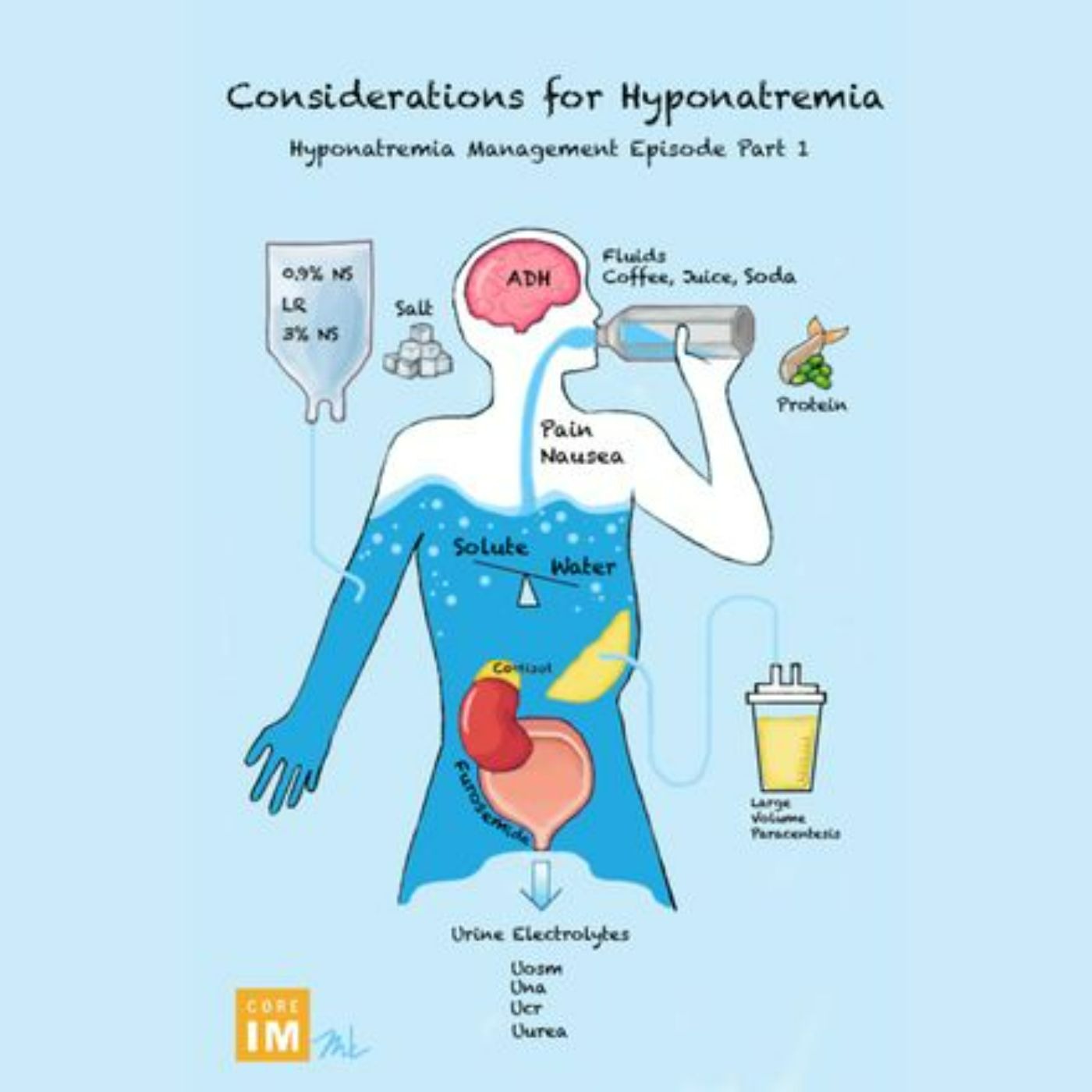
[SPEAKER_05]: It really does help people find this. [SPEAKER_05]: Please tweet us, leave us a comment on our website page, or Instagram or Facebook page. [SPEAKER_05]: Thank you so much to our peer reviewers, Dr. Richard Sterns, Dr. Thomas Guerrero, and Dr. Sheldon Jen. [SPEAKER_05]: Thank you to Dr. Spontio for audio editing, as well as to Dr. Michelle Low for the accompanying graphic.
[SPEAKER_05]: As always, we love hearing feedback, so please email us at helloacquariampodcast.com. [SPEAKER_05]: A opinion expressed our own and do not represent the opinions of any affiliate institutions. [SPEAKER_05]: So when there's true hyponytremia? [SPEAKER_04]: Hmm. [SPEAKER_04]: Hi, okay, linear.
[SPEAKER_04]: Whoa, whoa, whoa, flat twice. [SPEAKER_05]: out that the rate with which you influse. [SPEAKER_04]: If your patient needs more fluids, the nigiri of what type of fluids. [SPEAKER_04]: I was going to let go. [SPEAKER_04]: I thought it would sound cool.
