

Core IM | Internal Medicine Podcast
#217 Treatment for Alcohol Use Disorder: 5 Pearls Segment
· 38 min
Kapitelklicken springt direkt hin
Shownotes
<p><em>“It didn’t work.”</em> This episode breaks down practical treatment options (dosing options for naltrexone, acamprosate, topiramate, gabapentin) and counseling pearls to help you meet patients where they are and support their recovery. Also discover blind spots in detox and rehab centers.</p><p>🔹<a href="coreimpodcast.com/2026/09/16/treatment-for-alc…; rel="nofollow"><strong>Transcript and Show Notes</strong></a></p><p>🔹 Explore ACP’s Substance Use Disorder Education Hub for videos and an AI-powered patient simulation to practice alcohol-use conversations: <a href="coreimpodcast.com/SUDhub"; rel="nofollow">coreimpodcast.com/SUDhub</a></p>&l… href="coreimpodcast.com/ASAMVideos"; rel="nofollow">Alcohol Use and Chronic Health Conditions Mini Video Series</a></p><p>01:55 | #1: Naltrexone</p><p>12:06 | #2 Acamprosate</p><p>16:15 | #3: Topiramate</p><p>21:12 | #4: Other meds</p><p>29:31 | #5: Detox and rehab blind spots </p><p><br></p><p><strong>Tags:</strong> CoreIM, Medical Education, Addiction Medicine, Alcohol Withdrawal, Addiction Treatment, GLP-1, pharmacology</p><br /><br />Find the best disability insurance for you: patternlife.com/disability-insurance?campid=49… Sponsors:<br/>* Check out Eko: ekohealth.com<br/>* Check out FIGS and use my code FIGSRX for a great deal: wearfigs.com<br/><br/><br/>A… Inquiries: <a href='redcircle.com/brands'>https://redcircle… & Opt-Out: <a href='redcircle.com/privacy'>https://redcircl…;
Transkriptvom Podcast bereitgestellt · Zeitmarken springen hin
[SPEAKER_02]: We are sort of like, do you want to try and all checks on now? [SPEAKER_00]: Okay, whatever. [SPEAKER_02]: Whereas with other medications, like we sell it, right? [SPEAKER_02]: Even though the number need to treat further medications is way higher than the number need to treat for an all checks on.
[SPEAKER_02]: We are like all in on our GDMT for her failure, and we'll like really share with the patient why we think it matters and why we think it's going to help. [SPEAKER_02]: even if the benefits are relatively marginal and you know I feel like without holly's disorder medications in part because I think sometimes we don't know the evidence or we feel unbibble in ourselves we don't really sell it so I try to go all in on the benefit of medications and also planning to see that there's lots of different options and just because one is in helpful doesn't mean that medications won't help that we can always trial other things in the same way we think about managing again hypertension and our heart disease or some other illness.
[SPEAKER_04]: Welcome to the CoreM Thyapurral's podcast. [SPEAKER_04]: I'm Dr. Shreach Ravetti, and I'm joined by. [SPEAKER_01]: Hi, I'm Dr. Romsom, the rich. [SPEAKER_01]: And I'm Boris Ravetti, an addiction medicine, and I'm currently in GI Apatology Fellow at the University of Michigan. [SPEAKER_04]: Yes.
[SPEAKER_04]: And this episode is made in partnership with the American College of Physicians and made possible by a grant from the American Society of Addiction Medicine. [SPEAKER_04]: And with that, let's meet the discussions for the episode. [SPEAKER_04]: Two of whom were actually wrongs preceptors back in addiction medicine fellowship.
[SPEAKER_04]: First up is Dr. Michael Beer. [SPEAKER_00]: I'm an internist and an addiction specialist. [SPEAKER_00]: And I've been in Boston linked to mass general hospital for about 40 years. [SPEAKER_03]: My name is Alyssa Peterton. [SPEAKER_03]: I am an internist and addiction medicine doctor, Boston Medical Center.
[SPEAKER_02]: I'm Dr. Sarah Wakeman. [SPEAKER_02]: I'm an addiction medicine specialist by Wake and trial medicine. [SPEAKER_02]: And I'm senior medical doctor for substance use disorder across our academic health system called Master MLBRAGUM. [SPEAKER_04]: All right. [SPEAKER_04]: And this episode is going to be action packed with tons of medication, pearls, as well as management blind spots, for example, with detox.
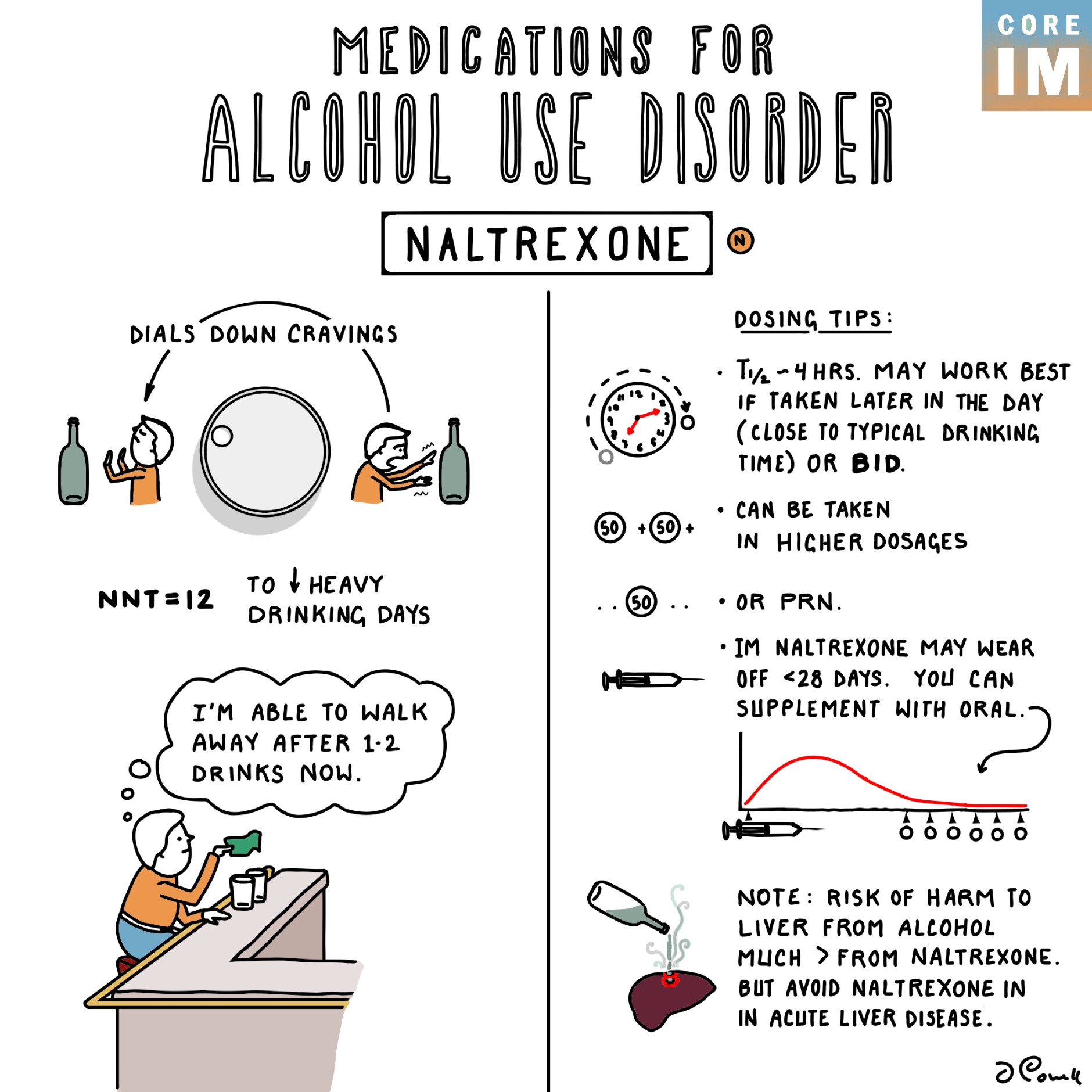
[SPEAKER_04]: Let's get started with a fan favorite. [SPEAKER_02]: might feel about now trucks on for patients, the way that it works and I will say this six of the opioid receptors in the brain, which at first feels kind of counterintuitive for alcohol use disorder. [SPEAKER_02]: I would use an opioid block of alcohol use disorder, but one of the ways that alcohol is reinforcing and causes pleasures by activating the endogenous endorphins system, and so it's actually the release of endorphins binding to the new opioid receptor that's one of the pathways that reinforces the pleasurable effects of alcohol.
[SPEAKER_02]: and so if you block that pathway, people don't get sick if they drink but what they describe is they don't feel the urge to keep on drinking. [SPEAKER_01]: So it helps us at expectations. [SPEAKER_01]: It's not like you're taking out Trexon and it's this huge traumatic experience. [SPEAKER_01]: It's actually pretty subtle and it works behind the scenes to really turn down the volume knob on cravings.
[SPEAKER_04]: You know, Ram, I honestly had not appreciated that aspect of Nealtrack Zone. [SPEAKER_04]: I'll often break up on rounds like, oh, the number needed to treat is 12 for reducing heavy drinking days. [SPEAKER_04]: And I think I haven't translated that subtlety about like turning down the knob on cravings as well in my patient counseling.
[SPEAKER_01]: You know, I like to tell people, we all have a mind-body connection, and that's really what not treksome works on. [SPEAKER_01]: So if you're rocking past a liquor store, your body remembers what it felt like to reach for alcohol. [SPEAKER_01]: But we're not treksome. [SPEAKER_01]: You'll notice that those feelings and cravings will be less intense.
[SPEAKER_04]: Yeah, that is really helpful, kind of imagery of what a patient can expect, because I think for me what I want to do next time, I prescribe someone not treksome is to kind of paint for them. [SPEAKER_01]: Right, it's a huge win, and oftentimes what patients on Nutripson will say is, I had one or two drinks, and I just didn't have the same urge to keep drinking.
[SPEAKER_00]: A lot of times, people say, oh, that drug didn't work for me. [SPEAKER_00]: Nutripson didn't work for me. [SPEAKER_00]: And it's possible that the dose was too low or mistimed, because I am Nutripson. [SPEAKER_00]: People think that the I am Nutripson shot lasts 28 days. [SPEAKER_00]: It doesn't.
[SPEAKER_00]: There are a lot of people who feel it wearing off after 20 days. [SPEAKER_00]: So I typically will give a prescription for P.O. [SPEAKER_00]: now track zone with the instructions. [SPEAKER_00]: Take daily, starting 20 days after any intramuscular now track zone injection. [SPEAKER_00]: and that sort of takes care of the follow-up problem, if someone doesn't quite get to a clinic for the next shot, because it does wear off before 28 days.
[SPEAKER_04]: Okay, there were tons of good points in there. [SPEAKER_04]: So, one is that intramuscular I am Naltruxone. [SPEAKER_04]: It's a monthly medication, Q-2080s. [SPEAKER_04]: But for some patients, it might wear off after 20 days, and so maybe go to send them with some oral Naltruxone to the pharmacy to hold them over until they're next intramuscular injection.
[SPEAKER_00]: And the pill lasts, I think, it's eight hours. [SPEAKER_00]: And so people are taking it once a day and still finding their drinking at night. [SPEAKER_00]: And there's an individual variability, but sometimes you wanna time it before your peak drinking occurs. [SPEAKER_00]: So, ramen is instructed to patients to take it when they leave work, rather than when they first sing in the morning.
[SPEAKER_01]: Right, exactly. [SPEAKER_01]: The firm of kinetics really varies for all of these and for oil and outtracks. [SPEAKER_01]: So it only takes about an hour to kick in after you take it. [SPEAKER_01]: And then, well, yes, it's technically a 24-hour duration of action in practice. [SPEAKER_01]: It may also be shorter than that and the half-light is actually only four hours.
[SPEAKER_01]: So I find it playing around with a timing of the medication can really make a big difference. [SPEAKER_00]: I tend to like drugs first thing in the morning, because I had a patient who told me about their buprenorphine, I take it before my addiction wakes up. [SPEAKER_00]: First thing, I take it when my eyes open.
[SPEAKER_00]: So sometimes if that's the case and people are drinking all day, you may want to split the dose of Nutracks on, or double the dose. [SPEAKER_00]: And then there are other ways of fancy ways of using Nutracks on a PRN or only when drinking, that sort of thing. [SPEAKER_04]: Wait a minute, we'll get to timing in a second, but did he just say like he could split up the dose or double the dose, and he may be even given PRN?
[SPEAKER_04]: I'm curious, have you done some Nautraxone for McKinna next week? [SPEAKER_04]: For example, have you given it twice a day? [SPEAKER_04]: It has all the time. [SPEAKER_01]: Yeah, super effective. [SPEAKER_04]: So that's good to know, I haven't done that, I've actually had any of the other thing he mentioned was giving Nautraxone just kind of like PRN.
[SPEAKER_04]: I'm curious what type of patient might like, hey, just like pill in the pocket, [SPEAKER_01]: I've definitely used it. [SPEAKER_01]: I think it really works best for the young 20-something-year-old and binge-drinks at a party. [SPEAKER_01]: And so there's very interim midden, happy drinking, but in between, not a lot of drinking.
[SPEAKER_01]: And so that's the same clear method. [SPEAKER_01]: You take a dose right before the event. [SPEAKER_01]: Or, you know, for the person who wants to regulate their drinking, but instead of taking maybe eight drinks, they'll have two drinks on their satisfied without really experiencing that loss of control.
[SPEAKER_01]: And everyone is a little bit different. [SPEAKER_01]: So, you know, I've had some people with intramusual and outtracks on once a month, and then I give a little bit of, as needed oral nitracks on that top of that. [SPEAKER_04]: Ah, so many different ways to kind of think about it and what might be right for your patient.
[SPEAKER_04]: I think the other thing in terms of just trying to be better about patient counseling also is like, how long do you tell them to wait before they say, ah, now Jackson's not working. [SPEAKER_01]: Yeah, you know, most people should feel something within the first week or so, but I like to give it a good month, that taking it consistently, and really try to clarify how did their cravings, their number of drinks, their sense of control, how did all of that change over the course of that month?
[SPEAKER_01]: And of course, definitely make sure they're on a good dosage before writing it off. [SPEAKER_01]: You know, at minimum $15m, so no tracks on, but there's definitely room to bump it up to 100mg, or even more than that. [SPEAKER_02]: With oral maltrics and I think that this standard dose is 50 milligrams, but you can definitely go higher than that.
[SPEAKER_02]: And many studies have looked at 100 milligrams daily or even higher, although we tend to use 58 doesn't have to be the only dose that you use. [SPEAKER_04]: Oh, there. [SPEAKER_04]: So, I guess who are the people that you might bump up to 100 milligrams of oral maltrics zone? [SPEAKER_01]: You know, either someone who's noticed a difference, but it's not quite strong enough, or they haven't really felt an effect, but they're also not having too many side effects that are bothersome.
[SPEAKER_04]: Okay, speaking of side effects, what are the side effects to know about when it comes to no track zone? [SPEAKER_02]: The other really important thing to remember is that the worries about impact on hepatotoxicity are totally overblown with no track zone that we've used safely in patients with cirrhosis and that the health harms bond going out call use are far more significant than any worry about hepatotoxicity from no track zone.
[SPEAKER_01]: So now Trexon is safe at Cerosis, and I'm all key even starting it in stable decompensated patients with Cerosis. [SPEAKER_01]: The only time I really hold off is in acute liver failure, severe hepatitis, actively uptrending liver enzymes, or acutely decompensated Cerosis with SPP, HRS, or acute GI bleed.
[SPEAKER_01]: You know, wait for those issues to stabilize, more Cerosis doesn't cloud the picture, and people don't start to blame that not Trexon. [SPEAKER_04]: Mm, yeah. [SPEAKER_04]: I feel like people can easily blame the no-tracks and I feel like it happens all the time. [SPEAKER_04]: You know, you were scratching your heads, like, oh, what are those ASDLT bump and, you know, no-tracks and gets discontinued?
[SPEAKER_04]: Exactly. [SPEAKER_01]: And percent of the time, the answer is just keep the no-tracks on going. [SPEAKER_01]: So keep in mind, it's really a dose-dependent epatotoxicity. [SPEAKER_01]: Really, it starts to become more relevant when we're getting to, like, now strikes on 150 milligrams or 200 milligrams or more than that.
[SPEAKER_01]: The epatotoxicity data really came from these early weight loss studies, and they were all hanging at like 300 plus milligrams. [SPEAKER_01]: And so if you're really worried, you can check, level around those, but just do it in a way that doesn't scare the patient. [SPEAKER_04]: Yes, yes, all good points.
[SPEAKER_04]: So basically take away is you are not checking LFCs for a patient who's just on the run on the mill. [SPEAKER_04]: I'll not have 750 milligrams. [SPEAKER_04]: Yeah, definitely would not check at 50 milligrams. [SPEAKER_04]: Great. [SPEAKER_04]: And then what are those side effects to know about when it comes to no track zone?
[SPEAKER_01]: Now, some people get a little nausea, mild headaches, and oftentimes it kind of goes away on its own in a few days. [SPEAKER_04]: Okay. [SPEAKER_04]: And then in terms of cadre indications, you know, anything that makes no track zone off the table for someone. [SPEAKER_01]: So it's catering to catering with long-term opioids.
[SPEAKER_01]: And so if you do have someone that has regular opioids, and then they start to take not tracks on, it basically pushes them into precipitated withdrawals, and it just goes back to how not tracks on works. [SPEAKER_04]: So let's pause here in summer as an ultra zone. [SPEAKER_04]: I think what I'm taking away is to move away from my initial reflex of an ultra zone or all 50 milligrams for everyone, right?
[SPEAKER_04]: I think especially like in terms of navigating some of the, oh, it didn't work for me. [SPEAKER_04]: Some people might need it twice a day. [SPEAKER_04]: Some people might be the timing to be better, right? [SPEAKER_04]: Like right before they might. [SPEAKER_04]: Leave work, for example.
[SPEAKER_04]: Some people might want to intermuscular and autoxone, but need some oral, not autoxone as needed to bridge them to their next injections or if cravings get really bad. [SPEAKER_04]: And then, remember, I think it was also helpful to appreciate the phenotype of people who might be okay with not autoxone as like a pill in the pocket, just PO, PRN is needed before social events when they're around alcohol.
[SPEAKER_01]: Exactly, you know, the bottom line is that not truck zone has so many different ways that you can use it as a very adaptable medication, and so the better you can understand what someone's context, how does drinking fit into their life? [SPEAKER_01]: That's really where you can tailor these approaches for exactly the patient that you're doing with.
[SPEAKER_04]: Okay, great. [SPEAKER_04]: And then any other thing I'm changing in my counseling, thanks to you again, is that I think, yes, I always mention, hey, there's really good data for Naltruxon, but I never specify the intent here is to turn down the knob on cravings. [SPEAKER_04]: I think my worry is that when someone here is how effective it is, like if they feel like they don't have complete absence at a Naltruxon's not working, but nope, the win here is we're gonna decrease the intensity on the craving, and hopefully have you have a decreased number of drinks that you're having.
[SPEAKER_01]: exactly and you know everyone has their own internal motivator to cut down on drinking and so it's a constant battle between motivation and craving and so now strikes on really tips those scales when you're turning down that volume up on cravings you allow those intrinsic motivators to take predominance and help empower someone's recovery and absolutely you can get folks at achieve complete abstinence with not tracks them.
[SPEAKER_04]: Yes that's always a happy story. [SPEAKER_04]: All right, Ram, I feel like I enter a confessional booth here because even as we were working on this episode, I recently had a patient who unfortunately had a really bad fallout with a business partner invested a lot of money and unfortunately was using drinking to cope.
[SPEAKER_04]: And unfortunately, in one of her binge episodes, had a really bad fall and bleeding in various places, rib fractures, and with a refractors really needed opioids to kind of help with that. [SPEAKER_04]: She was interested in autoxone, but unfortunately, it couldn't get it. [SPEAKER_04]: As we just mentioned, she needed to be really leaned off the opioids for her to be able to take autoxone, and my goodness, I so wish I had thought about a can't proceed, but I didn't.
[SPEAKER_01]: Yeah, I mean, it's such a great medication and the data's really good Sometimes it gets a bad rap or it just not uses often, but there's actually really good news We can't per se is a very hard drug to take because most people prescribe it to ID [SPEAKER_00]: you can prescribe it BID, and the pharmacokinetics are fine.
[SPEAKER_00]: The BID drug is, I think, doable. [SPEAKER_00]: Some people can do TID, but it can't per se it can be prescribed as three pills BID. [SPEAKER_00]: And it's effective, and it works. [SPEAKER_01]: Yeah, I mean, I can't per se, it's actually a really great medication. [SPEAKER_01]: But data is really good, and it works really well.
[SPEAKER_01]: Sometimes it just gets a bit of a bad rap. [SPEAKER_04]: Yeah, maybe it was like the TID aspect of it that made me shy away. [SPEAKER_01]: Yeah, sometimes that can be a barrier, but the flip side is that some people actually prefer the TID dosing of the campus aid, and it can really be a steady reminder, even an affirmation of the recovery goals in multiple time points throughout the day.
[SPEAKER_04]: Yeah, wait, I think I just heard him say three pills. [SPEAKER_04]: TID or BID, sure he's my three pills. [SPEAKER_01]: Yeah, I mean, for some reason, it only comes in at 333 milligrams tablets. [SPEAKER_01]: And so you either have to do three pills to get to the 999 price of a or you two pills to get to the 666 milligrams TID.
[SPEAKER_00]: I don't know why, but take it for 48 weeks and you can stop and it still has an effect for the next 48 weeks. [SPEAKER_00]: Why? [SPEAKER_00]: Who knows? [SPEAKER_04]: Hmm, okay. [SPEAKER_04]: So some really great form of kinetics in here that if you do take [SPEAKER_01]: Yeah, I can't proceed it's fascinating.
[SPEAKER_01]: And I don't know if it's a far enough kinetic thing. [SPEAKER_01]: Maybe it might be more of a rewiring thing from its impacts on NNDA receptors, or not really sure. [SPEAKER_04]: Yeah, I think whatever it is, what we will take it. [SPEAKER_04]: And you mentioned the data is really good.
[SPEAKER_04]: Can you talk a little bit more about that what's the number needed to treat? [SPEAKER_01]: Yeah, so with a camera say, they actually study people who are absent from alcohol, and they measured return to heavy drinking. [SPEAKER_01]: And the number needed to treat is great. [SPEAKER_01]: It's around 12 to prevent return to any drinking.
[SPEAKER_01]: So there is pretty good data for maintaining abstinence. [SPEAKER_04]: And then how long do you tell patients to take a can't proceed for a to like have an effect or before they throw in the towel and say, hey, can't pretty still working for me? [SPEAKER_01]: You know, similar to Nutracks on, give it at least a month or so.
[SPEAKER_01]: And of course, the longer you stick with it, the more you'll benefit. [SPEAKER_04]: And then what are the side effects of a can't proceed? [SPEAKER_04]: We should look out for it. [SPEAKER_01]: You know, mild nausea, sometimes you can get loose your stools, but that also gets better with time to be honest, I've never really had anyone with baller, some GI symptoms, but it is written on the label, and then of course we do have to reenlead those to care per se.
[SPEAKER_01]: So especially if it's cranking clearance less than 30, it's unfortunate it could be off the table. [SPEAKER_04]: Hmm, okay, all good things to know. [SPEAKER_04]: Maybe I'm summarizing what I'm taking away with regards to campus aid. [SPEAKER_04]: It's like one, dear sure, I have remembered to use it more often.
[SPEAKER_04]: There is good data and I think thankfully now, I know I can actually prescribe to campus aid twice a day and maybe get rid of some of the bad rap that it's a TID medication, but I think as Brom is you said, like you've had some patients say that they actually like that it's a TID medication and it's a reminder to their commitment to alcohol abstinence.
[SPEAKER_04]: And then second thing is to really, I think, internalize for me that's really effective in terms of helping people maintain abstinence and even if they take a campus seat, I guess twice a day, or three times a day for a little under a year, that they actually could have a durable effect, even if they stop a campus seat.
[SPEAKER_04]: All right, let's see what else we have in our wheelhouse. [SPEAKER_04]: We've covered Naltrexone. [SPEAKER_04]: We covered a camera seat. [SPEAKER_04]: Let's get into top here in me. [SPEAKER_02]: My next go-to is top here in me, which is off-label and not FDA-approved, but probably as effective if not more effective than Naltrexone.
[SPEAKER_02]: And top here in me, it patients all share this to us and around for forever. [SPEAKER_02]: We use it for lots of other things, like epilepsy and migraines. [SPEAKER_02]: It can cause loss of appetite and weight loss, which for some patients is a plus. [SPEAKER_02]: If they're also worried about their weight, or trying to lose weight, [SPEAKER_02]: And the main challenge is just that you have to start low and tight rates slowly.
[SPEAKER_02]: And so it does require ongoing follow-up. [SPEAKER_02]: And I sometimes, I think we'd forget to do the titration. [SPEAKER_02]: So if someone's in the hospital for a week, they're generally not going to get too very high dose. [SPEAKER_02]: Maybe only the 25 milligrams or 25 milligrams twice a day.
[SPEAKER_02]: And the target dose is really 100 milligrams BID or even 150 milligrams BID. [SPEAKER_02]: And we would increase weekly by around 25 to 50 milligrams a week depending on if a patient's having side effects. [SPEAKER_02]: The main side effects we worry about are cognitive slowing, so that's really the dose limiting side effect from why we start solo on titric slowly, but also very safe, and again really facted.
[SPEAKER_01]: Yeah, and in the impatient setting, you can dose escalate a little bit more frequently every 48 hours, every 72 hours, and then in the discharge summary, you can even write in the timeline for when to keep going up on the dose and by how much, and obviously stop whenever the side effects are getting too much, tolerate, and maybe you're feeling some pairs.
[SPEAKER_01]: These are some lip tinkling, even some brain fog, but if you're still feeling the benefit as long as you're tolerating the side effects, that's probably a good spot to hold off on going up further. [SPEAKER_01]: I keep in mind to approve me, it's a less subtle medication compared to an abstract zone.
[SPEAKER_01]: There's a much more noticeable of thisceral sensation in the body earlier on. [SPEAKER_04]: Maybe we're a sooner than the taking into effect a week is that what you're saying? [SPEAKER_01]: More or so that you notice the effects sooner. [SPEAKER_01]: So for someone that wants to know, like, hey, this is what I'm feeling when I take this, this I call it to you that might fit and as someone's recovery differently.
[SPEAKER_04]: Oh, interesting. [SPEAKER_04]: And then how good of a medication is to peer me? [SPEAKER_01]: Oh, it's great, the number needed to treat is around 12 to reduce heavy drinking days. [SPEAKER_01]: Maybe even stronger than now, Trexon, according to some of those studies. [SPEAKER_01]: So the main trade-off is really the cognitive side effects.
[SPEAKER_01]: So if someone's working a very cognitive heavy job near or a programmer, that's something that would give me a little bit of a pause and consider an alternate agent. [SPEAKER_04]: Mm-hmm. [SPEAKER_04]: Oh, I said, who would you then think, okay, to appear in my big good trip for? [SPEAKER_01]: You know, I'll think about to appear made for someone who's maybe tried some of the FDA-approved options, like I'll track so on or a can't per se, but maybe didn't have too strong of an effect from it.
[SPEAKER_01]: It's a great next step, especially if it's got migraines, which it'll co-treat. [SPEAKER_01]: It could be a bit of a mood stabilizer as well. [SPEAKER_03]: I also bundle that, right? [SPEAKER_03]: It's an off-label treatment for people who have cocaine use disorder. [SPEAKER_03]: So, is there a way, is there another condition that I can address with this off-label medication?
[SPEAKER_01]: And that's a huge one, because alcohol and cocaine are really frequently co-occurring, especially than are these, and dopamine is perfect for those patients. [SPEAKER_04]: Yeah, I didn't know. [SPEAKER_04]: I definitely want to try to think about topium or next time I see a Utahx positive for cocaine, and they're coming in with what you're all's definitely going to try to reach for some topium.
[SPEAKER_04]: There's definitely some people I can think about right now, who could use some topium aid? [SPEAKER_04]: It's good to know. [SPEAKER_04]: Anything else we should know about topium aid, Ram? [SPEAKER_01]: You know, we should avoid to prepare made of someone who's at previous kidney stones.
[SPEAKER_01]: And the other thing is that there is a bit of a stigma. [SPEAKER_01]: Sometimes around to a pyramid, the brand name is Topamax, but some patients might refer to it as Dopeamax because they feel like really slow down or Dopey. [SPEAKER_01]: Again, not everyone will look at that way. [SPEAKER_01]: And the goal is to get you to a good dose where you feel the benefits without feeling the cognitive side effects.
[SPEAKER_01]: And so I really tried to get a sense of, once someone's heard about Topia are made in the past, it's really data is so strong. [SPEAKER_04]: Yeah, that's awesome. [SPEAKER_04]: Maybe it's a good place to kind of pause and recap. [SPEAKER_04]: So Chopin right, it's one of these medications that needs careful dose escalation with close monitoring where I'm as you just said like it's a medication where you want to get to a good dose without kind of having some of the less desirable side effects that cognitive dulling.
[SPEAKER_04]: And then the doses that are shown to be effective is kind of [SPEAKER_04]: 100 milligrams twice a day or one 50 milligrams twice a day, which I think is helpful context as I'm sure like the next time I like this one's MedRack and I see they're just like sitting at top here in my 25 milligrams a bit like oh maybe that's like not enough to help with the alcohol cravings.
[SPEAKER_04]: I think the other teaching point for me is that I used to think that enough traction was the one to roll them all. [SPEAKER_04]: It was the most effective. [SPEAKER_04]: If I sounds like if I'm thinking about all the meds that we talked about so far, I [SPEAKER_04]: What I've learned is that it can't per se, it may be just as effective as Naltruxone and Topurami, might have even stronger data.
[SPEAKER_04]: I say this with a green salt because these haven't been studied head to head, but just like good to know that there is good data that these other medicines can be effective too. [SPEAKER_01]: Right, all three of these are really great options. [SPEAKER_01]: And really the flip side is that Naltruxone is so much easier.
[SPEAKER_01]: So you don't have to worry about dose escalation or monitoring for side effects in the same way. [SPEAKER_01]: It's a lot easier to prescribe, a lot easier to keep up with, and it still has great efficacy. [SPEAKER_04]: All right, let's get into the other medications, right? [SPEAKER_04]: Say, for what a reason we can't reach for an autoxone or can't proceed or to fear me.
[SPEAKER_04]: What are some of the other options so we might be able to reach for? [SPEAKER_00]: I think the other thing about alcoholic disorder is the co-morbid psychiatric complaints or diagnoses are common and can be treated even in the face of drinking. [SPEAKER_00]: So the use of gap of pentane might be in a situation where anxiety is one of the things driving drinking.
[SPEAKER_00]: And so the problem is that drug is that people don't stop taking it. [SPEAKER_00]: Like a lot of things, we start them and then they take on a wife and they're all. [SPEAKER_01]: It's not a problematic drug by and large. [SPEAKER_01]: So I really like that a Penton were anxiety or even insomnia as a huge trigger for drinking.
[SPEAKER_01]: And the data shows that six toucher milligrams CID is a good target dose to reach the decent reduction and heavy drinking. [SPEAKER_01]: You can go up even higher on the QHS dose. [SPEAKER_01]: Even 900 milligrams or even more. [SPEAKER_01]: But definitely take caution, especially for anyone older or frail, would definitely consider those reducing to 100 or 300 milligrams, or even just hold off altogether.
[SPEAKER_04]: Yeah, okay, so it's good to know kind of like we need to get to a high enough dose, like 600 and 900 to have an effect in when it comes to anxiety. [SPEAKER_01]: Right, you know, usually when I say 200 and 900 milligrams, they start to feel an effect. [SPEAKER_01]: But keep in mind, when you've had a massive reduction in drinking, say from one pint of liquor a day down to a half pint of liquor a day, you're going to feel some rebounding anxiety.
[SPEAKER_01]: That would pence and can really take the edge off of that and even help reframe that association that alcohol halls what I reach for when I feel anxious. [SPEAKER_01]: I feel like the other person I think about forgot a pension is someone that has really bad alcohol related neuropathy or diabetic neuropathy and sometimes that pain can be so painful that that can be a huge trigger for drinking.
[SPEAKER_01]: Oftentimes when they show up with a cute alcap where they're really sick, they may have a lot of other symptoms that are really taking to forefront of their medical care. [SPEAKER_01]: They have knowledge of fatigue, jaundice, all that's taken to forefront. [SPEAKER_01]: Then [SPEAKER_01]: After three to six months, when that's all cooled off, people realize they have this severe burning leg pain that's not going away, and that can actually ensure people to go back to drinking.
[SPEAKER_01]: So, government is great through that overlap. [SPEAKER_04]: Oh, is this all helpful? [SPEAKER_04]: I'm curious, Ram, have you ever had any hesitation from patients or like other teams pushing back being like, well aren't we just replacing alcohol with something else that's working on the GABA receptors, especially if it's like such high dose, like can you feel guilty or like, I'm the one putting someone on 900 milligrams to ID of GABA content.
[SPEAKER_04]: What do you kind of say to that? [SPEAKER_01]: Yeah, I mean, it definitely comes up. [SPEAKER_01]: I think that there's really two things to think about. [SPEAKER_01]: One is that we always have to make sure on a case-by-case level that the benefits are going to outweigh the risks. [SPEAKER_04]: You know, if severe anxiety is a major return of drinking or it's uh, or sleeping at a patient recently where like they were using alcohol to help them sleep and I thought about like, should I give him 900 at nighttime?
[SPEAKER_04]: But I'm like, am I just, am I just doing the same thing as alcohol does? [SPEAKER_01]: Yeah, I mean, it's all a risk benefit. [SPEAKER_01]: So if someone is kind of drink, you know, one to two points of alcohol to help them get to sleep and they're going to lose control and have all these other impacts, alcohol, then withdrawals.
[SPEAKER_01]: Get a pen to and won't have those same side effects. [SPEAKER_01]: I mean, yes, it can be sitating, but it's not going to cause alcohol. [SPEAKER_01]: It's not going to lead to withdrawals quite in the same way. [SPEAKER_01]: The severe acute alcohol withdrawals can manifest. [SPEAKER_01]: Again, it's always a conversation case by case.
[SPEAKER_01]: I mean, the flip side is also for conditions like diabetes, and I love the diabetes analogy. [SPEAKER_01]: If someone needs insulin and you're prescribing them insulin, we don't tell them, oh, now you're just becoming dependent on medication. [SPEAKER_01]: It's important to maintain your [SPEAKER_01]: So there is good data for it and, you know, if you're seeing someone that has a radical use of other sedating medications or, you know, the struggle with bensers in the past, it definitely is appropriate to ask if this is the right medication for someone.
[SPEAKER_01]: And so one of the nice things about Gavipenten is that there are even these outpatient alcohol withdrawal protocols based off of Gavipenten. [SPEAKER_01]: And so you can kind of use Gavipenten to help taper someone off of moderate to heavy shrinking where they may have some very mild alcohol withdrawal symptoms.
[SPEAKER_01]: And so even starting out front with the higher doses and gradually tapering it all for weeks to months, can actually have a huge benefit. [SPEAKER_04]: Amazing. [SPEAKER_04]: Lots of good stuff. [SPEAKER_04]: I think the other medication to talk about is disulfaring. [SPEAKER_04]: We had briefly mentioned it.
[SPEAKER_04]: It's one that a lot of patients know about, but what else do you think we as clinicians should know about? [SPEAKER_01]: the best description I've heard of desktop for Amazon is that it's really at the hate real intervention where they go into it knowing that here's the deal it's going to take alcohol off the table and psychologically I know that it's not an option and it has to be someone that engages with that motivator.
[SPEAKER_00]: One way to use it safely is to have a responsible other who's kind of part of the diet of recovery. [SPEAKER_00]: You know, and it doesn't have to be a punitive jailer saying take this pill. [SPEAKER_00]: It's more darling. [SPEAKER_00]: Thank you for letting me be part of your recovery.
[SPEAKER_00]: I'm so happy to watch you take your disulfur. [SPEAKER_00]: That's sort of thing. [SPEAKER_04]: Okay, so are there people that you've actually seen want Dyself Frame where you saw Dyself Frame on and it made a difference? [SPEAKER_01]: Yeah, definitely. [SPEAKER_01]: It's a very carefully-segged patient population, and it's usually someone that has insight into the motivators, and the responsible enough to take it on a regular basis.
[SPEAKER_01]: And so oftentimes it's someone who's older or they're more familiar with it because Dyself Frame's been around for a longer, and they know that they're going to get violently sick, and so any drop-of-out goal haul is just off the table. [SPEAKER_01]: And so Dyselfram is actually something we should avoid with liver disease.
[SPEAKER_01]: Unlike not trapped somewhere, so Dyself's dependent hepatotoxicity. [SPEAKER_01]: Dyselfram is actually more idiosyncratic, and so if they have underlying liver disease, we just can't predict at what Dyself might develop some hepatotoxicity. [SPEAKER_04]: at a sex, I think like just not knowing if this person will get hip-hop toxicity from Dyself-RAM.
[SPEAKER_01]: Right. [SPEAKER_01]: But aside from that, it's important to counsel that they should avoid alcohol-based mouthwashers and aftershave and hand sanitizer, just to make sure they're not going to get a mild reaction that could be pretty uncomfortable. [SPEAKER_04]: Mm, that is a great pro-chip in terms of counseling.
[SPEAKER_04]: And then I think last but not least, in terms of the other medications is a new case on the block that GLP1 men's. [SPEAKER_02]: The kind of new kit on the block, which is really exciting, is the whole class of GLP1 medications, especially semi-glutide, where I hope we may see FDA approval at some point in the not-too-distant future, but where we have great three clinical evidence and now a big clinical trial showing improvement that'll call outcomes.
[SPEAKER_02]: and seems to be a pan addiction, pan craving, obesity, obviously wonder drug that we are talking about lots of different spaces. [SPEAKER_02]: But on the addiction side, it seems to work across substances and in a randomized control trial amongst folks that call you to sort of want seeking treatment showed significant improvement.
[SPEAKER_02]: I'll call you south comments. [SPEAKER_02]: So really exciting to think about it's an option. [SPEAKER_01]: So right now, we have really good phase two data. [SPEAKER_01]: It's very promising, free clinical outcomes, and they're looking at reduction of volume of drinking. [SPEAKER_01]: We don't yet have the robust clinical outcomes, but the phase three studies are right around a choir.
[SPEAKER_01]: And the thing is really exciting about GLD1 agonists is that they're also really helpful for stiotosis and liver disease. [SPEAKER_01]: So if you can find an insurance indication, you know, they got diabetes or obesity, you can actually help with their liver disease as well. [SPEAKER_04]: Great rap, why don't we summarize all good things when it comes to a gap-pinted, I self-ream, and GOP ones, how do you think about them, and how do think people should kind of approach when they should reach for one versus the other?
[SPEAKER_01]: Yeah, these are great off-lapable options that are really good for certain niche populations. [SPEAKER_01]: And so, Gabapentin Dyselfram very carefully selected. [SPEAKER_01]: Gabapentin really great for those folks, where anxiety is a huge tricker for return to drinking or even neuropathic pain and folks that have alcohol or diabetic related neuropathy.
[SPEAKER_01]: And Somia, without the use tricker, Gabapentin is something about Dyselfram is the very carefully selected patient who is specifically interested in that motivator of taking alcohol off the table. [SPEAKER_01]: The GLB ones are super promising the coverage from an insurance standpoint is really going to be for those folks who have obesity to have diabetes If they have concurrent alcohol use disorder, it's great and it also has the added perk of helping with the atosis, so it can even help their liver disease to But the phase three studies are right around the corner and hopefully soon enough will get an on label indication for it.
[SPEAKER_02]: I think the most common thing that often people think of is the best treatment for our alcohol use disorder for addiction treatment generally is detox and rehab, and that is definitely not true. [SPEAKER_02]: So it's good to challenge that misconception, quote unquote, detox is really inpatient medically and into withdrawal.
[SPEAKER_02]: And for alcohol use to assure that often is needed as a first step. [SPEAKER_02]: But if all someone does is go to detox, the risk of recurrence is incredibly high. [SPEAKER_02]: And so again, really thinking of kind of a chronic care management model. [SPEAKER_02]: If you think of detox is almost like closing someone's gap on the FDA.
[SPEAKER_02]: Yes, that's necessary, but it's not sufficient to manage diabetes. [SPEAKER_02]: You need to both manage that acute crisis and then you need to treat the underlying condition. [SPEAKER_04]: That's a helpful context into terms of thinking about detox. [SPEAKER_04]: But I'm assuming in our patients, you know, when they get discharged from the eating and go to detox that then these patients are going to get put on a drug zone or a campus aid or whatever medication that makes sense for them when they're withdrawals over.
[SPEAKER_01]: I mean, in my experience, it's hit or miss and more often than not, they end up not starting. [SPEAKER_01]: I don't know if they refer to employees disorder. [SPEAKER_04]: Oh, all right, that's the one that's good to know. [SPEAKER_04]: Maybe maybe next time I just heard someone to detox, to maybe also make sure they have addiction medicine appointment or maybe their PSP dose to help think about medication management and other kind of supports.
[SPEAKER_03]: And then I guess in addition that it would be good to know kind of who are the right people to send to detox. [SPEAKER_03]: For me, the biggest thing of when I was a fellow, like I spent some time in what's commonly known as detoxes, we're trying to move away from that word, they'll we call it ATS or acute treatment services.
[SPEAKER_03]: And I was just, I was amazed, oh, what was happening, what could be done, but I think there was someone who came in the night before and he was actually having hallucinations and I was like, oh my gosh, and then by attending was like, yeah, he has to go back to the hospital. [SPEAKER_03]: We can't handle that.
[SPEAKER_03]: It's very protocolized, right? [SPEAKER_03]: It's like you're here for alcohol withdrawal, they take the box, okay, we do die as a pan here, they take that box and like it gets started. [SPEAKER_03]: So when the nurse has so many patients to manage, like you have to have so what we skydive taking those boxes is fairly easy to manage.
[SPEAKER_03]: sending people there who have maybe major traumatic brain injury, seizure disorder, not the ideal candidates, or have sort of complex risk for heart failure, actually, might not be where you want to send them. [SPEAKER_03]: And the other thing is that they have to have meds with them, right?
[SPEAKER_03]: If they're coming in in the evening, a lot of some of these places are not affiliated with pharmacies, they have to order out medications. [SPEAKER_03]: So like if they're meds that you [SPEAKER_03]: Think your patient is going to need within the next 24 hours. [SPEAKER_03]: You make sure they come with their supply or at least send refills to the pharmacy so they can pick them up before they go to these programs.
[SPEAKER_01]: So the teaching here is that these detox centers that can often be very nursing driven and it's very protocolized. [SPEAKER_01]: So anyone with complex withdrawals, it had seizures or DTs before, or if they're at risk of going into HL with RVR, these are not going to be well suited for going to a detox center.
[SPEAKER_01]: And so keep in mind, these are not hospitals, they can't do daily labs, they don't have telemetry monitoring, released for garden variety, bread and butter, uncomplicated alcohol withdrawals, so you can manage with a very protocolized approach. [SPEAKER_04]: that again is helpful context.
[SPEAKER_04]: I guess in terms of other dispo or destinations, in addition to detox, we're sending us just charging people to kind of re-haves or residential rehab. [SPEAKER_02]: And of course, if we can kind of think about what exactly that is in some of the blind spots there, re-haves this idea of sending people a way to a residential setting where they're removed from their environment and have intensive treatments.
[SPEAKER_02]: On the one hand, there can be benefits of that, especially if someone doesn't have housing, and the alternative is going back to the street and being in chaos being on a structured setting can be really helpful. [SPEAKER_02]: On the other hand, there's not great evidence for residential treatment programs.
[SPEAKER_02]: There's a lot of heterogeneity and what's offered there, and sometimes the quality is in all that great. [SPEAKER_01]: So it is true that some alcohol rehabs or residential programs are not very good, and they don't necessarily do evidence-based practices, and they charge a huge premium.
[SPEAKER_04]: in ramen year experience, what's like the best example of a residential rehab versus them one that was like the most not evidence-based. [SPEAKER_01]: You know, the good ones are gonna use proven therapies. [SPEAKER_01]: Things like CBT, good therapy modalities. [SPEAKER_01]: They're working on your triggers.
[SPEAKER_01]: They're working out relapse prevention planning. [SPEAKER_01]: They're trying to help build coping strategies. [SPEAKER_01]: How do you deal with these difficult feelings? [SPEAKER_01]: They come up and can trigger alcohol use. [SPEAKER_01]: On the flip side, I've seen some that use at client therapy.
[SPEAKER_01]: You ride a horse and, oh my gosh, or surf therapy. [SPEAKER_01]: There's an area in LA. [SPEAKER_01]: They call it the rehab revira. [SPEAKER_01]: And it charge tens of thousands of dollars a month. [SPEAKER_01]: huge premiums and it is executive rehab as the term they use, but yeah, it's a whole industry sometimes, but again, there really are places that are doing a great job and they're really trying to focus on it.
[SPEAKER_04]: And how do you want to know? [SPEAKER_04]: I'm assuming like the Google reviews are obviously like, take a grain of soft based on that person's experience, but is there any like objective way, like you know, hey, this rehab would be good for you versus is it just kind of word a mouth of?
[SPEAKER_01]: Yeah, it's a lot of word amount. [SPEAKER_01]: And I think this would be a great opportunity to reach out to your friendly neighborhood of dicrimas and specialists who really knows what's going on locally. [SPEAKER_01]: And what have they been placed with those sent people? [SPEAKER_02]: Not all residential programs offer medications or offer actually evidence-based therapies.
[SPEAKER_02]: So ambulatory treatment very much is as good as not that are in terms of long-term outcomes. [SPEAKER_02]: And so that can be medical management with a doctor or the doctor is prescribing medication and during medical counseling. [SPEAKER_02]: Plus, often therapy, or sort of therapy, based on a mentioned site cognitive behavioral therapy, and that can occur in like an intensive setting, which we talk about as IOP, which is usually three days a week of intensive groups in the digital counseling, or a PhD has even more intensive, usually two weeks that all day that you live at home.
[SPEAKER_04]: That's so interesting, but helpful in terms of thinking about maybe they have that that a residential rehab, but to think like, hey, could seeing someone outpatient be helpful versus would that message rehab be the best place for this person? [SPEAKER_01]: Yeah, and really the phenotype of someone who benefits from residential rehab.
[SPEAKER_01]: It's someone who has a chaotic life situation and maybe they're on sheltered or their social environment is full of people who are actively drinking or using substances, and that would otherwise be a major trigger to be around. [SPEAKER_04]: Mm, yes, definitely. [SPEAKER_04]: From, could you do us the honor of maybe summarizing for us some of the key blind spots or what you want people to take away when it comes to just charging people to detoxes and to residential rehabs and what we can do better?
[SPEAKER_01]: Right, so detox residential rehabs, these are non-hospitals, they can't do daily blood draws. [SPEAKER_01]: They don't have close to elementary monitoring. [SPEAKER_01]: It's very protocoled nursing driven. [SPEAKER_01]: And so garden variety, bread and butter, alcohol withdrawals, or they don't have anything else [SPEAKER_01]: That's the perfect person to send to a detox enter.
[SPEAKER_01]: And remember, this is short-term treatment. [SPEAKER_01]: It's like closing the gap for your decay, but it's not long-term, and it's not going to change the trajectory of someone's recovery. [SPEAKER_01]: If you're not also pairing it up with longer-term treatments, like front-look at therapy, counseling, and really understanding what's driving someone's alcohol use.
[SPEAKER_01]: residential rehab programs are great but the data is really mixed and they're very hit or missed and there's some that aren't and so really it's a matter of identifying what are the patients needs and if they have a very chaotic life environment if they need a clean slate to work on their recovery this is a great place to do that.
[SPEAKER_04]: That is a wrap for today's episode. [SPEAKER_04]: If you found this episode helpful, our ask is to please share it with one other person that could use this and I think it'll be so impactful. [SPEAKER_04]: And I know for me, I've changed the way I have gone and talked to patients. [SPEAKER_04]: And it's really kind of undoing some of these misconceptions or traps that we can all fall into.
[SPEAKER_01]: And thank you to our reviewers and to Dr. Jesse Powell for the accompanying graphic. [SPEAKER_04]: And if you want to check out more that ACP is done on the topic, particularly these really great videos on motivational interviewing, I think a believe Dr. Peter can wasn't involved with some of them.
[SPEAKER_04]: We'll put the link in our show notes, as always opinions express our own, and just not replace the opinions of any affiliate institutions. [SPEAKER_04]: Thank you and take care.
