

Kapitelklicken springt direkt hin
Shownotes
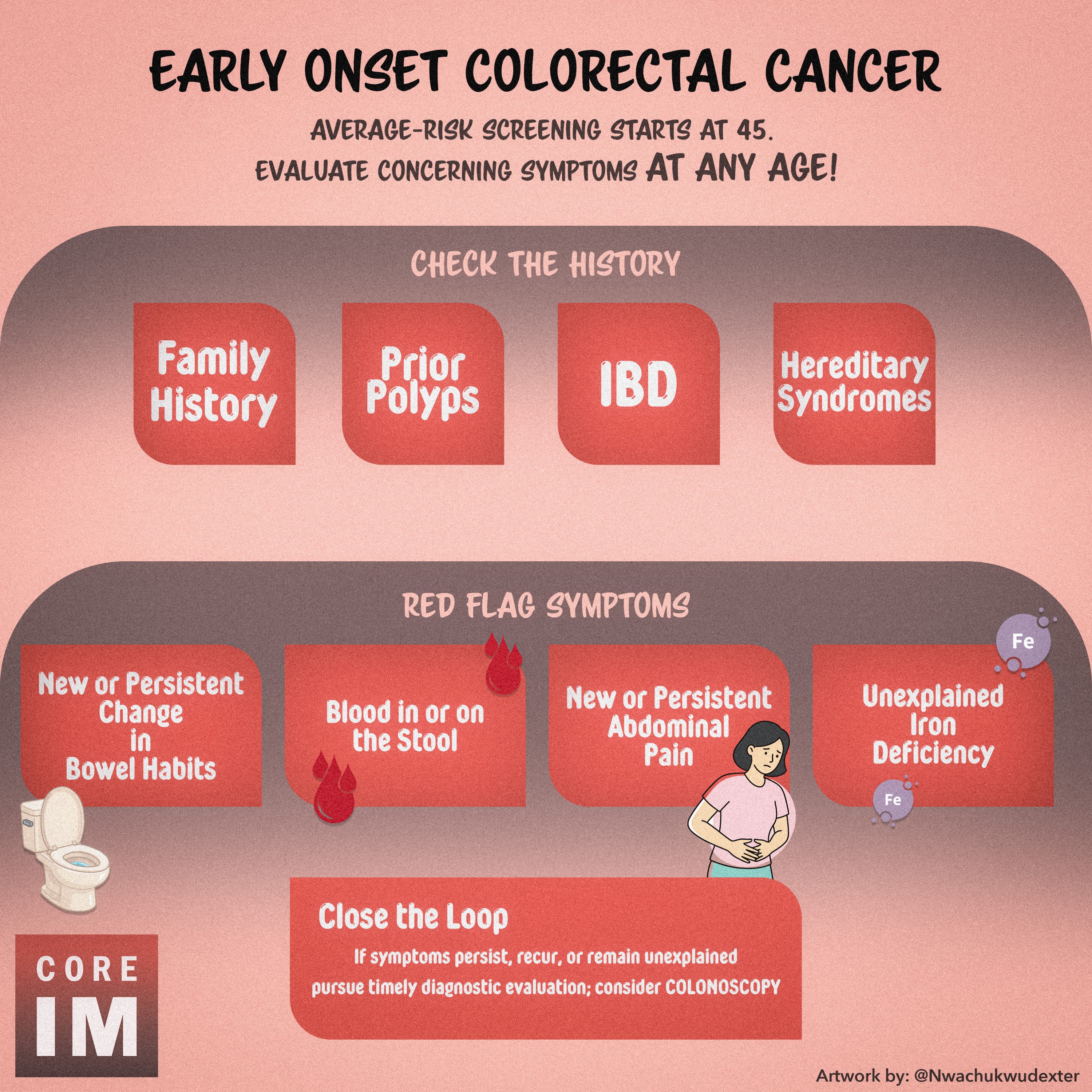
<p><em>“Too young for colon cancer.” </em>This episode unpacks the red flags of early-onset colorectal cancer (CRC), from blood in the stool and iron deficiency anemia to persistent abdominal pain and changes in bowel habits, and offers practical pearls for closing the clinical loop. Also learn why a “negative” family history may need a yearly refresh.</p><p><br></p><p>🔹<strong>Sponsor:</strong> Search “<a href="coreimpodcast.com/Pharmacy5"; rel="nofollow">Amazon Pharmacy</a> Nationwide Home Delivery" in your EHR to get home delivery (often same-day).<a href="coreimpodcast.com/Amazonpharmacy"; rel="nofollow"> </a><a href="coreimpodcast.com/Pharmacy5"; rel="nofollow">Learn more here!</a></p><p><br></p><p>🔹<a href="coreimpodcast.com/2026/09/23/early-onset-crc-5…; rel="nofollow"><strong>Transcript and Show Notes</strong></a></p><p><br></p><p>01:45 | Colorectal cancer rising in younger adults </p><p>06:42 | Why screening starts at age 45</p><p>08:15 | What may be driving early-onset colorectal cancer </p><p>13:37| Key takeaways: symptoms, follow-up, and family history </p><p><br></p><p><strong>Tags</strong>: Colorectal Cancer Screening, Internal Medicine, Gastroenterology, Cancer Screening, Oncology</p><br /><br />Find the best disability insurance for you: patternlife.com/disability-insurance?campid=49… Sponsors:<br/>* Check out Eko: ekohealth.com<br/>* Check out FIGS and use my code FIGSRX for a great deal: wearfigs.com<br/><br/><br/>A… Inquiries: <a href='redcircle.com/brands'>https://redcircle… & Opt-Out: <a href='redcircle.com/privacy'>https://redcircl…;
Transkriptvom Podcast bereitgestellt · Zeitmarken springen hin
[SPEAKER_00]: And by 2030, it is estimated that for people, men and women, under the age of 50, colorechal cancer will be the number one cause of cancer deaths in that group. [SPEAKER_00]: And those statistics are very stark. [SPEAKER_00]: And let's enlarge part why the guidelines were updated to include people starting screening at the age of 45.
[SPEAKER_02]: That's Dr. Rachel Isaka, Gastrogrammologist from the University of Washington. [SPEAKER_02]: Welcome to the Chlorium Thy Pro's Podcast, bringing you how yield have been in space pearls. [SPEAKER_02]: I'm Dr. Shreya Trevetti. [SPEAKER_06]: And I'm Dr. Steve Weber-Top, in Turtle Medicine Residence at Beth Israel Deacon's Medical Center.
[SPEAKER_02]: And today, we're talking all about colorectal cancer and screening, and let's meet our discussions for the day. [SPEAKER_03]: My name is Xavier, I'm a gastroenterologist and 11 years ago, I moved to Yale to head the GA Cancer Prevention Program. [SPEAKER_05]: I'm Smyr Gupta, I'm a gastroenterologist at the VA San Diego Health Care System and a professor of medicine at UC San Diego.
[SPEAKER_00]: My name is Dr. Rita Lisaka, I'm a gastroenterologist and a health services researcher at the Fred Hutchinson Cancer Center and the University of Washington and Seattle. [SPEAKER_04]: My name is Joe Furerstine, I'm the Clinical Chiefs of Gastronerology at Beth Israel. [SPEAKER_01]: And we originally recorded this as one Comprehensive 5 Pro's episode in colorectal cancer, but there was so much good stuff that we actually decided to buy it to three shorter episodes that will release over the next couple of weeks.
[SPEAKER_01]: And in this first episode, we're going to unpack why screening now begins at age 45, which symptoms and younger adults should really prompt us to look further. [SPEAKER_01]: And personally, I had a vested interest in learning why is it that so many people in the 30s are getting diagnosed with colorent cancer?
[SPEAKER_01]: And with that, let's get to the episode. [SPEAKER_02]: I think a lot of us are taught that colorectal cancer is something that happens later in life. [SPEAKER_02]: I think the illness script is like someone who is elderly, weight loss, anemia, maybe a positive test. [SPEAKER_02]: But that mental model is changing.
[SPEAKER_03]: that's because of the last 15 years or so, while we've seen these very constant decrease in colorechal cancer incidents overall, we've seen creeping up this colorechal cancer among the youngest individuals that in general would call them before the age of 50. [SPEAKER_03]: So the increases have been so rapid at like close to 1.5% per year, but less than about 50% of the individuals who develop colorechal cancer before age 50, actually developing before age 45.
[SPEAKER_03]: So, we are not going to be catching those when we started 45, so what we're really doing is emphasizing also more not to dismiss symptoms that in the past because individuals were young and the suspicion was very, very low. [SPEAKER_03]: We're being a little bit dismissive, blood in the stool or changing mouth habits, persistent abdominal pain, [SPEAKER_03]: Some things that in younger individuals in the past we were being dismissive and I think no longer we are and we're being much more aggressive in terms of working out this just because of that rise among youngest individuals.
[SPEAKER_02]: That is so humbling and definitely makes me uncomfortable. [SPEAKER_02]: I think if I have just counted a younger person symptoms in the past and I definitely want to do better. [SPEAKER_05]: I think to tie back to what I would tell clinicians, number one, we really have to raise awareness that colon cancer is not just an old person's disease.
[SPEAKER_05]: So one of the number one complaints if not the number one complaint or concern that we hear from young onset colon cancer survivors that it took way too long for them to get a diagnosis. [SPEAKER_05]: And they'll tell stories about how they had himatechisia [SPEAKER_05]: and that they even brought up potentially exploring a diagnostic colonoscopy.
[SPEAKER_05]: And they were brushed off because the clinician just didn't think it was possible for them to have colon cancer. [SPEAKER_05]: So, everyone needs to know what the potential red flag signs are of colon cancer. [SPEAKER_05]: So, hematiques, your change in bowel habit, unexplained of galloping, are indifficiency, andemia.
[SPEAKER_05]: That doesn't mean that every single one of these patients has to go [SPEAKER_05]: The nine causes of these symptoms if you treat them based on a working diagnosis should resolve or get better within 30 or 45 days. [SPEAKER_05]: And if they don't, then we have to bring cola cancer or higher on the differential and they really should be considered for a colonoscopy.
[SPEAKER_05]: So I think that would be my take home message for clinicians to know the red flag signs and symptoms. [SPEAKER_05]: and for people who they don't send for a colonoscopy to make sure they close the clinical loop within 30 days to make sure that whatever their working diagnosis was correct in the patient is getting better.
[SPEAKER_06]: So that really hits home. [SPEAKER_06]: I had a patient in his 30s in clinic recently who had mentioned a diagnosis of IBS from a prior provider that was driven by constipation and mucus in his stool, which had somewhat improved dietary modifications. [SPEAKER_06]: But when we dug a little bit of deeper, he said he had recently had blood in his stool, but that he hadn't mentioned it because he had chalked it up to dietary discretion that this had happened in the past.
[SPEAKER_06]: So we got the colonoscopy loan behold [SPEAKER_06]: Well, in someone in their thirties, yeah, and it was kind of unfortunate because it was caught at a little bit of a later stage. [SPEAKER_06]: And it makes me think about how in cases like these closing the loop on a diagnosis and making sure the patient symptoms are solved.
[SPEAKER_06]: And if not, pursuing that further diagnostic workup could make a difference with these young patients. [SPEAKER_06]: You can catch the caloric delcancer at a point where we can still do surgery. [SPEAKER_02]: Yeah, for sure. [SPEAKER_02]: And then first of all, Kudos to you for doing a good job digging and finding that.
[SPEAKER_02]: Whenever a review is I think also noted something that she's had to do in her clinic, which is really like be creative with her patients about how she asks these questions and she's been able to find [SPEAKER_02]: a lot more things. [SPEAKER_02]: Our patients get a notice and has what to look for or kind of the words that we use and so maybe just being more explicit and saying, have you ever seen red, does it ever look like ketchup or tomato sauce instead of just saying like, oh, is there any blood in your stool?
[SPEAKER_02]: Has made her catch things as she wouldn't have otherwise? [SPEAKER_06]: exactly and rather than just asking about if they have a dominal pain, maybe asking about how they tolerate different foods, if they've ever felt that the gut was off, if they ever experienced intimate discomfort, really kind of digging down into the specifics of what they might be feeling.
[SPEAKER_02]: Yeah, I think it goes back to, you know, being at good interness and being thoughtful about kind of how questions maybe received and kind of being creative. [SPEAKER_02]: I wanted to loop back to something that Dr. Aboi had said in the beginning of the episode that's still bugging me. [SPEAKER_02]: He said that a good percentage of, you know, early onset colon cancer develops even before the age of 45.
[SPEAKER_02]: Wow. [SPEAKER_02]: And so I'm curious, you know, like, if so many people are getting colon or actual cancer before 45, then why are [SPEAKER_00]: And so using a combination of those, you know, kind of epidemiological studies as well as modeling information as really what informed the task force to make the recommendation to reduce the age of screening to start at 45.
[SPEAKER_00]: Now, because of the rising incidence of colon cancer in those who are under 50, some ask, well, why not go even younger? [SPEAKER_00]: Why stop at 45? [SPEAKER_00]: And that recommendation is really based on a balance of exposing individuals to risk and harm and where they might benefit.
[SPEAKER_00]: And so the task force [SPEAKER_00]: really kind of fuses that as a cut point at what point are we saving more lives and causing less harm? [SPEAKER_00]: And right now, based on the data that we have that number appears to be 45. [SPEAKER_00]: I think the task force is open to evaluating new information, so should that age move down then we would have updated recommendations that reflect that?
[SPEAKER_00]: But that's just not our current state today. [SPEAKER_02]: the good old balance of benefit versus harmed. [SPEAKER_02]: Okay, fair. [SPEAKER_02]: And then a part of me is worried, I think, about me, my loved ones, so many of my young friends, have kind of gone through unfortunate early onset colorectal cancer as well.
[SPEAKER_02]: And I'm kind of saying, like, I'm curious what's driving this? [SPEAKER_02]: Is there anything we can do to prevent this? [SPEAKER_02]: And what's going on here? [SPEAKER_05]: There's the usual suspects, and then things that might be new. [SPEAKER_05]: So usual suspects will be city tobacco, alcohol, those do appear to play a role in study specific to early onset cancer.
[SPEAKER_05]: We're seeing things come out about sugar-sweetened beverages, more sedentary time, as measured by TV watching. [SPEAKER_05]: There are some data linking ultra-processed foods to increased prevalence of pre-cancerist [SPEAKER_05]: And I think what's hard about this is that all of us have patients who are otherwise completely healthy, who have been 35, 38, 40 presenting with the colon cancer.
[SPEAKER_05]: So clearly, while these risk factors are probably important, they don't tell the whole story. [SPEAKER_05]: and the thing that has been the most understudied and has been environmental factors, so chemicals in water, in what we're eating could be a pollution could be a factor. [SPEAKER_05]: All these things have not really been well studied and that's probably where the morning is.
[SPEAKER_05]: I should also mention I guess two other things. [SPEAKER_05]: One is when we see birth cohort trends, [SPEAKER_05]: The one thought is that early life exposures might be especially important. [SPEAKER_05]: And we have seen some signals of this. [SPEAKER_05]: So, for example, exposure to bacteria that produce a toxin-cloth-collevactin.
[SPEAKER_05]: And that this exposure, the timing of it is more likely than not to have been an early life exposure. [SPEAKER_05]: So the story that people have been telling with that is that children may be being exposed to something, whether it's antibiotics or something else, that is shifting their microbiome that's more permissive for bacteria that might produce toxins such as this cold backton that is contributing to a higher risk for cancer.
[SPEAKER_05]: So there's a lot of interesting work going on here, but a lot to discover. [SPEAKER_02]: I am so sad to hear that last one. [SPEAKER_02]: Sadly, every time when I was young, I'd have like the slightest cough, Mama Trevetti would take me to our family doctor and make me get as the pack. [SPEAKER_02]: Sasha really actually just demands the pack, unfortunately.
[SPEAKER_02]: And I is just RIP to my brother by own. [SPEAKER_06]: Oh, man, I know. [SPEAKER_06]: I had the same experience, and I spent a lot of our viewers also good. [SPEAKER_00]: Yes. [SPEAKER_06]: I had that same exact experience. [SPEAKER_06]: Speaking of family, the thing I found the most humbling preparing for this episode was we often anchor on family history, but most chloractyl cancer is actually sporadic.
[SPEAKER_04]: So, I'd say the scariest part of colorectal cancer screening is that the vast majority of colorecensors that we diagnose are sporadic. [SPEAKER_04]: Family history is only about a quarter of the cases that we have in general, and most of these cases that we're seeing, our ship no family history at all, and that's the biggest challenges because you would never know to start screening earlier in these individuals.
[SPEAKER_04]: Very often there were symptoms, especially in the more advanced cases, and that's where people are seeing blood in their stool. [SPEAKER_04]: That to us nowadays is a very simple binary decision. [SPEAKER_04]: Is there blood present? [SPEAKER_04]: And if there is, we should do a colonoscopy and make sure there is no advanced polypure cancer already there.
[SPEAKER_04]: Way too often we see people having seen blood in their stool for six months or longer, but most of these are related to just sporadic changes. [SPEAKER_02]: Yes, and then even more humbling news is that even though family history may be only convert 25%, it is still 25% and even that we are not good at capturing that 25%.
[SPEAKER_05]: So there have been now three studies that have shown that very substantial proportion of people who have a young onset colon cancer had a family history that was sufficient [SPEAKER_05]: where they could have benefited from earlier initiation of colon cancer screening that could have detected or maybe even prevented their colon cancer.
[SPEAKER_05]: So we see both in the data and in clinical practice, we routinely see people where [SPEAKER_05]: They had a young relative, first to be relative with cola cancer, and the history was not elicited or at least it's not documented as such, and the colonoscopy was never recommended, or worse, the history was collected, but the guideline-based recommendation was not given to the patient to start cola cancer screening earlier.
[SPEAKER_06]: I think we can all do a better job reassessing family history and cancer history, especially yearly. [SPEAKER_06]: Just because the patients' family history was negative last year doesn't necessarily mean it's negative this year. [SPEAKER_06]: Things can change year to year. [SPEAKER_06]: And I think oftentimes we get caught up because they can often auto-populate an epic or our notes.
[SPEAKER_06]: And it might not have been updated in years, but we might still think it is. [SPEAKER_02]: Yeah, I think it's love hanging for and depending on how your clinic is set up, you know, patients may or may not fill it out online. [SPEAKER_02]: So, you know, always good to make sure we're asking about at least yearly or have some system in place where someone is capturing that yearly.
[SPEAKER_02]: So, Steve, I feel like it's a good point to recap. [SPEAKER_02]: What are you taking away? [SPEAKER_06]: So, my takeaway from Pearl 1 is that colorectal cancer is no longer just an older person to disease. [SPEAKER_06]: Even though the age of screening has moved up to 45 years old, a ton of early onset colorectal cancer happens earlier than age 45 years old.
[SPEAKER_06]: So it's important for us to look out for younger patients who have unexplained our indifficiency, unexplained abdominal pain, changes in bowel habits or blood in their stools. [SPEAKER_02]: Yeah, and that closed that clinical loop line is still really sticking with me and I think, you know, just that idea of circling back with things are not getting better.
[SPEAKER_02]: And then even on the outset, trying to, you know, set expectations with the patient saying, hey, there might be a diagnostic colonoscopy in the horizon if things are not getting better. [SPEAKER_02]: And that's just one other layer to make sure these young patients don't get lost up all up.
[SPEAKER_06]: and of course reassess the family history yearly because for those 25% with family history that family history can change year to year and that's definitely something I want to be better at. [SPEAKER_02]: Same. [SPEAKER_02]: And that is our wrap for today's episode. [SPEAKER_02]: If you got anything at this podcast, it inspired you, our ask is to please send it to one other colleague who might also learn something from this episode too.
[SPEAKER_06]: and a big, big thank you to our discussants, Dr. Sumirukupta, Dr. Rishal Isaka, Dr. Havir Lloyd, and Dr. Joseph Firstine, as well as our peer reviewer, Dr. Elizabeth Hausman. [SPEAKER_02]: And thank you, Dr. Dexter Nautchukuk, for the graphic, as well as all the other people who made this episode possible.
[SPEAKER_02]: As always, we love hearing feedback. [SPEAKER_02]: Please email us at hello, at corri and podcast.com, opinions expressed our own, and do not represent the opinions of any affiliate institutions. [SPEAKER_02]: Thank you and take care.
