

Kapitelklicken springt direkt hin
Shownotes
<p><strong><em>“The triglycerides are high. Now what?”</em></strong> This episode breaks down a practical approach to elevated TGs, from knowing when to check ApoB or non-HDL-C to choosing lifestyle changes, lipid-lowering medications, and when to suspect an underlying genetic disorder. </p><p><br></p><p>🔹<a href="coreimpodcast.com/2026/09/29/updates-in-trigly…; rel="nofollow"><strong>Transcript and Show Notes</strong></a></p><p>02:17 | Check a non-HDL-C or ApoB if TGs are ≥150 mg/dL </p><p>07:18 | Address waist circumference and lifestyle before meds for high TGs</p><p>10:52 | Dr. Watson’s 3-day carbohydrate responsiveness trial </p><p>17:07 | Order a fasting or nonfasting lipid panel?</p><p>19:00 | When do you reach for TG-lowering medications? </p><p>25:26 | Familial chylomicronemia syndrome (FCS)</p><p><br></p><p><strong>Tags</strong>: CoreIM, Medical Education, Hypertriglyceridemia, ACC AHA lipid guidelines, lipid guidelines 2026, cardiovascular risk </p><br /><br />Find the best disability insurance for you: patternlife.com/disability-insurance?campid=49… Sponsors:<br/>* Check out Eko: ekohealth.com<br/>* Check out FIGS and use my code FIGSRX for a great deal: wearfigs.com<br/><br/><br/>A… Inquiries: <a href='redcircle.com/brands'>https://redcircle… & Opt-Out: <a href='redcircle.com/privacy'>https://redcircl…;
Transkriptvom Podcast bereitgestellt · Zeitmarken springen hin
[SPEAKER_03]: So obviously normal normal normal triglycerides by all lipid panels is less than 150, but when you think about it, true, true normal fasting triglycerides is probably 70 or so. [SPEAKER_03]: You really should not be making a lot of triglycerides. [SPEAKER_03]: But if it's less than 150, you're fine.
[SPEAKER_03]: If it's above 150, but less than 500, you're in that high cardiovascular risk profile. [SPEAKER_04]: That's Dr. Carol Watson, professor of Cardiology at UCLA, and a nationally recognized expert in Cardiovascular Disease Prevention. [SPEAKER_04]: And we asked her expand on what you really meant by that truly normal, fast interclusoride being closer to 70.
[SPEAKER_03]: It's like glucose. [SPEAKER_03]: We say 100 is a cutoff, but most past in glucose is our lower than that. [SPEAKER_03]: And they get the same kind of theme. [SPEAKER_03]: It's not bad that you're at 150, but that tells you there's probably some insulin resistance under a line that. [SPEAKER_03]: And if I blink or do you have one bad day, you're going to be over a full limit.
[SPEAKER_04]: Hi everyone, welcome to an awesome episode on updates and trickless rides. [SPEAKER_04]: I am Dr. Schrecher, Medi, and I'm joined by. [SPEAKER_02]: Hi, I'm Dr. Hoorini Shaw, a PGY3 resident at UCLA. [SPEAKER_03]: I don't just think of triglycerides in isolation. [SPEAKER_03]: They're like cockroaches.
[SPEAKER_03]: They never exist alone. [SPEAKER_03]: They always have these bad things running with them, like height and slender, insulin resistance, et cetera. [SPEAKER_03]: And think about that, because that's driving your risk as much as the triglycerides themselves. [SPEAKER_03]: So they're a marker of risk in as much as just an actual risk themselves.
[SPEAKER_04]: Oh, triglyceride and cockroaches. [SPEAKER_04]: Unfortunately, I will remember that forever. [SPEAKER_04]: So yes. [SPEAKER_04]: Yes, at this point, I think whenever I see that triglycerides elevated, I'm going to look around and see who else came to the party, insulin resistance, visceral adiposity, diabetes, triglycerides are a metabolic clue.
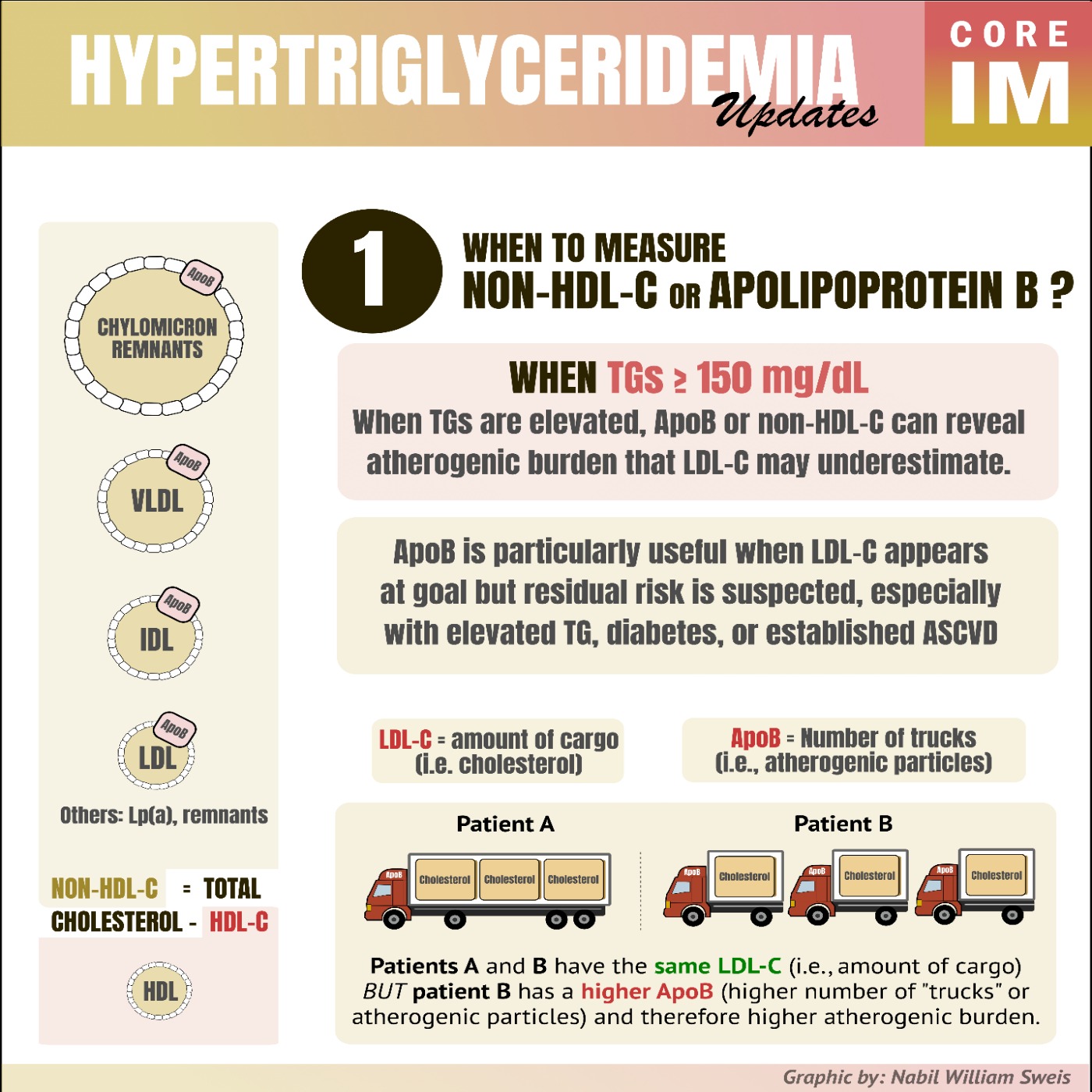
[SPEAKER_02]: Sure, one update I didn't fully appreciate before reading these guidelines is actually how helpful [SPEAKER_03]: For most people, your LDL level and your APOB level are about the same if your triglycerys are normal. [SPEAKER_03]: But if your triglycerys are high, your APOB will be out of proportion high compared to your LDL.
[SPEAKER_03]: So it's important to look at that. [SPEAKER_02]: So here's the teaching point. [SPEAKER_02]: Elevated triglycerys, especially once they're above 150, can really make the LDL on a routine lipid panel look falsely reassuring. [SPEAKER_03]: Remember, APOB, it's the protein portion of every single anthropogenic glyphorotein LDL.
[SPEAKER_03]: Calamacrons, VLDL, ideal, LDL, all of them have one APOB molecule. [SPEAKER_03]: Because in the body, the overwhelming predominant anthropogenic glyphorotein is LDL. [SPEAKER_03]: For most people, your LDL level and your APOB level are about the same if your triglosars are normal. [SPEAKER_03]: But if your triglycerys are high, your able-be will be out of proportion high compared to your LDL.
[SPEAKER_03]: So it's important to look at that. [SPEAKER_04]: Yeah, I also think I didn't really appreciate that until we broke down the guidelines and worked on the episode. [SPEAKER_04]: And then to some of my things a little bit more, we also sat down with Dr. Roger Blumenthal, a preventive cardiologist at Johns Hopkins and the chair of the [SPEAKER_00]: I think that most people feel that the APOB measurement is most helpful when the triglycerides are above average.
[SPEAKER_00]: And if you have someone who's triglycerides or 200 above, then if you use the standard free and world equation, the LDL cholesterol may be falsely low. [SPEAKER_04]: And yes, for the cardiology levels out there, we will definitely link that equation in another equation in the show notes.
[SPEAKER_04]: But the idea and the premise is that the LDL values are actually calculated rather than directly measured. [SPEAKER_04]: So as a triglycerized rise, that calculation becomes less accurate, and someone's LDL may appear lower than a patient's true, atherogenic burden. [SPEAKER_02]: and so when should we consider ABOB testing?
[SPEAKER_02]: Turns out it's a two-way recommendation to check ABOB after you've used a little bit lowering therapy to achieve your target LDL, and your triglycerides are still above 150. [SPEAKER_02]: Those elevated triglycerides basically signal excess after a genetic risk that might not be captured otherwise.
[SPEAKER_02]: But then Shreya, if you dig deeper, particularly in the management section on triglycerides in the guidelines, it does say that it's reasonable to check an Abo B over LDL in patients with triglycerides above 150 milligrams per deciliter to help guide your decision-making. [SPEAKER_04]: Awesome, awesome, okay.
[SPEAKER_04]: So once we get that, Abo B, what do we actually then do with that information? [SPEAKER_02]: Yeah, sure. [SPEAKER_02]: I went looking for a single universal able be cut off, but I found that it really depends on whether you're talking primary or secondary prevention. [SPEAKER_02]: Briefly, though, for primary prevention, let's say an able be is really high, like 120 mx plus plus plus plus plus plus plus plus plus plus plus plus plus plus plus plus plus plus plus plus plus plus plus plus plus plus plus plus plus plus plus plus plus plus plus plus plus plus plus plus plus plus plus plus plus plus plus plus plus plus plus plus plus plus plus plus plus plus plus plus plus plus plus plus plus plus plus plus plus plus plus plus plus plus plus plus plus plus plus plus plus plus plus plus plus plus plus plus plus plus plus plus plus plus plus plus plus plus plus plus plus plus plus plus plus plus plus plus plus plus plus plus plus plus plus plus plus plus plus plus plus plus plus plus plus plus plus plus plus plus plus plus plus plus plus plus plus plus plus plus plus plus plus plus plus plus plus plus plus plus plus plus plus plus plus plus plus plus plus plus plus plus plus
[SPEAKER_04]: Okay, so ApoB grew then 120 is like an LDL, like higher than 135, 140, so no bueno, and another reason to lean on, sorry, that's it. [SPEAKER_02]: And so just like LDL, you can actually trend ApoB with lower targets as cardiovascular risking creases. [SPEAKER_02]: So for the lower targets, even our lipid experts told us that they look up those cut-offs in practice, which was very valid, because I had already opened the table approximately [SPEAKER_04]: Yeah, fair, fair.
[SPEAKER_04]: Yeah, I can already think of so many patients who kind of had an LDL where that number didn't actually match the one liner of cardiovascular events they had. [SPEAKER_04]: And I wonder if checking ApoB might have changed how I interpret their residual cardiovascular risk. [SPEAKER_02]: Oh, and by the way, if you can't check an ApoB, the guidelines do say you can also check non-HDL cholesterol, which is already on your lipid panel normally, and is a free alternative.
[SPEAKER_04]: Ah, thanks. [SPEAKER_04]: Good to know. [SPEAKER_04]: So if the triglycerys are elevated, you can look at an A-Buby, as well as a non-HDL cholesterol to better characterize that cardiovascular risk. [SPEAKER_04]: And yes, we will put in the show notes the what are equivalent LDL, A-Buby, and non-HDL targets.
[SPEAKER_02]: Yeah, and just to summarize, sometimes the LDL is giving us a decidively flattering version of the story if the triglycerides are above 150. [SPEAKER_02]: And in that case, as you said, the apobier, the non-HDL cholesterol can really tell us more about the overall afterogenic burden. [SPEAKER_04]: Yep, and we will get more into treating the apobie and triglycerides in just a little bit.
[SPEAKER_04]: Okay, say we have a lipid panel and we've checked their April B, they're non-HDL cholesterol. [SPEAKER_04]: We kind of have a better sense of their cardiovascular risk. [SPEAKER_04]: Those triglycerides are still like 200, 300's. [SPEAKER_04]: Where should our mind go to next? [SPEAKER_02]: My first instinct, Trey, I used to be to ask, okay, what meds should I add now?
[SPEAKER_02]: But interestingly, the new lipid guidelines really flips that thinking for me. [SPEAKER_00]: I think we have a lot of innovative medications for high triglycerides. [SPEAKER_00]: if it's much better to control the triglycerides with better glycemic control and weight loss and better lifestyle habits.
[SPEAKER_02]: The guidance focus on lifestyle targets, you know, the typical things like promoting weight loss and increasing physical activity. [SPEAKER_02]: But Dr. Blumenthal also brought up something that I did not realize was as prioritized in the triglyceride world. [SPEAKER_00]: I think the guidelines, again emphasizes the importance [SPEAKER_00]: of going over a patient's dietary and exercise habits, as well as getting a baseline measure of their this row at a positive via low-tech waste circumference.
[SPEAKER_00]: And you'd be surprised how many people, you know, if they come back six months, 12 months later on, when they think they've been doing a good job and they say, Doc, let's double check that waste circumference measurement. [SPEAKER_04]: So, fun fact, waste circumference performs comparably to actual measures of etapocity on imaging.
[SPEAKER_04]: So, both the AJ and our recent lipid guidelines recommend actually measuring a least circumference alongside a BMI for all your patient methods. [SPEAKER_00]: They also, again, emphasize that really at each visit, we should take out our little tape measure, get to the top of the Aliyah crest, and measure parallel to the floor.
[SPEAKER_00]: And so give people an idea that, you know, there are body mass index, maybe within quote, normal limits, but they have a protuberant abdomen, it means that they have an [SPEAKER_00]: And a lot of people think, well, being overweight doesn't really make that much difference. [SPEAKER_02]: This is a really good reminder that while BMI a normal could be reassuring, it's unfortunately not a cardiometabolic whole pass, we could still be missing this for a lot of positive.
[SPEAKER_04]: Yes, yes, BMI is tricky indeed. [SPEAKER_04]: And we asked Dr. Blumenthal if there is a waste of conference cutoff that he's really trying to aim for, but his answer was simple. [SPEAKER_04]: Less visor of a deposit, the better. [SPEAKER_02]: and measuring waste or conference over time can be a practical way to trap progress that be my alone name is exactly.
[SPEAKER_04]: And then for those of you that like numbers like me I did go searching and the OPC site it does use less than 40 inches for men and less than 35 inches for women. [SPEAKER_04]: But I think what is honestly the more practice you need to think for me is to just start. [SPEAKER_04]: measuring a downward circumference, right?
[SPEAKER_04]: Like, just trying to have a measuring tape on hand and the clinic tracking waste circumference alongside the BMI over time, I think, was going to be a big shift. [SPEAKER_02]: Yeah, so to summarize, waste circumference is something to track over time, to see whether industrial out-of-possies improving.
[SPEAKER_02]: And the premise of that is, visual out-of-possities increasingly recognized as an independent cardiovascular risk factor. [SPEAKER_04]: Okay, I thought this one was fascinating because I think so many of us and our patients kind of immediately blamed triglycerides on dietary fat. [SPEAKER_04]: But most people, it's more about the excess refined carbs or the underlying insulin resistance that are bigger drivers of the elevated triglyceride.
[SPEAKER_02]: And there's so many ways to approach dietary counseling but we wanted to highlight one strategy from Dr. Watson's lipid clinic because it's so simple, practical, [SPEAKER_03]: The first way of managing it for everyone will be lifestyle. [SPEAKER_03]: Everyone, for every single high-track glyceride referral we get to our lipatlinic, everyone gets a three-day lifestyle trial to see if their diet responsive.
[SPEAKER_04]: Wow, three days. [SPEAKER_04]: I think a lot of us, you know, following the pattern saying, okay, work on your diet. [SPEAKER_04]: We'll check your lipids in three months or so. [SPEAKER_04]: This is so interesting. [SPEAKER_04]: And I will have to say, like, what Dr. Watson and some other lipidologists around the country do isn't in the guidelines, but we just found it so that provoking and managing the LVA triglycerides that we just wanted to learn more.
[SPEAKER_03]: The three day trial we give is an extreme carbohydrate reduced trial. [SPEAKER_03]: And I'm talking less than 100 grams a day. [SPEAKER_03]: which is really restrictive and again, it's not because we expect them to stay on less than a hundred grams per day forever. [SPEAKER_03]: It's because we want to see if they're diet responsive.
[SPEAKER_02]: Finally, a lifestyle intervention designed for my attention span and a lot of people, right? [SPEAKER_04]: It's hard to sustain things over three months. [SPEAKER_02]: Yeah, I love this and just to say it out loud during those three days, patients are also asked to abstain from alcohol.
[SPEAKER_04]: right. [SPEAKER_04]: And again, I think most people assume triglycerides are more driven by too much that, but here we're really focusing on car restriction, less than a hundred grams day. [SPEAKER_03]: We want to see that there is a significant reduction in triglycerides with this. [SPEAKER_03]: And it's going to vary depending on how much insulin resistance an individual has, but some people can get a 50 [SPEAKER_03]: attached to three fatty acids, glycerol is derived from glucose.
[SPEAKER_03]: If you starve the body of the substrate, you literally can't make it. [SPEAKER_03]: If that is the basis for your hyper-triplists or anemia. [SPEAKER_03]: There are some people who don't have that as a basis. [SPEAKER_03]: They have as a basis a true lipid disorder like inability to make life a protein-like pace or something else.
[SPEAKER_03]: And then that [SPEAKER_03]: But for most people, the overwhelming majority, high triglycerides are carbohydrate driven. [SPEAKER_02]: Oh, how I love when biochem becomes unexpectedly useful. [SPEAKER_04]: The surround materials. [SPEAKER_02]: But even more, I love the idea of a 3D trial that gives both the patient and the clinician feedback right away.
[SPEAKER_04]: Yes. [SPEAKER_04]: And we did go back and ask Dr. Watson, what does an adequate response entail? [SPEAKER_04]: She said she's happy with, you know, over 20% reduction in serum triglycerides with the carb control. [SPEAKER_04]: But often she sees greater than 50% reduction with a 3D carb responsive trial.
[SPEAKER_04]: And say the triglycerides are not responsive to carb control. [SPEAKER_04]: Then it should prompt us to think about another underlying cost, right? [SPEAKER_04]: Is there a genetic disorder? [SPEAKER_04]: Is there a primary lipid disorder driving this? [SPEAKER_02]: Is it, for example, hypothyroidism, where you're not clearing trigosterides efficiently, or maybe it's kidney disease, like nephrodic syndrome, or CKD, which can impair phyllo micron clearance?
[SPEAKER_02]: Or is it insulin-opinic diabetes maybe like type 1, or superlate-stage type 2, where you have no intrinsic insulin production? [SPEAKER_02]: And so you lose that insulin's activation of lipoprotein lipase, and then lastly, [SPEAKER_04]: Yeah, sorry, they're so common. [SPEAKER_04]: And given for too many COPD exacerbations, well, no, they did.
[SPEAKER_04]: So I have to keep it back. [SPEAKER_04]: Yes, you know, yes. [SPEAKER_04]: Serred packs here and there are very common. [SPEAKER_04]: So definitely go to do that medication review. [SPEAKER_04]: I'm there's a bunch of other secondary causes from from the medication perspective too, right?
[SPEAKER_02]: Yeah, I just wanted to bring up a couple of high yield points here from my personal practice. [SPEAKER_02]: I have noticed that atypical antipsychotics, particularly, Oland's a peanut clasipine, can raise triglycerides pretty quickly after you start them. [SPEAKER_02]: And what I found is that switching to a more metabolic weak-friendly agent, that's not Oland's a peanut clasipine.
[SPEAKER_02]: And of course, working alongside a psychiatrist in the meantime can definitely bring them down dramatically. [SPEAKER_02]: And then there's also evidence for starting metformin alongside that a typical antisacotic to blunt some of those triglyceride raising effects. [SPEAKER_02]: I actually know some psychiatrists who do this upfront, in fact.
[SPEAKER_02]: And then another example is that we might see a lot in clinic is oral estrogen. [SPEAKER_02]: I just had a patient last week who was on oral estrogen, we saw. [SPEAKER_02]: a pretty high look in the 200s of triglycerides, and we switched to transdromalusian, we were able to bring that triglycerides down to like mid-100s.
[SPEAKER_02]: Yeah, it was amazing. [SPEAKER_02]: Such a quick fix, but really changed the risk profile for that person. [SPEAKER_04]: Nice, look at you doing awesome, cardiovascular prevention. [SPEAKER_04]: I think my takeaway from this section is this overall idea of car response. [SPEAKER_04]: And it's so awesome if you're in a system where you're able to do a rapid three-day car control trial that generates [SPEAKER_04]: information not just lowering the triglycerides, and especially if your patient has more than 20% reduction in their triglyceride, that points more to a diet-driven disease, but then a lack of response should prompt some careful searching of secondary causes.
[SPEAKER_04]: We'll have more comprehensive list in our show notes, medications, or is this a primary lipid disorder? [SPEAKER_04]: Okay, so we talked a lot about what patients eat. [SPEAKER_04]: So I think another very practical question is, should we be checking triglycerides fasting or not fasting?
[SPEAKER_03]: People are so focused on this fasting lipid panel. [SPEAKER_03]: I have to have it to make sure my LDL's accurate. [SPEAKER_03]: Nothing really changes much with fasting, except triglycerides. [SPEAKER_03]: The triglycerides will tell you exactly what you ate in the last 12 hours. [SPEAKER_03]: And that's why the new guidelines say, obtain a lipid panel fasting or non-fasting because the one thing that will change is triglyceride.
[SPEAKER_02]: Yes, so for most patients and non-fasting lipid panels totally fine and arguably could give us a snapshot of what their body's exposed to for most of the day. [SPEAKER_03]: I actually want to see what your body sees and who let's be frank. [SPEAKER_03]: We're fasting for like a seven-hour period while we're sleeping the rest of the day.
[SPEAKER_03]: We're kind of eating out there. [SPEAKER_02]: But the guidance do spell out a few times when fasting is preferred. [SPEAKER_02]: Like, for example, a family history of premature ACBD, which is defined as a first degree meal relative with an event before 55 or a female before 65. [SPEAKER_02]: And then, [SPEAKER_02]: Also, in suspected genetic or triglyceride metabolism disorders, and then finally, if you're non-fasting triglyceride comes back at 400 or higher, generally, the guidelines recommend to repeating a fast and lipid panel at that point because it would change our management.
[SPEAKER_04]: Yeah, definitely. [SPEAKER_04]: I think a triglyceride over 400 is a little too high for my comfort. [SPEAKER_04]: The last practical point about fasting versus non-fasting is that when you are trending triglycerides, try to compare apples to apples. [SPEAKER_04]: So if your patient's last triglyceride was fasting, ideally compare it to another fasting one.
[SPEAKER_04]: All right, so we talked about risk assessment, lifestyle, fasting, non-passing, the next natural question is what are reaching for medications and which medications should we reach for? [SPEAKER_02]: So the updated guidelines clearly tell us the answer. [SPEAKER_02]: For primary prevention, among adult 40 to 75, without ACVD or diabetes, but who have persisted triglycerides between 150 and 499, rather than starting a medication, the first step is actually calculating a prevent score.
[SPEAKER_04]: What? [SPEAKER_03]: I was not expecting that answer, but that makes a lot of sense. [SPEAKER_04]: Okay, so prevent, I think, as we all kind of know now, it helps us, you know, restratify patients from low risk, borderline, intermediate to high risk, but you know, I can't help but wonder if triglycerys are so important, then why are triglycerys missing from the parent score?
[SPEAKER_02]: Great question Shraya, much of the risk associated with triglycerides is already reflected in non-HDL and HDL cholesterol, which prevent fuzz include. [SPEAKER_02]: However, persistent triglyceride elevation can still help with the treatment discussion. [SPEAKER_02]: Let's say our patient score comes back borderline, which is 3% to under 5%.
[SPEAKER_02]: In that case, an elevated triglyceride level would be considered a risk enhancer and provide another reason to consider a statins for that person. [SPEAKER_04]: Yeah, awesome. [SPEAKER_04]: And I think that highlights another real shift for me that when we are thinking about medication for triglycerides, we're still first reaching for a statin.
[SPEAKER_03]: statin therapy is to treat elevated cardiovascular risk. [SPEAKER_03]: So whenever your risk is driven by, if it's elevated, a statin is indicated. [SPEAKER_03]: This is not just a cholesterol long-drawn. [SPEAKER_03]: This is a risk reducing agent. [SPEAKER_03]: The best risk reducing agent we have.
[SPEAKER_02]: So for a person with elevated triglycerides, it's not about lowering the number or reaching for fibraids or a fish oil. [SPEAKER_02]: Instead, the guidelines tell us we should optimize someone's risk first by intensifying their LDL lowering treatment. [SPEAKER_03]: The first thing is important to point out is that LDL is still the primary target of therapy LDL.
[SPEAKER_03]: Don't forget about that. [SPEAKER_04]: Yeah, I think for me, the guidelines are to clarify the order of operations. [SPEAKER_04]: Because, for example, based on the guidelines, if someone's already on a max statin and has residual risk and has an elevated triglyceride, you know, the answer is not to go to a triglyceride specific medication.
[SPEAKER_04]: The answer is go to a zennemide or go to a PCSK 9 inhibitor. [SPEAKER_04]: And here I thought Omega 3 facial oil might be the next step, particularly the one that's been studied the most, I close up pentethyl, but that is incorrect. [SPEAKER_02]: Speaking of omega 3, a.k.a. [SPEAKER_02]: I co-suppend Apple or some call EPA for short, yeah, the recommendation is way more selective than I expected.
[SPEAKER_02]: I co-suppend Apple landed at a class to be recommendation, meeting quote, it may be reasonable in certain patients. [SPEAKER_02]: Most relevant is if your patient's fifth year older has known at ESCBD or diabetes with another risk factor, already on a max statin with an LDLL goal, but those darn triglycerides keep being over 150.
[SPEAKER_04]: Yeah, just a quickly zoom in on EPA, and no mega-three's a little bit more, there was this reduced at trial, which I think is a great one to do for a journal club, because the headline is that there was an impressive cardiovascular benefit, but the placebo was mineral oil based, and so that was a little bit controversial, because it did worsen some of the lipid inflammatory markers in the placebo group, and then on top of that, even there was some concern about [SPEAKER_04]: higher rates of eighthed and bleeding and so putting all that uncertainty together, I think the guideline author is landed on a quote unquote, maybe reasonable rather than a stronger recommendation.
[SPEAKER_04]: But I'm sure there's future trials coming, then I'll help us understand what's best for our patients. [SPEAKER_02]: Yeah, we're definitely not seeing the end of the oils. [SPEAKER_02]: Oh, and just to clarify, the guidelines do specifically recommend prescription purified EPA or Icosipent.au, not over the counterfish oil.
[SPEAKER_03]: And if you look at a lot of the over-the-counter fish oils, most of them are not more than 30 to 50% true fish oil. [SPEAKER_03]: And the remainder is actually crazy stuff like saturated fats. [SPEAKER_03]: The only the really expensive, bushy fish oil capsus, use things like olive oil.
[SPEAKER_03]: Everybody else uses regular oil, cut it, energetic oils, and that we don't like. [SPEAKER_04]: It is very eye-opening that some of the over-counter oils contain the exact thing we're trying to avoid for our patients, and then it's also no surprise that the guidelines are very explicitly recommend against using any dietary supplements.
[SPEAKER_04]: So, yeah, definitely worth asking our patients, hey, what supplements are you taking? [SPEAKER_04]: What natural remedies are you taking? [SPEAKER_02]: So Shria, what happens once triglycerides climb above 500? [SPEAKER_02]: It sounds like, at this point, the goal shift's pretty dramatically here, when no longer just thinking about ASCBD risk, we're also trying to prevent pancreatitis.
[SPEAKER_03]: Fibrates are not for cardiovascular risk reduction. [SPEAKER_03]: That's really important to point out. [SPEAKER_03]: But in people at real risk for pancreatitis, they are the agents we go to. [SPEAKER_03]: The problem is the vibrate, statin combination can be more dangerous for raved of myelisis.
[SPEAKER_03]: And all of these patients are at high cardiovascular risk, so we don't want to forego the statin. [SPEAKER_03]: So we have to be very careful. [SPEAKER_03]: And it's been a vibrate rather than gym diprizzle, which is the preferred vibrate in that case. [SPEAKER_04]: Okay, so here what I'm going to remember if the triglycerides are between 1.50 to 499 I'm thinking a specific risk first, right?
[SPEAKER_04]: Optimize, you know, look at the prevent score, optimize LDL lowering therapy with the statin, reverse something like acosopentinal at the all from or selected high risk patients. [SPEAKER_04]: And we [SPEAKER_04]: Once the triglycerides are over 500, particularly above 1,000, then the party really shifts towards pancreatitis prevention.
[SPEAKER_04]: That's why we reach for things like fibrates, particularly phenophybre to minimize any interactions with statin and prescription omega-3 therapies become much more important. [SPEAKER_02]: Our last section features someone who's story really brought to life our last few updates in the guidelines.
[SPEAKER_01]: And I've always known that something is wrong. [SPEAKER_01]: There's never been a time in my life where I didn't feel some type of stomach discomfort. [SPEAKER_01]: And that goes back to my earliest memories. [SPEAKER_01]: And for years, I would be lower energy, stomach problems, and brain fog.
[SPEAKER_01]: School was quite hard for me because grasping and retaining information. [SPEAKER_01]: And now we know that is what they call brain fog. [SPEAKER_01]: And I just remember all through school, I wouldn't participate in sports. [SPEAKER_01]: If I could get out of PE, I would. [SPEAKER_01]: If I could take easier classes, I would, because my stomach hurt all the time.
[SPEAKER_01]: My joints hurt. [SPEAKER_01]: I couldn't retain information. [SPEAKER_01]: I was nauseous all the time. [SPEAKER_01]: You know, on my best days, I would have a mid grade flu all day. [SPEAKER_01]: And that was my best days. [SPEAKER_01]: So imagine being born and trying to get through life, having the flu every single day.
[SPEAKER_01]: You know, it was rough. [SPEAKER_01]: And you know, it'll also be embarrassment of having to go to the bathroom three or four times a day at school, right? [SPEAKER_01]: Like the teachers were like, what's going on? [SPEAKER_01]: You're always going to the bathroom. [SPEAKER_01]: Well, it's like, I have diarrhea all the time.
[SPEAKER_01]: You know, and that's just part of this disorder. [SPEAKER_02]: That was Erin Bowman, who lives with familial chylomacrininius syndrome, or FCS, which is what we'll call it. [SPEAKER_02]: That's a rare genetic disorder that causes lifelong, often profound hyper-triplist radienia. [SPEAKER_01]: Hi, I'm Erin Bowman, the FCS patient and an overall good human being.
[SPEAKER_01]: Every single doctor said a couple things to me. [SPEAKER_01]: eat better exercise more. [SPEAKER_01]: Okay, and if the symptoms would persist or get worse, a lot worse, and I would go to a new doctor and they'd be like eat better exercise more. [SPEAKER_04]: Yeah, and before his diagnosis was made, he spent years seeing doctor after doctor searching for an explanation, and as well he's struck to hear not about how rare FCS is, but more so in his story, [SPEAKER_01]: If any of those doctors said, oh, man, we're finding a surprisingly high amount of fat in your blood.
[SPEAKER_01]: Well, let's go through this logically. [SPEAKER_01]: It's it you don't drink, right? [SPEAKER_01]: What do you eat every day? [SPEAKER_01]: Okay, the little cures, you know, and couple doctors got to that point with me, not the fat and the blood, but they're just like, I want you to tell me what you had to eat yesterday, and I would give them a run down right and they just look at me usually like I was lying, I can read people pretty good and I'm like, you think I'm lying, you know, like when I said I don't drink and you'd have doctors turn be like, you're like, okay, dude, I don't drink.
[SPEAKER_02]: what I took away from our conversation with Erin was the importance of believing our patients when the history doesn't fit the numbers. [SPEAKER_02]: If someone gives you a careful dietary history insist that they don't drink alcohol and their triglycerides are persistently like, you know, hundreds or thousands.
[SPEAKER_02]: That disconnect is itself a clue that there may be an underlying genetic disorder going on. [SPEAKER_04]: Yes, I guess when we do suspect FCS, what should we be doing reaching for? [SPEAKER_00]: All of his arson was specifically mentioned in our guideline, and then Closassarin was subsequently approved in this country, and I think both are going to get much more a use in the coming years, because there are quite a number of patients with this severe hyper-tribal strideemia who we usually think about familial, Caitlyn Micronemia being [SPEAKER_00]: both plosassurian and all those arson-allic unit individuals whose triglesurides are 500 or higher.
[SPEAKER_00]: So those are things that are typically, you know, if you have a patient where they're having those persistently high triglesurides, probably a smart idea to send them to lipid specialists. [SPEAKER_02]: So to summarize, if Turg Lester had to say severely elevated, especially around 800 or higher, or if there was recurrent paincreteitis or clinical picture that just doesn't hit the lifestyle story, would refer to a lipid specialist and consider genetic testing at that point.
[SPEAKER_04]: Definitely, and interestingly, when we asked Dr. Watson about genetic testing, she said that it's actually not something that she does regularly for our patients she [SPEAKER_03]: So, we rarely do genetic testing in our lipoclinic, and I can tell you most clinicians don't either. [SPEAKER_03]: There's a really characteristic patterned patients with familial, chylo-micronemia syndrome.
[SPEAKER_03]: It's not subtle. [SPEAKER_03]: and you can often see it like we see this really commonly, especially young women can be find their whole life then they have their first period and that's certain estrogen. [SPEAKER_03]: They suddenly get recurrent pancreatitis and we see it. [SPEAKER_02]: I thought that was a really helpful perspective, genetic tests are good, but they definitely aren't perfect and can miss people with atypical presentations, so sounds like a lot of look atologists, really just look at the clinical picture and then treat as FCS at the history fits.
[SPEAKER_04]: Awesome, yes. [SPEAKER_04]: And so before we wrap up, one we do some rapid fire takeaways. [SPEAKER_02]: If triglycerides are 150 to 499, don't treat the number, treat the risk. [SPEAKER_02]: We calculate prevent, look for secondary causes, and then optimize LDL lowering their be first.
[SPEAKER_04]: And then if triglycerides are elevated on the LDL looks reassuring, and you're still worried about some residual risk. [SPEAKER_04]: Think about ApoB or a non-HDLC. [SPEAKER_02]: Spend more time, counseling on refined carbohydrates, alcohol, and then don't forget measuring the waste or comforts.
[SPEAKER_02]: Also, remember Dr. Watson's three-day carb control trial, which can quickly target carb response of hypertrekless radinea. [SPEAKER_04]: and then non-fasting lipid panels are generally appropriate for most patients unless the triglycerides are markedly elevated, you suspect genetic lipid disorder, or the fasty result, which change management.
[SPEAKER_04]: And then of course, just make sure we're comparing apples when you're trending the triglyceride levels. [SPEAKER_02]: And then finally, if the triglycerides are 5-bundered or higher, that's when we start thinking about Pancry Titus, if especially there's recurrent Pancry Titus, or a history that does not fit the elevated triglycerides we think of FCS and then consider referring to a lipid specialist.
[SPEAKER_04]: Great. [SPEAKER_04]: Awesome. [SPEAKER_04]: And with that, a huge thank you to Dr. Carol Watson, Dr. Roger Blumenthal, Erin Bowen, for sharing the expertise in their experience with us. [SPEAKER_04]: Thank you to Dr. Annibill Swiss for the graphic, will link the 2026 ACCHA Lipid Guidelines in additional resources in our show notes.
[SPEAKER_04]: Thank you so much for listening and we'll see you next time on Koran. [SPEAKER_04]: Take care. [SPEAKER_04]: particularly the one that's been studied. [SPEAKER_04]: I co-supent the love. [SPEAKER_04]: What are you saying again? [SPEAKER_04]: I think it's a co-supent at the, okay. [SPEAKER_04]: I just sat adding, adding, elves and random places, right?
[SPEAKER_04]: Okay, I started over. [SPEAKER_04]: So no one's like, don't forget, I'm like, but I never knew that to forget it. [SPEAKER_04]: You know what I mean? [SPEAKER_02]: It's like, I actually don't know. [SPEAKER_03]: I don't know. [SPEAKER_03]: In fact, I don't know. [SPEAKER_04]: I don't know.
[SPEAKER_04]: I don't know. [SPEAKER_04]: I'll try not to forget what I didn't know. [SPEAKER_04]: No. [UNKNOWN]: Remember?
