

Core IM | Internal Medicine Podcast
#220 Colon Cancer Screening Nuances: 5 Pearls Segment Part 2
· 21 min
Kapitelklicken springt direkt hin
Shownotes
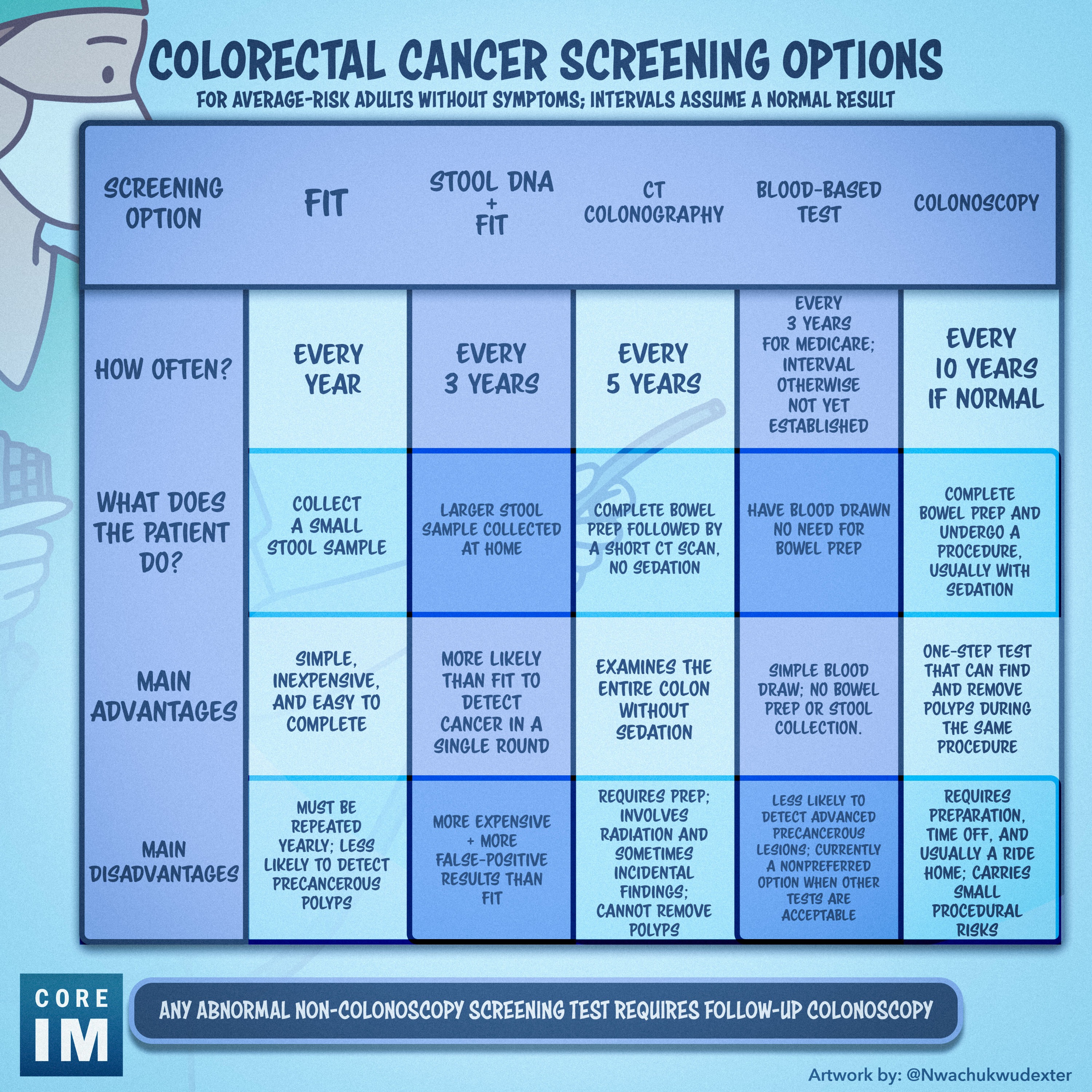
<p><strong><em>“What’s the best way to screen?”</em></strong> This episode breaks down the pros, limitations, and follow-up needs of FIT, Cologuard, CT colonography, and colonoscopy to help you choose the right CRC screening option for your patients. Also learn practical colonoscopy surveillance intervals based on polyp size, number, and pathology.</p><p><br></p><p>🔹<strong>Sponsor:</strong> Search “<a href="coreimpodcast.com/Pharmacy5"; rel="nofollow">Amazon Pharmacy</a> Nationwide Home Delivery" in your EHR to get home delivery (often same-day).<a href="coreimpodcast.com/Amazonpharmacy"; rel="nofollow"> </a><a href="coreimpodcast.com/Pharmacy5"; rel="nofollow">Learn more here!</a></p><p><br></p><p>🔹<a href="coreimpodcast.com/2026/10/07/crc-screening-par…; rel="nofollow"><strong>Transcript and Show Notes</strong></a></p><p>01:24 | Screening Options Besides Colonoscopy</p><p>11:22 | How FIT, FIT-DNA, and CT colonography differ and when each makes sense.</p><p>12:52 | Colonoscopy and Frequency</p><p>19:29 | How adenoma number, size, and histology guide surveillance intervals. </p><p><br></p><p><strong>Tags</strong>: Core IM, Internal Medicine, Colorectal Cancer Screening, Gastroenterology, Cancer Screening </p><br /><br />Find the best disability insurance for you: patternlife.com/disability-insurance?campid=49… Sponsors:<br/>* Check out Eko: ekohealth.com<br/>* Check out FIGS and use my code FIGSRX for a great deal: wearfigs.com<br/><br/><br/>A… Inquiries: <a href='redcircle.com/brands'>https://redcircle… & Opt-Out: <a href='redcircle.com/privacy'>https://redcircl…;
Transkriptvom Podcast bereitgestellt · Zeitmarken springen hin
[SPEAKER_05]: I think it's still true that the best approach when he comes to colon cancer screening is the one that gets done, meaning we need to get people's screened one way or another. [SPEAKER_01]: Welcome to the core, I am Thye Pearl's podcast, bringing you how you'll have didn't space pearls, so I'm Dr. Shreya Trebedi.
[SPEAKER_04]: And I'm Dr. Steve Leberton, in Turtle Medicine Residence at Beth Israel, Deaconess Medical Center. [SPEAKER_00]: And today, we're going to compare the four nonvasive and perhaps more accurately, two stage screening options and we'll go through exactly what each of the tests are detecting and how to better counselor patients when they do get a positive result that requires a colonoscopy and then we'll cover surveillance intervals after colonoscopy and really try synthesize it in a way that makes sense because of course it's not only critically relevant, but also very relevant for boards and you'll hear from four GI experts.
[SPEAKER_05]: My name is Xavier, I'm a gastroenterologist and 11 years ago, I moved to Yale to head the GA Cancer Prevention Program. [SPEAKER_02]: My name is Dr. Rachel Isaka, I'm a gastroenterologist and a health services researcher at the Fred Hutchinson Cancer Center and the University of Washington and Seattle.
[SPEAKER_06]: My name is Jo Furstine, I'm the clinical chiefs of gastroenterology at Beth Israel. [SPEAKER_03]: I'm Smyr Gupta, I'm a gastroenterologist and a professor of medicine at UC San Diego. [SPEAKER_03]: All right, let's dive in. [SPEAKER_00]: Okay, so let's say we're thinking about screening colonoscopies.
[SPEAKER_00]: With a patient who's 48 years old for a while of a visit, talking through the different options we have for screening. [SPEAKER_00]: Remember this is not diagnostic, this patient's asymptomatic. [SPEAKER_00]: How do we think about the best options for colorectal cancer screening? [SPEAKER_04]: I do think there's this implicit idea that colonoscopy is the gold standard and that everything else is somehow, quote, second best, but I think the hot take for screening options for colorectal cancers, that there really is not a one-size-fits-all for patients, especially those that are not at increased risk.
[SPEAKER_04]: So practically speaking, I feel like my head cannon has always been to separate these tests into screening as invasive or not invasive tests. [SPEAKER_01]: Yeah, I love that because I can imagine there's probably a group of patients who would not want to do a stool test and then there's another probably group of patients who would want to put a colonoscopy at Paul costs.
[SPEAKER_04]: I'm so glad you brought that up because even before we get into the non-invasive tests, it's so important to tell our patients that if this non-invasive test is positive, then you need a diagnostic colonoscopy. [SPEAKER_02]: If there was anything I want listeners to walk away with, it's really understanding that all of those non-invasive tests are what we consider to be a two-state screening strategy, meaning that if somebody has an abnormal result for whether it be fit, a capsule colonoscopy or a virtual colonoscopy that they in fact need a full colonoscopy examination of their colon, [SPEAKER_02]: to correlate with those abnormal results.
[SPEAKER_02]: And a lot of patients sometimes forget that or don't get that message when they initially complete those tests. [SPEAKER_02]: They often think that these are one-and-done tests and they're simply not. [SPEAKER_01]: Yeah, so sounds like we shouldn't be calling these tests non-vasive, but really just like really bling them to two-stage screening tests.
[SPEAKER_04]: I love that. [SPEAKER_04]: And this is really why we should ask before ordering a stool car or a CT colo. [SPEAKER_04]: If a person is even willing to undergo a colonoscopy. [SPEAKER_04]: And then the second important thing is to set that expectation for what a positive test for these two step tests might be.
[SPEAKER_06]: A positive test by no means indicates cancer. [SPEAKER_06]: A positive test, for example, on a multi-stool DNA, just indicates there may be an advanced poly. [SPEAKER_06]: And again, this is the concept of colon cancer prevention so that when we do a colonoscopy, we can still remove that poly bit prevent cancer.
[SPEAKER_01]: Yeah, I really appreciate kind of the framing also that this is cancer prevention, right? [SPEAKER_01]: Where in the business right now trying to find and prevent polyps from escalating into cancer? [SPEAKER_01]: So, let's start with kind of our first two-stage screening cancer prevention test, which is stool testing.
[SPEAKER_01]: I think this is the one that most of us have heard about, and the first up would be a fit, which is a type of FOBT, a fecal called blood test. [SPEAKER_04]: So, fit is the classic stool card that we think of. [SPEAKER_04]: It detects a global part of the game of global, which makes it more specific than the older guiak FPVT tests.
[SPEAKER_04]: That being said, it still doesn't have great sensitivity because it relies on both the size of the adenoma and it needs for these early stage cancers or advanced adenomas to bleed. [SPEAKER_04]: I don't almost let our less than six millimeters are essentially invisible to the fit, and it really doesn't do much better up to nine millimeters.
[SPEAKER_01]: Yeah, I think that helps kind of set the rationale for getting a fit yearly. [SPEAKER_01]: So the rationale for the annual fit is that repeating the testing over time compensates for a low single test sensitivity, right? [SPEAKER_01]: The lesion might not bleed on one occasion, but might bleed on another.
[SPEAKER_01]: So we're gonna yield a cumulative sensitivity that's gonna be higher than just the one time sensitivity. [SPEAKER_04]: Awesome. [SPEAKER_04]: Let's move on to the Fit DNA, or I think it's a lot of us know it as the cold guard. [SPEAKER_04]: So this is a test that is sent directly to home and is covered by all insurances.
[SPEAKER_04]: It combines both the fit tests that we just talked about, as well as stool DNA for advanced polyps, which are defined as polyps that are one centimeter or bigger. [SPEAKER_06]: The fit test is purely looking at blood in the stool. [SPEAKER_06]: It's in immunohistochemical tests that's being run.
[SPEAKER_06]: The stool DNA tests in order to increase its yield of bloodshed testing, they combine the two-part test. [SPEAKER_06]: So it's looking for both stool DNA and blood in the stool. [SPEAKER_04]: So that combination in the coligard improves sensitivity, but at the expense of more false positives.
[SPEAKER_06]: So when we talked about like a false positive of the color guard test, I don't know is it false positive because the stool DNA was positive or was the fit test positive because it was a drop of blood in the stool let's say from a hemorrhoid or something else and that's why a stool DNA has up to 7% false positive rate that goes up as one gets older as well.
[SPEAKER_01]: Yeah, I think it's so tricky when people have hemorrhoids. [SPEAKER_01]: So we push our discussions like, what would they do for these patients? [SPEAKER_01]: And they did say, you know, try to avoid a fit or call a guard in someone who has known hemorrhoids, or say a fit comes back positive in the patient's head as you later, oh, maybe it's from their hemorrhoids.
[SPEAKER_01]: Then the GI physician said, no, they would still want this person to go be seen by GI for a colonoscopy. [SPEAKER_04]: Ah, hemorrhids are so common, especially in the day and age where all of us are scrolling on our phones on the toilet every single day. [SPEAKER_04]: Ah, ah. [SPEAKER_01]: So real.
[SPEAKER_04]: And the other reason for this higher false positive with the colagard is because there are so many different types of pathology in the GI tract beyond adenoma that could drive the false positive results, particularly with the either the blood or the stool DNA. [SPEAKER_02]: The Fit DNA, we tend to see more false positives, but that's a large part because the changes in DNA that the test is looking for are not specific to colorectal cancer and can be associated with other cancers of the gastrointestinal tract.
[SPEAKER_02]: In fact, we've seen data show that when patients have an abnormal Fit DNA and get a normal colonoscopy that endoscopist once spend more time looking throughout the colon because they're worried that they're missing something. [SPEAKER_02]: and that they also order more tests. [SPEAKER_02]: For example, recommending an upper endoscopy or recommending a CT scan because they're worried they want to make sure that those changes from DNA are not indicative of cancer elsewhere in the gastrointestinal tract.
[SPEAKER_01]: Yeah, I think that makes sense with the added benefit of catching DNA from the GI track with the trade off of wondering, oh, are we missing something in the colonoscopy? [SPEAKER_01]: All right, next up and third, let's briefly talk about blood-based tests, which are newer and I have to say something I had not heard about before.
[SPEAKER_06]: Now, there's also actual cancer tests as well, which are new. [SPEAKER_06]: Those are the blood tests. [SPEAKER_06]: So that, I would say, is a little bit of a change because really what we're talking about in GI, in general, is colon cancer prevention. [SPEAKER_06]: We call it colon cancer screening, but that's a misnorm.
[SPEAKER_06]: We're really trying to prevent colon cancer. [SPEAKER_06]: We're trying to find a polyp, remove the polyp before it ever becomes a cancer. [SPEAKER_06]: A blood test for cancer identification is actually a cancer screening test, and that is a different type of modality. [SPEAKER_04]: So the nuance for these blood-based tests are that they are actually screening for colorectal cancer specifically, and they have less than a ability to identify those advanced polyps in the way that the other two stage screening tests do.
[SPEAKER_01]: Okay, so from what I understand these blood-based tests are not recommended yet. [SPEAKER_01]: So why are we talking about them? [SPEAKER_04]: So I think it's because we have this goal of reaching an 80% colorectal cancer screening rate in the US. [SPEAKER_04]: And so this could potentially be a part of the armorarium of tests that we could use.
[SPEAKER_02]: At 80% goal that we're trying to reach in this country, that number is covered around 60 to 65% for a really long time. [SPEAKER_02]: And everybody's grappling with how do we get to that 80% goal? [SPEAKER_02]: And for some people, you know, the belief is that [SPEAKER_01]: Okay, so it sounds like these blood tests may be helpful in the future for people who we can't capture through our usual screening mechanisms.
[SPEAKER_01]: With the big caveat is that these blood tests are not good at detecting precancerous lesions, and we're just for the actual colorectal cancer. [SPEAKER_02]: The fourth one I'll mention is the CT colonography would sometimes called a virtual colonoscopy. [SPEAKER_02]: And this is a CT scan in which we're again, taking pictures of an individual's colon and then looking for polyps in that way.
[SPEAKER_02]: The CT colonography in the capsule andoscopy are most likely going to pick up polyps that are a little bit larger, so six millimeters or larger in size. [SPEAKER_04]: So a CT colonography is effectively very similar as a colonoscopy and that you still have to do a bowel prep need under gocholonic insufflation for evaluation.
[SPEAKER_04]: And since it detects polyps based on morphology rather than biology, it ends up being kind of similar to the fit in that there's a size threshold to actually detect these polyps. [SPEAKER_04]: And that reflects the spatial resolution of the imaging rather than testing for biological property of the lesion.
[SPEAKER_01]: Yeah, so it's similar in terms of that 6mm threshold of catching adnomas away with the stool base testing and sound similar in terms of the CT colonography. [SPEAKER_01]: One thing that I find is interesting that we have bucketed this under the non-vasive two-stage screening because I don't know about you Steve, but doing perhaps seems pretty invasive to me, but it is what it is like as it still counts as, you know, someone not doing the whole [SPEAKER_01]: I think like it is there to say with all of these we thought to remember like even with CT chronography, if there is something even slightest detected, you still have to go through the colonoscopy and get the actual removal of the polyp or mass that might be found.
[SPEAKER_04]: Exactly. [SPEAKER_04]: So to summarize my own take away from this pearl is that these tests are not just differing convenience, but they're actually looking for fundamentally different things. [SPEAKER_04]: The fit is asking is a bleeding today, whereas the fit DNA or coligar is asking is a bleeding or shedding abnormality in a.
[SPEAKER_04]: And then the CT colo asks, can we physically see a polyp that is large enough to detect on imaging and is intervened all? [SPEAKER_01]: Yeah, and then I think once I started thinking about it this way, then the strengths and limitations of each test kind of made a bit more sense to me. [SPEAKER_01]: And I think another way I think about it is kind of from a sizing perspective, tiny, adnomas, under six millimeters.
[SPEAKER_01]: They're basically invisible to stool testing. [SPEAKER_01]: They're not shedding enough material yet. [SPEAKER_01]: The fit DNA adds a bit more sensitivity, but you know, you still struggle with smaller lesions. [SPEAKER_01]: But as lesions do get larger, you know, particularly greater than 10 millimeters, [SPEAKER_01]: they become more biologically active, leading more structurally louder that you might catch it on CT call andography and those detection rates get higher.
[SPEAKER_04]: Exactly, and it also helped me understand why the annual fit matters so much, because fit is not a one-time snapshot, it's more like repeated surveillance for intermittent biologic activity. [SPEAKER_04]: And so a poll that isn't bleeding this year, namely next year as it continues to grow.
[SPEAKER_01]: Yeah. [SPEAKER_01]: And also, I think the underlying message is not to think, okay, what's the best test? [SPEAKER_01]: But, you know, one, what's the best test that is most likely going to get done. [SPEAKER_01]: And then from there, understanding the limits and the reasoning behind the frequency and the follow-up.
[SPEAKER_01]: So now that we walk through the two-stage screening tests, AKA the non-invasive screening test, let's talk about what most people consider the gold standard, colonoscopy. [SPEAKER_04]: Right, the stool and imaging tests can only flag that something might be. [SPEAKER_04]: Colonoscopy is amazing because this both diagnostic and therapeutic.
[SPEAKER_04]: It finds those pre-cancers' polyps and then removes them in the same procedure before they can grow into those cancers. [SPEAKER_01]: And just to emphasize something Dr. Farenstein said in our last section, you know, this test, the colonoscopy or if you're getting a sigmoidoscopy similar idea, we're thinking about cancer prevention, right?
[SPEAKER_01]: Because a colonoscopy or the flexiig is going to find and remove the polyp before it can progress to cancer. [SPEAKER_04]: Exactly. [SPEAKER_04]: But the practical next step to discuss is what comes up when frontline conditions are counseling patients when to be screened after colonoscopy?
[SPEAKER_04]: And the surveillance interval depends on the number, size, and histology of the polyps found. [SPEAKER_03]: or guidelines recommend that for people who have conventional adnomas or susasarated lesions, that they have some kind of clonoscopic surveillance based on the number size and type of polyps that could be one year, could be three, it could be five or seven, it could be ten years, depends on the lesions.
[SPEAKER_03]: For people who have simple hyperplastic polyps in the historical and that's treated as a normal finding [SPEAKER_01]: Yeah, so the ACG guidelines are pretty concrete with what are the different thresholds for one-year follow-up versus three, five, seven, and 10-year follow-up. [SPEAKER_01]: And I think importantly, all these recommendations are assuming that you've had a high-quality colonoscopy with adequate prep and complete polyprimable.
[SPEAKER_01]: And that's also wording you want to look out for in foreign questions and things too. [SPEAKER_01]: And honestly, before this episode, I'd probably just like memorizes before board prep [SPEAKER_04]: exactly. [SPEAKER_04]: And they're so hard to remember that I always feel like I have to look them up when I'm going to get went again.
[SPEAKER_04]: Thanks for your patience on this. [SPEAKER_04]: But the pattern actually becomes pretty intuitive if you just think how worried are we that this colon is growing a dangerous polyp and how much of a polyp farm is this patient? [SPEAKER_01]: I never heard that term before this episode, but I guess it makes sense.
[SPEAKER_01]: So let's start with the low-risk findings. [SPEAKER_01]: You get longer intervals with that, so if someone has a normal colonoscopy 10 years, if they find one to two small two-wheeler adnomas and the threshold that you want to remember is under 10 millimeters, that's pretty reassuring and you can get away with seven to 10 years.
[SPEAKER_04]: Exactly, but as either the number of adnomas increases or the biology looks more aggressive, [SPEAKER_04]: So, when a patient is three to four small adenomas, we're looking at about three to five years. [SPEAKER_04]: Five to ten adenomas, we're looking at three years. [SPEAKER_04]: And any advanced adenoma, meaning one that's ten millimeters or larger, has a bill of histology, or a high grade dysplasia, also gets a three year or a shorter follow-up.
[SPEAKER_01]: Yeah, I think the memory trick for me was seeking, you know, it was similar like the size and number threshold. [SPEAKER_01]: And I think it's the number number is 10, right? [SPEAKER_01]: So if there's more than 10 adnomas, you worry. [SPEAKER_01]: Or if it's more than 10 millimeters or okay, one centimeter, if you do that conversion, you're had you also worry.
[SPEAKER_01]: So that histology also is there, but then the number greater than 10 or the size greater than 10 millimeters or one centimeter. [SPEAKER_04]: And I think one thing to think about, too, is that if someone has more than tad-out and almost on a single exam and really kind of as a part of farmers, we like to say, you start thinking more beyond routine surveillance.
[SPEAKER_04]: And you might start to consider a part of post-is syndrome. [SPEAKER_01]: Yeah. [SPEAKER_01]: And we'll just say there's a whole separate conversation about serrated polyps, which behave a lot more aggressively and progress a lot faster than the classic adnoma-carcinoma pathway that we expect to kind of move along after the classic adnoma-carcinoma pathway that usually kind of takes ten-ish years.
[SPEAKER_04]: Right, and we won't get all into the serratus surveillance intervals here, but I think the simple rule of thumb is really that large serrated lesions or serrated lesions with dysplasia should make you think that a patient is higher risk and usually warrant closer serratus. [SPEAKER_01]: And then at point about normal colonoscis, I think it's important to remember that, you know, just because someone has the normal colonoscis doesn't mean they're completely in the clear for the next 10 years.
[SPEAKER_04]: And so going back to one of our earlier points, it's really important to keep screening for symptoms, even after a patient had that, a quote, normal microscopy. [SPEAKER_04]: It's important to remember, endoscocasts are humans too, and things can be missed, or things can just grow really, really fast.
[SPEAKER_04]: One of the reviewers actually mentioned a patient to literally had a colonoscopy six months prior to their colorectal cancer diagnosis, and then the repeat colonoscopy ended up showing a new colorectal cancer. [SPEAKER_01]: Humbling is the word for this episode. [SPEAKER_01]: Okay, so let's round out kind of this like, what happens after our normal colonoscopy discussion?
[SPEAKER_01]: Let's say someone initially had an abnormal stool test right at the same time in the past. [SPEAKER_01]: Can they ever go back to one of those non-basive options that we talked about in the last section? [SPEAKER_03]: Well, if someone has, for example, an abnormal fit and a normal colonoscopy, and it was done by a colonoscopist with an adequate adverse texture rate, the bowel prep was excellent.
[SPEAKER_03]: That patient set low risk for colon cancer, and they can wait 10 years before repeating colon cancer screening. [SPEAKER_03]: After 10 years have gone by, they can't consider all options so they could consider doing a non-invasive test at that point or doing a colonoscopy. [SPEAKER_03]: Most of the patients end up being recommended at doing colonoscopy, but the option is there.
[SPEAKER_01]: So a positive fit test is not permanently locks someone into colonoscopy surveillance. [SPEAKER_01]: If the follow-up class be was truly normal, would the coffee up being one to the patient have adequate prep and two to the endoscopists have an adequate adnoma detection rate, which I think is, I just want to point out, it's ironic to say because it's something that's described a lot in the literature, but in practical real life, it's not like you're gonna be able to look up a GI doctor ran like look up with their adnoma detection rate is.
[SPEAKER_04]: exactly. [SPEAKER_04]: And just to say it out loud, if the colonoscopy does find had an omnis, then there's no returning back to that's not invasive tests. [SPEAKER_04]: Of course, there is ongoing research that's exploring this idea and actually looking into whether some of these patients could get away with just annual fit testing versus continuing on colonoscopy-based Surailants.
[SPEAKER_01]: Okay, so what I'm taking away is that with colonoscopy surveillance, which we really think about how worried are we that this colon [SPEAKER_01]: And so if we find one to two tubular adnomas that are small, what does small mean? [SPEAKER_01]: If they're less than 10 millimeters or less than one centimeters, we're okay with falling up 7 to 10 years after removing one to two tubular adnomas that are small.
[SPEAKER_01]: say you have three to four small tubular adnomas come back in three to five years, a bit more great, but being more cautious. [SPEAKER_01]: And then where do you want people to come back in three years? [SPEAKER_01]: So if it's five to ten small tubular adnomas, less than 10 millimeters, or if the sizing or the histology worries you.
[SPEAKER_01]: So if the size of any adnomas is more than 10 millimeters or one centimeter, [SPEAKER_01]: That buys you coming back in three years, or if the path report of any size adnoma is high-grade dyslasia, come back in three years. [SPEAKER_01]: And if the number is greater than 10 adnomas, then come back in one year and let's evaluate for Pala Costa syndrome.
[SPEAKER_01]: And that is a wrap for today's episode. [SPEAKER_01]: If you got anything at this podcast, inspired you, or ask us to please send it to one other colleague who might also learn something from this episode too. [SPEAKER_04]: and a big, big thank you to our discussants, Dr. [SPEAKER_04]: Senator Gupta, Dr. Rachel Isaka, Dr. Have Your Lloyd, and Dr. Joseph Firstine, as well as our peer reviewer, Dr. Elizabeth Hausman.
[SPEAKER_01]: And thank you, Dr. Dexter, now I'd like you for the graphic, as well as all the other people who made this episode possible. [SPEAKER_01]: As always, we love hearing feedback. [SPEAKER_01]: Please email us at Hello, at KoranPlydKest.com, a pinguins express to our own, and do not represent the pinguins of any affiliate institutions.
[SPEAKER_01]: Thank you and take care.
