

Core IM | Internal Medicine Podcast
#221 Colon Cancer Screening After Age 75 | 5 Pearls Segment Part 3
· 17 min
Kapitelklicken springt direkt hin
Shownotes
<p><em>“Should you stop screening for colorectal cancer (CRC) at 75?”</em> </p><p>This episode explores how to individualize screening decisions based on life expectancy, prior colonoscopy findings, and procedural risks. Learn how to navigate these nuanced conversations, avoid age-based assumptions, and use strategies like mailed FIT kits and offering screening choices to help more patients get screened.</p><p><br></p><p>🔹<strong>Sponsor:</strong> <span>Search “</span><a href="coreimpodcast.com/Pharmacy5"; rel="nofollow">Amazon Pharmacy</a><span> Nationwide Home Delivery" in your EHR to get home delivery (often same-day).</span><a href="coreimpodcast.com/Amazonpharmacy"; rel="nofollow"> </a><a href="coreimpodcast.com/Pharmacy5"; rel="nofollow">Learn more here!</a></p><p><br></p><p>🔹<strong>Transcript and Show Notes</strong></p><p>01:18 | Screening >75 yo?</p><p>10:06 | Takeaways on Colorectal Cancer Screening After 75 </p><p>10:37 | Systems thinking: How do we get to an 80% screening rate</p><p><br></p><p><strong>Tags</strong>: Core IM, Internal Medicine, Colorectal Cancer Screening, Gastroenterology, Cancer Screening </p><br /><br />Find the best disability insurance for you: patternlife.com/disability-insurance?campid=49… Sponsors:<br/>* Check out Eko: ekohealth.com<br/>* Check out FIGS and use my code FIGSRX for a great deal: wearfigs.com<br/><br/><br/>A… Inquiries: <a href='redcircle.com/brands'>https://redcircle… & Opt-Out: <a href='redcircle.com/privacy'>https://redcircl…;
Transkriptvom Podcast bereitgestellt · Zeitmarken springen hin
[SPEAKER_02]: Welcome to the core AM Thy Pro's podcast, bringing you how yield evidence-based pearls. [SPEAKER_01]: Hi, I'm Dr. Shreya Trebedi. [SPEAKER_05]: And I'm Dr. Steve Lebertop, in Turtle Medicine Residine at Beth Israel, Deacon's Medical Center. [SPEAKER_01]: And today, we're going to get into how do I think, honestly, about a patient who's older than 75, and thinking about colorectal screening for them.
[SPEAKER_01]: We're going to get into a lot of good nuances, and then we're going to zoom out and think about how do we increase screening in general. [SPEAKER_01]: And this will be actually really good space for a petition, tying in all the other things we talked about in the prior two episodes. [SPEAKER_01]: And today, you're going to hear from our four wonderful GI experts on the topic.
[SPEAKER_03]: My name is Xavier, I'm a Gastroenterologist and 11 years ago, I moved to Yale to head the GA Cancer Prevention Programme. [SPEAKER_04]: I'm Smyr Gupta, I'm a Gastroenterologist at the VA San Diego Health Care System and a Professor of Medicine at UC San Diego. [SPEAKER_00]: My name is Dr. Rita Lisaka, I'm a Gastroenterologist and a Health Services Researcher at the Fred Hutchinson Cancer Center and the University of Washington and Seattle.
[SPEAKER_03]: My name is Jo Furstine, I'm the clinical chiefs with gastroenterology at Beth Israel. [SPEAKER_03]: And with that, let's dive in. [SPEAKER_02]: [♪ INTRODUCTION MUSIC CONTINUES CHEERS AND CHEERS AND CHEERS AND CHEERS AND CHEERS AND CHEERS AND CHEERS AND CHEERS AND CHEERS AND CHEERS AND CHEERS AND CHEERS AND CHEERS AND CHEERS AND CHEERS AND CHEERS AND CHEERS AND CHEERS AND CHEERS AND CHEERS AND CHEERS AND CHEERS AND CHEERS AND CHEERS AND CHEERS AND CHEERS AND CHEERS AND CHEERS AND CHEERS AND CHEERS AND CHEERS AND CHEERS AND CHEERS AND CHEERS AND CHEERS AND CHEERS AND CHEERS AND CHEERS AND CHEERS AND CHEERS AND CHEERS AND CHEERS AND CHEERS AND CHE [SPEAKER_05]: Exactly.
[SPEAKER_05]: It stops being a simple guideline question and really becomes more of a nuanced conversation, a life expectancy, goals of care, and risk benefit. [SPEAKER_02]: Yeah, you know, what I found really helpful was hearing some of our GI discussions in how they navigate different cases. [SPEAKER_02]: And what were the cases where they decided, yeah, let's go and continue screening calls as to be used.
[SPEAKER_02]: And what were the cases where they said, you know what? [SPEAKER_02]: We might be able to hold that. [SPEAKER_03]: The good example, I just had an 81-year-old who had a colonoscopy earlier and had thought that she could stop undergoing colorectal cancer screening, but incredibly healthy, very surprise, she's doing everything on her own, had a little bit of bleeding.
[SPEAKER_03]: So that hour PCP said to her in, because they said you had bleeding, we're worried about you, and her last colonoscopy had been at age 75, and she had a history of pause before. [SPEAKER_03]: At age 81, I removed a three centimeter polyp from her rectum, which was advanced with high grade dysplasia.
[SPEAKER_03]: And what that tells you is that's literally one step before being a colon cancer. [SPEAKER_03]: And that really would have been something that really would have changed her quality of life for sure, and could have been her cause of her ultimate mortality, had we not been able to remove it in an early timeframe.
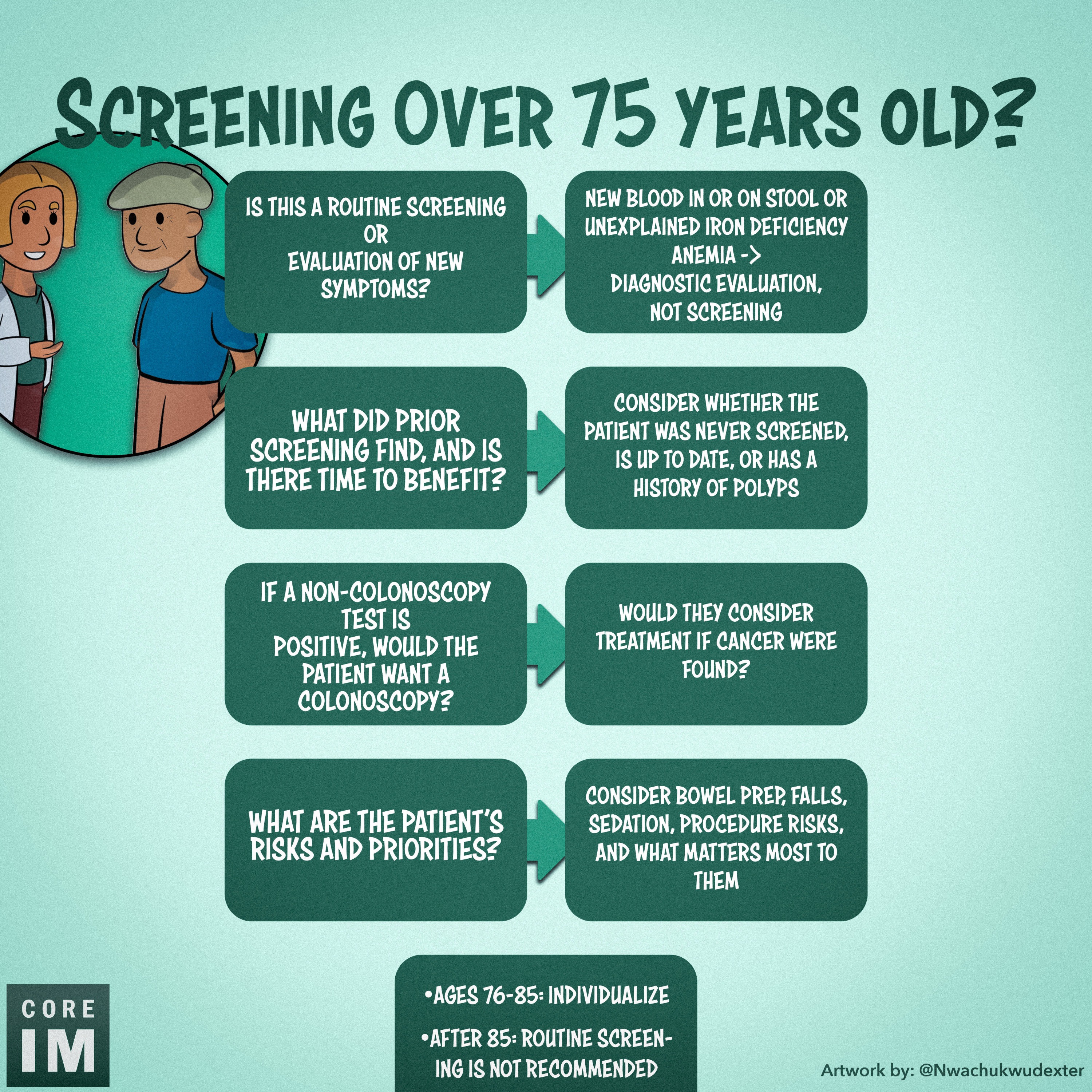
[SPEAKER_02]: Wow, what a surprise, a three centimeter polyp. [SPEAKER_05]: Yeah, that's crazy. [SPEAKER_02]: And you know, I think one important distinction is that this patient did have bleeding, right? [SPEAKER_02]: So this is no longer routine screening, but a diagnostic evaluation. [SPEAKER_02]: And even here, I think we pause, you know, it's persons over 75.
[SPEAKER_02]: But this case reminds me, just not to dismiss new symptoms because of age alone. [SPEAKER_05]: So it really is a case-by-case basis, and even when gastroenterologists are saying come back in a certain time, Dr. Firsts usually hedges and says after discussion with your primary care. [SPEAKER_05]: So based on your health and based on guidelines at that time because guidelines also evolve.
[SPEAKER_05]: And then Dr. Isaka talked about her approach to another patient who may be less robust. [SPEAKER_00]: Now let's consider a different patient, maybe they're 85, and they've had multiple whenoscopies. [SPEAKER_00]: They've had small polyps, less five millimeters or less, found every time, two to three, of them found.
[SPEAKER_00]: You know, at that point, again, taking into consideration their raw health, do I believe that a polyp could grow and become cancer and less lead to their cause of death? [SPEAKER_00]: unlikely, right in that setting. [SPEAKER_00]: And so with that age, it would probably be reasonable to say, hey, maybe let's, you know, take a beat from doing these procedures.
[SPEAKER_00]: Let's see how your health is in a year or two. [SPEAKER_00]: And if things are still improving or, you know, if you haven't had any major changes, maybe then we can re-evaluate. [SPEAKER_02]: Okay, I was so surprised to hear this, because I thought once you find polyps, you'd like continue on the surveillance colonoscopy training to your eighties, but I guess if you do the math with a possible life expectancy, which we can use things like e-pregnosis to help us think about more objectively and then when you factor in how long those polyps usually take to become cancer, which can be about 10 years plus or minus if they're going through the classic adnome of pathway, then yeah, it might be fair to say, you know what, let's see how things are going
[SPEAKER_05]: Yeah, exactly. [SPEAKER_05]: And I thought Dr. Gupta had one of the most practical frameworks for how to approach screening at patients over 75 years. [SPEAKER_04]: So the real calculus is what's the person's screening history? [SPEAKER_04]: And what is their life expectancy of there? [SPEAKER_04]: We talked about this concept of lack time to benefit.
[SPEAKER_04]: How long do they need to live to be able to benefit from a preventives or a screening intervention that you do now? [SPEAKER_04]: So the first things first, which is in a person who's had regular screening, for example, has had one or two colonoscopies. [SPEAKER_04]: And now they're 75.
[SPEAKER_04]: They're actually pretty low risk for colon cancer. [SPEAKER_04]: And we really should reserve screening for people who've been screening and are 75 and older to people who are extremely healthy. [SPEAKER_04]: We expect to have a 10 or more year life expectancy because those are the people who are more likely to benefit, where finding a cancer, you're going to do something.
[SPEAKER_04]: They'll actually benefit from the intervention such as surgery or other treatments. [SPEAKER_04]: for a person who has had prior screening and their life expectancy is uncertain beyond five years. [SPEAKER_04]: They're probably not going to benefit. [SPEAKER_04]: I think you could tell them to focus on their other health priorities.
[SPEAKER_04]: It's really a tough call. [SPEAKER_03]: So the challenges you start to have this cross between as someone gets older, right? [SPEAKER_03]: They may have also those longevity chains where they're actually going to live longer, where also their risk, just based on age and a history of polyps, go up as well.
[SPEAKER_03]: So in full transparency, do we scope people in their 80s? [SPEAKER_03]: Or even in their 90s at some point in time for colon cancer screening or really surveillance? [SPEAKER_03]: We do. [SPEAKER_03]: And the reason being is because some of these individuals keep forming polyps, and as long as they have a five-year life expectancy, then we really can help prevent Colman cancer in some of these higher-risk individuals.
[SPEAKER_03]: Contrast that, though, to someone who at age 50, had one small tubular adenoma and has had multiple colonoscis and has never shown anything else. [SPEAKER_03]: thereafter, you could make the argument that actually they shown they do not form polyps, and perhaps at age 80, you could offer them to forgo surveillance colonoscopy thereafter.
[SPEAKER_05]: The other one that comes up pretty often when we're talking about this is the risks of perforation bleeding, but in speaking to our discussions, it sounds like the risk is actually probably less than what it used to be. [SPEAKER_05]: And so yesterday is clear that the data show that the risks of colonoscopy go up with age, and especially about people who are about the age of 80.
[SPEAKER_05]: However, overall, those risks are still pretty rare. [SPEAKER_02]: Yeah, and maybe a good way to round out kind of a risk benefit with screening colonoscopy and accurately, with what we thought was a powerful story that helps tie in some of those theoretical complications that come up, and also I think more importantly, what it means to check our bias.
[SPEAKER_03]: I remember there was one case where it was actually a 90-year-old where we had anemia and some rectal bleeding. [SPEAKER_03]: They came into the hospital. [SPEAKER_03]: The team, I remember, right away, said, they're 90's, like, there really is nothing we should do for this. [SPEAKER_03]: And then one of their children that actually made the comment saying that, [SPEAKER_03]: But you know, they're pairing, they do everything.
[SPEAKER_03]: Like why are we not offering them what they need to? [SPEAKER_03]: And it was an example. [SPEAKER_03]: We went ahead and we finally did the colonoscopy. [SPEAKER_03]: People talked about the increased risk of complications in the elderly. [SPEAKER_03]: I would say that's a concern, but what we consented them for is, almost to concern to actually about the bell prep in the elderly.
[SPEAKER_03]: Because that's where if they jump off the bed or they miss the commode, a hip fracture is really going to really [SPEAKER_03]: So, I'm really cautious about how we do the bowel capture they've done inpatient with different assistants, but the procedure itself, we do with monitoring anesthesia care, we go slow, it's more of just a theoretical markup modeling and different things which show the increased risk.
[SPEAKER_03]: But I end visual-based as like in our group, for example, we do not see a specific higher rate necessarily a perforation or complication. [SPEAKER_03]: Because I really think it's one of those situations where we know if we're pushing too hard, we abort, we're not trying to prove anything.
[SPEAKER_03]: However, in this individual, it was really satisfying that we did diagnose a cancer. [SPEAKER_03]: And what's important to you about colon cancers that suddenly would like to talk about obitth as a cancer would you undergo go chemotherapy, would you undergo all these different things? [SPEAKER_03]: But what people forget about is the treatment for an early colon cancer is usually just a laparoscopic reception of that area.
[SPEAKER_03]: There is no chemotherapy. [SPEAKER_03]: There is no radiation. [SPEAKER_03]: It's one of these things where if you have a localized cancer, surgery is curative in those situations. [SPEAKER_03]: So that's really where it ends up being an excellent outcome. [SPEAKER_03]: The patient underwent a laparoscopic resection.
[SPEAKER_03]: They had their cancer removed. [SPEAKER_03]: And then they just did excellent. [SPEAKER_03]: And they went back home and continued in their way that they were doing before. [SPEAKER_03]: And that's where it's just, they feel sometimes with the ages and we just write people off because we just don't think it can be done or we write off the risk of the procedure or the theoretical or what if we found something.
[SPEAKER_03]: But instead, sometimes it's taking step back and realizing that we can still help people and do it even if they are older. [SPEAKER_02]: I really love this story and the idea of thinking about ageism and I'm sure it comes up more often than we'd like. [SPEAKER_02]: To me, to summarize, I think we know that the risk of perforation increase, you know, when people are over the age of 75, seeing with cardiovascular complications with anesthesia or other sedation.
[SPEAKER_02]: And so we have of course when I try to avoid that. [SPEAKER_02]: With balancing, what is the gain that the patient might get if we do these screening tests? [SPEAKER_02]: And if we do find something, right? [SPEAKER_02]: But when we're taking into account life expectancy, you know, robust 80-year-olds, that is going to be different than someone who made more frail.
[SPEAKER_02]: And we can use things like e-proknoces to help us out. [SPEAKER_02]: All right, let's round out our discussion with some real talk about colon cancer screening from a population health perspective. [SPEAKER_01]: I love this for two reasons. [SPEAKER_02]: One, because I think from a meta education perspective, this is just some good space for a petition of things we had talked about earlier.
[SPEAKER_02]: And then two, Steve sat down and had this great chat with Dr. Isaka that I thought was really inspiring and love ending on a thought provoking way. [SPEAKER_05]: So in kind of your work that you've been doing, they have to run any like more population level strategies that you've determined are actually really successful in helping to encourage screenings.
[SPEAKER_00]: Yeah, 80% goal has been elusive as a national goal for a while used to be that tagline was 80% by 2018. [SPEAKER_00]: And then 2018 came and passed and we didn't reach it. [SPEAKER_00]: So now it's 80% in every community and that's what we are striving for. [SPEAKER_00]: And I will say that the evidence-based strategy that's really helped us get to that goal that we know of is mailed outreach.
[SPEAKER_00]: And so what I'm talking about is mailing kits and most of the time these are fit kits to individuals' homes. [SPEAKER_00]: And this has to be done as part of an organized program. [SPEAKER_00]: They're tracking that information. [SPEAKER_00]: They have individuals navigating them and they're directing people who have abnormal results to colonoscopies.
[SPEAKER_00]: And then when people are diagnosed with cancer, [SPEAKER_00]: And so when we see that replicated here in the United States and the best example I have for that is the Kaiser Health System, we see that we can reach that 80% screening goal. [SPEAKER_00]: So Kaiser over a couple of your decade process, went from the typical sort of just colonoscopy based approach of screening to mailing individuals, but kits, and doing this in a organized population-based approach.
[SPEAKER_00]: What they found was over 15 to 20 year period that the colon cancer screening rates across all groups went from anywhere between mid 40 percentile to 80 percent and this was for all racial and ethnic groups and what they also found was that over this time. [SPEAKER_00]: that the incidence of colorectal cancer went down, right?
[SPEAKER_00]: Because you're screening a technique earlier, and the number of colon cancer deaths also went down. [SPEAKER_00]: What's really remarkable is that they showed that the gap in cancer deaths between white, black, and other racial ethnic minority groups almost disappeared across that period of time.
[SPEAKER_00]: Because once you got everybody screaming at the same level, detecting cancer earlier, [SPEAKER_00]: I think it's hard for primary care to do it on their own, like as an individual primary care doctor. [SPEAKER_00]: It has to be done at the health care system level. [SPEAKER_00]: And I think that primary care doctors make a really strong case to health system administrators and others about making such an investment.
[SPEAKER_00]: And the reason being, cancer costs a lot, not just from a money perspective on insurance companies, but when we think about from a societal perspective, [SPEAKER_00]: on families and just the anxiety related to it right like those costs are like not even measurable. [SPEAKER_00]: And so yes, there are some investments that are required in developing population-based programs, but I think the payoffs, you know, really are exceed those initial costs.
[SPEAKER_05]: Awesome. [SPEAKER_05]: Thank you. [SPEAKER_05]: I'm trying like thinking through like I guess why don't we do this at let's say like a state level or a national level other than I guess cost and the [SPEAKER_00]: that's exactly why. [SPEAKER_00]: So, I mean, I think it requires ownership, right?
[SPEAKER_00]: Someone has to own that. [SPEAKER_00]: And in order to execute colon cancer screening while we wrote a paper years ago that offer strategies for how this might be done well, it requires that you understand who the denominator is, like who the patient denominator is. [SPEAKER_00]: And right now, because we don't have a national health system if you will, it can really [SPEAKER_00]: Certainly, I think states could create programs where health systems have to report that information and that would give you the denominator across the state, but we just don't have examples of that yet to my knowledge.
[SPEAKER_00]: And so, but I think that's possible and I do think it's something we should strive for because the data is so compelling. [SPEAKER_00]: Within our own health care system, I can tell you that since we initiated our population health, colon, cancer screening program in 2021, our cancer screening rates have increased from 62% to 72%.
[SPEAKER_00]: And this is over almost five year period now. [SPEAKER_00]: And so, you know, we're getting closer, right? [SPEAKER_00]: But it takes those initial investments. [SPEAKER_02]: Yeah, that is so inspiring from a population health perspective that we can actually make a dent on mortality, right?
[SPEAKER_02]: If we have, kind of, some institution-based male outreach program, and that's at least until we have something more nationally or statewide. [SPEAKER_02]: But that's to say, let's not underscore the power that we all [SPEAKER_04]: if that has been shown time and time again to be a great predictor whether people get to bring people want to get that wreck from their clinician and that clinician wreck really means something.
[SPEAKER_04]: I think it's really important in the clinic to offer choice. [SPEAKER_04]: My bigger preference is to offer patients, colonoscopy in the option of at least one non-invasive test such as fit or call a guard based on current guidelines. [SPEAKER_04]: And that's because the research is really strong in showing that when we offer test choice, more people will participate in screen.
[SPEAKER_02]: And that is a wrap for today's episode. [SPEAKER_02]: If you got anything out of this podcast, it inspired you. [SPEAKER_02]: Our ask is to please send it to one other colleague who might also learn something from this episode too. [SPEAKER_05]: and a big, big thank you to our discussants, Dr.
[SPEAKER_05]: Senator Gupta, Dr. [SPEAKER_05]: Racial Isaka, Dr. Have Your Lloyd, and Dr. Joseph Firstine, as well as our peer reviewer, Dr. Elizabeth Hausman. [SPEAKER_02]: And thank you, Dr. Dexter Nowich, who's for the graphic, as well as all the other people who made this episode possible. [SPEAKER_02]: As always, we'd love hearing feedback.
[SPEAKER_02]: Please email us at Hello, at Cori and Podcast.com. [SPEAKER_02]: Appinians expressed our own and do not represent the opinions of any affiliate institutions. [SPEAKER_02]: Thank you and take care.
