

Core IM | Internal Medicine Podcast
#222 AFib Stroke Prevention: WATCHMAN, DOACs, and the CHAMPION-AF Trial | Beyond Journal Club Segment with NEJM Group
· 32 min
Kapitelklicken springt direkt hin
Shownotes
<p>If your patient asks you about a left atrial appendage closure device, what should you tell them? </p><p> In the latest episode of the Beyond Journal Club podcast from CORE IM and NEJM Group, the hosts will help you: </p><ul><li> <strong>Understand the trade-offs</strong>: stroke prevention, bleeding, procedural risks, and medications afterward. </li><li><strong> Build clinical judgment:</strong> weigh which approach may better serve the individual patient, beyond the trial’s headline. </li><li><strong> Learn from thoughtful counseling</strong>: hear how you might discuss the evidence, acknowledge uncertainty, and explore what matters to your patients.</li></ul><p><br></p><p>🔹<strong>Sponsor: ACP MKSAP </strong>Oakstone CME</p><p>Use the code "CORE25" for 25% off: <a href="coreimpodcast.com/MKSAP7"; rel="nofollow">coreimpodcast.com/MKSAP7</a></p>&… href="coreimpodcast.com/2026/10/28/afib-stroke-preve…; rel="nofollow"><strong>Transcript and Show Notes</strong></a><strong> </strong> </p><p>01:09 | What the Watchman is, and why it should work?</p><p>05:58 | The checkered history: PROTECT-AF and PREVAIL</p><p>09:06 | The plot continues: PRAGUE-17, OPTION, OCEAN, and CLOSURE-AF</p><p>12:35 | CHAMPION-AF: the biggest test yet</p><p>15:03 | Reading the fine print</p><p>19:23 | A local solution to a systemic problem</p><p>22:45 | How patients hear about it</p><p>25:44 | So what do we tell our patients?</p><p>29:52 | Takeaways</p><p><br></p><p>Tags: IMCore, Internal Medicine, Medical Education, WATCHMAN device, Atrial Fibrillation, Cardiology, DOAC Anticoagulation, Primary Care, Hospital Medicine</p><br /><br />Find the best disability insurance for you: patternlife.com/disability-insurance?campid=49… Sponsors:<br/>* Check out Eko: ekohealth.com<br/>* Check out FIGS and use my code FIGSRX for a great deal: wearfigs.com<br/><br/><br/>A… Inquiries: <a href='redcircle.com/brands'>https://redcircle… & Opt-Out: <a href='redcircle.com/privacy'>https://redcircl…;
Transkriptvom Podcast bereitgestellt · Zeitmarken springen hin
[SPEAKER_02]: Welcome to another episode of Beyond Journal Club, a collaboration between Korea and Henny Jamger. [SPEAKER_00]: The goal of Beyond Journal Club to take landmark critical trials and put them into the context telling the story of how we got to where we are and what it means for how we take care of our patients.
[SPEAKER_00]: I'm Dr. Scherratty, I'm an internist at the IDMC. [SPEAKER_01]: And I'm Dr. Glenn Lee, a metteethosclist with a Master in El Brigham, and a WD editor for any chain clinician. [SPEAKER_02]: And I'm Dr. Greg Katz, cardiologist at NYU. [SPEAKER_02]: Today we are talking about left-atrial appendage occlusion devices, and specifically one of the ones that's been most studied the Watchman device, and Champion AF, which is the largest ever trial of this device that was done, published in the New England Journal of Medicine on March 28th, 2026.
[SPEAKER_00]: Yeah, so first of today, we'll cover what actually is the watchman. [SPEAKER_00]: And why on paper is should be a great idea. [SPEAKER_01]: Yeah, then I get the privilege of walking us through the device's rocky history because you can't really understand champion AF without the trials that came before it.
[SPEAKER_01]: And looking at it from the lens of a cynic, I know I'm going to love this part. [SPEAKER_00]: Oh, boy, I'm okay. [SPEAKER_00]: And then last but not least, we will dig into champion AF itself, read the fine print and figure out what are we going to actually tell our patients when they bring up the watchman?
[SPEAKER_02]: So let's start out by talking about the most concerning part first. [SPEAKER_02]: Everyone's biggest fear with atrial fibrillation is the risk of stroke. [SPEAKER_02]: When the atrium fibrillates instead of contracting, there's this concern that blood can pool and clot, and if a clot breaks off, a small piece of that, and travels to the brain, that causes a stroke.
[SPEAKER_02]: With a lot of patients who have a fib, clots conform in one particular spot in the heart, this little dog-year shape pouch at the [SPEAKER_00]: Yeah, so I'm following that logic, right? [SPEAKER_00]: And if most of those clots are coming from that one pouch, then let's close that out. [SPEAKER_02]: Totally right.
[SPEAKER_02]: And we have proof that this works, closing off the pouch is successful. [SPEAKER_02]: In a trial called LAAOS3, patients who had at arial fibrillation, and were already having open heart surgery for another reason, had their appendage clicked, and that lowered the risk of stroke over the following four years.
[SPEAKER_00]: OK, but I mean, we're not going to crack open people's chest just to clip independent. [SPEAKER_02]: No, that would be insane. [SPEAKER_02]: In LAAOS 3, they had already opened the chest, and they were already inside. [SPEAKER_02]: The watchman is a device that closes off the left-age real appendage, but it's implanted through a catheter in the leg without surgery.
[SPEAKER_01]: Yeah, one asterisk on LAAOS 3, though. [SPEAKER_01]: Those patients stayed on their blood thinner after the surgeon closed the appendage. [SPEAKER_00]: Hmm, okay, so this wasn't like a proof of concept closing the pouch, stop the blood thinner. [SPEAKER_00]: Uh, thank you for that kind of caveat, Nasterick.
[SPEAKER_00]: Okay, all right, good to keep straight. [SPEAKER_00]: Okay, so before we get into whether the washman works, like can we just level the playing field? [SPEAKER_00]: What actually does the watchman procedure in tail because I think there's a lot of like hand-waviness that happens on rounds We're like, oh, they put in a watchman or let's consider a watchman for this complicated e-fib patient, but what does it actually entail?
[SPEAKER_02]: So, I always tell residents that if you don't know what a procedure entails and you don't know where access is obtained, then you have no idea what you should be looking for when that patient comes back to the fork and you're thinking about post-procedure complications. [SPEAKER_02]: We get to the left-hatrial appendage through the femoral vein, but in order to get there, you have to go all the way up to the heart and then cross the atrial septum by puncturing it.
[SPEAKER_02]: And then you deploy the Watchman device in a place around the left-hat real appendage where the heart is about one to three millimeters thick. [SPEAKER_02]: The Watchman is about the size of a quarter, it's shaped like an umbrella, and because the wall is so thin there, about 1% of these procedures end up needing emergent paracariosynthesis because of a small perforation.
[SPEAKER_02]: And then after the fact, patients need to stay on long-term aspirin after they get the watchman. [SPEAKER_00]: Ah, that is all good to know. [SPEAKER_00]: I wonder 100 perforation risk. [SPEAKER_00]: That's not nothing. [SPEAKER_02]: So the next consideration is that the device has to seal completely.
[SPEAKER_02]: If it's not perfectly sealed, you get a leak, which is stagnant blood behind a partially sealed pouch, and that creates its own clotting risk. [SPEAKER_02]: It can also have the risk of clots forming on the device itself. [SPEAKER_02]: Anyone who's done these surveillance TE's has seen that before.
[SPEAKER_02]: And whileing off the appendage is not a completely benign event, and the appendage does place some role in a trail kick and how the heart fills. [SPEAKER_01]: Yeah, great. [SPEAKER_01]: And it's not what I'm done despite how it's being advertised on TV. [SPEAKER_01]: Like after implantation, these patients still need a short course of either anti-collegation or dual anti-play with therapy and really varies depending on what protocol on the device that they got.
[SPEAKER_01]: Plus, they'll need follow-up imaging afterwards. [SPEAKER_01]: And then, many people need to continue long-term aspirin afterwards. [SPEAKER_00]: Okay, let me just double tap on that 45 days of a blood thinner after the procedure and then life long aspirin. [SPEAKER_00]: This is really interesting because I think people here like quote unquote baby aspirin, but that still has bleeding risk.
[SPEAKER_02]: baby aspirin feels like it's not an actual medication because you can buy over the counter and baby sounds like it's a child's dose. [SPEAKER_02]: But 81 milligrams of aspirin has been compared to a pixibane in high-risk patients in the haverest trial. [SPEAKER_02]: And in that trial, we saw that the risk of bleeding for aspirin compared to a pixibane is really not all that different.
[SPEAKER_00]: Yeah, I do get the appeal right, like plenty of patients hate being on a blood thinner. [SPEAKER_00]: They worry about a bad bleed if they fall and also maybe they don't want to take a pill twice a day. [SPEAKER_00]: So I think if you could safely take away that blood thinner, it could possibly be a real win in terms of quality of life and I see that appeal for a patient.
[SPEAKER_02]: the appeals totally real. [SPEAKER_02]: That's why the pitch is so persuasive and compelling. [SPEAKER_02]: And so the question is not whether this is an appealing concept. [SPEAKER_02]: The question is whether device delivers on that concept. [SPEAKER_02]: And this is where I look at the data and it makes things a little bit uncomfortable.
[SPEAKER_01]: You know me, I love the uncomfortable, so let's get into it. [SPEAKER_01]: The Watchman got FDA approval in 2015 as a result of two trials, Protect AF and Preveil. [SPEAKER_01]: The most important thing about both trials is what they compare the advice against, which is Warframe. [SPEAKER_00]: Oh, Warframe?
[SPEAKER_00]: Not a doughak? [SPEAKER_01]: Yeah, that's right, Shreya. [SPEAKER_01]: It's worth repeating again, the washman was not compared to the current standard of care, a dough-ac, a direct oral anticoagulant. [SPEAKER_01]: Warfin requires monitoring, it causes more bleeding, including intra-cranial bleeding, and so it's really not a great comparison because these trials tell us nothing about how the washman compares with the better drug, the dough-ac.
[SPEAKER_00]: Yes, fair, fair point. [SPEAKER_00]: And I think that's where champion AF, that trial will come into play in a couple minutes, but curious as worth the humapas, how did the washman device compare to Warfin? [SPEAKER_01]: So the first trial protect AF found that closing the left atrial pended with a washman was not inferior to warfriend for a composite cardiovascular outcome.
[SPEAKER_01]: And warfriend Cosmour Bleeding, which is not surprising to anyone. [SPEAKER_02]: And so after Protect, the FDA asked for another trial, and that led to prevail. [SPEAKER_02]: And prevail did not establish non-inferiority for its main efficacy endpoint. [SPEAKER_00]: OK, all right. [SPEAKER_00]: Can you say that in plain English?
[SPEAKER_02]: Yeah, the trial and plain English that prevailed did not show that the watchman was as good at war for and for preventing stroke and systemic embolism. [SPEAKER_02]: And the published conclusion basically says, not inferiority wasn't achieved, but event rates were low, so the estimates were in precise and numerically comparable.
[SPEAKER_02]: But that's not the reassuring, confirmatory trial that you'd hope for before a device gets approved. [SPEAKER_01]: Yeah, and there were actually two co-premari endpoints, and for the second one, stroke or embellism, the washman was found to be non-inferior to war friend. [SPEAKER_01]: However, there was an important wrinkle in how the results for this end point were analyzed.
[SPEAKER_01]: They actually excluded events during the first seven days after the implant. [SPEAKER_00]: Wait, why would researchers exclude the first week post a watchman? [SPEAKER_01]: Yeah, they made the argument that there's this learning curve and some early complications might decrease as the procedureless gain experience.
[SPEAKER_02]: That might be true, but early events still matter to patients. [SPEAKER_02]: The procedure in the days immediately afterwards are part of the treatment. [SPEAKER_02]: No patient care is whether a stroke is categorized as procedural or later. [SPEAKER_02]: Patients care if they had a stroke.
[SPEAKER_02]: If you exclude that riskiest window, of course, the procedure is going to look better. [SPEAKER_02]: But the results of prevail led to the FDA approval of the Watchman, which set the stage for tens of thousands of implantations per year. [SPEAKER_01]: Yes, remarkable. [SPEAKER_01]: And to put a number on the tens of thousands, it's around 20 to 30,000 a year in the U.S. now.
[SPEAKER_01]: And worldwide, more than 600,000 devices have been implanted since approval. [SPEAKER_00]: Hmm, 600,000, that's a lot of procedure stemming from mixed data. [SPEAKER_00]: It seemed like if I were to summarize, we had one encouraging trial, Protect AF, followed by what would have been a conformatory trial, but that was prevailed AF, but it did not meet its main non-inferiority endpoint, and both use warfriend rather than a modern dough act to compare.
[SPEAKER_00]: Alright, so after approval, did any researchers finally compare the left atrial-pengaged closure with a modern blood thinner? [SPEAKER_01]: Yeah, there were actually a couple of trials that looked at this. [SPEAKER_01]: One was Prox 17, which compared left atrial-penish closure to doax and patients both at high risk for clotting and bleeding.
[SPEAKER_01]: Now, it looked like the closure was not inferior, regarding composite outcome, but the trial wasn't that big. [SPEAKER_01]: And then there was the option trial in 2024, which looked at a different populations. [SPEAKER_01]: So these were actually low-resupations going for a fib ablation.
[SPEAKER_01]: Here, the Watchman device group was not inferior. [SPEAKER_01]: It would regard so composite outcome and there was less bleeding in the group. [SPEAKER_00]: Okay, that sounds a bit more favorable. [SPEAKER_02]: Yeah, I think that when you look at Prague, Prague is a small trial that does not give us enough sample size to measure stroke individually and bleeding risk individually and then option is [SPEAKER_02]: It's, again, it's not apples to apples, it's not really device compared to no device, it's device plus a relation compared to a relation.
[SPEAKER_02]: And, you know, when you think about option and translating that to the modern world, there's another trial, ocean, which is just an ablation trial, looking at whether [SPEAKER_02]: low-risk patients who have a successful patient can actually stop their anti-quay on therapy. [SPEAKER_02]: And it seems like their stroke risk is really, really low.
[SPEAKER_02]: And so I look at option. [SPEAKER_02]: And I'm not really sure what to conclude about that and whether the left-age real appendage occlusion actually accomplished anything beyond what just a successful ablation would accomplish in a low-risk group. [SPEAKER_00]: It's all fair. [SPEAKER_00]: So my takeaway is people might have done well post-ublation anyway, and it's pretty hard to draw a conclusion about a left-eat trail-pended Ecclusion device from that study.
[SPEAKER_01]: Yeah, exactly. [SPEAKER_01]: The last trial I want to bring up before our main study today is Closure AF, and this one cuts the other way. [SPEAKER_01]: It enrolled a population that was similar to Prox 17, but enlarger numbers, so these were older patients with both high stroke risk and high bleeding risk, which is exactly the type of group that you'd want to know if you can safely take off anti-gradulation, the ones who have high bleeding risk.
[SPEAKER_01]: Yeah, so closure AF test of device versus best medical therapy, which for most patients were doux, but somewhere on no therapy. [SPEAKER_01]: And the result, officially it was not non-inferior. [SPEAKER_00]: Wait, disappointing. [SPEAKER_00]: Okay, so could that not non-thier outcome be because closure AF looked at two different left-hedral appendage devices?
[SPEAKER_00]: I think that was something I saw in the [SPEAKER_01]: Yeah, it could be, but we don't really know because it wasn't broken down by device type in that trial. [SPEAKER_01]: So the trial raise concern in this high-risk population, but it didn't give us a specific answer about the Watchman device.
[SPEAKER_00]: Mm-hmm. [SPEAKER_00]: Okay. [SPEAKER_00]: So let me just make sure I'm getting this story straight here. [SPEAKER_00]: So the original approval trials used Warframe. [SPEAKER_00]: We got some mixed results from that. [SPEAKER_00]: Now later studies, again, Stoax were informative, but, you know, somewhere small, some focus on selected oblation patients that were going to do well anyway, and some had multiple devices incorporated into the mix.
[SPEAKER_00]: So we still need a large contemporary trial of Watchman versus [SPEAKER_01]: Yeah, exactly, and that's why we're looking at the Champion AF and more detail. [SPEAKER_01]: All right, so now we've covered that detail background. [SPEAKER_01]: Let's get into the biggest test yet, champion AF, which looks at a newer generation washroom device versus a modern do-ac.
[SPEAKER_01]: So these researchers enrolled 3,000 patients across 141 sites in 16 countries. [SPEAKER_01]: The average age was about 72. [SPEAKER_01]: Their mean chasvaskor around 3.5, which is a substantial stroke risk. [SPEAKER_01]: However, these patients had low bleeding risk with a mean hazblat score of about 1.3.
[SPEAKER_01]: So these were patients who needed to be on a blood thinner and were able to be anti-coagulated. [SPEAKER_00]: Okay. [SPEAKER_00]: So this is a fair, well-powered fight device versus actual standard of care, doughwack and a population that could take either. [SPEAKER_02]: Exactly. [SPEAKER_02]: And the procedure went really well.
[SPEAKER_02]: It was implanted successfully over 90% of the time. [SPEAKER_02]: There was a really effective seal at four months in most of these patients. [SPEAKER_02]: And so this destroyed about a mature procedure where operators [SPEAKER_01]: Yeah, and the headline, the device was non-inferior in regards to the composite outcome of cardiovascular death, stroke, and systemic embolism.
[SPEAKER_01]: And after three years, events had occurred and in 5.7% of patients with a device versus 4.8% in patients on a blood thinner. [SPEAKER_00]: Okay, time out. [SPEAKER_00]: We said non-verior a bunch of times throughout, again, in plain English, what does non-inferior actually mean here? [SPEAKER_00]: It sounds like as good as, but I suspect that isn't.
[SPEAKER_01]: Yeah, I think it's easy to fall into that trap. [SPEAKER_01]: Non-infioriure does not mean as good as. [SPEAKER_01]: It means not worse than, and by more than some amount, we agreed on ahead of time. [SPEAKER_01]: And that amount, the margin, as it's known, is a crucial detail. [SPEAKER_02]: And so in champion, there's some controversy about where that non-infioriardi bar was set.
[SPEAKER_02]: And a lot of people think it might have been a little bit too generous to lift a drill-pender's occlusion. [SPEAKER_01]: Yeah, and setting that aside, about 1 in 7 of the blood thinner group crossed over and got the device during the trial, mostly for patient or physician preference. [SPEAKER_00]: Interesting, 1 in 7 crossed over to getting the device.
[SPEAKER_00]: So basically 14% of people who actually were supposed to just get a blood thinner actually got a watchman, definitely in a muddy the comparison, right? [SPEAKER_01]: Yeah, it's certainly Ken, and an intention to treat analysis like this one, cross over 10 supple the two arms together, which might make things look more similar or non-inferior.
[SPEAKER_00]: Okay, so the headline of Champion AF was that the Watchman was non-inferior, but what is the subtext? [SPEAKER_00]: Let's get into it. [SPEAKER_02]: So I want to just emphasize looking at all of these subgroups is just us investigating and being hypothesis generating. [SPEAKER_02]: But when you separate out all of the different components of the primary endpoint, it was notable to me that there were more scheme extremes.
[SPEAKER_01]: Yeah, great. [SPEAKER_01]: If you look at the primary endpoint of cardiovascular death, stroke, and systemic symbolism under the magnifying glass, there are numerically more events in the Washman device group than the Blethener group, 81 versus 65. [SPEAKER_01]: And then when you pull out the stroke specifically, there are more ischemic strokes in the device arm, 45 in the Washman group versus 27 in the Blethener group.
[SPEAKER_01]: And if you look at the actual percentages, it's really only around 2 to 3% stroke risk in [SPEAKER_00]: Wow. [SPEAKER_00]: Okay. [SPEAKER_00]: So that's 45 strokes versus 27 strokes in a device whose whole job is to prevent strokes. [SPEAKER_02]: It's a component of a composite endpoint.
[SPEAKER_02]: It's not powered enough to actually determine a difference. [SPEAKER_02]: But when I'm thinking about this device, that is the number. [SPEAKER_02]: That is the single line in the tables that I'm going to look most closely at for any study. [SPEAKER_02]: Looking left a drill pen in your conclusion.
[SPEAKER_01]: Yeah, great. [SPEAKER_01]: But something else that struck me is that this stroke risk 2 to 3% doesn't that seem kind of low. [SPEAKER_02]: Yeah. [SPEAKER_02]: And so you can actually look at how good systemic treatment is gotten by looking at those numbers. [SPEAKER_02]: The classic teaching is every point on the Chads 2 vascular confers about a 1% annual risk of stroke in older data sets.
[SPEAKER_02]: so an average chads to vascore of 3.5 like in champion A.F. [SPEAKER_02]: predicts a 3 to 4 percent annual stroke risk, approximately. [SPEAKER_02]: And you compare that to what we actually saw, which is a 2 to 3 percent risk over the course of three years in this trial. [SPEAKER_00]: That is something that makes you pause, right, for Markle.
[SPEAKER_02]: it's remarkable and the stroke rates and the medical therapy arms were far below what those risk scores predict this is not a knock on the trials it's talking about how good stroke prevention has gotten and you might wonder if in a trial setting there are some additional benefits of extra surveillance and medication titration that patients might not get in the real world but these are impressive results.
[SPEAKER_01]: Yeah, the most favorable read of this trial is that the watchman is not worse than a dough act, but the least favorable read is that maybe you're training a little extra stroke risk for the privilege of skipping a plethora. [SPEAKER_00]: But I guess that device wins when it comes to bleeding, right?
[SPEAKER_00]: The safety end point was lower, 11% in the watchman group versus 19% in the dough act group experience, some bleeding outcome. [SPEAKER_01]: Yeah, sure. [SPEAKER_01]: I think we need to read a carefully, though, that primary safety endpoint was specifically non-proced related bleeding. [SPEAKER_01]: So, like previous trials, that excluded bleeding from the procedure itself.
[SPEAKER_01]: But when we take a deep dive and look at only the major bleeding and then include that procedure related bleeding, the arms come out about even 5.9% versus 6.4% at three years. [SPEAKER_00]: Okay, so off-front the bleeding risk looks lower with the watchman if we only consider all bleeding and exclude procedure related bleeding, but then if you look at it a little bit more closely, the headline about reducing bleeding doesn't seem all that robust when we peel back the layers.
[SPEAKER_02]: And keeping that clots sometimes form in this device and several percent of the patients who were imaged. [SPEAKER_02]: And a couple of those clots on the device seems like they cause strokes. [SPEAKER_02]: And so there's some irony to the idea that this device sometimes generates the clots that can embolize that it was meant to prevent from embolizing.
[SPEAKER_01]: Hmm, yeah, and even though that seems like it's quite rare, it would be such an autosophate for that to occur. [SPEAKER_01]: I guess I'm just struck by the fact that the device isn't clearly better, and maybe even a little worse at preventing the one thing it's actually designed to prevent.
[SPEAKER_00]: Yeah, which is a much less exciting headline than what it's in the press or in some of the ads that you might see for left atrial appendix closures. [SPEAKER_02]: And those advertisements were powerful. [SPEAKER_02]: I mean, they were so good that after champion came out, I actually had two patients who never had a fib ask me if I thought they should get a watchman.
[SPEAKER_00]: That is so painful. [SPEAKER_00]: Man, good advertising. [SPEAKER_00]: Okay, so stepping back, the Washman device mechanistically does the job right 99% of those patients successfully had a sealed lefty drill appendage, and still can't clearly beat the blood thinner. [SPEAKER_00]: Why? [SPEAKER_02]: So, I think that this is actually the most important idea in this episode, and it has a applicability way beyond the watchman.
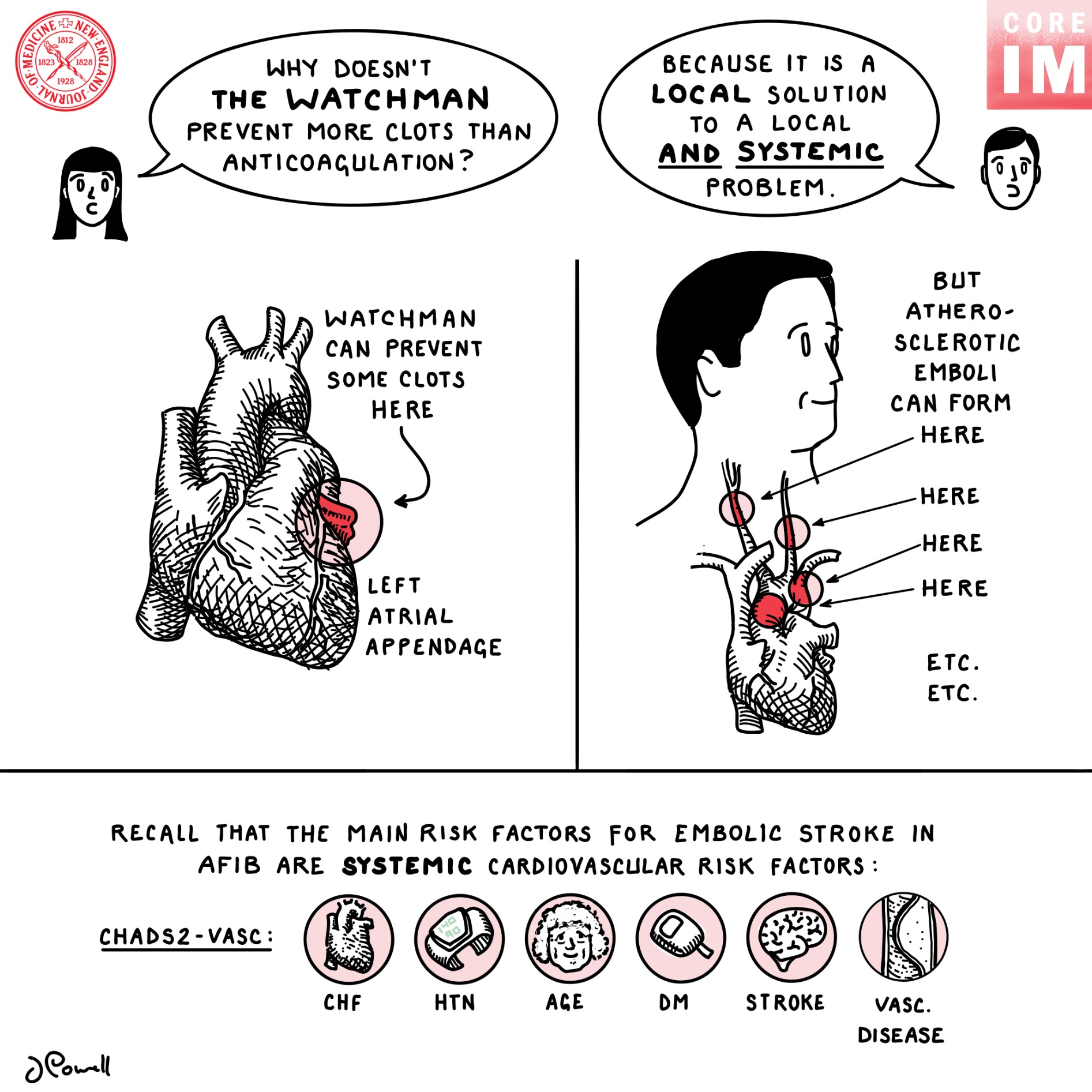
[SPEAKER_02]: The watchman is a local solution to a systemic problem. [SPEAKER_02]: It treats one anatomic spot, but people who have AFAP have strokes for lots of competing reasons, and not all of the reasons that they have strokes come from a clot in the left-hat real appendage. [SPEAKER_02]: Medications work everywhere in the body, but a procedure only works in one place.
[SPEAKER_02]: wait, hold on Greg. [SPEAKER_02]: What are you just said it is just willing my mind? [SPEAKER_02]: Where are these other clots? [SPEAKER_02]: So, strokes are caused pretty often by atherosclerotic disease. [SPEAKER_02]: When you do TEs on post-stroke patients, you see a fair amount of them have pretty significant plaque in their aorta.
[SPEAKER_02]: and a blood thinner like a pixie band or river oxa band would help prevent a clot from forming on any ruptured plaque and breaking off and going to the brain and causing a stroke. [SPEAKER_02]: I mean, if you even take a further step back, think about the way we decide about anti-quagulation and patients with AFAP.
[SPEAKER_02]: It's so overly simplistic. [SPEAKER_02]: You ever stop to think about what is the chads vascular actually telling us? [SPEAKER_02]: Part failure, hypertension, age, diabetes, prior stroke, vascularies, these are measures of systemic cardiovascular risk, vasculary disease, the process that drives heart attacks.
[SPEAKER_02]: They're not telling you about the size of the left atrium or the left atrial appendage emptying velocity or whether blood is pooling mer. [SPEAKER_02]: It's telling you about systemic cardiovascular risk. [SPEAKER_00]: So with a watchman, we're picking patients with these like high systemic cardiovascular scores and then treating them with something that only addresses one local mechanism and then we're surprised.
[SPEAKER_00]: Oh, the device didn't fully protect them. [SPEAKER_00]: Or maybe there's some signal and increased stroke. [SPEAKER_00]: And now I think I'm getting at the components of the Chad's vassor telling us that the risk isn't just confined to one pouch. [SPEAKER_00]: Greg, to zero framework for local solution to systemic problem generalize elsewhere.
[SPEAKER_02]: So I think there's such a good parallel if you think about a different type of stroke that generally affects young people. [SPEAKER_02]: And so when people have a stroke and have a PFO, that little hole between the two atria, that about one out of four people on planet Earth have. [SPEAKER_02]: And so after a cryptogenic stroke with a patient who has a PFO, when we're deciding about whether or not to close that PFO, we use something called the rope score, which is risk of paradoxical embolism.
[SPEAKER_01]: Yeah, and let's review the components of the Robescore. [SPEAKER_01]: So it includes age, hypertension, diabetes, smoking. [SPEAKER_01]: It's basically, after the same thing as the Chazbast, it's where asked. [SPEAKER_01]: How likely is it that this person's stroke came from systemic vascular disease instead?
[SPEAKER_02]: Exactly. [SPEAKER_02]: A young person who has no risk factors gets a high score. [SPEAKER_02]: The PFO is probably the culprit, and closing it probably makes sense. [SPEAKER_02]: An older person who has a ton ofascular disease gets a low score because the stroke likely came from somewhere else, and that PFO is just an innocent bystander unrelated to the mechanism of their infarction.
[SPEAKER_01]: Yeah, so in both of these examples of your framework rig, for both the PFO and the left-hedral pended, the more systemic risk someone has, the less likely closing that one structure or solves a problem. [SPEAKER_01]: That's the unified lesson to me. [SPEAKER_02]: It's not just my clinic, it's lots of people's could talk to any cardiologist who sees out patients.
[SPEAKER_02]: And so let me put a face on it. [SPEAKER_02]: And I'll tell you about a patient I had. [SPEAKER_02]: We'll call her Martha. [SPEAKER_02]: She's 70 years old, retired, placed 10 to 3 times a week, spends half the year in New York, half the year in Florida. [SPEAKER_02]: She has well-controlled A-Fab.
[SPEAKER_02]: She is doing really, really well on a loados of metoporal oil and epics event. [SPEAKER_02]: and she didn't come in to see me asking about whether she should get the watchman. [SPEAKER_02]: She came in asking when we could schedule it because she wanted to be off-bellicless. [SPEAKER_02]: Yeah, let me guess.
[SPEAKER_02]: She's seen an advertisement. [SPEAKER_02]: Yes, she saw it on TV. [SPEAKER_02]: The watchman's market had directly to patients, which is unusual for a medical device. [SPEAKER_02]: And the messaging is built around this concept of one time for a lifetime leave blood thinners behind. [SPEAKER_00]: What?
[SPEAKER_00]: But even the name does something like the Watch Many Cuts feel like you have a guardian standing between you and the stroke that you're afraid of. [SPEAKER_01]: Yeah, right. [SPEAKER_01]: The watchman reminds me of those DC comic superheroes that are in the watchman. [SPEAKER_01]: It doesn't exactly say the device that was not inferior in a number of heterogeneous clinical trials.
[SPEAKER_02]: And by the time somebody has seen these ads, the conversation we have in clinical is just wildly different. [SPEAKER_02]: A clinical appointment is sometimes just the last stop on a journey that began with marketing. [SPEAKER_02]: And untieaching somebody, what an ad taught them, is I find to be almost an insurmountable amount of work and persuasion to accomplish in a clinical [SPEAKER_00]: So true.
[SPEAKER_00]: I'm crying at that thought and I can only imagine, you know, it's not only the advertising not just long, I think that the system, Greg is a learned from you, also pays for it, insurance, like Medicare covers it. [SPEAKER_01]: Yeah, and there's a billing code now that is a combined code with a washman implant and an A-fib obligation together.
[SPEAKER_01]: So you can imagine how that can really incentivize people to do more procedures. [SPEAKER_02]: When we're talking about incentives here, we should be careful. [SPEAKER_02]: And so we're not insinuating that any one doctor is doing the wrong thing or this is the incorrect decision for any one patient.
[SPEAKER_02]: There's no villain in this story. [SPEAKER_02]: This is a sophisticated device, a quick read of the data says non-inferior. [SPEAKER_02]: Patience almost always prefer a one and done procedure to taking a daily blood thinner. [SPEAKER_02]: All of the incentives in the system kind of point towards action and everybody in the chain feels like they're doing the right thing.
[SPEAKER_02]: And this is one of the ways that a bias towards over medicalization plays out in real life. [SPEAKER_01]: Yeah, and that long boring conversation to persuade someone not to do a procedure doesn't have a billing code. [SPEAKER_00]: Okay, bring it home, a patient with A-Fibb is in front of us, asking about the watchman, what do you say?
[SPEAKER_02]: So my honest read of all of the evidence, not just champion AF, is that the device is just kind of fine. [SPEAKER_02]: It's not a God's end, it's not a panacea for a carefully selected patient, it probably has a role, but it's definitely not for anybody who has A-Fibb, who just wants to come off of their blood there.
[SPEAKER_02]: And the reason I say that is because my read of all of this data is that in exchange for stopping anticoagulation, you are getting a marginally higher risk of stroke. [SPEAKER_02]: And that's not for anyone trial. [SPEAKER_02]: It's just my read of the totality of the evidence. [SPEAKER_02]: And so the people that consider this for are really the ones who have a concrete reason why anticoagulation is untenable.
[SPEAKER_02]: chronic GI bleeding, a prior brain bleed, transfusion dependent in anemia, but you also need to keep in mind, patients need to be able to tolerate anticoagulant medications and antitrombotic medications in the short window after the procedure. [SPEAKER_02]: And so that ends up being such a smaller group than 30,000 implantations a year with suggests that it is.
[SPEAKER_01]: And that's basically what the editorial is said. [SPEAKER_01]: So the title of the editorial was a question. [SPEAKER_01]: Should recommendations be expanded? [SPEAKER_01]: And the answer was not broadly. [SPEAKER_01]: So the data that we reviewed support that the device is an option for selected patients, but it's not going to be broadly as effective as a bloodtherner for most patients with ACIP.
[SPEAKER_00]: Yeah, so, practically, when a patient asks about a watchman device left the eternal appendage closure, how do you frame that conversation without just complete disposing of the patient? [SPEAKER_00]: Or on the other hand, just, you know, mindless is it just saying, yes, moving on, setting that referral and how do you go about it?
[SPEAKER_02]: I try to have an honest conversation about what we know and what we don't know and I describe to them that I'm not sure that getting that procedure is actually going to be the same for their risk of stroke and so my read of the evidence is that the patient who tolerates anticoagulation probably has a lower stroke risk by a very very small amount but probably has a lower stroke risk of being on anticoagulation and the list of patients who [SPEAKER_02]: really have a net benefit from left-atrial appendage occlusion is really much smaller than we see in the real world.
[SPEAKER_01]: Yeah, and I think it's worth saying out loud, we as clinicians tend to overestimate the bleeding risk of anti-comagulation, which makes getting people off their blood thinners sound much more reasonable than the evidence supports. [SPEAKER_00]: definitely. [SPEAKER_00]: But that's what I'm taking to kind of the patient conversations.
[SPEAKER_00]: You know, checking my own instinct that like blood thinner isn't a scary of an option. [SPEAKER_00]: But yet Greg curious and I'm thinking about Martha, what did you tell her? [SPEAKER_00]: She was doing just fine on a blood thinner. [SPEAKER_00]: Did she get the watchman? [SPEAKER_02]: So we spent 45 minutes talking about all the details, procedural risk, risk of leak, the data, the fact that she'd be trading eloquist for aspirin and not necessarily escaping bleeding risk.
[SPEAKER_02]: And truthfully, the whole decision hinged on the fact that she liked to wear shorts and anti-quagant that she was on was causing some bruising on her shins and that was it, that was her decision. [SPEAKER_00]: After all of that, [SPEAKER_02]: I mean, she listened, we had a conversation.
[SPEAKER_02]: She's a smart person. [SPEAKER_02]: And at the end of the conversation, she said, I just don't want to take eloquent anymore. [SPEAKER_02]: And she got the watchman. [SPEAKER_02]: And she's doing fine. [SPEAKER_02]: She's off of eloquent. [SPEAKER_02]: She's on aspirin. [SPEAKER_02]: She's playing tennis.
[SPEAKER_02]: And she still has some bruising, by the way. [SPEAKER_00]: And I like a lot to ask. [SPEAKER_00]: Yeah. [SPEAKER_02]: And she's probably going to just be fine because her risk of stroke was low, no matter which path she picked. [SPEAKER_02]: The device wasn't sold to her as stroke prevention, though.
[SPEAKER_02]: It was sold until her as the idea [SPEAKER_02]: And that's a much more powerful pitch than non-inferiority by a small margin. [SPEAKER_00]: Um, man, that is such a good reminder that there is a bleeding risk with aspirin, as well as with the doughach and Man, Greg, I appreciate you bringing this story to light and just the ending that like, despite your best efforts, like, you know, She did an up going for a watchman and the outcome that she cared about less bruising on her shin did not change.
[SPEAKER_01]: As the podcast cynic, let me try to sum up all we've heard about the washman today. [SPEAKER_01]: So one, the washman is a local fix for a problem that is local and systemic, and that's why the device, which is a local mechanical fix, doesn't clearly be a blood thinner. [SPEAKER_00]: And second, when patients come asking something by name, it is worth gently asking, hey, where did that name come from?
[SPEAKER_00]: Because my God, do we have a hard job trying to compete with marketing and things that other people have already been convinced about before they even come CS and if only there was a billing code to do justice for the amount of time and expertise that takes. [SPEAKER_01]: And with that, we wanted to hear from you.
[SPEAKER_01]: Have you had this conversation? [SPEAKER_01]: Like a patient who walked in already having decided because of something that they saw on TV. [SPEAKER_01]: But in the comments, and how did you navigate that conversation? [SPEAKER_01]: I mean, seriously, I really want your advice I'm not sure how to do it.
[SPEAKER_01]: Okay. [SPEAKER_00]: I think you're probably doing the best thing again. [SPEAKER_02]: And that is our episode. [SPEAKER_02]: And so if you learn something from this episode, please share it with a colleague who might also. [SPEAKER_00]: Yes, thank you to our peer reviewer, Dr. Jane Leopold, as well as Dr. Jesse Powell for the Company Graphics.
[SPEAKER_01]: If you have feedback or suggestions, email us at HelloAtCore. [SPEAKER_01]: I am podcast.com. [SPEAKER_02]: Opinions expressed our own and do not represent any affiliated institutions. [SPEAKER_02]: Thank you for listening. [SPEAKER_01]: Yeah, so you guys know me. [SPEAKER_01]: I'm a pretty awkward guy.
[SPEAKER_01]: I love the uncomfortable things. [SPEAKER_01]: So let's get into it. [SPEAKER_00]: Watch for me. [SPEAKER_00]: I'm going to start differing adjectives. [SPEAKER_00]: Oh, thank you. [SPEAKER_00]: Ah, so real, I am crying. [SPEAKER_00]: We need to get that a billing code. [SPEAKER_02]: Sweet bird.
[SPEAKER_00]: Sorry. [SPEAKER_00]: She took that. [SPEAKER_00]: How do you frame that conversation without just dismissing them or just rubber stamping it? [SPEAKER_00]: What is rubber stamping me? [SPEAKER_02]: You just say, like, yes and move on. [SPEAKER_02]: Yes and play out. [SPEAKER_00]: Oh, okay.
[SPEAKER_00]: I've got to stand there. [SPEAKER_00]: I learned so much. [SPEAKER_02]: That expression is for sure dating us.
