

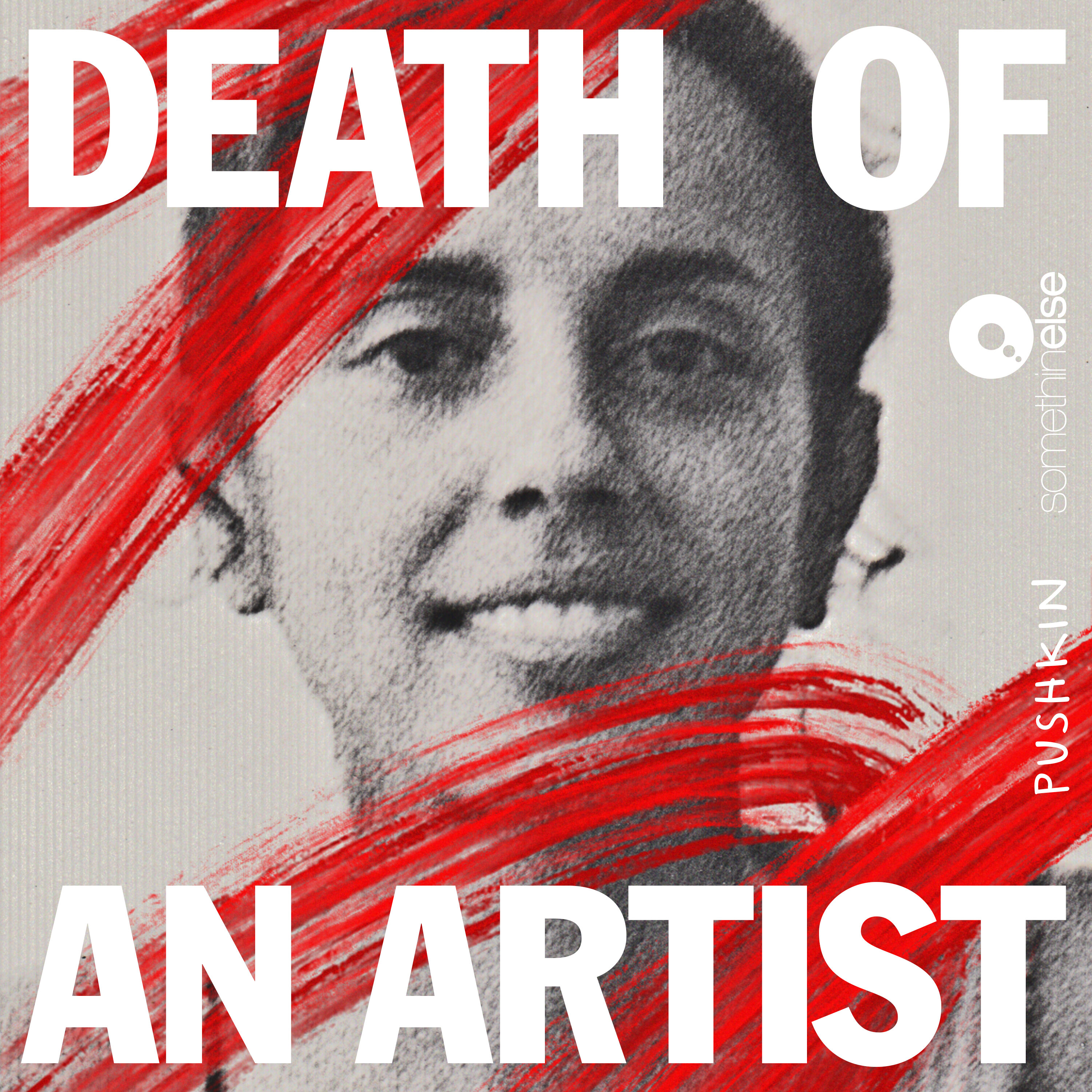
Death of an Artist· Staffel 1· Folge 3
Episode 3: The Feminist Cabal
Freitag, 30. September 2022 · 38 min
Kapitelklicken springt direkt hin
Shownotes
Ana’s art engaged with her identity as a Cuban female artist. She worked hard to be recognized in a world dominated by white men. After her death, Ana’s friends and family demand an investigation. Many of the most powerful members of the art world dismiss them as a “feminist cabal.”
To hear the rest of Season 1 ad-free, sign up for Pushkin+ on the Death of an Artist show page in Apple Podcasts, or at pushkin.fm/plus. If you’d like to keep up with the most recent news from this and other Pushkin podcasts be sure to subscribe to our email list (pushkin.us20.list-manage.com/subscribe?u=ec280…).
See omnystudio.com/listener for privacy information.
Transkriptvom Podcast bereitgestellt · Zeitmarken springen hin
Pushkin. This show contains adult language and occasional descriptions of violence. Please keep that in mind when choosing when and where to listen. Previously on Death of an Artist. I started to leave the gallery and then I thought, wait a minute, what if it's art? And I went an app and it went ARC and I got so excited. It was a revolutionary moment. This guy is now wooing her the way he loves wooing, with champagne, expensive dinners. And this is somebody who's writing down I have ten cents that I used to put on a stamp or whatever. That's enticing.
She was not fearful person, except interestingly when it came to heights. The last person to talk to Anna before she died other than Carl was her close friend Natalia Delgado. She knew the marriage was not working. They were on the phone. Anna was sure Carl was seeing another woman, and she had a plan for how she was going to prove it. She almost knew it was crazy. She said, I think you and I should put on some wigs and dressed like other people, and let's see if we can, like take some pictures of it. You should do it, because you won't recognize you, and I said, are you crazy.
I'm not going to do that. I mean, Carl was in the apartment as the two women spoke, possibly within earshot. Carl was in the background, and so I said, well, maybe you should be speaking in Spanish. But still their words that were the same, you know, like detective, divorce, the same words, you know. So I think that he probably could figure out what she was talking about. As far as Natalia knew, Anna never hired a detective, but she had talked to an attorney about how to file for divorce on grounds of infidelity, and she had said she was gathering evidence. She was making photocopies of all of the receipts from his American Express card and his phone bills. She's trying to reconstruct the events of the affairs,
and she wanted to use that for her divorce on grounds of infidelity. I thought it was better to tell him and say, look, this is what I've accumulated. I want a divorce and I have evidence of this. Did she ever say or sounds like she was afraid of him? Yes, that night, but I had no idea because she said he had a temper before. But I had no idea how that he could get really violent, and she said, yeah, he's going to blow up if I have this conversation with him, He's really going to blow up. It was late and Natalia said she had to go, so I said I would call her the next day. She said, waked me up. So I called her in the morning and I got Carl. I said I need to speak with Anna and he said she's not here and I said, well,
when will she be back. He said I don't know. I said, well, please tell her. I called and he said I will. This detail astounds me. Anna's best friend calls the morning Anna died, and Carl doesn't tell her what's happened, but agrees to pass on a message. Natalia has been sitting with this for decades. You know, it's something that's very painful for me, because I thought it is better to tell him and say, look, this is what I've accumulated. I want to divorce. It never occurred to me that he would kill her. I'm your host, Helen Molesworth and from Pushkin Industries, Something Else and Sony Music Entertainment. This is Death of an Artist. Episode three, The Feminist Cabal. Even when the whole world was arranged
to keep her away from what she wanted. Anna was invested in trying to change things. She wanted to go home to Cuba, the home she hadn't seen since age twelve, but icy Cold War relations between the US and the island made travel between the two countries impossible. Exiles were not allowed to return to Cuba. You leave, and it was like you're a trader and that's it, it's over.
That's Coco Fusco, an artist and the author of Dangerous Moves, performance and politics in Cuba, and this was deeply traumatic for people who left family members there, left homes, left lives. I grew up in a world in which, like all my relatives were like crying about Cuba all the time. So Anna pushed to change it. There were some groups of younger Cuban exiles like Anna who had come as children, who in the seventies organized politically to reopen the possibility of family reunification. Flights, who was one of the Cubans from the American side who sat down with people in the Cuban government and tried to bring the two sides together.
That's pretty daring, and they succeeded, and in nineteen seventy nine, those flights began. One hundred and fifty thousand Cubans went in the first few years of this. In nineteen eighty, Anna made her first trip back to Cuba, where she was able to reunite with her grandparents and extended family. It was a return to her roots. Here's how Anna, voiced here by the Cuban artist Tanya Brigera, explained it.
I find that my roots are Cuban. The branches might be American, but the trunk of the tree is Cuban, or the roots, you know. Anna started to travel to Cuba often, and these visits opened up a whole new world for her politically, socially, and artistically. On one of those trips, she made what I personally considered to be one of her most beautiful pieces, a striking group of petroglyphs carved directly into cave walls located in a dense patch of tropical jungle in Jaruco. More than three decades after she made them, an artist and fan of Anna Mendieta's, named Elise Resmussen, set out to find them. She recorded a video of her journey through the overgrowth and into the cave. Oh ship, we found one of the sculptures.
I don't know which one off hand, show us you can see, can see the head. I really thought that all of them would be destroyed, gone. There's others, he's times, others founded. The wall reliefs Mendietta left behind are thickly carved lines cut directly into the limestone walls. Then she took luminous black and white photographs of them. The images resemble a primordial female form from the Neolithic period. Clearly, Cuba meant a great deal to Anna. It's no easy task to carve into a stone wall, and no matter how deep in the jungle this cave was, no matter how hard the sculptures were to find, to leave a mark like that says I was here, I'm from here, and I plan to remain here. While in Cuba, Anna
also explored her interest in the Afro Cuban religion Santaria. She was finding a way into the culture. That's Eltrano again, one of Anna's Cuban friends in New York. You have to understand that Afro Cuban culture permeated the entirety all the classes in Cuba. Anna had grown up Catholic, with all of those images of sacrifice in blood, and as a little girl, she also liked to listen to the maids in the kitchen talking about their religion Santaria, with its images of blood and sacrifice. That interest was already visible in her work. Her early grad school performances include references to Santa Via rituals through her use of candles and chicken sacrifice. But Elatreiano makes the distinction that Anna
was more student than practitioner. She was not a santeata, she was not dressed in white. There is a very big difference between a practitioner of Santia and somebody who studies or uses it as a way of working with the culture. In fact, there's been criticism of Anna that she was working with a religion that she really didn't know enough about. Anna was interested in excavating her Cuban identity, but her trips weren't only about her. She regularly brought American artists and critics to Havana, hoping to build a cultural pipeline between her two worlds. This wasn't to everyone's liking, and her attempt to ch lenge the status quo earned her a visit from the FBI. For the first time in my career as an art historian, I found myself
looking at copies of heavily redacted FBI files. In September of nineteen eighty three, just before she left for Rome, an agent arrived at Anna's little apartment to question her about her trips. Her answers must have been satisfactory. The agent recommended the matter be closed. But it wasn't just the FBI who perceived her as a threat. She's threatening.
She is not like a pretty little girl, you know, making pretty paintings. That's Sarah Thornton, a sociologist whose book Seven Days in the Art World is an in depth study of the network of galleries, art schools, and auction houses that make up the art community. Her work is a threat to patriarchy. She's playing with gender and the body every single time, whether it's wearing beards and mustaches, her use of blood. For me, she is experimenting with the things done to women's bodies under patriarchy, and she's revealing it. I agree with Sarah. Anna's work does feel like a threat to patriarchy. Anna was not a well behaved woman. She was literally playing with blood and fire.
She's hiking into a jungle to make a carving of a vagina on a cave wall. Her studio equipment included chainsaws and gunpowder. This is a major badass, and badasses are enthralling, and when they are women, they also tend to be threatening. When Anna left for Italy and nineteen eighty three, she was thrilled to have the opportunity to spend an entire year, all expenses paid, on the lush grounds of the American Academy in Rome. This was Anna's chance to live in a city literally filled with art. Sculptures, paintings, and frescoes are everywhere on buildings, in churches and in parks.
It was a dream. But not everything at the studio was to her liking. And as my grandmother would have said, she made a stink. She kind of mobilized a group of people to protest conditions at the Academy. She came in with a list of demands, and I don't think the challegy was really used to that. There were sort of used to people being docile. That's Chris Halbe, a painter who was at the Academy with Anna. He describes how she made a bad first impression, but then organized some of her peers and got the academy to make improvements that helped every one. Your really more impression was who was this fin in the alice? More appreciative and respectful, you know, and all of that. But I think by the end they realized there was something about her. She
had the guys completely redoom or starlight, and I think it parlably led to a kind of reconstruction, the scarlights all around the building, just based on her complaints. There it is again Anna, the outspoken one, not afraid to nibble at the hand that's feeding her. Anna's time in Rome was her own for most of her fellowship. Carl was back home in New York or working in Germany, so he wasn't there. When Natalia Delgado came to visit Anna at the academy, I think with her a week and so she announces, I'm not here to babysit you, which of course I wasn't expecting, but she was like very clear. Anna gave Natalia a book of walking tours so Natalia could roam the city while Anna worked in the studio. She had started to experiment with freestanding sculptures
made out of would that she was burning with a blowtorch. In the evenings, the two friends went to the movies. They saw Apocalypse Now and they also went dancing. But Natalia's visit wasn't only for fun. She came carrying news from New York. I told her about the rumors that Carl was having affairs. She basically called it off with Carl and said, you know, it's over for us, you know, and she was wanting to make a new life for herself.
But Carl and Anna had been in a cycle of breaking up and getting back together for several years and it would continue. But then he decided to go out and court her. It was very sick. I thought, very very surprising to me that somebody breaks up with you because you're having relationships with other people. And what you do is the reaction is you go to see the person to try to get them back. And that's what he did, and that's when he proposed marriage to her, and Anna said, yes, she gave it a chance. You know, she wasn't going to find somebody outside of the art world.
I didn't think, you know, somebody who would understand that vocation. You know, she had a vocation. I mean she never wanted to have children. I get it. Anna was independent driven. Her whole life revolved around and stemmed from her art practice. She needed to be with someone who would understand that.
The two got married in Rome in January of nineteen eighty five. Their close friend Carol LeWitt was at the wedding. She was radiant. I'll never forget how she learned jobs. Absolutely beautiful. Do you remember? Yeah, she's wearing a gray knit dress and the girl I found her a great beautis. The newlywed started their next chapter with a honeymoon in each a place full of art that commemorates death. Anna had wanted to go for a while. Anna was so interested in death that she once said, I don't think you can separate death and life. And we can see how her meditations on death showed up in her art.
For two works that I believe are on view by Anna Na Mendieta M E N d I E t A. They currently have art on display in gallery two O three. Thank you so much. I appreciate that, no problem. Thanks. My producer Luisa and I decided to go to a museum to see one of Anna's pieces and what we're looking at is a work from nineteen eighty four, so you know, Mendietta dies in eighty five, and what we're looking at is a four worm that looks like an outline, maybe like a silhouette of a mummy. It's called Nile Bourne and I l e. Bourne. Anna's interest in Egypt was so deep that she was even dreaming about it.
She recounted a dream to a friend in which she and Karl were the king and Queen of Egypt at sale on a river, surrounded by thousands of snakes. So I wasn't surprised to see that her sculpture from this period resembled a sarcophagus. It looks like it's made out of dirt that's held together with some kind of binder.
It's really thin. In the interior, there's a very extenuated tear drop form slightly raised in a roll. It intimates the interior of the body. It intimates legs that spread open, it intimates that, you know, the interior space of the vagina. Louisa noticed that it looked like an out line of a dead body or a coffin, and that is exactly one of the things that has made Anna's art so chilling in the aftermath of her death. She's in the space of death for sure, So I think you gleaning That makes perfect sense to me. Almost all art is connected to the problem of death, because one of the things art is seagory of objects that we have decided we are going to save. But being interested in or making art about death isn't the same as wanting to die.
It seems clear that Anna had so much more work she wanted to do. This is like the moment when I actually find I get angry, because that's made in nineteen eighty four and she died in nineteen eighty five, So we actually don't know whether or not she thought that was successful. Did she keep making them? What would she have done with that idea moving forward? This is the tragedy of the artist who days young. We simply don't know how their work would have matured, how it might have changed over time. Anna's work was very dynamic, and in her short career the work changed quite a bit, from her use of blood to her use of nature to the final freestanding sculptures in her studio. Her work was already changing and growing. All of that potential violently
halted and my moment of anger in a museum in twenty twenty two. It gave me some small insight into how angry Anna's friends and family must have been when Carl showed up at her memorial. Let's go back to the morning of September eighth, nineteen eighty five, and to Natalia Delgado, just hours after Anna's death. Remember, Natalia called that morning and Carl had answered. She asked Carl to have Anna call her back, and he said he would, even though Anna was already dead. So I asked her, did you call a second time? Yeah, because she didn't call me back on her second call. The person who answered the phone was one of Carl's lawyers, Jerry Rosen.
Carl was at the police station, but he had sent Jerry back to the apartment to collect some documents. Here he is in a nineteen eighty eight interview describing that phone call with Natalia falls ring and I pick it up, and she says Anna there and decided to tell her. I said, Anna's dead, all right, and that Carl is in jail charge. And that time, Karl's lawyer, I think he just sat Anna's dead, and I was like, oh my god, you know, I was in disbelief. Remember Natalia is a lawyer. She realized something was off. I just said, what are you doing in there? Isn't that apartment blocked off cordoned off? And he said, well, yes, but uh he was in there. He went in. Then I thought Karl must have killed her. When she learned that her
friend was dead and that Carl's lawyer was in what was now possibly a crime scene, Natalia immediately got in touch with the NYPD. She told them about her last phone call with Anna, that Anna had been making copies of telephone and credit card bills to prove Carl was cheating, and that she was planning on filing for divorce. I was concerned about, particularly as I'd spoken to Jerry Rosen about what was in the apartment, that you know, that her evidence wouldn't disappear. We'll come back to this later, to the mysterious story of what happened to the xerox copies of telephone and credit card bills for now. In the immediate aftermath of Anna's death, news of what happened was spreading quickly. Some of Anna's friends began planning a
memorial service. Many were art stars, in their own right, heavyweights in the burgeoning feminist art movement. But it was complicated. Several of Anna's friends were also friends of Carl's. One of them, the extremely influential art critic Lucy Leppard, who played a major role in planning the service, had even been Carl's lover before he met Anna. The art world was small, and Anna's death was starting to divide it.
There were those who believed Carl that she jumped, or that maybe it was a terrible accident. And there were those, including many who identified as feminists, who were convinced that he had a hand in her death. The memorial service brought these two opposing factions into one elegant room. The memorial was in a landmarked building on Park Avenue called the Salon Boulevard. It had the grandeur of a high society mansion. Imagine Roman columns and crystal chandeliers. One of the many artists in attendance was a woman named Anne Minich.
She described the service to the journalist Robert Katz. The audio on this archival tape is a little hard to follow. They had music that Anna love, and they had flowers, and Anna of some of her Cuban friends brought a record player and the old fashioned Afro Cuban music that Anna loved to dance to. Anne said, tons of people showed up, including Carl, and it was in this huge room and there were sharedge amounts of people there, including Carl Andre who came. And of course he would have had to become because because his defense was that she committed suicide. It was an impossible predicament. On the one hand, Carl wasn't welcome, and on the other hand, not showing up would have been tantamount to an admission of guilt.
On the day of the memorial, Lucy Lapard had a difficult task. She had to tell Anna's family that Carl would be in attendance. On a sister made it clear that the family did not want to see him. Lapard had already prepared for this by seating Carl in one area and reserving seats for the family in another, such that they couldn't see each other. Here's Anne minuture. He sat over in the corner, and a lot of people, he's a very powerful man, went over and they felt very bad for him, and blah blah blah. It was, you know, there's probably hard to take for some people that he was being comforted as much as he was because and Minis doesn't finish her sentence there, But it's not hard to fill in the blanks. For the folks
who thought he killed her, his appearance must have been galling. They had this set up, this slide show that was continuous of the work, slide the documentation of her work since from the time she was in Iowa. And then after a while they asked people to start giving testimonials the way Anne remembered it. Nobody sugarcoated their memories of Anna.
They described her as she was. It came out that Anna was a difficult person. It gave the thing a reality. In other words, this was we're not memorializing a saint who was being assumed into heaven. It was a very impressive service. The most distasteful thing about the whole thing was carl Andre being there with these girlfriends. Well, I understood that that was his girlfriend. And she would walk across the room and she would go get coffee or whatever they were serving, and she would bring him back to He sat like a bump in this place, and he was like a specter. It was a strange thing to see he con at or what happened. This has got to be a terrible thing for him. How you saw Carl sitting in the corner depended entirely on whether
you thought he bore any responsibility for Anna's death. But however uncomfortable his presence was, Anna's presence loomed larger. Oh, I know that the memorial service was completely impression was very well done. It was we got a real sense of how these women were willing to pull behind her. Anna's memorial was the first gathering where it was clear just how ruthlessly this small community had been torn apart.
That night divided the Soho art world, and the tale of the two Carls began. There was guilty Carl, an innocent Carl. There was Carl the person and Carl the artist. There were those who loved Anna and wanted to see him convicted, and others who loved Carl and wanted to protect him. And when these two groups of people would meet in a gallery on the street at a bar or restaurant, which inevitably happened, things could get dramatic. Honest friend Eletroyano remembered an encounter with Carl. He was at a diner and at some point I used jilled at him that he was a murderer. But you know, he didn't do anything. He wasn't going to be confrontational. His thing is manipulation and silence. Here's Carl's friend and fellow artist,
Laurence Weener. Well, sometimes people would scream at you on the street. I would usually just ignore it, just stare at them. The majority of people who had something to say were quite provincial people. There was quite a confrontational thing. People saw this as the demarking of a feminist issue. The feminist issue, as Laurence Wiener called it, began when it became clear that Anna's friends were pushing for the investigation.
The women who knew Anna best knew the following things. She was excited about her work and had plans for the future. She was about to file for divorce. She was afraid of heights, and they knew that if they wanted justice, they'd have to fight like hell for it. These women included Natalia del Go, who was herself a lawyer, be Ruby Rich, who was writing for the Village Voice and had the power of the pen, and Anna's devoted sister roc Lean and they were all talking to the young assistant Da Martha Bashford, who in her five years on the job had already seen plenty of cases of men assaulting their wives, girlfriends, daughters or nieces. These women were prepared to use whatever power and influence they had
to convict Carl Andre and the pro Carl camp, the friends who bailed him out of jail and decided there was quote nothing more to say. They took note of this group of women, and that's how the journalist Robert Katz entered the picture. He had covered the art world. He understood that Carl Andre was already a canonical figure, and one of Carl's supporters told him quote the poor guy as being victimized by a feminist cabal. The folks who supported Carl simply assumed the cats would be on their side, which is of course why they asked him to look into the case. But that's not what happened.
Here's a bit from his interview over dinner with Carol and Saul Lowit have you wudn't covered anything but shopping, the biggest shocking thing that lives and currents the strange kind of networking that went to protector if you talk to Pauloopfen. I have talked Polo s part of the networks. Yeah, she was one of the people who wanted things to write about this, But really from from Kyle, from their point of view, that was that the sub exactly is the point of views that at one point it was what they believed was that feminist cabals sort of aout to get it with the district attorney. So they threw it as something, you know, like some evil force behind So when I got to look at that, I didn't agree with them. That's that it was some sort of blob.
What is their scenario for the event? I would like to accept whatever he said, he said very little. What is the problem with his story was that he contradicted the self stuff for a time that first day and then it's lawyer's all to shut up, said, it's an episode of word after. I wish there was a feminist cabal.
I don't think there was one, and I don't think there is one now. That's Connie Butler, chief curator at the Hammer Museum, who legendarily organized the most comprehensive exhibition of feminist art to date. Connie is one of the most respected curators in the art world. Cabal is just another word for in a way at which hunt you know.
It's just it's generations, old stories and year of women and the power that they might have if they really were to organize. Just for fun, I looked up cabal in the dictionary. It means a secret political clique or faction. And it's true that b ruby Rich in, Natalia Delgado and a few other women had meetings with the assistant da It's true there was a letter writing campaign and a series of phone calls and meetings to see if any of Carl's x's would verify rumors that he had been violent. Nothing came of it, but it wasn't a secret.
The folks agitating for Anna were highly vocal, and it certainly wasn't all the feminists banding together against Carl. Notably, both Lucy Lepard and Paula Cooper, two of the most powerful women in the art world, would not speak out against him. As b ruby Rich wrote in The Village Voice, the folks who supported Anna were quote the feminist artists, Latino artist, black writers, and unintimidated Cubans, all of whom had, as she would say, more passion than power, so not exactly a cabal. And what's underneath that, of course, is a long history and deeply rooted misogyny that gets thrown around too easily. In circumstances like this, it's easy to blame the feminist cabal. Yep, Blaming feminism definitely has a history.
And it wasn't only Carl's protectors back then who use this kind of language in which they imagine a coordinated plot in which they are the victims rather than the women who they've harmed. We still hear this kind of thinking from our entertainers, politicians, and even Supreme Court justices. No one can question your effort, but your coordinated and well funded effort to destroy my good name and destroy my family. After Anna's memorial, the criminal justice system slowly turned its wheels. Martha Bashford, the assistant DA, made two attempts to indict Karl, and both times she succeeded in getting the grand jury to agree with her and indict him on murder charges, and both times those indictments were
thrown out on technicalities. Even though the judge wrote, quote, it appears that there may still remain sufficient evidence to sustain the indictment. It was coming up on a year since her death, and Team Anna was starting to fear that the DA's office might drop the case completely, so b ruby Rich made a Hail Mary pass in the pages of the Village Voice. The reason I wrote the article on the first anniversary of her death was to try to raise the profile of the case again in public and make it too embarrassing for the district attorney to drop the case and let Karl off the hook.
In that article, b ruby Rich wrote the follow A woman artist tells Anna's sister some damaging information about Andrea, then retracts it after consulting with her husband. A businessman tells an artist friend of mine a story about Andre ripping up a bar in the sixties, then denies it to a reporter. Another woman artist still remembers Andrea's verbal viciousness towards his first wife, but she won't go public either.
I believed that this had killed feminism. I thought it was a sense of someone this tough, this strong, this brilliant, this passionate. As Anna could be killed, then any of us could be killed. If it could happen to her, then nobody stood a chance. B ruby Rich hoped her article would bring women forward, women who could verify the rumors circulating about Carl Sadly, nobody came forward as a result of that article. However, it did accomplish its main goal, which was to actually get the indictment and bring him to trial. And that last indictment stuck. And then when they assigned a new assistant DA and it went to trial, I felt, Wow, it really did work. Carl Andre was about to be tried for murder next time on Death
of an Artist, Jack Hoffinger stood up and said, my client wishes to waive a jury. No one could remember the last time anybody had ever waived a jury and murder trial. It's a very very rare event. That was truly an amazing surprise. He was not going to throw her shout out a lingo. Did its squalidness ever make you not want to go and see his show? Now?
I have nine key to show. There was this crazy thing called artistic license, which meant that artists get excused because whatever it is that they produced is so much more important than whatever damage they could do to people in our lives. Death of an Artist is a co production between Pushkin Industries, Something Else and Sony Music Entertainment, written and hosted by me Helen Mouldsworth. Executive producers are Lizzie Jacobs, Tom kinig Leta Mulad, Jacob Weissberg and Lucas Werner.
Produced by Maria Luisa Tucker, editing by Lizzie Jacobs. Our managing producer is Jacob Smith. Associate producers are Pooge Rue and Eloise Linton. Additional production helped by Tally Abacassas. Anna Mendieta's quotes were read by Tanya Burgera engineered by Sam Baer, fact checking by Andrea Lopez Crusado. Our theme song is by Pooge Rue. Special thanks to a Lise Resmussen. If you love this show, consider subscribing to pushkin Plus to listen early, ad free and get exclusive bonus content. Look for the pushkin plus channel on Apple Podcasts or at pushkin dot Fm. Find more great podcasts from Sonymusic Entertainment at sonymusic dot com Backslash Podcasts
