

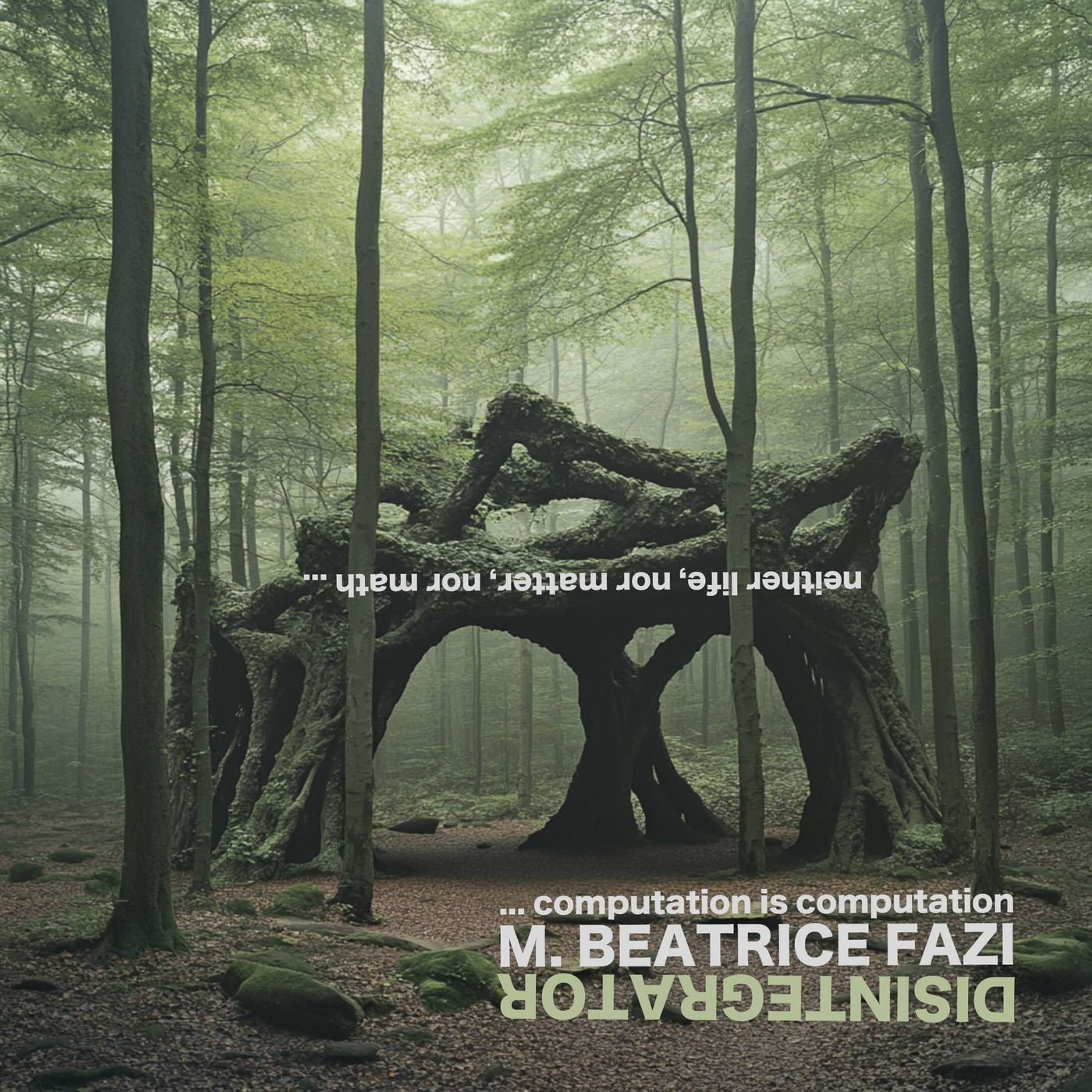
Disintegrator· Staffel 2· Folge 3
17. Computation is Computation (w/ M. Beatrice Fazi)
Dienstag, 20. August 2024 · 51 min
Kapitelklicken springt direkt hin
Shownotes
This episode features one of our most anticipated guests: M. Beatrice Fazi.
M. Beatrice Fazi is a philosopher working in philosophy of computation, philosophy of technology and media philosophy. In this episode we mostly cover some key definitions relating to computation and its onto-epistemology grounded in Fazi’s landmark book, Contingent Computation: Abstraction, Experience, and Indeterminacy in Computational Aesthetics published in 2018. But our discussion doesn't end in 2018.
Now more than ever, Fazi`s work on computation holds unbelievable importance with wide-ranging implications. Philosophy is becoming a major foil to technocapital and technopolitics, forcing us to seriously (re)consider fundamental questions about technology and correlated fundamentals of knowledge and being.
Ever wondered what computation actually is? According to Fazi, it exists and unfolds not only as a function, but also as a creative modality forming its own conditions for existence. This episode dives deep into the concept of computation as an autonomous form of thought and creation, that is nevertheless contingent, i.e. not independent from the material conditions of the world.
We move further into Fazis more recent work in ontology: the triangulation of abstraction, representation and thought. This pushes us into massive questions - what does computation mean for the future of thought? How should we conceptualize the relationship between humans and technology? And why should we rethink the idea of technology as merely an extension of ourselves?
Relevant Links & References:
• Fazi’s landmark book, Contingent Computation: Abstraction, Experience, and Indeterminacy in Computational Aesthetics—still essential reading for anyone interested in the philosophy of technology. About the fundamentals of what computation does and what material, ontological and epistemological consequences this holds.
• Brian Cantwell Smith’s essay, “The Foundations of Computing” (2003)—a text we explore, even if Fazi offers a different perspective on the nature of computation.
• Oh, also, look to Anil Bawa-Cavia's (life changing) episode of Interdependence (interdependence.fm/episodes/inhuman-intelligen…), where he enumerates further on computational functionalism, computational realism, but more importantly for more color on the paths to incompleteness traced in Gödel and Turing -- to which Fazi builds her main thesis: these incompletenesses are actually strengths and not limitations of computation.
Pls like and subscribe or leave a review or whatever we're a baby podcast that's doing huge things!
Transkriptvom Podcast bereitgestellt · Zeitmarken springen hin
Disintegrator Podcast This episode is kind of like a little birthday present to myself, especially in that it includes our number one most requested guest and one of our most giddily anticipated guests M. Beatrice Fazi. Fazi is a philosopher working in philosophy of computation, philosophy of technology, media philosophy. She's a reader in digital humanities in the school of media, arts and humanities at the University of Sussex, where she's currently also the head of the Department of Media and Cultural Studies. Fazi's PhD thesis and book, contingent computation, abstraction, experience and indetermacy in computational aesthetics published way back in 2018, like totally rings fresher than ever today. Seriously, like this book is
so unbelievably important to the present moment where philosophy has this resurgent power and capacity around the world as new developments of technology and their covalent emeshment in society and politics force us to ask seriously major, seriously basic, seriously like fundamental questions about what these things are and what they are doing and what they mean to us.
We spend a good deal of this episode, honestly like 90% of this episode, talking through some definitions and we do this for one reason. Like Fazi is like one of the few maybe like only people who actually provides us with like real accessible definitions for things like computation, algorithm, abstraction, thought and talking through those definitions is like really grounding and really really really helpful. And yeah, you can probably imagine like based on all of the above, like the episode is pretty dense, like it's pretty dense, but it's honestly like actually super unreal once you start to realize what Fazi is telling us — that computation is a distinct and autonomous form of thought whose distinctness and autonomy
are incredibly important to understand right now at this moment. There are some major deft blows to a lot of, you know, mainstream media theory, to some 80s and beyond philosophical speculation, and implicitly to political orientations toward computation that are packed within here. So buckle up. Totally, literally top five lifetime hero of the pod M. Beatrice Fazi. FAZI: What is computation? Okay, historically obviously there are multiple accounts of computation of them these accounts clash with one another because they originate in different fields, or aim to respond to different agendas in different goals.
There is a text quite like by the philosopher Brian Cantwell Smith, an essay called “The Foundations of Computing" which came out now 20 years ago in 2003. And the essay really maps some of the construals shaping our technological, cultural, and scientific understandings of computation. The text, which I was reading just recently, can be a useful entry point for your audience to have a sense of the intellectual debate on and around computation, although I should note that in the same text Brian also says that ultimately computation cannot be defined.
And I do disagree with that statement. I think it's very important to ask the "what is it?” question — what Socrates will call the “ti esti” question. And, also, I believe in the importance of defining words and terms especially within philosophy. So, in my view, philosophy must define, not just describe, it should demarcate problems... yes make them more circumscribed. And at the same time open up these problems to generality of a definition. So, let’s start from definitions, shall we?
My own working definition of computation is one I have formulated years ago, but I still stand by it. I understand computation as a method, a method of organizing, systematizing, arranging reality. A method that is quite peculiar and also distinctive because the organization of the real that it allows for is carried out by a logical, discrete, finite and quantitative means. Much of my work in philosophy of technology is really focusing on understanding about the ontological and epistemological specificity of the computational method. For me, ontology and epistemology always go together. There is a phrase that I wrote a year ago. I said something like "computation is computation." And that has been picked up by others to describe
my work and I'm fine with that because that phrase is meant, although it's a tautology and obviously within the limits of a tautology, it's meant precisely to summarize one of the key goals of my philosophical research, which is to approach computation on its radically singular terms. So for instance computation as a method, it's a method, we said, and as a method, is strongly related to mathematics. To compute is to a large extent to calculate.
And yet computation is not only mathematics, because computation has a distinctively processual character. So a computational procedure has to be run. Insofar as a computational procedure is a process, it's got a different ontoepistemic status from a mathematical formula for instance. So this process that computation always is has to bring itself into existence.
And the only way as to do it is by producing itself alongside its own world. And this striving for actualization is really something characteristic of computation, which we said, according to my own definition of computation is a method of systematizing and organizing. Yes, but those systematizations and those organizations are also constructions. Computation is a method of and for construction. Computation always constructs, in my view. Okay, so we said computation, a computational procedure, stands alongside a mathematical formula as a distinct entity, but I'd like also to add, that a computational procedure stands alongside a living organism and a physical object as an equally distinct entity. And I've written a lot about the differences
between ontologies of life, on the one hand, and ontology of mechanisms, on the other. I'm referring to my work on computational automation and my critique of the simulative paradigm in artificial intelligence research. When I stress the difference between a computational procedure and a living organism, obviously I'm implicitly criticizing pan-computationalist views.
I don't think that nature computes. I don't believe the universe is a giant Turing machine, for instance, but with that statement I also want to kind of underline the inadequacy of any vitalist approach to computation, which in my view do not consider the ontopistemic specificity of computational processes. Okay, so computation is different from a mathematical formula, it's not a living organism, and then perhaps the most contentious one. It's also we need to stress the differences between a computational procedure and a physical object. By saying that, obviously, I don't want to restate any mind-body dualis,, by all means, I'm not doing that.
And obviously it's correct to understand computation as a method that it's always realized to logic and through matter, through software and through hardware. In the past, maybe two decades, fifteen years or so, digital media studies, critical theory of technology, science and technology studies, philosophy of computation, they all emphasized the materiality of computation, of computing practices. And this is very interesting because as happened in parallel, with different emerging paradigms in cognitive science, which also stressed the embodiment and the situatedness of computational procedures and practices, and often they do that through engagements with phenomenological critiques of formalization.
And obviously I appreciate the work, and I also build on the work, and I do not deny the importance of considering the materiality of computation, but at the same time I think that stressing too much materiality of computing practices risks us to make us forget that the computational method would not really amount to much or account for much if it wasn't for a relationship with a dimension of intelligibility, a relation that is established at the operational level of every single algorithmic procedure, and in fact it's inscribed within the very definition of what an algorithmic procedure is. So, all intelligibility must reckon and contend with its embedding. However, computation is powerful and it's pervasive and makes worlds,
constructs, as we said, precisely because it has a relation with what is apprehensible only through forms of abstractive activity. And that's what I mean by intelligibility, what is apprehensible only through forms of abstractive activity. Without the relation, quite frankly, a silicon chip is just sand. So a central claim of my work is the computational system offer a different order of intelligibility, and if we are to understand computation's operations of structuring, we must address the order of intelligibility in its own terms.
Finally, to conclude, this very long answer to this question, these are two direct implications for the kind of speculative philosophy of computation I'm interested in pursuing. First of all, speculative philosophy of computation needs to acknowledge the specific contributions of computational formalization, and secondly, it should not include these contributions by conflating computation with related formal sciences or with its employment, in cultural and social practices. To sum up again, computation is computation.
What a great way to kick off the episode. I mean an unbelievably killer definition of computation, both positively and negatively. Following that up a little bit, like, where does computation come from? Is computation anthropogenic? Is computation something that is discovered or something that is constructed? Oh, that's a brilliant question, and it relates obviously, of course, to the question, a similar question in maths: are numbers discovered or constructed?
I'm tempted to say that it's constructed in so far as everything is really is a construction in my own kind of ontology. So it's not constructed because it can only live within like the social, cultural domain. I'm very much interested also in trying to explore whether the symbolic order, to use an old Lacanian term, can exist really beyond the cultural.
So in a way, yeah, it's constructed because it has to be made. I'm giving you a tentative question here. So yeah, I don't have the final question, but I will be tempted to say that it's constructed in so far it needs to construct itself alongside its own world. So it might be just constructed by its own activity. It's not a given. It's not something that we just go outside and we find computation, I don't know, the ants computing or the solar system computing. No, I don't believe that it's there are nice metaphors that we use. Cultural metaphors, so like, nature computes, so on and so forth… But it's constructed insofar as it's always mediated by the symbolic.
But yeah, great question. Okay, constructed, but it's not like it's not like subordinated to or thoroughly downstream of social construction, right? Like I feel like that's a point that I think a lot of people, yeah, I think I'm just trying to underline it because that’s the point that's kind of endlessly talked about at the moment is the sort of social construction of all of this stuff from, you know, computation to AI. No, I would say I'm a constructivist but not a social constructivist.
So it's more like an ontological constructivism of the relationship between what can be thought and what is instead found in nature. Som this relation between thought and world is always in itself a construction because it's mediated. It’s not just given, but it's definitely not a social constructivism. And in a sense, more than one sense, in fact, in my work, I always stress the autonomy of computation. So in classic or traditional kind of media theory, you know, the two, like the two camps, one side McLuhan and with the media as extension of men and the other side, Kittler as the autonomy of media. I would definitely side with Kittler, although I'm not Kittlerian, there is, there are problems with Kittler, in my view, but definitely one very, very good thing
that I take from Kittler is the autonomy of the technological. I believe in a technological a priori, in a sense. Yeah. Great, that was a really comprehensive intro to computation. I guess the next question, logical question is to discuss contingency, which plays a crucial role in your research and the role that it has within computation. And I guess the broad question of what is contingent computation... how would you, how would you define it? So the book came out in 2018. And since then we are more and more talking about contingency in relation to technological systems. Different people are trying to demonstrate the technology, in fact, does involve contingency in one way or another and I'm glad this is happening, although I always need, to in a way, stress the very specific way
in which I understand contingency in computation. Mine was a quite specific proposition with a lot of caveats. So let's start from what is not. Contingent computation is not unpredictability, it's not uncertainty, it's not something that might happen or might not happen, it's not the improbable, this is not the kind of contingency that I find in computation. It's not the contingency of empirical chance, it's not an accident, it's not randomness either, insofar as randomness always implied a kind of connection to probability. And then most certainly, it's not glitch - this is something I always need to specify when giving talks in art context, this is not the contingency of a machine running amok, but it's the contingency of a machine doing precisely what is supposed to do.
Artists love talking about glitch. And it's a phenomenon profoundly interesting glitch, but glitch is in the eye of the beholder, I always say because to an extent it doesn't exist in the machine. The kind of glitch, at least, in which that it's expressed artistically in many many profoundly interesting instances. But contingent computation is not glitch, definitely.
The key point of my argument about contingent computation is that this is a kind of indeterminacy which is profoundly different from the indetermination of life, of living systems, of lived experience. But it's in fact an indeterminacy that's formal, mechanical, and always internal to computational processing and which it’s, most importantly, inscribed into the logical and mathematical definition of what an algorithmic procedure is.
So in this respect the book “Contingent Computation” pursues like a kind of divorce between the concept of the contingent from the empirical. Obviously, I recognize and acknowledge computation might be modeled upon the mutability of the real word, for lack of a better word. And through interactive, embedded operations might become more powerful and adaptable. This is really what much of current machine learning is doing. And obviously, algorithms might be enmeshed with the empirical mutability of life and living beings and lived experience through different forms of applications, implementations and performance. However, the very, very key point of my argument about contingent computation is that computation is already contingent before any implication on association
with what I call the associated milieu, which is like really computation plus life, or computation plus culture, computation plus society, economy and so on and so forth. That was the negative answer also in the sense why this is not contingent computation. So why this contingent computation? It’s, quite simply, it should be viewed as the maximally indeterminate. It's the indeterminacy that I find by engaging with certain histories and trajectories in the history of computability theory, is the indeterminacy that I find at the very heart of computing itself.
It’s an indeterminacy that is central to the formal operations of computation, again, before we might consider any external source of indetermination. I think contingency brings us also to the history of computational theory. There are two key ideas that you discuss. One is Gödel's idea or discussion of incompleteness and also Turing’s incomputibility. And the question there, which is I think it's really interesting, you know, tracing the idea of contingency back to some of these foundational texts.
What is the connection? How do you trace this connection with these two key nodes? I could talk about Gödel and Turing for hours, but you'll be spared, I have also a short version of this. So, as we were trying to express, one of the central and hopefully more innovative theses of the work that developed for the book “Contingent Computation" is the argument that in order to find novelty in computation which should look no further than the axiomatic method of computation itself. I'll just briefly explain what an axiom is. An axiom is self-evident truth. It's the postulate from which consequences are inferentially derived.
Computational systems are formal axiomatic systems. There is no escaping from that. There's really no avoiding of that. And because they are axiomatic, they too implicate a starting point that is self-evident and which defines the inferential steps that can be taken from it toward a result. From this point of view, computer programs provide an output that is already implicit in the input. And you see if you want to find a kind of a form of extreme necessity in computation, that would be precisely this axiomatic nature, that everything is already kind of present and predetermined.
In the work I did, I proposed not to discard the axiomatics of computation but in fact to reengage with it. And I proposed what is the factor of reconceptualization of it. I took some negative results and I turned them into positive results. So Gödel and Turing, in a way, bought found limits to computation, and for me those limits became really the potential inherent to computation itself.
Something that at times my you know really sound a bit weird but it's quite justified in my view. So briefly what happened in the 30s? In 1931 the logician Kurt Gödel determined the incompleteness of formal axiomatic systems by demonstrating that there are propositions that appear to be true when viewed from the outside of the system, but which cannot be proved or disproved from within the system itself. This was 1931-31-32. Then in 1936 the mathematician Alan Turing, who was working in England at the time at Cambridge, he drew on Gödel's discovery of incompleteness to demonstrate that some functions are incomputable. So he strikingly described the limits of computing machines before any such machine was built.
Gödel addressed the theoretical consistency and completeness of formal rules for the description of logic and mathematics and Turing, on the other hand, investigated the possibility of finding a mechanical, finite step and formally expressed process that would set the standard for deductive procedures. What Turing did then, he formalized the computational method in terms of a procedure, an algorithm, that would solve a problem in a finite number of steps. So, computation in the sense, is formalized. I said before that my definition of computation is, computation is a method. Yes, it's a method, but through Turing, this foundational work done in the 1930s, not only by Turing, but other people also were working on similar formalization of computation, computation becomes also a theory.
So it's a method but it's also a theory. Through that formalization of computation, Turing's, however, it was revealed the very challenging existence of incomputable problems, that is, problems that cannot be solved by algorithmic means because the steps involved in their processing are not finite, but infinite. So Gödel's and Turing's respective results have been traditionally read in terms of failure of formal, axiomatic systems. However, iny my own philosophical reading, incompleteness and incomputibility, as I said, are not errors, so they are not stopping points, but a mark of computation’s potential.
They show that there is an indeterminacy that pertains not only to the empirical realm, but to the formal too. And in this sense, they show, they reveal computations very own contingency. As we were saying before, according to my definition of what contingency in computation is. Again, this is not the contingency of computation doing something that it's not supposed to do.
This kind of contingency doesn't contradict the functionality of computation, and quite the opposite, it’s this kind of contingency in this relation within an inherend indeterminacy at the level of the logical constitution of the algorithm itself, that makes computation work. So something that Roberto and I are really interested in at the moment, something that we’re currently working on a book on, is the concept of scale.
And we're taking scale from engineering, from design, from politics and economics. And we understand scale to be the kind of like interoperability of some object across or within certain domains of, let's say, size or complexity, magnitude, and something interesting to us. And something we talked about a bit with Georgina Voss is the kind of affordances of digital technology and specifically computation with respect to scale. So I'm wondering like, does computation scale? How do you understand the concept of scale within computation? And does computation as an object or as a method change its nature at different scales? In a way, scale doesn't fit feature in my work as a concept per se.
But if I am here to think with you about scale and how scale can be engaged alongside the things I'm interested in addressing and I've been studying for years, I would say that for me the most multi-scalar or scalable… or at the center of scale itself is the process, the concept or whatever we want to call it, of abstraction, which is really the core of my work. I always say, jokingly that yes, I studied technology and machines, but really what I study is abstraction, with an A, Abstraction.
Yeah, recognizing that computation is abstract and operates through abstraction is one of the most concrete things we can do. And abstraction might as well be the most multi-scalar of all phenomena, although not a phenomenon per se. It's something outside of computation because not only computing abstracts, we do abstracts, but like there are different forms and modes of abstraction, but it's also the concept that has got the largest impact in delimiting the scope of the field of philosophy of computation and of technology in large. So at the most like, the most molar or most molecular level, it's really abstraction, what would be a way for me to understand scale. What's the difference between abstraction and like generalizability? Yeah, yeah, that's another
good question. It's the systematizing, striving in a way for me. abstraction... So at the moment, I'm triangulating three concepts for my new book. And I don't have the answer, the full answer yet... but I will at some point. This triangulation is between abstraction, representation, and thought. So, abstraction always has to represent. It’s a form of representation and vice versa representation is through abstraction, and thought also abstracts and represents. So, something is abstract - it's not just general, something universal. It's not just a matter of the universal of the particular, as the Medievals would say, because abstraction implies an activity of drawing away and also constructing and systematizing those abstractions alongside other abstractions. So there's always a
constructivist element in abstraction as well. Yeah, and that's also going to speak on the concept of scale in relation to multiple planes of realizability. I think this might bring us back to another key concept that maybe we can discuss a little bit, which is that of the algorithm that you use in a specific way and maybe that's something we can discuss to some extent, the idea of the relationship there, which is almost performative between writing, doing transformative power of algorithm and so on. And yes, what is an algorithm? How do you envision an algorithm? Yeah, an algorithm is a step-by-step procedure to achieve an output from an input, but what is really interesting for me about algorithmic procedures, which, however are not
just computational, like they can be instantiated in computational systems, but it's a category very much larger than that of computation in a sense… it's the fact that this step-by-step procedure is an act of discretization. So, it's breaking up something into a sequence of finite steps, whether it’s, I don't know, an act such as, I don't know, walking from here to there, or something like a perceived continuity that has to broken down into a sequence of finite steps.
And the steps have to be finite precisely because if they are not, they wouldn't classify according to Turing's indefinitions of computability. And I'm interested in the algorithm as a form of discretization because, at the same time, to go back to what we were saying about abstraction, to abstract is also always to discretize. You have to, quite literally, if you take from the Latin, to draw away from the immanence of things. So, it might not be a transcendence per se, but it's definitely like a transcendental act of discretization. And again, according to Turing's model of computation, to compute, again, is to follow an effective procedure, in other words, an algorithm to solve a problem in a finite number of steps. In my study of algorithmic computation,
which is really a study of abstractive discretization, I'm not interested in... I don't want to offer an apology for the, like, regimes of instrumental rationality, but I want to rework the manner in which it's possible to understand this discretization, which in any case, I think we do anyway. I don't think it's possible to exist outside abstraction and representation really. So it's a form of discretization, an act of discretizing or cutting away, separating from the buzzing and blooming confusion of just, you know, immanent life as this blob of sensation. It's something that is an inherent in every act of experience. For me, abstraction, it's now how you leave the world, but in fact, how you enter the world and you inhabit and you construct it. So, it's not something that
reduces or detatches us from life, but it's how we enter life really. That's why I worked a lot on the relationship between abstraction and experience precisely to understand how this rapport is played out in computation, obviously, but also more generally. And the algorithm, to go back to your question Roberto, I mean, I'm interested mostly and primarily in algorithmic computation, precisely because I'm interested in understanding discretization, what this act of discretization is, and its rapport between finitude and infinitude. So to compound the complexity of all this further, like, how does algorithm or its kind of, you know, transduction here into the concept of discretization, how does that sit
within the trinity of abstraction, representation and thought? I'm assuming it's clinging to the former and kind of flirting with the other two categories, like... does it touch the third category of thought? Okay, this is still like work in progress. In the kind of ontology I'm building, it's really like, ultimately, discretization might be the least common denominator between the all.
I mean, is it the fact that … to abstract is to discretize, but isn't to represent to discretize too? And isn't thinking in fact an act of discretization? Whenever we think ... I mean, like the other day a colleague of mine said, "oh, I'm such an analog thinker." And I smiled, because for me, it's like a kind of contradiction here, because all things… I'm going to, yeah, I'm writing a piece on this, which is going to come out at some point about like, all thought is really digital, because all thought implies really like a critique of immanence, in a way. There’s not anything as such as thought that it's utterly eminented to sensation. There's always a kind of drawing away from sensation.
And I've wrote a lot on Deleuze. I have lots of, like, philosophical debt toward Deleuze, in the sense that he informed a lot the way in which I think about many things in life, in philosophy, but the thing I really couldn't get along with Deleuze is basically his flattening down of thought onto sensation. And that's primarily in my opinion why he really doesn't get computers.
Yes, so in my, in this triangle on a post-it, in these three words that I'm trying to work out, iscretization at the moment is the element that really unifies, for lack of a better word, the three concepts as the operation behind the three of them. So it's a plea also for the study of the digital in a kind of much more ontological sense. Another aspect of your thinking that I find, we find quite interesting, ... and I think in general it's really nice, the clarity, the conceptual clarity of how you frame things and how you define what you mean by things, which is sometimes lacking in general. And that's a bit of clarity, I think is fundamental. But to us it's very interesting how you frame the discussion of contingent computation within the aesthetic domain. And I guess the question
there is how do you address the relationship between the aesthetic and the logical? What is the aesthetic? That are, like, two reasons why I frame the problem of contingent computation, of the issue of the question of contingency in computation, within an aesthetic domain. The aim of the book was to demonstrate the computation can be productive of novelty, ontological novelty, not artistic novelty, it can produce the new at an ontological level. And it's because I focus on the question of ontological novelty, the production of the new, I have to situate this speculation within an aesthetic domain. I add to start from aesthetics because aesthetics is indeed about the production of the new.
And I draw from a lineage within continental philosophy, which understands aesthetics in ontological terms as a way to address reality itself at a metaphysical level. So aesthetics, in other words, is an openly metaphysical inquiry into the conditions of the real. In fact, into the potentiality of reality. This is a kind of pre-Hegalian reworking of the aesthetic inquiry. If we take Hegel as the moment in which, in the history of thought, when aesthetics became a theory of art, but also a reworking the while being pre-Hegalian, it's also post-Kantian because it proposes a study meant to address the production of reality in terms of its conditions of possibility.
So this is kind of hardcore because there's a little bit of a rupture with aisthesis, right? Like in some... Yes, I was getting to that. Yeah, yeah. Okay, sorry. Okay, no, no, no, no. Yeah, no, tell me, why you saw it in that way? Because that's that's that's why I meant it. Well, I mean, because you're speaking about aesthetics in kind of ontological terms, right, as the production of new ontological forms.
And it's therefore kind of existing on levels that are prior to the sensorium, or decoupled from the sensorium to some kind of meaningful extent. And of course, like, aisthesis is something that's very much kind of coupled to sensation. Yeah, yeah. So this sense of aesthetics as an ontological inquiry. So, an ontological aesthetics or an aesthetic ontology really comes from a lineage in in continental philosophy that really understood aesthetics as I said, not as a theory of art, but as a theory, the production of the new. Although that production of the new really comes from the original etymological sense of aesthetics as aisthesis, so Baumgarten, and of course aisthesis as knowledge that comes from the senses, and so on and so forth. What happened within
the history of philosophy, like recent history of philosophy and history of philosophy as applied to media and computation and so on and so forth, then that production of the new … because in order to produce the new, you have to find a potentiality … Where does the new come from? You have to find, like, the potential. The potential, within aesthetic discourses, has been predicated mostly, and uniquely, on sensation. This is again Deleuze, but this is also the affective turn in media studies and cultural theory, and so on and so forth. So, when I said to you that there are two reasons why I had to situate contingent computation within aesthetics, reason number one was because, yes, it's about producing the new. So, if I want to understand how the computation is producing the
new, this is an aesthetic inquiry. But then at the same time I was dealing with a sort of problem, a theoretical challenge that I found like contemporary debates in and on digital aesthetics to be stuck on. They were stuck on this sort of an impasse, I called it in previous work, between like the supposed continuity of, you know, lived experience and sensation, and perception, and the things that aisthesis is is really about, and then the discreteness the computational technologies are all about. Okay pixels, and instructions, and numbers, and functions, as discrete things ... but also the kind of discreteness we were talking about just moments ago. The discreteness inscribed in the logical level
of an algorithmic procedure or what is a step-by-step procedure. So there was this big clash between continuity and discreteness. And the book came out in 2018, but I've wrote it, like in many years... it was a long project, it was in fact my doctorate, my doctorate project, and what I was observing you know when you're doing your doctorate you also start to start from a problem in the field, and the problem in the field, in media philosophy or philosophy of technology, was for me this clash, the fact that when people wanted to talk about computers aesthetically, in this philosophical sense, they were making computers be what computers are not, so they were trying, like turning the quantitative into the qualitative, or trying to transduce to use a notorious Simondonian term,
something that is quite extensive, informational, instead in something that is intensive, forceful and affective. And for me that wasn't really speaking about the specificity of computation. So, a digital aisthesis, for me, it's really a contradiction in terms, it's like something that, in fact, is impossible. So I to find a way to reconciliate the digital, in the sense of the discreteness, with the aesthetic, in the sense of the continuity of a procedure. And that’s really the two reasons why I had to situate contingent computation, the concept of contingent computation, within aesthetics. At the same time, I must say that, in a sense, in a way sometimes I joke that I have said everything I had to say about aesthetics. Because
it was for me an entry point to build an ontology of computation and because my ontology of computation had to be foundational, we had to start from these questions. But I don't see my own philosophical project as being limited to aesthetics. In a way, I've done aesthetics. Now I'm doing different things because I'm building different parts of the system. I’m a very systematic thinker, so, okay, done aesthetics. Now I have to do, like, epistemology ... but everything is really ontology at the end because I'm a metaphysician at the core. So, computation, unique you know modes and aspects of contingency and meshed in the production of ontological novelty, it's coupled to thought and experience, but has kind of its own domains but there's some serious
enmeshment and some touching... so like super abstract question like what does computation do for the human and to the human? Like what are the kind of downstream implications for us as humans, kind of living cooperatively with computation and what are the specific affordances that computation you know provides us as humans? Super, super general question. On an intellectual and speculative level I think the greatest gift of studying computation is really like engaging with the question of what thought is, what thinking is, and I don't mean it like in the confined sense of cognition, of intelligence, but more broadly about really how thought is eventuated, how it is an event in the world and in reality, and what is the relationship between thought and world. So,
obviously, as everybody working on on these topics have done a lot of work on artificial intelligence, like I've been doing that for for 20 years, but for me the question really that computation gives us in relation to that, and to also understand the human and and what the human is and does, is that it helps us to reformulate the question of thought in terms of not so much "who thinks?" but "what is thought?" Let me explain this better. In the sense that I don’t...
when addressing artificial intelligence, for instance, I'm less interested in try to identify whether a machine thinks in the way in which a human can think, or a dog can think, or a plant can think, or a system can think... but I rather take the question more from like the ground So, “What is thought?” It's not, like, “Does this think like me?”, it's more, like, “Does this have thought?” And if it has got any form of thought, what kind of thought it is, and how can I even possibly recognize this as thought is that thought is so incommensurable with my own phenomenological ways of addressing reality. I'm saying phenomenological ways not because I'm phenomenologist, I'm really not, but because we are limited to our own phenomenology in order to
address any sort of thing in the world. So this system that it's out there that we call it computation, these process, really for me, the greatest, like, intellectual gift is helping, like, to really rethink what thought is in a way starting from scratch. On a practical level, then, I'm also very much invested in addressing technology in non-prosthetic terms.
So as not an augmentation, extension of the human, but something that exists alongside us, in proximity to us, with us and does things together with us, but not as an extension of the human. So, I'm definitely an advocate for a non-prosthetic understanding of technology. That's also why, to an extent, I find some projects such as post-humanism, and other ways to relate the human and the technological, ultimately disappointing, because in my opinion they always tend to default in a kind of prosthetic understanding of the technological — the cyborg being obviously the epitome of the prosthetic relation. And I'm generalizing here of course, for the sake of time, but that's generally what I think it's happening there. So, I think that the
challenge is to try to think the alliance between the technological and the human. We have to forge an alliance of some sort. The ground upon which to build this alliance might be the question of thought, not because machines will take our jobs or take over the world, but because that's really the inherent ground upon which both projects, the technological the human, are built.
At the same time, this alliance has to be forged by first recognizing the fracture between the human and the technological in the sense we are … yes, that there is a co-determination of the technological the human, yes, I think that's generally correct but at the conceptual level, at the level of the concepts and the abstractions that we need to build in order to engage with the world that will come. We need to start from the fracture, from the differences, and forge an alliance upon those recognized specificities, or at least that's been my project so far. Okay I might have a wild final question that might not make sense, but since we can edit things… If we think of computation or anything as a kind of from a historical perspective, I guess, the question would be
what is the future of computation? The future of computation is the future of thought itself, in a way, but not because… I'm not here subscribing to any computational theory of mind, it's not because the mind is a computer, but because, as I was saying before, it's an eventuation of a form of thought that has to be thought alongside other forms of thought, and the future of computation will be the future of this concept as well, and and vice versa. Although thought is a broader category than the computational, so computation is a form of thought, but not all thought is computation. I’m definitely not making the claim, I'm not a computationalist in that sense. So the future of computation is also a future that,
in a way, has to be conceptually constructed, and through those constructions, those conceptual constructions, we also need to engage with the limits and possibility of the computational. I've written a lot in the past about the concept of metacomputation, which is the concept, really... before we talked about my definition of computation as a method of systematizing and arranging reality through finite, logical quantitative means. And that's fine, and that's good, but the problem is, or the issue rather is, how we will understand these systematizations and these organizations and construction the computation builds. If we understand them as total matrix of all-enframing capture and reduction, then we are in big trouble.
Because, like first of all, "there's nothing outside computation” — that's wrong, I think there are many things outside the computational. And at the same time, it's also politically, ethically, quite problematic. I mean that's metacomputation was really Leibniz’s project of reducing everything that can be said thought into like an organizational schema, like mathesis universalis, what he called it. So yes, it's Leibniz's project, but it's also Silicon Valley's project...
there is a convergence there. And, interestingly, when philosophy criticizes computation (and philosophy has to criticize computation) it criticizes computation on the assumption, on the ground, or on the basis, that computation cannot be anything other than this total enframing, epistemic reduction of everything. Although the book “Contingent Computation" is not overtly political, there is a really kind of quite radical gesture in that, because it's shown a way in which, like a speculative way, in which we can understand computation otherwise... not as this total enframing of nature, life, experience, economy, and so on and so forth, but as something that can be indeed speculated about otherwise. So yeah, the future of computation — it's open but generally,
I tend to believe the most futures are open. Thank you so much to M. Beatrice Faze for joining us! You know, a friendly reminde,r this is a 1 billion percent bootstrapped project without any ads or subscription revenue. It’s... it's a lot of work. Tell your friends about this podcast and perhaps more helpfully, you know, leave a little rating and review. We’re starting to enjoy a healthy degree of, you know, presence and we're really like for real emboldened by the support like it's it's actually really really meaningful to us so thanks, thanks everybody! Also, we're welcoming
Helena McFadzean to the crew a curator, write,r and heavy thinker with London roots based in Vienna.
You'll definitely be hearing from her here soon. Thanks y’all. Subscribe to this podcast for more analysis at the intersection of algorithm subjectivity and the arts. Disintegrator Podcast. [Music] [Bell]
