

Kapitelklicken springt direkt hin
Shownotes
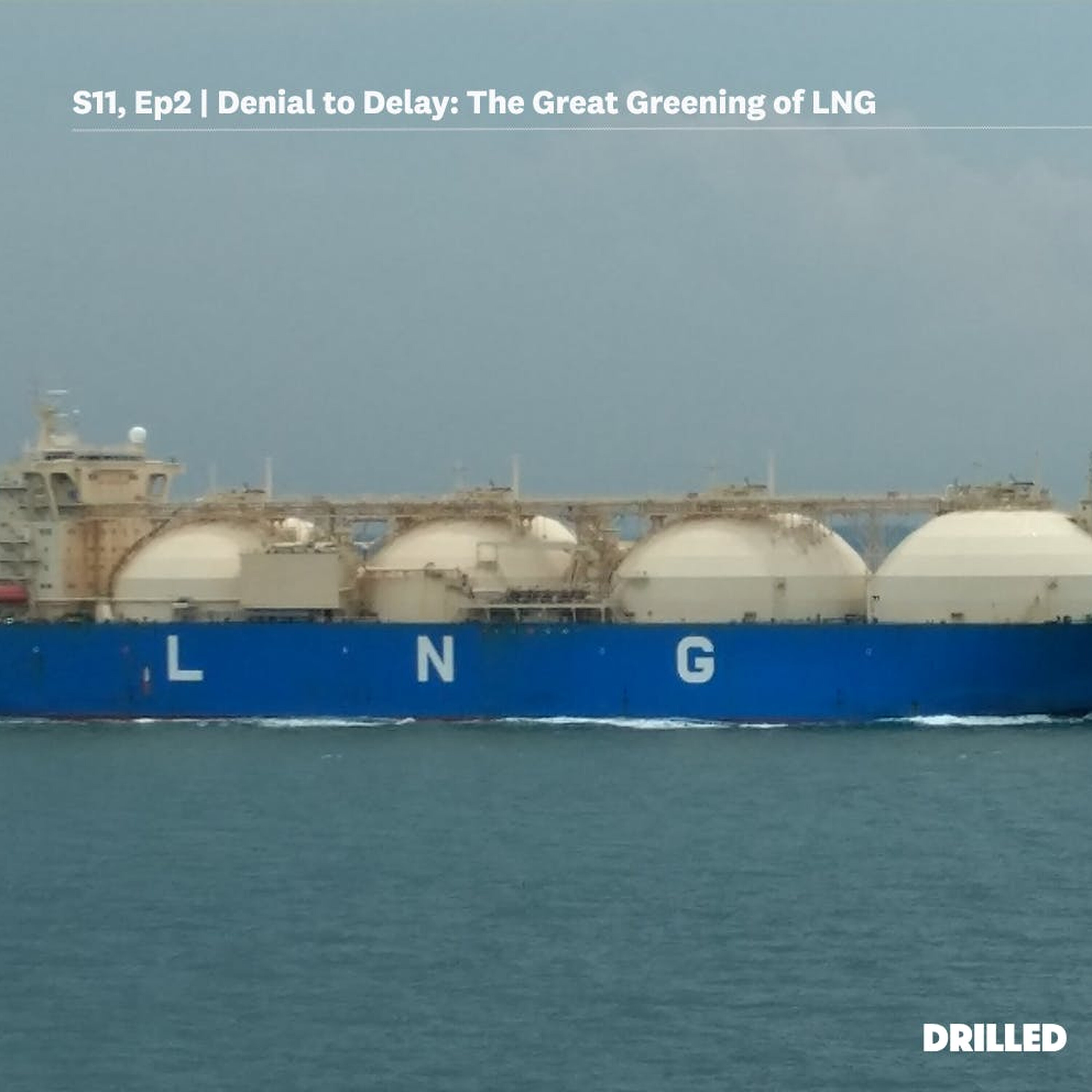
Liquefied natural gas (LNG) is increasingly marketed as a “green” or “clean” energy solution, but the reality tells a different story. As part of our ongoing series looking into new climate problems the fossil fuel industry is peddling as solutions, we uncover the role of a particularly active lobbying group pushing LNG as a climate solution.
See omnystudio.com/listener for privacy information.
Transkriptvom Podcast bereitgestellt · Zeitmarken springen hin
Hello, and welcome back to Drilled.
I'm Amy Westervelt.
We're currently running a series on false solutions, these kind of almost new climate problems that the fossil fuel industry is pawning off as climate solutions in some way. Last week we talked about the role that management consultancies play in formulating and pushing and amplifying and lending credibility to those quote unquote solutions. Today, I have Andy Rowl joining me to talk about a story that he and I worked on about a front group of North American natural gas producers who've been involved in creating the idea that liquefied natural gas a fossil fuel, is a green energy solution.
Pushing that idea has been really important to getting export terminals built in the US, but also to lobbying European politicians to build out more import infrastructure there. When we first started looking into this, there was a name that popped out at me because we had been doing some reporting in Pennsylvania on gas a few years back, and there was one person that several people talk to us.
About low drilling recommenced on December ninth, twenty thirteen. The next day, my dad called Toby Rice, and Toby said, he get him a hotel room. So they go go to the hotel room to check in.
No hotel room for us.
It's just they do what they want to do when they want to do it. Holly want to go, and Toby's making big money.
And Toby Rice himself is said to more than one person, we'll just move. The first year is the worst. We'll put you up on hotel for a year.
It was in a springtime. Toby Rice flies over here in this hellfter you don't have no tail numbers.
I'm not going to be a door mat.
And never again, especially for Toby Rice, I hope you sleep well.
Toby.
Toby Rice is the CEO of a company called EQT. They were an early fracking company. They're now one of the largest liquefied natural gas producers in North America. They also recently purchased the controversial Mountain Valley pipeline project, so they are in charge of that now as well. And Toby Rice kind of positions himself as like this young, upstart every man who just happens to be an oil CEO.
He's really into the idea that like he's a millennial he's an elder millennial. He calls himself a shaellennial, and he's kind of always looking for the thing that's going to finally make gas a lucrative, sustainable business because, don't forget the fracking guys, Guys like Toby Rice have been on a permanent boom and bus cycle for twenty plus years.
They have never found something that's really made the industry work for extended periods of time, and they're kind of hoping this LNG boom is going to be it. Rice and EQT have been leading forces behind this front group that we're going to talk about in this episode and lots of other initiatives to lobby both the US government and European governments to embrace liquefied natural gas as a climate solution. He's also been a big driver behind the idea of what the industry calls certified gas or differentiated gas.
This idea that you can reduce the methane emissions and CO two emissions associated with gas that's produced in the US and then use that to market it as sort of a more environmentally friendly option. The problem with that, of course, is the monitoring and auditing of these improvements, which has left a lot to be desired. We're going to get into all of that and more with journalist Andy Rowell. Coming up after this quick break.
Marvel Television's wonder Man, an eight episode series I'm now streaming on Disney Plus.
A superhero remake not exactly what we'd expect from an ascowinning director Simon Williams audition for one.
Of Man, I'm gonna need you to sign this, assuming you don't have superpowers.
I'll never work again if anyone foun my lips are sealed.
Marvel Television's wonder Man all eight episodes now streaming only on Disney Plus.
My name is Andy Roll.
I'm a journalist and writer and I'm a contributing editor at oil Change International. So yeah, and I've been working and on the fossil fuel industry and oil and climates since the early nineties, so for quite a long time.
Now, awesome, what made you first start tuning into Page? What were you? What Google or did you have set up that tipped you off to Page? Initially?
It's suddenly, I mean, you know, we're looking we've been looking at or oil Change have been looking at a sort of gas certification and the sort of greenwashing of the US L and G and gas industry. And then suddenly, I mean, and of course, like you know, Toby Rice and EQT they're the you know, they're the largest producer of natural gas in the in the US. I think if you if you made EQT a country, there'd be the twelfth largest gas producing nation.
So they're a big player. And and suddenly, you know.
We are sort of looking a bit at Toby Rice and what he's up to, because he's he's very vocal on this issue. And then sort of looked and think, hang on a minute, there's there's a new there's a new sort of organization that's pops up out of nowhere and called PAGE, the Partnership to Address Global Emissions, and so so started sort of trying to track what they were saying, what they were doing, and and sort of you know, the more the more we looked, the you know, the more concerned you've got. And it's i mean, it's pretty obvious. And Page is I mean for anyone who's sort of looked at sort of you know, the oil industry as you well know, like and it's front groups, and it's messaging and it's greenwashing. Page immediately was like
there was red flag after red flag after red flag.
Yeah, they kind of have all the all of the markers, starting with the like name that sounds vaguely climate friendly, you know. Yeah, it seems to me like they are, like Page is, predominantly they're to focus on l G exports from the US, like that's their their key focus versus some of the other front groups that EQT is involved with. It's solely focused on permitting reform or things like that. This really seems to be expert and particularly also lobbying the countries that US producers would be exporting to, so not just the US politicians. Is that we think that's like an accurate assessment.
I think that's totally accurate.
I mean, it's obvious that they've been targeting Europe, and you know they've they've been Rice has been over here, and so has Christrina who works with him, and also recently we've we've been aware that you know, they've they've also been targeting Asia. So I mean it is obvious if you're if you're targeting, if you're working on energ then Europe and Asia to the two key markets you're going to target, so very much which looks like Page is basically a front group or whatever you want to call it for the for EQT and the lerg industry to to try and lobby to get exports to greenwash gas, to tie Europe and potentially Asia into long term contracts, you know, for decades to come, even though the science
and is saying that, you know, we shouldn't, we can't be you know, carrying on extracting more fossil fuels, you know, if he want a Liverpool climate.
I find Toby Race very interesting because we did some reporting like a year or two ago on Pennsylvania and talked to a bunch of people in one of the areas that EQT has really dominated there, and they had all these wild stories about him, like showing up at town halls, and he kind of is has styled himself as this like every man, you know, like like he's just a rough knack who's made it kind of you know, and like the image of him meeting with like high level European officials is like somewhat amusing to me because this persona that he has like doesn't doesn't really seem at ease in like that kind of setting. Yeah, but it's yeah, I don't know, I don't know what you think about him as like a character.
Yeah, he looks or he comes always he's trying to portray an image here that he's the kind of guy you could go and have a couple of beers with and watch baseball with, and he just happens to be one of the well the largest you know, producer of natural gas in the Europe.
YEA good.
Yeah, So, I mean it's interesting you're saying Pennsylvania and looking into what EQT there. I mean, there was a recent investigation by public source. I don't know if you saw it came out and again, you know, it just blows away to the green washer or another layer of the green washing of of page saying that you know, this this stuff is you know, the greenest whatever he's calling it, the greenest natural gas or zero carbon. He can export zero carbon, you know, green gas to Europe.
And actually the reality for folks on the ground, you know, these could be the guys having a beer with him, is that like they can't even open their taps without methin coming out, or you know, you know their water is polluted with arsenic or barrier. You know, so the serious problems, you know, with fracking on the ground as well as you know, I wish we often sort of forget about if we're talking about sort of the climatic impact of this industry.
Yeah, we're gonna we're going to get into that a little bit in this podcast episode and share of that tape because we never ended up making that season, but I have a mountain of tape from people in Pennsylvania and a number of people. He was the only person that I heard multiple different people kind of mentioned. And one of the things that we heard repeated over and over again really was that, you know, he would sort of show up and because he seems to really want the local people to like him, you know, he wants to be accepted.
By by the local community, and so he would show up and he would be like, if you have any problems, you know, because people were complaining not only of the water being contaminated, but the realities of a shale drilling operation happening, you know, right next to your house are pretty bleak.
It's like it's like an ongoing earthquake. There's really bright lights all the time, and so people were like, I can't sleep, you know, my pets are being disturbed all this stuff, and he would offer to put people up in hotels and then they would show up at the hotel and there would be no reservation and they couldn't get a hold of them. This was like it was sort of like a just a recurrent theme in the people that we talked to, which I just I find it interesting when people are doing sort of small things like that that feel very attached to the larger things that they're trying to do.
Yeah, I mean it's interesting in the sense because you know, if you if you look at I mean quite often when you look at some of the big players or let's say the traditional companies that we that we think of when when we're investigating all and gas, like the Exons, the Shells, the BPS, the Chevrons, you know, you wouldn't expect like the CEO of like Mike Worth from Xon to sort of rock out of a town hall meeting to sort of try and justify as operations. So in that way, like Rice is, it's different. And you know, as his persona is trying to as we've just talked about, he's trying to be like this kind of man of the people, accessible, gut accessible and all that, but actually the trouble is the reality just doesn't stack up, you know,
for what he's saying.
Yeah, he might have good intentions, but it doesn't end up panning out. You mentioned Exon and Chevron, and I wanted to ask you about them because I find it. I also find it really interesting how you're seeing and you kind of have always seen this in the gas industry in the US at least, this divide between the sort of like rough and ready shale guys and the oil majors. And it's interesting that you see it in these lobbying groups as well, Like there's you know, you almost never see like an Exon and a Chevron in the same lobbying group as EQT or whatever. And in you know, we got some kind of late breaking documents from the folks at Trends of the Earth who had sued the State Department to get hold of Amos hawks
Teen's calendar, who is an energy advisor to Biden, a longtime gas guy, and he had all these meetings with with Toby Rice at EQT, the focus of which was, you know, to push the idea of like you know, certified low carbon gas or differentiated gas. This whole boondoggle that you've been looking into. And he says in like the lobbyist who's setting up the appointment for him says in a few different emails, like you know, basically like we're like differentiating ourselves in the industry and you know, I'm sure it's not going to go over well, but we need to do it, and all of this stuff, you know, like they're going to outpace x On and Chevron by doing more environmentally friendly gas and they're going
to spur everybody else in the end street On and all that kind of stuff. But I'm curious what you think about just how the oil majors and these guys operate kind of separate from each other in parallel streams.
I think that's a really interesting point.
Traditionally, sort of if you go back to some of the sort of sort of front groups that the oil industry was involved in, like the GCC or there they called the Climate Council as well in the in the nineties. You know, those were the oil majors. You wouldn't have had, you know, any of these kind of like fracking players in any of those organizations. I mean, they'll all sit under the umbrella of say the American Petroleum Institute, which is, you know, a broad church of the you know, the biggest lobbying group often in the US, pushing sort of the oil industry's interests, but in this specific you know instance, Yeah, often you see the sort of the small I mean EQC is like.
Hard to think of them as like the little guy, but yeah.
You know, like they're like the shock and in the small pond on't they you know, like you know, they're increasingly you know, they are the largest gas producer in the US, so I mean, they're a big player now, but they're still probably not in the same room often is it an excell on as a shell or as a BP right right.
Yeah.
It's interesting too because there was this moment around the pandemic where you can kind of see how groups like API, for example, at a certain point might be lobbying like in the interests of a Chevron and EXON and against the interests of like an EQT or a pioneer. There was a moment where within the EPI, Chevron and EXON were lobbying like against getting more federal bailout money for the shale drillers, and it was it was pretty clear that it was like their goal was to just snap up some of those guys, which they did.
You know, which is what you do? Which is the which is the playbook is you know? You know, yeah, and if you've got as much cash sitting in the bank as is excellent and then you know, when a minot gets too big and it's strategic, you do you just swallow it up?
Yeah, yeah, exactly. And you're seeing that, I mean with the Pioneer acquisition, Chevron's attempt to get hess there's like and you see too that in a lot of the chatter around the oil majors is kind of focused on, like we need to sort of buy up more resources to continue posting growth numbers and all that kind of thing.
It's like at a certain point they're running out of new reserves to tap and they have to just buy up the ones that exist already.
And doubling down on all the gas.
Yeah exactly, exactly.
Yeah.
I want to have you talk a little bit about the certified gas stuff and just how how little they're there there is you know, what is what are people actually measuring when they're claiming to have sort of environmentally preferable gas.
I try to take one step back. I think what you're seeing in with certified gas is in late twenty twenty, the French government, which is you know, they've got a I think it's a thirty three percent interest in NGI and ENNGI was just about to do a twenty year seven billion LNG project for it with Rio Grande by next decade, and the French government basically pulled the plug and they said, actually, we think we don't want you to import US gas because it's too dirty, it's got too much of a methane problem. Interesting and this sense shockwaves, huge shockwaves through the US gas industry. And so since then there's been this systematic campaign to greenwash US gas as green and the certification is part of that. So
what they're saying is like you can have this is what they're claiming, is like you can basically have green gas. You can have net zero gas or carbon neutral gas. And the way they're going to do it is they're going to certify, like put monitors on across you know, the upstream and midstream industry and check for leaks in real time and then you know, stop stop the leakage of methane. And if you can stot. You know, their argument is if you can stop the leakage of methane, and methane is of course a much more potent you know, greenhouse gases, it's whatever, it's like, eighty times more potent than carbon dioxide. And if you can plug the methane leaks and then you can offset the carbon emissions at
the end, then you could supposedly.
Have you know, zero carbon.
And you had a sort of a number of companies of which say Project Canary is one that basically sort of sprung up seeing a market opportunity and said, hey, we're independent and we will verify this gas as responsibly sourced or differentiated. There's a number of different words that are used, and so oil Change and Earthworks, you know, began looking again at what was going on. Earthworks went out in the field and they stuck their cameras in front of quite a few sites and basically showed the you know, the complete discrepancy between the rhetoric of what a company like Project Canary was saying and EQT and all these others are saying that, hey, this is great, we've got certified gas and the reality, you know, and
the report that one came out last year and another one's just come out this month. Last year's report showed over seven months, basically they failed to capture every significant pollution event and most of the time there were problems with the monitors. Often the monitors are placed outside you know, buffer walls or you know, in places where they you know, upstream where the wind is going downstream, so they you know, they know that the pollution will never be be caught.
Wow.
And then this year's report basically again basically showing regularly of missing pollution events. Project can Aries monitors, which supposedly continuously monitor for pollution events and methane leakage, were offline for twenty five percent of the time, so accord of the time they're offline, and even if there's a problem, companies are really taking action. So so there's there's serious, serious questions to answer about the sort of the claims the industry and you know, companies like Project can area making as to certified gas and how robust it is and how you know it is actually really reducing methane emissions.
Mm hmmm.
Didn't Project Canary do like a lot of pilot studies with EQT to like develop their whole thing too.
They were doing pilot studies with EQT and others. Yes, and the sort of what we were hearing on the street is a lot of their sort of pilot projects never sort of moved into sort of full blown fruition with the number of customers.
That's interesting because I know in those emails where they were requesting meetings with US officials, one of the things that they were using was this claim that Equt's gas is like has one tenth the methane of other US producers, which I was like, where's that stat coming from? Interesting?
Yeah, exactly.
And you know, if your monitor's not picking up your pollution and it's there's not enough monitors and they're all in the wrong place and you know they're not they're offline, all these kind of things, you know, it just shows there's a stack of problems. And I you know, I think there were there were other sorts of significant issues.
I mean, for example, like Chris Roma, who was you know then the sort of seer of Project Canary. He was talking about certifying gas is a way of fixing the gas into's brand problem. They would be claiming to be independent but actually saying, hey, guys, through certifying gas, we will fix your image and allow you to sell you know, so called you know, responsibly so gas to the Europeans, to the Asians and those who are worried about climate change. And that's where it gets really sort of dangerous, say from a European perspective, because you've got the Europeans now saying actually, you know, we we need or you know, talking to people like Toby Rice about importing leg and if there is a veneer of green
over that gas through certification, it allows them to go to the European consumers and say, actually it's okay, we can have European climate goals via you know, American LLERG because American energy is great. But again that is completely and utterly disingenuous because there are fundamental flaws with LLERG and also the certification process.
Yeah, that's really interesting because one of I know that one of the one of the things that all of the gas producers have been trying to do is increase the length of time that these contracts with Europe will last. And the European Union did put in place contract limits, but they also added this little, you know, amazing caveat for the industry, which around you know, the word unabated, which they put in you know, contracts for unabated gas cannot last beyond twenty forty nine. So I wonder if if that has also driven some you know, increased interest in certification and you know, just generally trying to make it seem like producers are quote unquote abating those emissions in some way.
Yeah, I mean, I think about or the industry claims about forty percent of US gas is now certified, so you know, that's been a significant change over the last two years and massive increase. And you know, there is no doubt about it that the industry sees certification as a sort of key tenant of getting long term energy contracts with European buyers. And if you go back to what happens in late twenty twenty and the fact that the French government got energy to pull out because of it concerns about how dirty energy was, you know, it shows that this is you know, the industry strategy to get around or to overcome those concerns and convince the Europeans that they can have their cake and eat it, which is they supposedly have got quite you know, bold
climate goals, but then they can still have massive imports of energy for the next well over twenty years. But again that is completely flawed from a sort of scientific perspective, and where you know, we know that the methane is still leaking in the US, We know that when you're burning gas, you're still a missing carbon. And and also that's the un and all the climate scientists are saying, well, you know, if we want a Liverpool, you know future, if you want to try and keep anywhere near one point five or even two degree warming, then we just cannot carry on, you know, looking and exploring for more or a gas And yeah, you know the other the other thing that's sort of really interesting from a sort
of public relations perspective, from the sort of you know, the Toby rices and others, is that, you know, gas used to be seen as a transition fuel. You know, they were saying, okay, well we need gas to be a transition fuel, you know, to renewables, and that all gives us time to develop renewables. But now the sort of messaging from Rice and others is actually, gas is integral to the transition because you know, if you clean up your metho in emissions and then you offsets the carbon emissions, you can have zero carbon kind of gas, and which is a misnomer.
Yeah.
There was even in the most recent kind of dumbo documents from the US government's investigation and to climate disinformation, there was this strategy document that was done for BP I think it was from Brunswick where they talked about the need to shift from the idea of gas as a bridge to gas as the destination. Yeah, which of course we all knew, but like they explicitly stated it.
Yeah, exactly, So there you go. It's on the nail. You know, it's in black and white. And of course it would be a PR company, you know, it's coming up with a strategy. You know, and I'm sure both of us could talk long and hard about, you know, the role of the PR companies in the climate crisis. But yes, there has been a significant shift in the public relations strategy of the oil and gas industry to sort of move the dial from gas, you know, as a bridge fuel is to actually say no, gas can be here to stay. It's integral to the transition, you know, as long as we've got certification and we've got offsetting. Yeah, a transition away from fossil fuels has now in their minds become a transition. You know, fossil fuels are integral
to it.
You know. It's mad.
Yeah, yeah, it's interesting too because I will often hear people kind of being like, oh, well, like it's too much of a leap to go from you know, coal and oil to renewables or whatever, like you need to have some kind of a transition in the middle and this, that and the other, right, But like they never talk about the transition from coal to gas as being too much a leap. It's like, but we're doing an energy transition.
It's just not not the right one. One of the things speaking of coal that EQUT says a lot and page as well, and it kind of seems to be integral to their mass on emissions. Is this idea that L and G that you know, US LERG is always replacing coal. I'm curious if you've seen that from other producers as well, Like this this this idea that like, well, if it's replacing coal, then it's definitely going to be better and it's always replacing coal, So that's great, We're good.
I mean, I think two things.
One is I mean, let's not forget that, you know, some studies have shown that you know, LNG is actually worse for the climate than coal. So so when Toby Rice says we're replacing coal as is just suggest that this is a beneficial there's actually you know that that statement needs to be unpicked and verifies, and I think a number of climate scientists would would counter him on that.
To me, Page seems to really doubled down on that, you know, messaging as hey, you know we're going to unleash LNG and it's you know it works as a coal replacement. But actually again in reality, it's never it's never like that, you know, what they're doing at the moment, or you know, they've in response to say Russia's invasion of Ukraine again they've been you know right, and others have been going to Brussels and Berlin to say it again as we've just been talking about, you know, let's lock Europe into LNG from the US, and so that's you know, it's not they're not replacing coal. They're basically trying to you know, make a new market for US L and G.
Right, it's more often just replacing other gas than coal. And yeah, yeah, to your point, we don't even know that it's a net good to replace cools gas either.
So yeah, but what it is doing, as you said before, is you're they're trying to lock Europe and other consumers into these long term contracts which never existed before. So in that sense, it's even worse for the climate.
Can I have you talk about that a little bit, like the fact that they never existed before. How how unusual is it for for companies to get the kinds of like twenty thirty even more you know year contracts that these guys are turning to lock in.
Well, my understanding is like European and potentially sort of maybe even Russian contracts, we're done on a much shorter timescale. But you know, the US LNG industry is basically it's had to it's having to build the infrastructure, a lot of the infrastructure to do the exports. So the only way they can make that sort of financially viable in the long term is is to lock their consumers into long term contracts. So the US industry has been really pushing and trying to sort of get you know, decades long contracts where Europe wasn't sort of used to having to do that before, and now because of say the Ukraine, you know, Russian's invasion and the Ukraine War, they've they've been at their sort of most energy vulnerable, you know,
and into that sort of into that space, companies like EQT, you know, people like Toby Rice have just sort of jumped and said, hey, you know, we've got your solution, but you know the problem with that is we want a long term contract.
Yeah. I mean, that's it's so interesting because I do feel like, you know, the US, especially the you know, the eqts of you know, Chesapeake and Chenier and all these like small they're not small anymore, but like the upstart racking guys. It's so it seems to me like so much of the desire for long term contracts is not just you know, of course everybody wants to lock in, you know, a high volume long term contract, but those guys in particular have had really like an endless boom and buff cycle their entire existence. It's like, you know, they have not been able to figure out a stable business model, and you I don't know, I feel like I always just kind of get that vibe from Toby Rice, like whenever I see him on a news show or whatever.
It's like it's just sort of like like a magpie going from shiny thing to shiny thing looking for like what's gonna what's going to deliver the kind of profitability they're looking for, Like I just you know, it's like it's zeru Bo's Asia, it's Ai. You know.
Yeah, you've got to keep you know, you've got to produce another cut out of your pas to justify you know, carrying on drilling, carrying on energy expansion, carrying on building the infrastructure, you know, when at the same time, the reality on the ground is impacted communities who can't drink their water, you know, with all the sort of health impacts, the climate impacts that you know, the UN and all climate scientists basically saying we cannot carry on drilling for more, and you know, the LERG industry saying, oh, yes we can, and this is how we're going to do it.
And we're also now hearing from Europe like we just don't need that much. Like there you know, there are all of these reports coming out that the import build out has already outpaced the actual need for ler G in Europe. So you know that's concerning too, because like what happens with the gaslet historically more plastic and petrocogals, you know.
Oh yeah, yeah, No, I mean that's a really fundamental it's a really fundamental point that you know, is actually I think I think US lergy exports to the EU have tripled in the you know, between twenty twenty one to twenty twenty three, but actually, you know, demand is decreasing.
Yeah, and like significantly too. We're talking, you know, I think it was a twenty two percent decrease from from twenty twenty two to twenty twenty three. That's that's really significant. And it's not just being replaced by renewables. It's also coming from efficiency, which is great because you know, I think there was just this report this past week where you see what happens when like you shift energy sources but don't reduce energy use, especially in the current context, it doesn't do much to emissions, but they're doing both, you know. So yeah, it's very concerned.
Yeah, and Europe, whether it already has I mean, I think you probably could make an argument that already has you know, got itself into a pickle because if those trends continue, where you've got massive increase of US energy and you've got you know, decreasing demand and you've just locked yourself into decades long contracts. Something isn't going to make sense very quickly. You're going to end up, you know, contractually important gas where you have no demand exactly.
And then the I've even seen some of the US producers kind of push this idea of like, you know, don't worry because then you can just sell it on to Asia. But you know that's really not that's not it's not a great fixed and they're the US. The US producers are also increasing their direct sales to Asia, so it's just sort of passing.
And from a climate perspective, it makes no sense to be you know, shipping energy to Europe to a and you know, don't forget European Union. They've got you know, quite robust climate goals and again again there's a discrepancy there between sort of the reality of how dirty Ellen g is and you know what those goals are.
Yeah, that's it for this week. Thanks for listening.
Keep an eye out for that LNG episode coming soon, as well as episodes on lots of other faulty problems masquerading as solutions from the fossil fuel industry.
Thanks for listening, and we'll see you next time.
