

In These Times with Rabbi Ammi Hirsch· Staffel 1· Folge 77
Re-CHARGING Reform Judaism: Clarity, Courage, and Moral Leadership
· 39 min
Kapitelklicken springt direkt hin
Shownotes
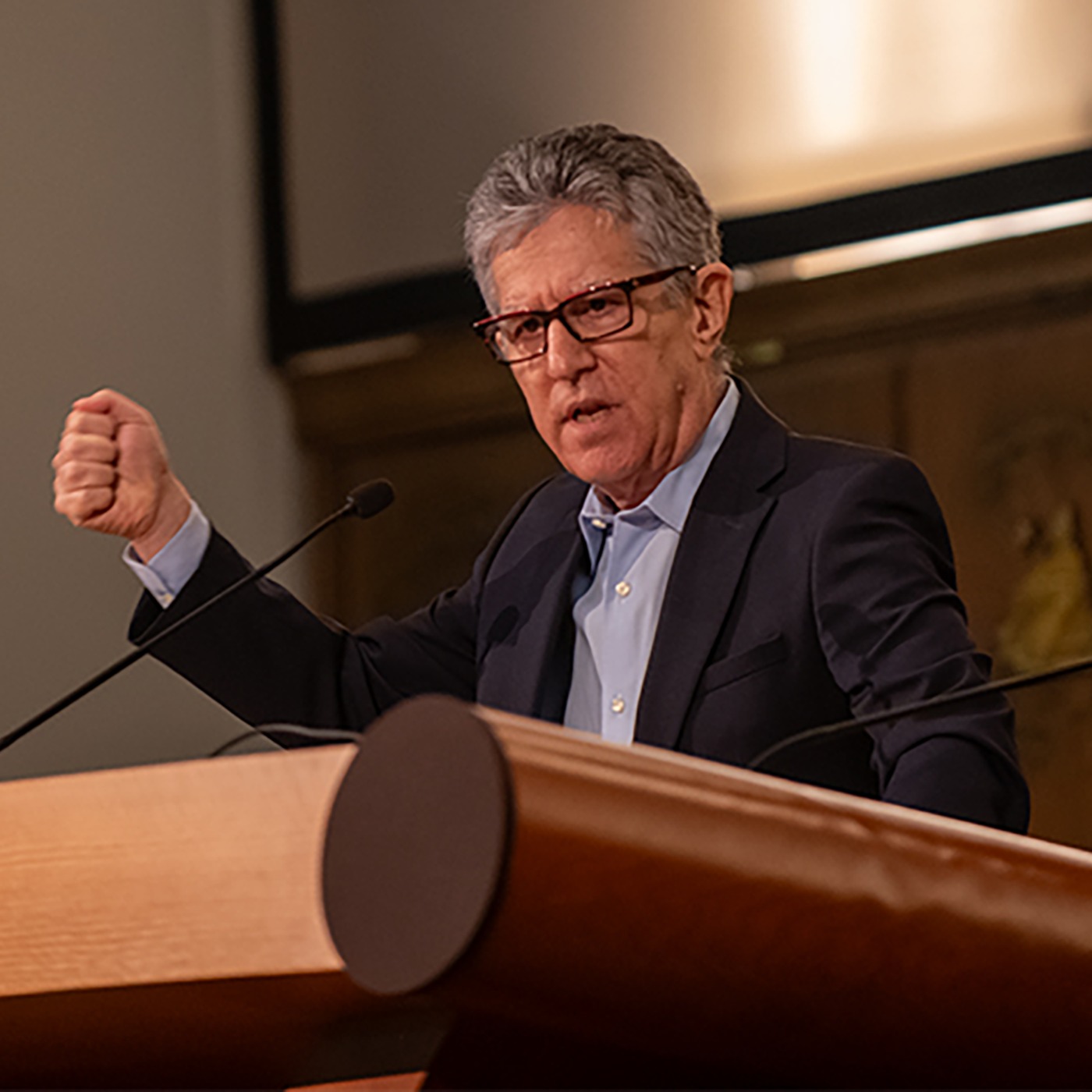
<p>In this special episode, Rabbi Ammi Hirsch delivers his keynote address from the third Re-CHARGING Reform Judaism conference, a gathering of more than 350 Reform rabbis and Jewish leaders at Stephen Wise Free Synagogue. Addressing what he sees as a crisis of Jewish peoplehood, Zionism and moral confidence within liberal Jewish life, Hirsch argues that the future of Reform Judaism depends on renewed commitment to the Jewish people, Israel, and the values that have long defined the movement.</p>
Transkriptvom Podcast bereitgestellt · Zeitmarken springen hin
I'm Rabbi Ammi Hirsch of the Stephen Wise Free Synagogue in New York and you're listening to IN THESE TIMES. On May 27th and 28th, we welcomed more than 350 rabbis, cantors, educators, synagogue presidents and board members, and other activists from across the Reform movement and around the world to our synagogue — the Stephen Wise Free Synagogue.
Over two days, we addressed the urgent challenges facing liberal American Jewry and continued some of the most important conversations happening in our movement today. So today I want to do something a little bit different. Instead of an expert guest, you'll be hearing more of me — my keynote from the third Re-CHARGING Reform Judaism conference.
Welcome to the Third Re-CHARGING Reform Judaism Conference! Welcome to New York City! Welcome to the Stephen Wise Free Synagogue! It is our honor to host you. Thank you for taking the time to spend these two days together, especially those of you from out-of-town. You may have followed the news that much has changed in New York since we last convened two years ago, not all of it for the better.
Nonetheless, there are still some interesting and fun things to do in the city, and it is a joy to see each other again, and spend time together. A special thanks to my friend and partner, Mark Anshan, who, for decades, has participated in, and led, many North American and international bodies of the Reform movement.
He is a talented lay leader, committed to the success and wellbeing of our movement, and is an intensely hard worker, more than justifying the enormous salary we pay him! I also want to express our collective gratitude to our philanthropic partners, individuals and foundations, many of whom are with us today, who support us, push us, press us and encourage us to succeed.
They are my kind of Jews! Whether they consider themselves Reform or not — they all recognize the immense challenges we face. They all understand that we are at an inflection point in Jewish history. They model for us what commitment to Jewish peoplehood means: the recognition that urgent times require setting aside whatever controversies we can for another day, and joining forces to confront the much greater challenges that threaten us all. We have come a long way in three years!
From the initial effort to convene several dozen Reform activists who were increasingly worried about the direction of the Reform movement, we have since built a nation-wide network of many hundreds of Reform rabbis, cantors, educators, other Jewish professionals, and lay leaders. Our accomplishments in the past three years are, themselves, testament to what we have always emphasized: Open your eyes.
There is a growing crisis within the Reform movement, and we must respond with vision and vigor.” Many more of us have now taken up that mantle. The most important and long-lasting achievement of any leadership generation in any vocation is to raise disciples; to inspire the next generation. At this Re-CHARGING Conference, you will meet many of our future professional and lay leaders. What an amazing group of people.
We are in very good hands if we can figure out how to produce, and empower, more of them. The Reform Rabbinic Fellowship is currently in its third cohort. By now, 59 early-career Reform rabbis have spent an intensive year with us. Some of them are here today; make sure to speak with, and get to know, these terrific rabbis.
We have had outstanding success in reinvigorating Birthright Israel in the Reform movement, leading hundreds of Reform Jews to Israel in the past few years, even during days of war. RAFI — the Reform Movement Alumnae for Israel — our effort to engage young adults — has expanded into eleven cities, reaching over 650 Reform alumnae.
We are collaborating with the Tell Institute on developing a new curriculum for Jewish youth and adults, and will hear from Dr. Dara Horn and SWFS member, Jessica Levin, about new approaches to Jewish education in this era of pervasive hostility towards Jews and the Jewish state. Our ideas and opinions, expressed through podcasts and conventional and social media, have gained widespread traction.
We meet all the time with visiting Israeli delegations of mayors and other politicians, journalists, influencers, IDF commanders and educators. As you saw a few minutes ago, Israeli leadership at the highest levels of government wants to help us. President Herzog telephoned me several weeks ago just to say that the State of Israel follows the work of Re-CHARGING Reform Judaism and Amplify Israel, and he asked how he, personally, can help.
We have had numerous productive meetings with the Ministry of Diaspora Affairs, which is eager to support us. I want to take a moment to recognize the brilliant architect of all these efforts, Rabbi Tracy Kaplowitz. My life changed — and so did yours — when she joined our team. From the outset, we emphasized that we are of the Reform movement, by the Reform movement, and for the Reform movement.
Most of us grew up in the movement, and we feel deep affection and loyalty to the institutions that educated and trained us, providing us the opportunity to devote ourselves fully to this marvelous vocation that has given immense meaning to our lives. It is love for Reform Judaism that generates our disappointment, pain and concern over what seems to many of us a loss of will to define and defend the values we uphold, at a time that urgently calls for moral clarity and institutional vigor.
Among the most important initiatives of this Conference is the introduction of four resolutions. We will debate them today, and vote tomorrow. These resolutions put our convictions on the record, and state our expectations that the national institutions of our movement recognize, reflect, represent and implement the principles stated therein — all well-established ideological pillars anchoring Reform Judaism for decades.
I want to thank the dozens of leaders who worked on the four resolutions addressing the centrality of Jewish peoplehood; the reinvigoration of spirituality, prayer and Jewish practice; innovative models of communal leadership; and the cultivation of Jewish learning and literacy. For the remainder of my time, I will devote myself principally to the resolution to strengthen Jewish peoplehood in the North American Reform movement.
The 21st century will increasingly be defined by ideological commitment and communal loyalty to the centrality of Jewish peoplehood. In the words of the proposed resolution: “Judaism finds its fullest and most authentic expression through a vibrant and lived commitment to Jewish peoplehood.” While different approaches to halakha will continue to constitute a natural ideological divide between the Orthodox world and the rest of us who comprise the vast majority of the North American Jewish community - in reality, even these distinctions are diminishing and will continue to do so, due to the growing threats and challenges we face.
For example, I can tell you that in the leadup to the New York City mayoral elections, those of us from Orthodox to Reform who defended Israel in the face of an onslaught of obnoxious opprobrium, found much more common ground — worked much more closely with each other — and felt much greater affinity one with the other — than with those in our own movements who promoted the anti-Zionist mayor of New York City.
And what we often forget but ignore at our peril, is while our movement is a religious body, committed to God and Torah, much of the Jewish world expresses their Jewish identity in secular form through a fierce commitment to the Jewish people and the State of Israel, the most eloquent expression of Jewish peoplehood in our times.
Many of these Jews are members of our synagogues. The religious teachings of Judaism do not exhaust the full content of Jewish civilization. It is the Jewish people that keeps Jewish civilization alive. If there are no Jews there is no Torah. The Jews do not derive their authority from rabbis. It is the opposite rabbis derive our authority from the Jews.
We are under such immense ideological, political and communal pressure from both outside and within the Jewish community, that, in the words of the proposed resolution, there is an “urgency for clarity, courage and moral leadership regarding Reform Judaism’s enduring commitment to Zionism and Jewish peoplehood.”
We cannot give in to those who would take us back to the days when our movement stripped all vestiges of Jewish peoplehood from Reform Judaism. We cannot succumb to those who preach a false philosophy of Jewish universalism that camouflages disdain for Jewish particularism under the guise of a sometimes sweeping, self-righteous, sanctimonious and suffocating misunderstanding of tikkun olam.
Judaism is a blend of universalism and particularism eescha le’goy gadol — I will make of you a great nation — ve’nivrechu vecha kol mishpechot ha’a’dama — and all the families of the earth shall bless themselves through you. Judaism’s distinctive genius is in the balance — a kind of particular universalism, unique in religious thought.
It is both the clarion call of Amos — “let justice roll down like water and righteousness like a mighty stream — and the clarion call of Amos I will restore My people, Israel. They shall rebuild ruined cities and inhabit them… and I shall plant them on their own soil, nevermore to be uprooted from the land I have given them.”
Have you been following developments at the Brooklyn Park Slope Food Cooperative? This is a years-long effort on the part of liberal New Yorkers to help the needy and food insecure. It has been heavily supported and led by Jews — including our own Reform rabbinic colleagues. Yesterday — by a vote of 2:1 — the Cooperative voted to boycott Israeli food products.
What should be our response? Looking back at the past years, can we say that we did everything we could in our interactions with Progressive partners to thwart the Boycott Divestment and Sanctions movement? And isn’t defending Israel and Judaism, itself — also tikkun olam? It is true that we are seeing worrying signs of a narrowing particularism in some quarters of the Jewish world and the Jewish state.
Those elements of the Israeli government that represent a closed-minded chauvinistic particularism are an embarrassment to Israel and world Jewry. And the hooligans who violently assault Palestinians on the West Bank are a disgrace. It is Israel’s responsibility to thwart them, on pain of imprisonment, and it is our responsibility to say so.
At the same time, while we may convince ourselves that the main problem in the Jewish world is a narrowing particularism the opposite may constitute an even greater challenge in the Diaspora: An expanding universalism threatening to eclipse Judaism’s fundamental command of ahavat Yisrael — love for the Jewish people.
A universalism unmoored from particularism is not Jewish universalism. It is just universalism, of the non-Jewish kind. As Rabbi Abba Hillel Silver asserted in a classic address to the CCAR: In the case of Christianity, it was [Paul’s] insistence upon a religious creed entirely divorced from nation, [people], land or language…that finally placed the movement outside the sphere of Jewish life.”
The anti-peoplehood philosophy of 20th century Reform Judaism threatened to do the same, Silver emphasized. We should heed this warning well. Given the growing hostility to Israel, especially in our circles, liberal and progressive spaces, it is not enough for us to proclaim our Zionist bona fides every now and again, often expressed defensively, and with so many qualifications, stipulations and modifications, that our enthusiasm for Zionism is buried under an avalanche of provisos.
It is not enough to issue occasional press releases, or tweets, that we are a Zionist movement. We are the leaders. We must lead. We must be proactive. It is harder now. These are times that try our souls and test our convictions. Israel has been at war for two and half years. It is a war of self-defense, imposed upon Israel against its will, but no armed conflict, even the most justified, can be waged with complete precision.
There has been widespread death, dislocation, and suffering throughout the Middle East. This, too, is a legitimate part of the story of the past two and a half years. Every loss of innocent life is a moral tragedy. Still, the reaction to October 7, and every day since, revealed the rot inside our most cherished Western institutions, moldering and spreading for years, infecting previously-healthy organs of our body politic.
It is more than the disappointment we feel at the hypocrisy or moral failure of this or that university president — or head of school — or student union — or media personality — or religious or social justice leader, or squad of politicians. It is the entire philosophy of Western liberalism that is under assault.
Increasingly we are living a surreal reality. More Jews are massacred in one day than any other day since the Holocaust — and immediately protests erupt against Jews! Israel is accused of genocide — an ancient blood libel dressed up for modern consumption - and the genocidal forces that launched this war are forgiven or forgotten.
What these assassins did to our brothers and sisters, children, uncles and aunts, cousins, grandparents and friends in Israel, is what they would do to all of us if they only had the capability. The reason that 1200 innocent Israelis were slaughtered on that day, and not 12,000 or 120,000 — was not because of intent — but capacity.
Their intent was to murder every Jew they could get their hands on. This was a bloodletting of savage and primordial rage — as bad and as wicked as the worst of the pogroms inflicted on our people. And had we found ourselves in those southern settlements on Simchat Torah morning, our liberalism would not have saved us.
Lifelong peace activists were murdered and taken hostage. No one asked them what were their views. And therefore - we — especially we — liberals — must respond with clarity, courage and moral leadership. If not us, then who? It is harder now. These are times that try our souls and test our convictions.
Israel has been ruled for most of the past 25 years by right-wing governments supported by ultra-Orthodox parties. For young American Jews, these governments are the only ones they know. And here in America, the Democratic party that two-thirds to three-quarters of American Jews have supported since the days of FDR, is turning against us.
According to a recent NBC poll, two-thirds of Democratic voters sympathize more with Palestinians than with Israel. And according to a recent Harvard/Harris poll, nearly half of young Americans between the ages of 18-24 favor Hamas over Israel. Hamas! But precisely because it is harder now - we — especially we — liberals must respond with clarity, courage and moral leadership.
If not us, then who? We cannot, ourselves, give credence to gaslighting efforts on the part of people who are not even Jewish — sometimes supported, wittingly or not, by fellow Jews — who seek to sever Zionism from Judaism. Precisely because it is harder now to contend with anti-Israel forces, and because much of the deterioration is expanding in our circles, liberal and progressive spaces, we have an obligation to summon all of our reservoirs of clarity, courage and moral leadership.
In the words of the proposed resolution: “We call upon the Religious Action Center of Reform Judaism and all arms of Reform institutional life to ensure that their public advocacy, partnerships, and policy positions reflect and advance the movement’s enduring commitment to Zionism and Jewish peoplehood.”
And “be it further resolved, that we affirm that our movement ensures that the pursuit of justice also includes the defense of our people — and that these commitments walk hand in hand.” It is not enough to say to each other, “look, see, we are a Zionist seminary, our students spend their first year in Israel, but our commitment to liberal education requires us to ordain anti-Zionists.” Under what theory of liberal education are we required to accept outcomes we did not intend, and do not want? It is not enough to say to each other, “we are a Zionist seminary, but liberal education requires us to accept bi-nationalism as a legitimate expression of Zionist thought.”
Even the bi-nationalists would be offended by our including them on the spectrum of Zionism. It is not enough to say to each other, “we are a Zionist seminary but there is a distinction in our minds between self-determination and sovereignty” as if given the condition of the Jews there can be self-determination in the absence of sovereignty.
Under what theory of liberal education is there a requirement on our part to even accept, let alone ordain, candidates for the rabbinate and cantorate who do not believe what our movement believes? Ours is a seminary, a sacred ordination, not a university graduate degree. It is not that they do not have the right to such beliefs, or that a community of Jews that seeks to hire such communal leaders does not have that right.
This is America. Do what you want and God bless you. But why our movement? It is not what we believe. Over the course of the past three years, I have received queries regarding the authority of the Re-CHARGING Conference: On whose authority,” I am asked, “do we even convene, let alone, write papers, and now pass resolutions?”
To clarify: this gathering has no constitutional authority over any institution of the Reform movement. But we are flesh of its flesh and bone of its bone. And therefore, I would reverse the question and ask: “On whose authority does our seminary, change decades of Reform theology, as expressed in numerous platforms and resolutions that do have constitutional authority, accepting, let alone, ordaining, anti-Zionists?”
And therefore, I hope that tomorrow we approve the resolution: Be it resolved that we call upon HUC-JIR to cultivate and expect a deep, informed and lived engagement with, and commitment to, Jewish peoplehood, Zionism and the State of Israel among all those pursuing ordination and professional leadership within the Reform movement.”
And be it further resolved that “we expect that all candidates for HUC-JIR’s educational programs rabbinical, cantorial, educational and nonprofit management — will be committed to a Zionism that echoes the commitments of Reform Zionism.” These are decades-long commitments on our part. Do we still agree with them or not?
If we do, then in these perilous times we should express our beliefs with “clarity, courage and moral leadership regarding Reform Judaism’s enduring commitment to Zionism and Jewish peoplehood” — and enforce our beliefs across the board. If we do not agree, explain why you disagree, why you think we should now change our decades-long hard-won values and commitments - and let us debate and reexamine our principles.
But remember: we have already engaged in a fierce fifty-year debate about Zionism and peoplehood in the 20th century, that almost ruptured the movement and led to the establishment of a competing liberal seminary next door — the Jewish Institute of Religion. History has already established that an anti-Zionist philosophy is not only catastrophic for the Jewish people — an abysmal misreading of history - but will be emphatically rejected by the vast majority of the world’s Jews.
We must be careful not to overly-intellectualize our approach. We must feel the heart, the spirit, the pulse of our people. And besides, intellectuals are often wrong. In 2021, the American Jewish Archives published a fascinating article about the two great historians of the 20th century, Jacob Rader Marcus and Salo Baron.
Marcus was described as “the dean of American Jewish historians.” He authored more than 300 books and articles. And Salo Baron was described as “the greatest Jewish historian of the 20th century.” Both knew everything. Alas, both were wrong about Germany. Both advised German Jews to stay and wait out the Nazis.
They both thought as intellectuals.
Baron wrote “There is no reason to despair of the survival of German Jewry.”
Marcus wrote that “the Jewish genius for survival” will manifest itself in Germany.” Liberalism is still alive even in the lands of fascist and national socialist control. A new age will dawn for Central Europe where the Jew will be accepted as an equal, as a simple human being among his fellowmen.” Asked in 1981 to comment on his earlier views, Marcus responded: all that was proved wrong was one paragraph three lines.
All the rest was correct.” Okay, maybe… but even so those three lines were pretty important, wouldn’t you say? This I believe: The third Jewish state will be the last. Israel’s destruction would lead to our disappearance as well. The Jewish people cannot survive a Middle East Holocaust less than a century after the European Holocaust.
Even now, more than eighty years later, we have still not recovered our pre-War numbers. There are fewer Jews living in the world today than on September 1, 1939. Anti-Zionism is a monstrous ideology of destruction that contravenes every principle of liberalism we hold dear. Of course, we have an obligation to discuss what we mean by Zionism.
We have an interest to establish the biggest possible tent. I am a liberal pluralist, and I believe in big tents. But even liberal pluralists have boundaries. If you believe everything, you believe nothing. If the North American Reform movement, in word or in deed, by action or silence, becomes, in fact, or even in perception, an anti-Zionist, anti-particularistic movement that cares only, or mostly, about universal concerns, unanchored in, and unmoored from, the centrality of Jewish peoplehood - most American Jews will abandon us — as they would have in the 20th century had history not forced us to come to our senses.
A diaspora community that disengages from Israel, where half of the remnants of our people lives, has no future. Such a community will eventually wither away and, at best, constitute a footnote in the annals of Jewish civilization. Any seminary that either in word or deed — in principle or impression acquires the reputation of being hostile to Zionism — a seminary that ordains anti-Zionist clergy — has no future in America.
If we marginalize ourselves from the mainstream of our people, the Jewish people and the Jewish state will continue without us, and it is we who will be remembered only in books and learned articles, a testament to a good idea gone awry, a haunting psalm to what might have been. At the beginning of the Book of Exodus, before Moses was called to leadership, the Torah describes this prince of Egypt’s first encounter with Hebrew slaves: Va’yigdal Moshe — and Moses grew up va’yetze el echav — and he went out unto his brethren va’yar be’sivlotam — and he saw their suffering.
The preeminent commentator, Rashi, effectively asked: “If he went out to his brethren do we need to be told that he saw their suffering? Since he had eyes — obviously, he saw their suffering.”
Rashi responded “He directed his heart and eyes towards them so
that he would suffer along with them.” We, the leaders of the North American Reform movement, have an obligation to teach our congregants and our students — with clarity, courage and moral leadership: Direct your hearts and your eyes towards your people. Feel their spirit, their pulse, their soul. If they rejoice, rejoice with them.
And if they are suffering — suffer with them. Mourn with them. Support them. Help them. Free them. Redeem them. What you heard was just the beginning of the discussion. If you're interested in hearing more, video from the conference is posted on our website at SWFS dot ORG slash watch. And in the coming months, we hope that the resolutions we passed will begin to impact on our movement and beyond…
Until next time, this is IN THESE TIMES…
