

Kapitelklicken springt direkt hin
Shownotes
<p>Rabbi Ammi Hirsch is the guest on this special episode hosted by David Harris, past CEO of the American Jewish Committee and Jewish Broadcasting Service TV's strategic analyst. Ammi discusses the state of American Reform Judaism and the new reality liberal Jews face in the wake of October 7th.</p>
Transkriptvom Podcast bereitgestellt · Zeitmarken springen hin
I am Rabbi Ammi Hirsch of the Stephen Wise Free Synagogue in New York, and you're listening to in These Times. Last week I sat down with David Harris for an interview on Jewish broadcasting service. David is a lifelong Jewish activist who led the American Jewish Committee for more than 20 years. Very brilliantly.
He asked me about the state of reformed Judaism in America, especially in the wake of October 7th. And with permission from David and JBS, I've decided to do something a little different. This episode today, I'll be the guest on Defending Israel with David Harris broadcasting on In These Times. Hello, JBS viewers.
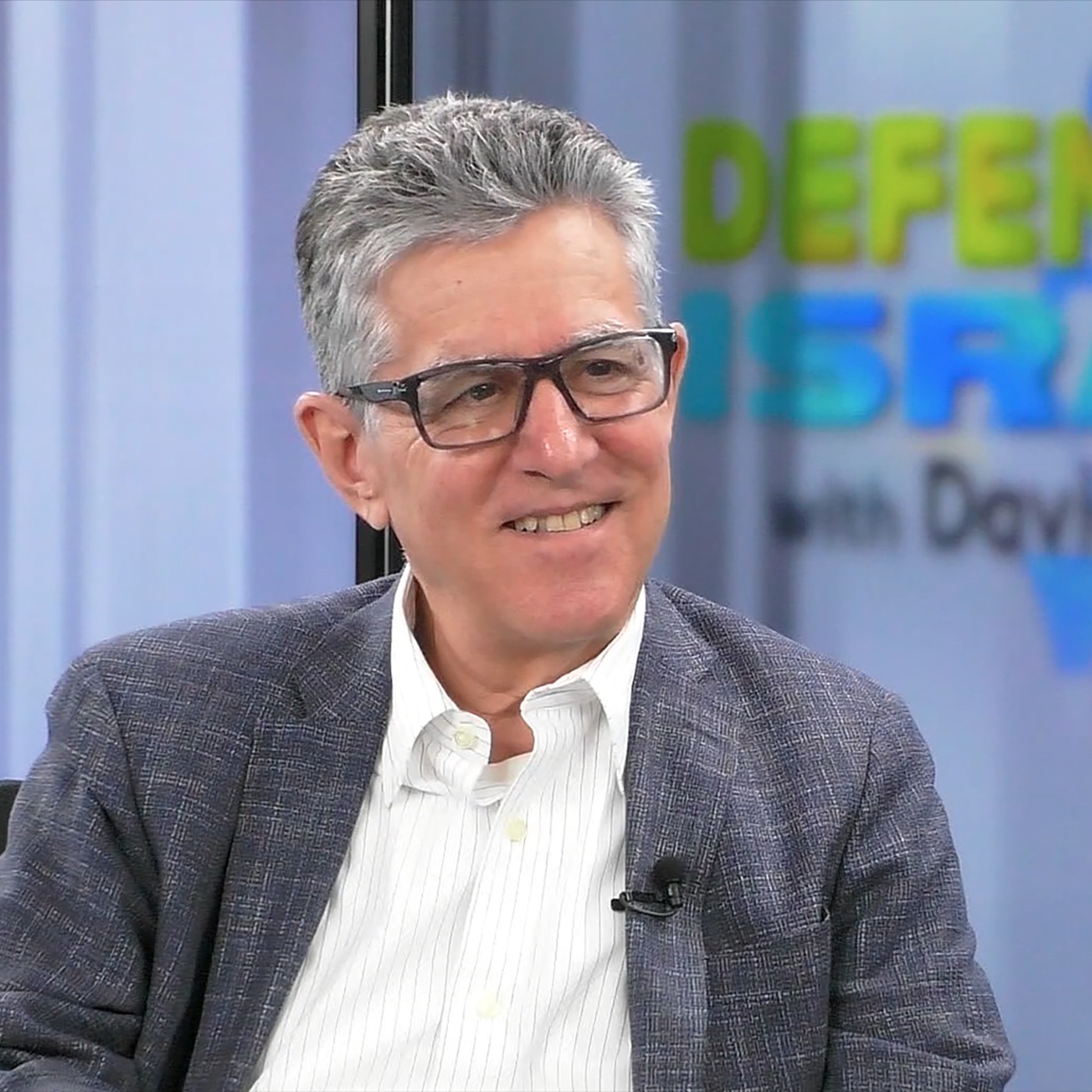
I'm David Harris and this is Defending Israel. This week I'm honored to have a very special guest, Rabbi Ammiel Hirsch or Ammi Hirsch. Many of you JBS viewers will know Ammi from his sermons, which are frequently broadcast on this channel. Ammi is a passionate Zionist, a brilliant orator, one of the leaders of moral clarity of moral leadership.
In our country, in our community, and all the more so since October the seventh, and simply for purposes of full disclosure, my wife and I were married at Stephen Wise Synagogue where Ammi is the senior rabbi, but we were married probably when he was still in grade school. Anyway, Ammi, welcome to the show.
Thank you. It's good to be here and you are looking great. I've always admired, uh, you. During your very elaborate and profound career and your post very profound career. So you're really doing a great service to the Jewish community. You've done that for decades. It's an honor for me to be here with you.
Well, it's not what I anticipated, but another good reason why I invited you on this show, Ammi. Ammi. First of all, for those viewers who may not know you or may not know about your background from an early age, you were connected to Israel, explain, I. My father, who was a reform rabbi and was the founder of the Religious Action Center in Washington, DC in the early sixties, and spent 11 years as the executive director of the Religious Action Center, right when the Civil Rights Movement began to take off.
Uh, and the partnership between, uh, the reform movement led by my father at the Religious Action Center and Martin Luther King and the civil rights leaders. Very tight, very profound. My father, I should say, never saw a contradiction between universalism in Particularism between social justice, what might be termed today in shorthand Tikun, Olam and Zionism.
And he was always a Zionist from the very beginning, even when the reform movement itself was cool on Zionism. And, uh, he decided to move the international headquarters of the, uh, reform movement to Jerusalem in 1973. He moved his entire family, uh, of the four of us, the four kids, and that's how I ended up in Israel.
I was 14 years old in 1973, and we got to Israel three months before the Yom Kippur war. Uh, I spent four years in high school, just they dropped me into an Israeli high school, not really knowing Hebrew, but within a very short time, I was completely fluent in Hebrew and. If you kind of know what I mean.
I became more Israeli than even the Israelis because I had, you know, you were 14 years old and I wanted to fit in and, and I loved Israel. Uh, so I spent four years in high school and then I was drafted. I spent three years as a tank commander in the IDF, and then one thing led to another. But those seven years in Israel were very formative years.
They were, you know, in biblical terminology, the seven years of plenty. And they filled me up for my entire life. Did you know from an early age as the son of a rabbi that you yourself wanted to be a rabbi or did you have other career ideas along the way? Never gave it a passing thought. It's really a funny story.
Until, until my wedding night when my father was a very close friend with a then dean of the Hebrew Union College in in New York, Paul Steinberg of Blessed Memory. And we got married in 1984. We first got married in Jerusalem, in the campus of the Hebrew England college. And because my mother-in-law always dreamt of how her daughter's wedding would look, we did in effect another wedding on the way back in London where I met my wife.
And so at that ceremony, it was everything including the wedding gown, and there was no hupa, but it was everything else. The custom in England was that the groom give a charge in honor of the bride. So I worked hard on it and it was pretty good. And somebody comes up to me afterwards, sticks his hand out.
I was an attorney at that time in New York, and he says to me, hi, my name is Paul Steinberg. You don't know me. I'm the dean of the rabbinical school at the Hebrew Union College. You're wasting your time as a lawyer. You should be a rabbi. And and it had never entered my mind. Up until then, but by the end of the evening, you know, we had a room up upstairs in the hotel where the reception was by the end of the evening when, you know, most couples are consummating their marriage or at least opening their wedding gift, I told my wife, you know what, I think I'm gonna be a rabbi now.
She had married, uh, what she thought was gonna be a New York attorney with high earning power, but I think it all worked out well in the end. So you went from high earning power to high or earning power, at least a higher spiritual level, I hope. And once you made that decision, there was no question that you'd follow the reform Jewish trajectory.
Yeah. Yeah, and I'm, I'm of course very happy with that. I would do that again. Okay. So let's fast forward, because you have been one of the most prominent voices, certainly in the reform movement, if not more broadly. Since October the seventh, how would you characterize today the reform movement's attitude towards Israel and more broadly, if you will, ideologically towards Zionism?
Well, I think there's a lot to be concerned about in terms of the future, which is why I'm asking as of now my intuitive impression. Which is supported by various empirical surveys indicate that most American Jews, most liberal American Jews, and most reform American Jews are strongly pro-Israel. Okay?
Something like 80 to 85%, maybe a little less when you zero in on the reform movement, but very high numbers. And so the values that I articulate are in effect. Representative of the mainstream of, uh, reformed Jews in the pews and reform rabbis. The challenge is the younger you go, uh, the less true that is.
The last survey that I saw of 18 to 24 year olds, I don't know if you saw this, David, that roughly half of them, I think the number was 48% of them define themselves either as anti Zionist or their criticism of Israel is so substantial that in effect it's the same thing. So what went wrong? Look, you can, and I've heard these arguments that young people have grown up knowing only center right and right wing governments.
And uh, you know, Netanyahu has been the only Prime Minister they've known, and it's a government that's hard to identify with for largely liberal Jews who are the bulk of American Jewry. And I think that plays a role on a certain level, but fundamentally. The problem in my view is connection to Judaism.
That's where we're losing the struggle and we have a lot to worry about in terms of the future. And Israel is a manifestation of the larger challenge of what we call Jewish continuity. And I think, and I've always felt that there's a direct correlation between the intensity of your support of Israel, which itself is part of the larger issue of the.
Belief in the centrality of Jewish peoplehood. There's a direct correlation between that and Jewish identity and the less Jewish identity you have, chances are the less everything, including attachment to Israel. That's why you see that the Orthodox, at least the Zionist Orthodox, the modern Orthodox in the United States have by all accounts the strongest connection.
To Judaism and you know, the more liberal you get, the numbers show decreasing numbers in terms of the attachment to Israel. And so fundamentally in my view, it's a question of Jewish identity, Jewish knowledge, Jewish literacy, Jewish education. That's where we have been falling behind now for decades.
Do you see a, a growing awareness of this within the reform movement and. Focus much more on Jewish literacy, Jewish knowledge, Jewish learning, Jewish education, or is it still lagging behind? I think there's an awareness of it, but I think there's a sense also that there's a limit to what we can do.
You know, that is the result. The product of our times we're all the products of our times, and the fact of the matter is Western civilization is. In many ways post religious, and at this point in time, on any given day today, fewer than half of American Jews are affiliated at all with any institution, let alone synagogues.
So these social factors are driving identification with Judaism and support and affiliation with Jewish institutions. So it, the, the problem is much bigger. Than, you know, any specific ideology. The reason that it's a problem for all of us, including those who presumably don't have such a large problem of Jewish continuity, again, go to the Orthodox world, is that most American Jews have not, are not, and will not be Orthodox, and I'm not even describing some kind of moral judgment.
I'm simply stating mm-hmm. A fact. It's likely to continue to be that way. So if we lose the bulk of American Jewry, we're going to lose the future of the American Jewish community. So everyone, all of us, whether we consider ourselves liberal or not, or whether we consider ourselves reform, all of us, including the Orthodox, have a direct vested interest, a fundamental stake.
Slowing this trend down, stopping it and reversing it over time. And if we do that, and if we raise future generations of literate Jews, the issue of Israel and Zionism will take care of itself. There are a lot of ifs in what you said, and my question is, and you're on the inside, is there in effect a war council within the Jewish world, the Jewish religious world, across denominations, within denominations that says.
There's a crisis ahead. You've just described the crisis. We have to be ready to face the crisis with our own solutions. Is that the case today? I don't think there's enough awareness, and I don't think there's enough awareness in the philanthropic community either, because if I'm right or at least partially right.
Okay. And that there is the the biggest challenge or a central challenge for the American Jewish community's future. Is Jewish literacy. Mm-hmm. Attachment to Judaism itself. Then you have to say, okay, well how do we reverse that? And they're basically three institutions outside the Orthodox community, which is the small minority of American Jews.
No more than six to at most. 10% of American Jews describe themselves as Orthodox. All the rest describe themselves as something else. Then you have to look at the institutions that are responsible. For Jewish literacy, for Jewish education, and what are they in the non-Orthodox world, aside from the family, which of course is the key structure.
But for the first time in recorded Jewish history, we are living in unprecedented times because for the first time, the parents don't know enough to teach the kids. If you remember the Passover of Gada, you know one of the children is the one who doesn't know how to ask. And so what's the solution to the one who doesn't know how to ask the parents?
Teach them some Judaism, but it never dawned on our predecessors that you would reach a generation where the parents didn't know enough to teach the children. So you have that. But the three institutions of American J of American, Jewish Life that are responsible for Jewish education and the installation of Jewish identity are Jewish day schools, summer camps.
And synagogues. Mm-hmm. And of the three synagogues are by far the most important, right? One because they reach the most number of people by far. And two, the other institutions are limited in time. You used two terms earlier, Ammi, when you spoke about anti Zionist and non Zionist Jews. Among the young cohort in particular, you yourself have said publicly that the notion of an anti-Zionist Jew is an oxymoron.
Explain what you mean. It's a contradiction in terms one, because you know the novelty of Zionism. What Herzl did in his successors is not that they conceived of new ideas in Judaism. They took ideas that have been developed in Judaism for 3000 years, specifically the centrality of Jewish peoplehood as Hago Gaal.
I will make of you a great nation. National territory and the covenant between God and the Jewish people and fellow Jews. That's what that essentially is what Zionism rested on in terms of its fundamental principles. And if you read Herzl, he says over and over again in the Jewish state, we are a people, one people, almost as a revelation, because Herzl himself was not a learner Jew.
That's part of the miracle of theater Herz. And what makes him one of the truly consequential. Jews and leaders in all of Jewish history is he took these ideas and politicized them. He found a way to create a movement of Jews based on these ideas that led eventually to the creation of the state of Israel, the Jewish state, but they rest on the basic principles of Judaism.
If you reject the centrality of Jewish peoplehood. You have rejected the fundamental pillar of Judaism, right? We're not simply a faith community. We're a people, and there is no instance in any Jewish text until modern day reform. Jews of the 19th century reform rabbis that rejected the centrality of the land of Israel.
Of, uh, the centrality of the Peoplehood of Israel. And by the way, that was our position preexisting to the Zionist movement, but within a historical blink of an eye, literally within three to four decades, we had already reversed that in the reform movement because the people rejected it, and our analysis of history was wrong.
And the Zionists were more right than the anti-Zionists because what they saw, or at least intuited. Nobody could have foreseen the Holocaust, but they intuited that there was something about the condition of Europe that was catastrophic for the Jewish body and the Jewish soul. So they took these fundamental principles and converted them into a political movement.
Now. Half of the world's Jews live in Israel, so I don't even know what anti-Zionism means. Honestly, when people say, and they can be older as well, but they tend to be Younger American Jews say that they're anti-Zionists. I don't know what it means. It's one thing to have been an anti-Zionist in the debate about whether this was a good idea.
Pre 1948, pre 1948, it's a whole other matter to say there's seven and a half million Jews living in Israel now. Out of the 10 million Israeli uh, citizens. When you say you're an anti-Zionist, what does that mean? Does it mean what Hamas says it means? Does it mean what BDS says it means? What do you mean?
If you're Jewish and you say you're an anti-Zionist, if it means the destruction of the Jewish state along with all of the consequent destruction of Jewish lives that. For sure is a contradiction. In terms, it violates every principle of Judaism, and I say that especially when it comes to rabbis, and this is a particular issue for us, but all of the non-Orthodox rabbinical seminaries essentially have the same challenge nowadays.
If you're a Zionist institution. For rabbinic leadership, you should be ordaining Zionist rabbis. You cannot be. And the reform institutions, to be clear, are self-declared Zionist institutions for decades. And we, for example, have a campus in, uh, Israel on King David Street in Jerusalem. Absolutely.
So that's a real problem. Okay. And that's a real challenge. It's not that I, you know, if there's a group of Jews who define themselves as anti-Zionists, of course. They're entitled to their views. And if they can find spiritual leaders to lead them who also believe the same thing, bless them. And if a young person comes and says, I wanna be a rabbi and I wanna be an anti-Zionist rabbi, they're entitled to their beliefs.
And if they can find a community that wants to be led by them. They don't have to come to us. We're not the institution that should be ordaining them. And this is a fundamental issue in particular after October 7th. Okay. And that's what I want to come to because you, again, Ammi, have been fiery, passionate, outspoken since October the seventh in what we American Jews need to understand.
What's changed in the landscape? What do we need to understand about the difference between October 6th and October the eighth? From the perspective of Ammi Hirsch, everything changed. Okay. In fact, I would say if you're a Jew, let alone a Jewish leader, communal leader, and you're agenda hasn't changed radically.
Chances are you're not living up to the historical demands of the times. You're not living up to your, so talk to, talk to us about Jewish responsibility, about at the top of your list, what's changed and what needs to be changed as a result? First of all, we discovered that actually we are not post existential threats against Israel and the Jewish people.
We're not post antisemitism in the west either, especially in the United States where we kind of assumed that we were, I think there were three revelations of October 7th that, you know, kind of like the Covid pandemic that created certain challenges, but also uncovered a lot that was hidden before. So October 7th did the same for the American Jewish community.
One it revealed, and it revealed this to Israelis two. That despite our fervent desire and our assumptions, Israel was not beyond existential threat and it couldn't kind of pull back, ignore the Middle East. Say we're part of Europe and the West and America. We've got all this high technology and we don't have to worry about what's going on on the other side.
That turned out to be catastrophically wrong. And so catastrophic that it'll be living with us for decades to come. We won't recover for decades, and it'll lead to all kinds of different approaches on the security level, on the economic level, and on the political level in every way. By the way, I don't think we're even on October 8th anymore.
We're still living this Groundhog Day of October 7th over and over and over again. We're still in the trauma. We're not even in the post-trauma phase. Until the hostages are restored, until the hot war ends and until commissions of investigations are established. To investigate responsibility, assign responsibility, and to force acceptance of responsibility.
On the military and political level, we're not really in even the recovery phase yet, but October 7th revealed three things to us fundamentally. One, the existential threats that still exist. Two. It revealed to the Jews of the West, and in particular American Jews, who really, most of us, had never before experienced any kind of consequential antisemitism in our lives.
I mean, you know here and there are some things, but nothing like what we're seeing today. It revealed that our assumptions about America and America's acceptance of Jews was wrong. That if we felt that we were in some kind of post historical phase, I. That the Jews didn't need to worry about antisemitism in America.
That turned out to be wrong. Right. American exceptionalism. Exactly. And then the third, uh, issue for us was, and this is especially acute in our part of the American Jewish community, the liberal part of the American Jewish community, is we discovered that the partners we thought who were with us on so many things actually weren't.
And they. Harbored hostility, intense hostility. At best, they were silent at best on October 7th at best. Yeah. And you see the time at the worst that that the idea that great universities that were supported by Jews. Funded by Jews. Populated by Jews disproportionately, and were in a sense, a haven for the American Jewish community that.
Valued by generations of Jews before us, uh, education and knowledge and the pursuit of truth and liberalism that these institutions, some of which were downright anti-Semitic and tolerated anti-Semitism, whether in the form of anti-Zionism or downright anti-Semitism, it was shocking. We won't recover for decades, ourselves from this.
So those three conceptions collapsed. As a result of October 7th and somehow or another, we have to figure out how to rebuild those three pillars, and it's gonna take us a long, long time. We don't have a lot of time left, unfortunately, but I want to add to your list with this question, you yourself have said you now don't expect to see a two-state solution in your lifetime, if even it remains conceivable.
Is that another fundamental change post-oc October 7th? Yeah, it goes, it goes to the existential issue I talked about and the liberal perspective of not only intellect but international diplomacy. What characterizes liberals on the international stage I. We believe that people can change. We believe we can change, and we believe that even our enemies can change.
And that suffered a catastrophic blow up in October 7th because the belief among many liberals was if only a liberal government took office in Jerusalem, they would see the opportunities. For peace, which would lead to a two-state solution. I don't want to go into parts. Not only that by the way, but on the Palestinian side too.
And you've spoken with people who suffered direct consequences of October 7th and Sylva, and they were the most liberal of Israelis, the most peace loving of Israelis, and they have radically changed their minds. Right? Does it also force some American Jews to face new political realities in this country?
Is that another change after October 7th or not? Yes. All of a sudden we're looking at the Democratic Party, which was the home of at least two thirds of American Jews, at least since FDR R'S time, right? At least since FDR, who voted overwhelmingly and supported overwhelmingly the Democratic Party. And I'm not voicing a partisan opinion, nor am I asking you.
But you know, American Jews turn around now and they look at a substantial wing of the Democratic party that not only doesn't represent them on domestic values of race and uh, identity politics, but that inevitably is connected to the question of Israel, Zionism and Jews. And they see that a substantial part of the Democratic Party, which was their home for close to a century, as essentially turned against them, and that is bound.
To have political ramifications for the years to come. Thank you so much. Oh, it's such an honor to be with you, David. Ammi No, it's, uh, it's so important to have your voice and especially now Postoc, October the seventh and JBS viewers, um, Ammi Hirsch.
