

Kapitelklicken springt direkt hin
Shownotes
<p>In "Ghosts of a Holy War," award-winning journalist Yardena Schwartz traces the roots of today’s Israeli-Palestinian conflict back to the 1929 Hebron massacre — a moment that still echoes across Israel and the Middle East nearly a century later. She explores how disinformation, religious incitement and media narratives shaped the conflict then — and continue to shape it in the aftermath of October 7.</p>
Transkriptvom Podcast bereitgestellt · Zeitmarken springen hin
I'm Rabbi Ammi Hirsch of the Stephen Wise Free Synagogue in New York, and you're listening to In These Times. In an era where narratives move faster than facts, story of Israel is not just contested, it is often distorted. Since October 7th, that distortion has intensified, shaping global perception in real time.
But this is not new. In Ghosts of a Holy War, my guest today, award-winning journalist and author Yardenna Schwartz, revisits the 1929 Hebron massacre, a moment of brutal violence fueled by incitement, misinformation, and denial. Her argument is unsettling. The patterns that ignited that violence have not disappeared.
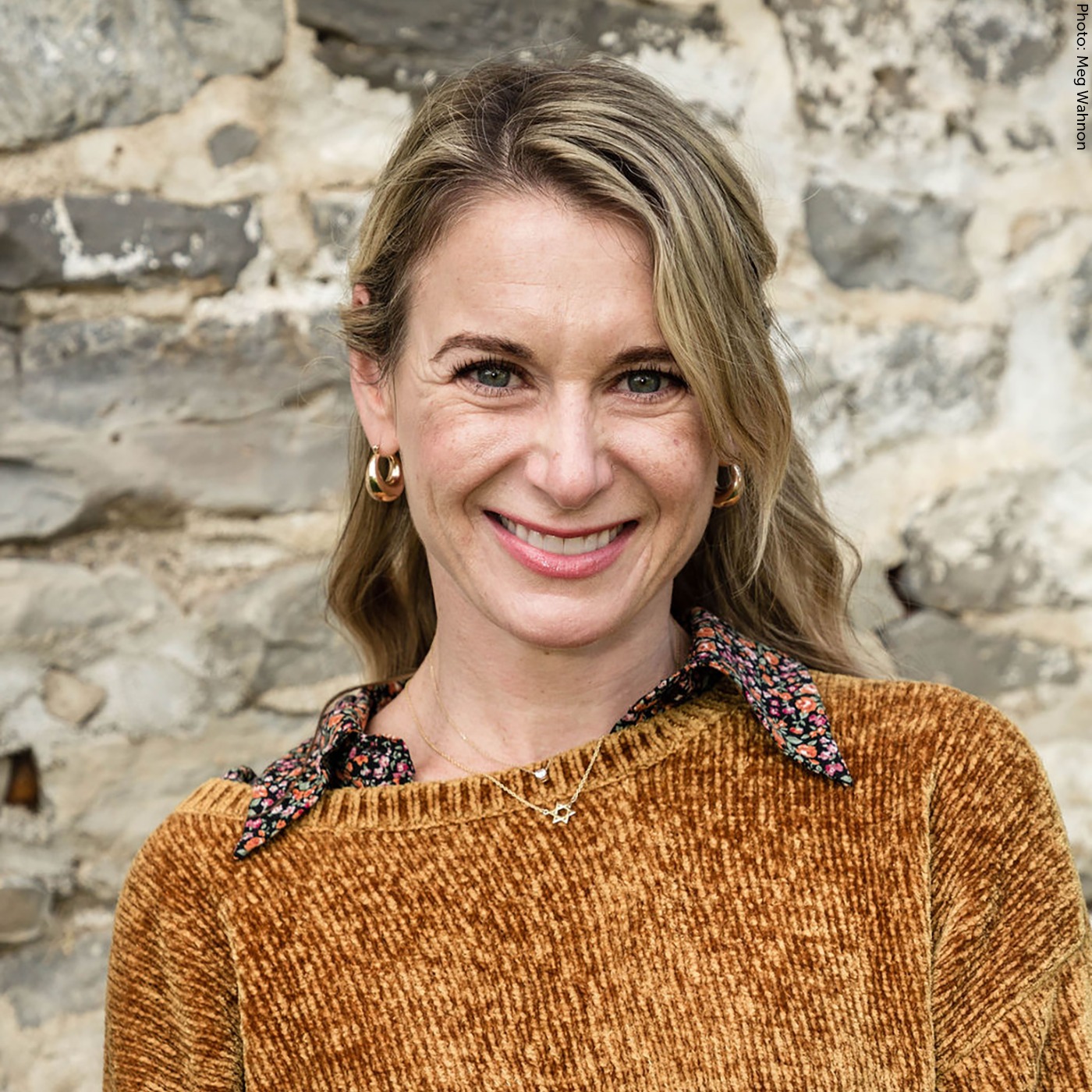
They have grown exponentially and are with us again. Yardenna Schwartz spent a decade reporting from Israel for major American media, including The New York Times and The Wall Street Journal. Her work forces us to ask, what happens when falsehoods harden into beliefs? Yardenna, welcome to In These Times.
Thank you so much for having me, Rabbi Hirsch. I've been looking forward to spending this, uh, time with you. I read your book, Ghosts of a Holy War, and it was just fascinating to me. I, of course, had heard about the Hebron massacres as part of the history that we all studied on the history of Israel and Zionism, I had never actually so deeply, one, into the personal details, and two, into the ramifications of history.
prompted you to research this and want to write about this book? And if you can also give us the main thesis of the book. So I was like you before I embarked on the journey of writing this book. I had heard about the massacre in Hebron in 1929, yet I knew almost nothing about what caused it, what took place during that massacre, and particularly what the consequences and the lasting impact of that massacre were for Israel, for Zionism, for the Jewish people.
And I didn't just wake up one day and decide I want to write a book about the 1929 Hebron massacre. The book technically came to me through Yossi Klein Halevi, who was approached by a family in Memphis, Tennessee years ago. They had discovered a box of letters in their attic, and those letters had been written by their late uncle, David Shainberg, who had sailed to Palestine in 1928 to study at what was then the most prestigious yeshiva in the land of Israel, the Hebron Yeshiva, also known as, as the Slonim Yeshiva Over the course of the next year, he wrote these beautiful, vivid letters describing what life was like in Hebron, what it was like to be an American in British Mandate Palestine at the time.
He described the beautiful, peaceful relations between Hebron's Jewish minority and the Arab majority, and his letters stopped in August 1929. His last letter was written just a few days before he was murdered in the Hebron massacre on August 24th, 1929, along with 66 other unarmed Jewish men, women, and children, in what was effectively the worst pogrom ever perpetrated outside of Europe at the time, up until the Farhud of 1941.
It was actually more deadly and more horrific than the infamous Kishinev pogrom, which had driven tens of thousands of Jews to flee Eastern Europe. Many of them had arrived in the land of Israel, building new lives in Holy Land, many of them in Hebron, actually, and the pogroms that they had left behind in Europe essentially followed them to the city of their forefathers and mothers in the place where they had least suspected it.
For 1,000 years in Palestine under Muslim rule, Jews had been second-class citizens. In Hebron, they couldn't actually enter the Tomb of the Patriarchs and Matriarchs. They had to pray outside of the tomb. But the relationships David described in his letters, and that I would come to read in other testimonies and other books written by survivors of the massacre, described this really unique kind of beacon of coexistence, where Arabs and Jews attended each other's holidays and weddings and family celebrations, and drink coffee in each other's homes.
And so when the riots of 1929 broke out, the Jews of Hebron were so sure that these riots wouldn't affect them, that they had repeatedly rejected offers of protection from the Haganah, who had come to warn them that riots were going to erupt because the tensions had been brewing, and it was very clear that something horrible was going to happen.
And the Jews of Hebron said, "You know, what happens in Jerusalem, what happens elsewhere won't happen to us. The Arabs of Hebron are our friends. We trust them. They'll protect us if anything goes wrong. If anyone comes from Jerusalem to hurt us, our Arab neighbors will protect us." And sure enough, there were two dozen families, Arab families that day, who risked their own lives to save more than 200 Jews from the slaughter that took place.
But 3,000 Arabs in Hebron took part in the massacre, and that was a huge ratio. I mean, there were 20,000 Arabs living in Hebron at the time, and 3,000 of them Hmm. took part in this massacre I just ask you, uh, so you spent a lot of time with this family who had gone up to the attic they were moving, or there was some reason for them to move these boxes and they discover all these dusty boxes they didn't really know about this history of the family beforehand.
Is that right? That's right. So Susie Lazaroff was a 70-year-old Jewish grandmother moving out of her home with her husband to an- another part of Memphis, and her husband had taken down all the boxes from the attic. And as she was going through them, she saw one that she didn't recognize, and it had said, you know, "Important papers.
Do not throw away." And when she opened them, she was shocked to discover these letters because she had known about her Uncle David. She knew that he had been killed in this massacre in Palestine, yet she had no idea that these letters were sitting in her attic all these years. And she knew very little about David himself because the family, his parents almost never spoke about David or the massacre that took his life.
It was such a painful memory for them because they had opposed his move to Palestine. They had not wanted him to go there. This was 1928. This was not a time when young American men left their family and moved to Israel. I mean, the state of Israel did not exist. It was not something you did, and especially not someone like David, who had attended Wharton Business School.
He actually dropped out of Wharton because he wanted to spend more time learning Torah and Talmud, and his parents were Jewish. You know, they were immigrants from the Ukraine who had fled the pogroms of Ukraine, come to their version of the Promised Land in America to live a life rid of antisemitism and pogroms.
But for David, this was not his Promised Land. He was just completely unsatisfied by assimilated life, by the life of someone who just lives their Jewish existence in hiding, in a sense, just behind closed doors. He wanted to be out in the open, studying Jewish texts with other young Jews, and he became just infatuated with Jewish history and Jewish tradition.
And so first he moved to New York to study at yeshiva there, and still there, he was dissatisfied. He felt it was just too materialistic and too... Just not this spiritual atmosphere that he craved, and that was what brought him to Hebron I'm just thinking about the drama. You could write a whole play about just discovering what they were 90-year-old letters of some uncle that you heard about in the family lore, but you never really-- nobody ever talked about him, and all of a sudden you open this dusty box and it's all there.
itself is a play or a novel or something. That must have been really exciting. So he's a 22-year-old. He was filled with this ideological fervor that was characteristic of the time in the Jewish world. decides just simply on his own, contrary to his parents and his family's desires, just to make his way from New York eventually to Hebron to devote his life to Jewish studies Well, he didn't really get there on his own because he was very influenced by various rabbis.
So as a teenager growing up in Memphis, he attended Baron Hirsch Synagogue, and the rabbi there was a French rabbi who ended up awakening this infatuation among many of his students, infatuation with their Jewish traditions and Jewish history that they hadn't really had at home. Their parents all came to really resent this rabbi for, you know, the kids, many of them convinced their parents to close their shops on Shabbat 'cause many of these families were merchants.
You know, David's father had arrived as a poor, penniless immigrant from Ukraine and came to become a very successful merchant and businessman with haberdashery, a dry goods store in Memphis that eventually became this chain of department stores across the South, I think in seven different states. And so he was destined to follow in his father's footsteps.
His parents thought that he would take over the business one day, and he said, "No, I wanna devote myself to studying." And I think he was the only one of his friends in Memphis who did that. When he went to New York, he made friends there who were similar to him, but they talked about their desire to go and live in the land of Israel, but none of them did it.
On- only he did. And this was at a time when Zionism was not yet a unifying force in the Jewish world, not in Palestine, not in the land of Israel, and not in the Jewish diaspora. In fact, I think you write there that David, he himself was opposed to the secular Zionists of the time. He believed in living in the land of Israel, which of course is an ancient Jewish mitzvah commandment.
But he himself, when he arrived, he, he wasn't a Zionist, and partially because they were mostly secular Exactly. So he was kind of representative of a very typical point of view at that time among traditional Jews. He saw Zionism as a contamination of Judaism. He felt that the return of the Jewish masses to Zion from exile should be achieved through the will of God, the arrival of the Mashiach, and not through the will of men.
Yet he himself took upon the Zionist calling in a way to return to our ancient homeland, and it was really interesting reading his letters, how there was this really drastic juxtaposition of sometimes on the same pages of him calling Zionism this vile anti-Jewish movement, and yet him speaking as a full-fledged Zionist saying how amazing it felt to be walking on the ancient soil of our homeland in the same places where the various holidays and biblical stories he had grown up on had actually taken place, and how awe-inspiring it felt to be celebrating holidays like Passover and like Shavuot on the land where these stories were meant to unfold and where his prayers were every day wishing to return to Zion, and he had returned.
So it was really interesting to see that clash of perspectives, and I often wondered if he had survived the massacre, if his perspective on Zionism would have changed, and my guess is it would have because after the massacre, when the Jewish community of Hebron, one of the world's most ancient Jewish communities, and at the time one of the most anti-Zionist communities, they were the victims of the worst atrocities and the highest number of casualties during the riots of 1929 despite their rejection of Zionism, despite their peaceful relations with their Arab neighbors, and it made many of these traditional anti-Zionist Jews in the Old Yishuv realize whatever their disagreement with the secular foundations of Zionism, they needed to embrace Zionism, they realized,
because no foreign power was going to protect the Jews in their homeland. Tell us sensitively as you can why these riots were so vicious, so consequential in terms of their long-lasting impact, and what triggered them, what set them off? People started to compare October 7th to the massacre of 1929, and in my book, you can see there are vast parallels between October 7th and the massacre of 1929.
But in many ways, the massacre of 1929 was even more vicious and more gruesome because The people who were killed on August twenty-fourth, nineteen twenty-nine in Hebron weren't slain with guns. They were slaughtered with knives and daggers, machetes and axes. And much like October seventh, entire families were butchered.
Children watched as their parents were slaughtered by their neighbors. Infants were killed in their mother's arms. Women and teenage girls were raped. Yeshiva students and rabbis were castrated. Synagogues, ancient synagogues were looted and destroyed. And the cruelty that was exhibited that day was just beyond cognition.
I mean, these were people who knew each other. These weren't strangers. These were neighbors killing their own neighbors. And many of the victims, as they were killed, were crying out to their assailants saying, "Why are you doing this?" And naming their assailants by name. They knew them. And it was just a few hours, the massacre.
It was... It-- So the riots of nineteen twenty-nine, they erupted on August twenty-third, a Friday. It was after afternoon prayers at Al-Aqsa Mosque that the riots erupted when thousands of armed worshipers who had gathered at Al-Aqsa descended from Al-Aqsa down to the old city, began to kill Jews wherever they could find them, set fire to Jewish businesses, and the riots just ricocheted throughout Palestine, reaching nearly every Jewish community.
The British had to evacuate the entire Jewish community of Gaza and bring them to places like Jerusalem and Tel Aviv, because in Jerusalem and Tel Aviv, the reason many of the Jews who were there ended up being safe was because the Haganah was very active and organized there. And it was in these far-flung areas like Hebron and Safed or, you know, outer-lying neighborhoods outside of Jerusalem where there was no defense force.
There were no armed Jews, so they were just completely defenseless, and this is where you had these massacres. There was actually also a massacre in Safed several days after the massacre in Hebron. But the massacre that began in Hebron was early Saturday morning. The Jews of Hebron, there were about eight hundred Jews living in Hebron, they had been told by the British police chief in Hebron that as long as they stayed in their homes and locked their doors and kept their windows closed, they would be safe.
And that proved completely false because the British police chief, who had been warned that this would happen, not only by Jews, but by Arabs who told him that this was going to happen, he had failed to evacuate the Jews or arm the policemen in Hebron. All but one of the policemen in Hebron were Arabs, many of them joined the riots, or just allowed the slaughter to take place as they stood outside of the homes where Jews were being effectively hunted down.
These homes were just being invaded by mobs who broke down doors with axes, broke through windows, even climbed in through roofs to reach the Jews who were hiding inside. And there was one home where 70 Jews had taken refuge because it was thought to be the safest place in Hebron. It was the home of Eliezer Dan Slonim.
He was the son of the chief Ashkenazi rabbi of Hebron, and their family had been in Hebron for generations, since the 1800s. They spoke Arabic. He, Eliezer, was the director of the bank in Hebron, and so he had many friends among the Arab nobles and leaders of the Arab community in Hebron. His Arab friends had told him days before that they would protect him and his family.
That morning, they actually were sitting outside his home, but when the mob arrived, someone said to him, "As long as you turn over the foreigners among you," so those who had taken shelter in his home, "As long as you t- turn them over, you'll be safe." And he said to them, "There are no foreigners among us.
We're all family." And they killed him first before slaughtering at least two dozen others in his home. They killed Eliezer, his wife. They raped his wife. They killed their five-year-old son. Her parents, Chana Slonim's parents, were butchered, um, in the most horrific ways, and their 11-month-old son barely survived.
He was found by another survivor, crying next to his mother, and he had been stabbed in the head, but he ended up surviving. And many of the Jews who survived that day survived, like Shlomo, just by the luck of being presumed dead by the rioters because they were covered in the blood of others. So I want to ask you, uh, both on a historic perspective as well as a personal level, prompts this kind of this savagery?
Just on a nationalistic level, it was shocking but not completely surprising. It didn't come out of the blue. There were riots the day before. were rumors that violence was going to explode. So what was the nationalistic background? What was the historical background that triggered this kind of response from neighbors who knew their neighbors?
So if you look at many of the pogroms throughout history, they were usually triggered by the same thing, disinformation and lies What information did they receive that was offensive to them? The disinformation campaign that began in 1928, spearheaded by the Grand Mufti of Jerusalem, Haj Amin Husseini, claimed that the Jews of Palestine were plotting to conquer and destroy Al-Aqsa Mosque in order to rebuild the ancient temple on the Temple Mount in Jerusalem.
And he planted that lie around Yom Kippur of 1928, and it grew and grew, and because he was the Grand Mufti, he was the most powerful Islamic official in Palestine. He'd been appointed by the British. He oversaw all of the appointments of imams, clerics, Muslim teachers, Sharia courts. And so that lie was spread throughout Palestine in mosques and in schools.
And in Hebron, the local Muslim official, the most important Islamic official in Hebron, localized that disinformation campaign, telling the Muslims of Hebron that the Jews in Jerusalem were planning to destroy Al-Aqsa. The Jews in Hebron were planning to turn Ibrahimi Mosque, the Arabic name for the Tomb of the Patriarchs, they were planning to turn that into a synagogue.
And so this threat, this menace to Islam from the Jewish population, was considered so dangerous and such a great threat to their livelihood, to their identity, to their religion, which was so important to them, that they were convinced by their leaders, by their religious leaders, that they needed to defend Islam and Al-Aqsa with their blood.
And the reason those riots broke out on August 23rd, 1929, was because on Tisha B'Av of 1929, so less than 10 days earlier, there was a demonstration of Jewish activists, young Jewish activists, who marched to the Kotel, to the Western Wall, on Tisha B'Av, the day after thousands of Jews had prayed at the Kotel, just as they had years earlier, to commemorate the destruction of the temples.
But again, this is following a year-long propaganda campaign claiming that Jews who are praying at the Kotel, praying at the Western Wall, are actually seeking to destroy Al-Aqsa, which is above. At the time, Jews could not access the Temple Mount. It was completely off limits. You know, unlike today, Jews can access it.
They just can't pray there. But then you couldn't even ascend the Temple Mount if you were Jewish. The only place you could go was the Western Wall, and at that time was a very tiny alleyway. And the Mufti, part of his campaign of propaganda was also to limit Jewish access to the Western Wall. So it wasn't enough to incite violence against the Jewish worshipers, who were increasingly being attacked on a weekly basis by Muslims who considered these peaceful Jewish worshipers a threat to Islam.
He was also making it harder for Jews to pray there. He had a doorway built into the Western Wall to allow Muslims to access Al-Aqsa through the wall, and that was what led to this march by young Jewish activists, many of them followers of Jabotinsky, on to Shabbat. And their march was actually in protest against the British, not against the Arabs.
They were protesting the British failure to protect Jewish worshipers from increasingly frequent attacks by Muslims, protesting their failure to ensure free Jewish access to the Western Wall, to the holiest site accessible to the Jews of Israel, and to the holiest site in Judaism. And their march was peaceful.
It was, it was provocative. They were chanting, "The wall is ours." They were singing Hatikva. They were carrying what would become the Israeli flag, the Star of David flag. Yet for the Mufti and his propaganda campaign, this march was exactly what he needed to point to his people and say, "Look, it's happening.
Look, here's your proof." They claimed that Jews had raped Muslim women, attacked Muslim men, cursed the prophet Muhammad. None of that was true, but at this point the truth had become irrelevant. And this horrific march to the Western Wall was really what sparked the riots. But it wasn't the actual march, it was the lies about the march that sparked the riots.
And this shouldn't have caused riots, but it was a result of this propaganda campaign and these lies that led over the coming days to attacks by Muslims against Jews in the Old City in Jerusalem and counterattacks by Jews against Muslims. And on August twenty-third, Friday prayers had been this focal point of this resistance, essentially, to this Jewish plot.
And the imams had called on Muslims to come to Al-Aqsa armed in order to defend Islam with their blood. And in sermons at Al-Aqsa that day, there were clerics who stood with a sword in their hands and demanded that after Friday prayers, that they go out and defend Al-Aqsa with their blood, and that's what they did In listening to you describe this, it sounds so much like modern times too, and I know that's one of the points that you make.
I wanna ask you about that second. I just-- In researching this for your book, unfortunately and sadly, you've had to delve into these extreme cases of violence and savagery that human beings inflict on one another. I, as a rabbi, you know, I always try and ask the basic questions of human nature, try and understand the human composition.
So you've had an opportunity to look at this carefully and deeply, extreme violence. What have you concluded about human nature? What sets this off? How could people be so cruel one to another, even if they have grievances, whether they're legitimate or not? I think people are capable of the most horrible things when they're part of mobs.
I think that individually, these people would not have done what they ended up doing that day, and I think it was because they were wrapped up in this fervor, and also because they were instructed by their leaders, the people who they looked up to most, the people who they saw as being the living embodiment of what it means to be a good Muslim.
I mean, it was... The people who were leading the mobs in Hebron were Muslim teachers. They were the imams, and they were telling them, "Go into that home. You know, you have to take vengeance on your brothers in Jerusalem," because they were telling them that it was Jews in Jerusalem who were killing Muslims in the streets of Jerusalem, which the exact opposite was happening.
When Arabs were killed during the riots, it was because they were carrying out attacks and were killed in the process of waging those attacks, and most of them were actually killed by British police, not by Jews. In Jerusalem, some of the Haganah defenders did end up managing to quell the riots. But in Hebron, no Jews were armed there, and they were just waiting in fear, knowing that their life was about to end.
And I think that when people feel that powerful and they're part of a mob, it leads them to perpetrate horrific things that they would never do on their own, and I think that leadership is to blame. I don't think that these people were born evil or would have felt the desire to do any of this if they hadn't been convinced of the necessity of doing so Do you think every human being has that in them, or do you think this is a product of culture or history?
And it kind of begs the question, so if the leaders provoked the people to riot and pogrom, what was the idea? What were the values that the leaders were provoking in the people themselves? It's hard for me to imagine, but I fear myself and I fear my capacity because I know what human beings are like.
But it's hard for me to envision actually doing the things that happened on October 7th and the things that you no matter what grievance I might have with somebody else. is that true? Is every human being, in your view, capable of this kind of extreme violence and savagery? Or is there something about cultures that promotes this and liberates somebody to be able to do this?
I don't think every person is capable of it, and I don't think every people or culture is capable of it. I think it-- there has to be that value of violence, that glorification of violence in a culture to enable that. And I think, you know, if you listen to what the rioters were saying on August 24th, 1929, they were praising Allah, saying that they were fighting for Al-Aqsa and defending Al-Aqsa against the Jews.
And in the sermons that encouraged them to do these things, they were told, "You need to defend Al-Aqsa. You need to defend Islam with your blood." This is, you know, violent language, "With your swords." They said, you know, "Islam conquered with the sword. It needs to remain with the sword." They were chanting, "Palestine is our lamb.
The Jews are our dogs." It was very much a religious experience, these riots, and it was very much done in defense of religion, in the name of religion. For that to occur, you need to have a religion that does place some sort of value in violence. And sadly, there are streams of Islam, not all, that do place a great value on jihad and violent jihad, and it can't be ignored, not in this bout of violence.
And also, you know, October 7th was called the Al-Aqsa Flood for a reason because this idea of protecting Al-Aqsa from this supposed Jewish plot, it didn't end in 1929. That was when it began, this lie that has withstood a century. And many Palestinians and Muslims around the world continue to believe that Israel is planning to destroy Al-Aqsa to rebuild the ancient temple.
And we even heard Tucker Carlson say this weeks ago when he claimed that Chabad was behind the war against Iran in order to destroy Al-Aqsa. I mean, it's absurd on so many levels, but I certainly never imagined that I would hear these points being spread by Tucker Carlson. We live in a very strange world.
But since the Grand Mufti began that lie in 1928 and saw how effective it was in silencing his own critics and his own criticism from the Arabic press and his political rivals, and the Muslim masses in Palestine had opposed his role as Grand Mufti. I mean, he was appointed by the British to a role he was not qualified for.
It was effectively like placing a rabbi who never finished rabbinical school, so not a rabbi, in the role of chief rabbi of Palestine. He was completely unqualified, and he was so corrupt that he was using religious funds meant for the waqf. He was so corrupt, and until this lie that he started to spread in 1928, he had been a very unpopular leader.
And once he created this far more menacing threat to the Muslims of Palestine, so much of that criticism just disappeared because suddenly, why did corruption matter when you had this threat to the holiest site for Islam in Palestine? And he, of course, later met He was an ally of the Nazis in the... He was a really bad guy.
He didn't just meet Hitler. I mean, he was essentially a Nazi. He was wanted for Nazi war crimes. After World War II, he was based in Berlin throughout the Holocaust, spreading Nazi propaganda, recruiting thousands of Muslims to fight for the Nazis. He worked directly under Joseph Goebbels. He was the director of the Arab Bureau of the Nazi Ministry of Propaganda.
So this leads me to one of the points in your book, which is that there is a direct connection between the events of 1929 and the events of today. And in fact, in reading your book, and even just somebody who didn't read your book, but just listening to you describing the language the motivations, initial reaction would be, this is just describing today what happened almost 100 years ago to the T in terms of the rhetoric, the impulses, the role of religion, the actual savagery that is inflicted on people.
What is the connection in your mind between 1929 October 7th? So aside from The centrality of Al-Aqsa and this idea of defending Al-Aqsa from the Jews, and of course, the chilling parallels between the atrocities that took place in August 1929 and October 7. Beyond that, I think the even more disturbing parallels lie in the aftermath of both massacres, because in both cases, the atrocities were simultaneously denied by Arab leaders and the Arabs of Palestine at the time and the Arabic press in Palestine, and blamed on their Jewish victims.
One of the statements I found that was put out by the Arab executive, like the leadership of Arabs in British mandate Palestine, was titled Scandals of Jewish Propaganda. It said that the Jews who were slaughtered in Hebron were in fact killed by their fellow Jews, by yeshiva students who wanted to raise funds from the diaspora for their yeshiva, and denied that there were any massacres by Arabs.
They claimed that Jews had attacked Arabs. And of course, all eyewitness testimony, whether it was Jewish or the British police testified for hundreds of hours in the course of the Shaw Commission, the British Commission that was sent from London to Palestine in the aftermath to study the causes of this massacre and what should happen.
And those hearings make very clear what led to the massacre, the incitement, the disinformation, and the fact that this was, you know... And, and the Shaw Commission concludes that this was a slaughter of defenseless Jews by Arabs. And yet, the victim-blaming also came from the British. In the aftermath of the riots one year later, the Shaw Commission concluded that despite all of that, they said that the riots were actually caused by fears, legitimate fears by Arabs of rising Jewish immigration and land purchases.
So at the time, Jews were about twenty percent of a population of less than one million people. This land today is inhabited by more than ten million people. So there was no lack of land, and the reason I use the word purchases and the reason the British were using the word purchases and even the Mufti was using the word land purchases is because contrary to the disinformation campaigns of today, none of this land was being stolen by Jews.
It wasn't being confiscated. It wasn't being handed to Jews by the British and taken from their Arab landowners. This land was being sold at exorbitant above-market prices by wealthy Arab landowners to Jews who were coming in, many of them refugees from pogroms, later on refugees from the Holocaust. And The British responded to the massacre by limiting Jewish immigration, limiting Jewish land purchases, and against the backdrop of Nazi persecution, and even against a backdrop of concentration camps, these strict quotas against Jewish immigration to the land of Israel withstood.
And during and after the Holocaust, tens of thousands of Jews who arrived on the shores of the land of Israel, of Palestine, were either sent back to Europe by the British, or they were detained in British internment camps in Cyprus and in Palestine. So essentially, Holocaust survivors or people fleeing the Holocaust were held in these camps surrounded by barbed wire.
Up until 1948, when Israel declared independence, there were still about 50,000 Jews being held in these British internment camps just in Cyprus alone. This was a direct result of this Arab violence, and that was the goal. The Mufti made very clear his goal of ending Jewish immigration. He told the British when they proposed the first two-state solution in 1937, not only would he not even discuss the idea of a two-state solution of sharing the land, he said that the 400,000 Jews living in Palestine at the time, this was in 1937, that they would all have to leave.
So this idea of sharing the land, of having, you know, a binational state, this utopian society where Jews and Arabs have equal rights, this was proposed by the British. It was actually embraced by the Zionist leadership at the time. And the Grand Mufti and other Arab leaders rejected it out of hand vehemently.
And do you think that ever since, is there something formative about riots beginning in 1929 that set into motion the entire rest of the century that we've experienced in terms of the relationship between and the Arabs and what became the Israelis and the Palestinians? Absolutely. In so many ways. I'm not arguing that this conflict began in 1929.
There had been tensions between Arabs and Jews in Palestine for years. The Grand Mufti, before he was appointed to his role by the British, he had actually fled Palestine, fleeing arrest by the British following riots in 1920 that he had also incited. But those riots were much less deadly. The massacre of 1929, the riots of 1929 were really the first mass casualty event of the Arab-Israeli conflict.
And not only that, it was the first time that the driving forces of this conflict today were set into motion. This argument This claim about a Jewish plot to destroy Al-Aqsa, which continues to galvanize so much violence and hatred today, whether it was Al-Aqsa flood, the Al-Aqsa Intifada, so many bouts of violence over the past century have had Al-Aqsa at their core and this idea of defending Al-Aqsa from this Jewish plot to destroy it.
That began with the riots of 1929 and so many other forces that continue to drive this conflict. So Zionism before 1929, there was a very small militant stream of Zionism. The revisionists were very a fringe element of Zionism. And after 1929, the revisionist side of Zionism became so much stronger. Many people who had until then embraced the idea of a binational state, of just a Jewish home, not an actual Jewish state, became convinced of Jabotinsky's arguments that nothing short of a Jewish state with a Jewish majority were necessary.
And also the idea of coexistence that had really just not been questioned before 1929. It wasn't controversial. There was coexistence in Hebron, in Jerusalem, in Spat, in so many other places. And this is why you had parties like Brita Shalom, these Zionist parties that argued for binational state. And after 1929, many of those members fell away, realizing that it just wasn't realistic, that if what happened in Hebron could happen there, what's preventing it from happening again?
And that trust in neighbors of their neighbors was tragically lost after 1929. I hope that we can someday see a return to the beautiful relations that the Jews and Arabs of Hebron enjoyed prior to the massacre and Jews and Arabs elsewhere in the land of Israel had. And when the Mufti rejected that first two-state solution in 1937, of course, he and every other Arab leader rejected the UN's two-state solution in 1947.
And so much of the violence that we have seen over the past century could have been prevented if Arab leaders had embraced two states for two people in 1947 in the way that the Jewish leaders of Palestine and Jewish leaders around the world and the Zionist movement embraced the two-state solution in 1947.
I mean, they even embraced the British partition plan in 1937, which would have seen just 20% of the British mandate Palestine become the Jewish state. 10% was going to be an international zone with the Temple Mount and the Arabs of Palestine would have had 70%. as the Arab state of Palestine. And I think what's often missing from the discussion of all of these solutions and offers were that this would have represented the first free Palestine, the first independent state of Palestine in history.
Because Palestine had never been free and independent, and it had always been ruled by foreign powers long before the British. The British conquered Palestine from the Ottomans, who had ruled it for over 400 years. Prior to them, the Egyptians, the Greeks, the Crusaders, the Romans. I mean, it was the Romans who named the ancient land of Israel Palestine.
It was not an Arabic name. It was a Latin name, and it was named that as punishment to the Jews of Judea for rebelling, for the Bar Kokhba rebellion. This was their punishment. The Romans renamed the land after the ancient biblical enemies of the Israelites, the Philistines. You're a, uh, seasoned, experienced, and award-winning journalist.
can you tell us about your observations on how Israel is covered traditionally and in particular recently since October 7th? Since October 7th, it has become painful to call myself a journalist and to be a journalist because I feel completely betrayed by my own profession. I attended Columbia Journalism School.
When I went to school there, it was very clear that the job of a journalist is to seek truth wherever it is found, regardless of who facts help or hurt. Truth was the core of your mission. It wasn't about advocacy. It wasn't about arguing in favor of a certain conclusion or narrative. And since October 7th, and even before October 7th, it was very clear that many journalists and entire news organizations no longer rest on those values, those core values of journalism.
What are their values? It seems that their values have become advocacy and activism. And, you know, Matti Friedman makes this argument better than anyone else, that it now seems as if so many of the articles we read about Israel aren't in service of truth, but in service of a specific narrative, the conventional wisdom of Israel being the oppressor and the Palestinians being the victim.
There are, of course, cases when that is true in certain instances, but at an overall picture of an entire people or two different peoples, that is just not reality. There are flaws on both sides. There are virtues on both sides, and you won't see that from the way Israel is covered today. And I think it's because so many of the journalists and leaders of news organizations today are Afraid.
Afraid of the mobs, afraid of the consequences if they report accurately and fairly and in a balanced, neutral way because many of their readers do not want to see the truth. They want to read the stories that reaffirm their own conventional wisdom and what they have been told. And much of what they have been told is propaganda, is disinformation.
And I think that a result of so many years of this conflict being mistaught, certain parts of the story being left out, whether it's the Grand Mufti, whether it's the 1929 Hebron massacre, whether it's starting the conversation about how this conflict began in 1948, which is itself propaganda. I mean, that, that is like starting a story halfway through.
This conflict had begun long before 1948. And the way in which even just 1948, what happened then is depicted by so many news organizations today, it's with- without any context of what preceded 1948, namely the 1947 partition plan that would have created two states. And when you talk about these things, you're immediately labeled a propagandist or, you know, a Zionist propaganda.
These are just facts. This is truth. And, you know, I've seen it in the way that my book, despite the fact that I worked for over a decade for liberal news organizations, NBC, MSNBC, wrote for Time Magazine, USA Today, Foreign Policy, so many magazines and news organizations that do cover books, and you see the books that they are reviewing or that they are mentioning or recommending.
My book was never mentioned by any of them, any of the newspapers and magazines I wrote for, because it is not in line with that conventional wisdom. And, you know, my book is not one-sided. It talks about also the 1994 Hebron massacre by Baruch Goldstein. I write at length about the way in which Palestinians live today in Hebron.
And, you know, I don't ignore the mistakes of either side, and yet in today's climate, it's seen as favoring a certain side. And I think that the second journalism enters a place in which facts are seen as helping a side and hurting a side, and so those facts are left out of stories or just not covered at all, journalism is no longer serving its mission of informing people.
And I think this is why so many people are just completely misinformed about the conflict. My undergraduate degree is in US foreign policy in the Middle East. I took many courses on the Arab-Israeli conflict, and never had I learnt about the Grand Mufti. I had never learnt about the centrality that Al-Aqsa and this lie about a Jewish plot to destroy it.
I never learnt about that. It was all about the occupation and the settlements. And of course, those are not lies. You know, there is a military occupation of the West Bank. Settlements have grown. You know, none of these are lies. But when you place that as your only context for understanding a conflict that is so much more complex than that, so much more nuanced than that, you're really not helping anyone.
And I think that a lot of this failure to accurately depict and accurately understand the conflict for what it is precisely why this conflict remains 100 years later unsolved. Because when you don't understand a problem, you're never going to solve it. This has been a rather sobering conversation. My last question to you is, is there any room for optimism?
Are you optimistic about the next period of time? Yeah, I know. It is very hard to come away from this history with optimism, but if you read the book, it actually does end on a hopeful note. And despite the sobering, depressing research I did for this book, I actually came away more hopeful than I had been going into it because, like I said, when you understand a conflict and realize what's truly driving it, then you realize it actually isn't that hard to solve if you address what's truly driving this violence, the incitement, the disinformation, you know, the Palestinian education system that is built around these lies and around this glorification of violence and martyrdom and defending Islam.
When you realize that is what is leading so many children who are innocent children, educating them to become something other than that, educating them to want to aspire to become martyrs, not only are you encouraging child abuse, but you're encouraging the perpetuation of this conflict. And I think when you realize that through a re-education campaign, through an absolute reformation of the Palestinian education system, and also an empowering and elevating of the peace-seeking Palestinian voices who are there, who want to be heard, and who have been sidelined for decades, not only by their own leadership who prefers continued violent resistance 'cause it serves their own interests, but also these peace-seeking voices being sidelined by
those outside of Palestine, those in, you know, the West who are glorifying violence and glorifying actors like Hamas who have brought only more death and destruction upon the Palestinian people. And so when you meet these Palestinians who are risking their lives to speak out for peace and for a two-state solution, despite all odds, you realize if they can do that, how are we not, we as in whether it's the Jewish community, whether it's Western organizations who claim to be working towards peace, whether it's Western leaders who are striving to achieve a two-state solution or some kind of peaceful negotiation, that is the only hope.
These peace-seeking, moderate Palestinians who understand the mistakes of the past and wish that their leaders had chosen a different path in the past, but are determined to pave a different path for the future, and they need help. They cannot create any kind of movement if their voice is seen as somehow treacherous to the Palestinian cause, if their argument is seen as somehow pro-Israel.
It is not pro-Israel. It's pro-Palestine. When you think about what they want, they want self-determination, and they realize that the only way to self-determination for the Palestinian people is to recognize the necessity of two states living side by side in peace and to reject this idea that a Palestine will only be free when Israel ceases to exist.
And there are many Palestinians who think this way and would love to be able to speak out, but they can't. Many of those who have have had to flee the West Bank and Gaza and seek asylum abroad. And so long as that is the atmosphere, we're not going to see a different kind of Palestinian leadership. So I think that what's absolutely necessary is an empowerment of these kinds of Palestinian voices in society.
And also only once you have a different kind of leadership can you then have that reformation and re-education within the Palestinian education system. Yardenna Schwartz, thank you very much. The book is Ghosts of a Holy War. I highly recommend it. Keep writing, speaking truth, and, uh, we're looking forward to your next monumental work.
Thank you so much, Rabbi Hirschen. I'm sorry if that was too much of a downer. It's funny, my friends always talk about how I'm one person in my professional writing life and another kind of happy, cheerful person outside of it. So I always try to end with a smile, and I hope, uh, No, the truth is sobering.
yeah, I hope I didn't bring you too down today. it wasn't sobering, this would've been resolved long ago. Speaking with Yardenna Schwartz about the Hebron massacres of 1929, all of the memories of October 7th, 2023 came flooding back to me. Yardenna asserts that the murderous impulses embedded within some quarters of Palestinian society in the early 20th century inflicted again on Jews practically a century later.
It is no coincidence, she feels, that the same acts, the same brutality, the same savagery was perpetrated by the descendants of the same people. It's an exceedingly difficult message to hear, especially for liberals like me. At the same time, we need to be honest with ourselves and admit that for many of us, dramatic shifted in our thinking after October 7th.
With the passage of time, some memories soften. But try to remember your feelings the first week of October 2023 when the news came seeping out. It was devastating. We saw in vivid reality what a pogrom looks like, mass mayhem and murder. The horror still shakes me to my core. Even now, two and a half years later, there are many moments when I want to look away a matter of self-preservation.
I just can't bear the pain. I can't shake the memories of utter helplessness, knowing that 250 brutalized Israeli hostages were languishing in dank, dark tunnels. But we need to force ourselves to not look away. We need to fully absorb what is in the nature of the human creature, what we are capable of doing to each other.
And as Jews, we need to be honest about our enemies. They massacred entire families in their homes. They mutilated corpses and paraded them in public on Gaza streets while delirious crowds hollered their crazed approval. They slaughtered babies. They assaulted young women as the bodies of their dead friends lay all around them They took men, women, children, mothers, and infants hostage into the bowels of Gaza.
Among them was an elderly grandmother, a Holocaust survivor. The youngest hostage was nine-month-old Kfir Bibas, who was seized with his four-year-old brother, Ariel, and his mother, Shiri. All three of them were strangled to death in captivity, according to Israeli forensic investigators. Husband and father Yarden Bibas, who was also taken hostage and did not know what had become of his family, was released after four hundred and eighty-four days, only learning in Israel that his wife and children were no more.
We must keep a clear moral compass. This is not freedom fighting. This is not resistance. It is rank, anti-Semitic, evil, wicked, villainous, abominable, heinous barbarism. And anyone in the Middle East, in the United States and the West, in the halls of Congress, in the media, or in schools or university campuses, anyone whitewashes, apologizes for, or justifies this repugnant degeneracy is morally compromised and morally complicit.
Any educator, any head of school or university cannot actually bring themselves to call out terrorism, name the terrorists, condemn their inhuman and atrocious brutality the most important test of pedagogical, moral, and civic leadership. Any religious leader prays for peace but cannot call out terrorism, name the terrorists, and condemn their inhuman and atrocious brutality practices faux morality, cowardly, fake, evasive armchair ethics masquerading as spiritual leadership.
It's not moral courage. It's moral preening. These are difficult days for the Jewish people. But history unfolds in phases. There are brighter days on the horizon. Remember, Israel was founded to empower Jews with self-determination. After two thousand years, a persecuted, abandoned, decimated people finally rose up and said, "Enough.
The days of murdering and massacring Jews with impunity are over. We will protect ourselves. defend our people. We will be masters of our own fate. They will not break us." There is no force in the world more powerful than the united spirit of the Jewish people in urgent times. It broke the will of Pharaoh, of history's tyrants who couldn't fathom how we were still around, and it will eventually break the will of Israel's contemporary enemies.
Until that day, there is no alternative but to fight back. I wish with all my heart it was not so. Until next time. This is In These Times.
