

Joe Lonsdale: American Optimist
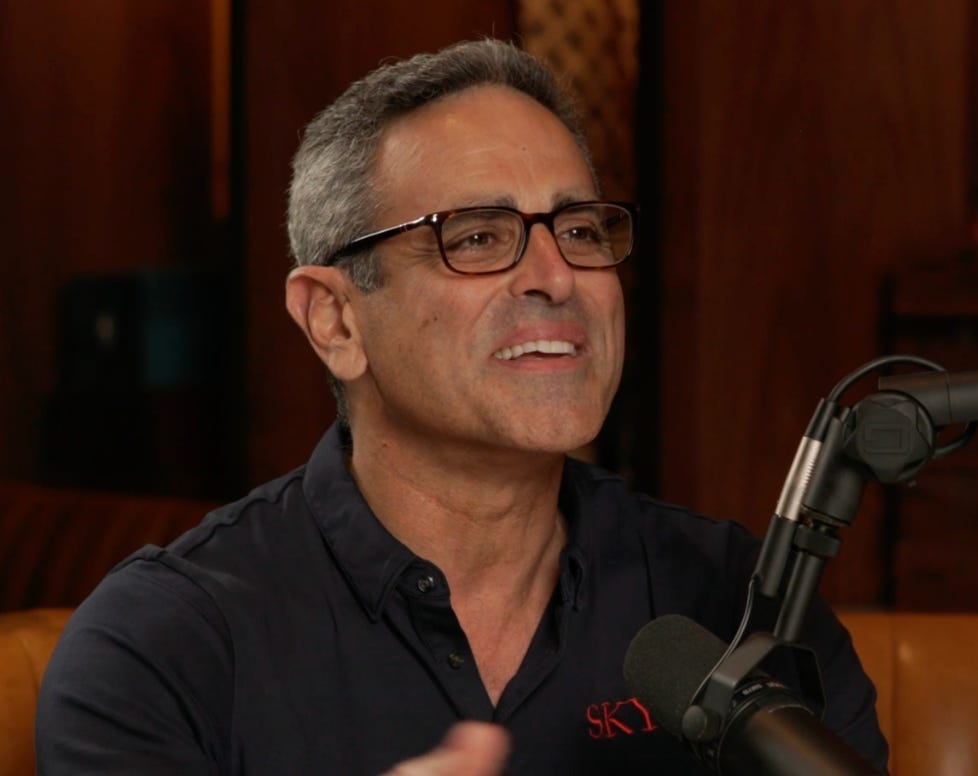
Ep 168: Sky Harbour CEO Tal Keinan on Why America Stopped Building Airports, the AI Wealth Wave & Private Jet Boom
Mittwoch, 4. November 2026 · 29 min
Kapitelklicken springt direkt hin
Shownotes
In the 1930s and 40s, the United States built thousands of airports; today that number is virtually zero. What happened? Why is it nearly impossible to build major new airports or even find hangar space in large cities? And how will the coming AI wealth creation exacerbate the supply and demand imbalance? Tal Keinan, founder and CEO of Sky Harbour Group (skyharbour.group), is addressing these challenges in the private aviation industry.
Born in Miami, Tal moved to Israel after college and was drafted into the military where he served as an F-16 pilot in the Israeli Air Force. In 2004, he founded Clarity Capital, and played an instrumental role in the growth of Israel’s tech ecosystem. He’s also the author of “God Is in the Crowd (amazon.com/dp/0525511164?lv=shuf&channelId…): Twenty-First Century Judaism.” In 2015, he purchased his own airplane in New York and quickly realized there was nowhere to park it. His experience led to the creation of Sky Harbour Group.
We begin with Tal’s path from fighter pilot to investor and his role in Israel’s economic miracle. Next, we dive into the history of America’s airports — thousands built in the 1930s and 1940s as New Deal jobs programs and World War II pilot training. Yet, America hasn’t built a new major airport in decades. Tal explains why general aviation airports struggle to turn a profit, why the FBO duopoly has no incentive to build more hangars, and how Sky Harbour pioneered the home-based operator model. Next, we explore how Tal uses AI throughout his business, particularly to pinpoint new hangar locations, and how the coming wave of AI-driven wealth will create even greater demand for private aviation. Finally, Tal shares his reasons for optimism and why he believes America, despite its challenges, always finds a way to course correct.
() Episode intro
() Eighteen years as an F-16 pilot
() Clarity Capital and Israel's tech explosion
() “Nowhere to park it” / Why did America stop building airports?
() Why general aviation airports don't make money
() The FBO duopoly & why they love NetJets
() How Tal created the home-based operator model
() How the Sky Harbour business model works
() How Tal uses AI to scout customers and locations
() AI wealth wave & private aviation boom
This is a public episode. If you would like to discuss this with other subscribers or get access to bonus episodes, visit blog.joelonsdale.com?utm_medium=podcast&ut…
Transkriptvom Podcast bereitgestellt · Zeitmarken springen hin
We're a dumb real estate company. I don't see any use for AI in what we do. I'm wrong about a lot of things. I'm really this wrong. There's very few major functions at the company that are not infused with AI. How did you get into this aviation business? I bought an airplane here in New York in 2015 and very quickly discovered there's nowhere to park it.
Where you need an airport, there's no land. There's land for an airport, there's no need. You pioneered the home-based operator category. Site acquisition, construction, leasing, and then operations. We have a lot of high-profile people.
By 2050, I think a lot more people will be able to afford airplanes that are private.
AI promises to scale productivity in a way that is going to create a lot more wealthy individuals who can own a lot of things.
[music]
Tal Keenan was a pilot in the Israeli Air Force. He helped build the Israeli economy over the last 25 years. His latest venture is Sky Harbor, which is working in a fascinating space. I'm really interested right now in the areas this AI industrial revolution is going to impact. We're going to have a lot of supply and demand imbalance, for example, on things like airports and planes.
If AI works as I think it will, you're going to have people who are middle class today who are often able to afford to fly private. That's not going to work if we don't have a lot more hangers. In fact, there's not nearly enough hangers today even for the IPOs that are coming. This is a huge market. It's a public company, Sky Harbor. He's going to tell us about it.
Welcome to the show. I want to hear about your background first to begin. Part of the reason you're here, of course, is that I try to think about what are we bullish on as investors that's interesting thanks to the AI industrial revolution that's not AI. And for me, that's Sky Harbor. I want to hear about it.
But let's go into your background more first. You were an F-16 fighter pilot in the Israeli Air Force. Tell us about that.
Yeah, well, so actually I was born in here. I grew up in Miami and the Protestant chaplain at my boarding school in New Hampshire got me into Judaism, ironically. Really? Yeah, which led to me starting to study Hebrew and kind of getting into Israel. I took a junior year abroad during college in Israel and decided I...
I want to be here. This is... Did it feel like home to you? What did it feel like? Meaning, I would say, I found my purpose there. And, you know, got drafted like everyone when I became a citizen.
What year was that? That was 1990. What was going on in Israel at the time? That was before some of the more violence of the later 90s.
Yeah, this was Intifada number one, which was, yeah, a little less violent than the second. That's right. We just had the first Gulf War. I mean, I came in right after that.
Came in right after the Gulf War.
And what did you do when you moved out there? Well, you know, I told Stan in this line, which was for Air Force testing, and went through that, found myself at the Academy. I didn't think I'd last. It was a pretty high attrition rate.
Do you not get sick when the fighter jet goes?
Yeah, at the beginning, pretty much everyone does. Oh, so it's normal.
Then you just have to fight through it. You get used to
it, yeah.
Okay, I should have fought through it, that's a lot for me. That's impressive, I tried to take pilot lessons. It's really rough. And so you were a pilot. How long were you in the Air Force? 18 years. Wow. Well, eight full-time and then
another 10
in reserves. Amazing. And was that a form of experience for you?
Yeah, it definitely was. I mean, it was an immersion into a really kind of beautiful world, which I think is not going to exist in another generation or so. Pilots, you mean? Yeah, yeah. Just manned aircraft.
We are building a lot of unmanned things in general, including fighter planes. There's still a little bit you need for pilots today. Yeah, but that use case keeps getting narrower. That is true. I wouldn't want to compete against the very best models and flying planes, especially if they can go G -forces that I can't do. Yeah, exactly.
You went on to found Clarity Capital and you were really a central figure in Israel's ascendancy economically.
What was Clarity? So I was in venture capital at the time. This is 2004 and Clarity was really born at a meeting with the finance minister at the same time, it was Bibi Netanyahu Who was pushing through a really interesting pension reform very quietly. He had met Jose Pinera, the Chilean finance minister, and kind of became enamored with Chilean pension reform, which he enacted in Israel, which really was maybe the last major move that took Israel.
Israel out of its traditional socialist economy into a truly function. It really unlocked a ton of potential in Israel. This allowed capital to go into places it couldn't. Exactly. So you had hundreds of billions of dollars in pension savings, which had all been invested in earmarked government bond just for the pension institutions.
And then, you know, very quickly, it was a 20 year phase out, but it started, you know, freeing up 300, 400 million dollars a month that had to go into risk capital, risk investments. And we kind of took advantage of that.
You were in Dan Siena's great book, Startup Nation, which I guess was probably happening with you guys from that, from building all those things. And then you also authored the book, God is in the Crowd. Tell us about that.
Joe, as you know, I consider myself a member of three communities, largely. I'm an American, I'm a Jew, I'm an Israeli. And they're both, I treasure all three of those. And I actually think they work very well together. And when I look ahead... For all of them, I see some real threats and some real opportunities in our near-term path, and I thought it was important to address those.
If you zoom out a little bit, I think you can You can segment humanity into creators and destroyers, right? And I think that first category is a lot smaller than the second. It's a lot easier.
Are there some neutral ones at least?
Yeah, maybe it's a spectrum. Maybe that's a better way to look at it. That's right. But the center of gravity on that spectrum, I think, is a lot more toward the people who are tearing or looking to tear things down. And I think these are three communities that are deeply invested. In building, in creating.
And I think it's useful to the world that all three of them continue to do that.
Not every part of the communities always do that, right? No, that's not uniform. Here in New York where we are today, there's maybe some Jews famously putting my DA in and trying to tear my town apart too.
Absolutely true.
That's right. But overall, the spirit of building there is definitely in the community and stuff. Definitely a nurturing, positive thing. So you were obviously an investor in Israel, a fighter pilot. How did you get into this aviation business? What was the pain point you discovered in aviation?
I guess two pain points. One was personal and one was the market pain point. Personally, Clarity used to run a quantitative trading business. And I watched that evolve over the years to a point where the models had become so sophisticated that even their own authors couldn't really predict what they're going to do.
Mm-hmm. And yeah, I don't think we were calling it AI quite at the time when it was machine learning. It's related. Yeah, related. But it seemed pretty clear that, you know, this was going to fundamentally change the way the economy works very broadly. I think there are a few ways you can approach that.
You can kind of join. But like being an AI guy was not really on the menu for me. Just I don't have the sort of intellectual background to do that. You can try to kind of be the Levi's to the gold rush. Great. I think we're doing that to a certain extent when we can get into that. This is funny.
I thought you were going to say Levi's because Israel is like the priestly caste that makes money off everyone else. That's right. Sorry.
Wrong millennium. Wrong Levinson. That's right. Keep going. Or you can look at areas of the economy that are probably going to be slow to be disrupted. And I realized real estate is one of those. As long as rule of law and time The title holds real estate actually is going to be very difficult to disrupt.
So I was very interested in real estate. I'd taken some time off to write the book. The guy who was running Clarity, frankly, did it better than I ever did. So I wasn't going to go back to the management of that company. And then I saw this market opportunity. I bought an airplane here in New York in 2015 and very quickly discovered there's nowhere to park it.
And that's not a New York phenomenon. That's most major metro centers in the United States. And I just got curious, what's going on? You've got an industry that funnels a lot of capital through it. How can a market inefficiency like that persist? And it's been the case for decades. Got curious and kind of went down a rabbit hole and that became Sky Harbor.
And it's a fascinating market in a lot of ways for me as well. I also admit this is maybe obnoxious for most of our listeners, but we probably both own airplanes and have this problem. So it's a larger, interesting market in the U.S. There are actually a lot more airports in the US than almost any other country, right?
I think there were something that was like very good for local economies that were funded everywhere. You know, if you go to try to land and go into a shoot in the UK, for example, you're always having to drive like two hours. Like what is this place? Whereas here, there's almost always a place to land nearby people, which is great.
And yet we stopped building these. Why can't we build
more? What's happened? So look, you're right. It is the densest airport infrastructure in the world, United States. The way that came about is the 1930s and 1940s. First, a New Deal employment scheme. Build. Build. I love it. Right. And we didn't have enough aviation to really justify the number of airports.
We're talking about thousands of airports.
It's the same way with the highways. We built extra highways. It's in some ways what China does today in a related way where you guess the infrastructure you're going to need and build it. Yeah.
I wonder if there was... I'm not familiar enough with what happened, but I wonder if anyone actually guessed that or just said, let's build. We've got to build something. Let's include airports in that. Ironically, they ended up having a profound use in the Second World War. It's the U.S. Army Air Force.
The U.S. Navy was able to train pilots at a rate higher than anyone else, even the Soviets, which was really the bottleneck to kind of- Amazing, because you had all the airports, you could train a lot more people. Yeah, that's the bottleneck, is runways. You know, we put out hundreds of thousands of airplanes over the course of the war.
Instructors, you could put out almost as fast as you can put out pilots. Runways is your real bottleneck, so the United States was in. But 1946, That entire system, essentially, if you look at it kind of in federal government terms, kind of broad brushstroke, that whole system falls into irrelevance, gets divested to local governments.
All the airports are owned by local government today. Got it. And then the cities get built up around them. So today, where you need an airport, there's no land. And when there's land for an airport, there's no need.
So we're stuck. This is the inventory. We're not going to have more. This is what we have. And then what's the hangar problem in particular? Why can't we just... I mean, I live in Austin, Texas, and you go to the airport. There's tons of open land all around the airport. And apparently, they're not...
I don't know. They're not competent enough. They don't want more hangars. Why can't we just add enough hangar easily?
Yeah. Right. So... I'm trying to think how not to get too inside baseball here. That's okay, people are interested in how things work. Okay, so there's 489 commercial airports, designated commercial airports in the United States and another 3 ,000 or so federally funded general aviation airports. Austin Bergstrom is a commercial airport but there's general aviation activity on almost all commercial airports.
The commercial airports can be financially viable right? They've got three big revenue streams it's landing slots car parking and retail concessions. General aviation airports, think Teterboro or Van Nuys cannot be profitable. They can't there is no revenue stream that's going to allow that to happen big enough it's not big enough you don't you just have the flow right that's gonna generate those big landing fees you know the parking there are no retail concessions on those airports so But, I mean, they contribute tremendously to economic development in all these jurisdictions and nationally.
So they get federal funding. So there's 3,000 general aviation airports that get federal funding in the United States.
And it helps the economy is a theory in general. Totally.
It probably does. I mean, there's, to me, very convincing DOT studies on the economic contribution of business aviation the U.S. economy. I think it's significant. But these airports will not exist without a federal subsidy. Yep. And that federal subsidy covers everything that is required to keep that airport functioning as an airport.
So that's runways, runway repaving, runway extensions, major taxiways, anything to do with safety. It doesn't include hangers. The airport sponsors, you know, think Port Authority of New York, New Jersey, want hangers on their airports because you're not going to really house, you know, the biggest, most expensive business jets if you don't have hangers.
And again, you get the economic development benefit in many jurisdictions. Texas, for example, you have ad valorem tax on aircraft. So there's direct revenues typically levitate the county level on aircraft.
I don't mind paying some taxes if they're not capital
gains, you mean. Yeah, yeah. So, I mean, so there's a real incentive to have them, but local government typically doesn't have the money. And when it has the money, it doesn't really have the political will to build what's perceived as, you know, homes for wealthy people. Of course.
Well, the government's not going to do it. So it just hasn't gotten done mostly.
Well, what the governments have done for the last 40 years or so is get the FBOs to build hangers. But if you think about the FBOs, the FBOs are really in the fuel business. That's where they make
their money. An FBO is like, what are the big ones? Signature and Atlantic. It's a duop. Signature and Atlantic. I've seen this thing called Millionaire.
Yeah, there's a couple
smaller ones, but Signature and Atlantic are the biggest ones by far.
I'd say 85% of the market is Signature and Atlantic.
And these guys are making money off the... The fuel and the other fees and stuff, but the fuel's the real money.
Fuel's the real money, exactly. And if you think about that, particularly what's going on right now is post-COVID, you had a real migration from commercial travel to private aviation among people who could afford it. 95% of people who could afford it were not flying private before COVID. And a much bigger percentage are now in it.
Well, you have to. I mean, these commercial flights are just delayed all the time. I think they cut one wire recently in New York. I was coming in and everything was shut off for a long time. All the commercial flights were rerouted. So it's been a bit of a mess.
Absolutely. Big problems with commercial. But if you think about how do people enter private aviation, Almost all of them come through either charter or jet card membership, not ownership of an airplane. Yeah. At least at the beginning, that's kind of your entry. And right now we're experiencing a multi-year kind of bulge in that segment of the market.
So think NetJets, FlexJet, VistaJet. There's all these jerks making all this money. A lot of money.
They're great businesses. Well, the people also buying the jets, too, because of the AI boom, I'd say. There's a lot of money in the economy right now.
100%, and we can argue about this, but I think that's actually self-sustaining, maybe even accelerating.
Well, I mean, with the SpaceX IPO getting liquid, with potentially I saw somebody saying the Anthropic OpenAI and SpaceX IPOs, if the last two go out, or we're bigger than all the other IPOs in tech combined for the last 45 years, there's just a lot of wealth coming right now in our country, a lot of wealth being created.
Yeah, 100%. And that's, again, I think one of the macro drivers of our business. But the FBOs... FBOs love that business. Because think of, you know, if a NetJets parks on your ramp, it's taking the same thousand gallons of fuel that you're taking, but it's not staying for four days. It's out in 45 minutes.
Yeah, making room for the next customer. So increasingly, the FBOs are oriented toward that.
So they care, they want more jet car business. They don't really care about the ones that stay longer, because that's not their interest as much.
That's right. And in crowded airports like Teeterboro, I'd say it hurts their business, right? What's called the Part 91, the... Either corporate or privately.
If I leave it there for too long, it's annoying to them.
Yeah. There's a big opportunity cost. They want people to fuel and get off the ramp.
Got it.
By the way, the other thing is you can't fuel indoors by regulation. So they're making their money outside. So the amount of hanger that they want compared to ramp is very small. They don't want you in the hanger. They can't even be fueling you there. That's crazy. Exactly. So the FBOs are not exactly a solution to the problem that we saw.
So you founded Sky Harbor. It's a public company now, Sky H, as you're wearing right now on your shirt. And you pioneered what's called the home-based operator category. What's that mean? What's that model?
So look, when we got in the business, we thought of ourselves kind of dogmatically as a real estate company, right? You have secure land on airports, build these campuses of private hangars, lease them out long-term to high-credit tenants. That's the business. Over the years, it became clear there's a qualitative gap that's not being met.
By the way, a lot of it has to do with what we just talked about, is that if your resources as an FBO are dedicated to NetJets and FlexJet primarily, that's coming at the expense of your Part 91 customers. And again, it makes sense. If I owned those FBOs, I'd be running the same way. The home-based operator model is, as it sounds like, it's just for home-based aircraft.
There are no transients. We don't have a transient business, which allows you to create a suite of services that the FBOs really can't give you. So it starts with just fault-free service, never a fueling delay, no hangar rash, which is kind of the fender benders that happen inside a hangar when you're moving airplanes around.
But then, I'll give you an example, and we kind of create these services in conjunction with our residents. As you know, we have a lot of high profile people. Their security concerns are mounting year by year.
Especially when you post about Israel online.
Oh, God, I know. That's right. Sorry. Yeah, right. But a couple of years ago, we got a request from a few of our residents to allow them to do all of their boarding and deplaning indoors.
To be able to drive the car into the hangar, get on. Exactly. No one sees you, I guess, huh? Exactly.
So we create, look, the security teams don't want people exposed outdoors. That makes sense. Yeah, totally. But, you know, that's a protocol that you need to put together to get, you know, to be able to do that without wasting a ton of time, right? It takes us about three minutes from the doors being closed.
Lemon fast, feeling good to do it. Exactly. And you do it when you need to do it.
And so you take the plane out maybe to fuel it before they come, put the plane back in, and then they're ready to go. Exactly. And so you recently broke ground, for example, on I think it was the Chicago Executive Airport on Sky Harbor campus there. Like what are some of the recent projects you're doing?
What does this business look like? What are you building?
So we're about to break ground at Dulles International in Washington. I think it's going to be one of our best campuses. We're about to actually finish construction and start operations at Bradley, Connecticut, which importantly is our first New York area airport. That's all Manhattan residents. The airplanes are repositioned to White Plains or Teterboro.
New York is the best market in the country. Are you going to Texas? So we made a big, big bet on Dallas and Fort Worth. So we've got four campuses coming up. Four campuses coming up in Dallas.
That's a legit city too.
The growth is incredible. So that's been great. We've got Houston. That was actually our first campus. Austin would be nice. We're working on it.
All right, all right, let's figure it out. And explain, what is this business model? How does it work? What do you own? You raise equity, you have debt, and you own this real estate, which is the hangar. Tell us about how do we think about the numbers or the model?
Yeah, so think kind of four pillars. Site acquisition, which is the hardest part of what we do. Construction, leasing, and then operations.
Mm-hmm.
The fact that we're doing multi-year leases, and 90% of our revenue comes from rent on multi-year leases, opens a very elegant financing avenue for us, which is called private activity bonds. So we're eligible through... Lacuna in the IRS code to issue tax-exempt bonds. Wow. Which, you know, that private activity bond market, first of all, is a very benign regime.
You know, you get a 10-year par call when you issue those bonds. They're transferable. If we sell the company one day, the buyer will assume that debt, doesn't have to refinance. It's a lot of really great features. But it's also, we're paying 4.18% fixed for over 30 years on our first issuance. We did a subsequent issuance at $475 fixed.
How much did you issue on these bonds about? $168 million in the first, $300 million in the second. You're using them to buy land and build the hangers? Well, so we actually don't buy the land. We lease it long.
We lease it long term.
You have to lease it long
term. No one will sell you the land next year. It's a long term lease.
Yeah, it's a federal property. You're not allowed to own it.
But it's a very long term lease. 50 years. 50 years. And then you're paying to build the hangar on top.
Exactly. The construction's on us. So we own the improvements above the ground, but the land is...
Do you just 20, 30 years in, just hopefully release it for longer or something like that? That's how these things work. Exactly.
We're too young to have actually tried that, but yes.
This is like where the king in England has to own everything. So they only give you 99 year leases. Yes, exactly. And there's always funny stories of them coming up and people forgot or something and then it's bad. But in general, it's not too hard to fix these things.
Yeah. And look, I think you probably don't wait till you're 20 or 30. You probably wait for a time where you can do something for the local community. Either a big capex commitment or something like that.
Some deal for them to help and then you extend it again and you keep doing it. So you have these inexpensive bonds and you have the hangar space and then people rent out the hangar space from you and they pay for services?
Yeah. So we'll have corporates like Chevron was our first tenant in the entire business and they're now, they've actually grown talking about the entire campus in Houston. Got high net worth individuals, got some government. That's the tenet.
And is this, do you consider this a real estate company? Because you started saying it's real estate, but then you also have some services, which I guess real estate people do as well.
Yeah, I think that's it. It's fundamentally a real estate company, but you have to layer in some services. By the way, you have to. Like certain things that we didn't realize at the beginning, you have to be able to provide fuel. We cannot leave it to the FBOs to give fuel this because that's probably the biggest service lapse that people are experiencing with the FBOs.
So we do that.
And why wouldn't Airfield like Dulles, I think you said, in Washington, D.C. has extremely limited ground square footage. Why are they going to give it to you?
So in a fundamental way, our interests are aligned with the local jurisdiction is that they want more hangers, right? The FBOs, again, it cuts into their revenue potential if they put up too much hanger space. So we're pretty nicely aligned. And we're also kind of in this sort of Goldilocks moment. We're for antitrust reasons that duopoly has issues expanding on a lot of the airports.
And we're here, we're capitalized, we've got a model that works that airports like. So it happens to be a very good time to be in that.
And it's an interesting business because you're building on government land. I think in Europe and even maybe Australia, I think they've privatized some airports. They haven't done that here. Is that something that could happen? They should, they privatize it. I guess, like, would that work for you? Would it matter?
Like, by the way, it seems like airports to me should be privatized. They'd be run much more efficiently. That's just my bias. Like, what are your thoughts?
Look, so again, on the general aviation side, no, because it's very difficult to, I rack my brain how to figure out how you're supposed to make money from a Teterboro or something like that.
You'd need the government. You'd need the government. On those airports. On the general ones.
On the commercial, like JFK, Maybe you're right.
That could be run more efficiently
and make money. There might be room for that. You're right.
Especially if you can have metrics that you require them to hit in terms of like one of the things like whenever I land and then you wait for a gate, I'm like, there's clearly no one's job to tie it to the number of minutes we're waiting for a gate right now.
It's ridiculous. Yeah. Yeah.
So maybe there's something like that. I guess the government could do that in theory, but they're not going to.
Yeah. And I remember there's a very kind of comfortable program through the airport improvement program where there's just so many, it's really hundreds of millions of dollars a week that go out to subsidize these airports. You'd be giving that up. So I think it's tough for local governments to do that.
And talk about your site acquisition team. I guess you have these ex-military aviators who are working with you on this. They're looking at a bunch of sites right now, doing trade-offs, modeling it out.
How's this work? Yeah, I mean, so we started off with people from the FBO industry doing site acquisition until we realized... The FBOs grow through M&A. We're very different. We're looking for raw land on airports. We usually initiate contact with the airports. We've got to learn this ourselves. And let's just take some guys who are kind of smart, young, aggressive.
Just first principles thinkers and redo it.
Exactly. There's nothing for them to unlearn,
so to speak. Any lessons for data center people on this? It seems like it's going to be analogous.
You know, probably is. I haven't really thought of it. And we're in such a kind of Byzantine arcane system that I don't... I haven't even thought outside if there's any implications of what we've learned too. Yeah. I might see those guys.
But there's just a gap in the market and it's a big gap in the market and it's going to only be a much bigger gap in the market if the wealth created allows more people to want to access these things. So it's good to fix it. You know, on the future of flight, we talk a lot about AI in this podcast. There's lots of new possibilities for the AI for construction.
There's new possibilities for new airplanes and aerospace. Are you incorporating AI in some way in your business? And what are you excited about there?
So Joe, I do a town hall every month and it like, I think it was kind of end of 2024. Somebody asked, you know, people can write in questions on the, what, how are we going to use AI in this company? And I said at the time, you know, we're a dumb real estate company. I don't see any use for AI and what we do.
So I'm wrong about a lot of things. I'm really this wrong. And I, now today there's, Very few major functions of the company that are not infused with AI today. What's an example? Take site acquisition. We need to validate an airport. Once we're committed to an airport, we need to go lease it up. I'll give you an example.
Camarillo, California. We've got an airport in Ventura County, California. It's a little west of LA. Most aircraft owners in LA are not familiar with Camarillo. Van Nuys is where people want to go, or maybe Burbank. But we started profiling our prospective residents, and we do this today way before we even commit to an airport, is we want specific tail numbers.
We want to know exactly who our residents are going to be when they came in. Came up with a pretty simple algorithm. If you live in Calabasas, California, and you have an aircraft that's based at Van Nuys, and you tend to depart in the mornings, and you tend to arrive in the evenings, which is a pretty typical profile for business aviation, You're going to be sitting in traffic sometimes for over an hour going from Calabasas to Van Nuys in the morning.
Camarillo is 28 minutes and there's never really traffic on that route. The amount of time you're going to spend on the ground taxing and lining up for clearance at Van Nuys is going to be significantly longer than Camarillo. By the way, again, inside baseball, but your departure routes are also shorter.
You're going to get to altitude faster, departing from Camarillo. So let's take the aircraft that are specifically that answer those criteria. Those are the people for whom we create the most value, and let's focus our efforts on them. And today, that's 100% occupancy, and that's exactly the profile of the resident.
I love it. Well, I'm also using AI to run almost everything, although not to ask my questions, apparently. But we always do the research with it, too. It's fun. I debate with it back and forth. You know, so one of my crazy views as American optimist is that by 2050... I think a lot more people will be able to afford airplanes that are private, and a lot more of them will be much more efficient and faster.
I think we're going to have supersonics for a lot of people. We're going to have air taxis everywhere. We're just launching those now. How do you see air travel changing? And if the demand, just as I believe, is going to go up another 10, 100x, it seems like we're going to need a lot more of these, aren't we?
Yeah, for sure. And I don't know exactly how we solve the problem. In the near term, this is good news for Sky Harbor. I agree with you. AI promises to, I think, scale productivity in a way that is going to create a lot more wealthy individuals who can own a lot of things.
You're going to have to build elevators in your hangar in like a second and third story.
So, you know, we've got all these Navy guys and one of the proposals has been let's buy some defunct aircraft carrier elevators, right? That elevate the whole airplane. There we go. I love it. Maybe. Maybe.
I mean, if we're going to need a lot more space, you never know. This is a big thing. Well, Tal, we started this podcast to push back on cynicism and pessimism. And I honestly do believe that there's going to be a lot more people who previously were upper middle class who now are going to be able to fly private in the future.
And so I think this is a really positive direction. I think what you're betting on is the fact that there's more and more people who are successful, who are very successful, which is what makes America work really well. What makes you most optimistic on the future?
Well... Specifically for America, And you started off with this. I agree. We are facing a lot of big challenges today, but I don't think there's ever been a political experiment that's been more successful self-correction than America. And, you know, yeah, we go astray a lot and that's fine. That's always going to happen.
But we find our way back to our mission as America, which is primarily about freedom and human flourishing. And so, yes, and I think, I mean, AI is only an accelerant to that. So I'm very optimistic about, you know, Maybe the immediate future is going to be a little choppy, but the medium and long term, I'm extremely optimistic.
Seeing if there's some crazy people who get elected, we shouldn't worry too much. We're going to find our way back to our core highs.
I think we correct that. I could be wrong, but I'm optimistic.
All right, well, we'll keep fighting for that. Thank you, Tom.
Yeah, thanks, Joe. Thank you.
