

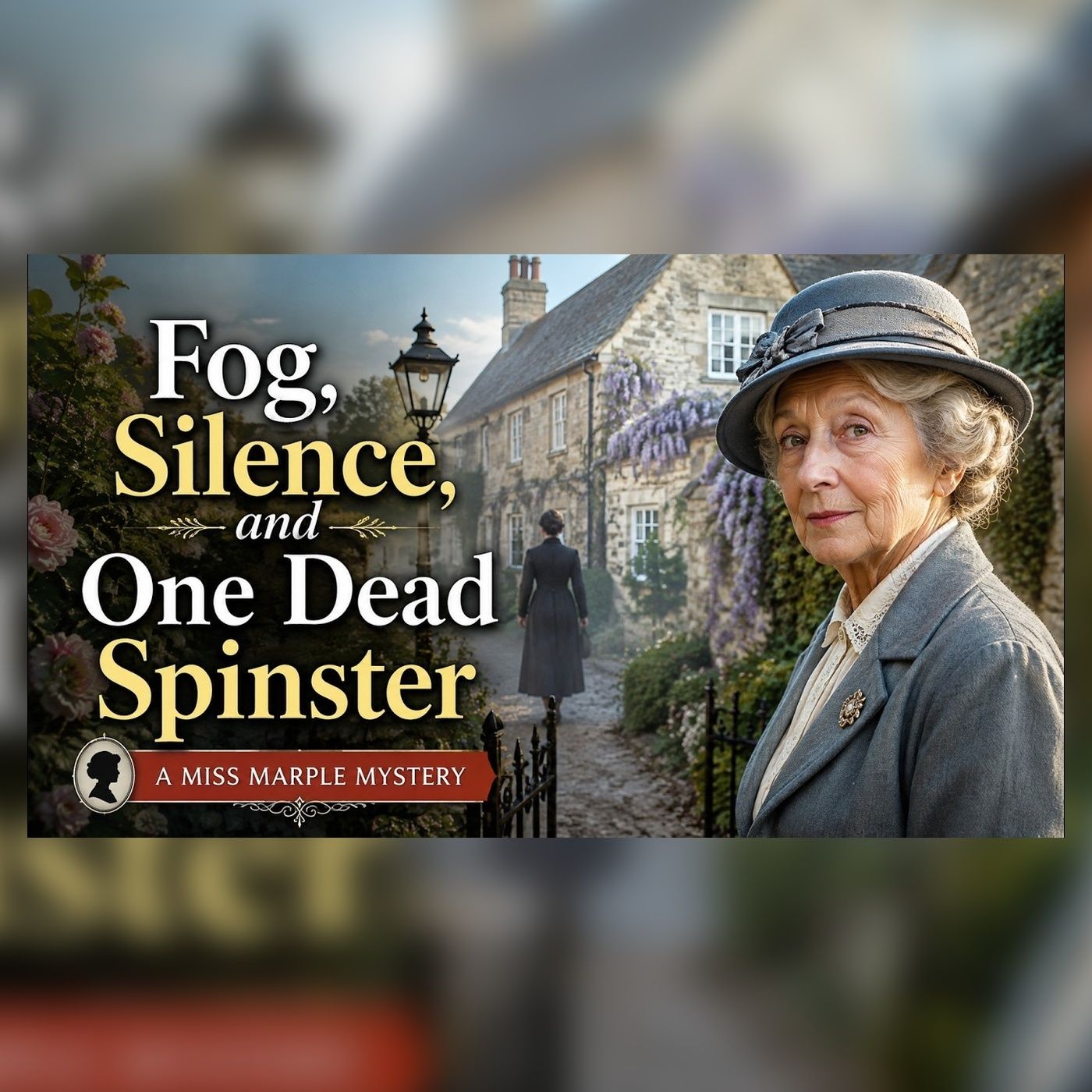
Miss Marple Sleep Stories· Folge 10
A Spinster Found Dead in the Fog | Miss Marple Sleep Stories
Mittwoch, 7. Oktober 2026 · 1 h 31
Kapitelklicken springt direkt hin
Shownotes
Step into the misty streets of a classic whodunit with this relaxing Miss Marple mystery. When a quiet spinster is found dead under a thick blanket of fog, the famous amateur sleuth must untangle a web of secrets hidden by the weather and silence. Perfect for winding down, this cozy English village mystery combines gentle narration with the thrill of a puzzle. Let Agatha Christie's beloved character guide you into a peaceful slumber while solving a puzzling crime. Listen tonight and let the mystery drift you to sleep. #MissMarple #CozyMystery #SleepStory #AgathaChristie #BedtimeStory
Transkriptvom Podcast bereitgestellt · Zeitmarken springen hin
The lamps are lit early against the valley mist, the last dahlias are still standing in the vicarage garden, and behind the lich gate a bell that cannot ring is keeping its own counsel. Draw your chair nearer the fire. In Lower Wintham, where the tea is always strong and the secrets are always older, a spinster lies dead in the vestry, and an old lady with pink cheeks and pale blue eyes is about to notice what everyone else has kindly overlooked. Fog, silence, and one dead spinster. A Miss Marple Mystery Section 1. The Fog Comes Down on Lower Wintham The fog came down on Lower Wintham on a Thursday, and by Friday morning Miss Evelyn Frobisher was dead, though the village, being a village, required the whole of
Friday and most of Saturday to adjust its understanding of the word dead from the natural sort to the other kind. It had been a beautiful autumn until then. That is what everyone said afterward. with the faint reproach of people who feel that weather, like a trusted servant, has no business changing its character without notice. October had come in mild and golden. The dahlias in the vicarage garden were still holding their crimson heads high. The apple crop was gathered.
The organ fund, after three years of envelopes and bazaars, and a dramatic reading of The Pied Piper by the schoolmistress, stood, according to Major Hartwell, who kept the ledger in a ruled exercise book, within forty pounds of its goal. Lower Wintham was the kind of village where nothing ever happened, and where, in consequence, everything was remembered. The last real event had been the fire at the Blue Boar in 1919, and people still described it to visitors with the appetite of a thing half-enjoyed. Miss Marple had arrived in the village on the Tuesday, two days before the fog, to spend a fortnight with her old friend Mrs Caroline Ainger at Dovecote Cottage. She came every few years, when the
London fogs she remembered from girlhood made her think, perversely, of country air. She was a very old lady now, pink and white and fragile as a China ornament, with China blue eyes that people tended to describe as sweet until they had known her a week, after which they described her, if pressed, as a little unsettling somehow. She sat that first afternoon in the window of Dovecote Cottage with her knitting, a shawl, pearl grey, of the softest wool, and looked out across the green at the church of St Cuthbert's, whose bell, she was informed, had been silent since September. Cracked, said Mrs. Anger, setting down the tea.
All the fittings are. Mr. Fanshawe is in despair. A church without a bell, he says, is like a village without a voice. Though between ourselves, Jane, half the parish is rather enjoying the quiet. Old Mrs. Tidd, opposite the lich gate, says she has slept properly for the first time in thirty years. How interesting, said Miss Marple gently.
One forgets how much of village life is arranged around sound. And the fog makes it worse. When it comes down in the valley, you can't hear the cows in the next field. It's like being wrapped in wool. Mrs. Anger shivered pleasantly, the way one shivers at a ghost story in a warm room. We shall have it before the week is out. It always comes when the wind drops after rain. It came on the Thursday, as promised, rolling up out of the water meadows at dusk and swallowing the village by inches, first the church tower, then the rooftops, then the very gates of the houses, until Lower Wintham existed only in small lit islands, the post office window, the vicarage study, the lamp in the doctor's surgery. It
was the sort of fog in which a person might pass his own gate and not know it, the sort in which footsteps arrived before the feet that made them, and voices seemed to speak from nowhere and be answered from nowhere. The villagers shut their doors early, and were glad of their fires. Miss Evelyn Frobisher did not shut her door early. Miss Evelyn Frobisher, sixty-eight years of age, President of the Mother's Union, Treasurer Emeritus of the Organ Fund, and the nearest thing Lower Wintham possessed to an institution, walked out of her house, Church House, the tall Georgian one beside the Lich Gate, at a quarter past six that evening, wearing, according to her companion Mrs. Halloway, her best grey shawl with the pearl pin, and crossed the
green to the church. She had told Mrs. Halloway she was going to look over the vestry before the choir practice on Saturday, and that she might be late, and that Mrs. Halloway was not to wait up. She was found at nine o'clock by young Bert Tanner, the verger's boy, who had gone to fetch a surplice, and found the vestry lamp burning, and Miss Frobisher lying at the foot of the brass eagle lectern, with her head against its base, and her grey shawl folded, folded. which was the thing Bert could never afterward explain to his own satisfaction, neatly over the back of the chair. Bert Tanner was fourteen, and he did what fourteen does. He ran. He ran out of the church and through the lich-gate and into
the fog which swallowed him at the second step. He fetched his father, and his father fetched the constable, and the constable fetched the doctor, and by ten o'clock the little chain of lamplight had done its work, and church-house stood with its door open and its curtains undrawn, blazing into the fog like a ship in trouble. It was the folded shawl that stayed with people. The blow could be hidden under the comfortable word accident, but the shawl.
The shawl was repeated everywhere, and everywhere it was repeated it made the listeners uneasy in a way they could not name. A shawl folded neatly in a room where a woman lay dead. It was wrong, that was all. It was wrong the way a hymn sung in the wrong key is wrong. Nothing you could point to, and nothing you could forget. The village constable, a stout young man named Purbright, bicycling through fog that deadened his own bell, decided it was a fall. Dr Lorimer, summoned from his surgery with his collar unbuttoned and his dinner unfinished, looked at the body for a long time in the lamplight of that small, close, hymn-smelling room, and said he would not sign anything until a proper man from the county
had seen her. He said it quietly, and he said it twice, and the fog outside pressed against the small diamond panes of the vestry window as if listening. By breakfast on Friday, Lower Wintham knew, that is, it knew two things, which it held simultaneously without embarrassment, that dear Miss Frobisher had passed away very suddenly, a mercy at her age, really, in the church she loved, and that something was being whispered at the butcher's which one did not repeat in front of the children. The postmistress sold stamps all morning, with the air of a woman keeping a secret the size of a haystack. The vicar, Mr. Fanshawe, went from house to house being gentle with people who were not, on inspection, grieving so much as exhilarated. At
Dovecote Cottage, Miss Marple sat by the window and knitted, and watched the fog come and go in drifts across the green, and said very little. It is too dreadful, said Mrs. Anger, who had said it eleven times since breakfast. Evil in Frobisher, in the vestry. One has known her forty years, Jane, forty years. She was at my wedding.
She bullied the caterers. One was grateful, of course, and now to slip on that terrible stone floor. I have always said those flags are dangerous when it's damp and nobody listens. Was the floor damp, dear? asked Miss Marple. Mrs. Ainger paused. Well, it had been raining earlier, but the fog really was dry. A dry fog. The driest thing about Thursday, one would have said. And the doctor would not sign the certificate. How did you know that? Mrs.
Tidd opposite, said Miss Marple, nodding toward the window. has had her curtains open since six. Nothing keeps Mrs. Tidd's curtains open at six except news of an irregular kind. She counted stitches under her breath, four and two together, and the pearl-grey wool grew in her lap like a drift of the fog outside, softening, obscuring. I met Miss Frobisher only once, on Tuesday, at your tea. She struck me as a woman who knew exactly where she was putting her feet. Everyone knew where Evelyn put her feet.
She was the surest walker in the parish. up and down to the church in all weathers, never a stumble. Yes, said Miss Marple, that is rather what I thought, and she dropped a stitch, and had to go back, and did not explain why she had dropped it, which was that through a gap in the fog she had just seen the county car, a black Wolseley with two men in it, draw up outside the lich gate, and the taller of the two men stand for a long moment, looking at the church door, with the particular stillness of a man who has read a report he does not like.
Inspector Hewitt had come to Lower Wintham. The fog stayed all that day and the next, and the bell of St Cuthbert's did not ring, because it could not, and the village moved about its business in a muffled, cotton-wool world, in which it was perfectly possible, as several people remarked afterward, with hindsight's uneasy pleasure, to stand three feet from another human being and not know they were there. Which, as Inspector Hewitt was shortly to observe to Sergeant Fanning, was precisely the trouble. Section 2 The village reacts. Precisely the trouble, said Inspector Hewitt, lowering his voice as the verger's boy clattered away down the aisle with the vestry key, is that everyone in this village was indoors in front of
a fire between six and eight on Thursday evening, and every one of them can prove it by every other one of them. It's like interrogating a bowl of goldfish. Sergeant Fanning, who had grown up in a village not unlike this one and knew better than to say so, made a non-committal noise and wrote goldfish in his notebook before thinking better of it and crossing it out. The word murder was not spoken in Lower Wintham that weekend.
It was considered, it was weighed, it was passed from hand to hand under the counter, so to speak, like a doubtful coin. What was spoken, freely and at length and with considerable artistry, was everything else. At the post office the theory was the niece. Miss Nora Teasdale, Miss Frobisher's brother's daughter, had arrived from London that summer in a motor-car she drove herself, wearing trousers, and had stayed three weeks at Church House, during which she had been heard, by Mrs Tidd, whose window commanded the gate, to say, on the subject of the house,' Aunt Evelyn, you can't keep this great barn for ever.' The postmistress, Mrs. Golightly, repeated this to every customer with scrupulous fidelity, adding each time,'
Not that I am one to talk.' At the Blue Boar the theory was Major Hartwell. The Major had quarrelled with Miss Frobisher at the Fate Committee on the Tuesday. The whole of the Scout Hut had heard it through the partition. over the organ fund accounts, which she had asked to see and he had declined, in his capacity as treasurer, to produce until they were properly cast up.
The Major had said, in his parade-ground voice, that he would not be audited by a woman in his own village hall, and Miss Frobisher had said, in her soft, precise voice, that she found that an interesting choice of words. The Blue Boar was of the opinion that the Major had a temper, had been in India, and had once shot a man in a duel in 1911. a story which had begun life as the major once shooting at a tiger and missing, but which had improved with keeping.
At the grocer's, more darkly, the theory was Dr. Lorimer, not that anyone says so, but the doctor was with her last, in a manner of speaking, and a doctor knows where to strike, if you'll pardon the expression, though what grievance the doctor could possibly have against the president of the mother's union, nobody could say, which, in a village, was not an objection, but an inducement. And at the vicarage, Mrs Diana Fanshawe poured tea for Miss Marple, who had been invited, with Mrs Ainger, as a known comfort in times of trouble, and said what everyone was actually thinking, which was the thing nobody had yet said aloud. It isn't that anyone wanted Evelyn dead, said Diana Fanshawe. She was a handsome, hurried woman of forty, much in love
with her husband, and much harassed by his parish, and she had the vicarage wife gift of saying the unsayable in a tone of voice that made it sound like the weather. That's what's so horrible. Nobody disliked her. She was tiresome about the accounts, and she never forgot anything, and she could make you feel nine years old with one sentence. But she was good, genuinely good. She sat up with old Mrs. Crump three nights running last winter, and now we're all sitting in our parlours wondering which of us. She stopped and put the milk jug down and said, in quite a different voice, And that's it, isn't it? That's the murder. Not Evelyn. This. My dear, said the vicar, distressed. No, Hugh, it's true. Mrs. Tidd
hasn't spoken to the postmistress since Friday, because the postmistress said that about Nora. And Major Hartwell came to the door this morning to say, quite unprompted, that he had never in his life raised a hand to a woman. Nobody had accused him, Hugh. Nobody had even mentioned him. We're poisoning ourselves. In a week, we'll all believe it of each other. The fog shifted outside the vicarage windows, thinning to a gauze in which the lich-gate appeared, and vanished like a thought one cannot quite hold. Miss Marple, who had been following the knitting in her lap with apparent absorption, the grey shawl now more than half finished, looked up and said, with the mildness that her friends had learned, over the years, to treat with a certain caution, Mrs.
Halloway must find the house very quiet. There was a small silence. Edith Halloway, said Diana. Oh, devoted, absolutely devoted. Twelve years she's been with Evelyn. companion, housekeeper, everything. She found the body, you know. No, I beg your pardon. The Tanner boy found it. But it was Edith who raised the alarm when Evelyn didn't come home, walked all the way to the Verger's cottage in that fog. She was in a terrible state. The doctor gave her something.
She went out in the fog to look for her. At half-past eight, anyone would have. Yes, said Miss Marple, anyone would have. And yet how few of us would have known where to look. She smiled at Diana's expression. Forgive me. Old women think about these things. To walk out into a fog like Thursday's, alone, and go straight to the church. Not the verger's cottage, Diana, for you said she walked to the verger's cottage, which means she did not go to the church first, and yet she must have known Miss Frobisher had gone to the church.
She had told her so herself. One would expect her to go to the church. Jane, said Mrs. Anger uneasily, you make it sound— I make it sound like nothing at all, dear— I am sure there is a perfectly simple explanation. There always is, for the way people behave. That is the whole of it, really. People always have reasons, and the reasons are always simple. It is only the rest of us who are complicated. She rolled her knitting and put it away, a little breathless, a little flushed, every inch the elderly lady who had talked too much at tea. Now, Diana, you must tell me about this niece. London, and trousers, how adventurous. Is she coming down for the funeral?
Nora Teasdale came down on the Monday, in the motor-car, with the trousers, and was observed by the whole village to have red eyes and a set jaw, and to go straight to Church House without stopping at the Blue Boar for petrol, which Mrs. Goh likely found significant, though of what she did not specify. She was observed also to embrace Mrs. Halloway on the doorstep, genuinely, you know, not for show, and to send the Major's card up unopened, or so Mrs. Tidd reported from behind her curtains. having deduced it from the Major's face as he walked home.
The funeral was set for Thursday, a week from the death, since the county police had not yet released a word the village repeated with relish, the body. Inspector Hewitt, meanwhile, moved through Lower Wintham like a man walking through a house of tissue paper, aware that everything he touched rustled.
He interviewed the verger and the verger's boy. He interviewed Mrs. Golightly and instantly regretted it. He interviewed Major Hartwell, who gave his account of Tuesday's committee with a stiffness that did him no favours. He interviewed Dr Lorimer in the surgery, among the bottles, and came away with a notebook page on which he had written, The doctor says the blow was struck before the fall, and then, after a moment, how did he know? And then, in brackets, ask again.
On the Tuesday evening, at Dovecote Cottage, Mrs. Ainger read the county paper's paragraph aloud. The death of Miss Evelyn Frobisher of Church House, Lower Wintham, is being treated as unexplained, and said, Unexplained. There. So it wasn't the other thing. It was the other thing, Caroline, said Miss Marple. The moment Dr Lorimer looked twice at her head in the lamplight, and the whole village has known it since Friday, whatever the newspaper finds it polite to say. Fog is very obliging stuff. It muffles everything, except, curiously, what people say about one another afterward. That travels for miles. She picked up her knitting. I think I shall call on Mrs.
Halloway tomorrow. A woman who has been twelve years in a house knows everything that has ever happened in it, and she will be in need of someone to tell it to, and I am such a good listener. Mrs. Anger looked at her old friend for a moment, at the mild blue eyes, the pink cheeks, the soft, inoffensive, gently bobbing head, and felt, as she had felt perhaps five times in forty years of friendship, a small cold draught at the back of her neck, as though the fog had found its way indoors after all. Section 3.
Early Investigation Mrs. Anger looked at her old friend for a moment longer, at the mild blue eyes and the soft bobbing head, and then the draught at her neck passed, as draughts do, and she said only, You will take your scarf, Jane, if you're going out in this, and went to fetch it. Church House stood beside the lich gate, tall and Georgian and faintly smug, as houses do that have been well run for a hundred years. Miss Marple was admitted by a small, grey, neat woman of perhaps fifty-five, with a face that had once been pretty, and had long ago decided not to trouble about it, and hands that were never still, smoothing, straightening, aligning. Edith Halloway had the particular worn brightness of a woman who has been
indispensable for so long that she has forgotten it was ever a choice. Miss Marple, how kind. Miss Nora is in the drawing-room. This terrible business. The police have only just gone. The hands fluttered, straightened a candlestick on the hall table, were still. You will forgive the house. I cannot seem to keep it as she... A pause, exactly one breath long. As it was kept. In the drawing-room, Nora Teasdale sat by a cold grate with a cup of tea gone cold too. A tall girl with her aunt's jaw and none of her aunt's armour. She was glad of Miss Marple. in the way that young people are glad of the very old, because they ask nothing.
They talked of London, of the motor-car, of the funeral arrangements, and all the while Miss Marple's gaze wandered, sweetly and vaguely and missing nothing, over the room. The photograph of Miss Frobisher as a young woman, chin up on the piano, the two chairs by the fire, one with a cushion beaten thin by use, one hardly sat in, the work-basket with its mending, a grey wool stocking, half darned. She was darning that the evening before, said Nora, following her eyes, and her voice cracked. A stocking, sixty-eight years old and running the whole parish, and she sat there darning a stocking like anyone's grandmother. I keep thinking I'll hear her tread on the stair. She had a tread like a sergeant major. Edith used to say you could set your
watch by it. Twelve years is a long time to keep house for another woman, said Miss Marple gently. Edith was more than a housekeeper. She was... I don't know what she was. Aunt Evelyn didn't pay her enough, that's one thing. I told her so in the summer, and she said... Nora stopped, and frowned at the memory. She said, Edith is looked after, Nora, though not in the way you mean. I thought she meant the will. I assumed there'd be something in the will. There is a will.
Mr Pritchett in Milchester has it. He wrote last year to say it had been... revised, I think was his word. Aunt never talked about money. She thought it vulgar. Nora gave a short laugh that was half a sob. She thought most things vulgar. Grief, probably. I keep catching myself being vulgar all over the place. It was then that Edith Halloway came in with the tray, and Miss Marple watched her move about the room. watched the hands, always the hands, and saw what she had come to see, though she did not yet know that she had seen it.
Every object Edith touched, she aligned. The cups went down with their handles at four o'clock. The traycloth was squared to the table's edge. When she took Miss Frobisher's unused chair cushion to plump it, she folded, actually folded, a small unconscious pleating motion, two turns of the wrist, the antimacassar that had slipped before she caught herself and set it straight instead. It was nothing, It was the sort of thing a tidy woman does ten thousand times in twelve years. It was the sort of thing nobody would ever think of twice, unless they had happened to hear, as Miss Marple had happened to hear from Mrs. Ainger, who had it from Dr. Lorimer's housekeeper, who had it from Constable Purbright's young wife, that Miss Evelyn Frobisher's best
grey shawl had been found in the vestry, folded, folded, neatly over the back of the chair, while its owner lay dead upon the floor. A murderer strikes, he does not fold. The police would never fold. But there exists a kind of woman in this world, Miss Marple reflected, accepting her tea with a small tremor of elderly gratitude, who has spent so many years folding another woman's things that her hands would do it alone, unasked, in the dark, in the worst moment of her life, a reflex deeper than guilt and older than murder. She had watched it, in her time, in a dozen parlours. In St Mary Mead, it had been old Mr Badger's housekeeper, poor soul, who had served him forty years, and laid out her dead
master's shirts with tears on her hands, though the man had been a brute and everyone knew it. The hands remembered what the heart could not afford to say. Edith had withdrawn to the kitchen for fresh tea, and Miss Marple turned to Nora with the sweet inconsequence of her kind. Your Edith has been here a long time. Forever, said Nora, longer than I've been coming anyway. She came after Uncle Morris died. Aunt Evelyn was alone in this barn of a place, and the agency sent Edith. and Edith stayed.
She knows where everything is. She knows things about this house that Aunt Evelyn herself had forgotten. Where the wedding presents are stored. Which stair creaks. How my grandmother liked her fire laid. Aunt used to say she couldn't die. The house wouldn't know what to do without Edith. Nora attempted a smile. That was one of her jokes. She had three, and they were all like that. Jokes about other people's indispensability to her. And was Edith happy here, would you say? Nora considered this with the brutal honesty of the young. I don't know that I ever thought about it. Isn't that awful? Twelve years, and I couldn't tell you if she was happy. She was just... Edith.
Like the clock on the stairs. You don't ask if the clock is happy. You're grateful it keeps the time. She stopped, and her face changed. That's what she was to all of us, isn't it? The clock on the stairs. Your companion, she said to Nora, when Edith had gone. Wore a pin this morning, I think. A pearl? No, forgive me. I confuse people so. She had not confused anything.
Edith Halloway had worn no pin, and Miss Marple had merely wished to watch her face when pearls were mentioned. But Edith had been gone from the room, and the experiment must wait. The fog had thickened again when she left Church House, and she stood a moment on the step, a small pink-and-white figure in a world gone grey, looking at the lich-gate looming and vanishing. Inspector Hewitt came through it at that moment, like a man materialising out of his own bad temper, and stopped and raised his hat, because his mother had taught him to raise his hat to old ladies in all weathers. You'll be Mrs. Ainge's visitor, he said, the one that's been asking questions at the vicarage. Oh, I never ask questions, Inspector. I only listen. People tell
one so much, don't you find, when they believe one isn't listening? She peered up at him through the fog. You have not found the weapon, I suppose. Hewitt blinked. The doctor says a blow, from something heavy and smooth, metal, likely. We've turned the vestry upside down. Candlesticks, lamp, the lot, nothing marked. Whoever it was wiped it clean and put it back where it belonged. Cool as you please, or else walked off with it into that, he gestured at the fog, and it'll never be found. There's a hundred ditches in this parish. Or it is still in the church, said Miss Marple, being looked at every day by everyone, which is the safest hiding place in the world. Good afternoon, Inspector.
She went home across the green, slowly, because the damp was bad for her, and the fog took her by degrees, first her feet, then her shoulders, then the soft white crown of her head, until there was nothing left of her at all. Behind her, in church house, Edith Halloway stood at the drawing-room window and watched her go, though there was nothing to see, and stood watching the nothing for a long time afterward, her hands folding and folding the edge of the curtain, two turns of the wrist, over and over, like a woman folding something away that would not stay folded. Section 4. The First Suspect. Over and over, like a woman folding something away that would not stay folded, until the curtain edge was warm from
her hands, and she let it go and turned back to the room. Two days later, Lower Wintham had its suspect. It was not, in the end, the whispering at the blue boar that did for Major Hartwell. It was the ledger. Inspector Hewitt, proceeding in his methodical, unimaginative, and frequently effective way through the small paper litter of Miss Frobisher's life, had asked to see the organ fund accounts, those famous accounts for which the dead woman had asked at Tuesday's committee and been refused in front of six witnesses, and Major Hartwell had produced his ruled exercise book, and the exercise book, examined by a police sergeant with an adding machine, was £ 90 short. £ 90. It was an enormous sum. It
was more than a year's wages for a girl like the postmistress's assistant. It was a motive wearing a uniform and marching in step. The Major, required to explain, stood in his own study with his back to the fireplace, and explained badly. He had, he said, advanced the money temporarily upon his own security, to meet a private obligation.
It had been replaced, would be replaced, within the month. He declined to state the nature of the obligation. He said, declined, several times, in a voice that had once made subalterns tremble, and each time he said it, Inspector Hewitt wrote something down. and the Major grew redder and more military, and more obviously a man with something to hide. He quarrelled with her on the Tuesday, Hewitt said to Sergeant Fanning, walking back through the village in a dusk that was, mercifully, only an ordinary dusk, the fog having drawn off for a day as if to breathe. She demanded the accounts.
He refused her in public. On the Thursday she was dead, and the accounts were ninety pounds short. She'd have found it, Fanning. She'd have found it, and she'd have had him up before the committee, the bench, the bishop. A woman like that doesn't do anything by halves. A man's whole position in a village like this. Gone. That's motive enough for any jury. And the opportunity, sir? He walked his dog on the green every evening at six. Mrs. Tidd's curtains confirm it. He says he walked the dog and went home, and his wife says he walked the dog and went home, and a wife's word fanning. Is worth exactly what the wife is worth, sir. Mrs. Hartwell, said Hewitt, came to the station this morning. He stopped walking. She came to
say her husband was at home all Thursday evening, and she said it, Fanning, without once looking at me, and when I asked her what they had had for dinner she couldn't tell me. A woman who lies about Thursday and can't remember the dinner. He shook his head slowly, like a man who has been a policeman long enough to be saddened rather than pleased. I'll have him in before the week's out. He was as good as his word, or nearly. On the Friday the Major was asked to attend at the Constable's Cottage, which served Lower Wintham as an interview room, and he attended, as he attended everything, in his best tweeds, with his stick, as though it were a point of regimental honour to be arrested tidily.
He was not arrested, he was invited to make a further statement, and he made it, and it was the same statement, word for word, and the very sameness of it told against him, for an innocent man, the police reason, varies his story with retelling, and only a rehearsed one stays put. What the police did not observe, being concerned properly with what the Major said, was how he looked saying it. A man terrified, yes, but not of the rope.
He kept glancing at the window that gave onto the lane, toward the Milchester Road, as if what he feared might come cycling toward him from that direction at any moment. Sergeant Fanning noted it in his book, because Fanning noted everything, and underlined it, because he did not understand it. Afraid of something coming from Milchester, he wrote, not of us.
It was the truest sentence in the whole of the police file. and nobody ever read it who understood it until much later. Mrs. Tidd, whose curtains had observed the dog walked at six o'clock on Thursdays since before the war, gave her evidence with the reluctance of a queen parting with a jewel, and was heard to say afterward that she had always known there was something about military gentlemen, and had said so, though nobody could recall when. The village, informed of none of this, knew all of it by nightfall, and knew it in an improved form. The major had been arrested, The Major had confessed. The Major's wife had left him. The ninety pounds had gone on a woman in Milchester. Only the last of these was near enough
to the truth to wound, and it was this version, sensed rather than stated, that brought Laura Hartwell to Dovecote Cottage on the Wednesday afternoon. A thin, elegant, frightened woman, with a cavalry husband and bridge debts, who had heard, as everyone heard everything, that Mrs. Ainger's elderly guest was clever about people. She did not say why she had come.
They talked, instead, about the chrysanthemums, and the shocking price of butter, and the Major's health. His heart, she said, the doctors had warned him about excitement, and it was only as she was leaving, with her hand on the door and her face turned away, that she said, in a voice of ordinary politeness, perfectly preserved, He never touched her.
He is a pompous man, and he quarrels in public because he has never learned to do it in private like the rest of us. But he never touched her. I lied to the inspector about Thursday because... A small breath. Because I was not at home on Thursday evening either, Miss Marple, and where I was is my own affair and nobody's, and I could not tell him where Henry was, because I was not there to know, and she was gone, down the path and into the grey afternoon, very upright, like a woman walking out of the house that is on fire, without letting the neighbours see the smoke. Well, said Mrs. Anger, when the door had shut. The bridge debts.
Everyone knows about the bridge debts. Ninety pounds were just about. But Jane, if she wasn't at home either, and she lies to the police, and the Major had the money and the quarrel, even you must admit it looks. It looks exactly as it is meant to look, said Miss Marple. Mrs. Ainger stared. Meant? Consider, dear, a village is a theatre with a very small stage. Everyone in Lower Wintham knew that the Major had refused her the accounts. Everyone knew he walked his dog at six. Everyone knew his wife could not account for Thursday. It is all so public, is it not? So conveniently public. When a thing is that visible, Caroline, one should always ask whose lantern is shining on it. She picked up her knitting, the grey shawl,
nearly done, soft as the weather outside. and was silent a moment. A man who embezzles ninety pounds does not commit murder to hide it. He commits murder to hide something a great deal worse, and ninety pounds is not worse. And a woman who loves her husband does not come to tea to defend him. She comes to tea to find out whether there is anything to hope. Mrs. Hartwell came to find out whether I thought he did it.
And do you? No, said Miss Marple simply. The Major is a vain man, and a silly man, and quite possibly a dishonest man in the small way of men who cannot say no to their wives, but he is not a cruel one. And this, Caroline, whatever the village thinks, was a cruel murder. Not violent, quiet, and quick, and the shawl folded afterward. That is what nobody has understood.
There was a great deal of feeling in that vestry on Thursday night, the sort of feeling that has been marinating for years. She counted her stitches, and the needles clicked. small and remorseless as a clock. Tell me, the funeral is tomorrow, is it not, and the family come back to church house afterward for the reading of the will?
I think, if Nora will permit it, I should like to attend. Old women are supposed to attend funerals. It is one of the few social occasions on which we are never in the way. Outside, beyond the window, the fog was coming down again over Lower Wintem, earlier than the night, soft and grey and patient, like something that had gone away only to fetch its strength. Section 5.
The Hidden Clue. Soft and grey and patient, like something that had gone away only to fetch its strength, and by the morning of the funeral it lay over Lower Wintham so thick that the bearers had to feel their way up the church path, and the bell of St Cuthbert's, which should have told, said nothing at all. A funeral without a bell, said the vicar, white and distressed, standing at the lich gate in his surplus. It isn't right, it isn't right. Evelyn rang that bell for forty years, in a manner of speaking. and now it can't even see her out. The whole village came, because the whole village would have come to a funeral in any case, and because this funeral was the social event of the decade, and because, though no one said so above a whisper,
everyone wished to look at everyone else and think, in the decent muffle of hymn and prayer, was it you? The Major sat very straight in the front pew, like a man on parade, with his wife beside him staring at her gloves. Dr. Lorimer stood at the back with his bare head bowed, and his face unreadable. Nora Teasdale cried openly, vulgarly, exactly as her aunt would have disapproved, and it was the most honest sound in the church.
And in the pew nearest the door, small and grey and neat, sat Edith Halloway, her gloved hands folded in her lap, not crying, her eyes fixed on the coffin, with an expression that Miss Marple, three rows behind, watched for the whole of the service, and could not at first name, and then could. It was not grief, it was not triumph, it was the face of a woman waiting for the other shoe to drop, for the thing she had set in motion to finish happening, so that she could stop being afraid of it. Afterward, while the village crowded into church house for ham and funeral cake, and the solicitor from Milchester, Miss Marple did a curious thing.
She asked the verger's boy, young Bert Tanner, proud and pale with his new importance as the finder of the body, whether she might see the vestry. For a moment's quiet, dear. Funeral baked meats always make me feel so faint. The vestry was small and close, and smelled of hymnbooks and polish, and very faintly, still, of fog. The brass eagle lectern stood by the door, its base scrubbed. She could see the scrub marks, and the lamp on the table, and the two candlesticks on the shelf, and the cupboard where the surpluses hung. Miss Marple stood in the middle of it with her hands folded on her handbag, and looked, the way she had looked at her garden for sixty years.
Not for anything. but at everything. Bert, dear, she said. When you found her, the lamp was burning, you told the inspector. Yes, miss, burning low, like it had been turned down. Turned down, not out. How very... considerate. She moved to the shelf. And the candlesticks. Brasses are your duty, I believe. Saturdays, miss. I polish Saturdays. Of course. And today is... Thursday. a week to the day. She did not touch the candlesticks. She merely looked at them, one and then the other, the way one looks at two children when only one has been in the jam. Then she turned and smiled and allowed herself to be escorted back to the funeral meets, a frail old lady restored by a moment's quiet. The will was read at three
o'clock in the drawing-room by Mr Pritchett of Milchester, a dry little man, with the air of a surgeon delivering news that is bad but not his fault. The village was not present for this part, but the village learned it all within the hour, from the parlourmaid's sister, and the village was disappointed. It was all so moderate. The house and the bulk of the estate to Nora Teasdale. Legacies, to the organ fund, to the mother's union, to Bert Tanner's mother of all people. and to Edith Halloway, in consideration of twelve years of devoted service, three hundred pounds, and the codicil dated the previous March, which Mr Pritchett read twice in his dry voice while the room held its breath. The lifetime tenancy, rent free, of the dower
cottage at the end of the lane, the same to be purchased and conveyed to her sole use and occupation for the term of her natural life, in recognition that she has made of my house a home, and of service, a friendship. There was a silence. The dower cottage was the prettiest house in Lower Wintham after the vicarage. Three hundred pounds was a fortune. It was not the will of a woman discarding a servant. It was the will of a woman securing, clumsily and completely and forever, the comfort of the one person she had. Nora saw it, and said so later, through her tears, loved. But the village, gathering up its umbrellas and its funeral gloves in the hall, did not see it so. The village saw the dour
cottage and three hundred pounds and drew its own conclusion with the speed of long practice. Edith Halloway had known what was coming to her and had got it. Nobody said this in the house. It was saved for the gates and the lanes where it grew very fast in the wet air. By nightfall the cottage had become, in the telling, the price of twelve years' patience. By the following day, the price of something else. Nora had cried at the graveside without shame, and the village, which had been prepared to find her fast and modern in London, found itself disarmed. A girl who cried like that, they told one another over the ham, could not be all bad, trousers or no trousers. It was the beginning of Nora's
conquest of Lower Wintham, though she did not know it, and would not have cared if she had. Miss Marple, taking her leave among the departing mourners, heard a little of what was being said at the gates, and stored all of it, the way her mind stored everything, in the soft, capacious way of a woman putting wool away in a drawer. She stood a moment in the hall while Mrs. Anger found her umbrella, and she looked at the house as Edith Halloway moved through it, among the dregs of the gathering, gathering glasses, straightening, squaring, and she looked at the young woman in the photograph on the piano, chin up, forty years ago. Evelyn Marsh. who had had everything arranged for her by a father with money, and
had spent the rest of her life in return arranging everybody else. People did not change, Miss Marple reflected, accepting her umbrella. They only grew more so. The child who organised the other children's games became the woman who organised the parish, and the woman who organised the parish had died in the end of organising, though not in any way the village was likely to understand.' Coming, Jane?' said Mrs. Ainger.' Yes, dear,' said Miss Marple.' I was only thinking about funerals. How strange it is that we read the will aloud in the house of the dead, with the funeral baked meats still on the table.' It is the one time a person is ever quite honest about what they meant to us, and it is always, always too late to answer. It
was revised last year, said Nora that evening to Miss Marple, who had stayed late at church house by some obscure elderly prerogative that nobody questioned. March, that's when Aunt Evelyn had the influenza and nearly died, and Edith nursed her through it, day and night, wouldn't let the district nurse touch her. She must have made the codicil as soon as she was well. She blew her nose. And the horrible thing, Miss Marple, the horrible thing is that last Thursday, the very day she, Aunt Evelyn told Edith at luncheon, about the cottage, she told me at tea, she was so pleased with herself, in her way, I have settled Edith's future, Nora, and she took it very quietly, but I dare say she is pleased. Quietly, Miss Marple, she
told her that day, and that night, she stopped, the fog pressed at the windows. Downstairs Edith Halloway moved through the drawing-room, among the dregs of the funeral, gathering glasses, squaring plates, folding, always folding, the linen napkins one by one, two turns of the wrist, her face serene and empty as a shuttered house. Nora, said Miss Marple very quietly, go and ask Mr Pritchett, he is still here, I think, whether Miss Frobisher told him, in March, why she wished the cottage purchased rather than left, and ask him to write it down. And then, my dear, go to bed, and do not lie awake thinking, because it will do no good, and what is done is done. She rose, creaking a little, and wrapped the fog-grey shawl of her
own knitting about her shoulders. I shall see you tomorrow. Sleep well, and Nora, be kind to Edith. Whatever happens in the next few days, my dear, be kind to her. She is going to need it. Section 6. Confrontations and Secrets She is going to need it, Miss Marple said, and went down the stairs, leaning on the banister, past the drawing-room where the glasses were being gathered one by one, and out into the fog. The days after a funeral in a village are like the days after a storm at sea. The wreckage comes ashore. It came ashore in Lower Wintham that week, piece by piece, borne on the tides of tea. The first piece was the doctor's. It surfaced at the vicarage, of all places, at the committee tea for the Christmas fate, which met, in defiance of
death and police, because the fate was the fate, and it surfaced because Diana Fanshawe, pouring, said carelessly that one could hardly expect Dr. Lorimer to judge a festivity. The man had been in love with Evelyn Frobisher for forty years, and had just certified her murdered. Forty years, said Mrs. Golightly, clasping her cup. The Lorimer boy. Well, he was the Lorimer boy then, and she was evil in marsh, and everyone said, But her father had the money, and the doctor's father had the practice, and neither family. She never married, said Mrs. Ainger, and neither did he, until his wife, and she died in nineteen. And he has lived in that surgery ever since, three hundred yards from her gate.
He was going to marry her, you know, said Diana Fanshawe, refilling the cups. My mother had it from her mother, who had it from the pew-opener, so it must be true. They were engaged for a fortnight in the summer of 1889, and then it was broken off, and Evelyn never spoke of it again. Not once in forty years. Mother said that was the frightening part. Anyone can have a broken heart.
But to wrap it up and put it away like a winter cloak and never take it out. She set down the teapot. He never sent her a bill in his life. She paid, of course. Evelyn would have died rather than owe him sixpence. But he never sent a bill. Forty years of doctoring, and not one bill. The whole village knew it, and the whole village thought it was touching.
And was it, said Miss Marple. Was it what? Touching. Diana Fanshawe opened her mouth and shut it again. I don't know, she said honestly. I have known that story all my life, and it has never once occurred to me to ask. Is that what you do, Miss Marple? Go about asking whether things are the things we call them?
Only the very old may do it, said Miss Marple placidly, because nobody minds the very old. We are expected to be tiresome. Mrs. Ainger glanced, despite herself, at Miss Marple, who was eating bread and butter with an air of total innocence. Jane, it explains, doesn't it, the way he looked at her that night in the vestry. The housekeeper said he stood over her for five minutes without speaking.
It explains why he would not sign the certificate, said Miss Marple, but not, I think, anything else. Love that has waited forty years, Caroline, learns patience if it learns nothing else. It does not suddenly lose its temper in a vestry at sixty-eight with a candlestick. She said candlestick quite idly, stirring her tea, and nobody noticed it except Inspector Hewitt, who had been invited to the tea in his capacity as a resident and was regretting it hourly, and who had never said aloud to anyone what the weapon might have been. He looked at the old lady for a long moment over the top of his cup, and said nothing, and wrote nothing down, and remembered. The second piece of wreckage was the Major's, and it came
ashore by his own hand. On the Friday, eight days after the murder, a package was pushed through the vicarage letterbox in the dark, the organ fund ledger, which had been missed from the Major's study that morning, and with it, ninety pounds in notes, and a letter in a strong, shamed, soldierly hand. Major Hartwell came to the police station himself at nine o'clock the next day, and stood at attention before Inspector Hewitt's desk, and confessed to the defalcation, his wife's bridge debts, the Milchester Card Club, the whole shabby little structure of pretense, and to having refused Miss Frobisher the accounts, because she had already, on the Tuesday before the committee, taxed him with it privately, and given him
until Christmas to repay. She was decent about it, said the Major. and his voice, for the first time in the whole affair, was neither military nor defensive, but simply the voice of a tired man telling the truth. That is the devil of it, Inspector. She was decent. She said, Every man has a weak place, Hartwell. The thing is not to build your house on it. I have thought about that sentence every night since she died. I should like you to know, he swallowed. that I walked the dog on Thursday at six, and was home by twenty past, and I did not go near the church, and I cannot prove it, because my wife was in Milchester paying her debts with money I had told her we did not have. That is the whole of my part in
this business. Do what you must. Hewitt, who had been a policeman a long time, knew truth when it finally shuffled into his office with its hat in its hands. He did not drop the major from his thoughts. Policemen cannot afford such luxuries, but he put him, so to speak, on a lower shelf, and sat back and stared at the wall, and thought, if not the money, then what?
The third piece of wreckage came ashore at Church House, and it was the worst, because it was not a secret of the dead woman's, but of the living one. Miss Marple had taken to calling at Church House every afternoon, for Nora, ostensibly, who was young and alone and drowning in probate, and she sat in the drawing-room with her knitting and her gentle, meandering talk, and Edith Halloway brought the tea, and stayed, sometimes, to drink a cup. because Nora, with the blind grace of the young, insisted that Edith was practically family. And it was on one such afternoon the talk had turned, by one of those drifts that nobody steers, to the subject of service. The grocer's girl had given notice. Everyone agreed that girls were not what
they were, that it happened. It is not the work they mind, said Edith Halloway, in her quiet, precise voice. It is the being nothing. A girl in a good place gives her whole self, her sleep, her knees, her best years, her, her heart, if she is foolish, and she is still the girl. The family may love her, oh yes, in their way, the way one loves a chair one has sat in for twelve years, but let the chair creak, let it ask for one thing of its own, and it is put out on the landing.
She stopped. The room was very quiet. She set down her cup with a small, precise click, handle at four o'clock, and smiled, and the smile was worse than the words. But Miss Evelyn was not like that. Miss Evelyn was generous. She said the word the way one says the name of a disease. She had settled my future. She told me so that Thursday at luncheon. The dower cottage, and three hundred pounds, and my, my own home, at last, at fifty-five, when there is nothing much left to put in it. Her hands lay in her lap, still for once, folded.
She meant it so kindly. That is what nobody will ever understand about her. She meant everything so kindly. and it never once occurred to her that kindness, from the top of the stairs, is only another word for dismissal. Nobody spoke. Outside the fog shifted against the windows like a listener changing its weight from foot to foot, and then Edith Halloway rose and collected the cups and squared the traycloth to the table's edge and was herself again, quiet, grey, indispensable, and went out and closed the door so softly that it made no sound at all. Jane, whispered Mrs. Ainger.
who had walked her friend over and now wished she had not. Jane, that was the most dreadful thing I have ever... Yes, dear, said Miss Marple, watching the closed door. Twelve years of devotion. One does not know until something breaks it whether devotion was a gift or a debt. And a debt, Caroline, a debt of twelve years, called in with a cottage and three hundred pounds, and the words, My own home at last. She rolled her knitting, slowly, and her face was sad and very old. A debt like that can hate, oh yes, it can hate very quietly, for a long time, and no one ever hears it, like a bell that is cracked, dear. It hangs in the tower, and looks like every other bell, and makes no sound at all, until one day someone strikes it.
Section 7. The Second Shock Until one day someone strikes it, said Miss Marple, and the words were still hanging in the warm, tea-smelling air of the drawing-room, when the door opened, not softly this time, and Constable Perbright stood on the threshold, scarlet and out of breath, his helmet under his arm, with the fog on his cape in little beads. Mr Hewitt's compliments, he gasped, and will Miss Teasdale come at once? No, not you, Miss, best not. It's Mrs Halloway. The doctor's with her now. She's taken something. The bottle by her bed.
The sleeping stuff the doctor gave her. Half of it gone. She... he did not finish. Nora was already past him and up the stairs, running as her aunt had never run in that house, and the constable turned in the doorway and said, to the room at large, in the voice of a man delivering the sentence he has bicycled through fog to deliver. She left a letter, on the dressing-table, addressed to the police. The village, which had been starving for an ending, seized upon this one with both hands.
By nightfall it was everywhere, polished and improved in the telling. Edith Halloway had confessed. Edith Halloway had confessed and died. Edith Halloway had confessed, died and named an accomplice. In the post office the letter was said to be three pages long and to name the accomplice as a person highly respected. In the Blue Boar it was said to be one page and to name no one, which was somehow worse. Mrs Tidd, who had seen the constable arrive and the doctor arrive and the inspector's car arrive, retired behind her curtains with the air of a woman who has been given a box at the opera. and was understood to be composing her account for posterity. What the village did not know, and would not have believed, was
how quiet it all was. No handcuffs, no shouting, no drama. Only a doctor's bag going up the stairs, and a young woman with a set jaw running up them after it, and the fog leaning against the windows of Church House as it had leaned on the Thursday, as if it knew the house now, and had come back to see the rest. Nora sat by Edith's bed until midnight, holding the thin, still hand, and thought about the codicil, and the cottage, and the words, She took it very quietly, but I dare say she is pleased. She had repeated those words as a small wound, now they seemed to her a great one. To tell a woman at luncheon that her whole future was settled, kindly, generously, over the cold ham, and to expect pleasure. Was that love, Nora wondered,
or was it merely love's paperwork? And if it was paperwork, how many years of it could a heart file away before something tore? The truth, as usual, was smaller and sadder. Edith Halloway was not dead. Dr. Lorimer had reached her in time, and she lay in her small room under the eaves, grey as her own name, breathing shallowly, with Nora in the chair beside her. And the letter, which Inspector Hewitt read twice in the lamplit dining-room of Church House, confessed to nothing at all. He read it aloud in the end to Miss Marple. He did this in defiance of every regulation of his service, and he did it because she had been fetched, at her own quiet suggestion, conveyed by the constable, as someone the deceased's family would
wish present, and because he had reached the point in the case where an extra mind, even a very old one in a lace cap, seemed worth more than another policeman. The letter was short, in a small, neat, governessy hand. To the officer in charge. By the time this is read, the matter will no longer concern me. I have served Church House for twelve years, and I will not leave it to be spoken of as I have heard others spoken of this fortnight. I did not harm Miss Frobisher.
Before God I did not. But I find I cannot live in a village that has already decided I did, nor in a house that no longer has a use for me. The cottage was kindly meant. That is the worst of it. It was all so kindly meant. E.H. The lamp hissed. Fog pressed at the windows like a face. Well, said Hewitt heavily, folding the letter. The village will say it's as good as a confession. Half the bench will say it come to that. Despair, remorse, guilty conscience. I've seen juries hang on less. He looked up. You don't think so. I can see you don't. I think, said Miss Marple, that it is a letter of the utmost truthfulness, Inspector.
Every word of it. Consider what she says. She did not harm Miss Frobisher before God. A woman who has just tried to die does not lie to God in her farewell letter. It is the one correspondence she cannot deceive. And the rest? A house that no longer has a use for me. She is not confessing to murder, Inspector.
She is dying of being dismissed. She has been dying of it since Thursday at luncheon. She was silent a moment, her hands still in her lap. No, Mrs. Halloway did not write that letter because she killed Evelyn Frobisher. She wrote it because the village thinks she did, and because, in some part of her heart that I very much hope we shall never quite have to examine in a court of law, she is not entirely sorry that she is suspected. Hewitt stared. That's the damnedest. He stopped. Beg pardon.
Then we're nowhere. The major's cleared, more or less. The niece was seen in Milchester at half-past six by three people at the garage. The doctor was in his surgery with a patient. The tidwoman. of all useful witnesses, curtains or no curtains. The vicar was writing his sermon. Mrs Fanshawe was addressing envelopes with half the parish. He shuffled his papers with a sound like defeat. Everyone accounted for.
Everyone indoors in the fog, every one of them swearing to every other. A woman walks into a church at a quarter past six, in a fog you could carve, and somebody meets her there, somebody she knew well enough to turn her back on, near enough to strike before she cried out. And that somebody is made of fog, apparently, because nobody in this blasted village saw them go or come.
Somebody who knew she would be in the vestry at that hour, said Miss Marple. Somebody who knew the house so well that her own movements in it were invisible. A person coming and going from church house on an errand, in the fog, would attract no remark at all, would they? If it was someone whose comings and goings were a part of the scenery. Somebody who knew about the quarrel over the accounts. and who, perhaps, made sure the village knew about it too, afterward, and about the trousers and the motor-car and the doctor's late visit. A whisper here, a word there. Fog is not the only thing that can be laid over a village, Inspector. She rose, slowly, and he rose too, automatically, because his mother had taught him.
May I see her, Mrs. Halloway, for five minutes? I am, after all, practically family. Upstairs, in the small room under the eaves, Edith Halloway lay with her eyes open, staring at the ceiling, breathing. Nora had gone down to telephone the nurse. The room was painfully neat, the brush and comb squared on the dresser, the chair against the wall, nothing anywhere that was not aligned, and on the dresser, alone in a saucer, stood a small heap of things emptied from a pocket, a thimble, two buttons, a handkerchief folded to a square. Miss Marple sat down by the bed with the little grunt of effort that old ladies permit themselves, and took one of the still, cold hands in hers, and said nothing at all for a long time. Outside,
somewhere in the muffled dark, the fog shifted its weight against the village, and the dead church bell hung in its tower, silent. Edith, my dear, Miss Marple said at last, very gently. I have been knitting a shawl, grey, soft wool. It has been a great companion to me these two weeks. One thinks so clearly, knitting. The hands are busy and the mind is free. She paused. The police found Miss Frobisher's shawl, you know. Her best grey one, with the pearl pin. Folded over the chair, so neatly. I have thought about that shawl every day, Mrs. Halloway. A person lies dying on the floor, and someone, someone in that room, folded her shawl. The cold hand did not move in hers.
The breathing did not change. Only love does that, I think. Hate strikes the blow, but only love stays afterward and folds the shawl. The fog pressed in, and in the small, neat room under the eaves, Edith Halloway's eyes filled slowly with tears that slid, one after another, sideways into her hair, and her hand turned, barely, a degree, within Miss Marple's, and held on. Section 8 Miss Marple's Test A degree, within Miss Marple's, and held on and for a long while the two old women sat so in the lamplight, hand in hand, while the fog moved against the small window like something that wanted to come in and could not.
It was Edith who spoke first, at last, in a voice rubbed thin as old linen. She wore the shawl, her best one, grey, with the pearl pin that was her mother's, I remember thinking, the vestry, in her best shawl, on a Thursday. One doesn't dust hymn books in one's best. But I had learned not to wonder where she was concerned.
Twelve years teaches you that. You can know everything about a person, how she takes her tea, how she holds her pen. the exact sound of her tread on the stair, and know nothing at all about what she is doing it for. A pause, the shallow breathing. She said, going out, I am going to settle the last of it, Edith.
I thought she meant the vestry books. The last of it. She had settled me at luncheon, you see. The cottage. My own home. And I stood in this house, Miss Marple, in the hall, with the door still shaking from her going, and I, I did not feel anything I should have felt. That is what I could not live with. Not the village, my own heart. I opened my mouth to thank her, and nothing came out but, very good, Miss Evelyn, like a parlour maid. Twelve years, and that is what came out.
And what should you have said, my dear? That I did not want a cottage, that I wanted, the thin voice frayed, oh, I don't know, to be asked, to be something besides settled. She was going to die, I think. knowing she had done right by everyone, and not one of us had the courage to tell her that being done right by is the loneliest thing in the world.
Edith turned her head on the pillow. I did not kill her, but I let her walk out of the door with Very good, Miss Evelyn, for a goodbye, and there is not a night now that I do not hear it. You did not know what she was going to tell you then, said Miss Marple. It was not a question. No, she said only that she was going to settle things. She had been saying it all week, At breakfast. I am going to settle Edith. I am going to settle the fund. I am going to settle someone else. The thin voice paused. She did not say who, but she was pleased. I knew her pleasures, Miss Marple.
Twelve years teaches you those, at least. She was pleased the way she was pleased when the bazaar came right, or when the bishop wrote back by return. It was the pleasure of a woman signing the last page of something. And you think there was someone else? still to be settled. I think there was one person in this village she had never arranged, said Edith, and that it was preying on her, that last week, that she had arranged everyone except him. Her eyes closed. I should not say these things.
I have no proof of anything. I have lived in this house twelve years, and I know where every creak in it comes from, and I know nothing, Miss Marple. That is what service is. You are the walls. The walls hear everything, and are asked nothing. and know nothing, because knowing is a privilege of the people who sit in the chairs. Hush, my dear, said Miss Marple, and there was something in her voice that was not elderly at all. The walls hear everything, you have said so yourself, and a wall does not need proof, Edith, it needs only to have been standing in the room. Miss Marple sat a while longer, and then she said, very gently, that grief and guilt were the two most exhausting emotions in the world, and that Edith must sleep, and that
she herself would come again to-morrow. and she tucked the thin hand under the coverlet, and went downstairs, and found Nora, and said what was needed, and then went home through the fog to Dovecote Cottage, where she sat down by the window and did not pick up her knitting. Caroline, she said at last, Do you think Dr. Lorimer would see me in the morning? This damp has got into my shoulder something cruel. Mrs. Ainger, who knew her friend, said nothing at all. The surgery smelled of carbolic and coal-tar soap, and Dr. Lorimer received her with the grave courtesy of his profession, a tall, stooped, grey man with a beautiful pair of hands, and the loneliest eyes she had seen in many years. He looked at her shoulder,
he prescribed liniment, he wrote it down in a small, exact hand. And while he wrote, Miss Marple talked, in her soft, wandering, elderly way, of the village, and the shock, and poor Evelyn, and how the police were really so thorough, remarkable. They notice everything, those county men. The lamp turned down, such a strange little thing. And the shawl, folded, with the pin gone. The inspector is quite puzzled about the little pearl pin. It was not on the shawl, you know.
He keeps that back, of course. The police always keep one thing back, I believe, so that they may know when a person knows too much. A pearl pin. Her mother's, Mrs. Halloway says. She never wore the shawl without it. The pen stopped. It was the smallest thing in the world, a pause, a quarter of a breath, the nib holding still above the paper, so that a drop of ink swelled and fell. She was not wearing it, said Dr Lorimer.
The surgery was very quiet. The coal ticked in the grate. Outside, beyond the frosted pane, the fog stood against the glass like a face pressed close and listening, and somewhere far off a door banged, muffled to nothing. Not wearing it? said Miss Marple, innocent as milk. But Mrs. Halloway was quite sure. The pearl pin, she said, she never wore the shawl without. I meant, said the doctor, and his voice was perfectly level, the voice of a man who has delivered bad news for thirty years, and knows how to hold a sentence steady. That if she had been wearing it, it would have been found. That is all.
The police are very thorough, as you say. Forgive me, he rose, and the prescription was in her hand, and he was at the door. holding it open with that grave courtesy which was, she thought, the whole of the man. The shoulder should be kept warm. A shawl is better than a coat, at our age. Good morning, Miss Marple.
She went home through the fog, slowly, because the damp was bad for her, and because she was thinking. He knew. He had known, in one unguarded quarter-breath, that Evelyn Frobisher's pearl pin had never been on the folded shawl at all, that it had come away before the folding, and there was only one room in the world where a person could have learned that, and only one hour, and the fog had wrapped that room and that hour as carefully as wool wraps china. At Dovecote Cottage she found Inspector Hewitt waiting on the doorstep, damp and sceptical and faintly hopeful, because the old lady's message, conveyed by Constable Purbright, who had been made to repeat it twice to be sure he had it right, had said only, Tell him to
bring his notebook and his patience, and not to expect anything so vulgar as proof. Well, ma'am, said Hewitt, I've brought the notebook. I'll tell you frankly, the Chief Constable wants the Major, the Coroner wants anything that'll hold still, and I've got a witness at the garage in Milchester, a wife lying about a dinner, a companion half-poisoned, and a vicarage full of envelopes. If you've got something, for pity's sake. I have very little, Inspector. I have a candlestick that was polished on the wrong day. I have a lamp turned down by a kind hand. I have a shawl folded by a loving one. I have a day-book, I fancy. You must look at Dr. Lorimer's day-book, and ask Mrs. Tidd, very casually, what time she got home
to her kippers on Thursday. And I have a pearl pin. She looked up at him, and her eyes were not sweet at all, but very clear, and very old, and very sad. And I have a man, Inspector, who has loved a woman for forty years, three hundred yards from her gate, and who was told last Thursday, in the kindest possible words, exactly what that love had been worth. Tomorrow, I think, will be difficult. Tonight I must finish my shawl.
One likes to finish a thing before the weather changes. She glanced up at the sky, where the fog, for the first time in a week, was beginning, barely beginning, to thin. Because the fog is going, Inspector, and when it lifts, everything in this village is going to be visible at last. I am not sure Lower Wintham will much care for what it sees. Section 9 The Quiet Assembly of Truth Not sure Lower Wintham will much care for what it sees, said Miss Marple, and went in, and sat down by the fire, and took up the grey shawl, and knitted, stitch after stitch, while the fog outside thinned and thinned, until by midnight, when she cast off the last stitch and bit the wool, a watery moon was standing over the church tower, the first sky
the village had seen in eight days. The morning came up clear and cold, and ruthlessly bright, as mornings do after a long fog, and everything in Lower Wintham looked new-washed and faintly ashamed, the gutters running, the bare trees dripping, the lich-gate black and shining. And into this scoured light came, one after another, like witnesses called to a quiet bench, the last of the facts. The first arrived by post, in a stiff envelope from Milchester. Mr Pritchett, the solicitor, wrote in answer to Miss Teasdale's inquiry, with the dry precision of his kind. As to your aunt's instruction that the dower cottage be purchased and conveyed to Mrs. Halloway in her lifetime, rather than left by will, Miss Frobisher
was quite explicit. Her words, as I have them in my attendance note of March last, were, A legacy can be contested, Mr. Pritchett, or whittled, or resented. A gift given while I am alive is a promise kept where people can see it. I would have Edith safe, and I would have her know that she is safe, and I would have the village know it too. I may say she appeared to attach considerable importance to the point.
Nora read it twice, standing in the hall of Church House, and then she sat down on the stairs in her aunt's house, and cried as she had not cried even at the funeral, because it was so like her, so exactly like her, the clumsy, magnificent, high-handed love that arranged everything. everything, foresaw everything, provided for everything, and never once thought to say, I love you, in any language a person could answer back.
She was building Edith a wall against the whole world, Nora said, to the stairs, to the house, to the ghost of the sure tread upon them. and all Edith could see was the door in it. She took the letter to Dovecote Cottage that same afternoon, and Miss Marple read it twice, and was silent for a long while, looking at the fire. You see what it means, my dear, she said at last. Your aunt was afraid, not of death, of dying with her affairs unwitnessed. A will speaks after, she wished to speak before. She wished Edith's security to be a thing seen, dated, signed, and handed over in the light of day, a promise kept where people could see it. That is not the action of a woman tidying her papers. That is the action of a woman
making amends in the only grammar she knew. Amends for what? For twelve years of being loved and calling it service, said Miss Marple. And perhaps, she folded the letter along its crease, exactly, and handed it back. Perhaps for something older. People who have once accepted an arrangement at the cost of their own hearts, Nora, spend the rest of their lives arranging other people. It is a form of restitution, it is also a form of tyranny, and the two live in the same house and answer to the same name.
Nora turned the envelope over in her hands. She told someone else that week that she was going to settle them. Edith said so, someone else, on the Thursday, and she never came home. Yes, said Miss Marple quietly, that is rather the point, my dear. A person who is being settled, after forty years, may not find it as pleasing as the settler expects. Kindness from the top of the stairs, Nora, it can fall a very long way down, and it can hit very hard at the bottom. The second fact came from Mrs. Tidd, and it came, as everything from Mrs.
Tidd came, gift-wrapped in grievance. Inspector Hewitt, instructed to be casual, called about a supposed complaint of boys at her fence, and admired her view, and asked whether the fog had not quite spoilt it, and was told at length that the fog had been a mercy, that she had slept for the first time in thirty years without that bell, and that she had not been well herself, no, not well at all. She had been at the doctor's that very Thursday, not that anyone asked after her, and Hewitt, heart-knocking, said he hoped the doctor had not kept her waiting long. Waiting? Me?
I should think not. I was in and out, and home to my kippers by half-past six. and I know the time, young man, because I put them under the grill when the postmistress's clock struck the half-hour, and a kipper is four minutes aside. A kipper, as Miss Marple observed afterward, is four minutes aside all over England, and no one has ever improved on it as an alibi.
The doctor's day-book, requisitioned that afternoon with a politeness that fooled no one, recorded Mrs. Tidd's visit as ending at ten minutes to seven. The hand was small and exact. The figure, on close inspection, had been Kate. There was no other word for it, and the police handwriting man from the county used none other. Kate mended. A two converted with a single small exact stroke of the doctor's own pen into a five. The third fact was the candlestick.
Hewitt brought both of them, wrapped in brown paper, to Dovecote Cottage and set them on Mrs. Ainger's best tablecloth, with the air of a man handling the crown jewels, and Miss Marple looked at them, one and then the other, the way one looks at two children when only one has been in the jam. Bert Tanner polishes the brasses on Saturdays, she said. Today is Saturday week. Bert tells me, I asked him this morning, at the gate, that when he came to do them on the Saturday after, one of them was already done. Bright as a button, he said, and smelling of the doctor. His very words, Inspector, smelling of the doctor. He thought he must have done it himself and forgotten, the way one does. Carbolic, you see.
A man who has spent thirty years washing his hands of other people's pain would not come away from such a moment without washing. It is not in him. Whatever else he had become in that one second, the doctor in him went home and washed. She put the candlestick down gently. There will be nothing on it for your men to find. There was never going to be. He is not a careless man. That is rather the point.
The fourth fact was the pin, and it was not so much a fact as a silence. Hewitt confirmed it, grudgingly, as a man confirms a card he has been keeping up his sleeve. The shawl, folded over the chair, had had no pin. Mrs. Halloway's statement said the pin. The shawl had no pin. The police had told no one, Kay, no one in the village, no one at the vicarage, not the coroner. We always keep one thing back, ma'am, said Hewitt, so that we'll know when a person knows too much. and Miss Marple said yes, she had heard that the police were very thorough, and did not smile, and Hewitt looked at her for a long moment, and understood, suddenly and completely, what she had done in the surgery, and with what, Kay, a cup of tea, a sore shoulder,
and the name of a dead woman's mother, Kay, she had done it. There's one thing I don't see, he said, at the door, his voice low, though there was no one to hear but the dripping trees. Why not let it stand as a fall, He was the doctor. He could have written accidental death and gone home to his fire, and no power on earth could have touched him. Instead he looks at her head and all but calls the county in himself. I've been two weeks on that, ma'am.
It keeps me up. That, Inspector, said Miss Marple, is because you have been thinking of him as a murderer who happened to be a doctor, when you should have been thinking of him as a doctor, a good doctor, an honest man, a man who has signed what is true for thirty years over the bodies of people he loved.
who happened, once, in one second out of forty patient years, to be a murderer. He could not write the lie across her body. It was the last thing left of him, don't you see, and he gave it to her. He gave her the truth, and he knew it might hang him, and he gave it anyway. She gathered the grey shawl, finished now, soft as the departing fog, about her shoulders.
It is time, I think, to call on Dr. Lorimer. We shall not need the handcuffs, and I would be obliged, Inspector, if you would let me speak first. He has waited forty years to be listened to. It would be a pity to begin badly now. Section 10. The Reveal. To be listened to. It would be a pity to begin badly now, said Miss Marple. And they went out together into the scoured bright morning, the old lady on the inspector's arm, across the green where the last rags of fog hung in the bare elms, like washing forgotten on a line, three hundred yards from gate to gate. Dr.
Lorimer received them in his consulting room, among the bottles. He did not seem surprised. He had, Miss Marple thought, the look of a man who has been standing for two weeks on a platform, watching a very distant train, and has just heard its whistle. He asked them to sit. He asked if he might offer them sherry. He was, to the very end, the best-mannered man in the village.
It will not take long, Dr. Lorimer, said Miss Marple gently, and I should like to say first that I am sorry. I have been sorry since Wednesday, when I watched you at the graveside. It is a terrible thing to lose the person one has loved longest. It is a more terrible thing to have to stand by the grave and know what everyone is thinking, and to know it is the wrong thing. You knew, said the doctor. It was not a question. He sat down slowly behind his desk and folded his beautiful hands. The pin, I suppose, in the surgery. I heard it as I said it. Thirty years I have kept this face for my patients, and it took an old lady with a sore shoulder and a cup of tea four minutes to take it off me.
He looked at her, and there was, extraordinarily, the ghost of a smile. My colleagues in London would tell you, Miss Marple, that there is no such thing as an old lady with a sore shoulder. There are only patients, and we are all of us patients in the end. Will you tell us about Thursday? said Miss Marple. Not the evidence. The inspector has the evidence. Tell us about the evening. Hewitt opened his notebook. The coal ticked. Outside a robin was singing on the surgery gate. I loved her for forty years, said Dr. Lorimer. You know that.
The whole village knows it and thinks it a pretty story. The doctor and Miss Evelyn. How sad, how faithful. The village has no idea. It was not pretty. It was my whole life. I married a good woman I did not love, because Evelyn's father and my father agreed between them that the marsh money and the practice were not to be mixed, and Evelyn— Evelyn accepted it. That is the thing I never told a soul. She was not prevented.
She accepted. She looked at me across her father's dinner table, and she chose. The parish, the committees, the being needed. She chose to be Miss Frobisher of Church House. And I stayed. Three hundred yards away. Because I had decided, you understand, that she loved me really, underneath, and that we were both of us waiting, that there would come a day when the committees were done, and we should be old, and it would be our turn. Forty years, Inspector.
I sat with her in fevers. I carried her father to his grave. I built the whole of myself around a door that I believed would one day open. He stopped. The room was very quiet. In March, in the influenza, she was dying. We all thought so. And in the fever she called me John. She had not called me John since 1889. She held my hand and she said, John, I have wasted it. I have wasted all of it.
And I, God forgive me, I was happy. At her deathbed. Because I thought the door had opened. but she got well. Edith nursed her like a lioness, and when she was well, I was Dr. Lorimer again, and the door was shut, and I told myself that the fever had been the truth, and the health was the convention, and I waited again.
And on Thursday she sent a line round. She said she would be in the vestry at a quarter past six, and would I step over, there was a matter she wished to settle with me before she told the village. Settle, said Miss Marple softly. Settle, the word came out of him like a tooth. I dressed as if for a wedding, I crossed the green in that fog, and I have walked through this village for thirty years as if I were made of it, Miss Marple. No one sees the doctor.
The doctor is part of the scenery. The doctor in the fog is no one at all. And she was there, in her best grey shawl, with the lamp turned low and her chin up, pleased with herself, the way she was always pleased with herself when she had been good. And she told me. She had settled Edith at luncheon, a cottage, bought and conveyed, so the world could see.
She had settled the fund, she had settled Nora, and now she was settling me. I was in the will. Five hundred pounds, and her gratitude, her gratitude, those were the words. She had made Pritchett write them down. To my oldest and dearest friend, in gratitude for a lifetime of devotion. His voice did not rise at all. It went, if anything, quieter. Forty years, and I was a tradesman to be tipped. She had spent one day, one busy, happy day, winding us all up. all the people who loved her, like clocks, and setting us on shelves. And she stood there in her best shawl, and waited for me to thank her. And I looked at her, and I saw that she had never once, not for one hour in forty years, been waiting at any door. The
door had never been shut. There had never been a door. There had only ever been me, standing in the road. The candlestick, he said, had been in his hand before he knew he had picked it up. One blow. She had no time to be afraid. He had made sure afterward, professionally, automatically, kneeling in the lamplight with his fingers on her pulse, and that was the part he would take with him, that his hands, which had mended half the village, could find no way back from what his hands had done.
He had washed the candlestick and set it back. He had turned the lamp low so that the fog-grey room would be kind to her face, and her shawl had slipped from the chair back, and he had picked it up and folded it. I had watched her fold things all my life, he said, and I was never once allowed to do anything for her, and my hands did it alone. And the little pearl pin had come away in his palm, and he had kept it. She gave everything else away that day, he said. I would not leave it for the police to tag in an envelope.
It was the only thing of hers that ever lay against her heart. He opened the desk drawer and took out an envelope, and from the envelope took the pin, a small thing, a single seed-pearl, and laid it on the desk between them, where it sat in the lamplight like a tear. You will want it, Inspector, and the day-book, you will have seen the day-book. I mended the five over the two at midnight, and I sat here afterward and listened to the silence where the bell should be, and I thought, that is the truest thing in this village now, a cracked bell that everyone has stopped hearing.
He looked up. You are wondering why I did not write accidental death. I will tell you. I could have. It was in my hand, and no one would have questioned it, and I should have gone home to my fire, and I could not do it. I stood over her for five minutes, and she had never in her life told a lie, and I found I could not write one across her body and sign my name. It was the last thing I had left to give her, the truth, even if it hanged me. He rose and straightened his waistcoat and was again himself. May I have an hour, Inspector?
There is a letter I should like to write to Miss Teasdale, and I should prefer to walk to the station like a man paying a call, if the village is watching. It will make a great deal of talk either way, but one likes to set the style of a thing. At the door he paused, and turned, and looked at Miss Marple. How did you know? he asked.
Not the pin, before the pin. The shawl, said Miss Marple, from the first day. Murderers run, Dr. Lorimer. Only love stays afterward and folds the shawl. He bowed to her, an old-fashioned bow from another century, and said the last thing she ever heard him say, standing in his doorway. On Thursday, for the first time in my life, I was grateful for the fog. One should never be grateful for the fog, Miss Marple. That was when I knew.
Section 11. Aftermath. The bell rings for Advent. Grateful for the fog, Miss Marple. That was when I knew, said Dr. Lorimer, and he went back into his house among his bottles to write his letter, and the door of the surgery shut behind him with the soft, exact click with which it had shut on half the sorrows of Lower Wintham for thirty years. The village, which had waited a fortnight to hate somebody, found to its bewilderment that it could not hate Dr. Lorimer, and this frightened it far more than the murder had. It is comfortable to discover a monster at the end of a lane. It is not comfortable to discover, at the end of the lane, a man one has known all one's life, who set the Tanner boy's arm, and sat up with old Mrs. Crump,
and carried one's husband to his grave. A good man, the village said, in the bewildered tone of people revising a will. A good man who had done the worst thing, once, in one second, for the oldest reason in the world. For a week or two the village was gentler than it had ever been. People were careful at the post office.
Mrs Tidd sent a jar of dams and jam to the postmistress, with whom she had not spoken since the Friday. Diana Fanshawe said, at the vicarage, what everyone was thinking. We did it too, you know. All of us. Forty years we watched him wait at that gate and thought it was pretty. We made a story of it. We never once asked what it was costing him. That would have been vulgar. And the vicar, who was a good man though a harassed one, preached on the first Sunday of December from the text about the beam and the moat, and was heard in a silence the church had not known in living memory, because there was no bell to quarrel with the quiet. Dr Lorimer was committed for trial at the Assizes and did not see them. His heart,
which had served the village faithfully for thirty years, and its owner, perhaps, less faithfully, stopped one January night in the infirmary at the county town, quietly. He left the practice to a young man from Scotland, and a letter to Nora Teasdale, which she burned, and a small bequest, which she accepted on his behalf, and did exactly as he asked with it, the little seed-pearl pin, her great-grandmother's, and her aunt's, and briefly a murderer's, went with Evelyn Frobisher into the churchyard in the end, in the spring.
It was the only one of Evelyn's settlements that was made by somebody else, and Nora said that her aunt would have allowed it had anyone dared to ask her. The Major was not prosecuted, the fund was repaid, and there had been, the Chief Constable decided, quite enough of Lower Wintham, and he resigned the Treasurership with a short speech of such rigid and painful honesty that the Committee, in a spasm of respect, elected him President. His wife gave up the Milchester Card Club, and the Major gave up pretending not to know why she had gone, and people meeting them on the green in the evenings, walking the dog together, said that the Hartwells had come out of it better than anyone, which was the kind of
thing Lower Wintham said now, having learned what worse looked like. The Christmas fate was held that year in a village that had forgotten how to be ordinary and was just learning again, and it was, everyone agreed, the strangest and the best in living memory. The Major presided in his new office with a humility that sat on him like a borrowed coat, stiff but becoming. Mrs. Golightly sold tickets for the raffle and invented nothing whatsoever about anyone for a full three hours. Diana Fanshawe organised the produce stall and told nobody what to do, a first in the annals of the parish, and the vicar, judging the miniature gardens, awarded first prize to Mrs. Tidd's grand-nephew and was seen to shake the old lady's hand, a reconciliation conducted like
everything else in Lower Wintham, without a word being said about the thing it reconciled. Only the church stood a little apart from the merriment, as churches do, its tower empty of sound, waiting for its new voice. Some of the older villagers, coming out into the dark after the fate, found themselves glancing up at it and hurrying on, not from fear exactly, but from a new and uncomfortable knowledge of what a silence can hold. The vicar said in his Christmas sermon, that a bell was a strange thing to found a metaphor on, since it was all mouth and no heart. And then he looked out over his congregation, and said no, he was wrong, it had a heart, and the heart was the crack, and the crack was
where the sound got lost. It was thought to be the best sermon he ever preached. Edith Halloway did not take the dower cottage. She came down from her room under the eaves in the second week of December, thin and grey and upright. and told Nora, with the quiet precision of a woman laying a table, that she was obliged, and would not. Your aunt meant it as a home, Miss Nora, and I should always have sat in it remembering the shape it came in. I keep the letter, the one I wrote, that the police were kind enough to give back, to remind me that I was angry at being loved in the wrong shape. It is more than most people get, loved in the wrong shape. I shall go to my sister in Bournemouth, where there is
a sea and no church tower, and nobody who knew her. She went in the new year, and at the station Miss Marple put a parcel into her hands, soft, grey, unmistakable, and said, It is a shawl, my dear, folded by hands that wished you well. And Edith Halloway, who had not wept since the night under the eaves, stood on the platform with the grey wool against her face and wept, and the train came in and took her away to the sea. Church House did not go to strangers. Nora Teasdale, having shocked the village by arriving in trousers, shocked it a second time by staying. She kept the house, and learned the parish, and discovered in herself, to her occasional alarm, her aunt's exact tread upon the stair she asked Miss
Marple once before the old lady went home to St Mary Mead what she ought to do about the mother's union presidency which the village had offered her out of sentiment Miss Marple considered accept it my dear she said and do the work which is considerable but do not settle anyone Help them or thwart them, or love them as loudly and badly as you like, but never settle them.
Your aunt's whole life was a will, Nora. It is a dreadful thing to be remembered as a bequest. The bell of St Cuthbert's, which had hung cracked and silent since September, was taken down in February and sent to the founders, and came home in the spring with a new tone, lower than the old one, richer, a little sad.
It rang for the first time on Easter morning, and the whole village stood still to hear it, and old Mrs. Tidd, opposite the Lichgate, was heard to say that she had slept very nicely without it, but was glad all the same. That night she did not sleep, and lay awake listening to it mark the hours, and was not sorry. Miss Marple went home to St. Mary Mead before the spring, on a morning of thin sunshine, with her knitting-bag empty for once, and her mind, as she told Caroline Ainger at the station, much quieter. Mrs. Ainger asked her, It was the question the whole county would have asked. Could it have got near enough? Whether she did not find it all terribly sad? Sad? said Miss Marple. She looked
back along the platform, toward where the Tower of St Cuthbert stood over the bare trees in the clear air. Yes, dear, sad. But not strange. Every village is a room full of bells that never ring, Caroline. All the things people feel and never say, all the love and all the resentment— hanging up there in the dark where nobody has to listen to them. And we go about underneath, and we call the silence peace, and we are so proud of how quiet everything is. She gathered her coat about her, for the train was coming in. The tragedy is never that someone strikes one, in the end. That happens everywhere, and always has. The tragedy is that no one ever thinks to climb the tower and look for the crack, until the day it breaks, and brings the whole bell
down with it. The train took her away through the water-meadows, where the fog had all gone and would come again, as fog does, and forgetfulness, and next year's gossip. And behind her the new bell rang the hour over Lower Wintham, clear and lowered, and faintly sorrowful, and the village went on about its business beneath it, which is what villages do, and what, in the end, they are for. The End
