

Podcast4Engineers· Folge 59
Semiconductors and Al in home appliances: Focus on induction cooktops
Dienstag, 12. August 2025 · 17 min
Kapitelklicken springt direkt hin
Shownotes
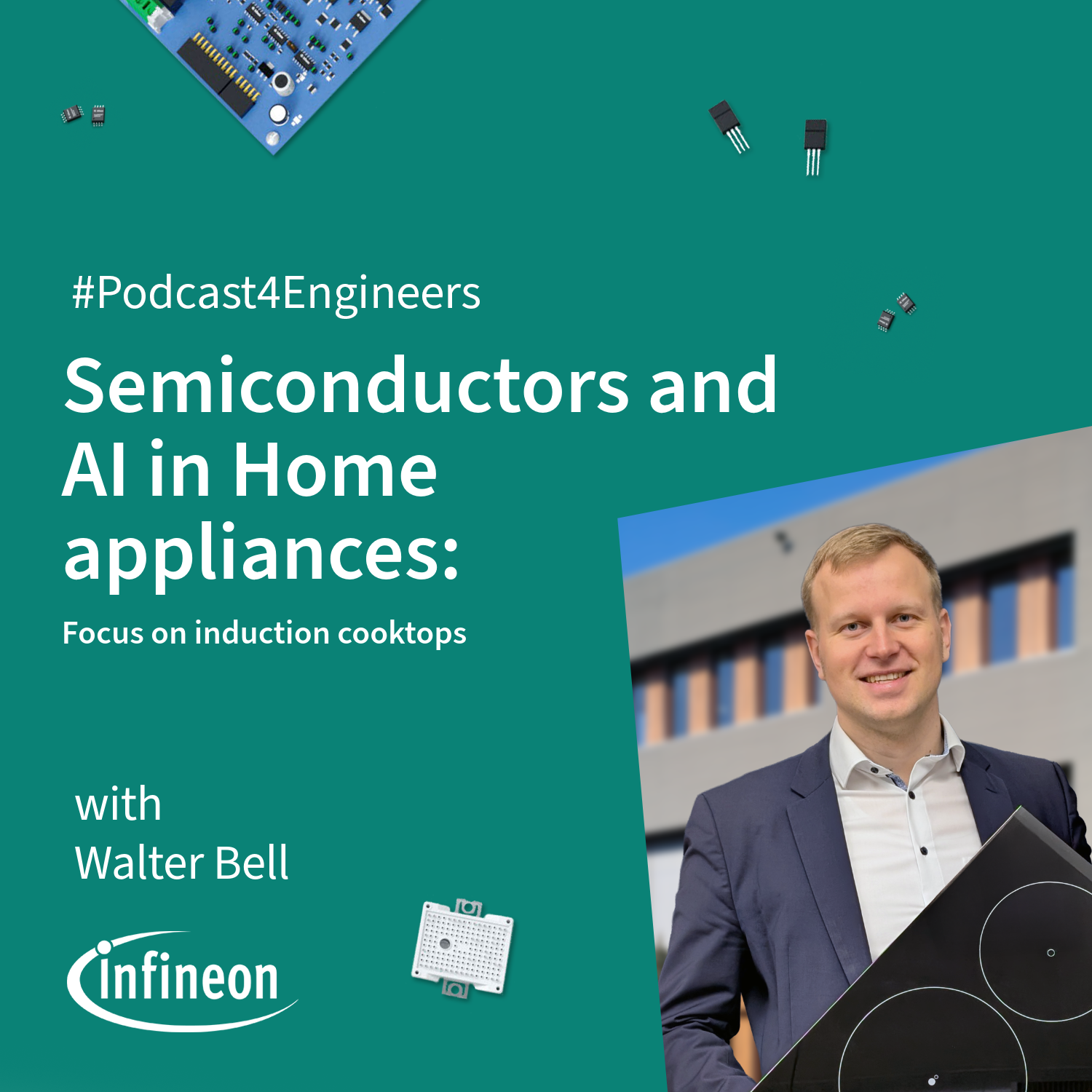
In this episode of Podcast4Engineers, host Peter Balint is joined by Walter Bell, Director of Application Marketing for Home Appliances at Infineon, to discuss the latest trends and innovations in induction cooktops. They explore the benefits of induction cooking, including its energy efficiency and flexibility, and how semiconductors are playing a crucial role in improving the technology. Read the infineon.com/gated/infineon-engineering-modern….
Transkriptvom Podcast bereitgestellt · Zeitmarken springen hin
We believe in a green planet. And therefore we need to make sure that we all want, home appliances. We will, we want to turn them on. But, everyone, when making a decision to buy a new device can make a decision to buy one that has lower power consumption. Hello and welcome to the Podcast4Engineers.
It's the podcast you just have to listen to if you're interested in what's going on in the semiconductor market. I'm your host, Peter Balint and today I am joined again by Walter Bell. He's the director of application marketing specifically for home appliances here at Infineon. Thank you for coming today and welcome.
A big pleasure from my side to be back. Thank you for inviting me again. So last time we had a very interesting conversation. We talked about things like, what role does the semiconductors play in home appliances...things like AI in home appliances and, computing on the edge versus, cloud computing for home appliances.
And we really learned quite a bit. And today I was hoping that we could maybe do a deep dive on a specific application and something that's, close to you, which is induction cooktops. So, maybe you could give us the rundown and kind of what's interesting for you about these induction cooktops and what you focus on and what's our what our, our customers focusing on. Yeah.
So induction cooktop is, really, most innovative topic. It's the most modern way how you can, cook your dishes today. It's the most energy saving you have direct heat transfer. So induction cooking is, the best in terms of energy efficiency. If you're looking at anything, induction cooking will have, the most flexibility it is will boil your water the fastest.
It has a very good heat transfer, like gasoline cooking. So, it has a lot of, benefits, cooking with induction. And, when I started to to work on the first induction cooktop or when I had my first induction cooktop, I thought that this all, coming, from, first time had a touch interaction. And this touch interaction did not really, work as I expected...it was, beeping all the time.
It was not reacting to, to my inputs. And this is something I found this quite annoying. But this is also, quite some time back. So it's, ten, 15 years, back that this happened. And when I, took over induction at Infineon as a topic, and I've seen how far this has progressed. I was really, astonished.
So, hope that everybody out there, who's listening to us today knows that, this is not going to happen with the next cooktops. The, CAPSENSE™ technology has improved, significantly. It's now, more sensitive. It's faster in responsiveness to sensitivity. Helps us to make it, water robust. So when your water is boiling over, when you're cooking something and you need to wash it away, you will not be, traumatized by, a lot of alerts that you are getting from your induction cooktop.
This is something with, more with better technology, we are able to fix this. And, I think this is, when I first laid hands on the really modern cooktop. This was a big game changer for me, as I knew. Okay, this is the what I want in my next cooktop. Therefore, we need to make sure it's getting there.
So people who have maybe negative experiences from a few years ago with induction cooking, this might be a thing of the past. With the advent of semiconductors and better controls within the induction cooktop. Exactly. So it's, the controls of the induction cooktop, also things like heat transfer, the coils got much better.
We have, devices that are able to transmit, a lot of, energy. So if you had to experience that, you know, it's not cooking evenly. That's, changing now with multi-zone induction cooktops. So there is a lot of innovation going on in the induction cooktops. It's. Yeah, simply the the most versatile and innovative way how you can cook your meals. Okay.
And when we think about our appliances getting smarter, or we could call them, I guess smart appliances. The one thing that comes to mind is this idea of presence detection. Because, this is a way that the user can really interface with, with the machine. So tell us a little bit about that and how that works and how effective that is.
So, with more digitalization in your home appliances. So that means, usually that, in the background when you have a display, on your home appliances, this needs to be activated. So, basically it's running. It's a small computer now, and, in these small computers, as you experienced at home, have a little bit of a startup time.
And, people are sometimes also frustrated. Okay. I'm now in front of my appliance. The cannot touch it. I need to wait. And this is something that, will also change with technology. I'm thinking here of presence detection, presence detection allows you to, recognize when, people are in the room, close to their, devices.
You can do that with CAPSENSE™ , for example. But you can also do this, with other ways, with radar technology or also with, wireless connectivity. You can detect if somebody is close to the machine. And, this helps us to make sure when you want to use your device, it's already up and running. And on the other hand, when you're not in the room, it's turning off.
It's, not consuming your power. Again, we want to save electricity, and, this, also, will be enabled with presence detection in your home appliances. Okay, but it won't make you cook any better necessarily, will it? No, it won't make you cook any better. You need AI to do that, I see. Okay. Now let's talk about, in terms of semiconductor solutions in the, induction cooktop arena.
If you haven't addressed it already, then what is the presence of semiconductors in a, in a, if you could run down the list of it, what the importance is a of these devices. So, first of all, I'm, I pointed that the power, of the induction cooktop is great. In order to have great power delivery, in your devices, you need great IGBTs which we are offering, to operate and IGBT you need, gate drivers.
You need, a control logic, you need a microcontroller which is able to control it to make sure it's in the always in a safe state and safe operation. And, this is something that we can offer. Of course, you will need to, general, power in your device. Voltages. We have, auxiliary power devices that can directly transform the AC voltage that you have from the wall plug to DC voltages that you can use, to operate your, microcontrollers in your device, your gate drivers.
So everything that needs to function, will be powered on. And of course, HMI. HMI is a big, topic, as well as connectivity to make sure that, you can connect your devices, and, they are online and, are interacting with your smartphone. Okay. And we talked about this concept of your appliances being online in the last episode.
And if you didn't see it, then check it out because it's really interesting. But I wonder now, is is it just a matter of time before all of our appliances are online, or will there be a time when if you don't want your appliance online, you could choose this or what direction are we headed in in this area?
So and I think, since, since I think in the last ten, 15 years I've seen that more and more devices got connected and I think, we are following this trend. I think, we will get, more smart features. The trend to Matter that we mentioned in the last, session, will be a big game changer for connectivity if you go to, any, yes.
Electronics store and you look for, new laundry machines, the need to make them more energy efficient, is now today, leading to all of these devices having connectivity. I think it will go a little bit faster for some appliances, where you directly can say, okay, I can save power by connecting it to the internet for other devices where it, helps you to get, an easier user interface, for example, by controlling it through your phone and always knowing, if your, induction cooktop is still on while you're already at the airport.
This is, a feature and functionality that will be easier and cheaper to integrate over time. So that's the great power of semiconductors, that, with each generation, we are making things, more advanced in performance, lower in power consumption and usually also cheaper in price for our customers. And that's the, the big part of semiconductors that we can deliver into, those devices.
Okay. And, you know, whenever you talk about putting something online security, this is always the big question. I'm curious, what are you doing to address these security concerns. And maybe not just you, but the and the community of of developers. Yeah. So, security is a big aspect. You do not want to basically, if you have a microphone in your devices to, be online all the time with your voice that somebody can enter in your private space and, to make really sure that, this is not the case, from Infineon side we make sure that, anytime, security vulnerabilities, we fix these in the firmware, that we are providing to customers, we make sure that, you are receiving, regular updates.
We make sure there is a new regulation coming from the European Union. It's the Cyber Resilience Act. This will come into effect in December of 2027. And, at that point, everyone who is, selling home appliances, but not only home appliances, basically connected devices will have to make sure that over the lifespan of this product, they are staying safe.
They are getting updates and, that known vulnerabilities are getting fixed. So I think this is, will have a huge impact, for us as users of these devices and, having a good feeling that, yeah, they are secure. Okay. And it sounds like there's a lot of interest in this regulation moving forward. Yes, absolutely.
So, basically, as this is already, in two years from now, usually development cycles are, about, in this time frame. So, two years for home appliances as a development cycle is, is quite common. And to... that means you need two to start with it now, it means that by the design of the device that you're, making, it's already having this thought, of security built in.
We do this with, microcontrollers and the firmware that we are delivering. So security is one of the, core know-hows Infineon has not everybody is allowed to, produce passports. And passport chips, for you, we are. And we have, this by heart, to to bring this also to our customers. So what does Infineon offer in terms of, development?
And are there, kits or reference boards or, what do you have out there? Yeah. So if you, for example, want to start with, building your induction cooktop today, I would, recommend you, just, type into Google Infineon induction cooktop. We have for all our home appliances and, even more applications, landing pages that will show you.
Okay, these are the most modern, products that you can use in your appliances today. So you will find all the material there. You will find application presentations that show you. Okay. These are the products that we would recommend to use. Others are using this already. And this gives you a head start.
Basically in your development, these are, the next generation products that you could, can select, and, I think this is a way how you can get easily, access to evaluation boards, but also, more information, what you can use in your appliances overall. okay. ...and where the trends are. So it pays to sort of stay in touch with Infineon as a, provider for these, for this information and for these products.
And we will have a link in the show notes to, tell you where to go for this. So we've talked about AI in appliances. We've talked about, connectivity. Where do you see the future? This is always an interesting question. I mean, here we are now, what is it in five years? What is it in ten years? So I think, a big topic, that I see is this the cycle.
And, I mentioned in the first session, it's a cycle of digitalization and decarbonization. And this is really also, by what, what we believe from Infineon side, we want we believe in a green planet. we want we believe in a green planet. And therefore we need to make sure that we all want, home appliances.
We will, we want to turn them on. But, everyone, when he making a decision to buy a new device can make a decision to buy one that has lower power consumption. And, we do this, with, like, wide bandgap material. I see a huge trend in home appliances going towards wide bandgap. That means gallium nitride and silicon carbide.
So, new technologies that you can use in your appliances that will, not make your motors spin different, but with lower energy consumption. And I think that's, big advantage here. And, the other thing I would like to, to mention is, it's, we we have certain technology that we want to, our audience to see, what what really excites me is also what I see, coming from the market.
So not every, brilliant idea, is coming from us. But, also, from the market side, customers which are releasing vacuum cleaner, cleaners, which just look like a stick, just like a traditional mop. And this is, I've never seen such a product before. There are, customers out there which, making new laundry machines, which have three drums.
So you can, wash three things, at the same time. Never seen that before. And, also in robots, robot vacuum cleaners that, are now attached with an arm that can pick up things and bring it to the right location, whatever you have to find in your home. And I think these, a couple of really interesting things that we are seeing from the market, where I'm excited, that, that, new technology can add to it, make things smaller.
And, I'm excited to see from our audience what they are coming up with new ideas, with smaller devices, more energy efficient devices that can last longer with the smaller battery and allow them to build a new form factor. And it sounds like you're always open to the challenge of whatever's on the market to make it better and more efficient.
Yeah, good. Well, I think we learned a lot. And this topic, I think is very interesting because it appeals to such a wide audience. So, thanks for your knowledge today. I really appreciate you coming in. Thank you, Peter, for having me. And to our audience, I say thanks for tuning in today, we will have, information in the show notes, so please have a look and we hope to see you real soon.
Thank you. Thank you very much. Bye bye.
