

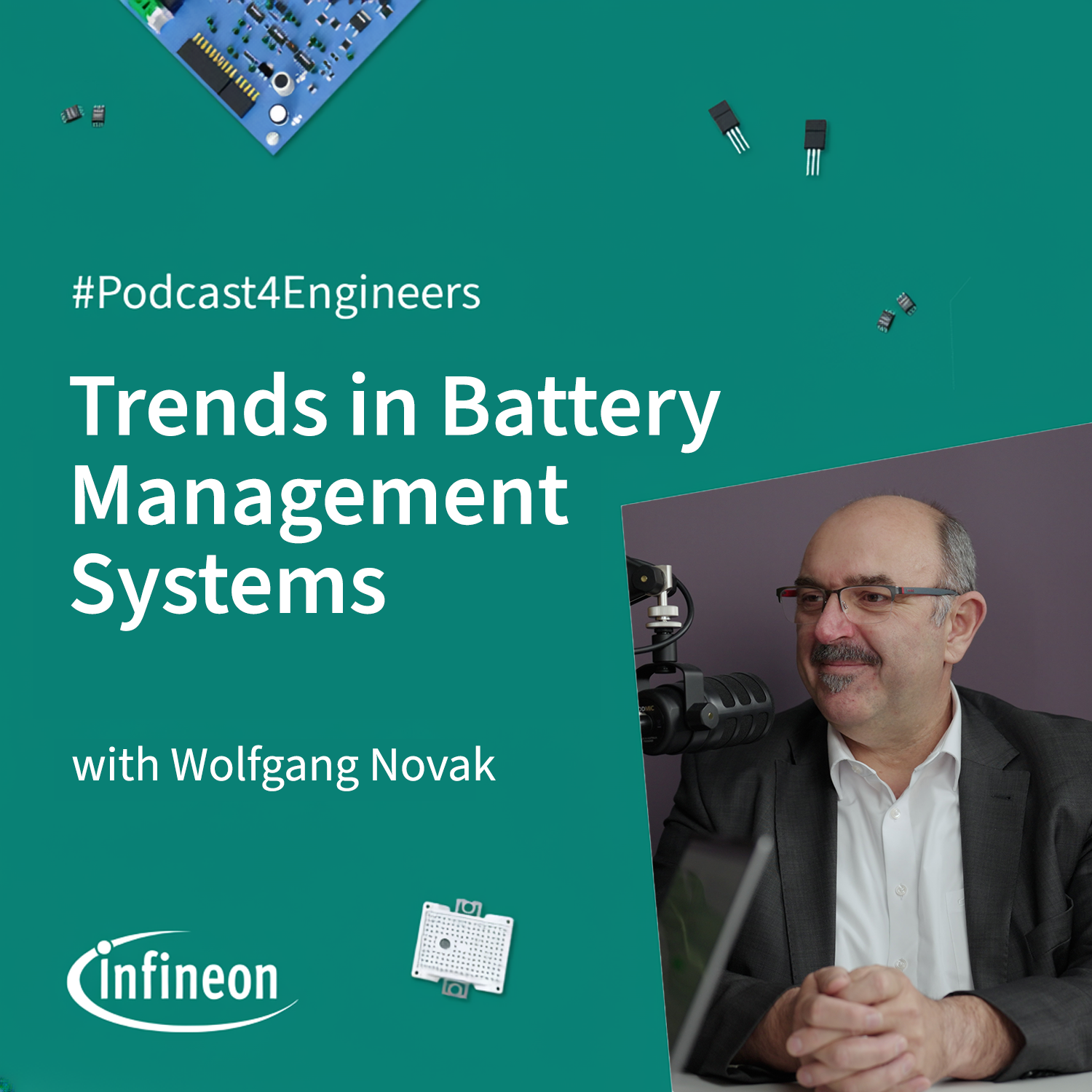
Podcast4Engineers· Folge 75
Trends in Battery Management Systems (BMS)
Freitag, 30. Oktober 2026 · 23 min
Kapitelklicken springt direkt hin
Shownotes
In this episode of the Podcast for Engineers, host Kelsey speaks with Infineon system architect Wolfgang Novak about the critical role of Battery Management Systems (infineon.com/applications/automotive/electric-…) (BMS) in electric vehicles. They explore how advanced BMS technologies improve battery safety, performance, and lifetime by accurately monitoring voltage, temperature, and state of charge. The discussion highlights future innovations such as electrochemical impedance spectroscopy, AI-powered battery analytics, and smarter system architectures. Wolfgang also shares insights into a groundbreaking silicon carbide proof-of-concept capable of disconnecting 800V and 650A in just two microseconds, dramatically improving electrical safety. Tune in to discover how next-generation battery management is shaping the future of electric mobility.
Transkriptvom Podcast bereitgestellt · Zeitmarken springen hin
(light music)
- We have created a proof of concept board
that can disconnect 800 volts and 650 ampere continuously in two microseconds.
- So it's really fast. Okay. 1,000 times faster than electromechanical systems are. Yeah, it's a big improvement, a thousand times. That's a big improvement,
and it can help us to level the short-circuit current. The short-circuit currents can go up to 15,000 amperes in such a system. (transition whooshes) (light music continues) (letters clacking) (light music continues)
- This is the "Podcast4Engineers,"
the show where we translate today's engineering challenges into tomorrow's systems. We talk a lot about power on this podcast, and we've even talked a lot about storing energy at large scale. Today, we're zooming into the vehicle, though, specifically automotive battery management systems, or ABMS, for short.
I'm Kelsey. I'm your moderator. and I'm joined by Wolfgang Novak, who's a system architect here at Infineon. Wolfgang, thank you so much for being here.
- Thank you for the invitation. Before we start, let's talk about BMS
because we're going to be saying the word BMS, this acronym, quite often. It means battery management systems, but what exactly is there to manage inside a battery of an EV or a hybrid vehicle?
- So a lithium ion battery,
that this stores the energy in an electric vehicle, has to be controlled by a battery management system so you can operate it only in a safe operating area in terms of temperature and voltage. And the intention of this management is to ensure the battery safety, to increase the battery performance, and to optimize the battery performance and to increase the battery lifetime.
- Mm-hmm, I think a lot of things have evolved
in terms of EVs over the years, including the battery management systems. What are some of the biggest trend drivers that are really pushing forward these changes?
- So I think, first, always is safety.
So you don't want to go into a fire or... So if you operate the battery outside of the safe operating area, you have the danger to come into, to reduce lifetime, and to get into a EV car fire.
- We don't want that. Yeah, we don't want that.
Second topic is of course increasing the range. That means using the energy content in the battery system as efficient as possible, and also increasing the lifetime. So in the moment there are guarantees from OEMs about batteries for eight or 10 years and more than 150,000 kilometers.
- Yeah. It's a big investment.
So you want to make sure that it pays off in the end.
- Exactly. So you talked about safety, performance, and lifetime.
Let's talk about safety first. You mentioned safe operating...
- What was it? Area. Safe operating area.
What happens if your battery's not operating in the safe area? And how can we prevent it from going outside that area?
- So if you're going outside that area,
so the safe operating area is mainly defined by voltages and temperatures. So you have a minimum voltage and the maximum voltage where you have to operate your cells, and you have a minimum temperature and the maximum temperature. And if you go outside of this area, then you create or you stress the chemical inside the cells so that it reduces the lifetime, it reduces the performance, and in the end it can cause a terminal event.
And that's when we create internal short circuits. It can lead even to a fire, as mentioned before, yes.
- I mean, it sounds like there's a lot of complicated things
going on in a battery. So what are some of the biggest challenges that designers have when compensating for this complication?
- So there is of course keeping the cells
inside this operating area. So you have to detect the voltage of the cells very accurately, and you have to detect the temperature of the cells. And unfortunately we do not have temperature sensors inside the cells because it would be too expensive and also not so easy to implement a temperature sensor into that cell.
So we are measuring the temperature outside of the cell and then estimating the cell temperature, also according to the load situation and the voltage that we measure.
- Mm-hmm. And there is a second point
in terms of safety that we have to recognize, and that is the electrical safety. So you have a very high power and you have very high energy. So electrical car batteries are handling 800 volts, up to 1,000 volts, and also delivering currents of 1,000 and more amperes. So that's a very great challenge.
You cannot disconnect and handle that so easily.
- Okay, are there any...
So how are we handling it right now?
- So we are handling that right now.
So we are measuring the voltage of the cells. I mentioned the estimation of the temperature of the cells. And in safety terms, we are disconnecting that with mechanical relays in the moment. And these mechanical relays are protected by melting fuses or by pyrofuses. So that means if you have to disconnect 1,000 amperes, there is a very high current, and you can create an arc if you disconnect mechanical contactors; you can create an arc that can lead to a welding, and the contacts of these relay can weld together.
So then you are not able to disconnect anymore. And that's the reason why you need this melting fuse or a pyrofuse that is controlled with a pyrotechnical element. And you can fire it at a certain amount of current, and then you can disconnect the high energy from the powertrain.
- Okay, so this is like...
Is this the future then already that you're describing here, or are we...
- No, in future, we will have different methods.
So for the detection of the thermal runaway and for the safety, we will use different measurement methods. So like for example, electrochemical impedance spectroscopy in future; that will be much more accurate and will give us a much better calculation of the cell temperature inside than these estimation methods that we use now.
So that is one point. And in the terms of electrical safety, we will use semiconductor switches in future that are able to disconnect the battery from the powertrain much faster than these electromechanical components can do it now.
- Are we talking about certain materials like wide bandgaps,
liquid carbide, or is it a different type of technology?
- We are talking about silicon carbide in the moment
that's going up to 1,000 volts, above 1,000 volts, and can handle these high currents. And we have created a proof of concept board that can disconnect 800 volts and 650 ampere continuously in two microseconds.
- So it's really fast. Okay.
1,000 times faster than electromechanical systems are.
- Yeah, it's a big improvement, a thousand times. That's a big improvement,
and it can help us to level the short-circuit current. The short-circuit currents can go up to 15,000 amperes in such a system, depending on the whole system configuration and on the impedance in the system. But if we can disconnect in two microseconds, we can level it down to around 200 to 500 amperes, and that's a different story.
- Okay.
You mentioned a total of three. So after safety came performance, right? And I don't know that a lot of people associate electric vehicles with performance in terms of pedal to the metal gas speed, but maybe you have an opinion on that.
- I have an opinion on battery.
And electric cars are creating high accelerations, very high accelerations. The reason is, first, the torque that is available in an electrical motor instantly. And the second one is of course the high energy and the high power that can be provided by the electrical system. And so you can create accelerations in sports cars below three seconds, from zero to 100 kilometers per hour.
- Yeah, which seems pretty fast. (laughs) It's pretty fast, yeah. But I bet this puts a lot of strain on the battery,
and it makes it even more important that we have good battery performance that we're able to measure it and improve it, right? So what are some of the things that we're doing to measure battery performance or to improve it?
- To improve the battery performance,
we have to calculate, and it's the same story, so we are measuring the voltage and we are measuring the temperature. And so you need to have a very accurate measurement of the voltage and of the current, also of the current, so that you can always know where you stand, and you don't have to add safety buffers.
So if you need to add safety buffers, you need to limit your energy content that you can use out of the battery. And the second one is we have to avoid chemical processes that lead to a faster aging. And that's very important for the charging of the system, for example. So you have to limit the charging current, that you can really do a fast charging, but you are not exceeding the current so that it would come to lithium plating or to really damage of the chemical system.
So in the meantime, there is fast charging rates of around 10 to 15 minutes from 10 to 80% state of charge are very common.
- Yeah, on the Autobahn, on the highways,
do you see chargers?
- Yes, it's coming more and more.
So it's a lot. And you have a very good charging net and charging grid in Europe. You have charging stations nearly everywhere, so it's not a problem. If you go out of Europe and if you go to not so industrialized regions, it's a little bit more difficult. So then you have more topics with charging.
- But how are then designers designing efficient systems
with all of this in mind?
- The design of these efficient systems
is really taking into account the state of charge. So we have to calculate the state of charge very accurately. That's not so easy, even if you look at different chemistries. For example, at lithium iron phosphate, you have to do some special methods like Coulomb counting to get this accuracy. And then you can really use the whole content of your battery, and you don't have to add 10% of buffer that you cannot need because you don't want to stop on the street even if you have 10% of charge in your battery.
- Okay.
And so monitoring the way that we're monitoring cells to make more efficient systems, does it look the same today as it did five years ago or 10 years ago maybe? (chuckles)
- It was worse 10 years ago. Okay. But it's getting better, but we still are remaining
to the conventional measuring methods. It will become better in future if we look at, for example, this electrochemical impedance spectroscopy.
- So we can- Or is there a short word?
This is a mouthful of words: electrochemical impedance spectroscopy.
- EIS? So we usually use
the abbreviation, EIS, so it's much easier.
- Okay. And it's a real bad word for a podcast. Yeah.
Okay, but you said the EIS is going to make an impact then.
- It makes an impact, and it will be
much more accurate, and it will be possible to calculate even in chemistries that are very difficult to handle, to calculate the states of charge very accurately, and then really use the whole energy content that is in the battery.
- Okay, so you've mentioned a few state of words
so far in the podcast: state of charge, state of health. I think you mentioned state of power also. Can you explain a little bit about what state of power means?
- State of power means what is the remaining power
that the battery can deliver in its actual state of charge. For example, if you look into aviation applications, there are a lot of drones and especially air taxis that want to do a vertical takeoff and landing.
- Uh-huh. Yeah, straight up and down. Straight up and down, exactly.
And that takes a lot of power. And that costs a large amount of energy. So you always have to know where you stand. Because if you can go up, you also want to go down.
- So it would not make sense- Softly. (laughs)
to have not enough power to land. Because then gravity takes control, and that's not a thing that you want to have in an aviation application.
- Okay, so state of power is also becoming
more and more important
- then as well. Yes. Okay, so we've talked about safety,
we've talked about performance, and there was one other word you mentioned: lifetime. Let's talk a little bit more about battery lifetime. Why is this so important?
- It's important
because if you buy a car, it's a large amount of money that you spend, and it's a large...
- Investment, right? Investment, yes.
And so you want to ensure that your battery is not giving up after two years, okay? So in the moment, battery lifetime goes, or most of the OEMs give guarantee to the batteries for about eight years or 150,000 kilometers.
- Mm-hmm. So
the first results or the first observations of the fleets are giving us indications that the batteries are living much longer than expected in the first development stage.
- Okay, so this first generation of batteries
is then even not outliving the car perhaps, but I hear a lot about second lifetime of batteries and everything. Is this also something the industry is thinking about considering?
- Yes, it's considered,
and it's highly recommended by politics. And so usually the batteries are living their first life in an electric car until they go down to 80% of their capacity. So that means 80% state of health. Now we have the "state of" wards again.
- Yeah. (laughs)
And afterwards, the battery is not dead, so it can serve down to a much lower state of health. And you can use it then in the second life, for example, for a home application or for industrial application in a stationary battery storage system, for example. So that could be the second life that the industry is thinking about.
In Europe, we have the situation that politics has given us the new battery regulation.
- This is the battery passport, right? Yes, it's also known as battery passport,
but it's not only dealing with this passport, also dealing with recycling rates.
- Okay. So you have to recycle
the materials that are inside the battery, and you have to use a certain amount of recycled material if you want to create new batteries. So that's the intention, is to bring the whole industry in a circular economy.
- Okay.
So yeah, I mean, lifetime definitely makes sense from a consumer point of view. So what is actually killing the lifetime of batteries?
- So killing the lifetime could be,
as mentioned before, operating outside the safe operating area.
- So the temperature, the voltages. Okay. Exactly.
So charging at very low temperatures, for example. So if you want to put a lot of power into this chemical system, electrochemical system at minus 10 degrees Celsius, it's not good for the lifetime. Operating outside the voltage area and stressing the batteries too much could lead to some chemical procedures inside the battery, leads to lithium plating, for example.
That means there is a deposition of lithium, of metal lithium, at the electrode surface. And that could increase the inner resistance of the battery cell. So you create more heat during operation. And increasing the resistance could lead to shorter lifetime. So that's one of the main reasons. But that can also, there can be mechanical stress on the cells, leads to cracking of the material, for example.
And all that could lead to a damage of cells.
- Okay, and I mean, I guess we're also looking,
you said the OEMs, it's very important to extend lifetimes. So how are we looking at measuring and monitoring lifetimes right now? What are we doing today?
- So we are calculating,
out of the measurements we do with voltage, current, and temperature, we are calculating also the state of health. And this state of health is always with a relative uncertainty. And so if we can have a more accurate voltage result, measurement results, then we can also calculate the state of health more accurately.
That will be improved in future also by some machine learning routines and by using artificial intelligence inside the microcontrollers, and inside the software of these microcontrollers, to make this calculation more accurate.
- And so microcontrollers are becoming
even smarter to adapt.
- Exactly. Okay.
If you're a designer right now who wants to start designing with these future ABMS systems, where's the first place that they should go?
- So they should come to and visit infineon.com. Absolutely, of course.
(both laugh)
- Because we are providing a lot of evaluation
and demo boards for all the components that are inside the battery management system. So we have finished a battery, a complete battery management system demonstrator where you can order all of the components on infineon.com.
- Okay, that sounds like a good place to start, to speed up.
So before we wrap up, I always like to get the expert's perspective on where we're going in this field. So where do you see automotive battery management systems evolving over the next five to 10 years? What's next?
- So there will be special trends coming up.
One of them is, we call it X-in-1. And that's a kind of integration that a large microcontroller with a lot of calculation power is used by more than one systems. And the frontends that are doing the data acquisition and the measurements are becoming more intelligent. And so the line between frontend and microcontroller will be a little bit shifted.
- Okay. So that will happen.
And there will be also different new methods for measuring the data, like EIS, mentioned before. And this will be topped by the usage of machine learning routines in the calculation software. So when we are calculating the parameters of the battery, we will use these new routines, and then will be more accurate, create more safety, more performance, and more lifetime.
- Great, it sounds like we're in a good space for BMS,
but things are looking even brighter in the future. So thank you, Wolfgang, for being on the "Podcast4Engineers."
- Thank you. And thanks to everyone for listening
to the "Podcast4Engineers." If you enjoyed this episode, follow the show and share it with a fellow engineer. And be sure to stay tuned for upcoming episodes on automotive battery management systems. We'll see you next time. (light music continues) (light music fades)
