

Kapitelklicken springt direkt hin
Shownotes
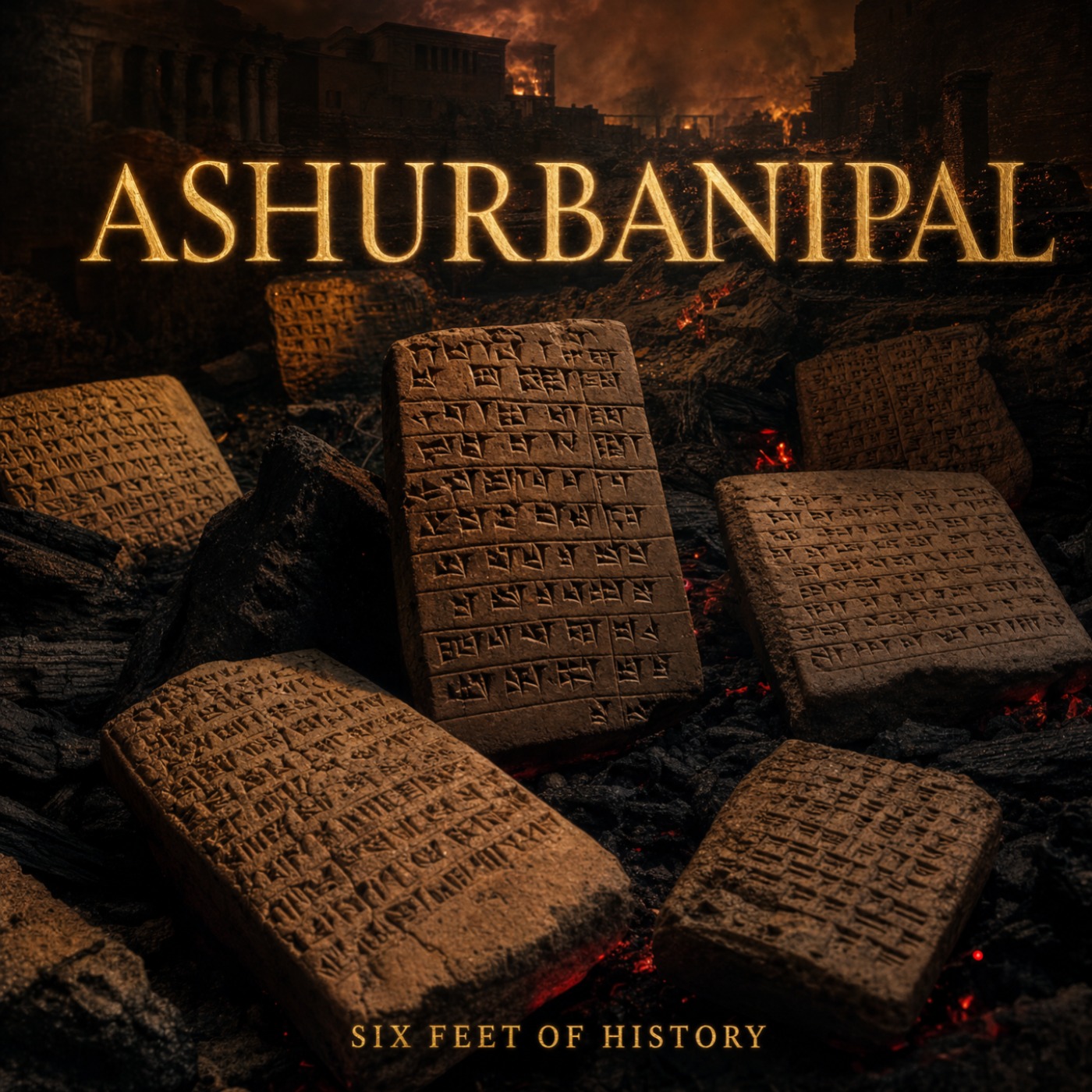
<p>When an empire burned an ancient palace to the ground, it should have destroyed its greatest library. Instead, because the books were made of clay, the fire baked them hard and preserved them for two and a half thousand years. Buried in the ruins was the oldest story ever written — a king, a great flood, and a search for immortality, a thousand years before the Bible.</p><p>August Mercer tells how a catastrophe saved humanity's first epic. This is Six Feet of History — five minutes of the past they'd rather you forget.</p><p><em>Follow for a new story every day. A Dark Whisper Studios production.</em></p><p><em>#history #truehistory #truestory #truestories</em></p>
Transkriptvom Podcast bereitgestellt · Zeitmarken springen hin
[SPEAKER_00]: A palace burns to the ground nearly 3,000 years ago, and in burning, it accidentally saves the oldest literature on earth. [SPEAKER_00]: The fire that destroys the Empire's greatest library does not consume its books, because the books are made of clay. [SPEAKER_00]: And the intense heat of the flames does to those clay tablets exactly what a kiln does to a pot.
[SPEAKER_00]: It bakes them hard, and preserves them buried in the ruins for over 2,500 years. [SPEAKER_00]: When archaeologists finally dig them out, they find tens of thousands of tablets, and among them, a story. [SPEAKER_00]: A story about a king and a great flood and a desperate search for immortality written down a thousand years before the Bible.
[SPEAKER_00]: The oldest surviving great work of literature in human history. [SPEAKER_00]: And we very nearly never knew it existed. [SPEAKER_00]: This is six feet of history. [SPEAKER_00]: Five minutes of the past they'd rather you forget. [SPEAKER_00]: I'm August Mercer. [SPEAKER_00]: And tonight, the Library of Ashabani Pal and the Epic of Gilgamesh, the fire that preserved a lost world and the discovery that stunned the Victorians and rewrote the history of storytelling.
[SPEAKER_00]: the setting is the Assyrian Empire, one of the great powers of the ancient Near East in what is now northern Iraq. [SPEAKER_00]: And in the seventh century before Christ, its ruler was a king named Ashyabani Pahl. [SPEAKER_00]: Ashyabani Pahl was by the standards of ancient kings an unusual man.
[SPEAKER_00]: He was a fearsome warrior and a ruthless ruler as Assyrian kings tended to be. [SPEAKER_00]: but he was also literate, genuinely deeply literate, which was rare for a monoc of his time when reading and writing were specialist skills left to a trained class of scribes. [SPEAKER_00]: Ashabani Pal could read.
[SPEAKER_00]: And more than that, he was a passionate collector of knowledge. [SPEAKER_00]: He set out quite deliberately to build the greatest library in the world. [SPEAKER_00]: He wanted to gather in his capital city of Nineveh, a copy of all the knowledge of Mesopotamia, the accumulated learning of a civilization that was already in his time thousands of years old.
[SPEAKER_00]: And he pursued this with the full power of an empire. [SPEAKER_00]: He sent scribes and agents out across his lands and beyond to temples and archives and scholarly centers with instructions to find, copy or seize important texts and bring them to Nineveh. [SPEAKER_00]: He acquired tablets by every means, commissioning copies, demanding them as tribute, and simply confiscating collections outright.
[SPEAKER_00]: And the writing itself needs explaining, because it is central to why any of this survived. [SPEAKER_00]: The Mesopotamians wrote in a script we call qnaiform, wedge-shaped marks pressed into the surface of soft clay tablets with a reed stylus. [SPEAKER_00]: Once written, the tablets could be dried or baked and they were durable.
[SPEAKER_00]: As civilization's entire literature, its laws, its science, its religion, its business records, all pressed into little tablets of play. [SPEAKER_00]: And Ashabanepal gathered tens of thousands of them into his library at Nineveh. [SPEAKER_00]: It was a staggering collection, a systematic attempt to hold the entire intellectual inheritance of Mesopotamian civilization in one place.
[SPEAKER_00]: There were texts on astronomy and astrology, on medicine, on mathematics, on omens and divination, on religion and ritual. [SPEAKER_00]: There were dictionaries and word lists, there were royal records and letters and legal documents. [SPEAKER_00]: and there was literature, myths, hymns, and epic poems, some of them already ancient by Ashabani Pal's Day.
[SPEAKER_00]: It was in a very real sense the Alexandria of its age. [SPEAKER_00]: But earlier and, as it turned out, far lucky are in how it was lost. [SPEAKER_00]: Because the Assyrian Empire, like all empires, fell. [SPEAKER_00]: Not long after Ashabanipal's reign, a Syria was overwhelmed by its enemies, and in the late 7th century before Christ, its great capital, Ninniver, was captured, sacked and burned to the ground.
[SPEAKER_00]: And the palace, with its magnificent library, burned with it. [SPEAKER_00]: Now, if that library had been made of papyrus, like Alexandria, or of parchment or paper, the fire would have been the end of it. [SPEAKER_00]: Everything would have turned to ash and smoke, and the knowledge of Mesopotamia would have been lost forever, exactly as the contents of Alexandria were lost, but it was made of clay.
[SPEAKER_00]: And when you put clay in a fire, you do not destroy it. [SPEAKER_00]: You fire it, you harden it. [SPEAKER_00]: The flames that consumed Nineveh reached the tens of thousands of clay tablets in Ashobani Phaos library, and rather than burning them away, they baked them solid, turning fragile sun-dried clay into hard, durable, kiln-fired ceramic.
[SPEAKER_00]: And then the burning palace collapsed on top of them, bearing them in a protective layer of rubble and debris, and there they lay. [SPEAKER_00]: For over two and a half thousand years, [SPEAKER_00]: A whole library, accidentally preserved by the very catastrophe that was supposed to erase it, sleeping under the ruins of a dead emperor in the desert of northern Iraq.
[SPEAKER_00]: The rediscovery came in the middle of the 19th century, when European archaeologists began excavating the ancient mounds of Mesopotamia. [SPEAKER_00]: And when they dug into the ruins of Nineveh, they found the tablets, thousands upon thousands of them, along with the magnificent carved stone reliefs of the Assyrian palaces.
[SPEAKER_00]: The tablets were shipped back in enormous quantities principally to the British Museum in London, where they sat waiting to be read. [SPEAKER_00]: Because there was a problem, at first nobody could read them. [SPEAKER_00]: and the pain-staking work of deciphering it, one of the great intellectual achievements of the 19th century was still in progress.
[SPEAKER_00]: So the tablets from Nineveh arrived as a vast pile of mute, wedge-covered clay, holding secrets no living person could yet unlock, and then slowly uniform was cracked. [SPEAKER_00]: And scholars began for the first time in thousands of years to read the words [SPEAKER_00]: And in the 1870s, a self-taught scholar at the British Museum named George Smith was working his way through the Nine of Attablets, when he came across something that stopped him cold.
[SPEAKER_00]: He was reading a fragment of an epic poem. [SPEAKER_00]: And in it, he found a story about a great flood, a flood sent by the gods to destroy humanity, a man instructed to build a great boat to save himself his family and living creatures. [SPEAKER_00]: the boat coming to rest on a mountain as the waters receded, and the man sending out birds, releasing a bird to see whether it would find dry land.
[SPEAKER_00]: If that sounds familiar, it is because it is unmistakably astonishingly close to the story of Noah's arc from the Book of Genesis. [SPEAKER_00]: but this tablet was a thousand years older than the biblical account. [SPEAKER_00]: George Smith, reading this, reportedly became so excited that he leapt up and in the stage surroundings of the British Museum began to undress in his enthusiasm.
[SPEAKER_00]: He had realized what he was holding, and a count of the flood older than the Bible from a lost civilization. [SPEAKER_00]: It caused a sensation, the story broke in the newspapers. [SPEAKER_00]: It was, for the Victorian public, deeply religious, and just beginning to grapple with new scientific challenges to a literal reading of Scripture and earthquake.
[SPEAKER_00]: The flood story turned out to be part of a much larger work, the epic of Gilgamesh. [SPEAKER_00]: And Gilgamesh is the treasure at the heart of this whole story. [SPEAKER_00]: It is the oldest surviving great work of literature in the world. [SPEAKER_00]: Versions of it go back thousands of years.
[SPEAKER_00]: Its roots reach back to ancient Sumer. [SPEAKER_00]: Well before Ashabani Pal collected the fullest version we have into his library. [SPEAKER_00]: It predates Homer. [SPEAKER_00]: It predates the Bible. [SPEAKER_00]: It is, as far as we know, humanity's first epic. [SPEAKER_00]: And it is not a primitive or crude thing.
[SPEAKER_00]: It is a profound, moving, sophisticated meditation on the deepest questions human beings have. [SPEAKER_00]: The story tells of Gilgamesh, a powerful and arrogant king, and his friendship with a wild man named Enkidu, who is created by the gods, and becomes his closest companion. [SPEAKER_00]: Together they have great adventures, and then Enkidu dies.
[SPEAKER_00]: and Gilgamesh shattered by the death of his friend and suddenly and terribly aware of his own mortality sets off on a desperate quest to escape death to find the secret of eternal life. [SPEAKER_00]: He searches. [SPEAKER_00]: He suffers. [SPEAKER_00]: He meets the survivor of the great flood who has been grounded immortality by the gods and who tells him the flood story.
[SPEAKER_00]: And in the end Gilgamesh learns the oldest and hardest lesson [SPEAKER_00]: that immortality is not for him, that he will die as all people die. [SPEAKER_00]: And he comes home to his city and finds a kind of peace not in living forever, but in what he has built and what will outlast him.
[SPEAKER_00]: The great walls of his city, the works of his hands, the memory he will leave. [SPEAKER_00]: Think about that. [SPEAKER_00]: The very first great story humanity ever wrote down is about a man confronting the fact that he is going to die and trying and failing to escape it and finally learning to make his peace with it.
[SPEAKER_00]: Nearly 5,000 years ago our ancestors picked up a read and pressed into clay the same question that haunts every one of us still we are going to die so what do we do with that? [SPEAKER_00]: The oldest story is our story. [SPEAKER_00]: It has not changed. [SPEAKER_00]: The technology has changed, from clay tablets to scrolls to books to screens, but the thing at the centre of it, the fear of death and the search for meaning in its shadow is exactly the same.
[SPEAKER_00]: We are still writing the epic of Gilgamesh. [SPEAKER_00]: We have never stopped. [SPEAKER_00]: and we only have it, we only know that our oldest ancestors wrestled with these same questions in such a beautiful and sophisticated way, because of a series of accidents. [SPEAKER_00]: Because a literate king was obsessive enough to collect the tablets, because his enemies burned his palace down, because the fire baked the clay instead of destroying it, because the rubble buried and protected it.
[SPEAKER_00]: because thousands of years later archaeologists dug it up, and because a self-taught genius learned to read a dead language and happened to notice a flood. [SPEAKER_00]: Break any link in that chain and Gilgamesh stays lost forever, and we never know that the oldest voice in literature was asking the oldest human question.
[SPEAKER_00]: And that is the beautiful mirror image of the Alexandria [SPEAKER_00]: Alexandria was a library of perishable materials, lost slowly and completely to neglect and decay, taking untold masterpieces into oblivion. [SPEAKER_00]: Ninova was a library of clay and the disaster that destroyed the empire around it was the very thing that saved its books.
[SPEAKER_00]: One civilization's catastrophe erased its knowledge and others preserved it. [SPEAKER_00]: The difference was not virtue or care or wisdom. [SPEAKER_00]: The difference was the material and luck. [SPEAKER_00]: That is the fragile accidental thread by which the deep past reaches us. [SPEAKER_00]: Not a careful, reliable process of preservation, but a scattering of flux and fires and coincidences.
[SPEAKER_00]: Most of the ancient world is gone, silently, the river. [SPEAKER_00]: And just occasionally by pure chance, a fragment survives. [SPEAKER_00]: A palace burns in exactly the right way, and hands us the oldest story ever told, intact, across 3,000 years. [SPEAKER_00]: And there is a poignant footnote to the man who found it.
[SPEAKER_00]: George Smith, the self-taught scholar who first read the flood tablet, became so consumed by the ninn of a material that he traveled to the ruins himself to search for more. [SPEAKER_00]: He found further fragments, including missing pieces of Gilgamesh. [SPEAKER_00]: but the region was harsh and on one of these expeditions he fell ill and died still a young man far from home in pursuit of the rest of the oldest story in the world.
[SPEAKER_00]: He gave his life to recovering the words of people who had been dead for 3,000 years. [SPEAKER_00]: There is something very Gilgamesh about that. [SPEAKER_00]: That's the library of Ashabani Pal and the epic of Gilgamesh. [SPEAKER_00]: a king who wanted to hold all the world's knowledge, an empire that fell, a fire that saved what it should have destroyed, and a story about the fear of death that turned out to be the first thing and the truest thing, that human beings ever bothered to write down.
[SPEAKER_00]: And that is where we will leave it tonight. [SPEAKER_00]: We spend our time here digging through the dark and the buried, and every so often what comes up out of the ground is not a horror, but a gift, the voice of someone thousands of years dead, telling us they were afraid of exactly what we were afraid of, and that they found a way to live anyway.
[SPEAKER_00]: we will keep digging. [SPEAKER_00]: Follow 6 feet of history for a new story every day. [SPEAKER_00]: Next time, more of the dark story is the world tried to bury. [SPEAKER_00]: I'm August Mercer. [SPEAKER_00]: And this was 6 feet of history. [SPEAKER_00]: A dark whisper studio's production.
