

Kapitelklicken springt direkt hin
Shownotes
<p>A city of three million was surrounded, sealed off, and left to starve. The daily bread ration fell to a piece you could hold in your palm — and half of it wasn't flour. Around eight hundred thousand civilians died.</p><p>And yet: truck drivers ran a road built on ice. Scientists starved to death guarding a seed bank they refused to eat. An orchestra of skeletal musicians played a symphony out over the rooftops toward the enemy guns. August Mercer tells what people can do to each other — and what they can endure. This is Six Feet of History — five minutes of the past they'd rather you forget.</p><p><em>Follow for a new story every day. A Dark Whisper Studios production.</em></p><p><em>#truehistory #history #truestories</em></p>
Transkriptvom Podcast bereitgestellt · Zeitmarken springen hin
[SPEAKER_00]: A city of 3 million people is surrounded, cut off and told in effect that it will not be conquered. [SPEAKER_00]: It will be starved, no food will come in. [SPEAKER_00]: The plan is simply to wait and let winter and hunger do the work. [SPEAKER_00]: The siege lasts 872 days, nearly 900 days.
[SPEAKER_00]: and in the depths of the first winter, the bread ration for an ordinary citizen falls to a piece of bread you could hold in the palm of your hand, and much of that bread is not flour, hundreds of thousands of people die. [SPEAKER_00]: And through all of it, the city refuses to fall. [SPEAKER_00]: Scientists starve to death guarding seeds they will not eat, and orchestra plays a symphony to a starving city.
[SPEAKER_00]: This is what human beings can endure. [SPEAKER_00]: This is six feet of history. [SPEAKER_00]: Five minutes of the past, they'd rather you forget. [SPEAKER_00]: I'm August Mercer. [SPEAKER_00]: and tonight, the siege of Leningrad, one of the longest and deadliest seages in human history, and what it revealed about how far people will go in both directions.
[SPEAKER_00]: The city is Leningrad, the old imperial capital, once St Petersburg, one of the great cultural cities of Europe, home to palaces, museums, and around 3 million people. [SPEAKER_00]: The year is 1941, and Germany has invaded the Soviet Union. [SPEAKER_00]: The German advance reaches Leningrad in September, but the plan is not to storm the city.
[SPEAKER_00]: Taking a large city street by street is enormously costly, and there is another option. [SPEAKER_00]: The city is encircled, the land routes cut, the supply line severed, and the decision is taken to blockade it. [SPEAKER_00]: To seal it, shell it, bomb it, and wait for starvation to do what infantry would find expensive.
[SPEAKER_00]: And so, from September 1941, Leningrad is sealed off. [SPEAKER_00]: And the food begins to run out almost immediately. [SPEAKER_00]: The situation was made catastrophically worse at the very start. [SPEAKER_00]: enormous food warehouses in the city were bombed and burned in the first days of the siege, destroying a substantial part of the stored supplies, and the city had never been provisioned for a long encirclement.
[SPEAKER_00]: The rations were cut, and cut. [SPEAKER_00]: And cut again. [SPEAKER_00]: By the depths of that first winter in late 1941, the daily bread ration for a dependent, a child, an elderly person, someone not doing essential work, had fallen to around 125 grams. [SPEAKER_00]: That is a small piece of bread that is roughly a couple of slices per day, and that was very nearly all there was, and it was not really bread.
[SPEAKER_00]: To stretch the flower, the bakeries were mixing in whatever they could, saw dust, cellulose, cotton-seed cake, floor sweepings and other fillers. [SPEAKER_00]: Perhaps only half of that small ration was actual grain. [SPEAKER_00]: And then came the winter, and it was one of the coldest anyone could remember.
[SPEAKER_00]: Temperatures fell brutally, and the city had no fuel, the heating failed, the electricity failed. [SPEAKER_00]: the water pipes froze and burst, so people hauled water from the frozen river and canals through the snow. [SPEAKER_00]: There was no public transport. [SPEAKER_00]: There was no light.
[SPEAKER_00]: So picture the reality. [SPEAKER_00]: It is dark, and it is well below freezing indoors as well as out. [SPEAKER_00]: There is no heat. [SPEAKER_00]: You are burning your furniture, your floorboards, and your books to stay alive. [SPEAKER_00]: You have to eat a couple of slices [SPEAKER_00]: And you have to walk in that condition through deep snow to fetch water and to cue for your ration.
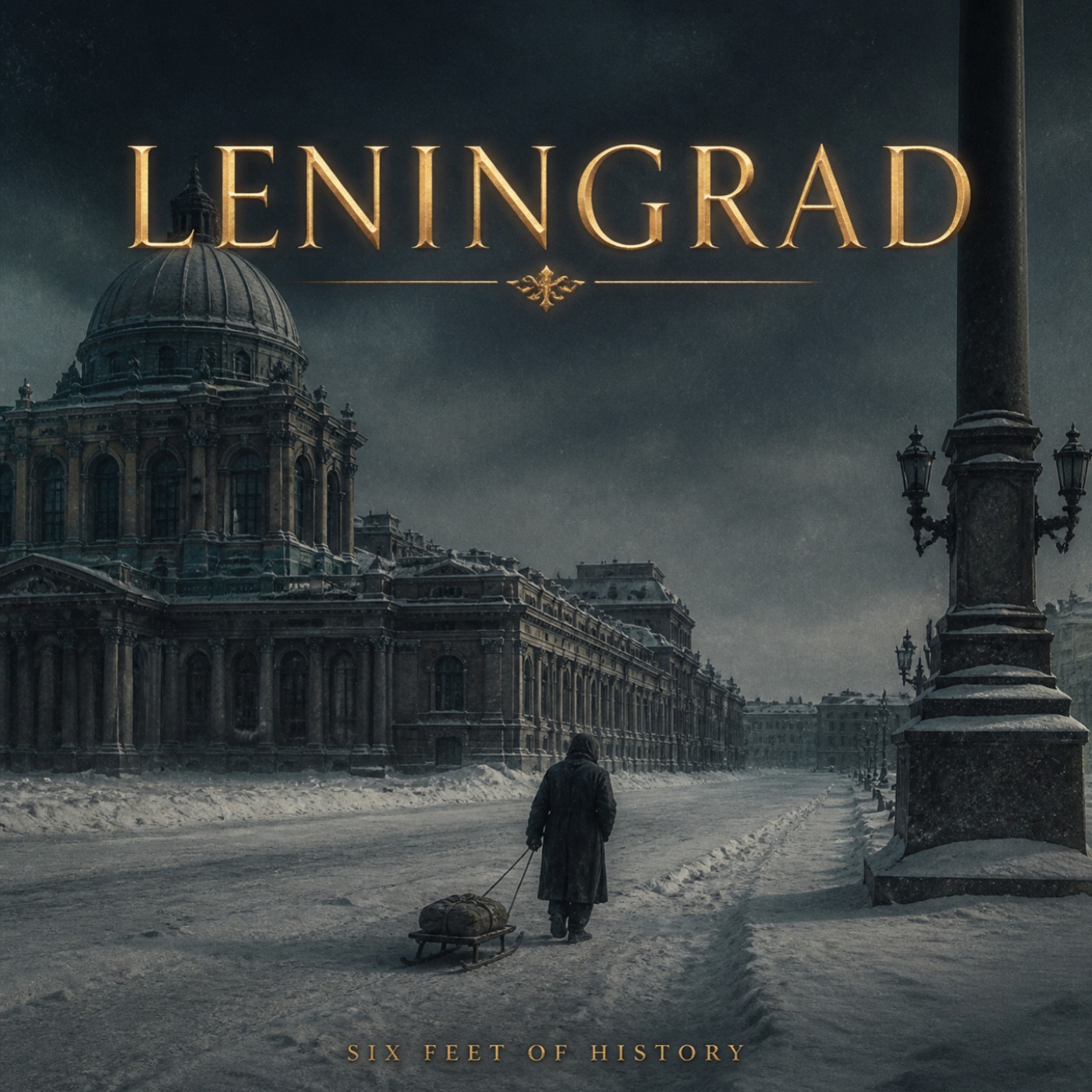
[SPEAKER_00]: And this goes on for months, people began to die in enormous numbers. [SPEAKER_00]: They died of starvation of cold of the diseases that prey on starving bodies. [SPEAKER_00]: They died in their apartments in the streets in the queues. [SPEAKER_00]: Corpse is lay in the snow because the living were too weak to bury them and were dragged on children's sleds to collection points.
[SPEAKER_00]: The city's death toll in that first winter alone was catastrophic, people dying at a rate of thousands per day. [SPEAKER_00]: In total, over the course of the siege, the number of civilians who died is generally estimated at around 800,000, and by some counts higher, an almost unimaginable figure.
[SPEAKER_00]: this was a city full of ordinary families, being deliberately staffed to death. [SPEAKER_00]: And I want to be careful and restrained here because this show does not trade in gratuitous horror. [SPEAKER_00]: But I would be lying to you if I pretended the extremity of that hunger did not push some people past every boundary there is.
[SPEAKER_00]: It did. [SPEAKER_00]: The records are clear and the authorities dealt with cases of people driven to unthinkable acts by starvation. [SPEAKER_00]: I will not dwell on it. [SPEAKER_00]: I mention it only because it is the truest possible measure of what these people were subjected to. [SPEAKER_00]: There is one document from the Siege that says more than any statistic.
[SPEAKER_00]: A girl named Tanya Savichever, 11 years old, kept a small notebook. [SPEAKER_00]: She was not writing a diary in any conventional sense. [SPEAKER_00]: She was recording deaths. [SPEAKER_00]: Line by line in a child's handwriting she noted each member of her family as they died with the date and the hour.
[SPEAKER_00]: Her sister, her grandmother, her brother, her uncles, her mother. [SPEAKER_00]: and then the final entries, which are the reason that Notebook is now in a museum, that the savagefs had died, that everyone had died, and that only Tania was left. [SPEAKER_00]: She was evacuated, eventually, but her health had been destroyed, and she died anyway, not long after.
[SPEAKER_00]: Nine short lines in a Notebook. [SPEAKER_00]: That is what 800,000 deaths looks like when you zoom all the way in on one of them. [SPEAKER_00]: And yet, and this is the path that stays with me. [SPEAKER_00]: The city did not collapse into anarchy, it held. [SPEAKER_00]: There was one thin thread of hope, and it ran across water.
[SPEAKER_00]: To the east of the city, lay Lake Ladoga, a vast lake, and the far shore was still in Soviet hands. [SPEAKER_00]: In summer, supplies could be brought by boat. [SPEAKER_00]: And in winter, when the lake froze solid, they built a road on the ice. [SPEAKER_00]: It became known as the road of life.
[SPEAKER_00]: Convoys of trucks drove out across the frozen lake in the dark in the cold, carrying flower and supplies into the city and carrying evacuees, the sick, the starving children out. [SPEAKER_00]: It was appallingly dangerous. [SPEAKER_00]: The ice could break. [SPEAKER_00]: Trucks went through and vanished into blackwater.
[SPEAKER_00]: The route was bombed and sheld by German aircraft. [SPEAKER_00]: Drivers ran the route again and again and many died doing it. [SPEAKER_00]: But the road of life kept learning grad alive. [SPEAKER_00]: It was never enough to feed the city properly. [SPEAKER_00]: The rations remained starvation rations.
[SPEAKER_00]: But it was enough that the city did not die entirely. [SPEAKER_00]: It was, quite literally, the difference between a terrible siege and total annihilation. [SPEAKER_00]: And in the middle of all this, people did things that make no rational sense at all, and that are, I think, among the finest things human beings have ever done.
[SPEAKER_00]: In the city was a scientific institution holding one of the world's great collections of seeds and plant material and in enormous seed bank gathered over decades containing the genetic diversity of the world's crops. [SPEAKER_00]: Rice, wheat, maize, potatoes. [SPEAKER_00]: thousands upon thousands of samples.
[SPEAKER_00]: Food, edible food, sitting in a building, in a city where people were starving to death in the streets, and the scientists who were there guarded it. [SPEAKER_00]: They did not eat it. [SPEAKER_00]: They protected the collection from rats, from cold, from looters, and from themselves. [SPEAKER_00]: and several of them staffed to death.
[SPEAKER_00]: In the building, surrounded by seeds and grain, they refused to eat because they understood that the collection was the future of agriculture. [SPEAKER_00]: And that if it were consumed to buy a few more days of life for a few individuals, something irreplaceable would be gone forever. [SPEAKER_00]: They died of hunger, sitting next to food, to preserve seeds for people who had not yet been born.
[SPEAKER_00]: I do not think there is a pure act in the history of science, and then there is the symphony. [SPEAKER_00]: The composer Dmitry Shostakovich, a son of the city, had begun writing his seventh symphony in Leningrad as the war closed in. [SPEAKER_00]: He was eventually evacuated, and the work was finished elsewhere and performed to greater claim.
[SPEAKER_00]: but the authorities wanted it played in Leningrad itself. [SPEAKER_00]: The problem was that the city's orchestra was destroyed. [SPEAKER_00]: Musicians had died or been evacuated or were too weak to play. [SPEAKER_00]: The remaining players were assembled and they were not enough. [SPEAKER_00]: Musicians were pulled from the front lines and brought back into the city to fill out the orchestra.
[SPEAKER_00]: When they first gathered to rehearse, some were so weak they could barely hold their instruments. [SPEAKER_00]: Rehearsals had to be kept short. [SPEAKER_00]: at least one musician reportedly died during the preparations. [SPEAKER_00]: The score itself had to be flown into the besieged city.
[SPEAKER_00]: And on the 9th of August 1942, in a starving, shelved, encircle city, that orchestra of half-starved musicians performed the Lenin grad symphony. [SPEAKER_00]: The concert hall was full. [SPEAKER_00]: and the Soviet forces determined that the performance would not be shelved, launched an artillery bombardment beforehand to suppress the German guns.
[SPEAKER_00]: An operation reportedly given a name meaning squall, specifically so that the music could be heard. [SPEAKER_00]: And it was broadcast on loud speakers out across the city and out toward the German lines so that the besieging soldiers could hear it too. [SPEAKER_00]: German soldiers sitting in their positions outside the city they had been told was dying, heard a full symphony orchestra playing, think about what that says, think about the message.
[SPEAKER_00]: You have starved us and frozen us and sheld us for a year and buried hundreds of thousands of us and we have an orchestra and we are playing. [SPEAKER_00]: The siege was finally broken in January of 1944 [SPEAKER_00]: The Soviet forces drove the Germans back and the encirclement was lifted and food came into the city by rail and the survivors stood in the streets and wept.
[SPEAKER_00]: But the cost was almost beyond comprehension. [SPEAKER_00]: Somewhere in the order of 800,000 civilians dead and many more broken by what they had endured, an entire generation of a great city hollowed out by hunger. [SPEAKER_00]: So what do we take from Leningrad? [SPEAKER_00]: Two things, I think, and they sit un-easily together.
[SPEAKER_00]: The first is what human beings are capable of doing to one another. [SPEAKER_00]: This was not a battle in which soldiers killed soldiers. [SPEAKER_00]: This was a deliberate decision to starve a civilian population. [SPEAKER_00]: Old people, children, families, as a military method, and to sit and wait while it worked.
[SPEAKER_00]: That is what happened here. [SPEAKER_00]: It was chosen. [SPEAKER_00]: and the second is what human beings are capable of enduring and of preserving in the face of that, a city that would not surrender. [SPEAKER_00]: Truck drivers who ran a road made of ice in the dark under bombs, because on the other end, were children who needed to get out, scientists who starved beside food to save the seeds.
[SPEAKER_00]: an orchestra of skeletal musicians who picked up their instruments and played a symphony out over the rooftops towards the enemy guns and the seeds survived. [SPEAKER_00]: That collection, protected by men and women who starved rather than eat it, endured the siege and material from it went on to contribute to agricultural science and crop breeding in the decades that followed.
[SPEAKER_00]: the people who died guarding it, never knew whether it would matter. [SPEAKER_00]: They simply decided that it might, and that this was enough. [SPEAKER_00]: That's the siege of Leningrad, 872 days. [SPEAKER_00]: 125 grams of bread that wasn't really bread, and a city that was supposed to die quietly, and instead spent nearly three years refusing.
[SPEAKER_00]: And when you next hear someone say that people cannot be trusted, that under real pressure, the veneer of civilization falls away and we become animals. [SPEAKER_00]: Remember the truck drivers on the ice and the botanists beside the seeds and the musicians who could barely lift their instruments and play it anyway.
[SPEAKER_00]: it fell away for some. [SPEAKER_00]: It did not fall away for all. [SPEAKER_00]: That distinction is the whole of human history. [SPEAKER_00]: Follow six feet of history for a new story every day. [SPEAKER_00]: Next time a whole world of kingdoms and empires collapses at once, cities burned, trade routes severed, writing itself forgotten, and no one can say for certain who did it.
[SPEAKER_00]: I'm August
