

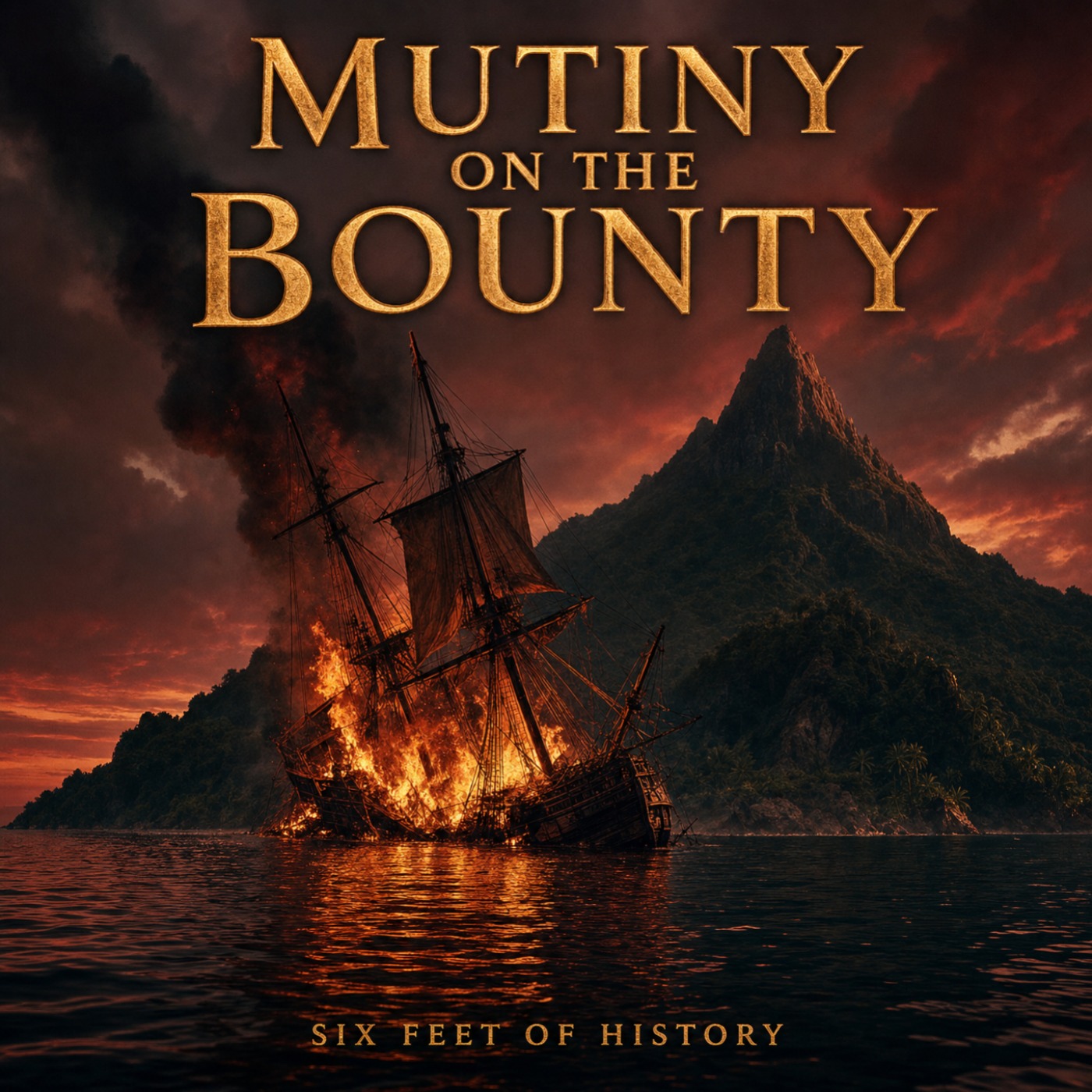
Six Feet of History – Dark History in 5 Minutes
Mutiny on the Bounty: The Truth About Pitcairn
· 14 min
Kapitelklicken springt direkt hin
Shownotes
<p>The crew seized their captain, set him adrift in an open boat, and sailed off to vanish. He survived one of the greatest feats of navigation in history. The mutineers found a hidden island wrongly placed on every chart, burned their ship, and disappeared — and what happened next was a descent into violence that killed almost all of them.</p><p>August Mercer tells the real story behind the legend, and the descendants who still live on Pitcairn today. This is Six Feet of History — five minutes of the past they'd rather you forget.</p><p><em>Follow for a new story every day. A Dark Whisper Studios production.</em></p><p><em>#history #truehistory #truestories #truestory </em></p>
Transkriptvom Podcast bereitgestellt · Zeitmarken springen hin
[SPEAKER_00]: A ship's crew ceases their captain in the dark sets him adrift in a tiny open boat in the middle of the Pacific and sails off to vanish from the world. [SPEAKER_00]: The captain, against all odds, survives one of the greatest feats of seamanship ever recorded and reaches safety to tell his tale.
[SPEAKER_00]: But the mutiniers have a problem. [SPEAKER_00]: They are now the most wanted men in the British Empire, with the Royal Navy certain to hump them to the ends of the earth. [SPEAKER_00]: So they go looking for somewhere the Navy will never find them. [SPEAKER_00]: And they find it. [SPEAKER_00]: A speck of rock in the vast emptiness of the ocean, wrongly placed on every chart.
[SPEAKER_00]: They land, they burn their ship so it can never betray them and they disappear. [SPEAKER_00]: And what happens on that island over the next few years is a descent into something close to hell. [SPEAKER_00]: This is six feet of history. [SPEAKER_00]: Five minutes of the past, they'd rather you forget.
[SPEAKER_00]: I'm August Mercer. [SPEAKER_00]: And tonight, the mutiny on the bounty and the dark fate of the men who hid on Pitcare in Island a story far grimmer than the romantic legend suggests. [SPEAKER_00]: You have probably heard the famous version, the tyrannical Captain Bly. [SPEAKER_00]: The noble mutiny of Fletcher Christian, the paradise of Tahiti, it has been made into films and novels many times over, and the real story is more complicated and much darker than the legend.
[SPEAKER_00]: The bounty was a British naval vessel sent on a very particular mission in 1787. [SPEAKER_00]: Its job was to sail to the island of Tahiti in the South Pacific, collect a large number of breadfruit plants and transport them to the British colonies in the Caribbean, where the plan was to grow breadfruit as a cheap food source for enslaved people on the plantations.
[SPEAKER_00]: So the voyage itself was already entangled in the machinery of empire and slavery. [SPEAKER_00]: The ship was commanded by Lieutenant William Bly, an extremely capable navigator, but a man with a difficult temperament. [SPEAKER_00]: And here we must be fair because the legend has been unkind to him.
[SPEAKER_00]: Bly was not the sadistic monster of the films. [SPEAKER_00]: By the standards of the Royal Navy at the time, he was actually not especially brutal with the Lash. [SPEAKER_00]: His real failing seems to have been his tongue. [SPEAKER_00]: He was a harsh, sarcastic, humiliating, verbal disciplinarian, prone to furious tirades, particularly against his officers.
[SPEAKER_00]: The bounty reached Tahiti and then spent around five months there waiting for the breadfruit season. [SPEAKER_00]: And those five months were, in a sense, the seed of everything that followed. [SPEAKER_00]: because the crew, young men, far from home, subject to harsh discipline, spent their time living in what must have felt like paradise, a warm, beautiful island with a culture far more relaxed about many things than rigid British society.
[SPEAKER_00]: Many of the men formed relationships with Tahitian women. [SPEAKER_00]: Some effectively went native, they tasted a kind of freedom and ease they had never known. [SPEAKER_00]: and then they had to leave it and go back to being sailors under Blaise Tung on a cramped ship on a long hard voyage, the tension built.
[SPEAKER_00]: and a few weeks after leaving Tahiti in April of 1789, it broke. [SPEAKER_00]: Led by the master's mate, Fletcher Christian, a man Blair had berated and humiliated, and who appears to have been near breaking point emotionally. [SPEAKER_00]: A portion of the crew mutin' it. [SPEAKER_00]: They seized Blair in his cabin at dawn.
[SPEAKER_00]: They did not kill him. [SPEAKER_00]: Instead, blie and 18 men loyal to him were forced into the ship's launch, a small open boat, dangerously overloaded with limited supplies and set a drift in the middle of the Pacific Ocean, thousands of miles from any European settlement. [SPEAKER_00]: It was, in effect, a death sentence, just one carried out by the sea, rather than by the mutiniers' own hands.
[SPEAKER_00]: And here the story does something extraordinary because, why whatever his flaws as a leader of men was a genuinely brilliant semen. [SPEAKER_00]: In that tiny overloaded open boat with almost nothing, he navigated over 3.500 nautical miles across the open ocean to reach safety in the Dutch East Indies.
[SPEAKER_00]: It took around 47 days. [SPEAKER_00]: He lost only a small number of men. [SPEAKER_00]: It remains one of the most astonishing feats of open-boat navigation and survival in Maritime History, and it meant that the story of the mutiny would be told and that the Navy would come hunting. [SPEAKER_00]: So now we turn to the mutinyers because that is where the real darkness lies.
[SPEAKER_00]: After the mutiny, the men who had taken the bounty were divided about what to do, many of them wanted to go back to Tahiti to the women and the life they had loved. [SPEAKER_00]: and a group of them did exactly that and settled there. [SPEAKER_00]: But Fletcher Christian understood the danger.
[SPEAKER_00]: Tahiti was known. [SPEAKER_00]: It was on the charts. [SPEAKER_00]: It was the obvious place the Navy would look. [SPEAKER_00]: To go back there was to be eventually caught and hanged. [SPEAKER_00]: And indeed, a naval ship, the Pandora, was later sent out and it captured a number of the mutiniers who had stayed on Tahiti, several of whom died when the Pandora itself was wrecked on the voyage home, and some of whom were tried and executed in England.
[SPEAKER_00]: Christian was right about the danger, so Christian, with a small group of the remaining mutiniers, decided to disappear completely. [SPEAKER_00]: They took the bounty, and with them they took a group of Tahishan people, some willingly, but including a number of Tahishan women who, by most accounts, were effectively abducted, taken along to be the mutiniers' companions and some Tahishan men.
[SPEAKER_00]: And they went searching for somewhere to hide forever. [SPEAKER_00]: and they found Pitcare Island, a tiny, isolated, uninhabited volcanic island, far from the shipping lanes and crucially marked incorrectly on the British charts placed in the wrong position. [SPEAKER_00]: A place the navy would look for and never find.
[SPEAKER_00]: They landed on Pitcare in 1790. [SPEAKER_00]: and to make sure the island could never betray their presence. [SPEAKER_00]: A ship offshore might spot the bounty. [SPEAKER_00]: They stripped the vessel of everything useful and then burned it and sank the remains in the bay below their settlement.
[SPEAKER_00]: They burned their only way off the island. [SPEAKER_00]: They were now truly hidden from the world and truly trapped on it together. [SPEAKER_00]: There were, in this founding community, a small number of English mutiniers and a slightly larger number of Polynesian men and women. [SPEAKER_00]: And the society they built in isolation cut off entirely from the outside world, curdled almost immediately into violence, and the root of it, as with so much of this story, was the treatment of people as property.
[SPEAKER_00]: because the English mutiniers divided the island's land among themselves, and, appallingly, treated the Polynesian men as servants, or effectively as slaves, and treated the Polynesian women as possessions to be distributed among the men. [SPEAKER_00]: When some of the English mutiniers' companions died, they simply took the women who had been with the Polynesian men deepening the injustice and the rage.
[SPEAKER_00]: And so, on that tiny, beautiful hidden island, a cycle of resentment, jealousy, and murderous violence began. [SPEAKER_00]: I will not lay out every killing, because it becomes a grim catalogue. [SPEAKER_00]: But the essential shape is this, the mistreated Polynesian men eventually rose up against the English mutiniers who had abused and enslaved them.
[SPEAKER_00]: There was a day of bloodshed in which several of the mutiniers were killed. [SPEAKER_00]: And by most accounts, Fletcher Christian himself, the leader of the whole enterprise, was among those killed, cut down on the island he had chosen as his refuge, though the exact circumstances of his death remain uncertain and disputed.
[SPEAKER_00]: and the violence did not stop there. [SPEAKER_00]: It spiraled. [SPEAKER_00]: There were reprisals. [SPEAKER_00]: The Polynesian men were in turn, killed. [SPEAKER_00]: Alcohol entered the picture. [SPEAKER_00]: One of the mutiniers worked out how to distill spirits from a local plant and drunkenness made a violent situation worse.
[SPEAKER_00]: There was more killing, madness, and death. [SPEAKER_00]: Within a few years of all the English mutiniers who had landed on Pitkin, only one was left alive. [SPEAKER_00]: One man, surrounded by the Tahitian women and the children who had been born on the island, children of the mutiniers and the Polynesian women.
[SPEAKER_00]: Every one of his fellow mutiniers was dead, and most of the Polynesian men too, killed in the violence that their own choices had unleashed. [SPEAKER_00]: The hidden paradise had very nearly destroyed itself entirely. [SPEAKER_00]: And here, the story takes its strangest turn. [SPEAKER_00]: Because that last surviving mutinere, a man named John Adams, underwent something like a transformation.
[SPEAKER_00]: Left alone of the only adult man among a group of women and a growing number of children, Adams turned to the Bounties Bible, which had come ashore with them. [SPEAKER_00]: and whether from genuine conviction or guilt or the simple need to impose some order on the wreckage, he used it to build a new, devout, disciplined community out of the survivors.
[SPEAKER_00]: He raised the children in a strict Christian faith. [SPEAKER_00]: He established rules and peace and stability where there had been nothing but bloodshed. [SPEAKER_00]: And so, by the time the outside world finally stumbled upon Bitken, an American ship happened across it in 1808, 18 years after the landing.
[SPEAKER_00]: They found not a den of murderers, but acquired, orderly, pious little community of women and children, presided over by a single gentlode patriarch, all of them speaking a mixture of English and Tahitian, and living in a parent harmony. [SPEAKER_00]: the British authorities, when they eventually learned of it, faced a decision about the last mutinier.
[SPEAKER_00]: And in the end, they chose to leave John Adams alone. [SPEAKER_00]: He was an old man of the founder and father of a peaceable community and arresting him to hang him for a mutiny, two decades gone, seemed to serve no purpose. [SPEAKER_00]: He lived out his life on the island and it bears his settlements named to this day.
[SPEAKER_00]: And here is the truly remarkable coder, the descendants of the bounty mutiners and the [SPEAKER_00]: Pipit Kern Island remains inhabited today by a tiny community, a few dozen people, many of whom carry the surnames of the mutiniers and who are the living descendants of that violent, doomed, hidden founding.
[SPEAKER_00]: One of the most remote, permanently inhabited places on earth, populated by the children of a crime. [SPEAKER_00]: So, what do we take from the bounty? [SPEAKER_00]: The legend gives us a simple tale, cruel captain, noble rebels, a bid for freedom in paradise. [SPEAKER_00]: And almost every part of that is too simple.
[SPEAKER_00]: Bly was harsh, but not a monster, and he was in the end gravely wronged and astonishingly brave. [SPEAKER_00]: Christian was not a noble hero, but a man who broke under pressure led others into a capital crime, abducted people to serve the mutiniers and led them all to a hidden island where most of them were murdered, himself included.
[SPEAKER_00]: The real story of the bounty is not about freedom. [SPEAKER_00]: It is about what happens when people who have escaped one system of domination immediately rebuild it. [SPEAKER_00]: The mutineers fled the harsh discipline of the Navy, seeking liberty, and the moment they had their own island, their own little world to build from scratch, they built a society founded on servitude and the ownership of human beings.
[SPEAKER_00]: They recreated in miniature the very injustice of the world they had fled and it destroyed them almost to the last man within a few years. [SPEAKER_00]: Given a blank island and total freedom, they chose to make slaves and possessions of the people around them. [SPEAKER_00]: And that choice, not lie, not the navy, is what killed them.
[SPEAKER_00]: That's the mutiny on the bounty and the dark truth of pitcane. [SPEAKER_00]: A ship seized in the Pacific Dawn, a captain cast a drift to a survival that became legend and a band of fugitives who found the perfect hiding place and turned it into a slaughterhouse through their own inability to imagine a world without masters and property.
[SPEAKER_00]: The bounty burned in the bay, the mutant hears killed each other on the hillside. [SPEAKER_00]: And out of that wreckage, somehow, a community survived, and endures to this day on a lonely rock in the vast Pacific. [SPEAKER_00]: The living descendants of one of history's most famous crimes, still there, still carrying the names.
[SPEAKER_00]: Follow, six feet of history for a new story every day. [SPEAKER_00]: Next time, a library of clay tablets baked hard by the fire that destroyed the palace around them, and the oldest story ever written. [SPEAKER_00]: I'm August Mercer, and this was six feet of history. [SPEAKER_00]: A dark, whispered studios production.
