

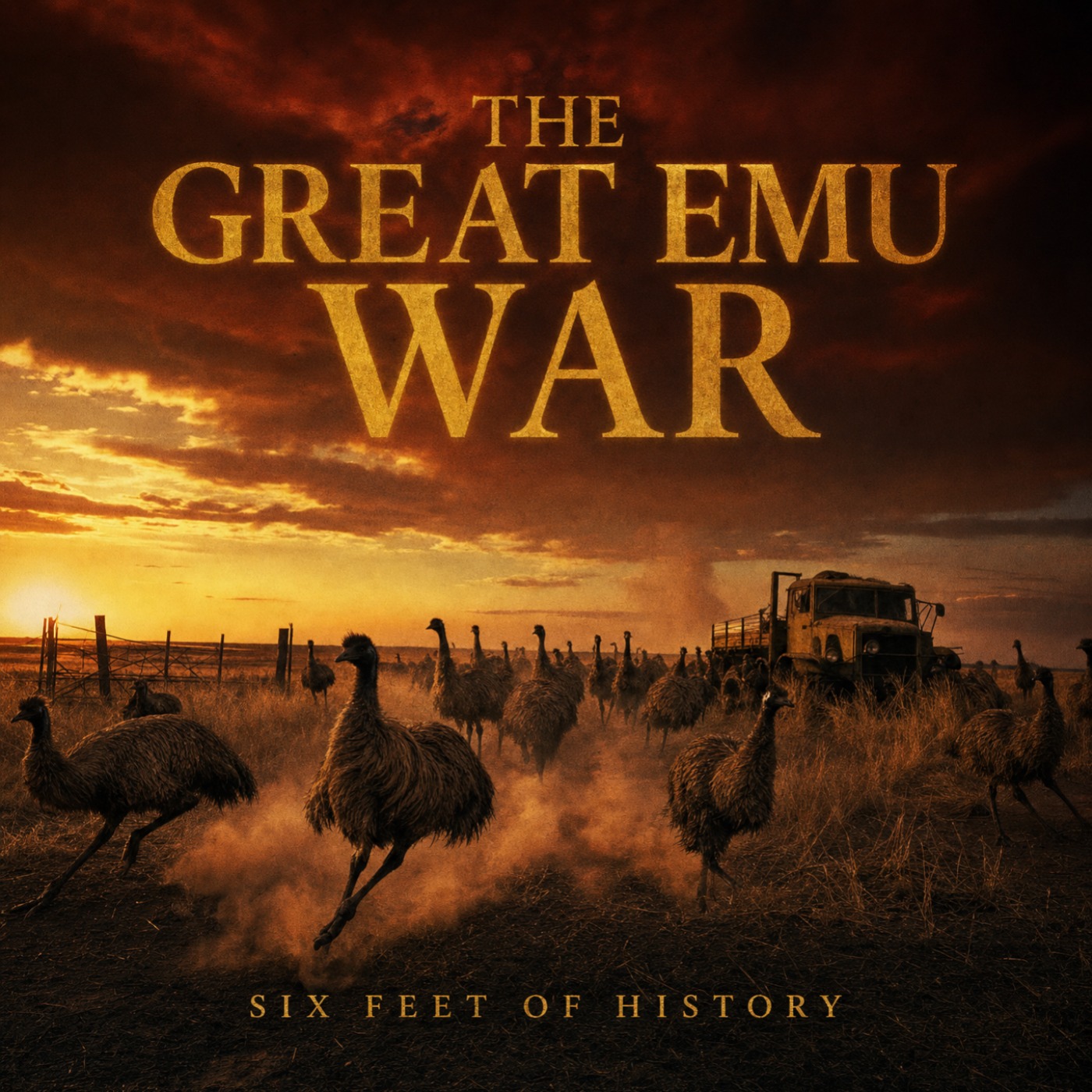
Six Feet of History – Dark History in 5 Minutes
The Great Emu War: The Army That Lost to Birds
· 14 min
Kapitelklicken springt direkt hin
Shownotes
<p>In nineteen thirty-two, the Australian military went to war against an enemy twenty thousand strong, armed with machine guns, and lost. The enemy was the emu. This is the true history of one of the strangest military defeats ever recorded.</p><p>On Six Feet of History, host August Mercer tells the real story behind the Great Emu War: how soldiers with machine guns were outrun and outlasted by flightless birds, and why the whole farcical campaign ever happened at all. But underneath the comedy is a bleak true story about broke, abandoned ex-soldier farmers in the Great Depression, and a government that chose a spectacle over a solution.</p><p>If you love true history, forgotten history, and the dark and strange corners of the past that never made it into your textbook, this is your podcast. New stories every day. Follow Six Feet of History and subscribe wherever you listen. A Dark Whisper Studios production.</p><p>#history #truehistory #historypodcast #emuwar #australianhistory #darkhistory #forgottenhistory #historyfacts #untoldhistory #sixfeetofhistory</p>
Transkriptvom Podcast bereitgestellt · Zeitmarken springen hin
[SPEAKER_00]: In 1932, the Australian army declared war on a bird and lost. [SPEAKER_00]: Not metaphorically, literally, soldiers were deployed with machine guns under the command of a major, with orders to defeat an enemy of around 20,000. [SPEAKER_00]: and the enemy was the Emu, a large, flightless Australian bird that cannot fly cannot shoot back and is not by any measure a military genius.
[SPEAKER_00]: And the Emu's one, they routed the army. [SPEAKER_00]: They absorbed the gunfire, scattered, regrouped and kept coming until the humiliated soldiers with [SPEAKER_00]: And underneath the comedy is a genuinely bleak story about desperate people, broken promises, and a government that would rather shoot birds than help its own farmers.
[SPEAKER_00]: This is Six Feet of History, five minutes of the past they'd rather you forget. [SPEAKER_00]: I'm August Mercer, and tonight the Great Emu War, the time the Australian military was defeated by flightless birds and the very unfunny reasons it happened at all. [SPEAKER_00]: To understand the Emu War, you have to understand the misery it grew out of because the comedy sits on top of real hardship.
[SPEAKER_00]: The setting is Western Australia in 1932 in the depths of the Great Depression. [SPEAKER_00]: and the men at the center of the story are wheat farmers. [SPEAKER_00]: Many of them form assages, veterans of the First World War. [SPEAKER_00]: After the war, the Australian government had encouraged returning soldiers to take up farming, offering them land in marginal country on the edge of the wheat belt.
[SPEAKER_00]: It was sold as a reward a fresh start, a way to build a life. [SPEAKER_00]: In practice, much of this land was difficult, remote and hard to farm, and the soldier settlers struggled from the beginning. [SPEAKER_00]: And then the depression hit and wheat prices collapsed. [SPEAKER_00]: The government had promised subsidies to help, and those promises were not being reliably kept.
[SPEAKER_00]: So here were men who had fought for their country, being given marginal land as a reward, and were now watching their livelihoods disintegrate in an economic catastrophe, feeling abandoned by the government that had put them there. [SPEAKER_00]: And then, on top of all of that, came the E-muse.
[SPEAKER_00]: The E-muse is the second largest bird in the world. [SPEAKER_00]: A big, powerful, flightless bird native to Australia, standing up to nearly two meters tall, capable of running at high speed. [SPEAKER_00]: And E-muse, my great. [SPEAKER_00]: After breeding, large numbers of them move across the country in search of food and water.
[SPEAKER_00]: and in 1932, their migration route brought them straight into the newly cleared wheat farming districts of Western Australia. [SPEAKER_00]: Something like 20,000 E-muse descended on the farmland. [SPEAKER_00]: And from the EMU's point of view, this was wonderful. [SPEAKER_00]: The farmers had hopefully created large areas of clear land with crops and water sources for livestock.
[SPEAKER_00]: It was a paradise. [SPEAKER_00]: From the farmers point of view, it was a disaster. [SPEAKER_00]: The EMU's trampled crops ate the wheat and crucially roped down fences, and the gaps they made in the fences then let rabbits through compounding the damage. [SPEAKER_00]: For farmers already on the brink of ruin, a plague of 20,000 large birds eating and flattening their crops was potentially the final blow, so the farmers appealed for help, and here is where it gets strange.
[SPEAKER_00]: Many of these farmers were ex-soldiers, they thought in military terms, and they asked the minister of defense not the agriculture department, the defense minister for military assistance. [SPEAKER_00]: Specifically, they asked for machine guns. [SPEAKER_00]: and it is worth pausing on how genuinely strange that request was.
[SPEAKER_00]: These were not soldiers asking to fight a war, these were farmers asking the Department of Defense to lend the machine guns to shoot birds. [SPEAKER_00]: In almost any other context, the request would have been laughed out of the room. [SPEAKER_00]: But the men making it were ex-servicemen, they framed it in military language, and the [SPEAKER_00]: so a farming problem was quietly reclassified as a military operation, which is exactly the kind of category error that produces a fast, and remarkably the government agreed.
[SPEAKER_00]: The Minister of Defense approved the deployment of soldiers armed with machine guns to [SPEAKER_00]: There were reasons that appealed to the government, it might help the farmers, it would use up some surplus ammunition, and there was even a sense that it could be good publicity a demonstration of the government doing something.
[SPEAKER_00]: A news-real cameraman was even sent along to film the triumph. [SPEAKER_00]: So in November of 1932, a small military detachment was dispatched, under the command of a major named Gwynid Meridith, armed with two light machine guns and a large supply of ammunition with orders to make war on the M-use.
[SPEAKER_00]: and the E-muse it turned out had not read the plan. [SPEAKER_00]: The first engagement set the tone for the entire campaign. [SPEAKER_00]: The soldiers located a group of E-muse and attempted to engage them, but the birds did not conveniently bunch together to be moaned down. [SPEAKER_00]: They scattered.
[SPEAKER_00]: E-muse, it emerged, are fast, they are alert, and when frightened, they break up into small groups and run in different directions at speed, making them very difficult targets. [SPEAKER_00]: The machine guns were mounted and not easily swung around to track fast, dodging birds. [SPEAKER_00]: They managed to kill some, but nothing like the numbers hoped for.
[SPEAKER_00]: The E-muse simply ran, absorbing the chaos and dispersing. [SPEAKER_00]: The second major attempt was even more farsical. [SPEAKER_00]: The soldiers set up an ambush near a dam where a large number of E-muse were expected. [SPEAKER_00]: Over a thousand birds approached, the gunners waited and opened fire.
[SPEAKER_00]: and the gun jammed after killing only a small number, and the rest of the E-muse escaped. [SPEAKER_00]: Time and again, the birds proved maddeningly resilient. [SPEAKER_00]: Reports from the campaign noted with a kind of baffled respect that the E-muse seemed remarkably tough, that they could take gunfire and keep running, that wounded birds kept going and that they were extraordinarily hard to bring down.
[SPEAKER_00]: The major reportedly tried mounting a machine gun on a truck to chase the EMU's down. [SPEAKER_00]: This failed spectacularly because the truck could not keep up with the birds over the rough ground and the ride was so bumpy that the gun could not aim at all. [SPEAKER_00]: At one point an emu got caught in the truck steering and caused a crash.
[SPEAKER_00]: The soldiers were in short, being comprehensively outmanoeuvred by large flightless birds. [SPEAKER_00]: The emu's had, in effect, developed guerrilla tactics, scattering, using the terrain, refusing to present a mass target and simply outrunning and outlasting their heavily armed pursuers.
[SPEAKER_00]: And the whole thing became a national embarrassment. [SPEAKER_00]: word got out. [SPEAKER_00]: The press had an absolute field day. [SPEAKER_00]: The image of the army firing machine guns at Emu's and losing was irresistible and it was reported within Normus Glee in Australia and internationally.
[SPEAKER_00]: Questions were asked in Parliament. [SPEAKER_00]: The major's expenditure of ammunition thousands of rounds for a modest number of dead birds was mocked mercilessly. [SPEAKER_00]: The major reportedly summed it up by comparing the emues to a crack infantry division, noting their ability to face machine guns with the invulnerability of tanks.
[SPEAKER_00]: He said, in effect, that if the army had a division of men who could take bullets like these birds, it could face any army in the world. [SPEAKER_00]: now in fairness. [SPEAKER_00]: Because this show insists on fairness even about emers, the campaign was later restarted quietly after continued pleas from the farmers and over a longer period the calling did kill a fair number of birds.
[SPEAKER_00]: So it is not quite true that the E-muse escaped entirely unscathed, but the overwhelming verdict of history and of the participants themselves was that the E-muse had won the war. [SPEAKER_00]: The birds were not defeated, the problem was not solved by machine guns. [SPEAKER_00]: The army had been sent to conquer a flightless bird and had come home humiliated.
[SPEAKER_00]: There is one more detail worth savoring before we get serious because it is the perfect punchline. [SPEAKER_00]: The commanding officer, tallying up the results of the campaign, is said to have reported that his men had suffered no casualties. [SPEAKER_00]: The emus, in other words, had achieved total victory without inflicting a single loss, [SPEAKER_00]: But the only casualty of the Emu War was the dignity of the Australian army, and that it turned out was considerable.
[SPEAKER_00]: So why does this daft little story deserve a place on a show about the dark corners of history? [SPEAKER_00]: Because it is funnier on the surface than it is underneath, and the underneath is what interests me. [SPEAKER_00]: Underneath, the comedy is a story about desperate people being failed and then offered a spectacle instead of a solution.
[SPEAKER_00]: Think about the actual situation. [SPEAKER_00]: you have ex-servicemen, men who fought for their country, who were given poor land as a reward encouraged to build farms on it and then left to drown in an economic depression as prices collapsed and promised support failed to materialize.
[SPEAKER_00]: These were people in genuine distress facing the loss of everything. [SPEAKER_00]: And when a plague of e-muse threatened to finish them off, the government's response was not to fix the underlying problem, not to deliver the subsidies, not to address the collapse in wheat prices, not to grapple with the fact that these farms were failing, the reasons that had nothing to do with birds.
[SPEAKER_00]: The response was to send soldiers with machine guns, to shoot at emers while a cameraman filmed it. [SPEAKER_00]: It was, in a sense, a piece of theatre. [SPEAKER_00]: a visible dramatic action that looked like help, that could be filmed and reported, that let the government be seen to be doing something, without doing the difficult, expensive, structural thing that would actually have helped.
[SPEAKER_00]: Shoot the birds. [SPEAKER_00]: Get the news real, move on, and it did not even work as theatre because the emers refused to cooperate, and the whole thing collapsed into fast. [SPEAKER_00]: But the instinct behind it is not [SPEAKER_00]: It is one of the oldest moves in government, when faced with a complex, expensive, structural problem, find a visible enemy, launch a dramatic campaign against it, generate some headlines and hope people mistake the spectacle for a solution.
[SPEAKER_00]: The EMU's were the enemy that could be shot at. [SPEAKER_00]: The real enemies of those farmers, the depression, the collapse in prices, the marginal land, the broken promises, could not be machinegunned and were far harder to face. [SPEAKER_00]: So the government went to war with the birds instead, and there is a final quieter irony in it.
[SPEAKER_00]: The EMU's were not villains. [SPEAKER_00]: They were doing what amused do, migrating in search of food and water, and finding it in the cleared land and crops that human beings had put in their path. [SPEAKER_00]: The birds were simply responding rationally to a landscape that had been transformed.
[SPEAKER_00]: The war was, in the end, a war against nature for behaving naturally, fought by desperate people who had been set up to fail and staged by a government that preferred a spectacle to a solution. [SPEAKER_00]: The EMU is one because they were never really the problem, and you cannot solve the problem by defeating something that isn't it, that's the great EMU war.
[SPEAKER_00]: A real military deployment with real machine guns against 20,000 flightless birds that ended in genuine, documented defeat and national embarrassment. [SPEAKER_00]: It is, on its surface, one of the most absurd episodes in military history and you are entirely allowed to laugh at it because it is genuinely very funny.
[SPEAKER_00]: But spare a thought underneath the laughter, for the men it was really about. [SPEAKER_00]: The broke, abandoned, ex-sojour farmers who asked their government for help and were sent to machine gun and a cameraman instead. [SPEAKER_00]: The immeas got the last laugh. [SPEAKER_00]: The farmers mostly did not, follow six feet of history for a new story every day.
[SPEAKER_00]: Next time a message that took a hundred years to arrive, a bottle thrown into the sea and the science hidden inside a child's daydream. [SPEAKER_00]: I'm August Mercer. [SPEAKER_00]: And this was six feet of history, a dark, whispersed studio's production. [UNKNOWN]: Thank you.
