

Six Feet of History – Dark History in 5 Minutes
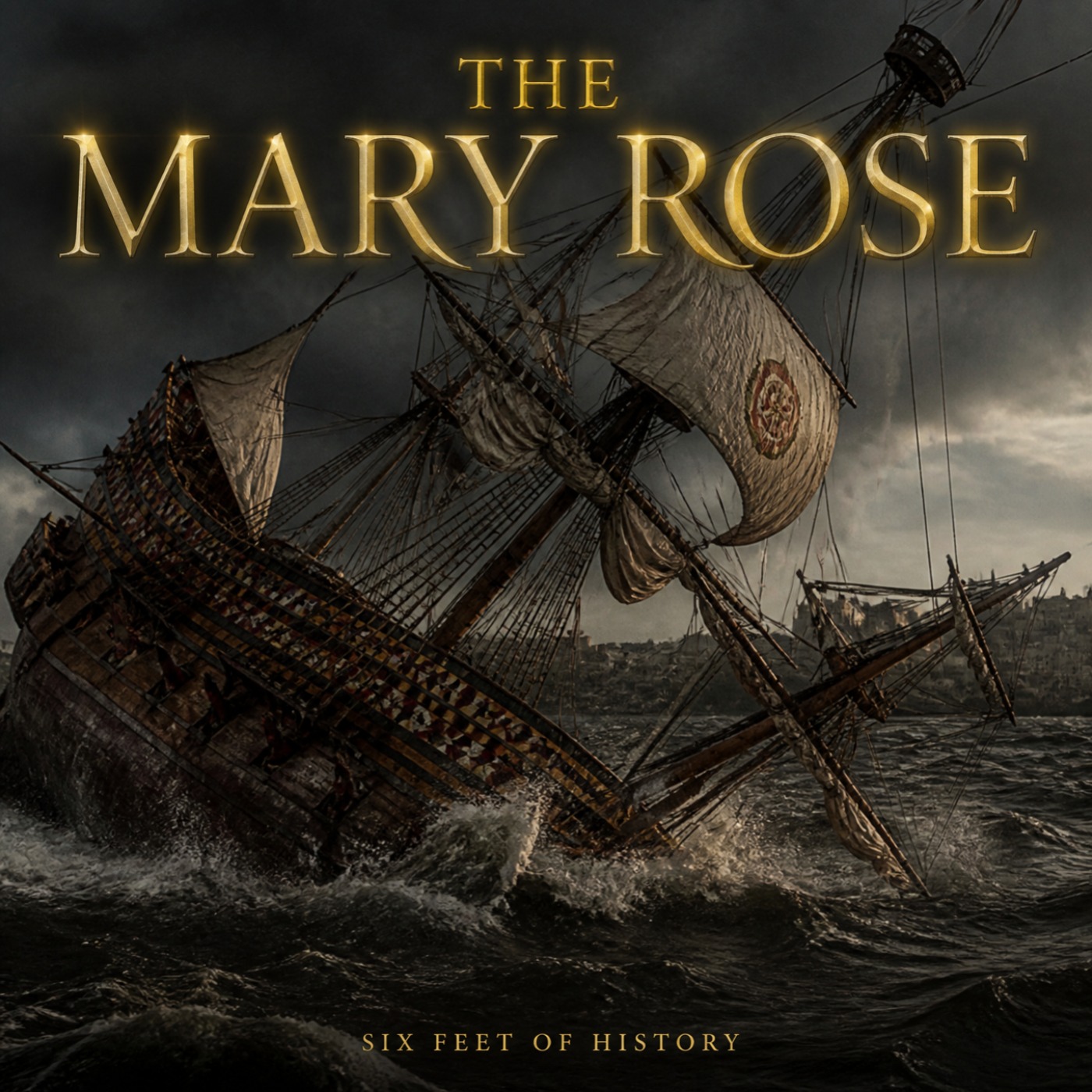
The Mary Rose: The Ship That Sank in Front of the King
· 14 min
Kapitelklicken springt direkt hin
Shownotes
<p>In fifteen forty-five, Henry the Eighth watched his favourite warship turn, heel over, and sink in minutes — the sea pouring in through her open gunports, anti-boarding netting trapping hundreds of men below. Almost the entire crew died within sight of shore.</p><p>Then the mud kept her for four hundred and thirty-seven years. August Mercer explores the sinking, and the astonishing Tudor world that came back up with her. This is Six Feet of History — five minutes of the past they'd rather you forget.</p><p><em>Follow for a new story every day. A Dark Whisper Studios production.</em></p><p><em>#history #truehistory #truestories</em></p>
Transkriptvom Podcast bereitgestellt · Zeitmarken springen hin
[SPEAKER_00]: The King of England stands on the shore, watching his favourite worship sail out to meet the enemy. [SPEAKER_00]: She is the pride of his navy. [SPEAKER_00]: He has known her for 34 years. [SPEAKER_00]: She turns, her gunports open, her decks crowded with hundreds of men in armour, and she heels over in the wind, and the sea pours in through the open ports, and she goes down in minutes in full view of the king, close enough that he may have heard the men screaming.
[SPEAKER_00]: nearly the entire crew dies, and then the sea keeps her and her men for 437 years. [SPEAKER_00]: This is six feet of history, five minutes of the past they'd rather you forget. [SPEAKER_00]: I'm August Mercer. [SPEAKER_00]: And tonight, the Mary Rose, the flagship that sank in front of her king, the mystery of why she went down, and the astonishing time capsule she became.
[SPEAKER_00]: The year is 1545. [SPEAKER_00]: The king is Henry VIII, by now an aging, ailing, enormously heavy man, but still the ruler of England and still at war. [SPEAKER_00]: A French fleet has crossed the channel, a huge force larger than the Spanish Armada that would come decades later, and it has entered the sollent, the stretch of water between the English mainland and the Isle of White, threatening the Great Naval Base at Potsmouth.
[SPEAKER_00]: and, and the Mary Rose sails out to meet them. [SPEAKER_00]: She was not a new ship. [SPEAKER_00]: She had been built early in Henry's reign decades before and she was one of his favourites, a large, powerful warship that had served for years and been rebuilt and upgraded over time, and that upgrading matters as we shall see.
[SPEAKER_00]: She had been made heavier and she had been fitted with more and bigger guns, mounted lower in the hull, firing through gunports cut into her sides. [SPEAKER_00]: That innovation. [SPEAKER_00]: Gun ports low in the hull was what made ships like the Mary Rose so deadly. [SPEAKER_00]: It allowed heavy cannon to be carried low close to the waterline without making the vessel dangerously top heavy.
[SPEAKER_00]: But it came with a hard rule that every sailor understood when those low gun ports are open the ship must stay upright. [SPEAKER_00]: If she heals over far enough that the open ports go under, the sea comes in, and once the sea is in, she is gone. [SPEAKER_00]: On 19 July 1545, the English fleet engaged the French in the so-let.
[SPEAKER_00]: Henry himself was watching from a castle on the shore, and then the Mary Rose maneuvering turned, and she healed, leaned hard over, and her open lower gunports went under the water. [SPEAKER_00]: She flooded, catastrophically, and she went down almost immediately. [SPEAKER_00]: And here is the detail that turns a [SPEAKER_00]: The Mary Rose was rigged for battle, which meant that anti-bording netting had been stretched across her upper decks, heavy netting, designed to stop enemy sailors from swarming aboard.
[SPEAKER_00]: It worked brilliantly for that. [SPEAKER_00]: It also meant that when she rolled and sank, the men below and on deck could not get out, the netting held them in like a trap. [SPEAKER_00]: of a crew that likely numbered around 400 men or more, only a few dozens survived. [SPEAKER_00]: The rest, hundreds of soldiers, sailors, gunners, archers, boys went down with her in shallow water within sight of shore within sight of their king, and there is one detail from that shoreline that has never left me.
[SPEAKER_00]: Standing near the king was Lady Karu, the wife of the Mary Rose's Vice Admiral, Sir George [SPEAKER_00]: and the king, watching his flagship die and hearing the cries carried across the water, is said to have turned to comfort her. [SPEAKER_00]: A woman who had just seen her husband drowned in front of her in a matter of minutes in shallow water half a mile from where she stood.
[SPEAKER_00]: a George Karoo went down with the ship. [SPEAKER_00]: So what actually happened? [SPEAKER_00]: Why did she turn over? [SPEAKER_00]: And the honest answer nearly five centuries later is that we are not entirely sure. [SPEAKER_00]: But there are several candidates and they may all be true at once.
[SPEAKER_00]: The French, and surprisingly, claimed they had sunk her with gunfire. [SPEAKER_00]: But there is little evidence of catastrophic battle damage and English accounts do not support it. [SPEAKER_00]: The English [SPEAKER_00]: One eyewitness account suggested she was simply mishandled that she was turning, caught a gust of wind, and healed at exactly the wrong moment with her ports open.
[SPEAKER_00]: Another contemporary suggestion from a survivor was blunt, that she was overloaded, that she had too many men aboard, and that the crew were undisciplined and did not obey orders, that there were too many people crowded on the upper decks, making her top heavy and unstable. [SPEAKER_00]: Over the years, the Mary Rose had been made heavier, more guns, heavier guns, more men, more equipment, and modifications like that can push a ship closer and closer to the edge of her stability until she has almost no margin left.
[SPEAKER_00]: She may have been an old ship, loaded far beyond what her original design safely allowed, carrying too much weight too high and needing only a gust of wind and an unlucky turn to finish her. [SPEAKER_00]: and one more theory is worth mentioning, because it is very human. [SPEAKER_00]: The Mary Rose carried a large contingent of soldiers as well as sailors, and there is a suggestion that there were tensions and confusion of command aboard that in the crucial moment orders were not clearly given or clearly obeyed.
[SPEAKER_00]: The likelyest answer is probably a combination, an old, heavily modified, overloaded ship crowded with men, executing a turn in a gusting wind with her gunports open, and losing her stability in a matter of seconds. [SPEAKER_00]: not a single dramatic cause. [SPEAKER_00]: Just a stack of small compromises that finally, fatally, added up.
[SPEAKER_00]: And then she lay on the sea bed of the solid for 437 years. [SPEAKER_00]: Attempts were made to raise her almost immediately after the sinking and they failed. [SPEAKER_00]: Over the following centuries, she was partially salvaged, partially forgotten, and eventually lost entirely. [SPEAKER_00]: Her location, a mystery, her story reduced to a footnote in Tudor history.
[SPEAKER_00]: But the sea, as it happens, was preserving her. [SPEAKER_00]: Because the Mary Rose settled into the sea bed at an angle and her starboard side, the side that went into the mud, was steadily buried in fine, oxygen-pore-silt. [SPEAKER_00]: And in those conditions, the organisms that normally devour wood and organic material cannot survive.
[SPEAKER_00]: So while the exposed side of the ship rotted away entirely, the buried side did not. [SPEAKER_00]: It was sealed, and with it everything inside it. [SPEAKER_00]: In the modern era, the wreck was we discovered, and from the 1970s, systematically excavated by divers over thousands of dives, one of the greatest underwater archaeological projects ever undertaken.
[SPEAKER_00]: And in 1982, in front of a television audience of millions, the surviving hull of the Mary Rose was lifted out of the soul and dripping and black into the daylight. [SPEAKER_00]: The surviving hull was a fragile, water-logged shell that had been held together by the mud for four centuries.
[SPEAKER_00]: Engineers had to build a custom lifting frame, drill through the hull to attach bolts and cradle the whole structure in especially made steel support before easing it off the seabed. [SPEAKER_00]: During the lift, a lifting leg slipped, and for a moment it looked, on live television, as though the whole thing might be lost in front of the world.
[SPEAKER_00]: It held. [SPEAKER_00]: And then came the conservation which took decades. [SPEAKER_00]: Waterlogged timber that dries out simply shrinks, cracks, and destroys itself. [SPEAKER_00]: so the hull had to be sprayed continuously. [SPEAKER_00]: First with chilled water and then for years with a waxy chemical solution the gradually replaced the water inside the wood cells and stabilise them before an enormously slow controlled drying process.
[SPEAKER_00]: The ship spent longer being conserved than she ever spent at sea, and what came out of that mud was for historians almost unbelievable. [SPEAKER_00]: Because the Mary Rose was not just a shipwreck, she was a sealed Tudor world. [SPEAKER_00]: Tens of thousands of objects were recovered, an entire floating community, frozen at a single instant on a July afternoon in 1545.
[SPEAKER_00]: Not the treasures of kings, [SPEAKER_00]: They found long bows, hundreds of them, the great English war bows that everyone had read about, but almost no one had ever seen, because wooden bows simply do not survive in the ground. [SPEAKER_00]: Suddenly, we had them, in quantity, and thousands of arrows, and we could measure them, and test them, and finally understand what these weapons actually were, and how enormously powerful they must have been.
[SPEAKER_00]: They found the gunner's tools. [SPEAKER_00]: The cooking pots, the great cauldrons of the galley, plates and bowls and spoons, a backgammon set, musical instruments, a fiddle, pipes, a drum, combs, still with ice caught in the teeth, leather shoes worn into the shape of individual feet, dice, a pocket sundial.
[SPEAKER_00]: The barber surgeon's cabin, with his complete kit of instruments and oigments, laid out as he had left them, and they found the men. [SPEAKER_00]: But human remains were recovered from the wreck in significant numbers, and they have been studied with enormous care. [SPEAKER_00]: And those bones told us who these people actually were.
[SPEAKER_00]: Analysis showed many of them were young, teenagers and men in their twenters. [SPEAKER_00]: Their bones told stories of hard physical labor of childhood malnutrition of old injuries. [SPEAKER_00]: Some of the skeletons show a distinctive pattern of damage to the shoulders and spine, consistent with a lifetime of drawing those immense long bows.
[SPEAKER_00]: The physical signature of the archer written into the skeleton. [SPEAKER_00]: And chemical analysis of the teeth suggested that a striking number of the crew had not grown up in England at all. [SPEAKER_00]: Some appear to have come from southern Europe or further afield, sailors from across the world, serving on an English warship, dying in an English channel and lying in the mud together for four centuries.
[SPEAKER_00]: That is what makes the Mary Rose extraordinary. [SPEAKER_00]: Kings and queens leave us portraits and palaces and paperwork. [SPEAKER_00]: The ordinary people of the past leave us almost nothing. [SPEAKER_00]: Their clothes rot, their tools rust. [SPEAKER_00]: Their possessions are used up and thrown away.
[SPEAKER_00]: Their names are not recorded. [SPEAKER_00]: They vanish completely. [SPEAKER_00]: and then, once in a very long while, an accident happens, a ship rolls over on a summer afternoon and the mud takes her and holds her and gives her back four and a half centuries later with everything still in place.
[SPEAKER_00]: and suddenly we can hold the coma sailor used and the bowl he ate from and the dice he gambled with and the bow he pulled and we can look at his bones and see the work he did and the hunger he suffered as a child. [SPEAKER_00]: And you can go and see her. [SPEAKER_00]: The hull sits in a purpose-built museum in Portemoth alongside the objects that came up with her arranged as they were found, the bows, the bows, the shoes, the surgeons chest.
[SPEAKER_00]: Standing in front of it what strikes you is not the scale of the ship. [SPEAKER_00]: It is how small and ordinary everything else is. [SPEAKER_00]: That's the Mary Rose. [SPEAKER_00]: A catastrophe in front of a king that killed hundreds of men in minutes for want of a few degrees of stability and a closed gun port.
[SPEAKER_00]: and then 400 years of silence in the dark until we came back down for them and brought them up and finally learn their names, not the names in the register. [SPEAKER_00]: Their real names written in their teeth and their spines and the shoes they wore and the small ordinary human things they had in their pockets on the day the sea came in.
[SPEAKER_00]: and Henry the 8th outlived his favorite ship by less than two years. [SPEAKER_00]: He died in 1547 in his bed, an old and broken man. [SPEAKER_00]: While 400 of his sailors lay in the mud of the sollent, a few miles from the shore where he had stood and watched them go. [SPEAKER_00]: Follow six feet of history for a new story every day.
[SPEAKER_00]: Next time, a distress call from a ship at sea, a crew found dead with their faces frozen in terror and a mystery that may never have happened at all. [SPEAKER_00]: I'm August Mercer and this was six feet of history, a dark whisper studio's production.
