

Six Feet of History – Dark History in 5 Minutes
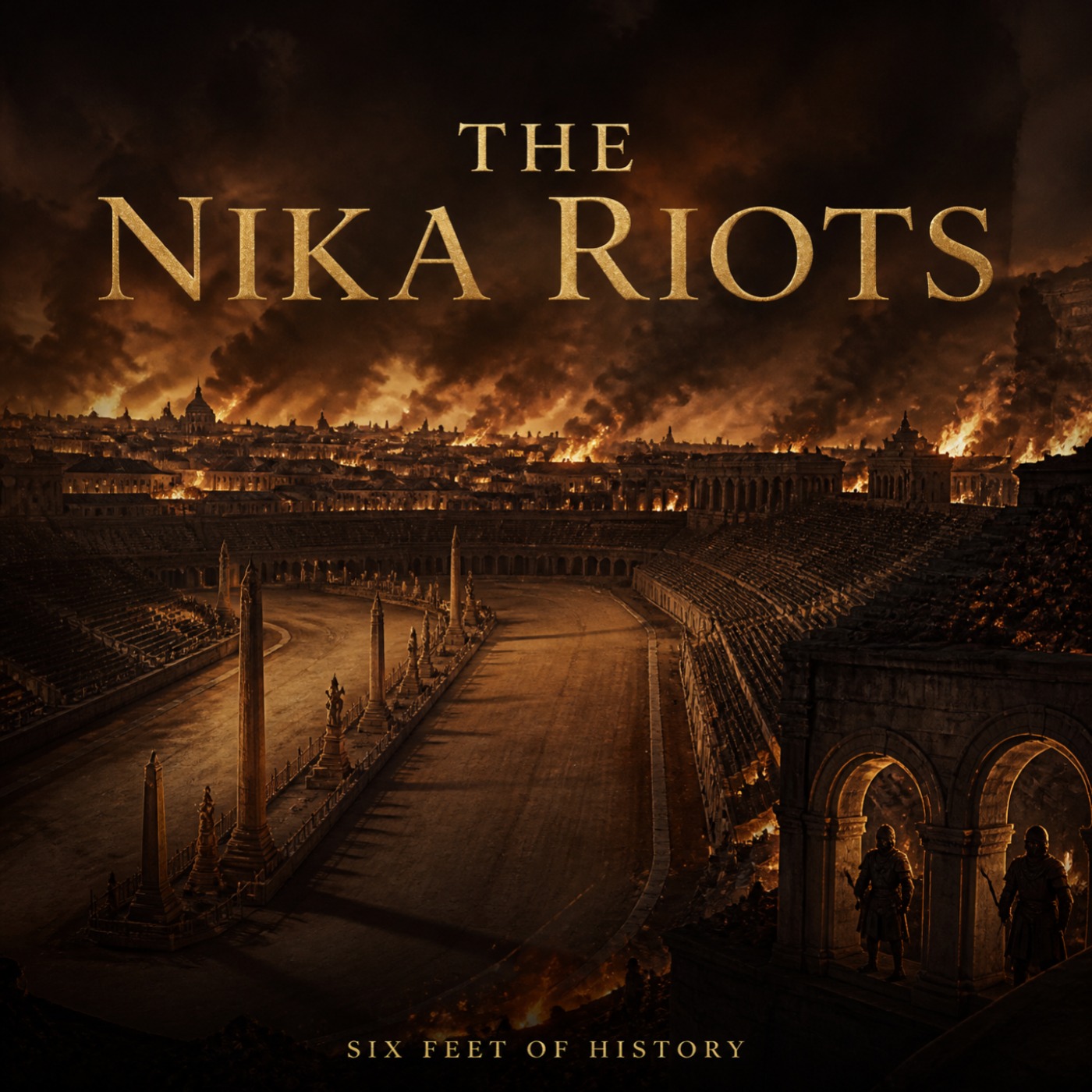
The Nika Riots: Thirty Thousand Dead in a Stadium
· 14 min
Kapitelklicken springt direkt hin
Shownotes
<p>It started with a chariot race. It ended with the greatest city on Earth in flames, a rival emperor crowned by the mob, and Justinian's ships waiting to carry him away. Then his wife stood up and told him she would rather die an empress than live as a fugitive.</p><p>August Mercer tells how sports fans nearly toppled an empire — and what it cost to put them back down. This is Six Feet of History — five minutes of the past they'd rather you forget.</p><p><em>Follow for a new story every day. A Dark Whisper Studios production.</em></p><p><em>#history #truehistory #truestories</em></p>
Transkriptvom Podcast bereitgestellt · Zeitmarken springen hin
[SPEAKER_00]: 30,000 people die in a sports stadium in a single afternoon, not from a fire, not from a collapse, they are massacred, deliberately, systematically by soldiers who lock the exits and go to work. [SPEAKER_00]: And the thing that started it all was a chariot race. [SPEAKER_00]: This is the story of how football hooligans effectively nearly overthrew the Roman Empire and how one woman in a palace stopped an emperor from running away and changed the cause of history with a single sentence.
[SPEAKER_00]: This is six feet of history. [SPEAKER_00]: Five minutes of the past, they'd rather you forget. [SPEAKER_00]: The year is 532. [SPEAKER_00]: The place is Constantinople, capital of the Eastern Roman Empire, the wealthiest, most sophisticated city in the world. [SPEAKER_00]: The Emperor is Justinian, an ambitious hard-driving ruler with grand plans to restore Rome's lost glory.
[SPEAKER_00]: and beside him is his wife, the Empress the Adora, a woman of extraordinary background who had risen from a life as a performer and curter Zann to sit on the throne of an empire and who was by all accounts that toughest person in the palace. [SPEAKER_00]: Now to understand what happened, you have to understand the chariot factions, and you have to take them seriously because they were not simply sports teams.
[SPEAKER_00]: chariot racing was the dominant public entertainment of the Roman world, and in Constantinople it took place in the Hippotro, an enormous stadium in the heart of the city right next to the Imperial Palace holding tens of thousands of people. [SPEAKER_00]: and the racing was organized around factions identified by colours.
[SPEAKER_00]: By this period, two dominated, the blues and the greens. [SPEAKER_00]: These factions were far more than fan clubs. [SPEAKER_00]: They were organized bodies with money, structure and leadership. [SPEAKER_00]: They had their own supporters associations, their own gangs of young men, their own political leanings and religious sympathies.
[SPEAKER_00]: They were in practice, the closest thing Constantinople had to organize political parties, and to organize street violence. [SPEAKER_00]: The young men of the Blues and Greens dressed distinctively, wore their hair in provocative styles, carried weapons, and fought each other in the streets.
[SPEAKER_00]: They committed robberies and murders and were frequently a menace to public order. [SPEAKER_00]: If you want a modern comparison, imagine, outrers, hardcore football wholigons, but with genuine political influence and access to the Emperor, because that is the other crucial thing. [SPEAKER_00]: The Hippodrome was the one place where the ordinary people of the city and the Emperor were in the same rule.
[SPEAKER_00]: The Emperor attended the races, sitting in his royal box, connected by a private passage to the palace, and the crowd could shout at him. [SPEAKER_00]: It was a recognized, ancient, semi-formal channel of communication between ruler and rule. [SPEAKER_00]: A place to chant demands, to complain, to demand mercy for prisoners and, if things went badly, to abuse the emperor to his face.
[SPEAKER_00]: by 532 Justinian's regime was deeply unpopular. [SPEAKER_00]: He was pushing hard on taxes, funding vast building projects and military ambitions. [SPEAKER_00]: His administrators, particularly his tax officials, were widely hated. [SPEAKER_00]: And the aristocracy resented him as an upstart.
[SPEAKER_00]: And it's worth naming the specific grievances because they were real. [SPEAKER_00]: Justinian had brought in two officials who were [SPEAKER_00]: One was his chief tax administrator, a ruthless and reportedly repatious man who squeezed the population hard to fund the Emperor's ambitions.
[SPEAKER_00]: The other was a legal official associated with harsh and arbitrary enforcement. [SPEAKER_00]: Both were seen as symbols of a regime that took and took. [SPEAKER_00]: Justinian also had a legitimacy problem. [SPEAKER_00]: He was the nephew of a former peasant soldier who had risen to the throne, and the old aristocracy of Constantinople regarded him and his low-born Empress with barely concealed contempt.
[SPEAKER_00]: So you had a heavily taxed population, a resentful elite, a hated administration, and a violent organized street movement with a weekly forum to shout at the emperor's face. [SPEAKER_00]: All that was needed was a spark. [SPEAKER_00]: The spark came in January. [SPEAKER_00]: Several members of the blues and the greens had been arrested for murder following riots and were sentenced to death.
[SPEAKER_00]: The executions were botched, the scaffold collapsed and two of the condemned one blue and one green survived and was spirited away by monks to sanctuary in a church. [SPEAKER_00]: The crowd took this as a sign of divine mercy and demanded the two men be pardoned and then something unprecedented happened.
[SPEAKER_00]: At the races on the 13th of January, the blues and the greens, bitter, violent rivals, did the one thing the authorities had never had to fear. [SPEAKER_00]: They united. [SPEAKER_00]: The two factions chanting together in the Hippodrome began calling for mercy. [SPEAKER_00]: and when the Emperor gave them nothing, their chant changed.
[SPEAKER_00]: They began to shout a single word over and over, filling the stadium, a word that was normally a cry of encouragement for a chariot team. [SPEAKER_00]: Nika, Kongka, Win. [SPEAKER_00]: And with that word as their banner, they poured out of the Hippodrome and into the city and Constantinople exploded.
[SPEAKER_00]: The mob attacked the prison, freeing prisoners, they set fires. [SPEAKER_00]: And over the following days, the greatest city in the world burned. [SPEAKER_00]: the fires spread and enormous swathes of the center of Constantinople were destroyed. [SPEAKER_00]: Public buildings, the baths, the Senate house and most significantly, the great church of higher Sofia, the principal cathedral of the empire which was burned to the ground.
[SPEAKER_00]: The rioting went on for days. [SPEAKER_00]: It became very quickly something far more dangerous than a riot, because the aristocracy saw an opportunity. [SPEAKER_00]: Senators and nobles who resented Justinian began to encourage the chaos and the demands escalated. [SPEAKER_00]: The mob was no longer asking for mercy for two condemned men.
[SPEAKER_00]: Now they were demanding the dismissal of Justinian's most hated officials, which Justinian granted and it changed nothing. [SPEAKER_00]: And then they went further, they demanded a new emperor. [SPEAKER_00]: And they had a candidate. [SPEAKER_00]: The rioters seized a man named Hippaceus, a nephew of a previous emperor, a reluctant, frightened aristocrat, who appears to have wanted no part of it, dragged him out and proclaimed him emperor, crowning him with a gold and necklace in place of a diadem, and carrying him to the hippodrome to be acclaimed by the crowd.
[SPEAKER_00]: And at that point, Justinian was finished, the city was burning, a rival emperor had been proclaimed the mob control the streets. [SPEAKER_00]: Justinian's own guards were of uncertain loyalty and he could not trust the Senate. [SPEAKER_00]: He had, essentially, lost. [SPEAKER_00]: and so in the palace, Justinian and his council prepared to flee.
[SPEAKER_00]: Ships were read at a private harbor. [SPEAKER_00]: The Emperor of the Romans was going to escape by sea, abandon his capital, and try to save himself. [SPEAKER_00]: And then the Empress the Adora spoke. [SPEAKER_00]: Our source for this is the historian Procupius, and it is one of the most famous scenes in Byzantine history.
[SPEAKER_00]: As the men around her prepared to run, Theodore Stewart and told them in substance that she would not flee. [SPEAKER_00]: She said that she had no intention of taking off the imperial purple, or of living to see a day when those who met her did not address her as Empress. [SPEAKER_00]: She reportedly reminded them of an old saying, that royalty is a fine burial shroud.
[SPEAKER_00]: She said, in effect, run, if you want, the ships are there, the money is there, but I am staying, I would rather die as an Empress than live as a fugitive. [SPEAKER_00]: And it worked. [SPEAKER_00]: The men in that room shamed by a woman who would not run, stopped running. [SPEAKER_00]: And Justinian, having decided to stay, did something ruthless.
[SPEAKER_00]: He had two brilliant generals, Bellissarius, the finest soldier of the age, and a commander named Mundus. [SPEAKER_00]: and he had loyal troops, including mercenaries with no ties to the factions and no sympathy for the mob. [SPEAKER_00]: And the entire rioting population, along with the new Emperor Hippaceus, was conveniently gathered in one place, the Hippotrome.
[SPEAKER_00]: Tens of thousands of them packed into a stadium, celebrating their victory. [SPEAKER_00]: There was also reportedly a bribe, an official was sent in secretly with gold to buy off the leaders of the blues and to remind them that the man they were about to crown was a green sympathizer, and the blues wavering began to slip away.
[SPEAKER_00]: The United Front, which had been the whole source of their power, started to crack. [SPEAKER_00]: And then the soldiers came. [SPEAKER_00]: Bellissarius and Mundus brought their troops in through different entrances and they sealed the exits. [SPEAKER_00]: and in the enclosed bowl of the hippodrome, packed with a vast, disorganized, largely unarmed crowd, the professional soldiers of the Roman Empire went to work.
[SPEAKER_00]: It was not a battle. [SPEAKER_00]: It was a slaughter. [SPEAKER_00]: The crowd had nowhere to go. [SPEAKER_00]: They were cut down in the stands and on the track in a stadium designed to hold them with the doors shut. [SPEAKER_00]: The figure given by the sources for the dead is around 30,000 people, 30,000 in an afternoon in a sports stadium.
[SPEAKER_00]: Even allowing for ancient exaggeration, the massacre was on a scale that is very hard to comprehend. [SPEAKER_00]: It effectively broke the population of Constantinople and it broke the factions as a political force. [SPEAKER_00]: Hypatious, the reluctant userpper, who had been dragged into the purple against his will, was arrested and executed, protesting that he had never wanted any of it, and the riots were over.
[SPEAKER_00]: Justinian had won. [SPEAKER_00]: His throne was secure, and it would remain secure for the rest of his long reign. [SPEAKER_00]: And here is the extraordinary coder. [SPEAKER_00]: Justinian took the smoking ruin of his burned [SPEAKER_00]: And on the side of the great church that the mob had burned down, he constructed something new, a cathedral of such scale and daring that it stunned the world.
[SPEAKER_00]: A vast dome seeming to float on light larger than anything of its kind. [SPEAKER_00]: The new, high-year Sophia. [SPEAKER_00]: It still stands in Istanbul today, one of the most extraordinary buildings ever raised by human hands. [SPEAKER_00]: and it exists in that form on that scale because a mob burned down the old one over a chariot race and an emperor who had nearly fled the city instead put down the revolting blood and then built himself a monument on the ashes.
[SPEAKER_00]: So what do we take from the Nika riots? [SPEAKER_00]: Two things I think, the first is how thin the ice is. [SPEAKER_00]: the eastern Roman Empire, the most powerful state on earth, came within an hour of being overthrown. [SPEAKER_00]: Not by a foreign army, not by a great rival, but by its own sports fans, radicalised by anger at taxes and by a botched execution and steered by opportunistic aristocrats who saw a chance.
[SPEAKER_00]: Order is not a solid thing. [SPEAKER_00]: It is an agreement and agreements can dissolve [SPEAKER_00]: We remember Justinian as a great emperor and the adora as a heroine who found her courage when the men around her lost theirs and both of those things are true, but they are true because of what happened in that stadium.
[SPEAKER_00]: Thirty thousand people, the ordinary population of a city, guilty of rioting, guilty of chanting, most of them, guilty of nothing more than being in the wrong stands, were sealed in and killed to make it so. [SPEAKER_00]: Anne, the adora incidentally, spent the rest of her life as the most powerful woman in the Roman world, a former performer, sneered at by the aristocracy who had been the only person in that palace with the nerve to stay.
[SPEAKER_00]: Justinian never forgot it and never made a major decision without her. [SPEAKER_00]: That's the Nicariahs. [SPEAKER_00]: It began with a chariot race and a chant. [SPEAKER_00]: It ended with a lot stadium and an empire soaked in the blood of its own citizens. [SPEAKER_00]: and the beautiful, soaring cathedral that rose from the ashes has been admired by the world for 1500 years, by people who have almost never been told what was paid for it.
[SPEAKER_00]: Follow six feet of history for a new story every day. [SPEAKER_00]: Next time, the pride of the English fleet capsizes in front of the king himself, taking hundreds of men down with her and lies on the sea bed for 400 years. [SPEAKER_00]: I'm August Mercer, and this was Six Feet of History, a dark whisper studio's production.
