

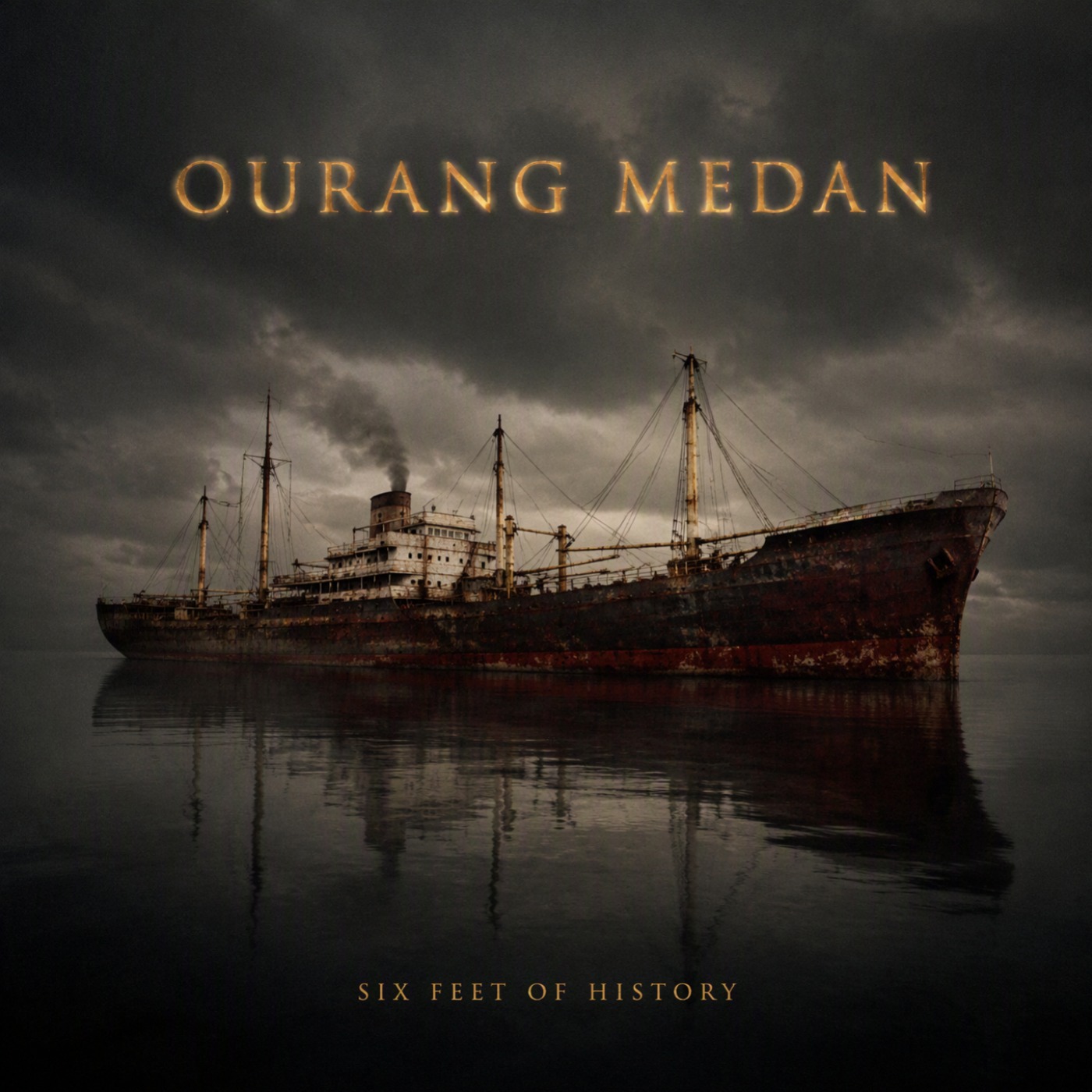
Six Feet of History – Dark History in 5 Minutes
The Ourang Medan: The Ghost Ship That Never Existed
· 13 min
Kapitelklicken springt direkt hin
Shownotes
<p>A distress call: all the officers are dead. The crew are dead. And then, one final line — I die. Rescuers board and find the entire crew dead where they fell, faces frozen in terror, not a mark on them. Then the ship catches fire and sinks, taking every answer with her.</p><p>It is the greatest ghost ship story of the twentieth century. August Mercer explains why there is almost no evidence the ship ever existed — and why that makes it more interesting, not less. This is Six Feet of History — five minutes of the past they'd rather you forget.</p><p><em>Follow for a new story every day. A Dark Whisper Studios production</em></p><p><br></p><p><em>#history #truehistory # truestories</em></p>
Transkriptvom Podcast bereitgestellt · Zeitmarken springen hin
[SPEAKER_00]: A distress call comes crackling out of the straight of Malacca. [SPEAKER_00]: The message is fragmented, desperate, all the officers are dead, it says, the crew are dead. [SPEAKER_00]: And then, after burst of unintelligible noise, one final line comes through and then nothing. [SPEAKER_00]: The line is, I die.
[SPEAKER_00]: When rescuers board the ship, they find the entire crew dead where they fell, sprawled on the decks in the corridors in the wheelhouse, their faces frozen in expressions of terror, their arms outstretched, their eyes staring up at nothing. [SPEAKER_00]: There is not a mark on them. [SPEAKER_00]: And then before the ship can be towed to port, she catches fire and explodes and sinks, taking every answer with her.
[SPEAKER_00]: and tonight the orang meddun, the most famous ghost ship story of the 20th century and the awkward problem at the heart of it. [SPEAKER_00]: There is almost no evidence that this ship ever existed at all. [SPEAKER_00]: The story, as it is usually told, runs something like this. [SPEAKER_00]: Sometime around 1947 or perhaps 1948, and the vagueness of that date is our first clue, a Dutch cargo vessel called the Orang Midan was sailing in the waters near Indonesia.
[SPEAKER_00]: Multiple ships in the area picked up in SOS. [SPEAKER_00]: The distress messages sent in Morse code, reported that the captain and all the officers were dead lying in the charthroom and on the bridge, possibly the whole crew. [SPEAKER_00]: And then, after a period of garbled transmission, came those final chilling words, I die.
[SPEAKER_00]: An American merchant ship usually named as the silver star responded and located the vessel drifting silently, a boarding party went aboard. [SPEAKER_00]: And what they found, according to the story, was a nightmare. [SPEAKER_00]: The entire crew was dead, not injured, not sick, dead. [SPEAKER_00]: And they were lying everywhere on the deck in the passageways in the boiler room on the bridge.
[SPEAKER_00]: The captain was dead on the bridge. [SPEAKER_00]: The radio operator was still at his post, his hand near his equipment, even the ship's dog was dead, reportedly frozen in a snarle, and it was the faces that made the story immortal. [SPEAKER_00]: The bodies were said to be lying on their backs, arms outstretched, mouths open, eyes staring wide, their features locked in expressions of extreme horror.
[SPEAKER_00]: There were no wounds, no blood, no sign of struggle or injury. [SPEAKER_00]: They had simply died, all of them, all at once, looking at something. [SPEAKER_00]: The boarding party also reported an intense unnatural chill in the lower decks, despite the tropical heat. [SPEAKER_00]: Disturbed, they decided to tow the ship to port.
[SPEAKER_00]: And then, as the tow line was raped, smoke was seen rising from one of the holes. [SPEAKER_00]: The silver stars crew barely had time to cut the line and pull away before the orang madan was engulfed, exploded, and sank into the depths. [SPEAKER_00]: Taking everybody, every scrap of evidence and every possible answer down with her.
[SPEAKER_00]: It is a magnificent story, it has everything, and it has been repeated in books, magazines, documentaries, and across the internet for decades. [SPEAKER_00]: And here we run into a wall almost immediately because the orang medan does not appear in the places a real ship should appear [SPEAKER_00]: Researchers have gone looking for her in the shipping registers of the era, the great published lists that record merchant vessels, their owners, their tonnage, their movements, she is not there.
[SPEAKER_00]: Investigators have searched Dutch maritime records and records of Dutch shipping in the East Indies and found nothing. [SPEAKER_00]: A vessel of that name, with that supposed history, appears to be absent from the official record. [SPEAKER_00]: And it gets worse. [SPEAKER_00]: The rescue in ship, the Silver Star, is itself a problem.
[SPEAKER_00]: Researchers have found vessels of similar names, but the details do not neatly line up, and there is no clear documentation of such a rescue, and then there is the date which floats. [SPEAKER_00]: Depending on which telling you read, the incident happened in 1947 or 1948, or sometime even the late 1930s.
[SPEAKER_00]: A real maritime disaster with radio traffic, a boarding party and a sinking has a date. [SPEAKER_00]: It has a position, it has paperwork, this one has a shrug, so where did the story actually come from? [SPEAKER_00]: The trail leads back to newspaper accounts. [SPEAKER_00]: The tale appears in the press in the late 1940s and versions of it circulated in the years afterward.
[SPEAKER_00]: One frequently cited path traces the story to accounts published in Indonesian and then Dutch newspapers around 1948 and later to a book and from there into the great sea of paranormal literature where it was reprinted endlessly, each retelling, adding a detail, sharpening a horror and gaining confidence.
[SPEAKER_00]: The story also received an enormous boost when it was picked up and published by an official seeming source in the mid-20th century, a maritime publication, which gave it a veneer of credibility it had not earned. [SPEAKER_00]: Once a story has been printed somewhere that looks official, it becomes almost impossible to kill.
[SPEAKER_00]: Every subsequent writer cites the previous writer, and no one goes back to check whether there was ever a ship. [SPEAKER_00]: and there's a useful lesson buried in how this thing propagated. [SPEAKER_00]: Notice the chain, a story appears in a newspaper, another paper picks it up and repeats it adding a detail, a book reprints it and cites the papers, a magazine reprints the book, a documentary cites the magazine, a website cites the documentary, [SPEAKER_00]: and 10 links down the chain.
[SPEAKER_00]: The story is being presented as a well documented historical incident. [SPEAKER_00]: Because everyone can point to a source and nobody has noticed that the source at the bottom of the stack is a single unverified newspaper item with no ship, no date and no witnesses. [SPEAKER_00]: that is not a supernatural process, that is just how information rods.
[SPEAKER_00]: So, most likely, the orang medan is not a mystery at all. [SPEAKER_00]: It is a legend, a sea story born in the newspapers of the late 1940s and grown fat on repetition. [SPEAKER_00]: But, and this is what makes it worth an episode, the theory is about what killed. [SPEAKER_00]: The crew are genuinely fascinating and they tell you a great deal about the world that [SPEAKER_00]: Theory One, and the one you will hear most often, is that the ship was carrying an undeclared illegal cargo of dangerous chemicals, commonly suggested as potassium cyanide and nitroglycerin or similar.
[SPEAKER_00]: The idea is that seawater leaked into the hold, reacted with the chemicals, and released clouds of lethal gas that killed the crew, and that a subsequent reaction or fire caused the explosion that destroyed the ship. [SPEAKER_00]: It's a tidy theory. [SPEAKER_00]: It explains the sudden deaths, the lack of wounds, and the fire.
[SPEAKER_00]: and it has a very specific, very post-war flavor to it. [SPEAKER_00]: Because the years after the Second World War were exactly the period when enormous quantities of surplus munitions and chemical agents were being quietly shipped, dumped, and disposed of around the world, often with breathtaking carelessness.
[SPEAKER_00]: The idea that a nameless freighter was carrying illicit chemical weapons through the straight of Malacca in 1947 and was killed by its own cargo is entirely plausible as a piece of fiction, precisely because it was so plausible as a fact. [SPEAKER_00]: Theory 2. [SPEAKER_00]: The mundane and rather more likely explanation of anything happened at all is carbon monoxide.
[SPEAKER_00]: a malfunctioning boiler or engine, a smoldering fire in a hole and an odorless, colorless gas seeping through a ship, killing men where they sit, followed by the fire, eventually breaking out and destroying the vessel. [SPEAKER_00]: That would explain almost everything, the sudden collective death, the absence of wounds and the fire, and the terrified faces, here we should be careful, because this is the most vivid detail and the least reliable.
[SPEAKER_00]: bodies do not reliably freeze into masks of horror. [SPEAKER_00]: What actually happens after death includes the slackening of the muscles and later rigor mortise and the retraction of tissue which can pull the lips back and make a corpse appear to be grimacing or snarling. [SPEAKER_00]: The expression of terror on a dead face is very often just decomposition, seen by frightened people who have already decided what they are looking at.
[SPEAKER_00]: Add in a story being retold by sailors, then embellished by a journalist, and you have your horror-struck faces. [SPEAKER_00]: And Theory 3, of course, is the one the internet loves, something supernatural, a curse. [SPEAKER_00]: Or, in the version that flourishes online, aliens, a UFO encounter, some unearthly force, an unseen visitation.
[SPEAKER_00]: And there is nothing to say about that, except that it is the natural endpoint of any story with no evidence attached to it. [SPEAKER_00]: When there are no facts, anything can be poured in. [SPEAKER_00]: And here is the thing that ought to make a skeptical, real ghost ships exist, and we know a great deal about them precisely because they are real.
[SPEAKER_00]: Vessels genuinely are found drifting and abandoned. [SPEAKER_00]: Cruise genuinely do disappear, and when it happens, there is a wreck, or a hull, or a lifeboat, or an inquiry, or a lawsuit, or a family demanding answers. [SPEAKER_00]: the evidence is messy and partial and frustrating, which is exactly what real evidence looks like.
[SPEAKER_00]: What real evidence almost never does is arrange itself into a perfect story and then conveniently destroy itself before anyone can check. [SPEAKER_00]: So why does the orang medan endure? [SPEAKER_00]: Because it is a perfect story and I mean that technically, look at its construction. [SPEAKER_00]: It contains the ultimate hook, not just a ship of the dead, but a ship that told you it was dying in its own words over the radio.
[SPEAKER_00]: It gives you a boarding party so you can walk the decks yourself. [SPEAKER_00]: It gives you a specific unforgettable image. [SPEAKER_00]: The outstretched arms, the staring eyes, the dead dog, and then crucially it destroys itself. [SPEAKER_00]: The ship explodes and sinks, which conveniently removes every piece of evidence that could ever be examined.
[SPEAKER_00]: That last part is not a bug in the story. [SPEAKER_00]: It is the entire point. [SPEAKER_00]: The story is built to be unverifiable. [SPEAKER_00]: It has an escape hatch sewn into its final act. [SPEAKER_00]: And that is the tell. [SPEAKER_00]: Real disasters leave debris. [SPEAKER_00]: Real disasters leave paperwork in queries, insurance claims, [SPEAKER_00]: the orang madan leaves nothing but the story and then politely blows itself up before anyone can look too closely.
[SPEAKER_00]: What we are really looking at, I think, is a piece of postwar folklore. [SPEAKER_00]: This story was born in a world that had just finished the largest and most horrifying war in history. [SPEAKER_00]: A world that had learned very recently that invisible agents could kill entire rooms of people that governments shipped monstrous cargos in secret and that the sea was full of things nobody would admit to.
[SPEAKER_00]: The Aurangmadan is that anxiety made into a ghost story and set a drift. [SPEAKER_00]: And I want to be clear that debunking it is not the same as dismissing it. [SPEAKER_00]: Stories like this one matter precisely because they show us what a society is frightened of. [SPEAKER_00]: The Aurangmadan was born in a specific moment in the shadow of chemical weapons, secret cargos, and a war that had just proved how casually the powerful would poison the world.
[SPEAKER_00]: strip away the ghost ship, and what is left is a very rational fear, wearing a costume that's the orang medan. [SPEAKER_00]: A ship that may never have sailed, crude by men who may never have lived, killed by something that may never have happened, in a place that no one can point to, on a date that nobody can agree on.
[SPEAKER_00]: and she is still out there in a sense, endlessly bordered, endlessly retold, her dead crew still staring up at whatever it was forever. [SPEAKER_00]: Because we would so much rather have a haunted ship with no evidence that admit that sometimes the most frightening story is simply a story, and that the deepest thing it tells us about is not the sea, but ourselves.
[SPEAKER_00]: Follow 6 feet of history for a new story every day. [SPEAKER_00]: Next time, a city surrounded and starved for nearly 900 days, and the ordinary people who kept a whole civilisation alive on nothing but bread and stubbornness. [SPEAKER_00]: I'm August Moser. [SPEAKER_00]: And this was Six Feet of History, a dark, whispersed Judeo's production.
