

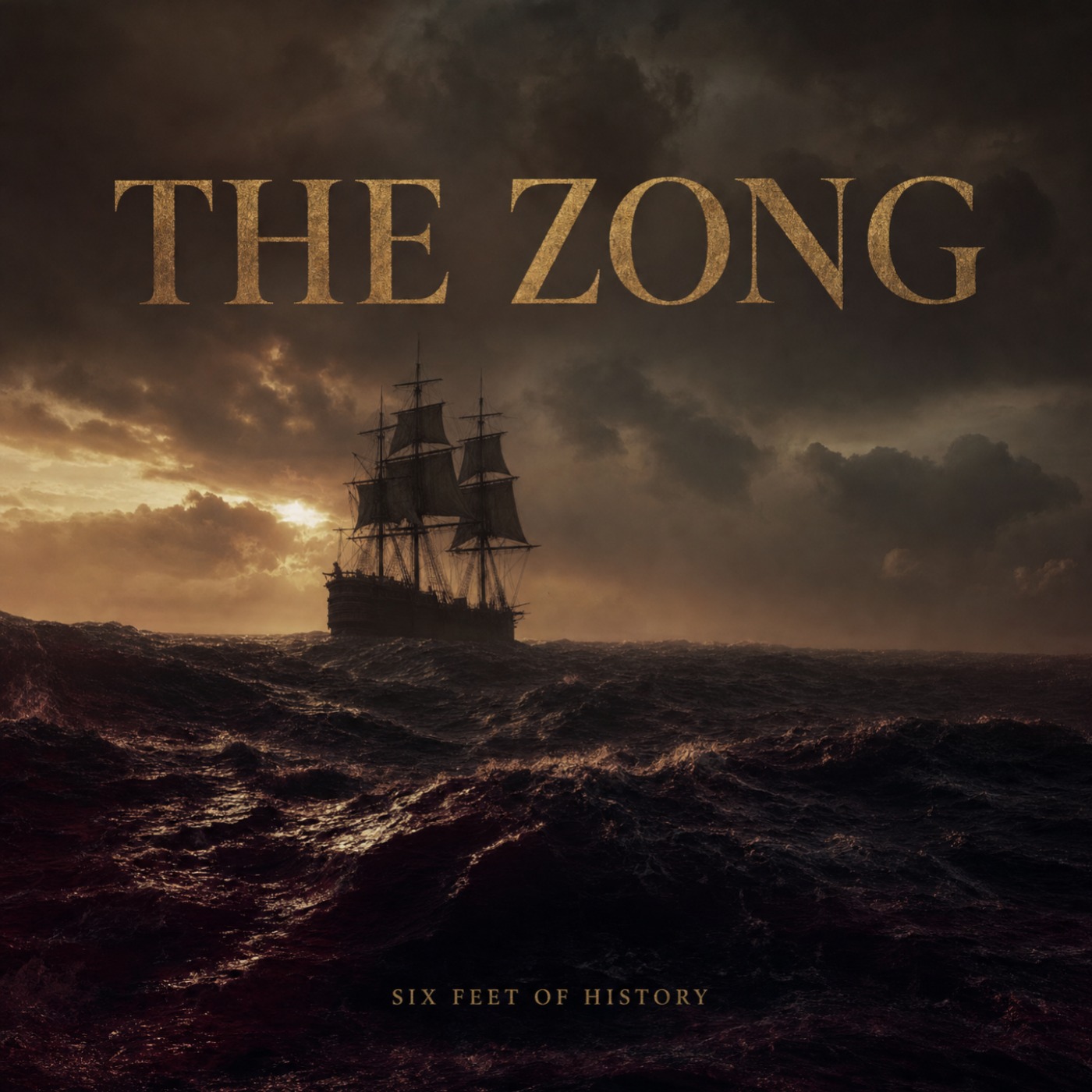
Six Feet of History – Dark History in 5 Minutes
The Zong: When Murder Was an Insurance Claim
· 13 min
Kapitelklicken springt direkt hin
Shownotes
<p>In seventeen eighty-one, the crew of a British slave ship threw around a hundred and thirty enslaved people into the sea to drown — because the ship was insured, and under the law, killing them paid out where letting them die did not. When the owners were refused their money, they took the insurers to court, over the value of the people they had killed.</p><p>August Mercer handles one of the darkest cases of the slave trade with the gravity it demands, and the reckoning it forced. This is Six Feet of History — five minutes of the past they'd rather you forget.</p><p><em>Follow for a new story every day. A Dark Whisper Studios production.</em></p>
Transkriptvom Podcast bereitgestellt · Zeitmarken springen hin
[SPEAKER_00]: In 1781, the crew of a slave ship makes a decision so cold that it will end up in an English courtroom, not as a murder trial but as an insurance claim. [SPEAKER_00]: The ship is overcrowded and running low on water. [SPEAKER_00]: and the men in charge decide that the solution is to throw a large number of the enslaved people on board into the sea, alive, to drown.
[SPEAKER_00]: Their reasoning is not concealed, it is written down. [SPEAKER_00]: They do it because the ship is insured. [SPEAKER_00]: and under the law of the time, if the enslaved people die of illness or thirst, the owners bear the loss, but if they are deliberately cast overboard to save the ship, the insurers must pay.
[SPEAKER_00]: So it is cheaper to drown them than to let them die, and when the owners are refused their money, they take the insurers to court, over the value of the people they killed. [SPEAKER_00]: This is six feet of history. [SPEAKER_00]: Five minutes of the past, [SPEAKER_00]: And tonight, the massacre aboard the Slaveship Zong, one of the darkest episodes of the entire transatlantic slave trade, and the court case that forced a nation to look at what it had allowed to become normal.
[SPEAKER_00]: I will handle this with the restrained demands, but I will not look away from it and neither should we. [SPEAKER_00]: The transatlantic slave trade was for well over three centuries, one of the largest and most [SPEAKER_00]: millions of African people were captured, sold, packed into ships and carried across the Atlantic in conditions of unimaginable cruelty to be worked and to die as property in the Americas.
[SPEAKER_00]: I could spend this entire episode on the scale of it and it would be justified, but tonight I want to focus on a single voyage because sometimes a single case reveals the machinery more [SPEAKER_00]: But the zone was a British slave ship. [SPEAKER_00]: In 1781, it was carrying a large number of enslaved African people across the Atlantic, packed aboard in numbers far beyond what the ship was suited to carry, which was itself standard murderous practice because more bodies meant more profit.
[SPEAKER_00]: the voyage went wrong through navigational errors the ship took far longer than it should have and drinking water ran dangerously short. [SPEAKER_00]: People on board both the enslaved and some of the crew were falling sick and dying. [SPEAKER_00]: And it was in that situation that the men commanding the zone made their decision.
[SPEAKER_00]: Face in a shortage of water and a ship full of people, some already dying, they chose to throw enslaved people overboard into the sea to their deaths. [SPEAKER_00]: Over the course of several days, a large number of human beings, men, women and children were cast into the ocean and drowned.
[SPEAKER_00]: The figure is generally given as around 130 people, though accounts vary, they were murdered. [SPEAKER_00]: There is no other honest word for it, and the reason they were murdered is the path that has echoed down the centuries, because the reason was written down in plain, unashamed commercial language.
[SPEAKER_00]: and the enslaved people aboard were ensured as cargo, as property, with a monetary value attached to each one. [SPEAKER_00]: Now, under the marine insurance practices of the day, there was a crucial distinction. [SPEAKER_00]: If enslaved people died of natural causes on the voyage of illness, of thirst, of the conditions, that was simply a loss borne by the ship's owners, the insurance would not pay.
[SPEAKER_00]: but if cargo had to be deliberately destroyed, jettisoned, thrown overboard, to save the rest of the ship and the voyage, under a principle of maritime law concerning sacrifice for the common good, then the insurers were liable. [SPEAKER_00]: The owners could claim the value of what had been thrown away, do you see the monstrous logic?
[SPEAKER_00]: If the enslaved people died on their own, the owners lost money. [SPEAKER_00]: If the owners killed them, deliberately, for the stated purpose of saving the ship, the owners could be paid for them. [SPEAKER_00]: So the calculation that the men on the song made was in the coldest financial terms rational.
[SPEAKER_00]: It was more profitable to drown living human beings than to let them die of the thirst the cruise-owned incompetence had caused. [SPEAKER_00]: Murder was the line item that paid out. [SPEAKER_00]: Neglect was the line item that didn't. [SPEAKER_00]: and so they did it. [SPEAKER_00]: And then the ship completed its voyage, and then the owners submitted their insurance claim for the value of the murdered people, and the insurers refused to pay.
[SPEAKER_00]: Not, I have to tell you, out of moral horror. [SPEAKER_00]: The insurers refused because they disputed the facts. [SPEAKER_00]: They argued that the deaths were not a genuine necessity, that they had in fact been water-reboard, that the jettisoning was not a legitimate sacrifice to save the ship, but a fraud to recover the value of sickly cargo.
[SPEAKER_00]: That was going to die anyway. [SPEAKER_00]: So, the owners took the insurers to court, and that is how this mass killing came before the English legal system, not as a murder, but as a commercial dispute, a disagreement about an insurance payout. [SPEAKER_00]: The question before the court was not, was it wrong to drown 130 people?
[SPEAKER_00]: The question was, who bears the financial loss? [SPEAKER_00]: Let that sink in because it is the whole horror of the thing in miniature. [SPEAKER_00]: In that courtroom, the deaths of over 100 human beings were discussed in exactly the same terms one would use for damaged goods or drowned livestock or jettisoned cargo, where they lawfully sacrificed or not.
[SPEAKER_00]: Should the underwriters pay or not? [SPEAKER_00]: The people themselves, their terror, their humanity, the fact that they were thrown living into the sea, were legally almost irrelevant. [SPEAKER_00]: They were the subject of the claim, not victims of a crime. [SPEAKER_00]: the initial verdict actually went in favour of the ship's owners.
[SPEAKER_00]: The court accepted at first, the ghastly framing that this had been a lawful jettisoning of cargo and that the insurers should pay. [SPEAKER_00]: But the case did not stay quiet, and this is where a sliver of light enters the story. [SPEAKER_00]: Because the details of the song reach the ears of the men and women who were beginning to fight against the slave trade itself.
[SPEAKER_00]: In particular, they reached a formally enslaved African man named Olauda Equiano, who had bought his own freedom and become a leading voice against slavery, and who brought the case to the attention of Grandville Sharp, a prominent British abolitionist. [SPEAKER_00]: and sharp seized on it.
[SPEAKER_00]: He tried unsuccessfully to have the crew prosecuted for murder. [SPEAKER_00]: He publicized the case relentlessly. [SPEAKER_00]: He forced people to look at it because the abolitionists understood something powerful. [SPEAKER_00]: The zone was not an aberration that the slave trade had to explain away.
[SPEAKER_00]: The zone was the slave trade revealed. [SPEAKER_00]: It was the logic of the entire system laid bare in a single undeniable document. [SPEAKER_00]: A system that turned human beings into insured cargo would inevitably, sooner or later, produce a moment where it was more profitable to kill them than to keep them alive.
[SPEAKER_00]: The zone was not a malfunction. [SPEAKER_00]: it was the machine working exactly as designed and that was a devastating argument to put before the British public. [SPEAKER_00]: It is one thing to defend slavery in the abstract as a distant economic institution. [SPEAKER_00]: It is another to defend a system in which a court solemnly debates whether murderers should be paid an insurance premium for drowning children.
[SPEAKER_00]: the case, and sharps campaign around it, became a significant moment in the growth of the British abolitionist movement. [SPEAKER_00]: It did not end slavery. [SPEAKER_00]: That fight would take decades more. [SPEAKER_00]: No one was ever punished for the killings. [SPEAKER_00]: The legal system never treated the drowned people as murder victims.
[SPEAKER_00]: In the narrowest sense, justice was never done for the dead of the song and it never will be. [SPEAKER_00]: But the case pierced something. [SPEAKER_00]: It gave the abolitionists an image and an argument of terrible clarity. [SPEAKER_00]: It helped move the slave trade from an abstraction to be tolerated into an atrocity to be confronted.
[SPEAKER_00]: the horror of the song became a weapon in the long war against the trade and that war was eventually in part one. [SPEAKER_00]: Now, I want to reflect on why this story matters so much beyond the specific horror of it. [SPEAKER_00]: Because the zone is the ultimate example of a theme. [SPEAKER_00]: This show returns to a gain and a gain.
[SPEAKER_00]: What happens when human beings are turned into entries in a ledger? [SPEAKER_00]: When a person becomes a number, a value, a line item, and asset on a balance sheet, then everything that follows, however monstrous, becomes a matter of arithmetic. [SPEAKER_00]: The men on the zone did not, as far as we can tell, hate the people they drowned.
[SPEAKER_00]: That is almost the worst part. [SPEAKER_00]: They were not in a frenzy of cruelty. [SPEAKER_00]: They were doing a calculation, profit and loss, cargo and insurance, and the calculation said, drown them. [SPEAKER_00]: That is what a system does when it successfully convinces people that some human beings are property.
[SPEAKER_00]: It does not require monsters. [SPEAKER_00]: It requires ordinary men doing ordinary commercial reasoning within a framework that has quietly redefined murder as the disposal of assets. [SPEAKER_00]: The evil of the song is not the evil of a smiling villain, it is the evil of a spreadsheet.
[SPEAKER_00]: And that is far more frightening, because spreadsheets are everywhere, and the men who fill them in mostly sleep soundly. [SPEAKER_00]: The transatlantic slave trade killed and destroyed on a scale so vast that the mind cannot [SPEAKER_00]: The song is one voyage and around 130 people out of many millions, but sometimes you cannot see the whole ocean and you have to look instead at a single unbearable drop and understand that the whole ocean is made of it.
[SPEAKER_00]: The people who died aboard the song have no graves. [SPEAKER_00]: We do not know their names, not one of them. [SPEAKER_00]: They were recorded, if at all, as numbers and as values, as units of insured cargo lost [SPEAKER_00]: They were thrown into the Atlantic and they were gone, and the men responsible went to court to be paid for them.
[SPEAKER_00]: The very least that history can do, the very least this show can do, is refuse the framing that killed them. [SPEAKER_00]: They were not cargo. [SPEAKER_00]: They were not a loss to be insured against. [SPEAKER_00]: They were men and women and children with names their families new thrown living into the sea to balance a book.
[SPEAKER_00]: And that is not a commercial dispute. [SPEAKER_00]: It is one of the great crimes of the modern world, and it should be remembered as exactly that. [SPEAKER_00]: It is worth saying, too, that the song was not unique, and the abolitionist knew it and used that fact. [SPEAKER_00]: Other ships, other voyages, produced their own atrocities that never reached a courtroom at all, because there was no insurance dispute to drag them into the light.
[SPEAKER_00]: The only reason we know the song in such detail is that its horror was attached to a claim for money and money leaves records. [SPEAKER_00]: For every documented song, there were countless killings at sea that generated no paperwork, no case and no memory. [SPEAKER_00]: The massacre we can see is a marker for all the ones we cannot.
[SPEAKER_00]: That's the zone. [SPEAKER_00]: A ship, a shortage of water, a cold calculation, and over a hundred human beings drowned so that their killers could file an insurance claim. [SPEAKER_00]: And a court that sat and debated the payout as though it were discussing spoiled grain. [SPEAKER_00]: There was no justice for them.
[SPEAKER_00]: but there was at least a reckoning of a kind, because good people refused to let the case stay quiet and use the horror of it to help end the trade that produced it. [SPEAKER_00]: The dead of the song did not get justice. [SPEAKER_00]: But they became part of the argument that eventually helped free others.
[SPEAKER_00]: It is not enough, it was never going to be enough. [SPEAKER_00]: But it is what there is, and we owe it to them to remember it. [SPEAKER_00]: Follow six feet of history for a new story every day. [SPEAKER_00]: Next time, a mutiny on a ship in the South Pacific, an island no one could find again, and the descendants who still live there today.
[SPEAKER_00]: I'm August Mercer, and this was six feet of history, a dark whisper studios production.
