

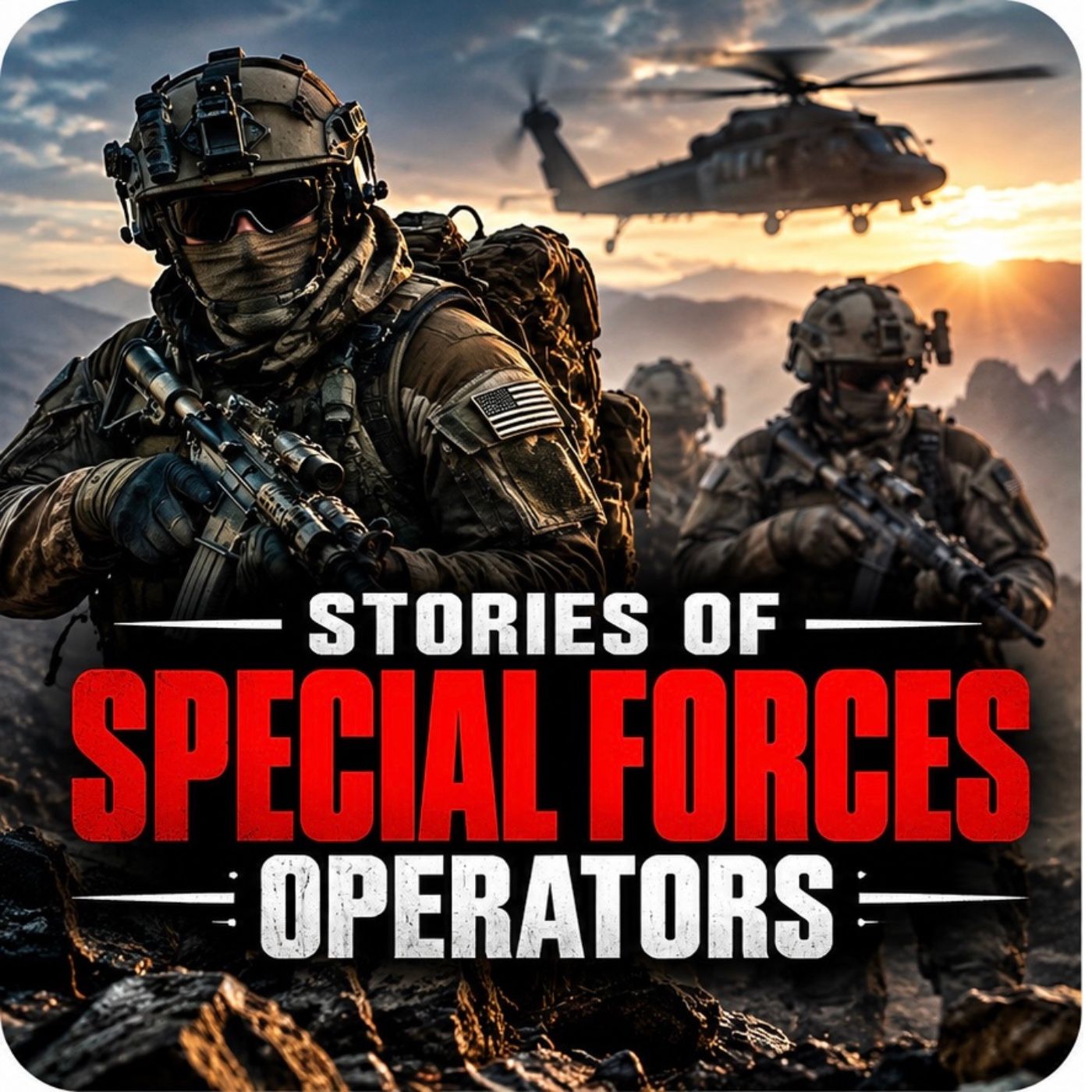
Stories of Special Forces Operators
The Battle of Takur Ghar: When a Navy SEAL Mission Became a Fight for Survival
Dienstag, 3. November 2026 · 4 min
Kapitelklicken springt direkt hin
Shownotes
On March 4, 2002, a nighttime insertion into Afghanistan’s Shah-i-Kot Valley turned into one of the most desperate battles of the early war on terrorism. What began as an effort to establish a reconnaissance position became a deadly engagement involving Navy SEALs, Army Rangers, Air Force combat controllers, and pararescuemen fighting against entrenched al-Qaeda militants. This episode examines the Battle of Takur Ghar, also known as the Battle of Roberts Ridge, and the intelligence failures, communications problems, and extraordinary acts of courage that cost seven Americans their lives.
Transkriptvom Podcast bereitgestellt · Zeitmarken springen hin
The Battle of Takur Gar, when a hot LZ becomes a meat grinder. Every special ops insertion hinges on a single ruthless assumption that you own the initiative until your boots hit the deck. At 0300 hours on March 4, 2002, atop the snow-swept ridgeline of Takur Gar, the assumption vaporized. Razor 03 flared at 10,000 feet into what intelligence assessed as an unoccupied mountaintop. Instead, the twin rotor birds settled straight into an interlocking kill zone. Entrenched Al-Qaeda fighters opened up a point-blank range with DSHK heavy machine guns and RPGs.
An RPG punched through the right turbine. A second severed the hydraulic lines. The massive Chinook bucked violently in midair. On the ramp, Navy SEAL Petty Officer First Class Neil Roberts slipped on oil and snow, plummeting 10 feet into the freezing dark. The crippled bird crash-landed miles away. The mission was dead. The clock on an isolated operator in hostile terrain had just started ticking. Through an operator's eye, the decision to reinsert on Razor 04 wasn't reckless heroism.
It was the sacred, lethal mandate of personnel recovery. But going back to the same exact hot LZ violates basic doctrine. For those who don't know, LZ's landing zone. Never insert directly onto an alerted, entrenched enemy. The SEALs took the risk anyway. Stepping off the ramp into waist-deep powder under night vision, they were fighting physics and geometry. As well as the enemy. The militants held dug-in bunkers under the ridgeline trees, firing down. They were moving, bounding, and dragging casualties in thin air at 10,000 feet, burns out an operator's lung in under two minutes. Attached Air Force Combat Controller Technical Sergeant John Chapman didn't hesitate, though. He surged forward into thigh-high deep snow, assaulted an enemy bunker head-on,
and cleared it before taking fire from a secondary fortified position. Severely wounded, Chapman was believed dead as the pinned-down team broke contact down the steep slope. Years later, overhead surveillance analysis would reveal the truth. Chapman regained consciousness, rallied, and fought alone. Desperate close quarters stand inside that bunker for over an hour, holding off converging fighters to save the incoming rescue force. When Razor 01 arrived carrying the Army Ranger Quick Reaction Force, Communications blackout struck again. They had no idea the LZ was actively occupied. As the Chinook touched down an RPG sheared through the right engine, small arms fire tore through the fuselage. Sergeant Philip Spack, Specialist
Mark Anderson, Sergeant Bradley Crose, and Corporal Matthew Commons were killed in the opening barrage. Thank you for your service, gentlemen. The surviving Rangers and Air Force pararescue men rolled out the back door directly into the snow, pinned behind the burning wreck. A pair of rescue men, senior airman Jason Cunningham, worked fanatically inside an improvised casualty collection point in the bitter cold. For 17 hours, survival came down to inches of snow cover, disciplined close air support, walk-ins from AC-130 gunships and strike jets, and young men refusing to yield a frozen mountaintop. Takurgar isn't a neat war story. It is a clinic in the friction of combat where intelligence blind spots everything. Degraded satellite radios in the primal drive
to never leave a fallen brother behind collide. If we look at it analytically, utilizing the same summit landing zone repeatedly eliminated the element of surprise and allowed entrenched defenders to pre-register. This was the trap of the Signal LZ. At 10,000 plus feet, Rotocroft... Rotor craft operate near the performance ceilings, reducing engine margins, limiting evasive maneuvers, and leaving helicopters vulnerable during the vulnerable load speed flare. And lastly, the fog of cross-echelon communications. Delayed satellite relay messages met the Ranger QRF inserted directly into a lethal ambush. The command elements had already recognized from remote feeds, underscoring the lethal gap between overhead reconnaissance and ground reality.
