

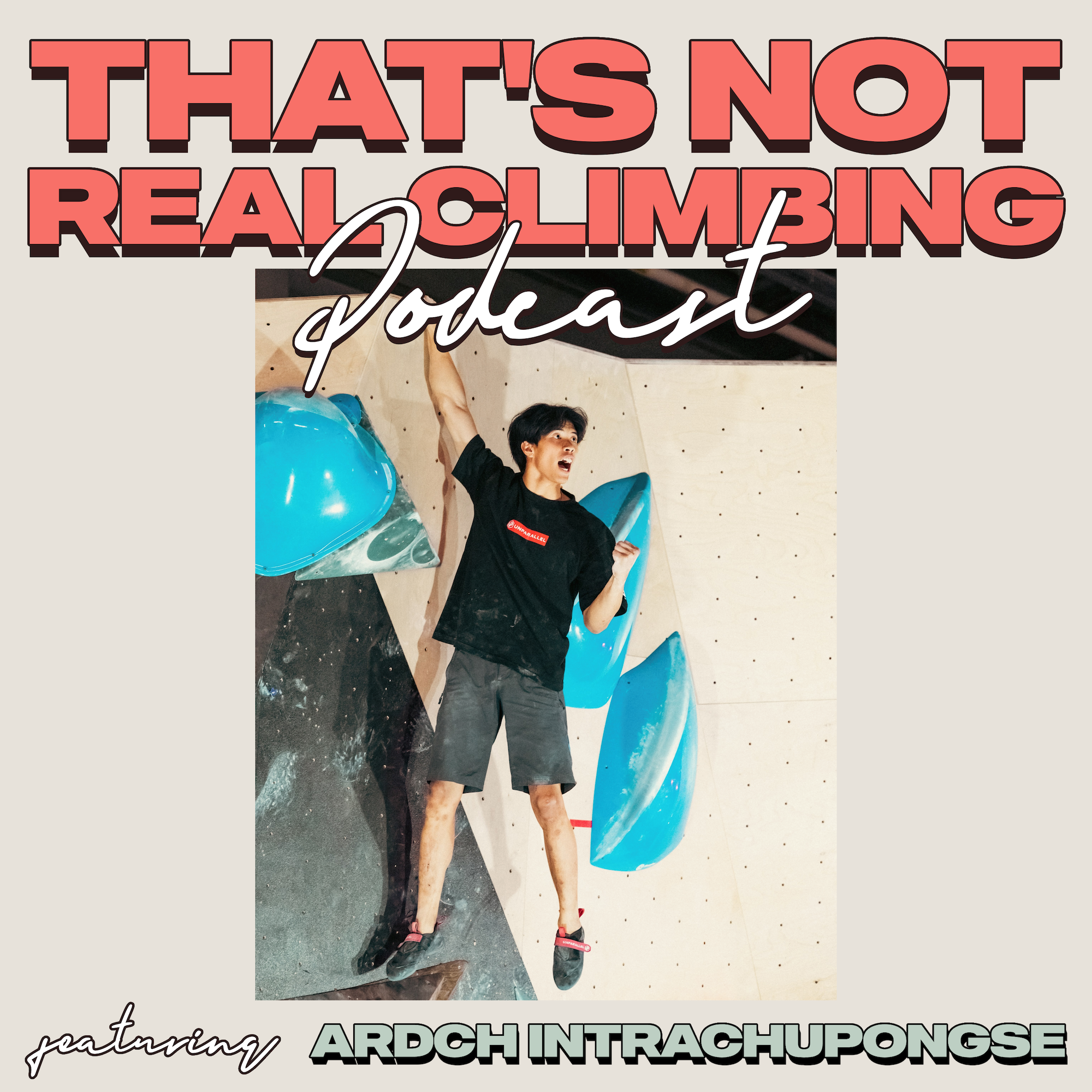
That's Not Real Climbing· Staffel 7· Folge 8
Ardch Intrachupongse - Thailand Climbing EXPOSED
Montag, 12. Oktober 2026 · 1 h 33
Kapitelklicken springt direkt hin
Shownotes
Got something to say to this podcast? Send a voicemail, and you might hear yourself on the next episode! (rss.com/podcasts/thatsnotrealclimbing/voicemail)
Ardch is a boulderer for the Thailand team, and he has made semis several times in World Climbing. In this episode, we’ll hear why he thinks climbing is performative in Thailand, why it’s hard to grow climbing as a spectator sport, and we’ll talk about where we draw the line on setting that is too trendy. Hope you’re ready for some hot takes and strong opinions in this one!
Guest links:
Ardch's Instagram (instagram.com/ardch.i)
Reference links:
PCL Bouldering Project Qualifiers (proclimbing.com/qualifiers)
Thank you Mad Rock for sponsoring this episode! Use code 'notrealclimber' for 10% off your ENTIRE order, even if you're a returning customer! madrock.com
Learn more about the podcast at thatsnotrealclimbingpodcast.com
Follow on Instagram at instagram.com/thatsnotrealclimbingpodcast
Join the FREE community in Discord! discord.gg/QTa668g8zp
Join Patreon for a welcome gift, deleted scenes, and question priority: patreon.com/thatsnotrealclimbingpodcast
Timestamps of discussion topics
- Intro
- Mad Rock Shoutout!!
- Winning Seattle Boulderfest + PCL
- Moving to the US, getting into climbing
- Performative climbing in Thailand?
- Lack of World Climbing level Thai climbers
- Should it become a D1 sport in the USA?
- How to grow climbing
- Goodbye dirtbags
- Outdoor paddle dynos
- What climbing trend goes TOO FAR?
- What does it take to make semis and finals in world climbing?
- Salt Lake City and Mental Pressure
- Why is the mens field so unpredictable?
- AUDIENCE Q: Wow factor to making finals?
- Glazing Sorato
- AUDIENCE Q: Most underdeveloped part of climbing?
- Words of wisdom and where to find Arch
Transkriptvom Podcast bereitgestellt · Zeitmarken springen hin
Climbing in Thailand started off as a very, very expensive and bougie sport. So everyone there that climbs makes an absurd amount of money. You can't build an obsessed generational fan base of an individual sport where you could cheer by name. I've spent so many years climbing not to fall, rather than climbing to top. I've always looked down and be like, I don't want to go over there. Rather than look it up and be like, oh, I wonder what's up there. I want Serato to win all of it. Welcome to another episode of the That's Not Real Climbing podcast. I'm your host, Jinni, and I'm excited to introduce my guest for today, Ardch Intrachupongse. Ardch is a boulder for the Thailand team, and he has made semis several
times in world climbing. In this episode, we'll hear why he thinks climbing is performative in Thailand, why it's hard to go climbing as a spectator sport, and we'll talk about where we draw the line on setting that is too trendy. Hope you're ready for some hot takes and strong opinions in this one. I hope you enjoy this episode with ardch. Please pardon this brief intermission, but let me tell you about Madrock's Remora Pro. You can now see several pros wearing Madrock shoes during competitions, and here's why. If you like being able to feel the chips you're standing on, and you like not having to worry about standing on sketchy volumes, then the Remora Pro is Madrock's softest aggressive shoe offering. They also have
a crazy 3D heel that allows you to get more surface area when heel hooking, inserts that lock your heel into the shoe no matter how hard you're pulling. Feel free to message me if you have any questions about the shoes or sizing and you can use the discount code NotRealClimber for 10 % off your entire Mad Rock order. Thank you to Mad Rock for helping to sponsor this podcast.
Now back to the show. How are you doing today? How was Boulder Fest last week? Good. Boulder Fest was good. I was pretty stressed, you know. When you kind of walk into a comp that you know you can win, especially that I've won it in the past. When I won, it was me, Sergey, Vale, and Sean Bailey in the finals. So it was four World Cup climbers. And obviously I grew up watching Sean Bailey and idolizing him. and winning that was very special to me but also knowing that who I've beaten and what I potentially have like the potential to do it kind of add more pressure into like oh this is just another event this is a smaller event so I should win it so it kind of plays in in my head where like how do I disconnect
that from the ego side of it like how do I have that confidence of like i can win but i can win and i want to win because i want to do it for myself rather than i want to do it because i can or i have or whatever like it i i have a very difficult time trying to separate those two just because like when confidence can be very easily mistaken for ego and then you feel like people expect you to win a bit as well well i mean probably there's probably a little bit of that of like I know people might expect me to or whatever it may be. Or one of the things that pops up a lot in the conversation when these events kind of comes around is like, I can't lose it. Why can't you lose it? What do you have to lose? You might like someone, I personally
a few years ago, my answer, well, I've done it before, so I have to do it again. Or it's my like, and when I'm looking back at that, it's like just strictly ego talking. But as much as. You know, I've grown and grown as a person and became a better competitor. There's still a little bit of that of like, oh, but I can't lose it.
Like I've done it before. I can't lose it. You know, I think shifting that perspective from I can't lose it to I really got nothing to lose except my own ego. And that really kind of flip a switch for me of like, ah, I can relax a little bit more. I can like have fun a little bit more and I can really enjoy the experience of this event a little bit more. But I was quite stressed just because me and Sergey, Sergey Lov, no, me and him, we train together all the time. We compete at most events together, mostly locals. And we have a very competitive but friendly friendship.
You know, we always talk shit up to each other. We trying to beat each other all the time. And we have been, we have been first or second or second or third. We've been like placing right next to each other, divided, like separate by me, like. one attempt for a bunch of the comps, you know. Boulder Fest last year, I beat him by one attempt. There's a few comps that I did here and there that he's beat me by one attempt.
I beat him by one attempt. And, you know, we've just always been there like with each other and trying to beat each other constantly. Well, congrats on your... You did win, right? I'm pretty sure. Yes, I did. Okay, congrats on that. Thank you very much. I also, I heard that Boulder Fest is like feeding into PCL. Does that... Yeah.
Okay. How does that work? Do you know? So all the finalists from each local event, from each local Boulder Fest, gets an invitation to go to the finale in St. Paul's. Okay. And the winner, one winner from each gender, men's and women's from St. Paul's, gets flown out to PCL. And we'll see who shows up because I... already talked to a bunch of people and i you know a few people aren't really planning to go oh really to the finale like it's the same weekend as uh the san siago world cup oh so a bunch of the elite and boulder uh world cup athletes who because they they made a post where they say all the top 20 world cup athletes are invited um which it's great except I've already asked a bunch of them
if they wanted to go and a lot of them just say they can't. Like a bunch of Japanese can't do it. A lot of French are going to Red Rocks right after. I guess I shouldn't be leaking their schedule, but whatever. Okay. I can cut it out if you think. No, no, you're good. It doesn't really matter. They're going to be there anyways. They're going to be posting anyways. So I just know that like it's just going to be a bunch of Americans. And I talked to Adam Shahar. I was like, hey, man, like, are you going to be at the finale? And he's like, ah, I'm still thinking about it. So I told him not to think too hard just so he doesn't go so I can hopefully win. Yeah. Yeah, you have a good chance if everyone else is going to be
going to the World Cup, I guess. So you are prioritizing this over going to Santiago? I'm not a lead climber anyway, so I'm not really planning on signing up. Oh, yeah, because I got confused because like that last year there was a bouldering. World Series. Yes, Kota Shiba. Yeah, yeah, yeah. And now it's just lead, which is... I see. Very thankful, so I don't have to go. Yeah, okay. Well, good luck there. That'll be interesting. I mean, there will still be, I guess, like semis there at least.
There'll be enough people for that. I think so. Qualifiers too, maybe. I heard there was quality semi and finals. I really hope it's all on -site round because that will favor me. I'm nowhere near the strongest athletes in America. But I think if it were to be a flash round or an onside round, I think it could potentially favor me.
Why is that? I noticed that my ability to consistently perform closer to my peak performance is pretty good. It's just my peak performance is not that high. my max grade on outdoor boulder is like v13 and i have second go of v12 you know and it's like it's just i'm pretty close up there i'm just not that strong yeah i feel a similar thing with my climbing and i don't exactly know what that means like what is that what does that tell you if you're like flash crate is really close to your your max grade um i think it's just your execution is very good that you're very good climber and your limitation is obviously you can always get better technique but i think uh it just shows that if i work on my physicality
and my strength that i will make a quicker improvement than if i were to just work on my skills i think it just shows you're a good climber oh thank you yeah Okay, cool. Well, let's get into your background a bit. Yeah, well, we spent a long time talking about PCL and Boulder Fest. So when did you first move to the US? And was it, did you always move like directly to Seattle? Or was there like other places you lived? Yeah, so my family decided to move to America in 2016.
And we directly moved to Seattle just because my mom actually did an exchange program here. In Seattle and my mom's side of family, her siblings and her parents lived here. So it's just kind of nice getting closer to home. And did you already start climbing before you had moved? Yeah, yeah, I started climbing. Actually, I checked this early February of 2014. Oh, okay. So not that long before you moved. Yeah, about a year and a half. two years yeah so i've already was already on thai national team and i already did my first international comp and that was i think it was malaysia it was asian youth championship geez after a year and a half of climbing it was like a year yeah i did it in 2015 yeah i it was horrible
i got second to last a third to last or something like that well yeah i got it's fair yeah exactly i did not expect anything more than that but i remember going over there and uh just seeing all these guys that you know i look up to now like i think i met the first person i remember meeting was actually shit i forgot her name that's nice yeah i I don't think she remembers me at all. She was a Chinese girl. She's doing quite well. I'm just blanking out. I'm not really linking names to faces. Well, is she still climbing now?
Oh, yeah, yeah. I think she just won her World Cup. I just forgot her name. Oh, was it like Zilu? I don't think it was Zilu. No, there was... It's the other one. Oh, crap. It's been so long since the last bouldering World Series. Okay, I got this. Oh, yeah, Yutong. Yes, right. So that was the first person I remember meeting over there. And then I don't think she remembers me anymore. I even vaguely remembered it. But that was a fun event. Met a bunch of people, met a bunch of Japanese guys. This was when like, I forgot who it was. I think it was Yoshiyuki used to have like crazy colorful hair. Oh, yeah.
It was, I was so young. I don't remember much from it, but it was a... It was a good and very eye -opening event for me to just kind of set my career. And so then how did you get into competing so early into your climbing start? So I'm like other people, mostly in America, where they're like, oh, I just went to a birthday party. That was not my path. My path was I went to this little private school in Thailand and they... decided to build a rock climbing wall inside in the middle of the school uh and the guy that they brought in the faculty happens to be the i think he was like a coach like a national team coach or someone's very very involved in the climbing community um and he basically approached my parents and
be hey if i can teach if i can coach your kids to have the potential to be national team and At that point, I was convinced I was going to be a soccer player. Fast forward, clearly that didn't happen. That would have been a better choice for sure. But at that point, like monetary wise. Yeah, exactly. I could be a very mediocre soccer player and still make more money than I am now. I heard that from Mika Malam. Yeah, yeah. Oh, yeah, I think he was. I remember him saying something like that. Like I, my ranking right now is obviously horrible. I'm consistently like. 33rd in the world. And if I was 33rd best football soccer player in the world, I would be making millions, you know? Yeah, I guess that's
true. And I am making not millions. Yeah. But yeah, so that coach approached my mom. And at that point, I didn't know better. And it was, I didn't actually like it that much. My sister did. I was very into ping pong. So I kind of chose that. But after my soccer and rugby practiced, my sister was still climbing. And being a 9, 10 -year -old boy that I was, you know, I always have way too much energy. So I was like, I don't want to wait for my sister. I'll start climbing.
And then I kept climbing. And so he kind of like really wanted you on the national team, I guess? I think he was just obviously being a gym owner as well. He was probably just trying to make profit. Okay, yeah. Yeah, I did that, did the team selection, did the national team selection, won, and then, yeah, got a national team, and I kind of was competing for Thailand until I moved to America because I wasn't able to travel outside the country, so it was going to be very difficult to go back and, like, do a team selection and slash or travel to another country for Youth World Championship. Because we were on an E -2 visa, so we weren't allowed to leave the country.
Well, at least I wasn't allowed to leave the country. So that was quite difficult. We got our green card in 2023. Was it maybe late 22? So that allowed me to essentially travel outside the country without having to reapply and redo all the visa process, which would have cost us $10 ,000 to get back. It was kind of not fun.
Okay, cool. Well, then let's get into the climbing scene in Thailand a bit. Absolutely. I don't know too many Thai athletes. I don't know if there are a lot out there. What is the scene like? It's growing very, very rapidly and I'm grateful for it. But every time I go back, there's certainly a few things that I'm like, wow, this is very, very performative. And obviously not from the gym commercial side, but just like kind of from the climber side of things. Yeah, what does that mean? So in America, climbing is obviously originated from actually rock climbing, which means that they were originated from, you know, dirtbagging and just people going out and climbing rocks and shit and living in their cars and all
that stuff. In Thailand, it started off quite different where you need to have money to do it. Climbing shoes are incredibly expensive. The chalk that you use, the rope that you buy, the import of all the equipment is incredibly expensive. And there wasn't really many places to do it. You need a big warehouse and a massive facility just to build a rope wall and stuff like that. So they need to pay for that. And climbing in Thailand started off as a very, very expensive and bougie sport. So everyone there that climbs. makes an absurd amount of money for thailand standard and some for american standard as well oh wow which is so it's there's so much money in that field and now it's like celebrities
are doing it like actually doing it like performatively and there's not there's nothing against that you know it's just like oh this is Because I obviously kind of grew up in this American climbing scene. So I've always been around people dirtbagging and living in cars and fucking going climb outdoors and whatever. Did you feel like it was still like that even when you started in 2014? Oh, yeah. Yeah, yeah, yeah. Oh, okay. Yeah, people pull up with nicer cars than I can afford now.
You know, it's like, I remember a dude that his hobby was literally wakeboarding. in thailand i was like how where do you even find places like that and like you go surfing like well one you're gonna have the time to be able to take off to go surfing also you own your own surf which you have to import that and it's like and it was like another thing that was like foiling oh yeah i've seen that and it's like that's just expensive anyways no matter where you are so it's it's always been pretty bougie And obviously I went to a private school and now all the Thai national team members are from the same school that originated from there. So just like it's a pretty expensive sport. So like seeing what
the climbing gym is like and what they're able to offer over there and the target audience that they were able to grab over there compared to what they would be able to grab here is very, very different. The climbing gyms are doing very well just because it is seen to be a... people are paying to be seen like taking photos there and like a bunch of videos yeah yeah yeah exactly people will be like in full like workout gears and then they're climbing up and they have a little headband and then i look down and it's a rental shoe and i'm like whoa what or like someone to wear like an andra comp and it will be the only and it's like there's no chalk on the andra comps and then it's the only climbing
post on their entire feet and the rest is like makeup or whatever maybe it's like You're just spending like 500 US dollars to LARP. It kind of confuses me, you know? Yeah. So then, does the money go towards the gyms? Are the gyms super fancy and have good setting? Gyms are fancy. Okay. Gyms are fancy. And obviously, given that a lot of the... people like traveling and flying in asia is slightly easier and thailand is so cheap that you can kind of just move there and you can just figure it out um the cost of living there is much nicer than if you were to be in america so they do have a few route setters that they fly that they have i'm gonna use the word import because they literally relocate the center
for the job and they like i need you here uh there's a few from like uh There's a few people from Southeast Asia. There's a few from Singapore that are very, very good setters. Derek, there's Ash. There's a few people that are kind of there that have IFC certification, where over here, the route setters kind of stop at USAC certification, and USAC certification is pay to win anyways.
Okay, interesting. Please excuse this brief intermission, but if you're interested in ad -free episodes and would like to unlock over four hours of deleted scenes, including one where Art expands on what he means by USAC route setting being pay -to play, do consider helping support this podcast on Patreon. Some other perks include a membership pin shipped to you after two months, prioritized guest questions or the ability to submit video questions, early release episodes, and more to come. The proceeds go back into the podcast.
Help me break down. even, and they help me improve the experience of the guests. If you'd like to help out non -monetarily, liking, commenting, and sharing helps a great deal as well. Back to the show. So yeah, they do import setters over there. They run a lot of workshops, especially with like, there's a lot of French setters that get flown out to teach a workshop or to set for a comp. Like there's a comp coming up that they're like their whole setting team. I think it's like two dudes from, one dude from Slovenia, one girl from Singapore, two guys from Germany, and like one from Austria or something. And that's like five people that they're flying out to set one comp. Wow. Which is like, it's kind of impressive
that they're, you know, able to do that. And it's just because they also care about developing the sport and as a whole. So that's pretty good. I obviously am a little biased and I'm also a bit more in touch with the climbing state in Thailand, the gym owners in Thailand. Over here, I'm not that in touch with it, but seeing BP selling out to a conglomerate, to a hedge fund and stuff like that, it doesn't really make me feel like they care the same way that these Thai gym owners care about the sport. So do you almost feel like it would be better for your climbing if you were still living in Thailand? Now, yes.
We have a national team training center that was built for the SEA Games 2025, which they have a... I think they literally spent $150 ,000 on climbing holds, and they have a nicer hold selection and a lot more hold selection than a bunch of gyms in America who spend $500 ,000 on BS that they don't need. Yeah. We have AGs, we have no -text holds, we have units, we have all this stuff that you never really see in America.
We have under -blue holds. Yeah. Like, I mean, obviously those are Japanese and AGs are like, AGs are obviously, you know, Chinese. So it's much easier and cheaper to trip. But still, I'm just like, yeah, I do. I always wonder that because whenever I go and climb in Asia, like in Singapore, China, I've been to a couple of gyms. They always have like such nice new holds and like huge macros that are super nice. And you just don't see that in the gyms here. And I wonder, like, I don't know why. because the mentality here is more holds the better except they don't look at the quality of the holds obviously you know they're that's maybe a perspective of i i i don't know obviously because i'm obviously not a gym owner
or a route setter i don't i'm not but it's just walking around in a bunch of climbing gyms is hold rooms you can see what they prioritize and a lot of these holds will never be put on the wall a bunch of these are just collecting dust and i'm like wow that's five thousand dollars worth of holds that you will never use like it's just obviously you know that that requires vision and yes these asian climbing gyms are starting way later and they are able to collect what these teams are doing wrong and not do that but dude but i we have a training center that we can set whatever we want that's closed down for only the national team numbers and we have national team national uh like route setters that would
set for us and i can go in whenever i want i i can set my own routes i like it over there the training has just gotten much better throughout the years for sure and even i used to like not really enjoy the route in thailand but now i'm looking through instagram i went back and tried a few routes i'm like wow i would not clear the gym in one session the same way i would in america and a lot of these easier like not top grade or not top ranked uh sorry grade or tape or whatever uh like i just wouldn't do it i just wouldn't send it and or i wouldn't need to like it would require a lot more for me more intentionality and more effort to send it the same way where if the american climbing gym max out at v10 a
v9 would be still easy so maybe maybe training in thailand would be better food is cheaper food is good You know what I mean? Easy to get around. It's cheaper to live there. I guess there's still not that many Thai climbers that are doing super well in the World Cups that I know of, at least. I don't think I've seen others in the semis.
I'm still the only one in the semis. But there's a new upcoming kid. Well, he's not super upcoming anymore. His name is Ozzy. Ozzy. He's great. Lovely kid. Really love the kid. He's doing very, very well. much much better now and I'm excited to see if I'm excited to see him on next season and I'm very I'm honestly just excited to compete with a teammate finally do you think then it's because like there just hasn't been enough time since the setting and hold selection and whatever has been developed or do you feel like there's something else that's you know that they're missing sport is new sport is very very new And obviously, given Aussie, he basically flies to Japan and Korea every other month. So it's not like he's
literally just trading in Thailand. You know, he's getting the benefit of the other Asian countries, which is great. That's, I think, one of the reasons why he's doing very, very well for himself. I, on the other hand, can do that. I can fly to the other side of the country and the routers too are going to be just as soft. But for the whole time... country of thailand i do think that i think it's the value that people have given into the competitions there are a few competitions that are being put up that explicitly say that if you are a former or current current or former national team member you are not allowed to compete that that essentially shows you what they value and that essentially shows you what they are
trying to keep it to be um Obviously, the one that I'm thinking about is now an open comp. So now we have international athletes, we have the World Cup and the current national team members competing over there. But there are also still events that only prioritize members, which is, I personally think that's great, right? You need to have a space for members to fully express themselves without being scared. of like the other open competitors because as much as I hate to admit it climbing against a 16 year old kid that is as good as you are or better than you are is very very humiliating you know I spent three weeks in Japan and there are kids that I'm just like god I really hope you're 18 so I feel less bad about myself I really hope you're
my age and I feel less bad about myself. And I look at them like, God, you're 13 and you're setting shit that I'm just like trying my hardest. So I totally understand. And I do think those comps are important. But at the end of the day, it's a sport that rich people do just to show that they can, that they are financially able to or that they are. Interesting. Obviously, this is kind of my view of it. And I'm going to... Also nitpicking the very small group of people in Thailand. There are obviously other people that have started climbing when they are older. So unfortunately, it's going to be very difficult for them to get into calm climbing because it requires a certain amount of physicality
and bounciness. And as much as I hate to say it, recovery, you need to recover quickly from these movements because it breaks down every part of your body. And if you're older, that's going to be much harder. If you start at 16, your joints won't be as developed. You won't be as good as kids. And I also think that the kids that are now doing climbing competitively in Thailand, most of them has only been doing it for a handful of years. So once that develops, once those kids have been starting to climb for, you know, 10, 15 years and the next generation comes in and there are clear pathways and there are clear idols to look up to, I think you'll be much better. Now that I'm... I think I was either second or third generation of youth climbers
in Thailand. I had basically nobody to look up to. Yeah. You know, the first generation of kid climber is literally my buddy. Yeah. That I kind of grew up with and that's... And then... There's a generation after me, which is, you know, Aussie. And then there's one more generation after Aussie, which is like, pow, pow. There's a little guy that's, he's incredible. So once the third generation, or I guess if you count me as second generation, it would be whatever, fourth generation. Once it's like fourth generation or fifth generation, those kids are going to start doing very well.
It's just because the sport is very young. Like when we think of like the The young kids that start climbing and start doing their own competitions in America, you think of like Sean Daly, who is now 28. He was the kid, you know? We have passed down so many generations. Like from Sean, I think there was a bit of a... gap with like oh there's like zach gala from there and then from that gala that goes to colin duffy and then that colin duffy kind of goes down to a few other kids i think it's just sports yeah yeah exactly any like the yeah the girls the younger girls was literally like wow who were like the the like were considered youth clamor like back back in the day i wanted to say ashima plus brooks
who are now like Consider the older girls kind of like, I don't want to be that guy, but kind of closing in on the end of the competitive career. Obviously, they still got a plenty more because they've got a lot of experience. But just looking at sheer age, we're getting pushed. And now there's 16 -year -olds who are competing against all these Olympians that are just doing very well.
Zoe Yi, for example. lucy duncan like it's incredible so i think and that's they have like a basically 10 years age gap so if we consider the first generation of the kid climbing and the next and the next generation when it's becoming very established then we would have to look at a kid who's currently 11 years old in thailand because i'm you know 21 uh and we then they're they're 11 You're not going to notice anything that incredible just yet. You have to wait until they're 15 or 16 years old and that's still five years away. And at that point when that 11 -year -old kid is 16, there's going to be an 11 -year -old that potentially could have that pathway to becoming great. But I will be 30 and I wouldn't even notice
it anymore. I wouldn't even be in the scene. Well, I guess we'll see in a few years how Thailand ends up. I hope it's going to be great. This is kind of the same conversation that I'd like to talk about with American climbing as well. Obviously, it would be perfect if one day it can become a NCAA sport. It can be a D1 sport, which would be great. If that were people from my generation, I would have loved it. That would have been everything we ever wanted. You know, the climbers will have an easy, will have a pathway to professional. But realistically, it's still like 10, 15 years away. And if I can do anything to push it towards that, becoming a thing, it would be a win. Obviously, I would never experience
it myself, but it's for the next generation. Yeah, I mean, let's talk about that a bit. Like, what does it mean to you for the sport to become professional? And I guess, like you mentioned, like the D1 sports and colleges and stuff like that. I don't really follow other sports that closely. Does that really mean anything? Do they make better livings out of being a D1 athlete?
Because I kind of thought it was just like you do sport for, I guess it means a bit more when you're in college, but it's not really like it translates to anything outside of college. Unfortunately, being a D1 sport, it doesn't really do that much. Yeah. But it would be cool to say, I guess. Yes, but also it gets preschool. Right, yeah. I just think that a lot of people dedicate their whole life to being very, very good at something that turns out to be relatively useless once you get into the real world. I have friends who are pole vaulters. They spend their whole life being very, very, very good at pole vaulting. Very niche.
Yeah, exactly. There's not really a professional scene unless you are... a prodigy or you are the best of the best. Thankfully, those two are. But there are people who I've talked to who are pole vaulters who are not as good as those two who are just like, I'm just doing this so I can get free college. Yeah, I didn't realize that was part of it. So that's definitely... It just would be nice, you know, because like the same way that like men's gymnastics at UW is not a funded sport. It's a club. And that make it very difficult for some of these athletes who have dedicated their whole life that I truly respect.
I'm definitely biased, but I respect all the gymnasts. They're incredible athletes. They have put their body through absolute hell. And just for it to not be funded to have the same fighting chance as other school, it's just a little rough. But obviously, you know, if you talk about stuff like that, we can talk about football where D1.
is a pathway to professional. Obviously, climbing is very, very far away. And in my opinion, we'll never get there. Just because it's not in the culture. And Americans do like their culture. Oh, hello. This one is very special to me. This is Tyson. He's my coach. Oh, and this is Sydney. How are you? Good to see you. Yeah, I didn't know he was going to be here. I didn't know you had a coach. That's good to know. Yeah, he watched me grow up ever since the age of 11. So most of my climbing is owed to him. He's helped me through so much life and just climbing as well.
Well -connected in the gym. Just to glaze him a little bit, he basically coached all of the athletes growing up. He built Sean from the ground up. He built Drew from the ground up. Melina Costanza. Kai Leitner, Ben Hanna. Everyone worked very closely with him and he basically fostered. He was a U .S. national team coach, head coach for a very long time alongside Stone Summit coach.
I forgot his name. I'm blanking out right now. Who also, you know, built Zach Gala, Xander Waller. Countless amount of people. Those were the two guys that basically built this whole entire youth funnel into whatever the pro scene is right now. Obviously alongside ABC and Team Texas and all those guys. But yeah, he's the man. He is very, very well connected. Yeah, I guess back to the D1. Yeah. Football and American culture. I just think that climbing wouldn't ever get there because I don't think people would... I mean, it's also an individual sport. Yeah. You can't build a fan base off... You can't build an obsessed generational fan base off an individual sport who only...
where you could cheer by name. Come on, Art. Like, come on, like, whatever, right? You're saying that person's name. But the second that person retires, then the fan base is gone. I see. You know, like, Yanya. Like, oh, I love Yanya. But no one goes, oh, I love the Slovenian team. Right, yeah. Right? Like, for example, Mellow is building a franchise. Like, it started as Mellow, and that's their product, and that's their brand. Once you build that brand, whoever comes after mellow they're like oh i love mellow it's not one person it's just that but i also can be franchised into other things climbing as an individual sport is kind of hard to make it that way um and smart people just want to root against other people and climbing we don't
really do that we just try to climb right yeah you know i never thought about that whole like mellow thing no yeah that's that's a good idea that makes sense so then in terms of i guess like growing the sport We're like totally going off of the schedule I had in mind, but that's fine. In terms of like growing the sport, what do you think it will take to grow climbing as a sport then? Are you thinking like teams or is it just there's like some way to grow it individually?
Wow, that's a very hard question. I mean, that's kind of a million dollar question. Yeah, that's true. If I knew how to do that, I could build. I mean, PCL is doing great. PCL is bringing to like Red Bull and all that stuff and kind of making it. They're literally building a franchise of it. There's going to be a storytelling world year -round. I'm only bringing PCL into this because I have no idea how to actually make it a D1 sport. I don't even know what's the requirement of a sport to become D1. I don't know any of that. I just know it could be nice. I just think it would be nice. But I think for it to not just...
Maybe become a D1 sport, but becoming a more professional sport would be, yeah, what PCL is doing. Make a stage and you basically build a story around it. One of the things I was very excited about, like I said earlier, is a year round storytelling. This is the same reason. This is the same thing. When I look at that, it's the same thing that I would think of F1.
I could not give a shit about which car goes in circle faster. Obviously, there's more than that. But watching last season, Max Verstappen being down 130 points and just trying to squeeze himself back into the championship spot. Catching up every so often. Trying his best. That story is what I follow. And I like a person. I like Kimi Ancinelli. I would like to follow another person's life. that turned me into a fan. And then I would go out of my way, give my attention into following this person's life. And I think what PCL is doing, what… The same thing with…
Have you seen the Crocs documentary? Was that the one about… Who was in that again? The Olympics. Yeah, yeah, okay. Yeah. I think that was like… Be able to… I think that's the easiest way is to basically build a story around it. And basically… built a fan base for a specific person, not because they want to watch the sport, but because they want to watch that person win. They're rooting for someone and they're cheering for that person.
No one could give a shit about climbing comps. I do. You do. A lot of people do. But that a lot of people is not going to fill a stadium. When people fill a stadium, they just want to watch their favorite player play or they just want to watch their favorite... team wins or they just are there because they want to get drunk on a Tuesday night sure yeah right but then but then you just need to make a climbing you just need to be able to market climbing as a cool thing to socially do which I think you know it's we're getting there you know like there's a Seattle watering project right by University Village oh sorry right by UW the University of Washington And oh my God, it is filled with college
kids. Not because they're there to climb. They're just there because their friends are there. They make an incredible amount of money just because everyone is there. It's like, oh, where should we go? Oh, it's kind of hot. We can either go swim or we can go climbing because they have AC in there. Oh, there's a nice place to study.
They just go in there because they can study. They just make it a nice thing and a social thing to do. Oh, I've been climbing before. Oh, you like climbing? oh you know this there's a event like a climbing competition i guess i'll come watch with you i want to hang out with you i'll come watch with you like you like make it a social thing i think that's gonna be the best way to make climbing more mainstream yeah i think a big issue with that though is that there are a lot of climbers and it somehow doesn't really translate into people who are watching the comms yeah it's a very it's a very individualized thing and uh um I just think that, but I also think that calm climbing isn't as glorified and marketed
as it could be. You know, the same way, like, you walk into B -Pump and you see Miho's face plastered all over the wall. You see Yoshiyuki's face all over everywhere, you know? We definitely, we need, like, a personality. Yeah, yeah. I feel like, especially in the US, it'll get, like, marketed like crazy if we had, like… Like a Michael Phelps kind of character. Yeah, yeah, exactly.
Like, I guess, climbing personality, we have, like, Magnus. We have Alex. But those guys, Magnus kind of moved off climbing. And I feel like most of our climbing personalities are outdoors. Because that's, like, what the core climber likes to do. It's just a bunch of fucking hippies. Hippies and weirdos. Not weirdos, because I'm also one of them. going outdoors get high in the woods and climb some rocks and be like hell yeah this is sick yeah like yeah it is sick but that's sick to me and that's sick to the people that won't spend a lot of money on the sport it might slowly change i mean there's so many like new comp climbing youtubers now who are like doing both i guess no one in the u .s actually yet
Yet. Yes, yet. But someone can fill that spot. So that's an idea for any U .S. climbers out there who are looking for a different source of funding. Call in Duffy, please. Yeah. Sergey Lugno, need to start a YouTube channel. Yeah, exactly. No, I'm kidding. He's one of the least entertaining person to actually watch. Jeez.
No, he's like you will ask him a question and then it would take him 30 seconds of just silence before he say one word. Hmm. Okay. We're going to do an interview with him for our Climbing Gyms YouTube channel. And I think I'll send it to you. I think you'll have a great time watching it. I'm going to ask the editor not to cut out all the pauses. It will be like a 15 -minute video of him saying maybe four sentences. Just because all that time he just spends thinking.
Interesting. Okay. I mean, do you think that'll be good for engagement? Oh, no, no, no. Horrible. Absolutely horrible. But it would be very entertaining for me, personally. But I think, yeah, I think there should be like Ross Fulkerson, if he can get back on the climbing team. If, you know, like he's slightly older and there's a lot of very, very competitive athletes coming in. So, you know, it's getting real, real hard for people who are established to be able to do that. Also, you need a lot of money to be able to afford a film crew. just someone to travel with you who or an editor or something you know yeah I actually I don't know how the other people are doing it like I watched Mejdi's videos and he
has like the craziest shots like the craziest footage I don't even know where he gets it like because it's like part of it is from the world cups and I never even saw that clip during the world cup it's like an even nicer shot than what they showed during the actual competition no idea a lot of time Mejdi gets uh some of the stuff if it's for like adidas tarix and sometimes they help oh um and a lot of time it's his friends who's also like let's say sam richard has the crew uh his his buddy that goes with him maybe sam pays for it maybe mishti helps him you know it's just stuff like that like oh he's buddy he's a buddy of mine he's a friend of mine he's just helping out and just like stuff like that
was like whoa kind of it's kind of nice you know Who knew? It's kind of like a logistical planning thing. Yeah. I mean, obviously, I don't know what they do with their money. And I don't know how they're able to pull that off. But props to them because, wow, Mischty have an incredible production team. Yeah. His videos are amazing.
Yeah. And so that kind of also reminds me, you kind of wanted to talk about like dirtbagging a bit. You've talked a lot about, you know, the hippie culture. It does seem kind of like it's going away. Do you think that's for the better for the comp scene? For the comp scene, I don't… I think that… I don't think there's a better or worse. I think that outdoor… With that kind of going away from the sport itself, I think it is going to separate the comp climbing and the outdoor climbing. So it would turn into…
a rock climber and a sport climber. And sport climber would no longer means a rope climber. That would just means a competitive climbing. So I think it was just kind of separate these two into two different sports. And I personally think that's fine. That's fine to me. Even now, I feel like it's very different anyways. We have outdoor climbers who are incredibly strong outdoors.
You put them in comp C and they will not do a single boulder. you put a calm climber in the outdoor scene, they would not immediately crush it. But with a little bit of time, they will start to do very, very well. You know, but that's also another controversial topic that I think a few people would definitely flame me for it.
But, you know, it's whatever. I mean, I just think that calm climbers... Well, I mean, I agree with that. Yeah, I just think that calm climbers... will go out and with a little bit of time, they're going to crush all the outdoor climbers. Yeah, I agree. Conor Herson, you know, like, yeah, there's a few people that I could think of that's been the case. But obviously, you need to have experience in outdoor climbing. And you also, another thing about calm climbing is that you have certain skin for fiberglass and crimps and indoor climbing, and you need to have certain skin for outdoor climbing. So maybe it's a...
It was just a cool thing of like, how do I get my skin right to be able to have the best friction on rocks? That's also, you know, different topics. Well, like what is that difference? Just stiffer, harder, thicker. Oh, right. Yeah. Yeah. Because you can be pretty dry. Your hair can be pretty dry outdoor and you probably won't dry fire as much as you would on fiberglass. And there are also products that helps your skin hold moisture.
for outdoors and that would be more effective for outdoor than it would be for indoor fiberglass friction climbing like there's you can climb pretty solid outdoor with like pretty glassy well okay not pretty glassy obviously but if you you wake up one day have a very glassy fingertips and you go outdoors and you don't want to sand it down there are products that will help you be able to get through the session pretty good um but indoors you're going to sand that down and you're going to basically mousse half the layer of your skin. Yeah, my tips are always very nice and smooth and they're not calloused.
That's nice. It's great, yeah. That sounds like a dream. I'm just looking at my fingertips now and it's all pink and it's just bad. Well, you climbed outside recently, right? I did. I went yesterday and it's granite as well. It's crystal climbing. Everything hurts. And I also did a bunch of paddling on fiberglass the day before.
I saw that, yeah. So it was just, you know, recipe for disaster. Yeah, Bharat, send that to me because we were talking about like outdoor boulders that are starting to turn more like comp style. Yeah, yeah. Do you think that people are going to start bringing comp style moves to outdoors more? Who's people? I guess like former comp climbers, current comp climbers who are, I don't know. Current comp climbers, absolutely. There's going to be things that we find easier. You know, for example, I posted that story about me doing Kingslayer with a paddle beta. Obviously, that's as a joke.
It's probably not easier. But to me, I had a pretty, I brought my old pair of shoes because I don't want to wreck my new ones. My foot just couldn't stay on the crystal. And I decided paddle and it was much easier. You know, obviously getting that skill is going to be harder for a lot of outdoor climbers who have spent their whole entire career trying to lock off certain things. I do want to see more comp movements outdoor. I just don't think that the outdoor climbers are going to be too pleased about it. And there's also going to be a lot of pushback from the media and all the people and all that. people who really have no idea what they're talking about pushback from media in what way not necessarily pushback
but they're just like bro that's not what great it is it's just like that's just not it you know it's just the same thing with like when you watch a v17 you're like that's not v17 i mean but you also but if it's in a movement that's more generic to rock climbing people will be more like all right yeah i guess that's fair but if it's just a paddle no one will understand no one be like bro obviously that's not it you know like i i put up this slab I call it a v10 slab but I literally it's just you start standing on one part of the rock and you just jump as high as you can go into a press and like a press thing oh wow it's probably not v10 but it's that like it's just so unlikely that you would do it quickly you
would have to put time into you have to put effort into it like obviously it's not that hard or physical to do But just to make sure that every piece is, every attempt, every piece is, every part of your body moves in a way that allow that move to happen. It's much harder than a bunch of other stuff I've done. So I put on a V10 and literally the comment is just like, this can't be serious. Like this dude doesn't know anything.
Like, oh, I'm now a V10 climber, you know? And like, like, it's just like, there's been - Well, did they do it? No, no, no. Most of them have never done it, you know. Obviously, but that's kind of the media. I thought it was funny. But it's like, it probably is closer to that grade just because how technical and like how hard it, like, I am more likely to be able to run laps on a V12 than that thing. Which, you know, and I'm giving it V10. So I think that there will be more of it. And I think it would take the media and the whole community a very long time until it's very normalized to do cordos and kind of like more comp move outdoors. And I think it's going to open up the doors for a lot of different, like new established as well.
I think it's going to be very, very cool to see where we can take that. Yeah, it'll be interesting. But back to what we were saying about, I guess like... comp climbers going outside and being able to pick it up pretty quickly. I feel like part of that has to do with comp climbers have to be a lot more well -rounded and they have to be able to do a bit of everything. And I think also along the lines of like the dirt bagging you were talking about, comp climbers are a lot more serious about their schedules and routines and training. So do you think that might be part of it? Yes, absolutely. I also think that calm climbers have this very particular skill that not a lot of outdoor climber has or at the same
level is be able to execute on the go. You watch Hamish McArthur climb a certain climb and you're like, wow, he said he's going to do it and then he just do it. And he's able to put that together. He's able to get his mind in the right place to make that happen. His execution is absolutely on point. And that's a great representation of a predominantly Formal probably like competitive focused moving into the outdoor world. I think it's very important in every sport. In every sport and everything, especially, you know, climbing.
But it's just you need that in comp climbing. You have four minutes. You have to do it. You give us five, it will be a completely different sport. Well, not actually, but, you know, it's like the climb will feel different. The way we're going to manage our time is going to be different. And just outdoor climbers, a lot of time, when I hear people putting in fucking hundreds of sessions into something and just hoping that they find that one day that they can do it. Or you learn to put yourself in a certain mindset and make sure that the temperature is right, make sure your body is right, and force that mindset before you give it that attempt. You know, you see people doing that all the time.
Mishti did that very well when he was in Squamish or anywhere, really. Because, I mean, I guess with rock, it'll always be there. So you can spend as long as you want on it. Yeah, you can just go and have a good day and have a good time hanging out with your friends at the rocks and trying to, like, put this thing together when you might not be in the mindset for it. I know Ross Fulkerson talked a lot about that, about, like, just kind of having the right mindset and how to get there. Calm climber just do that very, very well. And you can see that. I mean, this is kind of the same thing that we were talking about earlier of like how my flash grade is like pretty high in the same way that you flash is
pretty high as well. It's just so that you are able to be a good climber. Like you're a good calm climber. You have that mindset where you can just put that together when you can. Serato is not the strongest person in the session. He's just able to... force that mentality to be almost perfect immediately or when he needs to be he's definitely feeling the pressure though especially coming up oh yeah yeah i talked to him about it when i was in japan and he was just like i will win i think okay okay so we'll see i'm excited for sure yeah yeah that'll be good i guess thinking about the future of like comp climbing is there any climbing trend that you feel like is too far and like you don't like it like it's going
too far away i don't know maybe this was me but for me it's kind of to each their own if you enjoy you enjoy it you know uh what are some of the ones that you think are like a little too far i talked about this semi recently with um Max Ayrton, the British route setter. He was talking about using rope swings during comps.
He's the one who set the handstand boulder. He said he just wants to do that one time. He liked the idea that one time and he wants to set it one time and then he'll be done with that. The rope swing and the holds moving. It is like kind of funny. I don't necessarily know if I'd want to see it in a comp. I personally wouldn't want to see it in a comp either. I think it's kind of funny. Yeah. As long as it's not in World Cup, I think I'm okay with it. Okay. Well, because they said that at like French Nationals or something, he said. A rope swing? I mean, not like a full one, but I think I saw the... I have like a video on my Instagram about it. Oh, dude, that's hilarious.
It wasn't like a whole rope swing, but there was, they do make the holds that have like tiny ropes on the end. I guess they're part of like the monkey set. I forget what whole brand. Yeah. But yeah. That's pretty sick. I think it's 360. Yeah, yeah, exactly. Yeah. I think it's hilarious. Yeah. I think that there's a place for that, but. Not in a generic comp climbing event. Like, national. Don't. You know what I mean? World Cup. Cut that shit out. Yeah. Local? Great. Yeah, that would be a lot of fun for local. We did a climbing comp where... Have you seen that big ass rotisserie climbing thing? Oh, yeah. Yeah, yeah. So there was a climb on that. That you're supposed to climb and then you just... do like
a 30 -move go -around circuit. And instead of doing that, we just spin the rotisserie thing and then got on it and just jumped from the start to the finish. Oh, my God. And like going upside down and like the hardest part of it was trying to hold on. I think someone had a video of it. It is incredible. It's hilarious. If money was put on because of that route, we would be pissed.
But just because it's like... doesn't really matter and it's kind of fun. I think it's great. Maybe if it's in a quali, I think it's all right. But in a final, I think it should be proper. There's a place. There's a time. But I don't think you should be, you shouldn't force a competitive result out of those. Obviously, now we see as gimmicky. As for those gimmicky features, for example, you know, dual text used to be seen as gimmick. Yeah, so, like, where do you draw the line? I mean, a lot of people would say this is too gimmicky. No moving parts. Okay, yeah.
I think that's kind of where I draw my line. Okay, fair. No moving part. I think that's great. Different texture, whatever, right? You can put fake grass. You can put... Okay. Okay, okay, okay. That's a... No, I mean, let's do it. There's moss outside. And a top out. Yeah. Yeah, yeah. So it's like... I would understand if it's like, you know, if it's as long as it's solid and it can be the same for everybody. So if it's like jelly and you just rip it off or it's like something that like, you know, that would break apart a chassis or whatever, I wouldn't, I wouldn't enjoy that. Like sand, like don't, don't put sand on the climbing goal. Yeah. But as long as it's solid and there's no moving part, I think it's
great. And I think it's. could be that's that's my line yeah i mean you said grass and i was almost like yeah i mean if you put like turf on there that's kind of like yeah it's like a mossy top out in seattle yeah it could be like a sloper and then instead of like using a sloper you just like grab on the grass yeah oh i think it'd be horrible oh i think that thing could be i think that's kind of moving a little bit so maybe that's like yeah i wouldn't It'd be hard because you can't keep it that consistent because at some point it would break off probably.
Yeah, exactly. So maybe that could be the line, right? Moving parts. Okay, fair. So then let's go back to talking about the World Cups a bit. You've been in semis a few times in your world climbing career. You also had... like that really amazing result a couple years ago in Innsbruck, where you almost made finals in seventh. What do you think it takes to make semis versus finals?
Making semis, you just need to execute well. You're going to be real, real strong, but at the end of the day, you're just going to execute well. None of those boulders are going to be hard enough where you can't do them. Obviously, there's going to be a few and stuff like that, but with enough time, most climbers, most competitors can do most of those boulders. Just be able to put that together and not feel the nerves and not let that mental game get into your head.
Obviously, you know, for how much I pride myself of being a good competitor, that pressure gets to me. I feel nervous. I get on the wall and something goes wrong and I'm just, you know, I start losing it. I start losing focus. I start feeling fatigue or maybe I didn't eat enough or whatever it may be. Something always goes wrong. But quality to semi is essentially...
almost perfect execution or very, very strong. Semi to final, I think you're going to have something special. Something that you're real good at and better than most in the world. Rather that be you're a very good slab climber or you're very good at coronation or you're very, very strong. Look back on when I did Innsbruck, 2024. The only reason why I held on for that long was because I was comfortable on dual text and I figured out the quarto and I'm good at slap. The only reason why I held on, right? If I was a little stronger, I would do number one. I would be like, could have, would have, should have, whatever.
But I think you need to have something that you're quite special to happen because more often than not, it is going to be a two top, four zones round. to make it through to finals. Or maybe even less. And for eight or less people to do the boulders in five minutes with some of the best in the world, you could have something special.
You could be someone that really put that mark up there. Unless, you know, it's just strength. But then at that strength, you just need to be really goddamn strong. And anyone is very goddamn strong. And you mentioned earlier that you felt like this year you haven't been performing super well. Do you have a reason you feel like that's the case? Or is it just like the rest of the field has, I don't know. The rest of the field has gotten a lot stronger. Everyone has gotten very, very strong. I injured myself in late 24, actually, in a proc. During warm -up, I blew out my MCL. Holy crap. Not blown, but I was able to... relatively get through the round and then from there everything start going downhill I
start getting injuries that I never ever like felt before and then I had to make the gamble of will I keep training hard and hope I heal up for the next season or do I take a full break and take a full season off just so I can heal I chose to do the season and kept training and everything just one after another everything started hurting and just been hurting since 25, 26 has just been battling trying to balance training and competing realistically on a grand scale looking back at it actually I should have just took 25 off or 26 off but I didn't and I'm paying the price It felt like I was still relatively close even though something is always tweaky.
It shouldn't be an excuse of why I'm not performing. But also knowing that I can make semi without feeling my best. That obviously gets to me and that kind of turns to an ego like, oh, but I still can. Oh, I don't have to feel my best too. So maybe that turned into, oh, I'm not trying my hardest because I know I can feel meh and still make it through. So maybe there's a balance of like the ego and the, you know, my preparation that's not dialed or something that's just, you know, get in my head of like, oh, I know I can't.
And now I have to like, that's kind of the same thing with like local comms. Sure, yeah. I think the pressure gets to me more than I like to admit. And the ego definitely gets to me more than I like to admit out loud. But I think that's a big part of it. And that's, I think that has, been my downfall i think i need to do something with like finding the joy of competition again rather than just trying to bruce force my way through you know like one thing that uh i came to realization with talking to my coach was that i've spent so many years climbing not to fall rather than climbing to top i've always looked down and be like i don't want to go over there rather than look it up and be like oh i wonder
what's up there I guess, like, how do you feel about climbing in the future? Like, do you still, I mean, do you feel like it's fun? Do you enjoy it? Do you enjoy competing? I do. I do. I like competing. I certainly do like being in the spotlight, but I can't do that if I don't really climb for myself, you know? That just kind of sounds stupid, but it's just, like, there's only so much motivation that I can give myself and up to the obsession and the motivation. Another moment of dedication of how much I'm willing to push myself and get stronger and get better. I still love climbing.
I'm never going to quit it for trail running ever. Yeah. No, I'm kidding. Love you, Sam. Yeah. But it's hard going through comp by comp, weekend after weekend, just not seeing the results that I would hope that shows the work that I've put in. you know all the coaches say trust the process and trust your training and sometimes i do and nothing comes of it so that kind of makes me question if the training is really what i'm if i'm training correctly or is there something else i'm supposed to be doing just kind of going back to the scratchbook and just trying to see what what went wrong not necessarily what went wrong but what i could improve yeah i was gonna ask this earlier but um Well, I mean, I guess
your coach did show up. Has he been your coach since you started competing in the U .S.? I was on a different team for the first two years of moving to America. And then since 2018 is when he started coaching me. And he continues to do so ever since then. I don't necessarily have a session with him where I get feedback. I don't train, do weights with him every day. I coach alongside him as well. But every event, big event coming up, we would get together on a day where I would just kind of climb and I get inputs and we do made -ups and all the stuff like that, which is nice. But right now, I think he's playing more of a role as a mentor to me than just, you know, than a coach. Obviously, anyone can get
anyone strong, right? You do the same. You do the workout that has already been studied and you will get strong. How do you get good and how do you find motivation to keep trading and keep pushing? I think that's one of the most important thing for being a coach is just to find that chemistry with the athletes that allows them, that too motivates them. And I think I believe him. I trust him. You know, I really, really respect him. And I think that's why he's a very effective coach for me. And I think that's why I'm still working with him and not just...
by lifting and doing the plan that he's put up. But it's just having him as a mentor and talking to him and getting his feedback is very, very powerful. And I think that's enough. And I mean, certainly rank 30 something is not bad at all. No. It would be good to be in semis regularly and make the finals since you were so close that one time. But yeah, I mean, it's certainly not bad at all. Yeah. I'm happy with this year just because I'm getting more consistent. Yeah, exactly.
Just, you know, on to the next. I'm always going to keep pushing. Just because I'm not succeeding now doesn't mean I'm going to stop trying. I'm going to keep trying until I can't anymore. And Salt Lake is coming up. Yeah. Do you set goals for each comp or do you have anything in mind for Salt Lake? Or does setting a goal kind of freak you out? I think my goal is to climb like myself. Really focus on, again, you know, climbing to top rather than climbing not to fall. I think that's kind of been my consistent goal for a little bit now. I kind of stopped putting numbers and like measurable things as my goal because I feel like that gets into my head. I'm just going to go out there and enjoy the atmosphere,
enjoy the baseball stadium and climb some cool routes. Hopefully I get to climb more cool routes and hopefully I get to do another round of very cool routes, you know. I think that's just... But obviously I'm saying that now because this whole season I've felt very defeated. Obviously I want to make semi. It's the same goal as every other year. But because I want to make semi, there's definitely certain things that needs to happen for me to be able to do that. And maybe that's by not setting a goal. Or maybe that's to focus on something else. Or maybe that's to...
You know, whatever it may be, you know, I still need to find the tools. I'm no perfect competitor by any means. So I'm still learning as we speak. Do you maybe feel like the whole like mental side of things is your biggest weakness then? I think it's my biggest strength, but also my biggest weakness as well. I'm a very emotional person on and off the wall. If I'm having a good day, I'm going to have a great day. But if I have a... bad day then oh that day will just keep crumbling down on me I think that's what I've noticed and it's kind of hard when you know you're just emotional about it maybe I don't like where maybe like I don't know I think that I just need to change my mindset on the way I
feel and the way I perceive things so maybe I can hopefully control my emotion a little bit better but I'm a very very emotional climber and so you can see that by like if I'm having fun i'm smiling sometimes i'm just cruising through but yeah when i have to grit by my teeth and i just kind of maybe it gets a bit more difficult best of luck to you in salt lake i think thank you i'll be there so i'll be cheering you on and it'll be cool to see yeah yeah i'll try to look for everyone in the crowd it seems like you're super well connected in the climbing scene like you know a bunch of the top athletes um like from world climbing and everything like that um I've just been really curious lately, why do you think it's the case that the men's
bouldering field is so like up and down? Whereas like on the women's side, you can kind of predict what the standings are going to be. And on the men's side, it seems like even if you are one of the top athletes, you could just like almost completely miss semis. At the end day, all we can do is really just make speculation. We don't really, none of us really know why. But the...
Very obvious answer and basically just phrasing your question in different ways. Everyone in the men's field are very, very close in skill. There's a massive skill gap between the women's field with each other, the top girls, and the men's. The men's, there's a very, very small skill gap. Obviously, that's the obvious answer.
I mean, it's hard to know looking from outside and just watching on a screen. That's fair, yeah. But I could make up whatever reason or theories I want to, but I really don't know why that's the case. Maybe because there's that ego of competitiveness that I want to win and we train together and hard and trying to beat each other. And maybe because... there's a lot more guys that compete.
So we always have to try to beat each other and we would never let that happen. So everyone just kind of end up being around the same level. Maybe there are some girls that got really, really good really early on and then they start dominating the country and then no one else cared enough or wanted to put in that effort to try to beat that person or they're happy being second. And then instead of fighting for first, they started fighting for second. But also that's, again, speculation, right? Like, I can think of one thing that, I can think of one country, Australia.
Oceana McKenzie is a light year ahead of the second place. The second place is Maya Stueck. I'm not saying that she doesn't train very hard. She's just, for some reason, just very, very far away from Oceana. And maybe because it's resources that Osh is able to go train around the world. She basically lives in either Innsbruck, Paris or Japan. Yeah. Makes a difference, I guess.
Yeah. And Maya is just in Australia climbing on commercial sets. I don't know exactly what it is. I wish I could give you an answer, but I really don't know. I just know that from my own experience. From coaching the climbing team, the difference between what I see from the girl and what I see from the guy is that the guy will keep talking shit even though the other kid is so much better and they will keep trying. Okay, yeah. But the girls, if someone's much better than them, they're like, yeah, okay, but that's a person. I want to beat them, but that's a person.
And the guy was like, yeah, but they're always blaming on themselves. Like, oh, I lost that comp because I messed up. There's always an excuse about them messing up. And then when some, when this girl won that, obviously she's much better. When that girl win, they're like, oh, but yeah, I messed up, but she's just much better. And that's what I've seen from the climbing team.
I'm not saying that that's what it is on the World Cup circuit. Obviously there's still the competitive. It's like, oh, I want to win. I messed up. I want to win from the girl's side. I just see it more internalized rather than being. verbally expressed to the other side as well. So it's kind of like a lack of belief in yourself.
Maybe it's the way they express themselves here. Obviously, everyone everywhere is going to be different. But that's what I've seen here. And I also think that one thing I've seen very commonly amongst the guys, athletes, is that they just talk so much shit. Yeah. There's just so much competitiveness going on. Obviously, a lot of it's friendly. in a joking way but there's always something obviously if someone jokingly say oh yeah I'm gonna beat you one day I'll laugh it off I don't really care much but I'm also going to make sure that they never that never happens okay yeah so it's maybe that's something I don't know what it is on the girl's side maybe that would be a good question to ask the next girl
that comes on I mean I could see that because I do that as a lot as well like if someone if someone is like much better than me at climbing I'm never even gonna shoot for that as like a person to beat I'm just like well you know she's like over there and she's really good I don't really need like that's not my lane so I'm not gonna strive for that that seems like beyond my ability but I'm also like not that serious of a competitor so yeah big question mark for the the viewers to comment on what they think it is because I don't I I wish I knew that's a very I mean, it's an age -old question. We talked about it quite often, and it always just loops back to, we don't know. We couldn't really tell. Cool. Well, I think those were all my questions.
There were a couple audience questions that came in. So we'll just go over those. I'm nervous for these, actually. No, nothing bad. The first one came from Bharat. So what is the wow factor needed to make finals? Whoa, that's actually a crazy question, actually. No one really ever talked about the wow factor to make in finals.
Obviously, you know, one, be very, very strong. Two, incredibly good at slap. In a slap round where no one tops. Like Innsbruck, the way I did, I think there was four people that did the slap rather than everyone who zoned almost everything. Or, you know, Hannes, who are very, very good at hand slaps. And that allows him to stay very close because there's a lot of very handsy slap and he's very good at that. Incredible execution.
And that's another wow factor that you're just able to execute very, very well. Let's take a look at... I don't know who would be an example of very good execution. Mishti. Mishti is an incredible... He's very good at executing. He's going to do it. He does it. Serato is the other wow factor. We don't know why he's good. Serato is just wow. Or you're just going to be stronger than everybody else. We'd look at Yanya. She's just... physically so much stronger than everyone else. Doyoon Lee, so much physically stronger than everyone else. And I'm obviously, you know, naming a lot more guys because that's where I'm more familiar. That's where I'm comfortable feeling making claims. But I think those are the five
big factors that are like, whoa, like you're incredible. Maybe there's a few more that I can't think of right now, but I think those are the ones that are... That's the one that gets brought up a lot. That's like, oh, okay, this person just made finals. I think, was it Addy Barks made finals in his first World Cup ever? Yeah.
In China. And we've tried the round, and he got absolutely smacked in the finals, but he made it to finals. We were looking at the final semi round, and everyone was looking at it. Easy Kodo. Meh slap. That kind of doesn't really make a difference. really hard power climb and then the other one that you can power through as well so now that you have two and a half maybe two and the other two that's like relatively okay you know then you have that kind of round and you are strong enough you'll make it if it was instead of if if the power boulders were a little easier and the slab was slightly easier, so it matters more, so more people might top it, I think it would be a completely different outcome.
So, again, at the end of the day, you kind of got to get a little lucky, unless you, you know, the three people that made every single goddamn finals this year. Oh, are there three people? I think there's... I can think of Osh, Serato, and I think for the girls, Osh is the only one who's made every single finals. For the guys...
Yeah, for the guys, I think there's maybe another person, but I could be wrong. Do you think maybe... Did Annie make every finals? No, I think it's just Osh. I was pretty psyched for her. I was telling her about it. I want to say Doyeon, but no, not Doyeon. So two. Only two people made every single finals. Wow, really? Interesting.
It's Serato and... Yeah. Serato and Osh. Wow. Wow. I had no idea. That's crazy. That's impressive. I mean, every final is crazy, you know? I mean, it's obviously like a huge deal to, you know, get podium or get gold. But that's actually, yeah, that's quite an impressive feat. Yeah. We remember the first time, obviously, you know, Yanya dominated. So I immediately, like, hired the bar for... all female competitor to beat uh but the closest thing to that kind of glory that we the male had was yoshiyuki making every singles finals and we were like oh my god he is just he's god he's him he's doing it uh and then obviously he fell off but or just the japanese team got really hard to make uh but that was
like wow and then i think last year mishti made every finals I want to say, and Serato, Mishti. I think those were the only two. This year, he had a few hiccups, but... Okay, well, let's hope for Serato gold again. No, I want it. You guys will have such a person to look up to. Everyone wants it, you know? But, oh, I know, okay, I know everyone, this is actually a hot take and can totally clip. I want Serato to win. All of it. And not because I want it to be predictable and boring for the sport, but we are watching history being made. It would be so brutal to be so close and yet so far. Because I don't know if he's going to have another chance. Yeah. Like the sport's going to get so developed. It's going
to be so much harder. The center is going to make sure that doesn't happen again. And I really want to watch this history to just be able to say this dude was so dominated. I was there to witness it. If you were in finals, would you let him win? No. I'm taking it. If I am in finals, I'm doing anything and everything in my power to make sure I win. But if it's not one of the people that I fully root for, I want it to be Serato. Okay. I just want to see this history being made. I want it to be written down in a history book. So you don't think the other competitors will go easy on him just because they want to see it happen? No, no, no. No one is going easy on him. But if, God forbid, everyone else has
had a bad day, I do want it to be him rather than an unlucky thing that he just couldn't do. Do you think people will be mad if someone else gets gold? Like the viewers or the competitors? The viewers. Will there be less celebration because someone else won? And then will it feel like shit to be that person? I just think that it would suck. It would totally suck being that person if there's less celebration. I don't think that would be a thing. I think the climbers would be pretty psyched. That's like, oh my God, you actually broke the streak at the year of... this kid you know like this kid is having an incredible year and you were the one you're the one person that able to even get that uh i think it would
be pretty psyched but we're psyched nonetheless i think i'll be happy either way for the viewer i think i think that would be the cerato's fanboys and fangirls that are just like damn i was really hoping for that you know and maybe like weren't be as psyched and as like enthusiastic about like the another person winning But I just hope it doesn't happen. I just hope that whoever wins, that it's their best day and they should win.
Okay, well, we'll see. It'll be a good end to the season. I think it will be good, yeah. Okay, so then the last question comes from Santana Pastores. Oh, I love Santana. We used to climb together. He coached for the Brooklyn Bouldering Project. Oh, okay. He was a climbing team. He used to live in Seattle. We climbed together all the time. Yeah, good buddy of mine. He asked, what area of competition climbing is the most underdeveloped? Underdeveloped? I think everyone's stuck at slap. I think that's one thing that's very, very underdeveloped. I think people are a lot stronger than they are good at slap. Obviously, I can't really say that too much because I'm not setting every slap in the world. But I think
the no hand slap are still very underexplored. The French are doing that very well with all their no -hands stuff. But I think that even with that, it can be pushed a little farther. And it can be pushed. There are more room to push that than they are in... I guess you can always just get stronger. And at a certain point in slap, you will like... It would just be way too hard. It was just like physically, it just wouldn't make sense. And it wouldn't be possible physically to do a thinner slap or like a harder...
But I think that slab has so much room to grow where you compare that to power. It's just like, yeah, you can only set so hard. People can only climb so high. But I think the training slab in session are way, way harder than a comp slab. I think there could be a few things that could be explored. I think that's one thing that I would say. But other than that, I think this past two years, we've explored so much in calm climbing. That, I think, is very, very interesting.
You know, there's a lot of movement that has been set. There's a goddamn slider that has been set. You know, like, there's stuff like that. There's a bunch of STEM -y thing that doesn't even look like climbing anymore. Like, I think the Sprout Setters are doing a very good job in exploring the movements. what it could be, you know. At this point, 360 is boring to watch.
It's not boring to watch, but it's like, it's common to see now. People can now see what's a 360 supposed to be. All the paddles are getting lame. All the lache down the feet. It's like, kind of old sport, but just slow, methodical slap is still one thing that's missing. That I haven't seen as often as like, fucking like, cranking down on small crimp slaps, which is another. thing as well i just i don't know if that's like the most fun to watch like someone just yeah i know for a long time but absolutely hate it yeah well i think those are all the questions i had then um thanks for joining me today yeah is there anything else you want to shout out or like last minute words of wisdom climb hard
keep climbing this whole sports isn't is not going to grow by all the athletes it's for everyone everyone doing everyone watching everyone participating in it everyone's organizing all the gym owners everyone gonna help and be a part of this sport to allow it to grow as much as possible and this is i think it's gonna be better for the athletes it's gonna be better for the gym owners it's gonna be better for just the casual um climbers as well i think this is gonna be better for everyone so i think the faith of this sport growing is up to all of us to make it happen and i'm excited to see what you know the years ahead of us gonna bring awesome and do you want to let people know where they can find you uh yeah um my instagram
is r .i ardch .i and that's the only social media that i don't check so okay great i haven't don't check okay wonderful Well, thank you again. And it was awesome to talk to you. Thank you, Jenny. I appreciate it. Thank you for listening to this episode of the That's Not Real Climbing podcast. If you've been enjoying the podcast, I would appreciate if you like it on YouTube or rate it on your podcasting platform. And please leave a comment or reach out at any time if you have any thoughts. I try to read all of the messages.
If you want to continue the discussion, join the free competition climbing discord where we chat live during the World Series comps and talk all things climbing. The link is in the description and see you next time!
