

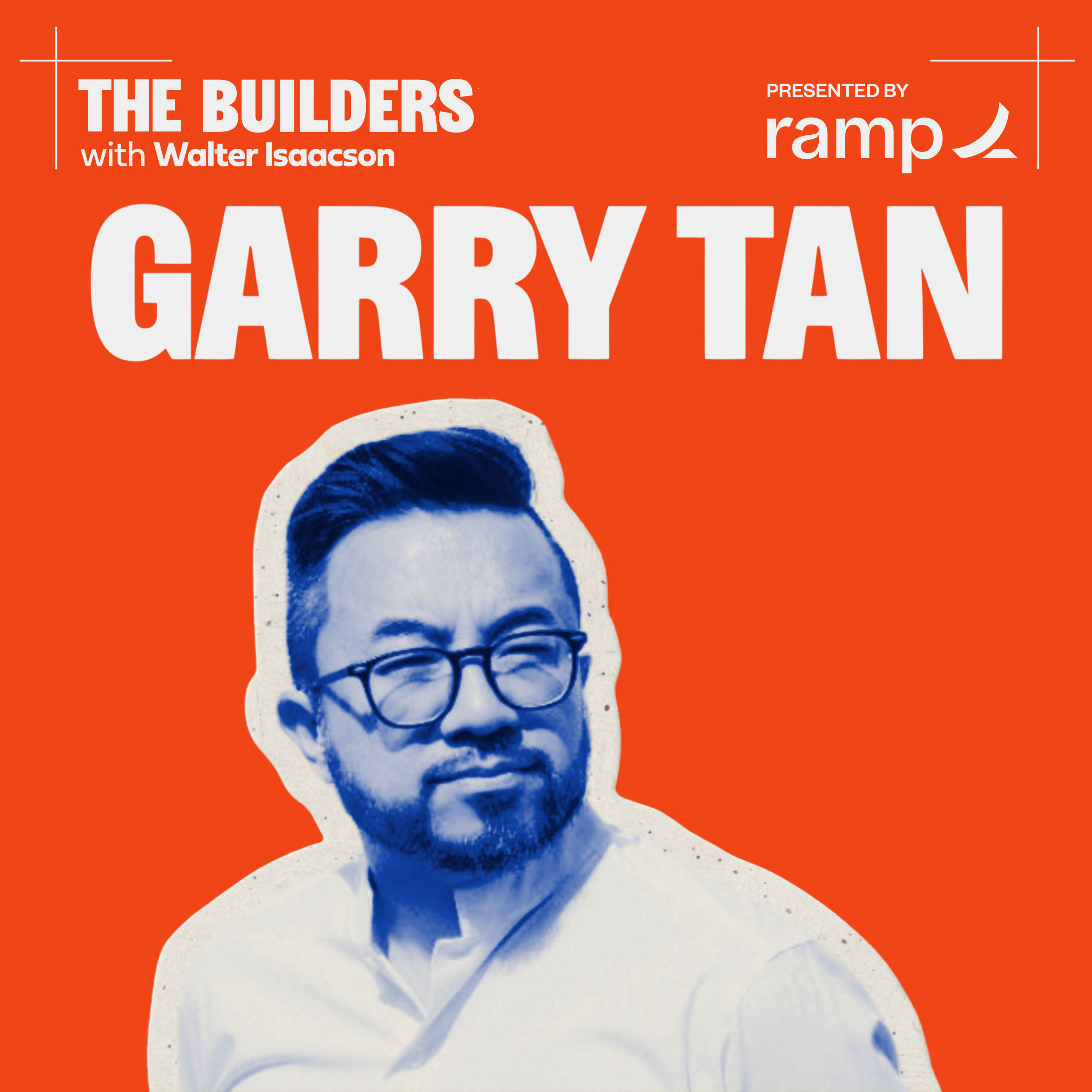
The Builders· Staffel 1· Folge 5
Garry Tan Decides Who Gets to Build the Future
Dienstag, 3. November 2026 · 40 min
Kapitelklicken springt direkt hin
Shownotes
As the leader of Y Combinator, the startup accelerator behind Airbnb, Stripe and DoorDash, Garry Tan backs founders with the ambition to change how we live. Tan wants more billionaires, but he also believes big tech has too much power. So, how does he square that?
Garry and Walter discuss how a 10-minute interview is all you need to vet a transformative founder, why he fears a future controlled by five AI “kings,” and how personal AI could put your social media feed back in your hands. A chat about how to lift the gatekeeping in Silicon Valley and the responsibility that comes with choosing who gets through.
Interview taped June 19, 2026.
And be sure to pick up Walter Isaacson’s The Innovators: How a Group of Hackers, Geniuses, and Geeks Created the Digital Revolution (simonandschuster.com/books/The-Innovators/Walt…), wherever fine books are sold.
ABOUT THE HOST
Walter Isaacson is the bestselling author of biographies of Elon Musk, Jennifer Doudna, Leonardo da Vinci, Steve Jobs, Benjamin Franklin, and Albert Einstein. He is a professor of history at Tulane University and previously served as CEO of the Aspen Institute, chair and CEO of CNN, and editor of Time. He was awarded the National Humanities Medal in 2023.
ABOUT GARRY TAN
Garry is President & CEO at Y Combinator, which he rejoined in Fall 2023 after founding Initialized Capital. Garry was one of YC’s first partners and funded and advised iconic YC companies including Coinbase, Instacart, and many others. In YC’s early days, Garry also served as a designer and engineer. Before advising and investing in companies, Garry co-founded the blog platform Posterous (acquired by Twitter in 2012) and was an early employee at Palantir and designed its logo.
IN THIS SEASON
Elon Musk (Tesla, SpaceX, xAI)
Peter Thiel (Founders Fund, PayPal, Palantir)
Mustafa Suleyman (Microsoft AI, DeepMind)
Dario Amodei and Daniela Amodei (Anthropic)
Garry Tan (Y Combinator, Initialized Capital)
and more!
See omnystudio.com/listener for privacy information.
Transkriptvom Podcast bereitgestellt · Zeitmarken springen hin
The Builders is a production of Kaleidoscope and iHeart, presented by Ramp. I'm Walter Isaacson. Welcome to The Builders, my series of conversations with the most consequential minds shaping our future. Today, I'm speaking with Gary Tan. Y Combinator has become one of the most powerful and important brands in Silicon Valley.
The companies that emerged from YC include Airbnb, Stripe, DoorDash, and Dropbox. Together, they have transformed how we travel, spend money, work, and communicate. Now, Gary Tan is deciding which builders come next. Gary first entered Y Combinator as a founder. He became an early investor in Coinbase and Instacart. And today, He leads YC itself. And so in some ways, he's helping shape those who shape the future. Here's my interview with Gary Tan. Gary Tan, welcome to The Builders.
Thanks for having me.
As a leader of Y Combinator, you have to pick founders who are going to make it. Do you look for one particular thing or are there like 20 different models of founders that can work?
Well, so the wild thing about Y Combinator is that we get 80, maybe 90,000 applications a year now for about 800 spots. So it is less than a 1% acceptance rate. Maybe 8 to 10% of those people would get an interview, sometimes less now. And the wild thing is we actually spend only 10 minutes with them. for that final stage. But the interesting thing is, you know, Paul Graham, the founder of YC, figured out that you didn't need half an hour. You don't need an hour.
You could probably actually do it in about five minutes, but five minutes feels rude. So that's how YC ended up at 10 minutes.
So what did Paul look for and what do you look for in those 10 minutes?
I mean, it sounds almost too simple, but 10 minutes is a wonderful time. constraint, kind of like how 140 characters for Twitter way back in the day was a wonderful constraint. If you can say something very simply that hits us, like, you know, here's a user, here's a real person who has a problem, and here's how the technology that we build actually solves that. We just want to know what it is and why it's awesome.
And then if we have a.
That founder is the person to go and build that thing. And you can do all of that in 10 minutes, and it's an up-down decision. Something like 10% to 15% of all self-made billionaires as of present time, age 50 and under, are YC alums.
Let me ask you a real quick question then. Suppose Elon Musk walked in and you had 10 minutes with him. What do you think the percentage chance is that you would actually fund him?
Oh, 100%. I mean, in current form, 100%. No, no, no, no.
I'm saying you saw him. You didn't know he was successful. He was a guy who'd just been, say, ousted from PayPal.
I mean, I had a managing partner meeting the other day, and that's actually one of the example questions we ask ourselves to figure out whether we're on the right track, right? Like, by definition, if YC is operating properly... Like if an Elon or a Bill Gates or a Steve Jobs or, you know, a Drew Houston from Dropbox, a Brian Chesky from Airbnb, Brian Armstrong from Coinbase, Tony Hsu from DoorDash.
Like if someone like that walks into our office, can we say yes to them in 10 minutes? And if that answer is no, actually, I'd have to rewrite everything. I would have to retool everything, right? That is actually almost the only question that really matters when it comes to whether YC is doing well or not.
And if you had walked in years ago, would you have accepted you?
I think so.
My startup, Posturus, it was dead simple blogs by email. And I mean, I had a pretty banger demo. So we had something that I think Paul and Jessica and Trevor Blackwell, the founders of YC, really got immediately. They didn't grill us at all. Like we came on with a really good demo and they said, well, that makes sense.
And then we got funded. So sometimes it's that simple though.
And I was creating that company, running that company for a while. How fundamental was that to your ability to be at Y Combinator and to be making venture capital decisions?
Oh, I think it's quite important. I mean, There's a Jay-Z line that I love. One of his songs, he goes, everybody wants to tell you how to do it and they never did it. And so, I mean, the entire act of being an investor in technology is actually bewildering and strange if you really think about it too long, because what we're doing is selling money. Like tech has now become such a fundamental force in the financial world of society that that there's way more money that wants to go into tech than good opportunities.
And that's really what YC is.
And if you look at most venture capital, it's crazy that it's grown so much. The S & P 500 is almost entirely driven by tech. And then the wild thing that Paul Graham figured out and Jessica Livingston figured out when they first started was, when they started in 2005, the type of people who would get funding, it would be your buddy at Stanford Business School, your golf buddy, like maybe someone who your son went to school with at like some prep school at Harvard Westlake or what, you know, I mean, it was like access, right?
As it was for a few millennia.
Time immemorial, right?
But do you all think you broke the back of that or is being a startup junkie or a startup entrepreneur something that you still have to be pretty privileged and pretty connected to do?
I mean, it would be a mistake to say that we were actually a meritocracy, but I will say and affirm loudly that we aspire to be.
We will never be. You know, I think that the woke age of sort of like five.
Or 10 years ago, we sort of lost sight of that, that like meritocracy could never be achieved, but it is a virtue to attempt to achieve it.
Well, the reason I ask about that in terms of a startup culture, which is what you very much nurture, is that it used to be somebody coming out of college, take a Steve case, for example, could go work at a company like a Procter & Gamble and learn a business. Nowadays, it's very hard to sort of get a steady job.
And the economy for young people tends to depend more and more on startups. And yet it seems to me that unless you got a safety net, unless you're somebody who doesn't have to make sure your next meal can be paid for, you can't be in that game, and it leaves a lot of people out.
I mean, that's why YC gives $ 500, 000, for instance. When I did YC, it was only $ 18, 000. Like today, you hear about seed funds and Stanford kids raising $ 30 million on $ 300 million post-money evaluation. It's like literally, like it's just an idea and one person, and the company is somehow worth $ 300 million. But when we were starting many years ago, It was a very small amount of money.
You had to show that you had something that was great.
And so that's why.
YC didn't stay. And we easily could have just stayed at $ 12, 000.
Or $ 15, 000.
But I think there is a recognition that if we want to be a thing that allows people to participate, you don't have to have rich parents. The half a million dollars getting into YC, you could just have an idea and you could come in and meet us for 10 minutes.
You were one of the earliest employees at Palantir. You got to see how Peter Thiel and Alex Karp in particular really worked. What did you learn from their style?
I realize now, like, if I hadn't rage quit, I would have been, you know, sort of a peer to some of the, you know, real legends who really built Palantir. You know, I would go on walks with Karp and he would sort of, I mean, he was a philosopher. You know, he was not a technologist, I would say, but he was incredibly knowledgeable about the world. One time, I was sent to DC to do some demos for customers.
And I remember being like a 25-year-old, and I was in my ripped jeans and band t-shirt and getting sent to stay at the Mandarin Oriental in DC. And we would wonder, Alex, why are we staying at the Mandarin Oriental?
Look at us. We're just kids.
We don't have to do that.
Just set me up in the Motel 6. We're a startup.
Alex looked at me and my other early engineers for the Palantir Finance product, and he said, guys, you're going to go and talk to such-and-such general or such-and-such VP of some Fortune 500, and you're going.
To show this incredible software that you've built.
And then as you go out, you're going to make small talk, and they're going to ask, well, how long are you around and where are you staying? And if you say Motel 6, they're going to think that they're buying Motel 6 software, and Palantir is... Mandarin Oriental software. And I'm like, okay, now I get it.
And so, you know, yeah, I don't know.
I think embedded in that story is just a lot of different things. And I learned a lot from Alex from that.
Don't go anywhere. There's a lot more. right after this break. I know you've been fighting this antitrust battle. How important is that in order to keep innovation and startup culture?
I think, you know, True free market enterprise has never been tried. I think that in tech in particular, we have very short memories. I would argue that Google itself, one of the big tech companies, was able to exist and thrive and become a trillion-dollar company because of the actions of the DOJ with the consent decree on Microsoft.
Microsoft was ready to take over the web, and it used its platform advantages in Windows to default install and take over the browser market.
And do you think Google is now doing the same thing?
I would argue yes.
The Delaware C Corp sort of actually insists on it. Like the governance structure itself actually insists on you're supposed to do your duty and your duty is to maximize shareholder value. So people are following the letter of the law and the spirit of like their Delaware C Corp to close platforms. Like it's less and less percentage of the screen real estate if you do a Google search is even non-Google properties, right?
And so that's self-preferencing.
So a lot of your tech bro friends are very much against antitrust enforcement. How do you have a startup culture if you're going to allow big companies to self-preference?
Well, I mean, my view is that we shouldn't allow self-preferencing. And then my super pro startup stance is we should stop self-preferencing. We should require open markets. Like I think the DMA in Europe, for instance, is a great example of forcing big tech to open its own platforms and not just data transparency and privacy, but also portability and reverse engineering. These are sort of things that allow for open markets and open access to startups. And if you ask me, is big tech too powerful? I say absolutely.
And the answer and the antidote is little tech. I think it's not that unlike robber baron times in that if you own the railroads and there was a monopoly on the railroad... you could set the price on literally everything else. And so one thing would lead to another thing, and you would have multiple monopolies across both commodities and the railroad the commodities travel over.
Well, wait, let's look at AI. I'm going to push back a bit. We get a whole lot of new companies, Anthropic, OpenAI, they're all popping up. Somehow Apple wasn't able to self-preference and embed its own system in its own phones. Even Google is trying to do that where it almost forces you to use Gemini when you're using Google search. And yet these other companies are doing well.
Yeah, that's right.
I mean, I think what's funny about the AI companies is like they're almost certainly, I mean, I think you can fairly say that they are the new big tech. And so I think I have concerns there as well, right? Critics of some of the AI companies would say that It's possible that as the AI wars progress, there might not be open access to the latest and best frontier models that those companies may gatekeep.
You think they should be open, that all the AI models should be open?
I mean, that would be certainly the thing that supports startups and the ability for new people to create new companies and, frankly, new wealth and to give consumers choice.
So what is the role that Y Combinator wants to play in AI?
I mean, what's funny is I think of YC almost as like, you know, we're not a union, but we have union-like characteristics. There's not really a group out there that can speak full-throatedly about policies and, frankly, actions that both governments and companies should take to make sure that the golden goose can still exist. And, you know, whether that's the billionaire tax in California or antitrust laws in D.C.
Or in Europe.
we're going to start talking about it and just having a seat at the table. One of the things I discovered as I started examining politics, most tech people are not interested in politics, but politics sure is interested in us.
And so I decided.
Like three or four years ago, like, oh, well, I should probably spend some time and reciprocate. Like, let me understand what's going on. And what I discovered was pretty wild. I mean, millions of dollars in AstroTurf money, going to groups that would take around basically almost hired actors. They would claim to speak for small software companies or, you know, little tech.
And they were just like paid chills, actually.
And they would go to the halls of power, whether it's Sacramento or D.C. And they would say, no, no, like this thing that actually mainly helps big tech. We, the little guy, really wants that. And I was like, oh, wow, this is crazy. Like no real startups actually go out there and talk to real people in D.C. And I saw a system that was broken, and I wanted to fix it. And so that, you know, we do very little things. Like, we have a tiny budget. It's, you know, probably one one-hundredth that of, like, even any given single big tech firm spends on policy. We have one lone full-time hire in D.C. in a man named Luther Lowe.
And we run it on a shoestring. But on the other hand, like, we're people-powered. I see that like a repeating pattern, like there are broken things in society. There are systems out there that, you know, have money, like just trace the money and like, you know, where's the money coming from and who benefits, right?
And then the heartening thing.
You know, I think a lot of people talk about social media in a very negative way. They think, you know, it was Facebook that ruined democracy. And it's like, I don't really, I don't think I agree. Like, I think that It's the little guy not realizing he has a voice. He and she do have a voice. And then, you know, when I look at YC, like, our job one is to find the next great founders. But I think right under that, it's like, how do we make sure that those people can have access to markets? How do we help people who would not have a voice, would not be able to go to D.C.? How do we give them that megaphone? And then YC itself now has a megaphone.
You know, we have more than 2 million subscribers on YouTube. We can sort of speak in aggregates. And I'm really excited about that because I think that that's us trying to speak truth to power. I don't want to deny that YC is also a power in and of itself, but the world is full of systems. These are all systems that were created and constructed by, as Steve said it, people no smarter or better than you or I. And we can mold it and change it. And once you realize that, you'll never be the same.
You were born in Canada, Chinese background. Tell me how important you think immigration is to the United States.
I mean, I shout to everyone who will hear that about 50% of all the startups that really make it have at least one immigrant co-founder. And what we realize is that's one of the things that makes America incredibly unique. People from around the world want to come here. And in tech, they want to come and build the future.
That's certainly my story. My mom's family came over from Burma. refugees, and my dad came here from Singapore.
Well, you talk about your dad, and we biographers tend to believe it's sometimes about dad, especially when somebody's successful. You had a pretty rough time, though. I mean, your father was at times unemployed, at times an alcoholic. Tell me how you had to deal with all that.
I mean, it really made me who I am today. I figured out that I can actually put myself back into let's say 1992, I'm 11 years old. And basically, I don't know when my dad would come home, like maybe around five or six, but I wouldn't know how many beers he would have already had. And I realized there's sort of this scanner that happens where if you don't know what father is coming home that day, then you get very attuned to other people and their interstates.
And like, how to sort of react to that. And then it's interesting because now I realize like that's a scanner that I use all the time. Like I can sort of sit down with someone and it doesn't happen every time, but it happens relatively easily for me where I can sit down and just kind of feel what's going on for other people as someone who sort of spends time with hundreds of startup founders every single year.
Like that's actually a pretty powerful superpower of.
Let me talk about what may be the next step in AI, which is AI agents. And you've said that you don't want to fund companies that look at AI agents as a feature. You want them to look at it as the core operating system. Explain how you think that changes what we think about when we talk about AI.
Yeah, absolutely.
I mean... We're going to get a little sci-fi here, but this is something that we're starting to see ourselves, you know, rebuilding the way we operate at YC. I think the number one thing that people get wrong is they just think that AI is just chat.
And then it is so much more than that.
We now have an internal AI agent, for instance, named Straylight, that kind of has a personality and then it has a company brain. Like it actually has the total context of everything. Founder we've ever backed, anyone who's ever emailed us, like all the applications. The way I think about it from an interesting tech perspective is like a human can only keep track in their heads like seven plus or minus three things. And what an AI agent is, is already super intelligent. It can keep, you know, I was explaining this to my 11 year old. What an AI can do is it can keep a stack of 1000 pages, think like three Harry Potter books. You know, it can needle in a haystack, any page, any fact, anything that
happened in those three Harry Potter books. It can just know, synthesize, work with. Like the working memory is absolutely gigantic. And, you know, the thing is in another year, it won't be three Harry Potter books in the brain of an AI agent. It'll be five or it'll be 10 or it'll be 20. And then the set of things that it can operate on is even bigger.
Well, give me a better example and make this more concrete for me, because data retrieval, even from three Harry Potter books, That's kind of cool, but that's not, I mean, that's just data retrieval. What makes something an agent?
I mean, I would point to what Peter Steinberger of OpenClaw figured out, which is if you use cloud code or codecs, I would say right now, they're so worried about sort of repeatability and safety that they actually trade off all of the beautiful parts of working with an AI agent, which like basically can be so similar to a human that like it sort of takes on human qualities.
So tell me what you ask your agent to do.
Oh gosh.
I mean, one of the things I did, I, you know, it's read all of my email and all of my Dropbox. It's read like all of my Apple notes, like, you know, even my therapy notes going back 20 years. I mean, for instance, like I used it for prep to be able to talk to you, not to get too meta about it, but in about 15 minutes right before this talk, like it was able to you know, download and transcribe your top 10 podcasts you've ever done. And then it actually diarized them. So, you know, I had an LLM go like line by line, timestamp by timestamp to pull out like major themes.
And that was really helpful for me.
But to be able to do that for like almost any thing that you do in your day-to-day life and for it to do it like somewhat more autonomously. And so it seems inevitable in about two to three years, I would say, Everyone's going to do it, and it's going to feel awesome. Think of it as a Jiminy Cricket on your shoulder at all times. Almost anything you want to do, it knows you, and it's there to help.
And it will actually sort of run ahead and say, what about this? Or it'll help you see around corners. And the reason why it's too expensive right now, I mean, it's just literally too expensive.
In order to have this experience.
I spend about maybe $ 100, 000 to $ 200, 000 a year on tokens. And so I realized that's a crazy privilege that not everyone can do that. You know, a lot of like CEOs that I know are doing it and they have wings.
Do you think that AI, especially the agents you've been describing, will end up destroying jobs or will it end up increasing enormously the number of jobs in society?
My hope, I mean, I don't know for certain and, you know, I'm not clairvoyant, but I, you know, I do believe that technology is over vilified. I think that it does have problems. And AI safety is something that we need to be concerned about. But the way to fix that is not to stop the technology from even happening.
It is actually going after the abuses of people when people actually use or misuse the tech.
But do you think it'll create jobs? There'll be more jobs because of AI?
That's certainly my hope, right? In the short term, it may not. And that's quite frustrating. So some of the reason why I've been working on open source and trying to teach people how to use AI, like my open source project, GStack, is literally working backwards from if I were trying to teach YC founders how to use cloud code and get 400 times the amount of output that they had before, that was like a project that they could just drop into cloud code and get exactly the stack that I use to get that. I think things like that, are necessary in order to teach people how to use the tools properly. And there will be people who lose their jobs because AI will have, like, sort of made that position redundant. And then, you know, I
think there's a big retraining issue here. But, you know, I think something like G-Stack or lots of other efforts out there could solve that, right?
If you have that.
Context, if you were doing job X, like, let's say you're a medical biller, like, What I want is for someone like that to maybe be able to pair up with a 22-year-old. They have domain expertise and someone who really, really knows how to make 400 times the amount of software that you could before. Maybe that person who knows that space inside out plus someone younger or even themselves, like train yourself to do it. I want them to be able to start a company in that space. And maybe it's exactly what they did before. Maybe it's something two clicks away, but either way, it requires an increase in the amount of agency. What we want people to do is go into their own history and their own lives.
And it's like, what do you uniquely know? What life did you live? What obscure hobbies do you have? Like, what have you seen that nobody else has seen? And then pair that with this incredible ability, like not just to code, but to think, to reason. And so I think that's like raising the floor. And then on the flip side, like the ceiling is sky high. Like I think that the responsibility for CEOs and people who have a lot of privilege is not to cost cut. Like that is the easy way. And the thing is, like, that can result in, like, a sort of dystopian moment where, you know, capital accumulates more and more wealth, and we're not sharing it.
We'll be right back after this quick break. You say you push back against people who obviously vilify AI, but those who are very pessimistic about it. When you're looking at companies to back or fund or encourage, do you consider an ethical component, whether what they're going to do is going to be driven by being good for society? Absolutely.
I mean, we have so many examples at YC where a team would come in and it was pretty clear that it was going to make a lot of money. The most extreme version of this I remember was, this was not when I was back at YC, but I have to call out my partner, Gustav Alströmer. He was head of growth at Airbnb for many years, and then he became a partner here at YC. And a company that was focused on ADHD meds for kids came through, and they applied, and it was a remarkable set of founders.
But the idea was tantamount to like, increasing the distribution of ADHD meds to a society that, you know, we couldn't tell if, like, that was a need, right? Like, it was definitely going to make money. And in the end, that company did get sanctioned by the FDA, and it shut down. And I even believe that there were potentially criminal charges about that.
I hadn't checked recently, but that was a bullet dodged, right?
And I'm very proud that YC is an institution where that kind of thing can happen. Like, We not only need to make money, really we have the responsibility to fund the things and the futures that we want to live in.
Give me an example of a couple things that would fund the future we want to live in.
I mean, let's see.
I mean, the hard part is like it's almost anything that we actually fund.
Well, I'll give you one, which is have social media... that instead of dividing us and enrages us, helps us be stronger as a society?
I think that's entirely possible. And actually, this idea of personal agents is actually, I think, very directly a way to do it. Going back to meta, right? Like, this is a huge company that controls the algorithm. And we all wish that they didn't at some level. And now they might not have to. So you could imagine a personal AI that you control, that you program, You don't download the Facebook app or the Instagram app. That's just an API. And you do have a social network, but the social network is mediated through your own cognitive filter.
You figure out what you want to see, and then you put that in there. And maybe that could even be programmed by not just you, but the people who are closest to you. I think that that's one example of actually being able to put control of what goes in your brain back into your own hands. And that's something that, you know, before wasn't really possible. Like even the idea of like, could a normal human being sit there and program their own algorithm that is beneficial directly for them? Well, A, they don't know how to program.
And B, like, what would that even look like? It's so complicated. But with the advent of AI agents and AI agents that can code, it'll know you, it'll know what your goals are. Like right now, my year right now, I just want to focus on in myself. I don't want to see anything about national politics. I might only care about local city politics.
Yeah, but we've had things like that in the past. We've had personalized social media, and yet the algorithms have a business model that works best when they enrage or divide us.
Yeah, and the business model is hosted by someone else, by a big tech company, and then that's their control and that's their power. And so what personal AI is, what I hope happens is sort of more like the personal computer revolution, kind of what Steve Jobs did in 1984. If you remember the original Mac commercial, you know, 1984 doesn't have to be like 1984. Big Blue, you know, IBM does not have to win the whole thing. And I think next year will be one of the defining years where there's the next browser war. And I think it's going to be whose AI agent do you use?
And I think it'll go similar to operating systems. Like, I think there will probably be a Mac. There will probably be a PC.
So you're saying all these anthropics, open AI, Gemini, it'll consolidate to just two or three? Wouldn't that be pretty horrible?
I mean, I think we're already there.
And, you know, I think last year, you know, our friends inside some of the AI labs talk about the five kings, which is actually a pretty astonishing vision where a light cone of all future value, literally like all commercial, anything that a business would do could potentially collapse into five kings.
So what can you do to disrupt that?
We're trying every day, right?
So whether it's policy, whether it's directly being the funding vehicle to find the next generation of talent, to help them thrive, to make sure that the markets are open for them, to make sure that there's open source, to, you know, find, I mean, what, What I want is there to be Linux, right, for personal AI.
Basically an open source operating system? Yeah.
And it just has to be easy enough to use and cheap enough to use that everyone chooses it.
And I think that's possible.
Do you think we should have regulation then that pushes in that direction? Or is that an impossible dream?
I wouldn't say anything is impossible, right? And I think that that might actually be a preferable outcome to some of the other things that Some of the politicians are putting out there, you know, Bernie Sanders wants to sort of seize assets. And speaking as an immigrant and children of immigrants who came to America to flee asset seizure, that, you know, we want prosperity. We want the ability for people to start new businesses to proceed and continue. And that's one of the defining traits of America.
It's like.
But so what would smart regulation look like?
I think it basically just looks like the Open Markets Act, like being able to create an app that actually operates on your iMessages, for instance.
Like, AI can't touch your iMessages.
And what Apple says is, like, we're the only ones who could possibly be safe enough for you. And I think that that's just not actually true. We shouldn't allow them to say that, like, nobody else could possibly do this. And that's just a smokescreen for, A, their own market power and making money through their own modes, but also, B, like, it actually just kills markets. And, you know, the next Apple can't emerge, right? If Google, Apple, and all the trillion-dollar companies don't open a lane and create markets, we will live in a world where there aren't startups. That's a bit of a nightmare scenario for me. I think that this is the counterweight against tyranny and, frankly, mismanagement in big tech. You need to have alternatives. And so
to the extent that the government can create regulation that makes sure that these markets are open, at the extreme, I would even say, you know, looking at how open source models are progressing now, we are just handing Chinese model companies a massive advantage. There's zero open source AI companies in the United States. And it doesn't have to be that way. Like there are probably regulations that could allow distillation, which is the exact advantage that Chinese companies have for American and European companies. And, you know, we can have a vibrant ecosystem. Some of these things being too big, I think that's real.
And that's correct.
And if you go all the way back to Brandeis and trust busting, we live in a better world when there isn't concentration in markets and that there isn't self-preferencing. And I think that that is more true than ever when it comes to tech and startups.
Well, in some ways, you're really going back when you talk about Louis Brandeis and you talk about the railway companies. You're really saying that we've been through this before. which is the 1890s. An explosion of technology is even greater than we have today. And then you create these great robber barons that control it. And then you have a period, whether it be Teddy Roosevelt or Louis Brandeis, that take on Standard Oil or take on the railways and say, you got to open up. You got to allow everybody else to ride your rails. You think we could just say, hey, let's learn from history and apply it now?
I think so.
I think we have to learn from history in two different ways. I mean, I think when you look at the Sanders and AOC end of things, or in San Francisco, Saikat Chakrabarty, or even what Tom Steyer was saying in his failed bid for governor in California, I think you're starting to see a thing that is, to me, like fundamentally un-American.
But wait, let me ask you, what are you more worried about? That a populace on the left are going to have some socialist system, or that we are going to have a technology system that gets too controlled by too few people, and it's not democratizing and it doesn't incent startups?
I mean, honestly, both scenarios are terrible. And I would stand against both of those scenarios. And I think that there has to be a middle way. I think that we should follow American history. And how do we create markets? How do we not make it illegal to create prosperity and wealth?
I don't begrudge Google.
I think there are people on the hard left, for instance, that would say, like, Google should not exist. And we want more Googles. We actually want more. OpenAI was a spin-out of Y Combinator. Sam Altman sat in my seat and said, you know, he got to see the front row of all the builders, all the young people with crazy ideas. And he and Ilya Suskovor and Greg Brockman said, They sat in a room and created YC Research that became OpenAI with Elon. And now we live on their timeline, right?
Now we live on an accelerated timeline where the age of intelligence is much closer. And so I don't think that's a bad thing. But, you know, AOC and a great many Americans today unconscionably believe that all billionaires are ill-begotten. And when people say that billionaires shouldn't exist, they're also saying that society should ossify, that LLM should not exist.
It also is saying that things like Google that, you know, organize the world's information that shouldn't exist. And to that, I say, like, I, you know, I disagree, you know, like, we should have more billionaires, we want more choice, we want more prosperity, we want more jobs, there is a middle way, it doesn't have to be big tech oligarchy.
But it also doesn't have to be mass asset seizure. Like, I think there's a middle American way. And That's what we very much will fight for and hope for.
Gary Tan, thank you so much for being part of the builders.
Thank you so much for having me.
Silicon Valley is very good at finding people who think differently. It rewards ambition, competitiveness, and ideas that can scale. But the interview made me think about the fact that so much of Y Combinator's energy is focused on AI. The biggest opportunity isn't simply to build what the market will reward.
It's to build what humanity actually needs. And if AI could focus more on helping humanity cure cancer, fight climate change, rather than just making chatbots and threatening our jobs, there would be a lot less backlash against what the industry is doing. So I'm curious to watch how Gary and Y Combinator will place their bets. Because when you get to choose who builds the future, You have some responsibility for the future they build. That's it for today's episode.
I'm Walter Isaacson. We'll see you next time on The Builders.
The Builders is a Kaleidoscope and IHAR production.
This series is hosted by Walter Isaacson.
It's executive produced for Kaleidoscope by Oswald Lishan.
David Weisbord, and Mungesh Atikudur.
Sheena Ozaki is the producer. Julia Nutter is supervising producer. Eva Zorich is our consulting producer.
Fact-checking by Eamon Whalen. Research by Gloria Thiel.
Maria Paz Mendez-Hodes is head of video. Marketing by Christy Mirabal and Elle Liu. Production support by Dara Luk-Potz.
Music for the series was created by Spencer Stevenson, a.k.a.
Botany, and it was mixed by Steve Bone. From iHeart, the series is EP'd by Allie Perry and Katrina Norvell.
Special thanks to Bob Pittman, Conal Byrne, Will Pearson, John Sykes, Nikki Etor, Carrie Lieberman, Binky Urban, Julia Prosser, Jeremy Blum, Alison Goldberger, WYES, and ASL Studios.
For more from Walter Isaacson, be sure to check out his newest paperback, The Innovators, how a group of hackers, geniuses,
