

Kapitelklicken springt direkt hin
Shownotes
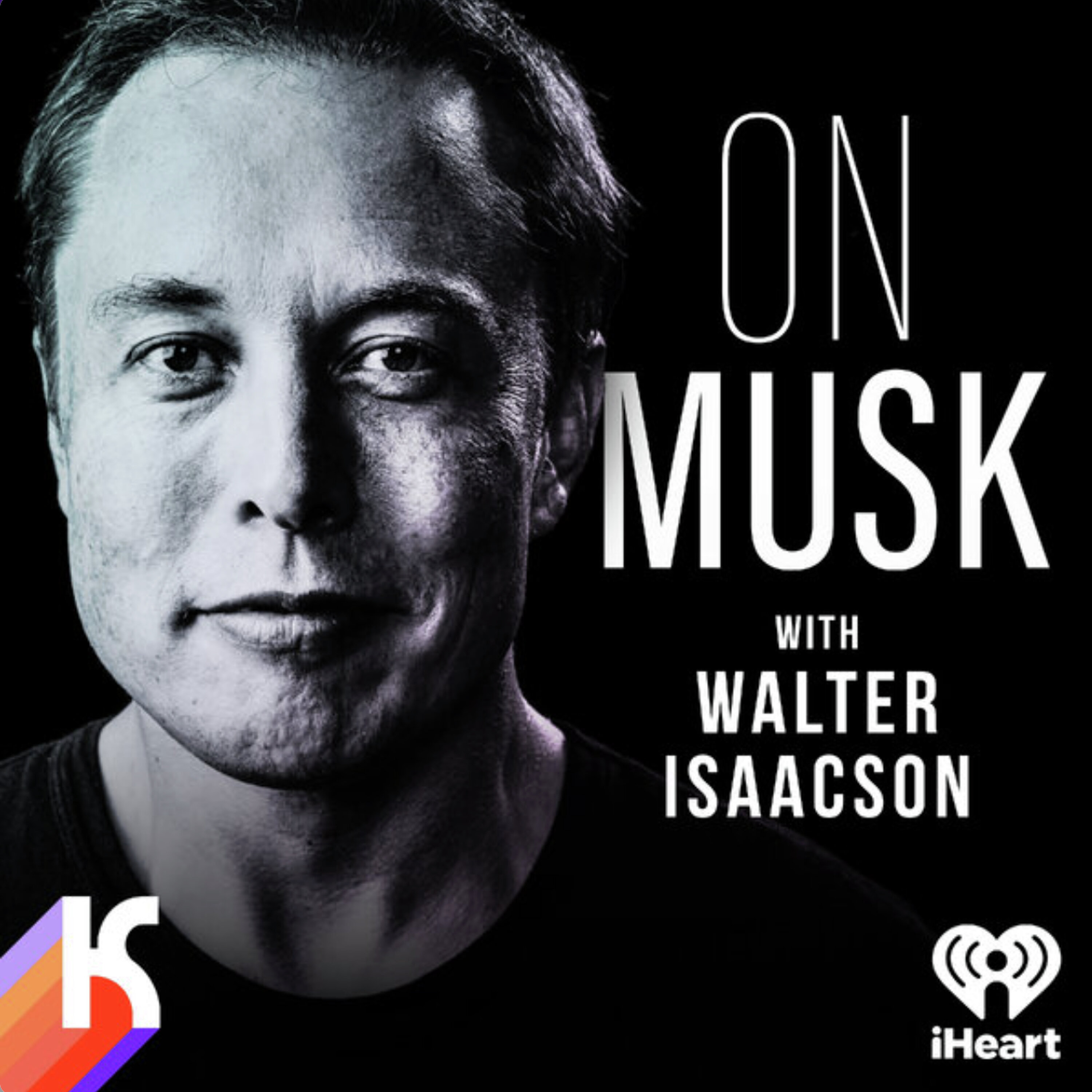
As a teaser to our upcoming series The Builders-- which kicks off with an interview with Elon Musk, we're re-airing our critically acclaimed 2023 podcast On Musk, Walter Isaacson's behind-the-scenes telling of writing the Elon Musk biography. We hope you enjoy it!
Space travel, electric vehicles, future-powering batteries—the ability to push technology forward and to bring it into the world in a real way is without a doubt the best of Elon Musk. In his 600 page biography, Walter Isaacson chronicles a man with superlative engineering skills, but who “doesn’t have a fingertip feel for social emotional networks.” On this first of four episodes, Isaacson shares the aspects of Musk that gave meaning and muscle to … the rest of Musk.
See omnystudio.com/listener for privacy information.
Transkriptvom Podcast bereitgestellt · Zeitmarken springen hin
I'm Walter Isaacson. Welcome to The Builders, my new series of interviews featuring the most consequential minds shaping our future. Our series starts with Elon Musk, but in anticipation, we're re-airing our critically acclaimed show On Musk in this feed. The show originally aired in December of 2023. It has four episodes of backstories, from the years I spent following Elon while writing his biography. Give it a listen, then stay tuned for The Builders. I think you'll like it.
How many rocket launches did you see?
Yeah, we can talk about visiting some of the launches. Boca Chica, Texas is at the very southern tip of the state, just beyond Brownsville on the Gulf of Mexico. And right on the street where Musk's house was, I had this little Airstream trailer, which was a little tough on the laundry and it's kind of hard to shower.
But after a while, it made me feel part of this weird scene that here on Earth in this parched A scrubland with a few swamps filled with mosquitoes and these old abandoned tract houses is the base from which people on planet Earth are going to get to Mars. And I knew that Musk was going to do the launch of Starship, by far the biggest rocket ever made, and he was waiting to launch it in Boca Chica.
And I'm in the Airstream trailer at 5 a.m. He's in the house nearby. And the security guards wake us up and they take us to the control room for the countdown. And the countdown goes 10, 9, 8. And he nods. And they launch it. And it goes up for a minute, two minutes. He's watching it. He runs outside onto the deck because you can see it. in the distance, and then runs back inside. And finally, after about two and a half minutes, you start noticing that two of the raptors, and maybe three now, there's a problem.
And they realize it's going to go off course, and they have to send a signal to blow it up over the water, otherwise it might do something really bad. So they all look at Musk, and it gives them the signal to blow it up. And at the end, he says, okay, here's a few things we've learned. Let's see how fast we can try it again.
My name's Evan Ratliff, and this is On Musk with Walter Isaacson. I'm a journalist and author, and recently I met up with Isaacson over a few days in New Orleans. Tough assignment, I know. Isaacson lives there. It's his hometown and the place he returned to after decades as a big-time reporter and editor on the East Coast. Nowadays, he's a biographer of the kind of people who alter the world through the force of their intellect. He's written about Leonardo da Vinci, Ben Franklin, Albert Einstein, the pioneering biologist Jennifer Doudna, and maybe most famously, Steve Jobs. When we sat down near Lake Pontchartrain, his 600-page biography of Musk had been out for about a month. It was a book that launched a thousand hot takes, not least because
Elon Musk is himself a hot take launching machine. But talking to Isaacson, I wanted to try to get past the noise, if we could, to understand why and how this gargantuan work came about, and to see with his eyes what wowed him, what shocked him, and how he reckoned with a subject who became one of the richest and most polarizing men on the planet, and who, since the book's release, at times seems determined to scorch his own legacy. by encouraging and even embracing the online hate machine.
You know, anti-Semitism, conspiracy memes, or whatever he happens to post about this week. This is our first episode of Four, and for this one, for a moment, let's try and forget everything you've learned about Elon Musk over the last, say, three years. Forget who he is on Twitter, forget his role in Ukraine, or whatever you know about his personal life.
And think about the Musk who helped build the first real online payments company, PayPal, the first true mass market electric car, Tesla, and the first private space company to put humans into orbit with SpaceX. Let's look at his better angels, so that when we talk with Isaacson about his demons, and we will, we'll have some ballast, some understanding of why he made such an intriguing subject in the first place. Episode 1, Genius.
So, gentlemen, I have coffee going, water ready, bathroom's down the hall, I'm rolling.
Alright, you good? Okay. Alright, Walter, it's great to meet you. As you can see, I have my copy of the book here, so I put little flags in it for things I want to talk about. I don't think we're going to get to all of these You've.
Read the book better than I have.
Just to say.
Well, it's good talking one writer to another. This will be fun.
Well, let's talk for a second about how you got on this roller coaster. Could you tell me the story of how this book first came about, the first seed that this book could be possible?
A mutual friend of mine in Elon Musk gave me a call. Antonio Gracias. He said, you all ought to talk. And Musk and I talked for about hour and a half or so on the phone. And I said a couple things to him. I said, I want to do a book unlike almost any other book since Boswell did Dr. Johnson, which is I want to be by your side at all times, when you're eating, when you're thinking, when you're in a meeting, when you're with your family. And I want for two years to have nothing off limits. In a very low monotone, he goes, okay. And then I go, all right, well, here's the other thing. I don't want you to have any control over this book. I'm not even going to show it to you before it's published.
He goes, okay. So I'm pretty surprised. And I was with a group of people. I'd gone off to take the phone call. When I get back, I was talking and all of a sudden people say, oh my God, I didn't know you would do them. I said, what do you mean? So, well, Elon Musk just tweeted out, Walter is writing my biography. And I thought, oh dear, I guess, I guess I'm committed now.
And how did the rhythm of that happen? evolve? Like, how did you figure out when you were going to go? How many conversations you were going to have?
Every couple of weeks, I'd say, all right, I'd like to come out and I'll spend the next 10 days. He doesn't have a scheduler because he wanted to keep control of his own time. So you never know where he's going. We would sometimes do two or three places a day. And so I learned pack everything in one overnight bag, bring lots of t-shirts and Black T-shirts. Everybody wears black T-shirts.
Oh, so you also got into the black T-shirt mode.
Yeah, and so I was like, all right. So I'd get four or five black T-shirts, a couple of pairs of khakis, and that would be it. It would have to be really light. It would have to be something I'd be carrying with me on the factory line because he'd inspect the factory in Fremont, and then he'd turn to the security guard, who was the one person who kind of kept things on track. He'd say, okay, now let's go to Cape Canaveral. We'd get in his plane, be at Cape Canaveral, then be in Boca Chica or in Austin, where he's building the great gigafactory for Tesla.
So you've got a whole lot of T-shirts and a whole lot of underwear, and you're ready to go for the ride. And usually after about 10 days of traveling with him, I'd run out of toothpaste and maybe underwear, and I'd say, okay, I'm going to take a break.
Was absolutely everything on the record? Or were there times when some executive from some other part of the company or someone tried to say, this is off the record?
Musk gave out the word that I could be anywhere at any time. There were a couple of exceptions that were both national security classified briefings. He was talking to either General Milley or the CIA, in which he said, I had to leave the room. But there were times when they would do a meeting and I would know that some of the Tesla executives would ask, you know, can Walter step out? For example, when they were deciding whether or not to create the $ 25, 000 car that's going to try to go after the Toyota Corolla. And he had wanted not to do it. He wanted to go leap ahead to the robo taxi, a car with no steering wheels that would be self-driving. And they were trying to convince him. No, no, no. And he let me
stay in the meeting.
By the time Isaacson started sitting in on meetings and everything else, Musk was the chairman, CEO, or chief technology officer of four companies. Later, he'd add two more. You've probably heard parts of Musk's history, but here's the short version. Born in South Africa, he'd started in Silicon Valley back in 1995 with a company called Zip2, kind of an early map quest he founded with his brother, Kim financed on his mom's credit cards and fueled by endless meals at Jack in the Box. After selling Zip2 and buying himself a McLaren, he invested much of the money into X.com, a financial payments platform that eventually combined with another company and became PayPal. Musk's new PayPal partners ousted him from
the company. But he still emerged fabulously wealthy and endlessly connected in the valley. He then turned that wealth onto more grandiose goals. First with SpaceX, a rocket company created around Musk's dream of getting humans to Mars. Then Tesla, built on the dream of electrifying not just cars, but all aspects of our lives. He added a couple of other companies, Neuralink and The Boring Company. More recently, he's launched an AI company, first called XAI, and of course, stuck his head into the Pandora's box that is Twitter.
Now he's combined both of those under one banner, X. It's a staggering amount of companies to own and operate simultaneously. And as his plane hopping shows, it's not just board meetings. Musk likes to be on factory floors and to take an active role in the engineering.
Musk has also a playful side, an inspirational side, and he often jokes about toys or things he loves. And at one point, he's sitting at his desk at Tesla's, And he's looking at a small car. You know, it's made of metal. And he looks at the underside of it. And, of course, the whole bottom of the car, including the axles and the chassis, is just one piece. It's made of cast metal. And so he keeps showing it to the designers at Tesla and say, why can't we just cast the entire underside of the car in one piece?
And it's taking 90, 100, 150 meters. sometimes components that have to be welded together. And they said, well, there's no press big enough to do that. He said, let's start calling around. And they call around, and all these companies that make presses that can make components or chassis say, no, that would be impossible. But one, I think in Italy, says, okay, we can try it. And they make this huge press that can do a half of the chassis and then another.
And you just have to pull them together. And then eventually, when he builds this huge auto factory, Giga Texas, he says, now we're going to do it in one piece. And they build this gigapress. And so the chassis of the car of a Tesla is now done in one piece. And he did it in a funny way. He didn't push people to total distraction. He just kept saying, think about it. The laws of physics don't say this is impossible.
And they keep looking at him like he's crazy. But then you go to the Austin factory and you look at these gigapresses and you say, I get it. That's why other companies, GM, getting out of making big EVs, other companies can't do it. But that sense of the physical properties, the physics, and sort of thinking out of the box. That was one of the great breakthroughs.
The other thing that's so interesting about the factory is you would think that Musk is just automating, automating, automating. And then he had this incident where he kind of discovers, oh, we've over-automated.
In 2017, when he's having trouble with the battery factory that they built in Nevada, he moves there, he sleeps on the floor there, he spends months there, and they realize at some point that something that they're doing that a robot is trying to do is taking too long. And he figures out, wait, a human could do this much faster. We could just get a big wooden table and hire six people, and they could do this three times as fast. So they run around the factory, figuring out what machines are really slowing things down rather than speeding things up. Musk and this cadre around him, and they have cans of spray paint. And they're just putting big X's on machines that they're going to have to take out. And it's almost like kids playing on the playground,
marking things. And they cut a hole in the wall of the factory and drag out some of this excess robotics. He still believes in automation. He's going to build one of the most automated factories in the world, both in Austin, Texas, an assembly line for the $ 25, 000 car, and then replicate it in Mexico. But he says that was one of his big mistakes. He said, we automated at the very beginning of the process. That should be the last thing you should do. You should only automate after you've simplified the process, questioned every requirement, figured out how fast it could be done. Then you do the automation.
That story sort of illustrates both the playfulness you describe, but also the sense that he doesn't seem to care about sunk costs. Like a lot of people would not do that. because they've put so much money into those machines, you know?
Yeah. There was a lot of resistance at first, because they put a lot of money and sweat and effort into making these robots. But then suddenly they realize that they should go along. This is going to be interesting. They're going to learn something. And even though people sometimes feel burned out or attacked by Musk... Those moments where he turns out to be inspirational and right, keep them going.
After the break, we contemplate the journey to Mars. Stay with us. Isaacson sees firsthand in his reporting that working for Elon Musk is, not a picnic, to put it mildly. Words like demanding or mercurial don't even really capture the way Musk approaches his employees. We'll get to that in episode two. But another thing Walter discovers is that incredibly smart people are happy, even eager, to endure a little hardship to work for a visionary. For them, Musk is an epic adventurer, reconnecting us with a lost sense of new frontiers, whether that's a sustainable energy future or or deep space travel. There is a kind of romantic view of space travel, and do you feel like we have lost that in general?
Yeah. Musk talks about three or four reasons why he wants to get to Mars. But the most inspiring is the notion that it's adventure. And he said space is the ultimate adventure. I mean, there's a kid who read a lot of comic books when he was a kid. And so... He's Captain Space. And he says that America somehow lost a sense of adventure and got mired in its day-to-day problems. Now, we have all sorts of day-to-day problems.
I mean, we can't get a Speaker of the House sometimes. We can't get budgets sometimes. We get involved in wars we don't know how to get out of sometimes. But he says you put that in perspective by having a grander vision. the thing that makes you want to get up in the morning, because it's a type of thing that makes us inspired as a species rather than mired in the everydayness. And he says, and if we keep our eye on the need to explore space and become spacefaring, it inspires us not only to do things, but also to do risky things, to know that people are going to die on the way to Mars. And It's not that he's cavalier about it, but he believes you got to take risks and have adventure. He believes it to
a fault, too much so. But sometimes I think the fault with us, the rest of us, might be we've lost a little bit of that taste.
And do you buy into the vision? Does that connect with you?
I must admit, I don't connect with his obsessions. that the planet Earth may get destroyed in the next 50 years and AI may destroy it, so we have to keep consciousness alive by having colonies on Mars. I'm like, all right, the things I wake up and worry about, that's not it. But I do believe we have to try to go to Mars because I believe in the adventure of it. When I was a young kid, like anybody of my generation, I held my breath as Walter Cronkite said, 10, 9, 8, It was pad 39A at Cape Canaveral. I remember visiting it and then going back there because Musk now has pad 39A. And those of us who watched John Glenn get into orbit, who knew that countdown and held our breath, we do buy into the notion that traveling through space may not have a
whole lot of utility. It may not be The best use of our resources if you're doing a cost-benefit analysis. But we ought to be doing it. And so there's an inspiring side to him as well. The only person who can get astronauts from the U.S. into orbit and then re-land the rocket. No other company, no other country has been able to take rockets, get things into orbit, and then land them upright and reuse them, which is necessary if you're going to get to Mars. And likewise, no other company was ever coming close to getting us to electric vehicles, and he doesn't. So I wouldn't write about somebody who didn't have both an inspiring side and also a mercurial, sometimes dark side.
Even in the midst of a launch, standing with his highest ranking engineer, with all the pressure of whether the rocket will make it into orbit or explode over the ocean, Musk can't stop obsessing about his ultimate goal, a colony on Mars.
I remember before that launch of Starship, standing on top of what's called a high bay. It's about 20 stories high, and it's where the rocket can be assembled upright and on a balcony with Mark Jankusa and a few others. He's talking about the distant future. He's talking about how can we make a hundred of these a year? How many houses are we going to need to build between here and Brownsville in order to have a workforce that can build a hundred a year? And they're even talking about how they're This is insane. These people are standing there overlooking the Gulf of Mexico in this godforsaken place, and all they can focus on is how are we going to get a colony to Mars. I mean, clearly this is the most interesting person around today. Now, interesting
is a word that has many nuances to it.
Isaacson catalogs how Musk's engineering approach particularly when it comes to both SpaceX and Tesla, involves a kind of first principles algorithm, examining each individual piece that makes up a rocket or a car down to the smallest ones and asking whether it's necessary. And if it's necessary, whether it can be made more cheaply. Delete, delete, delete, Musk intones.
And you know you've deleted enough when you discover that you need to add 10% back in. And looking at the rockets Musk has sent to the space station while NASA struggles to get Americans into orbit, or at the over a million electric cars on the road while the auto industry races to catch up. Well, the algorithm works, no matter what you think of Musk. This, as Isaacson portrays it, is a big part of Musk's genius. His ability to realize large-scale engineering marvels by focusing his attention on the smallest details. But Musk applies the same algorithm to safety rules and standard regulations in a way that critics find alarming. So is Musk just a penny-pinching capitalist who flouts sensible guardrails? Or is he a maverick genius
who blows through other people's cowardice, masking his caution? Or maybe, Isaacson discovers, it can be both. Like in SpaceX's third attempt to launch the Falcon 1, their first rocket. They're sort of going over the checks, and there's this issue about fuel sloshing. And I'm wondering if you can describe that, because then, at the end, it has an incredible kicker to that chapter.
The Falcon 1 was the very first rocket that SpaceX built. And they shot it off from an island in the Pacific. So it was really hard to get to. And the first one blows up. The second one blows up. And they make a checklist of all the things you have to get right. And they list 15, 20 of them. But Musk is willing to take risks. And he said, we're only going to worry about the top 10. And one of them is that if the rocket gets high enough and the fuel starts to deplete, it'll slosh around in the chamber. So you got to put little baffles in the chamber that'll prevent it from sloshing around. Well, Musk says, that's an extra part. It adds weight. It's something we should delete. And he deletes it. Well, the
rocket goes up, the fuel sloshes, the rocket crashes. They had made that number 11 on the list of things to worry about. And he said, from now on, We're including 11 things on the list.
And when he says, next time we're going to do 11 things, not 10, the rocket has just blown up. What's his level of humor around that statement? Is he kind of saying very seriously, we've got to do 11, not 10? Or is he sort of like, 11, not 10 next time?
When something really bad happens, he actually becomes the calmest and sometimes funny, sometimes making a joke about it, but also more determined. When the first three rocket launches of SpaceX blow up, they're out of money.
That could have been it for the company.
That's what they thought. Tesla, at the end of 2008, had totally run out of money. SpaceX had totally run out of money. Both were about to shut down. And everybody's waiting to see what's going to happen. And then he says, we're going to do this. I'm going to push all my chips back in, roll the dice one more time. And he ends up writing his own personal check statement. finding more money to try to do a fourth launch. The fourth launch is particularly interesting because they take the rocket from Los Angeles, where it's built in the factory, out to this tiny spit of an island in the middle of the Pacific. And he's in a hurry to get it done. So he allows them to charter a cargo plane. And something happens when the plane
starts to descend. the pressure gets up and the air inside the rocket starts to collapse. And when they get it down to the island, they see that one of the tanks is crumpled. They say to Musk, we're going to have to bring it back to Los Angeles. It's going to take another six months. And he said, no, fix it here. And that was an enormous risk. That's a worse risk than not having slosh baffles. And yet On that sandy, hot little island, they work for three weeks, pushing out the little dance. And then they think, okay, this may never work. But they shoot off the fourth attempt, and boom, it gets to orbit.
Stay with us, because the portrait of Musk's genius is about to get complicated. Did you develop a kind of philosophy of biography? You know, I've heard you talk about, or people have used around you, a kind of camera metaphor in terms of being a biographer and being a camera with subjects who are alive.
My goal is always to understand the roots of creativity. And it's not just about being smart, because Steve Jobs probably wasn't as conventionally smart as a Bill Gates. But he was more creative. Same with Leonardo. Even Einstein, who was damn smart. What made him different from Poincaré and Max Planck and others was that he was creative. So I try to observe people very carefully and how their mind works and say, what is it that makes them, in Steve Jobs' words, think different? And that helps show how they fit into history. Because by being creative, history is slightly different.
And that doesn't necessarily require that you like them or that you think they're a hero. But it does require at least a belief that if they weren't there, someone wouldn't just slot into their place. I remember reading this thing about Warren Buffett. And it was that if there wasn't a Warren Buffett, there would be a Warren Buffett, because statistically, someone would make all the right bets and they'd become Warren Buffett. It just happens in the market.
And you could apply a similar notion to these revolutions, that the revolution was going to happen, there would be a person, it might not be this person. Does that matter?
The people I write about, I believe, mattered. That, yes, at some point, people may have figured out special relativity. Maybe in 50 years, they would have tied it together with general relativity and the curvature of gravity. But because Einstein's there and he does both those things as well as equals MC squared and many other things, it really does change the course of physics. Ford and General Motors in the early 2000s get out of the electric vehicle business.
They crush the Chevy Bolt or whatever because they just think it's not there. Musk goes bankrupt twice almost with Tesla, but he keeps persevering. And now we have moved into the era of electric vehicles, and it will look odd if you know somebody 10 years from now who's buying a car that uses internal combustion engines with extracted fossil fuels.
And then he's brought us back into the era of space adventure. He's the only person who can get astronauts from the U.S. into orbit and then reland the rocket. No other company, no other country has been able to take rockets, get things, and then land them upright and reuse them, which is necessary if you're going to get to Mars.
And that might have been the story of Musk, the mercurial genius. pushing us to Mars, ushering in the electrified future. When Isaacson first hit the ground running back in 2021, that's more or less where the story was.
In some ways, deep inside, I, of course, wish he hadn't bought Twitter, because I I'm not somebody who loves conflict and controversy. I like creativity. And I'm not somebody who likes writing about people who people really, really hate because it makes it more difficult. However, it certainly makes for a better story.
On the next episode of On Musk, we descend into Musk's impulsive side, his preference for drama, his penchant for lashing out at staff, his personal demons, and of course, the fateful decision to jump into Twitter, now X.
Musk turns to his security guard and says, you got a pocket knife? It's like rocket engines were simpler to him than human emotions. And that's the type of toughness that I don't find, you know, easy to stomach. It really, really turned me off.
Did he ever... turn his anger on you? Did you experience demon mode directed at you?
That doesn't excuse all of Musk's behavior. And sometimes we confuse explaining something with excusing it.
On Musk with Walter Isaacson is a production of Kaleidoscope and iHeart. This show is based on the writing and reporting of Walter Isaacson. It's hosted by me, Evan Ratliff. Produced by Lizzie Jacobs. Assistant production from Serena Chow. Mixing and sound design by Rick Kwan. Thomas Walsh did the engineering.
From iHeart Podcast, the executive producers are Katrina Norvell and Allie Perry. For Kaleidoscope, it was executive produced by Mangesh Hatikador, with an assist from Oz Wolishan, Kostas Linos, and Kate Osborne. Special thanks to Bob Pittman, Conal Byrne, Will Pearson, Nikki Etor, Carrie Lieberman, Nathan Otoski, Allie Gavin, and the folks at WWNO who let us use their beautiful studio in New Orleans.
If you like stories about writers and their process, check out my other show, The Long Form Podcast. If you want a story about a different South African programmer who became one of the world's biggest criminals, you can check out my book, The Mastermind. And for more shows from Kaleidoscope, be sure to visit kaleidoscope.nyc. Thanks so much for listening.
