

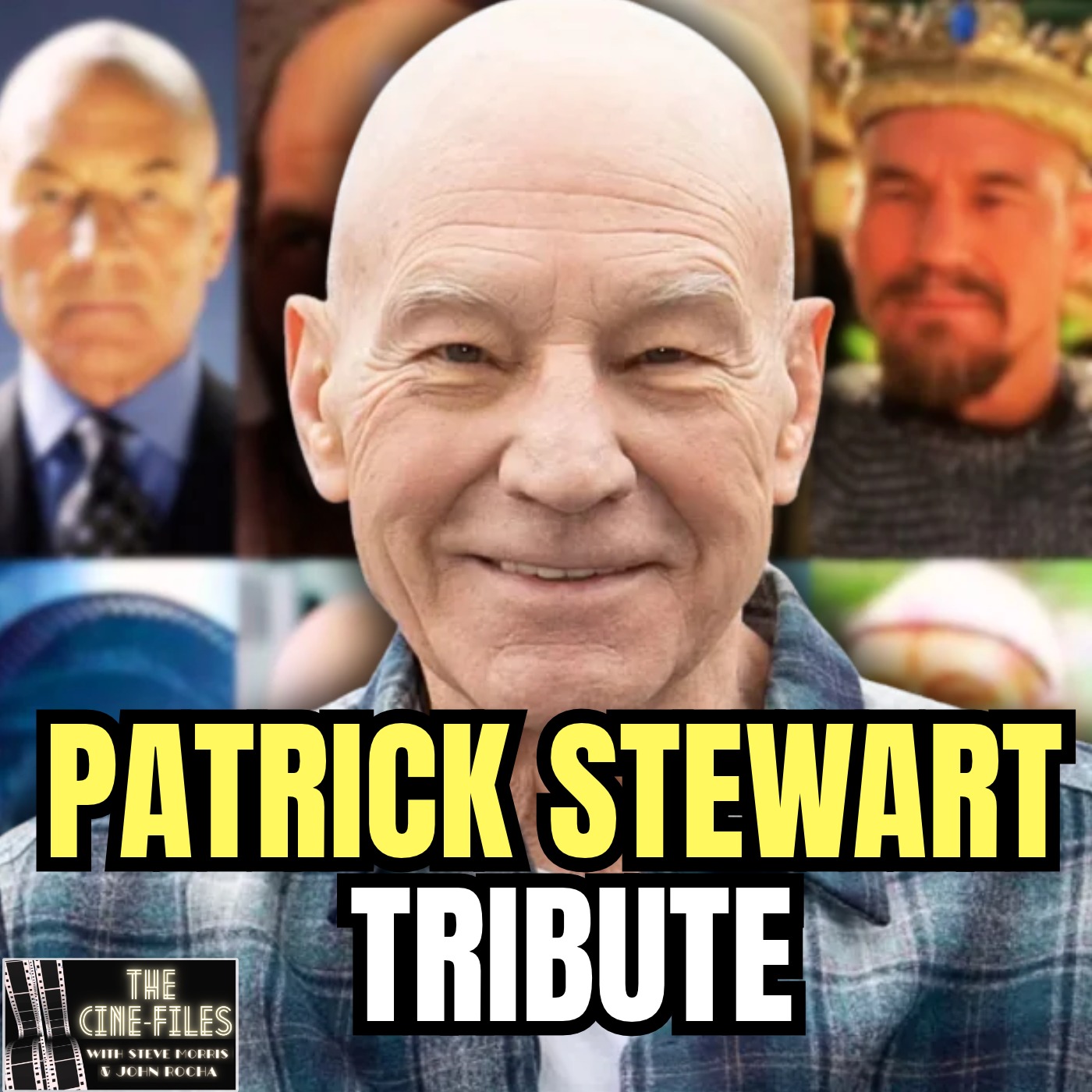
The Cine-Files· Staffel 10· Folge 505
505 PATRICK STEWART Tribute: Revisiting His Life, Work and Legacy
· 1 h 27
Kapitelklicken springt direkt hin
Shownotes
<p>On this episode of The Cine-Files LIVE, hosts John Rocha and Steve Morris offer up their tribute to the great Sir Patrick Stewart who we lost earlier this week. Steve leads the discussion exploring the early years of Patrick's start as an actor all the way up until he accepts the role of Jean Luc Picard on Star Trek: The Next Generation. Steve and John also lead us thru his career after Star Trek as Stewart becomes Professor X and appears in numerous other movies, TV shows and animated series as well. They also dive into the man that Patrick Stewart was off the set and how his early struggles during a tough upbringing led him to be the good, caring, empathetic and down to earth man he was for a majority of his life. It's a fantastic conversation with the guys exploring the life, work and legacy of Patrick Stewart.</p><p><br></p><p>Plus, we answer all the viewer's questions, thoughts and comments on Streamlabs or SuperChat.</p><p>#patrickstewart #startrek #xmen #marvel #startrektng #picard #ProfessorsX #thesimpsons #AmericanDad #films #movies #thecinefiles</p><p><br></p><p>To support The Cine-Files on Patreon, go to: www.patreon.com/thecinefiles</p><p><br></p><p>Buy or stream this movie here: link.amazon/B0dq0MNir</p><p><br… us on Facebook: facebook.com/TheCineFilesPod/?ref=bookmark<… episode is sponsored by/brought to you by the following sponsors:</p><p><br></p><p>QUINCE: Quince is an affordable luxury brand that sells high-quality fashion and home goods at radically low prices— direct from the factory floor. The company has pioneered a manufacturer-to-consumer (M2C) retail model in which factories produce inventory on a near just-in-time basis and ship their goods directly to consumers' doorsteps, cutting out financial and environmental waste. Check out their products at: www.quince.com</p><p><br></p><p>CURE HYDRATION: Cure is an everyday hydration mix built around the science of oral rehydration. Your body absorbs water more efficiently when it's paired with electrolytes and a small amount of glucose. Cure combines coconut water, pink Himalayan salt, and real fruit juice to provide electrolytes and naturally occurring glucose, without added sugar or artificial ingredients. Visit them at www.curehydration.com and use our promo code CINEFILES.</p><p><br></p><p>PROGRESSIVE: For over 80 years, Progressive has offered customers a wide range of insurance choices, including auto, home, renters, commercial auto, small business, motorcycle, boat policies, and more. Progressive is the second largest auto insurer in the country—a combined effort of every single person at Progressive. Visit them today and see what rates work for you at www.progressive.com.</p><p><br></p><p>FOLLOW:</p><p>Follow John Rocha: @therochasays</p><p>Follow Steve Morris: @srmorris</p><p>Follow us on Twitter @cine_files</p><br/><br/>Our Sponsors:<br/>* Check out Cure Hydration and use my code CINEFILES for a great deal: curehydration.com<br/>* Check out Progressive: progressive.com<br/>* Check out Quince and use my code CINEFILES for a great deal: quince.com<br/><br/><br/>Adv… Inquiries: <a href='redcircle.com/brands'>https://redcircle… & Opt-Out: <a href='redcircle.com/privacy'>https://redcircl…;
Transkriptvom Podcast bereitgestellt · Zeitmarken springen hin
[SPEAKER_02]: Hello everyone and welcome to a brand new live episode of the cinephiles here on the cinephiles YouTube channel. [SPEAKER_02]: I am John Rooka, one half of the cinephiles joined as always by Steve Morris, who is on the bridge. [SPEAKER_02]: Steve, how are you? [SPEAKER_02]: How are you feeling?
[SPEAKER_02]: How are things, my friend? [SPEAKER_01]: Well, I mean, it's sad. [SPEAKER_01]: I mean, you know, it's so when we do these things, it's always a different set of emotions. [SPEAKER_01]: And yeah, we're here to talk about the great, great Patrick Stewart, uh, who we lost, shocked shockingly to me.
[SPEAKER_01]: And you just kind of go back and go, oh, wow, this person was a huge, huge part of my life. [SPEAKER_01]: So I really, I'm sad about the reason, [SPEAKER_02]: Yeah, that's what we're doing today. [SPEAKER_02]: This is going to be our tribute for Patrick Stewart. [SPEAKER_02]: And this is going to be the episode for the week Steve.
[SPEAKER_02]: We both, you know, you suggest this. [SPEAKER_02]: We both agree to it. [SPEAKER_02]: So we're Captain America. [SPEAKER_02]: Part two will be up next week. [SPEAKER_02]: And then we'll go forward and finish off. [SPEAKER_02]: Civil War from there and then we'll have an announcement and an announcement later on in the show to let you know what movie we're doing after Captain America Civil War, which might have something to do with the gentleman we're talking about today.
[SPEAKER_02]: So, but Steve, please take it away. [SPEAKER_02]: I hand over the reins. [SPEAKER_02]: You have You have control of the bridge of the cop. [SPEAKER_02]: So, please take it away. [SPEAKER_01]: Well, since I have a con, I will start where we almost always start, which is do you remember how you first came to Patrick Stewart?
[SPEAKER_01]: Well, it's interesting. [SPEAKER_01]: Two things. [SPEAKER_02]: One, I remember coming to Patrick Stewart as John Luke Picard and Star Trek administration, you and I both grew up massive Star Trek fans. [SPEAKER_02]: They were relaunching the show. [SPEAKER_02]: I was still, I'm a massive Kirk fan, and so I was like, who is this person who is going to be the next captain in Star Trek?
[SPEAKER_02]: Because, I mean, it's not like now, where Star Trek fans have a wealth of captains to choose from at the time it was massive to have someone. [SPEAKER_02]: But I had clearly seen Excalibur before I had seen [SPEAKER_02]: Uh, starting a generation, so, but I, I like to Patrick Stewart, but he had not been a name that I remember.
[SPEAKER_02]: So, Glyum Neeson, yes, my first experiences as a caliber, I don't remember thinking, oh, my God, Liam Neeson or anything like that. [SPEAKER_02]: And the same thing here, I remember liking the Patrick Stewart performance, but it wasn't one that necessarily stuck in my mind. [SPEAKER_02]: I'll amidst all the other performances in that movie.
[SPEAKER_02]: So, Jean Le Picard is my first real coming to Patrick Stewart, but Excalibur is my first like seeing Patrick Stewart on screen. [SPEAKER_01]: My story is exactly the same, and it's one of those weird ones where the first time I was aware of Patrick Stewart is the premiere of Next Generation.
[SPEAKER_01]: But I had seen him both in Excalibur, which I watched many times, and I think I've said on the show before, that was my first [SPEAKER_01]: My mom was a huge King Arthur Camelot sort of fan, so my mom took me when I was 11. [SPEAKER_01]: And I just remember sitting next to my mom in the opening, you know, rape and heavy plate mails, just feeling so uncomfortable.
[SPEAKER_01]: It's one of the great movie experiences. [SPEAKER_01]: So I watched Excalibur a lot before knowing who, not only I not know who Patrick Stewart was, but I didn't as you said, Liam Neeson, I had no idea who that was, Gabriel Burn and Helen Mirron, [SPEAKER_01]: Even though I knew who none of those people were at the time and the other place I had seen Patrick Stewart But hadn't made a huge impression it's he's in David Lynch's do so right so I had totally seen him in that But yeah, it's it's it's next generation and I'll tell you I can remember because obviously like you huge Star Trek fan Yes, so excited to watch it.
[SPEAKER_00]: I think it's my sophomore year at Cal when it comes out and I remember watching it on my little nine inch black and white TV [SPEAKER_00]: You know, the one that had a little handle about this big. [SPEAKER_01]: Yeah. [SPEAKER_01]: And sitting on the bed in my dorm room, just being glued to what I thought at the time was so great.
[SPEAKER_01]: And only since then, you know, and I became, you know, it's, it's like the stories that I would hear about people in college in the late 60s, all gathering in the, you know, the central room to watch the original series. [SPEAKER_01]: That's what next generation became for me, is that, I, I, I, I would try to not schedule a play rehearsal or anything else so that I could be home or in the common room to watch next gen and then with my group of friends, for years it was like, no, we will be watching next gen and it even became an important part in my courtship of Karen.
[SPEAKER_01]: um because I can I was I turned her on to start trek the next generation and it was I'm sure you had this too. [SPEAKER_01]: It would regularly play the reruns at 11 o'clock at night and so care now she and I would commute to [SPEAKER_01]: to Berkeley when we were going to school there and I would drive her home to her place and go, hey, you want to watch it's almost 11.
[SPEAKER_01]: We watch next gen and we go and watch it and hang out and that is sort of the beginning of our courtship was that's a central part of it was those late nights watching reruns of next generation. [SPEAKER_02]: Well, it's fact, yeah, I'm going to remember doing that on WDCA 20 in DC, or Virginia, rather, when I live there, that was the local station.
[SPEAKER_02]: That's where they show next generation. [SPEAKER_02]: Same thing, just like you had to stay up and watch the replay, or if I couldn't, if I missed the first broadcast of it, and I, and thing is that I, I came to it from a different place, right, because I came to it much more. [SPEAKER_02]: like who this person think they are, what do they think they're doing?
[SPEAKER_02]: There was a level of excitement for sure, but then there's always says, like who is this person? [SPEAKER_02]: And not having known this person, will they be able to be as good as Kirk or as interesting as Kirk? [SPEAKER_02]: And so I have to say from the beginning, I really enjoyed Patrick Stewart's portrayal.
[SPEAKER_02]: I may not have been the biggest fan of the show in those first two seasons. [SPEAKER_02]: I think that's a show I came back to in the 90s and reappreciated, especially as it got into the movies, [SPEAKER_02]: I just remember being very impressed. [SPEAKER_02]: Three things hit me. [SPEAKER_02]: One, I loved Patrick Stewart's performance.
[SPEAKER_02]: I thought Marina Seertis was one of the hottest women on the planet as a Troy. [SPEAKER_02]: And then I loved that they had a cling on on the bridge of the ship. [SPEAKER_02]: Those three things really stood out to me. [SPEAKER_02]: Data, of course, but that was more like, well, I'd seen it in Italy.
[SPEAKER_02]: It's an Android being a part of the crew that kind of thinks. [SPEAKER_02]: So for me, it wasn't quite. [SPEAKER_02]: But those three things I remember just hit me distinctly, very strongly, but Patrick Stewart's performance [SPEAKER_02]: And you hear all the story, Steve, about how they kind of broke him a little bit because he came in with this really Shakespearean and serious approach to work and had all these ideas.
[SPEAKER_02]: And the cast had to kind of like break him. [SPEAKER_02]: And as Marin is here to set an interview, free him from all this stuff. [SPEAKER_02]: So he could really step in to become in the captain. [SPEAKER_02]: And I think that's one of the reasons. [SPEAKER_02]: Well, those later seasons are so good because Patrick [SPEAKER_01]: It's funny because I read those same things and what's interesting is I've read sort of two different perspectives one is is that he kind of came in Not as a jerk, but as the professional guy and when they were goofing around on set or didn't weren't entirely prepared He scolded them in that first season like this is not a weird professional actors.
[SPEAKER_01]: We had to do stuff like this [SPEAKER_00]: And then he kind of settled in as you said he sort of settled into what this group was and started to have a lot of fun, but I've also heard from Jonathan Franks who said they needed him to come in a bit like a hard ass and that they that he he really became the captain, you know, he became the leader of how that set was going to work.
[SPEAKER_02]: Yeah, yeah. [SPEAKER_02]: And this was a chance he was taking, right? [SPEAKER_02]: Steve, I mean, to step into the shoes to be the next captain, this is, remember, people forget, this is the late 80s. [SPEAKER_02]: This isn't the 90s. [SPEAKER_02]: Like, generation feels like a product of the 90s, but it began in the 80s, the late 80s.
[SPEAKER_02]: And so like this idea that he would be able to come in and that they would get across the Star Trek love and reignite it for people coming out of those those original series films that had pretty much dominated the 80s. [SPEAKER_02]: It was a hell of a task he was taking on to step in. [SPEAKER_02]: And I read that even his great friend Ian McKellen was like, what are you doing?
[SPEAKER_02]: Don't do this. [SPEAKER_02]: And a lot of his friends told him not to do this because it was a six-year [SPEAKER_02]: to play something that you're not even sure is going to work out. [SPEAKER_01]: Well, let's back up into a little bit of biography and get back up to this moment because I think this is like a key moment in his life.
[SPEAKER_01]: So he's born in 1940 in Yorkshire, very humble beginnings and his father who had served in World War II came back and it sounds like his father was tough, difficult, abusive to his mother, abusive to him. [SPEAKER_01]: And what's so interesting hearing him talk about it [SPEAKER_01]: you know, a tireless advocate for women's rights and feminism and fighting against domestic abuse, and it sounds like in the beginning of that charitable work and advocacy, he really condemned his father to a great degree.
[SPEAKER_01]: And then had to learn later on that, oh, my father had had traumatic experiences in the war. [SPEAKER_01]: He was clearly suffering from PTSD that I didn't understand. [SPEAKER_01]: And I've heard him interview about it multiple times. [SPEAKER_01]: And the sensitivity, his ability to [SPEAKER_01]: not back off in any way of protecting women or fighting against domestic abuse, while simultaneously incorporating so much of what he later learned about PTSD to reevaluate his father's behavior.
[SPEAKER_01]: And I think that's just one of the many things in his character that is so admirable is like I'm not just going to point and say this my father was a bad man. [SPEAKER_01]: I'm going to say that he was destructive and it hurt me and it scared me and it took, you know, he talks about it took decades for him to sort of shed those ideas of masculinity and anger and all those things that came from his father, but then incorporating all of this compassion for what the man went through despite how he heard him.
[SPEAKER_01]: It's an amazing turn to be able to make in your life. [SPEAKER_02]: You know, it's a, you know, it's just like whiplash to a degree. [SPEAKER_02]: And I'm not saying the relationship was the same in terms of the abuse, but this idea that sometimes in households, and certainly you don't want to you wish this on anyone, but sometimes in households with artistic people, [SPEAKER_02]: having a father who is or or parents shall we just say just to remove the exclusivity of it all, a parent who can be a bit hard on you can be a bit tough on you.
[SPEAKER_02]: It can tough on you. [SPEAKER_02]: It can make you prepare for the world, especially the world of [SPEAKER_02]: film and television and theater, which can be very cutthroat can be very difficult something and go years without a job or whatever not that Patrick did, but there are certainly and coming from a hard scrabble upbringing.
[SPEAKER_02]: He did not come from wealth. [SPEAKER_02]: He is even though he has this kind of elevated speech. [SPEAKER_02]: He does not come from any kind of wealth as you were saying, and so there was a hard scrabble existence that he had a tough his way through, and all those father was abusive. [SPEAKER_02]: It may be possible that some of those things that he endured there, toughened him up to endure the hardships of the world as he went out there, you know?
[SPEAKER_00]: Um, I think, I mean, we can't separate our ourselves as artists from our pain and from our experiences and it sounds like it's so interesting because, you know, as you said, not a lot of money. [SPEAKER_00]: He was introduced to acting in school at 11 years old, apparently the teacher handed, I don't even quite understand the story, but but handed him some Shakespeare and said, you get up on that stage and start reading this.
[SPEAKER_00]: And that was it for him. [SPEAKER_00]: Like he was like, Oh, this is what I want to do. [SPEAKER_00]: You know, he discovered who he's supposed to be. [SPEAKER_00]: And then spent a long time trying to figure out how as a guy with no money, he would be able to pursue what is not as you'd well know, not any easy thing to pursue.
[SPEAKER_00]: No. [SPEAKER_00]: And he ended up he worked. [SPEAKER_00]: after, you know, what we would call high school, you know, when he was like 1819, he started working at a newspaper and he was kind of did local reporting jobs. [SPEAKER_00]: He wrote obituary's except the thing was, is that he'd get an assignment like go down to this place, ask a couple of questions about, you know, a house burned down or something like that.
[SPEAKER_00]: And he would go, okay, I'll be back in a few hours and he would apparently sometimes not go to where the house burnt down. [SPEAKER_00]: do a rehearsal, totally make up whatever facts he wanted for the newspaper article. [SPEAKER_00]: And then write things that never happened until finally, and I'm not sure if his editor actually caught him officially at this, but his editor gave him an ultimatum.
[SPEAKER_00]: And he said, you got to either choose the newspaper or acting, make a decision. [SPEAKER_00]: Patrick Stewart went, see ya. [SPEAKER_00]: That was it. [SPEAKER_00]: That was it for that. [SPEAKER_00]: And he went off to, that's where he ended up at the Royal Shakespeare Company. [SPEAKER_00]: And this is 1966.
[SPEAKER_00]: And this is, I mean, it right away, he is acting with Ben Kingsley, Syrian Richardson, you know, like this is where the great and is around Olivier. [SPEAKER_00]: It was really interesting. [SPEAKER_00]: So Ian McKellen showed up there a little bit before [SPEAKER_00]: This is one of the great friendships, like arguably a male friendship that you enjoy any time they're together and chatting.
[SPEAKER_00]: This is an incredible model of male friendship. [SPEAKER_00]: They were friends in the early days. [SPEAKER_00]: They didn't work together. [SPEAKER_00]: It sounds like in the mid-60s and early 70s, [SPEAKER_00]: and a bit like he seems so warm and friendly today, but he I don't think he was quite like that.
[SPEAKER_00]: And so they didn't really hang out together very much in those early days. [SPEAKER_00]: And he did, as we said, he's he's [SPEAKER_00]: He did a lot of theater, tons and tons of theater. [SPEAKER_00]: I think he did like 60 plays in those first 10 years, or something like that. [SPEAKER_01]: That's true.
[SPEAKER_01]: Patrick Stewart did. [SPEAKER_01]: Yeah. [SPEAKER_00]: Yeah. [SPEAKER_00]: Huge, huge amount of work in doing all the Shakespeare and everything, and really the theater and Shakespeare, that's his true love is also getting work as we said on things like Dune and Excalibur, doing a lot of TV work, things like that, [SPEAKER_00]: Um, and traveling to the US for Shakespeare like he made his Broadway debut in 1971, um, he, uh, he acted in TV.
[SPEAKER_00]: He did things like Tinker Taylor, Soldier Spy, and Smiley's people on TV, um, and then he was also doing, he got invited because with Shakespeare work, [SPEAKER_00]: to go to kind of workshops at UCLA and he's at UCLA doing some kind of a stage reading to try to introduce people to Shakespeare.
[SPEAKER_00]: And one of the people at this informal reading is Robert H. Jussman, Bob Jussman, who is the big producer of Star Trek The Next Generation. [SPEAKER_00]: And so he goes, there's something about this guy and they call them and they call them and to do Star Trek. [SPEAKER_00]: And it's so funny, this is one of those stories that you hear all the time, but Patrick Stewart says, you knew nothing about Star Trek.
[SPEAKER_00]: Yeah, didn't, yeah, whether or not that's true because people always say that, but in his case, I kind of think it's mostly true. [SPEAKER_00]: And as you said, he did not want to sign that six-year contract. [SPEAKER_00]: because how is he going to do theater? [SPEAKER_00]: And basically, and Ian McKellon did say, why would you want to be on TV, you know, time?
[SPEAKER_00]: There's the stratification between TV and movies. [SPEAKER_00]: He, you know, Patrick Stewart's a serious dramatic actor. [SPEAKER_00]: And so they go, so he's saying, don't do this. [SPEAKER_00]: Don't take this part, which is funny thinking about it. [SPEAKER_00]: Now, when Ian McKellon has played Magneto and Gandalf, right now, but finally, what convinces him is his agent say, [SPEAKER_00]: 95% chance this thing is going to crash and burn, you'll probably get half a season and then they'll cancel it and then you so just take the job.
[SPEAKER_00]: It's not it's net there's no way this is going to go. [SPEAKER_00]: And Patrick Stewart apparently pretty much lived out of a suitcase for the first whole first year of next year because he kept expecting it to get canceled one more thing about it by the way. [SPEAKER_00]: because Luke Picard is French and with a two pay because no one believe there could be a ball to captain of the enterprise.
[SPEAKER_02]: Yeah, this was before bald was a thing like Michael Jordan kind of was the one who broke the [SPEAKER_02]: broke that. [SPEAKER_02]: Well, I mean, you could say, co-jack in the 70s, certainly telly civils, baby. [SPEAKER_02]: I mean, you could argue that, but it was like kind of Jordan, who kind of made it cool, and then eventually Bruce Willas and others, Jason Stainton, what would have you?
[SPEAKER_02]: So like, yeah, I mean, it was this thing of like, because at that time, it's something you may not remember this, but at that time, being bald was a symbol of not being manly enough, or something wrong with your testosterone. [SPEAKER_02]: There were those kinds of [SPEAKER_02]: So Picard coming, so I'm sorry, Patrick Stewart coming in with a two pay French accent, which is a fascinating approach, thank God that didn't go that route.
[SPEAKER_02]: You know, it was this kind of thing, but he talks about this in, in creating his characters on stage before them that heat for him it was about the facial hair and the adjustment to the putting, like all this stuff was really important to him as an actor. [SPEAKER_02]: Well, it talks about that so many actors talk about this, like putting on the facial [SPEAKER_02]: from the world.
[SPEAKER_02]: And I think this was something maybe he in a way he was trying to adjust the character to make it fit for what he was seeing and hide a little bit of himself in the character as well. [SPEAKER_02]: But I mean, stripping all that away, you get the Patrick Stewart that we have as as John Luke McCart.
[SPEAKER_02]: And it's really fascinating Steve, because we've talked about this off-camera and on camera, like those first two seasons of next gen, not the strongest seasons of the show. [SPEAKER_02]: So [SPEAKER_02]: fans that wanted this to succeed and believed it enough and enjoyed the cast led by Patrick Stewart enough to keep coming back to get it to survive until it really hit its right near the end of the second season.
[SPEAKER_01]: Yeah, it's funny, as you know, I did, you know, the enterprise incidents where we covered the original series and the animated series, and we had many, many conversations about moving on to next gen. And there were many reasons why I didn't want to do it. [SPEAKER_01]: A lot of what to do with other work and things like that.
[SPEAKER_01]: But big reasons, those first two seasons are almost entirely terrible. [SPEAKER_01]: I mean, looking at them now. [SPEAKER_01]: I mean, and I just couldn't imagine [SPEAKER_01]: week after week talking about episodes of bad television. [SPEAKER_01]: I don't think next generations batting averages as high as the original season, the original series, particularly the first two seasons of the original series, which is incredible.
[SPEAKER_01]: There are highlights of next gen that are absolutely on par with anything ever in Star Trek. [SPEAKER_01]: Some of the greatest Star Trek episodes of all time. [SPEAKER_01]: By the way, I just want to get back to the to the hair thing just because as you pointed out, yeah, I am less manly than you because I'm [SPEAKER_01]: No, I'm saying back then.
[SPEAKER_01]: No, that's what you said. [SPEAKER_01]: That's how I felt. [SPEAKER_01]: No, so two things about it. [SPEAKER_01]: One thing is someone I saw, Patrick Stewart might have been on Letterman or something in the 80s or early 90s. [SPEAKER_01]: And someone asked him about his very, very closely cropped bald head.
[SPEAKER_01]: And he said, oh, I do this because of advice I got from another RSC actor, Sir Ben Kingsley, who's Patrick Stewart, listen. [SPEAKER_01]: If you don't have much hair, have less. [SPEAKER_01]: And it's funny, I'm looking at myself right now and I'm like, yeah, I need a haircut because it's like, I've always followed that advice of just like, you know, don't try it because it's opposed to, you know, let's say my uncle Russell, who is not listening to the show, who had the most extensive come over, you could possibly imagine we actually kind of swirled his head.
[SPEAKER_01]: So if you pulled it down, it was like this long, it's like, okay, I'm not doing that. [SPEAKER_01]: Here's one of the things that I like about this is apparently a reporter goes up to Gene Roddenberry after next gen launches and says surely they would have cured baldness by the 24th century.
[SPEAKER_02]: Oh my god. [SPEAKER_01]: Roddenberry replied in the 24th century, they wouldn't care. [SPEAKER_01]: which I think is a fantastic line. [SPEAKER_01]: And I also think like what's so hard those first two seasons, first of all, in my opinion, how to get rid of Roddenberry, because Roddenberry, unlike the original series, have decided that problems really were all solved by the Federation, so there should be no conflict on the ship.
[SPEAKER_01]: which is so you just, we've got it all figured out. [SPEAKER_01]: Conflict only comes meet meet other places. [SPEAKER_01]: And that is not what makes Star Trek work. [SPEAKER_01]: You need conflict. [SPEAKER_01]: Apparently Patrick Stewart would continually go to the producers and say, essentially, can you stop having me speak all this techno-babel?
[SPEAKER_01]: Captain Picard needs more running and jumping and fighting and fucking. [SPEAKER_01]: But he told them, which is why by the time we get to the third season, Picard started to do things and have love interests and man, they really, and I think the other thing that's interesting too, and what's so great about the casting of Patrick Stewart is they went, we can't do Kirk.
[SPEAKER_01]: Is that right? [SPEAKER_01]: Captain has different. [SPEAKER_02]: Yeah, and that's the thing that I had to come around on, like I'm great upon us with you. [SPEAKER_02]: I had to come around on it. [SPEAKER_02]: I did not see the captain of the enterprise to be this British man who could speak shit because in a lot of ways, Patrick Stewart is like the rougher version of John Gilbert.
[SPEAKER_02]: a lot of their approach and a lot of their look and a lot of how they view Shakespeare, but Patrick can make it accessible in a way that Gilbert Gilbert couldn't always do. [SPEAKER_02]: Gilbert, it was very elevated, right? [SPEAKER_02]: And so with Patrick, it was much more in the gut.
[SPEAKER_02]: Why does Patrick came from a hard scrap of life? [SPEAKER_02]: Tough existence would have you. [SPEAKER_02]: So the elements were there when he performed. [SPEAKER_02]: So when I was watching the first couple of seasons of next generation, you know, I kind of was in and out because I wasn't happy to see someone try to replace [SPEAKER_02]: But now as I look back, of course, this was the, this was the changing perspective of masculinity at the time in the late 80s, right, this idea of we're seeing self help become a massive deal jogging is a massive deal working out taking care of yourself your body is a temple all these things are happening in the 80s as we change and evolve as human beings and as men the conversations about our feelings conversations about what we can talk about what we can't talk about those kinds of things are changing from the 60s.
[SPEAKER_02]: So you have to have an actor who is going to trick Captain that is relevant to the audience, the audience, the audience's taste that is changing there in the 1980s and Picard is a great counter to Kirk precisely because he's not going around fucking everybody in the universe as Kirk allegedly did with a lot of the stereotypes and he's not always fighting.
[SPEAKER_02]: Like Kirk always had to [SPEAKER_02]: different ways than Kirk used his mind. [SPEAKER_02]: And I like that as a challenge and as a different flavor for a captain of the enterprise. [SPEAKER_02]: So I had to come around on it. [SPEAKER_02]: It was my biases. [SPEAKER_02]: And it was still the late out to the mid-90s that I came around on next generation and called back up with it.
[SPEAKER_01]: It's I think it's an amazing choice what they did and it took a long time to sort of figure out by the third and fourth season they had definitely figured it out, but like I think part of it is that you know Kirk is a product of the sixties he is a he's a Kennedy Esk sort of character hugely charismatic and it's sort of the I know best I mean that's sort of the Kirk style is to leap in yeah aggressively to solve the problem.
[SPEAKER_01]: And sometimes that works out well, and sometimes it doesn't work out well, but like that's what Kirk Kirk is going to Kirk. [SPEAKER_01]: A card is going to stand back and be strategic. [SPEAKER_01]: He is going to think in a more complicated not and what's so what's so great because these are these are my two favorite Star Trek captains and Kirk is my favorite.
[SPEAKER_01]: I'll never get past that. [SPEAKER_00]: But [SPEAKER_01]: But Picard might be closer to Picard in terms of the way that I look at the world. [SPEAKER_01]: Oh, I don't agree with that. [SPEAKER_02]: I think you're a much more Picard person now. [SPEAKER_02]: I'm a much more Kirk person. [SPEAKER_02]: I agree with you 100%.
[SPEAKER_02]: Yes. [SPEAKER_02]: Yes. [SPEAKER_01]: Yeah. [SPEAKER_01]: And so that the stand back and be like, for instance, Kirk gets promoted to Admiral, but you know, before the motion picture, and it's the worst thing that could have happened to him because he needs to be out jumping on starships and fighting things in the galaxy.
[SPEAKER_01]: Yeah. [SPEAKER_01]: I don't think the card perfectly evolves into being an admiral, you know, it's it's that's that's just natural for him. [SPEAKER_01]: And I think where they really really started to find him is when is hit because here's the interesting epiphany I had when we did the original series and I think it's total because I went back I watched four episodes of next gen in preparing for this conversation because [SPEAKER_01]: And the epiphany that Scott and I had when we did the original series is, oh, when you think about it, Kirk, this charming charismatic outgoing, positive figure is in fact, in many ways, a tragic figure.
[SPEAKER_00]: His life has been filled with tragedy over and over again, and he has always chosen his duty over his happiness. [SPEAKER_00]: you know, and so like between Edith Killer and Miramani and death of his, we hear that his family was killed by like Kodo's the executioner. [SPEAKER_00]: We know that, you know, he's he's lost all these people, his his brother is killed, his sister-in-law's killed, it's like Kirk is, you know, it's pretty sad.
[SPEAKER_00]: Yeah. [SPEAKER_00]: So as Picard, Picard is a deeply, and what's so interesting about next gen that they really do [SPEAKER_00]: is he's a very removed sort of distant figure who learns how to actually treat that crew as his family. [SPEAKER_00]: And it takes him a long time, but many of the episodes in particular things like interlight, which is an incredible episode of Star Trek.
[SPEAKER_00]: there's a lot of pain that the card has to carry around with him and of course after the you know best of both worlds one and two where he's gets captured by the board that's that's a guy who's dealt with real serious trauma [SPEAKER_02]: Yeah, yeah, yeah, yeah, how they approach it. [SPEAKER_02]: Yeah, I think you're so right.
[SPEAKER_02]: When you watch next gen, it's a much more of a family. [SPEAKER_02]: There's much more of an interaction about what should be done, what should not be done. [SPEAKER_02]: When you watch the original series, Spock and McCoy are really the only ones that can tell Kirk what to do, or can counter Kirk's points of view.
[SPEAKER_02]: The other people on the ship, of course, get moments, but it isn't a consistent thing. [SPEAKER_02]: With next gen, you can tell the way they constructed it, and I think it fits who Patrick Stewart was as a person. [SPEAKER_02]: This is where he could flourish, because, as you said, he's a guy who comes out of the PTSD.
[SPEAKER_02]: He's a guy who becomes a person who's very sensitive to domestic violence. [SPEAKER_02]: He's a person who sees the world in a certain way. [SPEAKER_02]: And they, and they write the character to be symbolic of what I would say, be by the set of this, but the, the, um, idealistic liberalism of the late 80s that led into, Clint the Clinton era of politics in the 1990s, like this, he is the, like the beginning of this, [SPEAKER_02]: change in this evolution, right?
[SPEAKER_02]: So the idea that he would see his crew as his family, along with the people who are underneath them in terms of ranking, I think is so important for the evolution of the show. [SPEAKER_02]: And I think again, the changing tastes of audiences who want to watch shows that are much more interactive and kind of destroy the [SPEAKER_02]: the hierarchy that exists on shows like that.
[SPEAKER_02]: So people feel much more invested in embracing a character and following that character through this entire series. [SPEAKER_02]: And I think that's what's so great to watch about the show and the changes and the way it breeds new life into Star Trek. [SPEAKER_02]: and goes to places where they've never gone before us as the thing might say.
[SPEAKER_02]: And so I really appreciate that. [SPEAKER_02]: But I think a lot of it, Steve, as you were saying, like he approaches the producers and says, the gardening's do this, this and this. [SPEAKER_02]: I also think maybe the writers and the showrunners having conversations with Patrick Kennedy, you know, Patrick Moore, seeing how the cast and Patrick interact.
[SPEAKER_02]: There is this desire to, okay, we're going to write a different type of Star Trek that is much more humanist in terms of the approach and topical to what's going on here. [SPEAKER_02]: in our world, you know? [SPEAKER_01]: Well, I really think, and I think it happens in, um, uh, whatever, I mentioned the Nate title before now, it went, went out of my head, but in the series finale, where in the end he shows up at the poker game, you know, [SPEAKER_01]: We've been watching the junior officers all have this weekly poker game and Patrick Stewart never or Picard never felt invited and then decides to go.
[SPEAKER_01]: I wanted to I have a quote from him and I wanted to read because I liked it. [SPEAKER_01]: So he starts off doing Picard, you know, still living out of a suitcase because he's not really committing to it and then he keeps pushing and the show gets better and the character gets deeper and the scripts get better.
[SPEAKER_01]: And so instead of being this thing that he had resisted because he loved Shakespeare, this is the thing I'm doing to make money in order to go back and do theater, he started to feel like [SPEAKER_00]: that the success of Star Trek was because Captain of Picard in his own way was a Shakespearean character that this was like laying Richard the Third or Henry, he started seeing all of these characters is this is all out of Henry V, you know?
[SPEAKER_01]: That's what's really going on. [SPEAKER_01]: And this is a quote from him and he says, the fact is all those years in the world Shakespeare company playing all those kings, emperors, princes, and tragic heroes were nothing but preparation for sitting in the captain's chair of the enterprise.
[SPEAKER_02]: Wow. [SPEAKER_02]: Wow. [SPEAKER_02]: Wow. [SPEAKER_02]: Wow. [SPEAKER_01]: That's great. [SPEAKER_02]: And it's fantastic. [SPEAKER_02]: And I wonder, I wonder what Steve, the sliding doors of it all. [SPEAKER_02]: Like what happens to Star Trek? [SPEAKER_02]: If they don't cast Patrick Stewart, what happens to Star Trek or Patrick Stewart, if he turns down the roll, does he become a perfectly fine actor who works, but never becomes Patrick Stewart, you know, and maybe never becomes Professor X, maybe never becomes this entity shows up on American dad, you know, like all these things that later make him so beloved to people would [SPEAKER_02]: if he hadn't taken the role, it's a very interesting thing to think about because he had to change what the role, as you were saying, like he was kind of, you know, living in a suitcase, not sure, but as he put more ownership of the role, then there was a protection element that came to it.
[SPEAKER_02]: I think I read something where like he stormed off the set during a good morning America visit because they were trying to make fun of Star Trek. [SPEAKER_02]: And now he was not happy about it. [SPEAKER_02]: And so [SPEAKER_02]: Like I said, it's from my own portion point one should get certain people invested they will protect the thing with their dying breath and I have a feeling that Patrick Stewart is built to be that way like very loyal in that once he feels connected to the thing he will defend it like a [SPEAKER_02]: I don't know, like an act of warrior until the end, and so I think that was also what's fascinating to think about.
[SPEAKER_02]: Like, both things at the same time, destiny, finding that each other and embracing the role and creating this new appreciation for Star Trek, because I wonder if we would even still be talking about Star Trek now, if it had been for next gen to really get a whole new generation of people to invest in the franchise, you know?
[SPEAKER_01]: I don't think we would. [SPEAKER_01]: I really don't. [SPEAKER_01]: There's there's so many moments where Star Trek could have been lost and it's really just luck and circumstances that managed to continue like it was going to get canceled after the second season. [SPEAKER_01]: Yeah, there was a letter writing campaign which may or may not have been largely pushed by Gene Roddenberry himself.
[SPEAKER_01]: And people like selling, you know, doing their own homemade toys and homemade costumes and things like that, that kept it alive just enough. [SPEAKER_00]: You know, there's no, there's no continued Star Trek if Star Wars isn't a big hit. [SPEAKER_00]: Yeah, we have to have Star Wars as a big hit.
[SPEAKER_01]: Then we have to make the second movie after, you know, motion picture made money, but it was hugely expensive, so it really didn't make a lot of money. [SPEAKER_01]: the fact that they get wrath of Khan, that's without wrath of Khan, Star Trek dies, without Star Trek 4, which was hugely popular and they're most successful, that's why there's next generation.
[SPEAKER_01]: Yeah. [SPEAKER_01]: And then if the studio, you know, because it was not playing on the main networks, if [SPEAKER_01]: That first season is terrible, so there had to be enough interest to keep it going to the third season where it gets good. [SPEAKER_01]: And without that, once the original crew dies, that's it.
[SPEAKER_01]: If if if if if if if the electric the next generation gets canceled, I think that's the end of Star Trek. [SPEAKER_02]: You know, yeah, probably dude, probably is a franchise. [SPEAKER_02]: Yeah, I mean, and there isn't measure of a man in the first season. [SPEAKER_02]: So there are, like, there are second season.
[SPEAKER_02]: Second season, sorry. [SPEAKER_02]: So there are episodes in those first and second seasons that are maybe glimpses of what the show can be, right? [SPEAKER_02]: And I think measure of a man is just a great episode to go back and revisit. [SPEAKER_02]: Maybe not the greatest in terms of the writing and all of that, but I think it is a great episode because it kind of shows you the potential of the show.
[SPEAKER_02]: and what it can be if they get all the parts right and they did going into the third season and it really took off from there. [SPEAKER_01]: It's one of the episodes I rewatched was measure of him because in my memory and it totally holds up. [SPEAKER_01]: That is that is the first really good episode of next generation.
[SPEAKER_02]: Yeah, yeah, yeah. [SPEAKER_01]: And then you get to it. [SPEAKER_01]: And I know we I saw someone put a question about this in the comments, but that best of both worlds part one and two, which is the end of season three cliffhanger. [SPEAKER_01]: Yeah, this is one of the. [SPEAKER_01]: I, to me, other than like for me as a little kid, the greatest cliffhanger in the history of television was the big foot episode of the $6 billion man.
[SPEAKER_01]: Now as we continue to the end of that, that was amazing. [SPEAKER_01]: But, because this wasn't a thing, the big cliffhanger series for me of finale, or season finale, that's best to both worlds. [SPEAKER_01]: Like that, Star Trek to the next generation is why we have cliffhangers as a regular thing in sort of adventure TV.
[SPEAKER_01]: And that moment of cultural buy-in and waiting that whole summer for the next season to start, that is a huge part, I think, of why we still have Star Trek. [SPEAKER_02]: Yeah, yeah, and I don't think you do, to me that almost feels like one or two things, Steve, and I wonder what you think.
[SPEAKER_02]: Ballsiness? [SPEAKER_02]: or just effort, we got nothing to lose. [SPEAKER_02]: We're gonna end it this way and see what happens going into the next season. [SPEAKER_02]: You know, there's a, there's a gutsiness to that that I think is amazing. [SPEAKER_02]: We're gonna, they're gonna hold on until the end and we're gonna build up to this moment.
[SPEAKER_02]: We have confidence that we're gonna build up to this moment and it's gonna hit people so hard. [SPEAKER_02]: They were absolutely spent all summer. [SPEAKER_02]: thinking about it. [SPEAKER_02]: But in Star Trek, he's done this before. [SPEAKER_02]: Remember, the end of Spock, the death of Spock and Rathakan, you know, people spent all that time between the second and third movie wondering what was the truth?
[SPEAKER_02]: Is he really dead? [SPEAKER_02]: Is he not dead? [SPEAKER_02]: How can they possibly bring him back? [SPEAKER_02]: So the idea of cliffhangers in Star Trek is it necessarily something that is new within the franchise with how they play games sort of way, you know? [SPEAKER_01]: I also like it.
[SPEAKER_00]: It's sort of, you know, because after the season three, Patrick Stewart is starting to become a big star, which he wasn't before. [SPEAKER_00]: Yes. [SPEAKER_01]: And there's a whole bunch of things that I sort of find out about him in the late 80s, early 90s. [SPEAKER_01]: And one of them is that he's damn funny.
[SPEAKER_01]: And this is one of the things that totally, I think, even though Shattner and Patrick Stewart are very, very different people, they're both Shakespearean trained theater actors. [SPEAKER_01]: and they both have a very goofy side to them and they are both really, really funny people. [SPEAKER_02]: Yeah, yeah.
[SPEAKER_02]: And don't mind taking the piss out of themselves. [SPEAKER_02]: Yep. [SPEAKER_02]: Which is fun to see with both. [SPEAKER_02]: I mean, just that that shatter, conversely fighting the, the Gorn again, and you know, over the remote control, over the video game control, whatever it was, like this just to be able to do those kinds of things, I think are great.
[SPEAKER_02]: And I went into a wormhole last couple of days watching some Patrick Stewart commercials and Patrick Stewart poppins on animated and live action that are just hilarious. [SPEAKER_01]: I remember when he showed up on Saturday at live the first time and he just went full on. [SPEAKER_00]: It was like he was going to come even and it was funny because I remember watching, you know, because always an episode of Saturday and live, they're going to be some sketches that bomb.
[SPEAKER_01]: And I remember watching, I don't remember what the circumstance was, but it's the first time he's Saturday and live and he is in a sketch that is clearly not going well. [SPEAKER_01]: And he is just doubling down. [SPEAKER_01]: He's just like, all right, let's go full on. [SPEAKER_01]: Like he just, he just, so and it's the thing you said is that he's perfectly comfortable making himself look ridiculous.
[SPEAKER_01]: Like for all the, and this is what I heard about that friendship with the next gen cast is that's a goofy set. [SPEAKER_01]: They were all very silly and there's some of the outtakes from next gen, you know, where he bursts into song and all those things, they're just, [SPEAKER_01]: So great and it's also because and it's what happened after like Dolly Parton died too of like my feet is flooded with interviews with him.
[SPEAKER_00]: Yeah, telling stories Like the story where he discovered his he had his wife at to tell him. [SPEAKER_01]: Have you seen this one that he in fact is not circumcised He thought he was circumcised And then he went to the doctor to say, but I'm circumcised right and the doctor's like no [SPEAKER_01]: It's the funniest content story and I mean talk about an embarrassing story to tell publicly, but he was totally willing to do that for for the child again.
[SPEAKER_02]: I think this It's playing a lot of time on next year, but it's a seminal. [SPEAKER_02]: It's the seminal thing of Patrick's tour. [SPEAKER_02]: Yes, Professor X. [SPEAKER_02]: Yes, all these other roles on stage and in TV and what have you, but it really is next gen that is [SPEAKER_02]: a the formative thing that you solidifies him as as a character in our in our pop culture and as a as a actor as a celebrity as a icon in our mainstream pop culture as well and you know seeing him change because we're in a certain because of LA times when they described him being cast they called him an unknown Shakespearean actor.
[SPEAKER_02]: And Marina is here to say that they, to take the piss out of him, they cut that out of the paper and taped it to his trailer, and he rolled with it, and he left it up on his trailer for like years for seasons of shooting, and she said, because it was, it was a way of like being like, I get it, this is funny.
[SPEAKER_02]: And I think what you brought him away in the beginning when we talked about it with Jonathan Frank said, I think the cast changed Patrick and the Patrick changed the cast. [SPEAKER_02]: Like they were able to find a happy medium in working together. [SPEAKER_02]: Whereas when you look at Schetner, there's all kinds of bad blood with George to K with Walter Kona, who we also lost and did a short on, you know, at times him and him and Neymar were a strange, when he died, none of the cast is a strange from Patrick Stewart, none of the cast from what I understand had any issues with Patrick Stewart.
[SPEAKER_02]: I think Will Wheaton got a little too big for his breaches and had to be taken down a beggar to stuff like that, but like overall, the cast seems very, very complimentary and [SPEAKER_02]: of Patrick Stewart, and there's the difference, right? [SPEAKER_02]: And so you see that that was what he brought to the state and changed himself to fit within that cast and found whole new ways to be and whole new performances to deliver because he was able to, quote, unquote, loosen up a little bit, you know?
[SPEAKER_01]: I think that's what makes season three of the card such a joy and so satisfying because, you know, he comes back to play the character. [SPEAKER_00]: I know we've skipped a whole bunch of other things that we're going to talk about. [SPEAKER_00]: Yeah, but we're talking Star Trek. [SPEAKER_00]: He comes back to play the character.
[SPEAKER_01]: The first two seasons are kind of whatever they're, you know, they don't quite work, but the third season where we go, we're really just doing the next generation. [SPEAKER_01]: What's so interesting is you could just feel the love, everything I've heard, it's exactly the opposite, not the whole opposite of original series.
[SPEAKER_01]: But as you said, Shatter was separate and a pain in the ass and the big three and the other guys and that's not what next gen is. [SPEAKER_01]: And the feeling of them all coming together to tell this story is such a satisfying conclusion to that whole world. [SPEAKER_02]: Well, for, for Picard, Picard is three.
[SPEAKER_01]: Yeah. [SPEAKER_02]: Yeah. [SPEAKER_02]: Yeah. [SPEAKER_02]: I tell you my talent is doing a great job show running that season. [SPEAKER_02]: And yeah, God is back in love with Picard because of the first season is good. [SPEAKER_02]: The second season is not. [SPEAKER_02]: And so the third season is a great like goodbye to that series and to the characters and what they were to create.
[SPEAKER_02]: And I even watch the podcast that Spiner does with Freaks, which I think is a wonderful podcast to watch or listen to, it's on YouTube and the guests that they get to come on and talk about their experiences, a lot of fun. [SPEAKER_02]: Brent is definitely main character energy and Freaks is not, which is a great balance between the two when they do that kind of stuff.
[SPEAKER_02]: You know, he has shades of Anthony Daniels in the Star Wars side of things Spider does which I enjoy right so it's good common but like I think all of these things stem from their experiences working with Patrick. [SPEAKER_02]: Yes, they're all talented people to get booked for their roles, but I think working with Patrick kind of change them into who they could be down the road, you know, and I think that's such a great thing when you look at it.
[SPEAKER_01]: Here's an important award received by Patrick Stewart in 1992 that I've discovered in my research. [SPEAKER_01]: In 1992, TV Guide named him and Cindy Crawford as the most bodacious man in women in entertainment. [SPEAKER_01]: Bodacious, the most bodacious. [SPEAKER_01]: Patrick Stewart's response upon hearing this award was [SPEAKER_01]: So that was really funny, but what did happen is that he had planned on you know Star Trek getting canceled in the first season and then he could go back to doing all his theater work and it ended up being seven years of pretty intense work and that he really couldn't commit [SPEAKER_01]: to going doing a Shakespeare play on the West End or something like that.
[SPEAKER_01]: Yes, we just didn't have the time, and that's why he started developing these one-man shows like his Christmas Carol one-man show, which you could listen to the book. [SPEAKER_01]: You could find a video of it. [SPEAKER_01]: It's a spectacular performance and he did a bunch of shows like that throughout the 90s as he's looking for work.
[SPEAKER_00]: He also he played a habit and TV version of Bobbi. [SPEAKER_00]: Yeah, which I've not seen. [SPEAKER_00]: He's in Jeffrey and as you mentioned, he starts doing voiceover. [SPEAKER_01]: So he's did the arts vjipped. [SPEAKER_01]: He did, you know, he's on the Simpsons. [SPEAKER_01]: He's does the narration before nightmare for Christmas, which is a movie that I'm kind of interested in maybe watching again real soon.
[SPEAKER_01]: I don't know what you'd like nightmare for Christmas, but be I don't know, maybe interesting film. [SPEAKER_01]: And then in the late 90s, we get Professor Axe and the first Xman movie. [SPEAKER_02]: Yeah, I mean, this is so iconic, uh, what he brings to the, I mean, it's a lot of fan casting, right?
[SPEAKER_02]: Like, go, do you want to play this? [SPEAKER_02]: Uh, you get him. [SPEAKER_02]: And then you get Ian McClellan to come in and play Magneto. [SPEAKER_02]: So the old friends reuniting. [SPEAKER_02]: crazyly enough in the world of comic books, and he's just the perfect professor, actually, as much as Hugh Jackman is arguably the perfect Wolverine, like Patrick Stewart is just the perfect [SPEAKER_02]: uh... professor x and it's so funny because now he is in the shatter role right on in the xman franchise where every other uh... uh... uh... professor x has to live up to what right we did right we have macavoy who did it in the most recent iterations and now we have [SPEAKER_02]: Christopher Abbott, who is going to step into the role, what is he going to bring?
[SPEAKER_02]: And so, but yeah, his, he is essential for those X-Men franchise movies to succeed. [SPEAKER_02]: And arguably, essential to take us into the 2000s, believing that comic book movies can be successful. [SPEAKER_02]: I mean, you can argue that that movie is one of the foundational pillars of why we have superhero movies being such a massive part of our movie diet today.
[SPEAKER_01]: I 100% think so. [SPEAKER_01]: I think the combo of Samarimi Spider-Man and Bryan Singer's X-Men. [SPEAKER_01]: Yeah, that's what that's what makes and and with both of them, but particularly with X-Men is it said this other thing about comic books which is yes, we can have these crazy powers and huge action sequences, but the fact that the original X-Men movie opens in the Holocaust [SPEAKER_01]: And that's how you establish Baghdito's character is saying, hey, there's something more going on.
[SPEAKER_00]: And I think, too, with the casting of Patrick Stewart, it's almost like it's phenomenal casting. [SPEAKER_00]: But it's also, I think, sent us on this. [SPEAKER_01]: thing that we now constantly argue about, which is I always think that people care far too much about what characters look like, and whether or not this character looks like that character.
[SPEAKER_01]: Hugh Jackman be to perfect example. [SPEAKER_01]: He does not look like Wolverine. [SPEAKER_01]: We'll make sure. [SPEAKER_01]: But Hugh Jackman captures the essence of that character so we don't care. [SPEAKER_01]: Patrick Stewart looks perfectly like Professor X. [SPEAKER_01]: He is the ultimate of like, who else could you possibly have cast?
[SPEAKER_01]: Right. [SPEAKER_01]: But what makes him great is not that he's bald. [SPEAKER_01]: What makes him great is that he understands the essence, the moral complexity, the intelligence, [SPEAKER_01]: That's what he brought and the gravitas that he brings to it and what they did know by the way, is yes, he had known in McCellan since the mid 60s, but it's actually really on the set of the X men that their friendship really became a great French.
[SPEAKER_00]: Oh, wow. [SPEAKER_00]: Wow. [SPEAKER_01]: Like they knew each other. [SPEAKER_01]: They've got to work together. [SPEAKER_01]: They're in the same circles, but they became buddies on that movie. [SPEAKER_02]: Yeah, because the old two old Shakespeare actors, you know, dealing with the young actors coming through and they're wearing their tight uniforms and all that kind of stuff.
[SPEAKER_02]: There's something fun. [SPEAKER_02]: And you you feel like a, I'm sure you feel like a relaxed cop of confidence that you can work with a friend of yours. [SPEAKER_02]: on the set and have conversations about that. [SPEAKER_02]: You know, Alekenis didn't have anyone else on the Star Wars set, who was on his level as the renowned actor that he was to have those kinds of conversations with.
[SPEAKER_02]: I think that's an essential difference there between the two franchises. [SPEAKER_02]: And I would say, and I would say, again, I go back to next gen. [SPEAKER_02]: I wonder Steve, if the experiences with an ex-gen cast are what allow him to create this professor, ex that is much more warm and vulnerable and soft and understanding and caring, while still having a very strong point of view of what is and isn't right.
[SPEAKER_02]: And I think that's important, because if you watch Patrick Stewart before an ex-generation, it's a lot of grandiose acting. [SPEAKER_02]: Very believable, but it's very hard grandiose acting. [SPEAKER_02]: After next generation, there's a much more softer warmer approach. [SPEAKER_02]: And maybe it's also with age getting older.
[SPEAKER_02]: But I think there's central to lead us into what he creates in as Professor X, you know? [SPEAKER_01]: It's such a sign of like you really don't stop learning. [SPEAKER_01]: You know, is that he, I think, [SPEAKER_01]: I honestly think, this is psychoanalyzing a little bit, but that there's a connection to that dad and him, he says I needed to overcome these masculine tenancies that came from having a real tough childhood and having to be real tough.
[SPEAKER_01]: And I think that he probably applied that [SPEAKER_01]: that that drive that hardness, that toughness to being an actor, and then gets to the next gen cast. [SPEAKER_01]: And frankly, what I know about Jonathan Franks, like you just can't be that serious around him all the time, because he's going to go for round.
[SPEAKER_01]: And then I think, you know, he had the realization, like, oh, this can be fun. [SPEAKER_01]: And I think about, I'd never really thought until [SPEAKER_01]: is that, and thinking about, because he took the gig exactly like Patrick Stewart took Star Trek, which is like, yeah, here's dumb stuff.
[SPEAKER_01]: I'll make a little bit of money, and it's terrible, and I'll do my, and I bet I don't think he was hanging out with Harrison Ford and Carrie Fisher. [SPEAKER_01]: I think he was going back to his hotel and having a, you know, a scotch and then complaining about how terrible a director George Lucas is, I think that was supposed to be.
[SPEAKER_02]: Yeah, but that's that's the truth of them because think about that. [SPEAKER_02]: Like you're coming from fucking Lawrence of Arabia and all these massively important things, Bridge of the River Quiet, and now you're on this sci-fi movie in the 70s. [SPEAKER_02]: You know, for as great as the 70s is, or movies, [SPEAKER_02]: There are a lot of actors who kind of had trouble transitioning from the 50s and 60s into finding roles in the 70s.
[SPEAKER_02]: I mean, Olivier went through a enormous crisis of confidence until he found himself in, like, boys in the Brazil, boys from Brazil and marathon. [SPEAKER_02]: Yeah, there was a lot of the great arguably the greatest actor never walked the earth. [SPEAKER_02]: That's what a lot of people feel from that time had a crisis of confidence in transitioning into the 70s and finding roles that fit for what he wanted to do.
[SPEAKER_02]: So seeing someone as great as Alleghenus, and of course now Star Wars is massive all that, but at the time, I'm sure he must have been like, he was slumminous. [SPEAKER_02]: Oh, yeah, that's probably what he thought he was, hey, you know, but he had to work, had to make money, had to survive, and who knew how it was going to blow up as much as it did.
[SPEAKER_01]: You know what's funny. [SPEAKER_01]: I haven't thought about it quite this way, but it's almost like Gallic Guinness. [SPEAKER_01]: I don't know what his whole career is. [SPEAKER_01]: I'm sure they're movies haven't seen, but it's almost like he skipped the 70s and got right to the 80s.
[SPEAKER_00]: Like he was a 50s early 60s actor in these sort of classic epic British series. [SPEAKER_00]: Yeah, things. [SPEAKER_00]: And then because because even though Star Wars is 77, it's the it's the beginning of the 80s is it's the end that's the end of 70s filmmaking. [SPEAKER_01]: Right right.
[SPEAKER_01]: Um, yeah. [SPEAKER_01]: So anyway, back to back to back to Stuart. [SPEAKER_01]: He's he I love stuff that he shows up in like he did a whole run on Fraser, which is great. [SPEAKER_01]: Really, really funny. [SPEAKER_01]: I had no I had somehow missed this John, have you seen his version of the line and winter with Glenn close.
[SPEAKER_01]: No, I have not seen that. [SPEAKER_02]: I need to know about how he did a version of that. [SPEAKER_02]: Wow. [SPEAKER_02]: Okay. [SPEAKER_01]: Um, so I definitely want to see that. [SPEAKER_01]: And then, of course, we have the ongoing X-Men movies and how many times are we going to bring back Professor X in one way or another.
[SPEAKER_01]: And, of course, I guess his final performance will be his Professor X in Doomsday coming up. [SPEAKER_02]: Yeah, yeah, yeah, yeah. [SPEAKER_02]: Which I think is is, well, in some ways, it's poetic that this would be his final, [SPEAKER_02]: performance. [SPEAKER_02]: Because, I mean, a lot of times people dying, there's like four or five other like Ray Leotah had like four films in the can when he died.
[SPEAKER_02]: And there's something really perfect about him passing, who's I imagine he's going to die in the movie that there'll be something like really. [SPEAKER_02]: moving for all of us to see that they don't take on a whole other level now when we see it in the movie, you know, but but I also think, you know, this deserves a special recognition as well.
[SPEAKER_02]: His work in Logan, I saw a lot of people talk about how he wasn't nominated for that. [SPEAKER_02]: Everybody wanted Hugh Jackman nominated for it, but he's just every bit as good. [SPEAKER_02]: as Hugh in his role, maybe should have been nominated for Best Pointing Actor, he's fantastic in Logan's heartbreak.
[SPEAKER_02]: It watched again after he passed away and it's just like it's an incredible film. [SPEAKER_02]: And again, it's a different professor X kind of like his Picard is a different Picard in season three of Picard. [SPEAKER_02]: His professor X is a different professor X in Logan, and it's fascinating to see that, you know.
[SPEAKER_00]: is to play old and weak and confused and frail. [SPEAKER_00]: And his performance is so convincing in Logan that I was when I saw it in the movie theater, I went, man, Patrick Stewart's really getting old. [SPEAKER_00]: You know what I mean? [SPEAKER_00]: Like, like, it just can, and then I saw him interviewed on some show after I'm like, oh no, it's acting.
[SPEAKER_00]: Yeah, boy, like, I mean, it was so, what he doesn't that, it's the vulnerability and the pain and the fear that is just so [SPEAKER_02]: Yeah, yeah, yeah, so much of what he does. [SPEAKER_00]: Um, I have a few more things here. [SPEAKER_00]: One is, is that, you know, he creates that deep, deep friendship with Ian McCallon.
[SPEAKER_00]: In 2009, they go to the stage to do, um, waiting for Gado, it's a show I really wish I had seen. [SPEAKER_00]: Because I am seeing mostly bad back it because, yeah, that's what most of Beckett is. [SPEAKER_00]: And when you see people that are really good doing it, [SPEAKER_02]: Yeah, yeah, yeah, yeah, I would like to have seen it as well.
[SPEAKER_02]: And I don't think he also did Claudius in something years ago. [SPEAKER_02]: I would love to have seen him on stage as Claudius as well in, in, in, I'm sort of not Claudius, what am I thinking, King's, in, in Hamlet, the King's ghost. [SPEAKER_02]: Yeah, he's played the King's ghost and I would love to have seen that.
[SPEAKER_02]: Oh, yeah, as well, you know, probably like anything Shakespeare with him. [SPEAKER_02]: And I think there are clips online. [SPEAKER_02]: I don't know if some of these, [SPEAKER_02]: like Broadway World.com or these other places have these whole plays available to watch, but it would be fascinating to watch him on stage and that as well, you know.
[SPEAKER_02]: I did see him on stage. [SPEAKER_01]: I was really lucky. [SPEAKER_00]: So he's after after Gado, he and McCellan decided to do another play, which is they did Harold Pinter's No Man's Land, [SPEAKER_00]: because these shows tend to do like pre runs at regional theaters before they end up on Broadway and they did their run in at Berkeley Rap, where my mom had season tickets.
[SPEAKER_01]: So Karen and I drove up to the Bay Area to see Ian McKellen and Patrick Stewart in no man's land and Berkeley Rap is not a big theater, you know, it's not, it's more than a hundred, it's probably 250, 300 seats is my guess, maybe it's a little more than that. [SPEAKER_01]: But relatively small and I was pretty close.
[SPEAKER_01]: and to see these two guys acting together and the thing is they switch parts. [SPEAKER_01]: So one night they'll play it one way and then the next night they'll play the opposite roles. [SPEAKER_01]: So I would have been really curious to see them play it the other way. [SPEAKER_01]: They are so great together and I will say I don't mean any disrespect towards Patrick Stewart.
[SPEAKER_01]: watching him in Kellon on stage is one of the most incredible acting performance that we've seen. [SPEAKER_01]: And Patrick Stewart was fantastic the whole time. [SPEAKER_01]: And my eyes kept going in McKellen. [SPEAKER_01]: That guy is such a good actor. [SPEAKER_02]: Yeah, when I was in England a few years ago for a set visit or yeah, what it was, I got to see his one-man show in McKellen's one-man show.
[SPEAKER_02]: and it was incredible to see him do that show. [SPEAKER_02]: He ignored me both times I tried to get an autograph from him because he said he doesn't do that. [SPEAKER_02]: Because in the intermission he walked amongst the people coming back onto the theater. [SPEAKER_02]: He walked amongst the people coming back into the theater.
[SPEAKER_02]: I tried to get [SPEAKER_02]: I don't do that boy. [SPEAKER_02]: And so at the end of the end of this of the play, he come or his one man show. [SPEAKER_02]: He comes out into the lobby. [SPEAKER_02]: And so I came out to try to get an autograph again. [SPEAKER_02]: And he was collecting money because he was doing it for charity.
[SPEAKER_02]: So we had a bucket. [SPEAKER_02]: He was walking around and I put some money. [SPEAKER_02]: I was like, can I get a new just like, I don't do that. [SPEAKER_02]: And I told you already as they are. [SPEAKER_02]: But yeah, it was amazing to watch him on stage. [SPEAKER_02]: But it [SPEAKER_02]: And in DC, I was coming because I was there in DC at the time in 97 and I went and saw him do that photo negative version of a fellow because I'd read about it my friend who was working there had said dude you've got to come see this because this was the time where like [SPEAKER_02]: I was, I wanted to become an actor and I wanted to, and I was working my way towards going to Florida State.
[SPEAKER_02]: And I remember, and I had friends there in Virginia and D.C. and they were telling me, you gotta go see this thing. [SPEAKER_02]: And I bought a ticket, I went by myself, and I saw it, I was blown away. [SPEAKER_02]: He was the only white man in the cast, everyone else was black. [SPEAKER_02]: And so to do with fellow inverse, with fucking genius, and I just remember sitting there, blown away at the ball'siness to take on a role like this and take on a part like this, risking possible backlash.
[SPEAKER_02]: And the way they all, all the actors made it work, I thought was incredible. [SPEAKER_02]: And to me, in a way, Steve, it was like the voodoo McBeth, what they call the voodoo McBeth, the idea of having all of these black actors, who would probably never normally be cast in these roles, get to play these roles in a massive production of Shakespeare.
[SPEAKER_02]: I thought was amazing. [SPEAKER_02]: And so I think it served a great purpose in that way as well, to show that Shakespeare's for everybody. [SPEAKER_02]: And so I remember just being blown like, you know, I didn't get a program sign or anything, but I don't think he did that at the time.
[SPEAKER_02]: But I just remember seeing that being transfixed. [SPEAKER_02]: And again, this was the beginning of me understanding what I wanted to pursue in my life, what I wanted to be in my life and watching him play that was just like, stunning, absolutely stunning, you know. [SPEAKER_02]: It's the only thing I ever saw him do on stage in person.
[SPEAKER_01]: But yeah, it's a gift. [SPEAKER_01]: Yeah. [SPEAKER_01]: He truly, truly is something special. [SPEAKER_01]: I want to go back just to some of the charity work he did in terms of domestic violence because I have some quotes here that that I found really powerful. [SPEAKER_01]: He says, and this is talking about what happened to him as a child.
[SPEAKER_01]: He said the physical harm was a shocking pain, but there are other aspects of violence which have more lasting impacts psychologically on family members. [SPEAKER_01]: It is destructive and tainting as a child witnessing these events one cannot simply help, but somehow we were feel responsible for them for the pain and the screaming and the misery.
[SPEAKER_02]: Wow. [SPEAKER_01]: Yeah. [SPEAKER_01]: I found that really, really powerful. [SPEAKER_01]: Jesus. [SPEAKER_02]: But again, it speaks to his empathetic soul, right? [SPEAKER_02]: I mean, this sensitivity in him, but maybe he protected in his earlier roles, but God was, was able to access it for Picard through the cast and the roles and the writing.
[SPEAKER_02]: That changed him as a person, you know, because yeah, that's the things we struggle with all the time, especially become from parents who have that strong idea of what masculinity is, how do you break that chain yourself for your generation so you don't re-teach that, you know, especially when you get a following like Patrick had, I think it's amazing for him to speak about it so openly and honestly.
[SPEAKER_01]: And that's [SPEAKER_01]: Yeah, that's what I think is that, and part of it I think maybe is just the actor thing of an order for him to transcend the emotion. [SPEAKER_01]: He has to go into the emotion. [SPEAKER_01]: He has to face, you know what I mean? [SPEAKER_00]: And then I think really what happened was he had all this anger towards his father and then he started feeling his father's emotions.
[SPEAKER_00]: Yeah, why his father was that way, you know, and that's the thing that you just said of like, okay, life is really hard. [SPEAKER_01]: I have to become hard too to deal with the hardness of life. [SPEAKER_01]: And then what I think he found a way to do was to be both strong. [SPEAKER_01]: and tough enough to deal with life, but compassion and enough to not become callous or hard or difficult to keep that warmth.
[SPEAKER_01]: And this is the thing that, you know, in just watching interviews with him, the joy and the warmth that he showed. [SPEAKER_01]: Yeah. [SPEAKER_01]: It's like, that's why I keep, you know, it's not the same as Dolly Parton and Dolly, you know, another incredible hero of mine, but that [SPEAKER_01]: they both had that ability to make you feel comfortable, to make you feel okay, to make it.
[SPEAKER_00]: And in part of it was self-deprecating, being willing to laugh at yourselves, be like, like, there is a, I watched it again today because I just had to see it. [SPEAKER_01]: Have you ever seen Patrick Stewart, he is sitting with I assume his wife, he is clearly high. [SPEAKER_01]: He's got to be high.
[SPEAKER_01]: And he is demonstrating how to do a quadruple take. [SPEAKER_00]: Have you ever seen this? [SPEAKER_02]: No, I have not. [SPEAKER_01]: It is you've got it. [SPEAKER_01]: You've got to go watch it. [SPEAKER_01]: He literally the way they're sitting. [SPEAKER_01]: So he's like sitting against the wall like this.
[SPEAKER_01]: And you can see two female feet with painted toenails leaning up against his knees. [SPEAKER_01]: So they're like just and she's like filming him with a cell phone camera or something. [SPEAKER_01]: So they're just kind of snuggling and then he does this whole monologue about the difficulty of a quadruple take and how stylistically in terms of acting.
[SPEAKER_01]: It is entirely different from the single double or triple take. [SPEAKER_01]: Did you actually have to have a different thought and he does this whole thing? [SPEAKER_01]: It's just, it's a dorks. [SPEAKER_01]: It's the first time I've used a term of dorks, but it is what it is. [SPEAKER_02]: And they're just so many clips of him where I just like what a lovely lovely person he is.
[SPEAKER_02]: Well, I mean, I should we take some questions from the audience. [SPEAKER_02]: I think it's well, yeah, let's get some questions from you all as we head towards the end of this tribute here. [SPEAKER_02]: Carlton says London Calling. [SPEAKER_02]: Thank you, Carlton. [SPEAKER_02]: As a lifelong next generation fan, Patrick Stewart will be massively missed.
[SPEAKER_02]: A true gut punch will always be my captain. [SPEAKER_02]: Thank you, sir. [SPEAKER_01]: I agreed. [SPEAKER_01]: It got punch. [SPEAKER_01]: I, you know, Kirk still number one, but it's actually pretty close. [SPEAKER_01]: It's pretty close. [SPEAKER_01]: I think, I think as we get older, it gets closer and closer.
[SPEAKER_02]: Yeah. [SPEAKER_01]: But I would say when you go back and revisit those performances of stewards in next year. [SPEAKER_02]: While he says, I grew up on the X-Men movie, so that has always been Patrick Stewart for me. [SPEAKER_02]: As Star Trek experts, what episode of the next gen would you recommend?
[SPEAKER_01]: I think we had a couple of them, just getting into the agreement. [SPEAKER_00]: So arguably, the greatest episode of the original series is City on the edge of forever, which is a story of Kirk. [SPEAKER_01]: It a different time in an indifferent environment falling in love. [SPEAKER_01]: Arguably, the greatest episode of NextGen is Interlight, in which the card gets hit by a probe and ends up essentially living the life [SPEAKER_01]: all the way having children living an entire life.
[SPEAKER_01]: And it is so moving. [SPEAKER_01]: But I probably wouldn't start there because I think you should get to know, I would say that if you want to just a great Picard episode, the one I would go to is Darmock. [SPEAKER_01]: Darmock is Picard. [SPEAKER_01]: and another captain who do not speak the same language on a planet and they have to figure out how to communicate with each other.
[SPEAKER_01]: And it is top-to-bottom, a fantastic episode, and you see Patrick Stewart just absolutely shines. [SPEAKER_01]: I mean, Interlight is fantastic too, but it probably the greater episode of Star Trek, but I think Darmok is an introduction to that character of Jean-Luc Picard is a great one.
[SPEAKER_02]: And that stars Paul Winfield is the other counts. [SPEAKER_02]: Oh, we're filled. [SPEAKER_01]: Yeah. [SPEAKER_02]: From from Star Trek 2. [SPEAKER_02]: Yeah. [SPEAKER_02]: So it gets to come back and be a part of Star Trek. [SPEAKER_02]: As well, I would say the tapestry one with Q is a great one as well.
[SPEAKER_02]: But of course, as Steve said, you probably have to have watched a lot of next gen to really get their relationship between him and Q, but I like what they explore there of like. [SPEAKER_02]: What if you remove these things from your past, I wonder if there's a lot of meta stuff going on for Patrick Stewart and moving the stuff that do you are you still the same person if you remove all the trials and tribulations from your past you still have these things that make you a great captain in the future so coming to terms with the fact that your past is what makes you no matter how.
[SPEAKER_02]: hard, terrible, horrible. [SPEAKER_02]: It may be to remember it. [SPEAKER_02]: Your past is also, it makes you who you are today and can be turned into something positive and useful for your world. [SPEAKER_02]: I think those are some good episodes as well. [SPEAKER_00]: Another one I think you can recommend is, if you do, I think it's Q, who?
[SPEAKER_00]: I'm not sure what it is. [SPEAKER_00]: There's the first appearance of the board where Q, oh yeah, to fight the board. [SPEAKER_01]: That and then do best of both worlds part one and two followed by family, which is the second episode of [SPEAKER_01]: which is just a hugely emotional episode about the aftermath of the fight with the board.
[SPEAKER_01]: So all those are good. [SPEAKER_01]: My only recommendation is don't start it and counter at far point at the beginning of season one. [SPEAKER_01]: If you fall in love with next gen, by all means go back and watch season one, but I wouldn't start there. [SPEAKER_02]: Yeah, and the Robin Hood episode, uh, yeah, they're fun.
[SPEAKER_02]: Yeah, why do you obviously also just watch this Christmas Carol movie from 1999, it might be my favorite adaptation. [SPEAKER_02]: Very good. [SPEAKER_02]: It's been a while since I've seen that one. [SPEAKER_01]: You know, we talked about having Michael Vogel on the show and he would be arguing at this moment that the Muppets Christmas Carol was in fact the greatest adaptation.
[SPEAKER_01]: I personally am a big fan of happy days Christmas Carol. [SPEAKER_01]: Well, your favorite is still screwed. [SPEAKER_01]: I assume. [SPEAKER_01]: Yes, yes. [SPEAKER_02]: Yes. [SPEAKER_02]: You mean the happiest Christmas Carol on Happy Days, right? [SPEAKER_01]: Yes. [SPEAKER_02]: You don't mean the American Christmas Carol that also start Henry Winkler.
[SPEAKER_01]: I do not mean that one. [SPEAKER_02]: But I like that one. [SPEAKER_02]: I watch that one every year. [SPEAKER_02]: Yeah. [SPEAKER_02]: I like that one. [SPEAKER_02]: Yeah. [SPEAKER_02]: Cajus says, how long did it take you to accept an appreciate George materialist, but card because his acting style was totally different from Shatner style.
[SPEAKER_02]: Well, it seems like Steve you were in for the beginning. [SPEAKER_02]: It took me till the mid-90s to really appreciate and accept a different captain on the enterprise. [SPEAKER_00]: I'll tell you the thing they did that I think was, I understand why they did it, and I think it was really dumb, and it was one of the things they had to get past in those first two seasons.
[SPEAKER_00]: was I and I have no evidence of this. [SPEAKER_01]: I have not officially read this anywhere but I'm confident that this is true, which is that they went, okay, we're not going to have the swash buckling adventurer guy as the captain of the enterprise and we need someone to be the romantic swash buckling lady killer guy.
[SPEAKER_01]: So since we don't have James T. Kirk, we'll get William T. Ryker. [SPEAKER_01]: and William T. Riker, and I think the T is not middle initial is not an accident. [SPEAKER_01]: In the first few seasons, like every time a woman walks by, he goes, hey, hey, baby, and it's awful. [SPEAKER_01]: And because they were going like, well, we need Riker to do the stuff that Kirk would do, and it's only in the, again, it's, you know, and a second beginning of third season that William Riker starts to become a character that you can like.
[SPEAKER_01]: Because they're not doing all that fake Kirk stuff. [SPEAKER_02]: Yeah, Ducks says, do you guys remember that exactly when Riker said Mr. Warf fire followed by to be continued was that the biggest cliffhanger in your lifetime? [SPEAKER_02]: Well, I think we kind of answered that because the Steve Austin one was the biggest cliffhanger in your lifetime.
[SPEAKER_00]: My young life because I have the six million dollar man lunchbox and so it's a very special to me But no that fire is it is such a great cliffhanger and part two is is totally good [SPEAKER_01]: it's not as good like like I would say because there's so much tension because it's like his riker going to leave the enterprise is that you know like there's the person who's competing against riker who's your first officer there's yeah you know all the stuff that's happening there's so many things going on and they wrap up most of them in part two but yes yeah the nominal cliffhanger I mean the [SPEAKER_02]: Who shot J. R. I remember being aware of that one being a mass.
[SPEAKER_01]: But I didn't watch that. [SPEAKER_01]: Did you watch Dallas? [SPEAKER_01]: I never watched. [SPEAKER_02]: Yeah, I did. [SPEAKER_02]: I did my my mom watch Dallas. [SPEAKER_02]: So she would let me stay up and watch Dallas. [SPEAKER_02]: And I remember at the time that was a big conversation.
[SPEAKER_02]: at the a school water cooler of who shot J.R. has. [SPEAKER_02]: Yeah, I think it was a school day. [SPEAKER_02]: They were when it was in, but I remember that being a massive deal. [SPEAKER_02]: I think the lost ones, there's two of them right when they open the hatch, but we were Jack, where Jack says we got to go back, that one rocked my fucking world on so many levels, because I was knee deep into my loss fandom at that time.
[SPEAKER_02]: That's probably my greatest one. [SPEAKER_01]: Yeah, see, I was, at that point, I was so irritated with lost. [SPEAKER_01]: The, when we, the hatch, like the anestheson one, oh yeah, holy shit. [SPEAKER_01]: That was awesome, amazing thing in the world. [SPEAKER_01]: Somewhere in the end of season two, I just started to suspect like, oh, they're just bullshitting us.
[SPEAKER_01]: They're just, like, they're introducing some crazy mystery. [SPEAKER_01]: What could that be about next episode? [SPEAKER_01]: Here's a new crazy mystery. [SPEAKER_01]: What could this be about next episode? [SPEAKER_01]: Look, a polar bear. [SPEAKER_01]: Next episode is like, I was like, oh, you're just digging me around.
[SPEAKER_01]: So by the time we got to, we have to go back. [SPEAKER_01]: I was pissed off. [SPEAKER_01]: I was like, ah, fine. [SPEAKER_02]: Uh, but last still features my favorite episode of TV ever, which is the one with penny in the boat and everything. [SPEAKER_02]: That's just my, uh, Barnum. [SPEAKER_02]: Barnum.
[SPEAKER_02]: Good. [SPEAKER_02]: And steps on television ever for me. [SPEAKER_02]: Kages. [SPEAKER_02]: How would you rank Patrick Stewart's four Star Trek movies? [SPEAKER_02]: Ooh. [SPEAKER_01]: Well, last is easy. [SPEAKER_01]: Okay, easy I think. [SPEAKER_01]: Okay. [SPEAKER_01]: Nemesis is terrible.
[SPEAKER_01]: That is horrible. [SPEAKER_00]: It is an atrocious movie. [SPEAKER_01]: Like I'll re I'll re watch some Average Star Trek. [SPEAKER_01]: I will never never never rewatch Nemesis. [SPEAKER_01]: Last time I watched I was like this is awful. [SPEAKER_01]: I think first contact is the best right hands down number one yes and and I'll put generations seconds because we get it's not a great movie but we get shot right and it has some nice moments and kind of weird and beyond what wait no it's not beyond what's the other one it's a it's a direction that's all a bleeding F Murray Abraham who knows the whole movie [SPEAKER_01]: There are things in it that are okay, it's better than Nemesis, but yeah, that's my order probably first contact generations in selection in the Nemesis.
[SPEAKER_02]: First contact, Frank's directed first contact, and that's like... [SPEAKER_02]: Anyway, I feel like that was this one good thing like direction wise movie wise. [SPEAKER_02]: I think it's that one one thing that he got right. [SPEAKER_02]: Sometimes it just kind of lines up like in any sports.
[SPEAKER_02]: There's that one season where the guy who was kind of like, okay, all the time, kind of nails it for a season, that's what it feels. [SPEAKER_02]: That's what first contact feels like because it's so different from anything else has ever directed in terms of quality and timing. [SPEAKER_02]: Due to valsas every week, mom and I saw an acceleration.
[SPEAKER_02]: I lost her in 2022. [SPEAKER_02]: Oh, our condolences by the, sorry. [SPEAKER_02]: And I've been dreading this day ever since, yeah, TNG and mom taught me humanist morals. [SPEAKER_02]: I still try to live by today. [SPEAKER_02]: But card will forever be the character I go to for moral conundrums, RIP mom, RIP serpets.
[SPEAKER_01]: 100% agree. [SPEAKER_01]: I mean, for me, those moral things started forming with the original series, but that's why I mean, I look, Star Trek can be a lot of things and it can be successful in a lot of ways and not every single episode has to deal with a comp, you know, has to fight racism or the Cold War or something like that.
[SPEAKER_01]: But when Star Trek is good, there is a debate, and this is what I think Roddenberg messed up in those first two seasons by saying, hey, the Federation has figured everything out. [SPEAKER_01]: Because then you don't have that debate. [SPEAKER_01]: You don't have the Kirk Spock McCoy argument about what the whole we should do.
[SPEAKER_01]: You're not, you know, and this is what like Darmok is that interlight is that measure of a man is a perfect example. [SPEAKER_01]: It's a trial and what was really weird watching [SPEAKER_01]: because what is it about? [SPEAKER_01]: It's about AI consciousness. [SPEAKER_01]: And what are the rights of AI?
[SPEAKER_01]: And what do we need to worry about them? [SPEAKER_01]: Does AI have rights? [SPEAKER_01]: Like, what, are they just slaves? [SPEAKER_01]: And when does consciousness happen? [SPEAKER_01]: And is am I just a machine? [SPEAKER_01]: Or, you know, like, all the things that it's contemplating?
[SPEAKER_01]: And it makes you think about those things. [SPEAKER_01]: So like, for me, [SPEAKER_01]: Star Trek and a character like Captain Picard is a moral center asking what would Picard do is a damn good place to start on your moral questioning of the universe. [SPEAKER_02]: I think they challenged their points of views more next generation than they did in [SPEAKER_02]: The original series is presenting these things, and you actually have a battle a back and forth with people, you know what I'm saying, but like, they really explored it in the next generation.
[SPEAKER_02]: And to an audience that was more open to have these more nuanced conversations about these subject matters, because remember, that's coming after the 70s. [SPEAKER_02]: After the 80s, after, you know, it's over, end of the 80s. [SPEAKER_02]: So that generation is growing up and has much more, [SPEAKER_02]: Awareness, political awareness of what's going as opposed to the generation of the 60s, which is still caught up in believing in the possibility, the acceleration deals with the reality and certainly later Star Trek really deals with the reality of a corrupt system or issues within a system.
[SPEAKER_02]: While there was this sort about you about it again, Roker, but just finished the Michael Douglas book today. [SPEAKER_02]: It was a great read. [SPEAKER_02]: No, no worries. [SPEAKER_02]: While I'm done, I'm going on vacation for a week vacation. [SPEAKER_02]: I will be whatever that means for me.
[SPEAKER_02]: I will be reading the book on the plane for sure, or at the downtime in Virginia when I'm seeing my mom. [SPEAKER_02]: So yes, I will be catching up on the Michael Douglas book because everything I've read so far, it's an amazing book. [SPEAKER_02]: 89 pages into it. [SPEAKER_02]: I can't wait to finish it.
[SPEAKER_02]: Okay, Jay, speaking of Star Trek, what cool Star Trek collectibles do you guys have in a collection? [SPEAKER_02]: Any cool steel books? [SPEAKER_02]: I just got my track popcorn bucket. [SPEAKER_01]: Uh, so did I. [SPEAKER_02]: Sixth anniversary, I bought it for $14 at the local regal.
[SPEAKER_02]: And it now sits up here where I can see it every time I walk in the room. [SPEAKER_02]: But yeah, that's, that's probably the, I used to have salt and pepper, Kirk and, Kirk and Spock shakers that Mark Sloan gave me for as a member of his group party. [SPEAKER_02]: I had those for a very long time, but Steve, do you have any collectibles and you start your collectibles?
[SPEAKER_01]: So I have never been a collector guy in that sense. [SPEAKER_01]: I collect the comic books, but now I've sort of been building my movie collection. [SPEAKER_01]: I just got, by the way, not a paid advertisement, but I'm ripping all of these from a criteria in the West Andres. [SPEAKER_01]: Oh, yes.
[SPEAKER_01]: And so I got the complete West Andres. [SPEAKER_01]: So I do do that, but I, you know, I never really did what I wouldn't want to do in the Star Trek show is we would have guests on and Scott was always like, oh, well, this is where I got this, you know, genuine, you know, the phaser replica and I got this and the one that came up over and over again was the Star Trek photo novels.
[SPEAKER_01]: And the Star Trek with the original series Star Trek photo novels, they're little like paperback books and they have versions of the episodes that were frequently written based on the script. [SPEAKER_01]: The original script not the episode so they don't actually match what happened in the show and they're filled with photos stills from the show and Scott talked about them all the time and in almost many episodes he's like Steve I can't believe you don't know the photo novel Steve.
[SPEAKER_01]: This is a photo novel number six. [SPEAKER_01]: Why don't you have the photo novels? [SPEAKER_01]: We got to get Steve Morris, a copy of the photo novels. [SPEAKER_01]: And when we wrapped up the show, Scott gave me a complete collection of, wow, a check photo novels. [SPEAKER_01]: So that is my most wise starter.
[SPEAKER_01]: It was totally unexpected and really lovely. [SPEAKER_01]: Yeah. [SPEAKER_01]: So there are sitting on my shelf downstairs. [SPEAKER_01]: That's beautiful. [SPEAKER_02]: That's beautiful. [SPEAKER_02]: Vincent Zawada says, just because someone stumbles, loses their weight doesn't mean they're lost forever.
[SPEAKER_02]: Sometimes we all need a little help. [SPEAKER_02]: He's amazing in days of future past. [SPEAKER_02]: Yeah. [SPEAKER_01]: Agreed. [SPEAKER_01]: Yeah. [SPEAKER_01]: I actually think, what's it? [SPEAKER_01]: McAvoy who plays young, uh, yeah, uh, resurrects him. [SPEAKER_01]: That's a good, that's a good pairing.
[SPEAKER_01]: Actually, both of them are. [SPEAKER_01]: with Magneto and names are just fast-bender, fast-bender, but yeah, I think both of those pairings work really well and the scenes between young and old professor X are great. [SPEAKER_02]: Yeah, yeah, I know people like first class days of future past is my favorite of the of that version of X men.
[SPEAKER_02]: I just think there's more that's going on. [SPEAKER_02]: The fun of it all. [SPEAKER_02]: It's almost like generations, Star Trek generations in that way, seeing the old and the new combining with each other and having conversations with each other. [SPEAKER_02]: It's a fascinating step or whenever McCoy or Spock would show up like Spock showing up in Star Trek 2009, the JJ Abrams Wonder McCoy showing up in next gen. Those are always fun or Scottie showing up next gen. Those were always fun.
[SPEAKER_02]: Protestants says a hasten of files or sena files, I guess. [SPEAKER_02]: I wonder what a steward in McClendon version of grumpy old man would have been like Monti-Pythonish. [SPEAKER_02]: I hope Steve that would have been an amazing release. [SPEAKER_01]: Awesome. [SPEAKER_01]: Awesome.
[SPEAKER_01]: What a fantastic. [SPEAKER_01]: I'm so bond with great suggestion I'm so bummed that we couldn't get because they're so charming together and oh and if you would have them at each other's throats arguing over whatever version of Anne Margaret we're gonna have in this version. [SPEAKER_01]: Yeah, I'm 100% sold [SPEAKER_02]: Yeah, who would it be?
[SPEAKER_02]: Oh my god, that's a great, who would it be from that generation? [SPEAKER_02]: That could be really interesting to see, and who would be the Burgess Meredith who's given them both shit? [SPEAKER_02]: Who is the even older actor who's still alive? [SPEAKER_02]: A bit Mickey Rooney would have been perfect to play that character.
[SPEAKER_02]: If you could have lined up the time because he was great in night at the museum with Dick Bandite, it would have been fun to see Mickey Rooney play that Burgess Meredith, can't you? [SPEAKER_02]: Yeah. [SPEAKER_02]: Um, all right, we see. [SPEAKER_02]: I think that's all the questions. [SPEAKER_02]: Oh, uh, yes.
[SPEAKER_02]: That's all the questions. [SPEAKER_02]: I think we have. [SPEAKER_02]: No, we got one more dish. [SPEAKER_02]: Oh, do we? [SPEAKER_02]: Oh, sorry. [SPEAKER_02]: Okay. [SPEAKER_02]: Let me bring it up. [SPEAKER_02]: uh... thank you just in a Justin they says my gateway in a star trek was the next generation so captain but card was my captain he and Kirk on my top two favorites his work on the show was wonderful what a great actor he will be missed agreed a hundred percent i know i know their look whatever whatever star trek is your star trek i support you um... i know their huge jaynway fans i know their sister fans [SPEAKER_01]: Well, no disrespect.
[SPEAKER_02]: No disrespect. [SPEAKER_02]: We wouldn't have these other captains without those to laying the groundwork into vastly different Star Trek series. [SPEAKER_02]: And so it allowed places [SPEAKER_02]: for it to go, like a female captain, like a black captain, Scott back to the coming in as well.
[SPEAKER_02]: And even now, what we see with what ants and Mount is creating in Star Trek, strange in the world, is this version of Captain Pike is phenomenal. [SPEAKER_02]: And that the guy playing Kirk is great. [SPEAKER_02]: The young actor playing Kirk. [SPEAKER_02]: You know, I was hesitant. [SPEAKER_02]: And Chris Pine has been fantastic.
[SPEAKER_02]: So there's all the stuff that's laying the groundwork with these two performances that allow some many of these other captains to take the ball or the baton and run with it. [SPEAKER_02]: It's amazing to see. [SPEAKER_02]: Um, okay. [SPEAKER_02]: I think that's all of them Steve. [SPEAKER_02]: So, uh, show me, say like final thoughts or anything else you want to talk about here?
[SPEAKER_01]: Um, my final, I, I feel like I've said most of my final thoughts. [SPEAKER_01]: This is a beloved, a beloved actor into one role. [SPEAKER_01]: I mean, Star Trek is bigger than me than the X-Men films, obviously. [SPEAKER_01]: So, like the card is huge. [SPEAKER_01]: Absolutely huge. [SPEAKER_01]: The X-Men films and his portrayal of Professor X is absolutely fantastic, but liked Ali Parton, half of my feelings are not about him as a professional actor who's performances.
[SPEAKER_01]: I love half of my feelings are about him as a human, who seems like a really, really wonderful human. [SPEAKER_02]: Yeah, I think so, you're 100% right. [SPEAKER_02]: You, there are certain people who you watch work and you go, man, I wish I knew him in real life. [SPEAKER_02]: Man, I wish I was friends with that person in real life, and I wish I could share a beer with him.
[SPEAKER_02]: And there are all kinds of stories that have come out on social media. [SPEAKER_02]: talking about people who have had random conversations or bump in with Patrick Stewart. [SPEAKER_02]: I was reading one about a guy who was there with his dog and his wife were sitting at a table and it was in New York and this was right when he was shooting Logan.
[SPEAKER_02]: And he just finished shooting Logan and he was sitting at the table. [SPEAKER_02]: He was sitting at another table with his partner and he had his head on and sunglasses and the young woman is or the woman is a partner started talking to the man and they started talking to him and then they moved the table over and so the four of them just who had not known each other all just sat and talked about conversations and both Patrick Stewart and the woman is partner were asking the man about dogs and about and that was right before.
[SPEAKER_02]: They started a business, breeding dogs. [SPEAKER_02]: And so this was something that they were. [SPEAKER_02]: So he's like, he was quite initially and then as the conversation went, we realized who he was, he warmed up and had fun conversations. [SPEAKER_02]: So like for all his greatness, [SPEAKER_02]: He was just a regular dude from a fort town who found success and never lost his connection to that.
[SPEAKER_02]: And I think that's why we love him as much as we do, Steve, is that we feel he'd be someone we would love to know in real life. [SPEAKER_02]: And not just because of the fandom, but because of the conversations we would have with him about the world, you know? [SPEAKER_02]: Yeah. [SPEAKER_02]: Yeah, absolutely.
[SPEAKER_02]: All right, well there you go, that's our tribute to the great Patrick Stewart, who recently passed here and we hope you enjoyed that. [SPEAKER_02]: We'd love to hear from you all what you thought about Patrick Stewart, how he affected your life, what are your favorite moments of his work from movies we didn't mention or TV shows.
[SPEAKER_02]: we didn't talk about or any of the ones we did talk about. [SPEAKER_02]: What are your favorite next generation episodes? [SPEAKER_02]: What are your favorite conversations, commercials? [SPEAKER_02]: What are your favorite interviews with patches through? [SPEAKER_02]: Let us know down in the comments section below or let us know on our Patreon or tweet at us those things as well.
[SPEAKER_02]: Steve, what else do we have to tell the wonderful people who are listening or watching us now? [SPEAKER_01]: Well, if they want to tweet at us, it's Sina Underscore files. [SPEAKER_01]: You can see it right above my head. [SPEAKER_01]: It's the Sina files on Facebook, the Sina files podcast on Instagram, as John mentioned, patreon.com slash the Sina files.
[SPEAKER_01]: Also listed above our heads. [SPEAKER_01]: That's where you can get at free versions of the show as well as listen to our cinephile short and join our advisory board, which I believe we are going to have our next meeting. [SPEAKER_01]: I have to send the email out to the advisory board that it's got to be 3 p.m. on Tuesday.
[SPEAKER_01]: So if you want to join the advisory board or sorry, 3 p.m on Monday. [SPEAKER_01]: Thank you. [SPEAKER_01]: Yes. [SPEAKER_01]: Yes. [SPEAKER_01]: Thank you for the correction. [SPEAKER_01]: 3 PM on Monday. [SPEAKER_01]: So if you want to join the advisory board, you could do it today and join us for that meeting and we're going to be discussing the holiday movies are new change in our schedule based on some things that have happened recently as well as our plans for next year, including which director will get a season of.
[SPEAKER_01]: Yes, not yet decided. [SPEAKER_01]: And there's a whole bunch of other decisions to be made. [SPEAKER_01]: So that would be a Patreon dot com slash the cinephiles. [SPEAKER_01]: Please subscribe to the show right here on YouTube or on Spotify, Apple podcast anywhere else. [SPEAKER_01]: And if you want to reach me, I am at SR Morris on Twitter.
[SPEAKER_02]: And should we announce what we were doing after civil wars. [SPEAKER_02]: So we wait on that one until after we discuss it with our board. [SPEAKER_01]: I think it is perfectly appropriate to announce it right now. [SPEAKER_02]: So after Captain America Civil War in honor of the Grand Patrick Stewart because we both are very moved by the passing of him.
[SPEAKER_02]: We talked about a number of movies that we would want to do to honor him and we both settled on Logan. [SPEAKER_02]: So we are going to do Logan. [SPEAKER_02]: Technically breaking our 10 year rules since it came out 2017. [SPEAKER_02]: But the first trailer was in 2016. [SPEAKER_02]: So I think it does slide under the radar, especially because we're two months away from the 10 year anniversary of it anyway.
[SPEAKER_02]: So we are going to be tackling Logan after Captain America, Civil War. [SPEAKER_02]: I will be leading it. [SPEAKER_02]: So it's a daunting task. [SPEAKER_02]: I've already started early prep on that and we will have [SPEAKER_02]: Discussing that movie and honoring the great performance the Patrick Stewart delivers in that film as well So there you go.
[SPEAKER_02]: That's come. [SPEAKER_02]: Let's come up after Captain America civil war, which I imagine It's gonna go three or four parts. [SPEAKER_02]: Steve at this point. [SPEAKER_01]: I'm hoping we finish it in three I would like to finish because because as those of you who are here for the cinephiles awards during off-season Oh, yes, we have other work that we're supposed to be doing before the end of the year, so you know [SPEAKER_02]: Things are always a little bit tight on the cinephiles and we like to tell you a lot, which is always a big drags out sometimes.
[SPEAKER_02]: But there you go. [SPEAKER_02]: That's our episode. [SPEAKER_02]: Thank you all so much. [SPEAKER_02]: Hope you look forward to Logan. [SPEAKER_02]: Hope you continue listening to us on Katherine Harris Award. [SPEAKER_02]: As Steve said, please join our Patreon. [SPEAKER_02]: There's so many great things you get, so many great benefits.
[SPEAKER_02]: And especially now, our one takes. [SPEAKER_02]: We're starting to do these one takes. [SPEAKER_02]: We did do a recent one take on. [SPEAKER_02]: You can see everything that's out there for you all to listen. [SPEAKER_02]: That's out for everyone to listen to. [SPEAKER_02]: But we like to put those out a week early for our patrons.
[SPEAKER_02]: I think at the $10 level, so if you join at that level, you will get access to our one takes a week earlier than everybody else gets them. [SPEAKER_02]: But we did put, you can see everything out there for everyone to enjoy and get a sample of what those one takes are like for you all. [SPEAKER_02]: So all right, well there you go.
[SPEAKER_02]: Thank you very much for watching us. [SPEAKER_02]: We're listening to us from my partner Steve Morris. [SPEAKER_02]: I am John Rogo. [SPEAKER_02]: This has been the cinephiles live. [SPEAKER_02]: And we honor the great Patrick Stewart-Breston P. Sir. [SPEAKER_02]: Thank you for your service.
