

The Gradient: Perspectives on AI
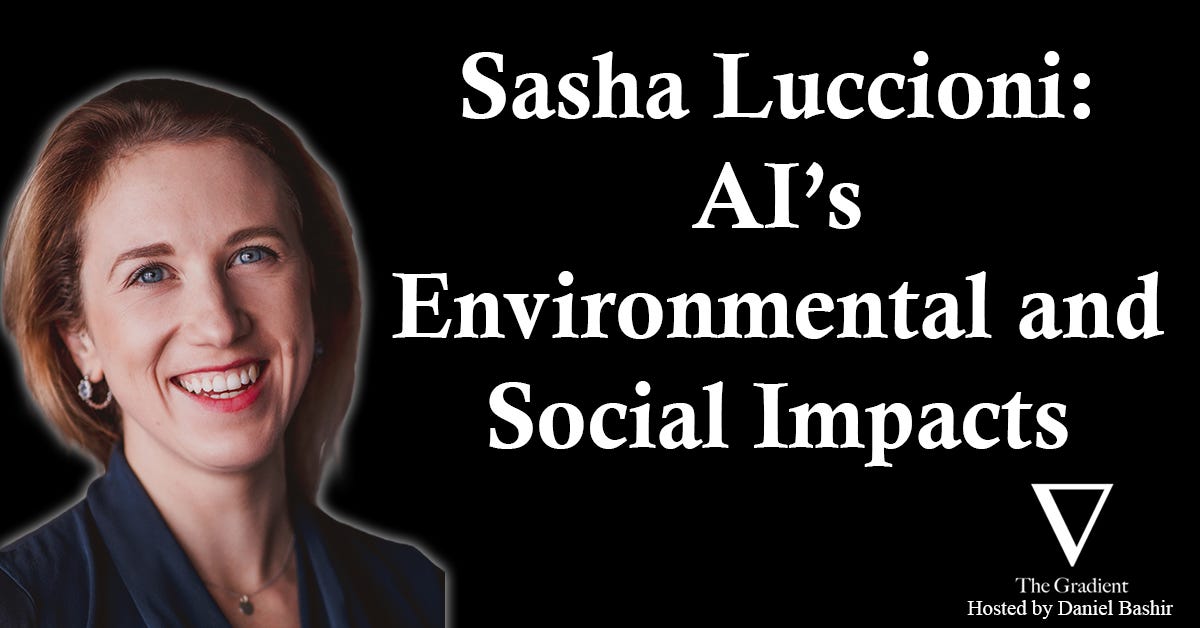
Sasha Luccioni: Connecting the Dots Between AI's Environmental and Social Impacts
Donnerstag, 18. April 2024 · 1 h 03
Kapitelklicken springt direkt hin
Shownotes
In episode 120 of The Gradient Podcast, Daniel Bashir (twitter.com/spaniel_bashir) speaks to Sasha Luccioni.
Sasha is the AI and Climate Lead at HuggingFace, where she spearheads research, consulting, and capacity-building to elevate the sustainability of AI systems. A founding member of Climate Change AI (CCAI) (climatechange.ai) and a board member of Women in Machine Learning (WiML) (sashaluccioni.com/about/wimlworkshop.org), Sasha is passionate about catalyzing impactful change, organizing events and serving as a mentor to under-represented minorities within the AI community.
Have suggestions for future podcast guests (or other feedback)? Let us know here (forms.gle/YNKGko9LCGNp1rhU7) or reach Daniel at editor@thegradient.pub
Subscribe to The Gradient Podcast: Apple Podcasts (podcasts.apple.com/us/podcast/the-gradient-pod…) | Spotify (open.spotify.com/show/6onNcSqsP6hEEqmZ6TU2g8) | Pocket Casts (pca.st/itunes/1569777340) | RSS (api.substack.com/feed/podcast/265424/s/1354/pr…)Follow The Gradient on Twitter (twitter.com/gradientpub)
Outline:
* () Intro
* () Sasha’s background
* () How Sasha became interested in sociotechnical work
* () Larger models and theory of change for AI/climate work
* () Quantifying emissions for ML systems
* () Aggregate inference vs training costs
* () Hardware and data center locations
* () More efficient hardware vs. bigger models — Jevons paradox
* () Uninformative experiments, takeaways for individual scientists, knowledge sharing, failure reports
* () Power Hungry Processing: systematic comparisons of ongoing inference costs
* () General vs. task-specific models
* () Architectures and efficiency
* () Sequence-to-sequence architectures vs. decoder-only
* () Hardware efficiency/utilization
* () Estimating the carbon footprint of Bloom and lifecycle assessment
* () Stable Bias
* () Understanding model biases and representations
* () Future work
* () Metaethical perspectives on benchmarking for AI ethics
* () “Moral benchmarks”
* () Reflecting on “ethicality” of systems
* () Transparency and ethics
* () Advice for picking research directions
* () Outro
Links:
* Sasha’s homepage and Twitter
* Papers read/discussed
* Climate Change / Carbon Emissions of AI Models
* Quantifying the Carbon Emissions of Machine Learning (arxiv.org/abs/1910.09700)
* Power Hungry Processing: Watts Driving the Cost of AI Deployment? (arxiv.org/pdf/2311.16863.pdf)
* Tackling Climate Change with Machine Learning (dl.acm.org/doi/pdf/10.1145/3485128)
* CodeCarbon (codecarbon.io)
* Responsible AI
* Stable Bias: Analyzing Societal Representations in Diffusion Models (arxiv.org/abs/2303.11408)
* Metaethical Perspectives on ‘Benchmarking’ AI Ethics (arxiv.org/pdf/2204.05151.pdf)
* Measuring Data (arxiv.org/pdf/2212.05129.pdf)
* Mind your Language (Model): Fact-Checking LLMs and their Role in NLP Research and Practice (arxiv.org/pdf/2308.07120.pdf)
Get full access to The Gradient at thegradientpub.substack.com/subscribe?utm_medi…
