

The Gradient: Perspectives on AI
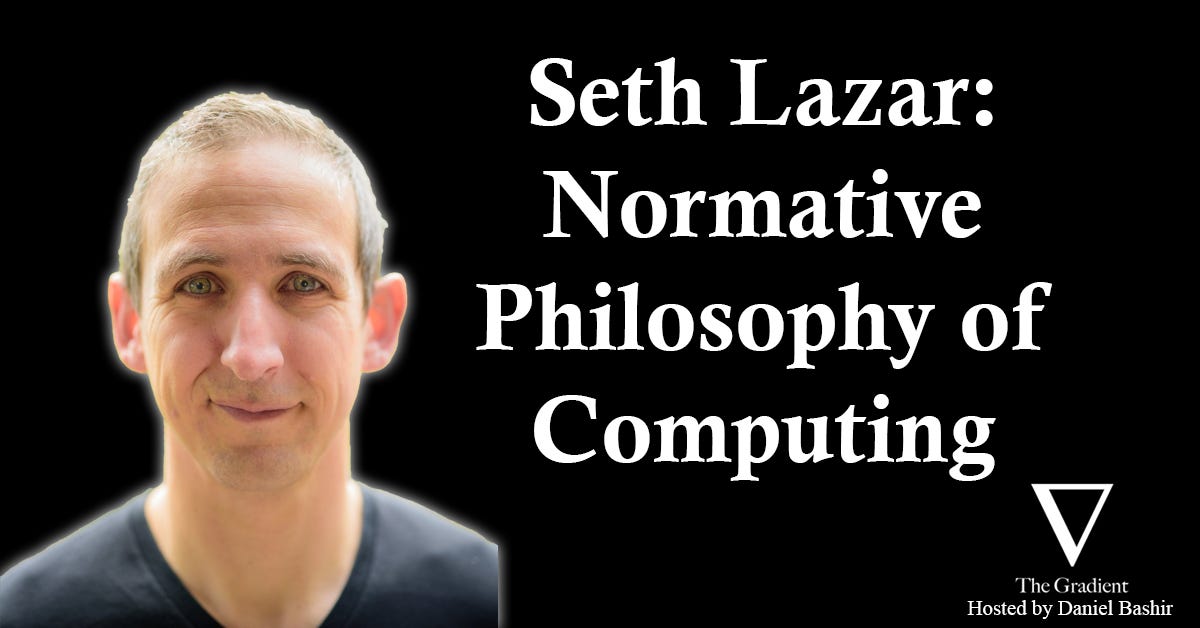
Seth Lazar: Normative Philosophy of Computing
Donnerstag, 23. Mai 2024 · 1 h 50
Kapitelklicken springt direkt hin
Shownotes
Episode 124
You may think you’re doing a priori reasoning, but actually you’re just over-generalizing from your current experience of technology.
I spoke with Professor Seth Lazar (twitter.com/sethlazar) about:
* Why managing near-term and long-term risks isn’t always zero-sum
* How to think through axioms and systems in political philosphy
* Coordination problems, economic incentives, and other difficulties in developing publicly beneficial AI
Seth is Professor of Philosophy at the Australian National University, an Australian Research Council (ARC) Future Fellow, and a Distinguished Research Fellow of the University of Oxford Institute for Ethics in AI. He has worked on the ethics of war, self-defense, and risk, and now leads the Machine Intelligence and Normative Theory (MINT) Lab, where he directs research projects on the moral and political philosophy of AI.
Reach me at editor@thegradient.pub for feedback, ideas, guest suggestions.
Subscribe to The Gradient Podcast: Apple Podcasts (podcasts.apple.com/us/podcast/the-gradient-pod…) | Spotify (open.spotify.com/show/6onNcSqsP6hEEqmZ6TU2g8) | Pocket Casts (pca.st/itunes/1569777340) | RSS (api.substack.com/feed/podcast/265424/s/1354/pr…)Follow The Gradient on Twitter (twitter.com/gradientpub)
Outline:
* () Intro
* () The allocation of attention — attention, moral skill, and algorithmic recommendation
* () Attention allocation as an independent good (or bad)
* () Axioms in political philosophy
* () Explaining judgments, multiplying entities, parsimony, intuitive disgust
* () AI safety / catastrophic risk concerns
* () Superintelligence arguments, reasoning about technology
* () Attacking current and future harms from AI systems — does one draw resources from the other?
* () GPT-2, model weights, related debates
* () Power and economics—coordination problems, company incentives
* () Morality tales, relationship between safety and capabilities
* () Feasibility horizons, prediction uncertainty, and doing moral philosophy
* () What is a feasibility horizon?
* () Safety guarantees, speed of improvements, the “Pause AI” letter
* () Sociotechnical lenses, narrowly technical solutions
* () Experiments for responsibly integrating AI systems into society
* () Helpful/honest/harmless and antagonistic AI systems
* () Managing incentives conducive to developing technology in the public interest
* () Interdisciplinary academic work, disciplinary purity, power in academia
* () How we can help legitimize and support interdisciplinary work
* () Outro
Links:
* Seth’s Linktree (linktr.ee/sethlazar) and Twitter (twitter.com/sethlazar)
* Resources
* Attention, moral skill, and algorithmic recommendation (onlinelibrary.wiley.com/doi/10.1111/nous.12477…)
* Catastrophic AI Risk slides (mintresearch.org/cataipres)
Get full access to The Gradient at thegradientpub.substack.com/subscribe?utm_medi…
