

The Gradient: Perspectives on AI
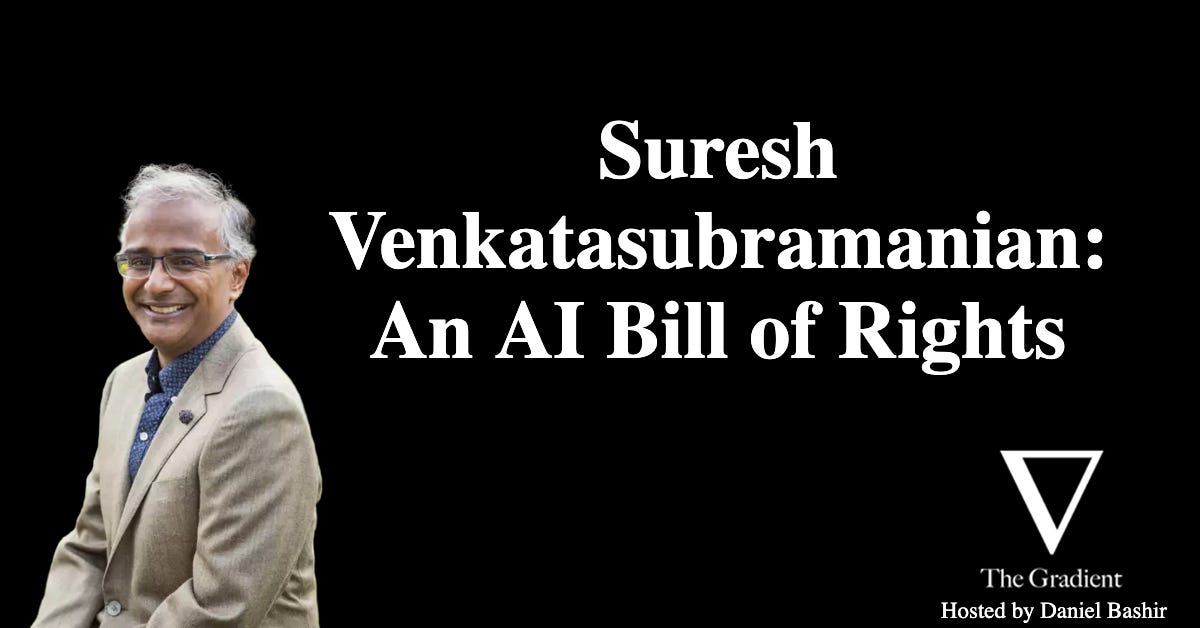
Suresh Venkatasubramanian: An AI Bill of Rights
Donnerstag, 12. Januar 2023 · 1 h 41
Kapitelklicken springt direkt hin
Shownotes
In episode 55 of The Gradient Podcast, Daniel Bashir (twitter.com/spaniel_bashir) speaks to Professor Suresh Venkatasubramanian.
Professor Venkatasubramanian is a Professor of Computer Science and Data Science at Brown University, where his research focuses on algorithmic fairness and the impact of automated decision-making systems in society. He recently served as Assistant Director for Science and Justice in the White House Office of Science and Technology Policy, where he co-authored the Blueprint for an AI Bill of Rights.
Have suggestions for future podcast guests (or other feedback)? Let us know here (forms.gle/YNKGko9LCGNp1rhU7)!
Subscribe to The Gradient Podcast: Apple Podcasts (podcasts.apple.com/us/podcast/the-gradient-pod…) | Spotify (open.spotify.com/show/6onNcSqsP6hEEqmZ6TU2g8) | Pocket Casts (pca.st/itunes/1569777340) | RSS (api.substack.com/feed/podcast/265424/s/1354/pr…)Follow The Gradient on Twitter (twitter.com/gradientpub)
Outline:
* () Intro
* () Suresh’s journey into AI and policymaking
* () The complex graph of designing and deploying “fair” AI systems
* () The Algorithmic Lens
* () “Getting people into a room” isn’t enough
* () Failures of incorporation
* () Trans-disciplinary vs interdisciplinary, the limiting nature of “my lane” / “your lane” thinking, going beyond existing scientific and philosophical ideas
* () The trolley problem is annoying, its usefulness and limitations
* () Breaking the frame of a discussion, self-driving doesn’t fit into the parameters of the trolley problem
* () Acknowledging frames and their limitations
* () Social science’s inclination to critique, flaws and benefits of solutionism
* () Computer security as a model for thinking about algorithmic protections, the risk of failure in policy
* () Suresh’s work on recourse
* () Kantian autonomy and the value of recourse, non-Western takes and issues with individual benefit/harm as the most morally salient question
* () Community as a valuable entity and its implications for algorithmic governance, surveillance systems
* () How Suresh got involved in policymaking / the OSTP
* () Gathering insights for the AI Bill of Rights Blueprint
* () One thing the Bill did miss… Struggles with balancing specificity and vagueness in the Bill
* () Should “automated system” be defined in legislation? Suresh’s approach and issues with the EU AI Act
* () The danger of definitions, overlap with chess world controversies
* () Constructive vagueness in law, partially theorized agreements
* () Digital privacy and privacy fundamentalism, focus on breach of individual autonomy as the only harm vector
* () GDPR traps, the “legacy problem” with large companies and post-hoc regulation
* () Considerations for legislating explainability
* () Criticisms of the Blueprint and Suresh’s responses
* () The global picture, AI legislation outside the US, legislation as experiment
* () Tensions in entering policy as an academic and technologist
* () Technologists need to learn additional skills to impact policy
* () Suresh’s advice for technologists interested in public policy
* () Outro
Links:
* Suresh is on Mastodon @geomblog@mastodon.social (and also Twitter (twitter.com/geomblog))
* Suresh’s blog (algorithmicfairness.wordpress.com)
* Blueprint for an AI Bill of Rights (whitehouse.gov/ostp/ai-bill-of-rights)
* Papers
* Fairness and abstraction in sociotechnical systems (papers.ssrn.com/sol3/papers.cfm?abstract_id=32…)
* A comparative study of fairness-enhancing interventions in machine learning (arxiv.org/abs/1802.04422)
* The Philosophical Basis of Algorithmic Recourse (doi.org/10.1145/3351095.3372876)
* Runaway Feedback Loops in Predictive Policing (arxiv.org/abs/1706.09847)
Get full access to The Gradient at thegradientpub.substack.com/subscribe?utm_medi…
