

The Gradient: Perspectives on AI
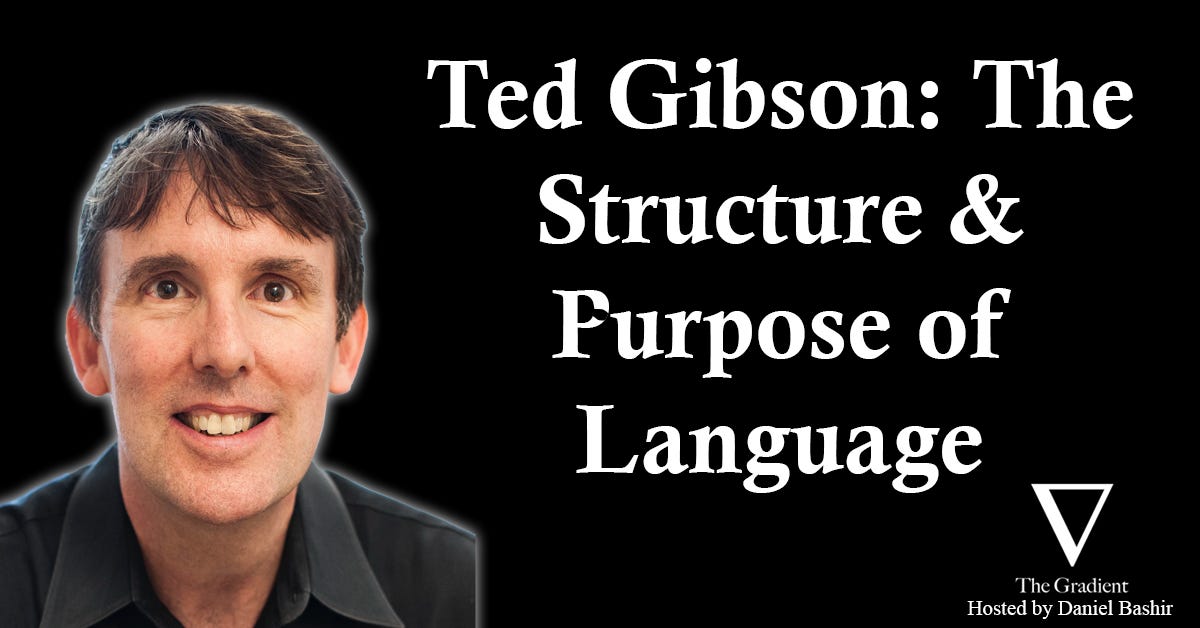
Ted Gibson: The Structure and Purpose of Language
Donnerstag, 18. Januar 2024 · 2 h 13
Kapitelklicken springt direkt hin
Shownotes
In episode 107 of The Gradient Podcast, Daniel Bashir (twitter.com/spaniel_bashir) speaks to Professor Ted Gibson (x.com/LanguageMIT?s=20).
Ted is a Professor of Cognitive Science at MIT. He leads the TedLab, which investigates why languages look the way they do; the relationship between culture and cognition, including language; and how people learn, represent, and process language.
Have suggestions for future podcast guests (or other feedback)? Let us know here (forms.gle/YNKGko9LCGNp1rhU7) or reach us at editor@thegradient.pub
Subscribe to The Gradient Podcast: Apple Podcasts (podcasts.apple.com/us/podcast/the-gradient-pod…) | Spotify (open.spotify.com/show/6onNcSqsP6hEEqmZ6TU2g8) | Pocket Casts (pca.st/itunes/1569777340) | RSS (api.substack.com/feed/podcast/265424/s/1354/pr…)Follow The Gradient on Twitter (twitter.com/gradientpub)
Outline:
* () Intro
* () Prof Gibson’s background
* () The computational linguistics community and NLP, engineering focus
* () Models of brains
* () Prof Gibson’s focus on behavioral work
* () How dependency distances impact language processing
* () Dependency distances and the origin of the problem
* () Dependency locality theory
* () The structures languages tend to use
* () Sentence parsing: structural integrations and memory costs
* () Reading strategies vs. ordinary language processing
* () Legalese
* () Cross-dependencies
* () Number as a cognitive technology
* () Experiments
* () Why counting is useful for Western societies
* () The Whorf hypothesis
* () Language as Communication
* () The noisy channel perspective on language processing
* () Fedorenko lab experiments—language for thought vs. communication and Chomsky’s claims
* () Thinking without language, inner voices, language processing vs. language as an aid for other mental processing
* () Dependency grammars and a critique of Chomsky’s grammar proposals, LLMs
* () LLM behavior and internal representations
* () Outro
Links:
* Ted’s lab page (tedlab.mit.edu) and Twitter (x.com/LanguageMIT?s=20)
* Re-imagining our theories of language (news.mit.edu/2023/re-imagining-our-theories-of…)
* Research — linguistic complexity and dependency locality theory
* Linguistic complexity: locality of syntactic dependencies (tedlab.mit.edu/tedlab_website/researchpapers/G…) (1998)
* The Dependency Locality Theory: A Distance-Based Theory of Linguistic Complexity (www2.bcs.rochester.edu/sites/fjaeger/teaching/…) (2000)
* Consequences of the Serial Nature of Linguistic Input for Sentential Complexity (tedlab.mit.edu/tedlab_website/researchpapers/G…) (2005)
* Large-scale evidence of dependency length minimization in 37 languages (tedlab.mit.edu/tedlab_website/researchpapers/F…) (2015)
* Dependency locality as an explanatory principle for word order (tedlab.mit.edu/tedlab_website/researchpapers/F…) (2020)
* Robust effects of working memory demand during naturalistic language comprehension in language-selective cortex (tedlab.mit.edu/tedlab_website/researchpapers/s…) (2022)
* A resource-rational model of human processing of recursive linguistic structure (tedlab.mit.edu/tedlab_website/researchpapers/h…) (2022)
* Research — language processing / communication and cross-linguistic universals
* Number as a cognitive technology: Evidence from Pirahã language and cognition (tedlab.mit.edu/tedlab_website/researchpapers/F…) (2008)
* The communicative function of ambiguity in language (dspace.mit.edu/bitstream/handle/1721.1/102465/…) (2012)
* The rational integration of noisy evidence and prior semantic expectations in sentence interpretation (tedlab.mit.edu/tedlab_website/researchpapers/G…) (2013)
* Color naming across languages reflects color use (tedlab.mit.edu/tedlab_website/researchpapers/g…) (2017)
* How Efficiency Shapes Human Language (tedlab.mit.edu/tedlab_website/researchpapers/g…) (2019)
Get full access to The Gradient at thegradientpub.substack.com/subscribe?utm_medi…
