

Kapitelklicken springt direkt hin
Shownotes
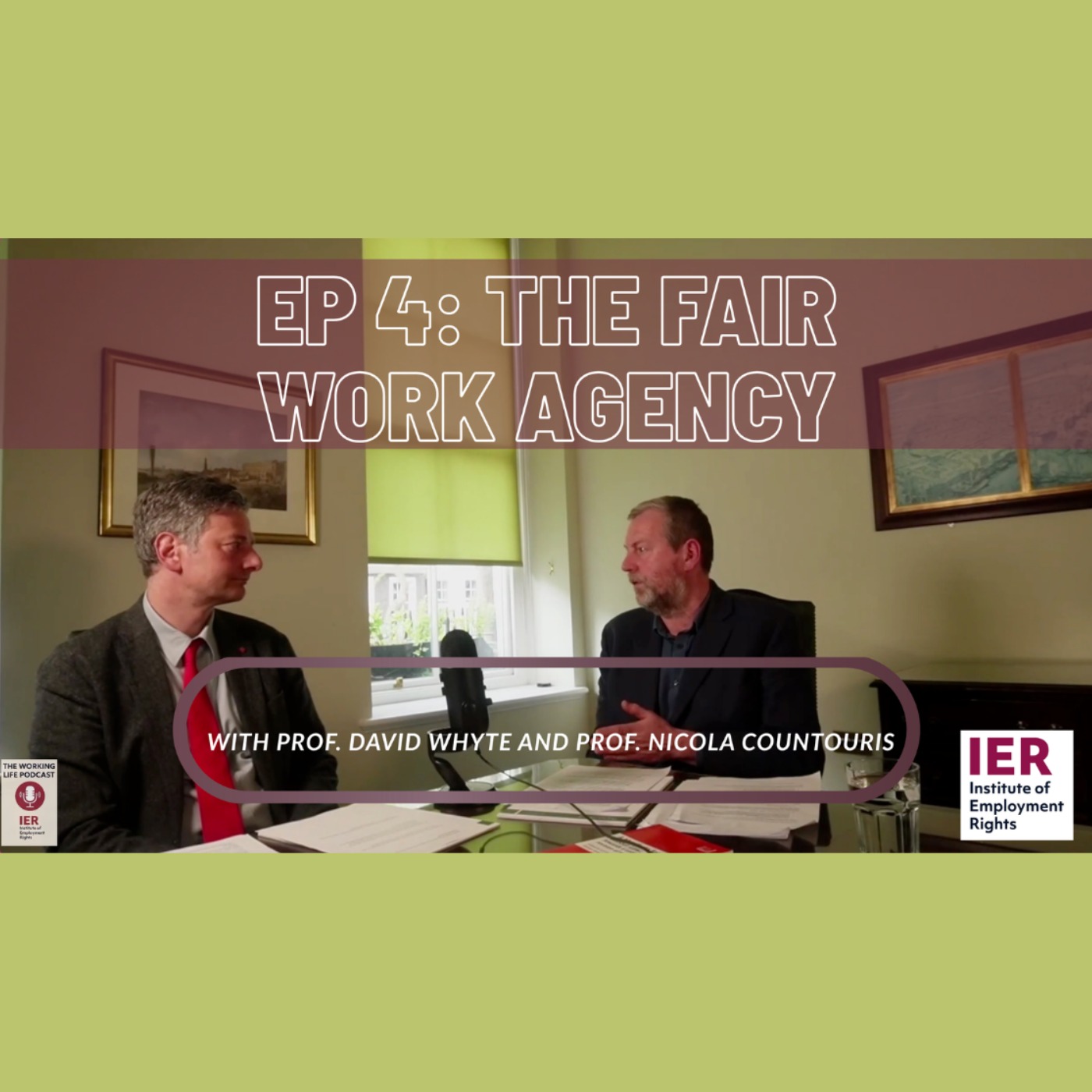
<p>In accordance with the Employment Rights Act 2025 (ERA), a new Fair Work Agency (FWA) was launched on the 7 April 2026.</p><p>The initial 'New Deal for Workers' (2021) said that 'Rights and protections are only worth the paper they are written on if they are enforced'. In this episode of the Working Life Podcast, we take a look at the hurdles this new agency is likely to face in its ambition towards achieving a significant improvement in compliance levels in the field of employment law.</p><p>We are especially pleased to have <strong>Professor David Whyte</strong> (Professor of Climate Justice at the QMUL School of Law and author of 'Ecocide: kill the corporation before it kills us') on. David is one of the foremost academic experts on the relationship between law and corporate power, with a unique level of expertise on issues ranging from working conditions, institutional fraud and corruption, human rights violations, and the institutions around the enforcement of labor rights, in which he is a great expert.</p><p>David has also co-authored (with <strong>Professor Ruth Dukes (</strong>Glasgow<strong>)</strong> the IER Briefing on the Fair Work Agency, which we recommend taking a look at once you've given the episode a listen. You can access it by following this link: ier.org.uk/publications/briefing-the-governmen… this episode,<strong> Professor Nicola Countouris</strong> (UCL and IER) talks to David about the FWA, what its strategic priorities are, the consequences of public sector funding cuts, and what the agency will need in order to be effective and credible.</p>
Transkriptvom Podcast bereitgestellt · Zeitmarken springen hin
[Kountouris]: Hi, and welcome to another episode of the Working Life podcast, the podcast of the Institute of Employment Rights. [Kountouris]: And Nicola Kountouris, and today I have the great pleasure of hosting David Whyte. [Kountouris]: David is a professor at the Department of Law at Queen Mary University, London.
[Kountouris]: He's also a member of the Executive Committee of the Institute of Employment Rights. [Kountouris]: David is one of the foremost academic experts on the relationship between law and corporate power [Kountouris]: and this interest of his has allowed him to cover with a unique level of expertise and insights a range of extremely topical questions and areas of inquiry ranging from working conditions, [Kountouris]: institutional fraud and corruption, human rights violations, and last but not least, the institutions around the enforcement of labor rights, in which he is a great expert.
[Kountouris]: And today we have David here with us to share some thoughts on the Fair Work Agency, having just published this IER briefing without our colleague Professor Ruth Dukes. [Kountouris]: David - [Kountouris]: Could you perhaps start by explaining to our audience to our viewers [Kountouris]: What is the fair work agency and how is it being set up?
[Kountouris]: As some may have not just heard about it just yet. [Whyte]: Yes. [Whyte]: Well, it's a new government agency, as you say, which has been set up to guarantee some aspects of labour rights, workers' rights and rights in the workplace. [Whyte]: And I'll talk about those in a moment. [Whyte]: But the background, I think, is quite important.
[Whyte]: because we find the background to this agency, really, in the Green Paper, Labour's Green Paper New Deal for working people, where they promised this new agency and did it with, I think, a very important kind of signal. [Whyte]: They said that rights and protections are only worth the paper they're written on if they are enforced and we know that the case with any aspect of law.
[Whyte]: and particularly when it comes to the laws that protect workers. [Whyte]: So Labour said they would ensure that we are enough inspectors. [Whyte]: For example, employed in the system, and the unannounced inspections would take place. [Whyte]: Anonymous reports, they specified anonymous reports would be followed up, and that they would be extensive powers.
[Whyte]: And so this is what they've rolled out. [Whyte]: The fair work agency is how they've rolled out. [Whyte]: Those promises, which were made, of course, a number of years ago. [Whyte]: So they bring three existing agencies into one. [Whyte]: First of all, the national minimum wage unit which operates within HMRC within the tax authority.
[Whyte]: and it guarantees and ensures that minimum wage regulations are being complied with. [Whyte]: The gangmasters and labor abuse authority, which was introduced after the Morecambe Bay disaster, to ensure that that particular types of employers could not be as unscrupulous as they were, and particularly, focuses on migrant workers.
[Whyte]: And the employment agency standards inspection, [Whyte]: which guarantees that that employment agencies are complying with law. [Whyte]: So it brings those three dimensions under one umbrella, and it also assumes the role of the existing director of labor market enforcement, who has an overactual responsibility for these agencies.
[Whyte]: So it doesn't bring every agency, [Whyte]: responsible for workplace regulation, but it brings those three major agencies, but we can maybe talk about the gaps in a moment. [Whyte]: That's essentially what it does and it seeks to guarantee those promises made in labels of green paper. [Kountouris]: Before we mention the gaps and your paper is extremely clear about that, you [Kountouris]: Could you tell us how the fair work agency proposes to achieve this merging in this process?
[Whyte]: It's a very, very good question. [Whyte]: It has about 600 inspectors. [Whyte]: That's the first thing to say. [Whyte]: So under it's, and I think we will talk about that a bit more later because we go into the importance of the numbers of front line inspectors in the briefing. [Whyte]: It's under the guidance of the Department of Business and Trade, and I want to flag that up because, of course, this is a department which sees as its priorities foremost responsibility- [Whyte]: -And if you go on the website, the first thing you'll read is that we support businesses.
[Whyte]: That's a direct call, actually, of their remit. [Whyte]: There's no mention of workers. [Whyte]: So I think we have to be a little bit aware of that because, of course, in the manifesto for labour law, which was produced [Whyte]: by the IER, the proposal was for a ministry of labour because labour conditions can be underpinned by a ministry of labour in ways that would not necessarily betray a conflict of interests.
[Whyte]: By other civil servants who are trying to promote the interests of business. [Whyte]: So I think that's an important marker that we have to kind of think about. [Whyte]: sets off some if not alarm bells issues of concern that might frame the work that the agency is doing. [Whyte]: The first chair of the agency is Matthew Taylor, who is former head of number 10 policy under Tony Blair for some people that might also set off some alarm bells, but he's also got a track record in this field.
[Whyte]: He was appointed by [Whyte]: Theresa May and our thing which may set off. [Whyte]: So alarm bells appointed by Theresa May and to head up the Taylor review of modern working practices, which was heavily criticized actually for not offering any way of dealing, seriously with the gig economy. [Whyte]: So, I'm only saying this because I think we have to be realistic about how the agency is being set up politically.
[Whyte]: There's also an advisory board which is very important which has trade union representatives as well as business representatives and it has independent experts. [Whyte]: So, it's kind of set up along the model of a tri-partise structure, but it's not a tri-partise structure because it has no powers.
[Whyte]: It only advises the agency on enforcement strategy. [Whyte]: And the thing I want to say about that, which I think is really important to answer your question, I'm sorry it's been a bit long winded, but to get to the real meat of the question, they have announced five strategic priorities already that will frame their work.
[Whyte]: And I want to just mention those now, 'thought leadership', [Whyte]: makes sense, you know, you know, you work has to be underpinned by some serious thinking before you start doing what you're doing, but it has to also tap into what the prevailing knowledge is in the different fields it has to enter into.
[Whyte]: Public awareness, the public have to be aware of the work of the agency, stakeholder engagement, of course, there is a number of stakeholders, business, [Whyte]: the trade unions, workers who are not represented by trade unions and other parties other regulators. [Whyte]: Communities also have an interest in how workplaces are being regulated, but we don't know how that's going to pan out.
[Whyte]: intelligence and data led enforcement and I think this is absolutely crucial because this is what we've seen in all of the regulatory agencies with I think some mixed consequences. [Whyte]: That's the fourth one and I'll come back to that in a minute. [Whyte]: The fifth reducing regulatory burdens on business.
[Whyte]: Now, now this has become [Whyte]: probably since just before the Blair government, so under major, this was a kind of client call, that tried to change the way in which regulators regulated that they had to think about business in different ways we could do it entirely. [Whyte]: You know, separate podcasts on this along.
[Whyte]: Maybe we will, but this is not a neutral statement. [Whyte]: To say that you're reducing burdens on business. [Whyte]: is saying something very specific. [Whyte]: It means somebody else is going to have to carry those burdens. [Whyte]: And that might be workers, it might be communities. [Whyte]: But something saying reducing the burdens on business as effective regulations, very different from saying we will reduce the burdens on workers of being ill or of not being paid enough or the law not being complied of the burdens on the public.
[Whyte]: And I do want to just say that those last two have a very important connection because if we look at, I think, a good model of this, a health and safety executive, they use data-led targeted enforcement from about 15 years ago. [Whyte]: And one of the things that they did was they, [Whyte]: they focused the regulation on high risk workplaces.
[Whyte]: And that meant that they defined a whole series of workplaces as low risk took them out of the regulatory system effectively. [Whyte]: Now, when Hazard's magazine investigated what that meant, they did a very interesting statistical analysis and found that 53% of deaths at work were in low risk workplaces as defined.
[Whyte]: So there's a real danger. [Whyte]: in targeted data led enforcement because of course it can be used to square circles. [Whyte]: I mean we'll come on to this but we have a very different idea of how those targets might be met. [Whyte]: Absolutely. [Kountouris]: There's a section in your briefing and the heading is yet to be decided.
[Kountouris]: Having read that I really started wondering if [Kountouris]: the fair work agency is ready to hit the rubber so to speak. [Kountouris]: What are your thoughts on this? [Whyte]: I mean, it has new powers, so partly it has a new power for to bring proceedings in employment tribunals on a workers' behalf, which actually strikes me as additionally odd.
[Whyte]: We have no idea how that's going to work. [Whyte]: because normally workers are represented by their trade unions who are unequivocally on their side, but this raises big questions about whether there's something going on which might displace the role of workers representatives as their representatives, right?
[Whyte]: But that's an open question. [Whyte]: There are powers schedule seven of the Employment Rights Act, which provides powers to expand [Whyte]: the list of labour market legislation that might be brought into to this. [Whyte]: So that's an open question, but what's expected in this is holiday pay and sick pay will be brought into the to the remit.
[Whyte]: I think that's fairly clear that's part, that's going to be part of the remit. [Whyte]: But there are powers also to employ more labor inspectors and there's a real crying that we're crying out for more inspectors across the board here, particularly in terms of health and safety, but I think also in this sphere we're talking about [Whyte]: You know, 600 inspectors- [Whyte]: Yeah, exactly.
[Whyte]: Way below the ILO, but we're talking, you know, but the regulation there may be millions of millions of workers and workers. [Whyte]: So we know what the gaps are there, but there are also powers been brought into delegate functions to other public authorities, which is very interesting. [Whyte]: You could bring, you could enhance capacity by bringing other public authorities.
[Whyte]: into this. [Whyte]: And you could even second other public servants, public employees into an inspection role. [Whyte]: Resources can be redeployed. [Whyte]: I'm not saying that's going to happen because I think that the the message of reducing burdens on business, [Whyte]: automatically creates an argument against that, but these powers are there.
[Whyte]: And I think we have to be shouting about those powers and talking about those powers as a means of of putting political pressure on the Secretary of State will have those powers [Whyte]: to expand that. [Whyte]: In terms of expanding the list of labor market legislation, there's big gaps, right?
[Whyte]: And we know that particularly in terms of equalities legislation, where is the enforcement of equalities legislation here? [Whyte]: And we know that we're crying out again for for something to fill that gap. [Whyte]: So I think when I say there are things to play for, I don't think it's all to play for, [Whyte]: but there are opportunities here for a secretary of state who wants to give this agency a bit more teeth to do so.
[Whyte]: There's no doubt about that. [Whyte]: Whether that happens is another set of questions. [Kountouris]: One thing that struck me when I was reading your report was the biggest selling point of the Fair Work Agency is that it brings together three pre-existing enforcement bodies in order to have some joined up thinking economies of scale.
[Kountouris]: But in the concerns that you list in your briefing with Ruth, the very first [Kountouris]: point that you set out is that it's part of this effort. [Kountouris]: One of the biggest concerns is that there's still a fragmented regulatory system and the also is a few more. [Kountouris]: I was wondering whether you could elaborate on those as well.
[Whyte]: Well, let's deal with the system remains fragmented. [Whyte]: There's a number of agencies which have responsibility for regulating various aspects of workplace law. [Whyte]: And I've just talked about equality legislation, Equality Human Rights Commission, for example, [Whyte]: an overarching role in this.
[Whyte]: We have other mechanisms for enforcing wages the agricultural wages inspectorate for example. [Whyte]: But I think the big elephant in the room here that we focus on in the briefing partly because the IER has done so much work on this in the past and partly because it's so important and that's health and safety regulation.
[Whyte]: So and I don't just mean the health and safety executive, yes the health and safety executive but also local authority enforcement [Whyte]: and local authority enforcement of workplace conditions in relation to health and safety covers actually a very large number of workplaces, shops and retail outlets, wholesale, warehouse, call centers, they're all under the responsibility of local authorities.
[Whyte]: And so one of our concerns is that there's all of this work going on, you know, when we're talking about local authorities, we're talking about the more than 300 different authorities responsible. [Whyte]: And if we're talking about the health and safety executive, you know, they have. [Whyte]: Yeah, I mean, it's a huge responsibility that they have.
[Whyte]: So that fragmentation is a first concern, and I want to come back to talk about the health executive. [Whyte]: Our second major concern is that there is no formal role for trade unions. [Whyte]: So, [Whyte]: I mean it might, this might feel like I'm using the language too strongly, but I do think that this advisory board is masquerading as a kind of tri-partite structure, but it has no power, it has no formal influence over the agency that's the first thing to say.
[Whyte]: And we are going to be talking about an agency which doesn't have the capacity to do the job. [Whyte]: It has, we've just mentioned there's only 600 inspectors. [Whyte]: So, what do you do in that context? [Whyte]: Well, we know that in every sphere of workplace regulation, it simply doesn't work unless workers are organised in the workplace and they have strong trade unions.
[Whyte]: If we come back to the example of, [Whyte]: of health and safety, colleagues who also have done work for the Institute of Employment Rights, David Walters and Phil James have done the work which shows that a unionised workplace is 50% safer. [Whyte]: So that means that means less people are being injured, less people are being killed, and that counts for every [Whyte]: sphere of workplace regulation.
[Whyte]: So the needs to be a formal rule for trade unions and we make some recommendations about that, that I'll talk about. [Kountouris]: I'll ask you about that. [Whyte]: Yeah. [Whyte]: Yeah. [Whyte]: Yeah. [Whyte]: The funding landscape is, is huge. [Whyte]: You know, since the austerity period, the health and safety executive has lost at least 50% of it's finding probably much more.
[Whyte]: That's what we know about it. [Whyte]: One in ten local authorities report, and this is what's done by another colleague who's done what for the IER with me, Steve Tombs. [Whyte]: He's [Whyte]: don't even have a single full time equivalent health and safety officer. [Whyte]: to regulate all the entire retail sector, call centers and so on.
[Whyte]: So that funding landscape has been completely decimated by years and years and years of public sector cuts. [Whyte]: So that needs to be rebuilt. [Whyte]: And those funding cuts have affected the agencies that have been rolled into this new agency to the Fair Work Agency. [Whyte]: And that means -to take another point which directly leads from that- the erosion, complete erosion of enforcement and of any credible scrutiny.
[Whyte]: I mean we like to say it's very difficult to tell but but we like you know we like to kind of predict how often you're likely to be inspected as an employer. [Whyte]: As far as we can tell, it's much more than once every 50 years, but actually in some sectors, you're never going to be. [Whyte]: I mean, it's going to be a lot more than that because of what I've just said.
[Whyte]: In the last 15 years, local authority inspections have fallen. [Whyte]: probably we cite the empirical work which was 94%. [Whyte]: That means there's only 6% of local authority inspections that are where 15 years ago. [Whyte]: Prohibition notice is the most important enforcement notice that the health and safety executive in local authorities can impose have fallen [Whyte]: have halved in a decade and prosecutions are fallen by 42% and are still falling.
[Whyte]: The point, without just throwing more and more numbers at you, the point is that there is no credible threat of inspection or enforcement for an employer in a British workplace right now, and that is the real crisis that we have to [Whyte]: we have to face and that drives a very employer friendly enforcement that we've just talked about.
[Whyte]: If we think about how the burdens and business are to be reduced, you have to ask what how can they be reduced any further in that context. [Whyte]: And finally, we're also very aware of one particular aspect that gives us concern of the work of the new agency. [Whyte]: And we've seen there's some [Whyte]: Credible evidence for NGOs and also academics that there's been some mission creep in the context of the GLA agency responsible for gangmasters for regulating gangmasters and the one that shades the most I think into migrant workers.
[Whyte]: And that issue has been mission creep where you have information sharing between different agencies including the UK border agency and effectively [Whyte]: raids very often become reduced to migration, raids rather than raids which are supposed to be protecting workers. [Whyte]: So the needs to be a firewall between those different functions, and we're very concerned that we don't see any evidence of that as the fair work agency is moving forward.
[Kountouris]: David, clearly you've and Ruth have put a lot of thought into this and you have also come up with [Kountouris]: proposals for improvement. [Kountouris]: Some of them are perhaps quick fixes. [Kountouris]: Some of them would require some thinking and some additional work on the part of government and parliament, perhaps.
[Kountouris]: Sure. [Kountouris]: Can you tell us a bit more about it? [Whyte]: Yeah, [Whyte]: I mean, we're thinking really, you know, what does this agency need to be credible? [Whyte]: You know, if the problem is that there is no [Whyte]: from the agency that the law will be enforced. [Whyte]: What makes it credible?
[Whyte]: And the first thing is the restoration of funding. [Whyte]: I mean, it's quite simple, [Whyte]: And that's across the board. [Whyte]: So not just the fair work agency, but all of the other agencies I've mentioned. [Whyte]: They've been completely gutted with 15 years of public sector cuts. [Whyte]: you know we need to we need to see that austerity driven assault reversed as it just as a starting point was storing the fair work agency and other agencies to pre-2010 levels of funding that's just as a starting point which probably wouldn't actually get us up to ILO compliant levels that you mentioned earlier the ILO suggest that the compliant level [Whyte]: for ILO convention number 81, which is the convention on labor inspection, which is one of the four core governance conventions in the ILO, which is British government is signed.
[Whyte]: It recommends that a country like Britain should have at least one to 10,000, as a ratio. [Whyte]: We're nowhere, as we've said, we're nowhere. [Whyte]: near that. [Whyte]: And that's, you know, those two steps to restore funding and to begin to bring us back to ILO compliant levels would then get us to a point where we can talk about a credible inspection and enforcement regime.
[Whyte]: But that would also mean, [Whyte]: planned inspection regimes, where employers can expect a proactive, even if nothing's happened, they can expect a surprise visit. [Whyte]: We're not talking about every week. [Whyte]: We're just talking about, they can expect that to happen to make sure. [Whyte]: And if they're legally compliant, then that's fine [Whyte]: Of course, for employers.
[Whyte]: And with a reasonable interval between visits, that's not too much to expect. [Whyte]: A credible threat of enforcement action and prosecution where there are breaches of the law. [Whyte]: I mean, again, that's something we all expect as citizens in our day-to-day life. [Whyte]: Why shouldn't employers?
[Whyte]: expect that. [Whyte]: But I think importantly the key performance indicators can't mess around with the kind of targeted intervention that we've seen in the past, which allows low risk [Whyte]: employers to go on killing and injuring employees, we have to have key performance indicators which include targets, both for inspections and for enforcement levels.
[Whyte]: That's the only thing that I think is going to be able to focus minds in the agency in that sense. [Whyte]: So I think that would be our starting points, but we also need to see and think about how we would restore a role for trade unions and for workers. [Whyte]: And for trade unions, I think workers and the unions should be involved in the setting of enforcement targets.
[Whyte]: They know what's needed in the workforce. [Whyte]: It shouldn't just be a question of the Department of Business and Trade, which has a particular remit setting. [Whyte]: targets, workers in their trade unions should be given the right to bring cases, not just as kind of individual applications through tribunals, but this is the part that might take a bit of thinking through, but it does happen in other contexts in other ways, but to bring breaches of the law to the court and to have the rule of initiating.
[Whyte]: those proceedings. [Whyte]: And workers in the workplace can be given a central role because after all, they are best placed to safeguard their own conditions. [Whyte]: So where there's no trade union agreement, of course that's very difficult for workers to do that. [Whyte]: So we're saying that where there is no trade union recognition in a workplace trade union should automatically have the right to enter those.
[Whyte]: and have a series of rights which allow them to organize workers to make sure they're properly represented. [Whyte]: We think there's a system which has been tested successfully in Australia, which we would propose for this, which is a system which allows workers to impose notices on their employers.
[Whyte]: Where there is a clear breach of the law, this would be an elected representative who would issue what's known as a provisional improvement notice and that would automatically trigger an investigation by the fair work agency. [Whyte]: Again, that's been tried and tested, it gives workers a central role.
[Kountouris]: It presupposes union presence in the workplace though. [Whyte]: Yes, and that's why those two things that I've mentioned before, go hand in hand, yeah. [Whyte]: And finally, we, there was an earlier IER pamphlet on national minimum wage regulations, which very loosely proposed or workable, proposal for a fair work compliance statement.
[Whyte]: And in that, basically the requirement is that, [Whyte]: employers produce that statement which is then given to workers and the trade unions to verify and we think that these are crucial guarantees. [Whyte]: I would also say that point about anonymity that we start off the discussion with is crucial because there is a practice in most workplace agencies, if not all one, those agencies in this country where [Whyte]: When workers report something, they ask for their anonymity to be waived.
[Whyte]: Now, there's a reason for that. [Whyte]: And the reason is because the regulator of the inspector will then go to the employer to ask about what's been reported. [Whyte]: And typically they will want to know what the veracity of the complainers and the worker's name. [Whyte]: But we don't see [Whyte]: in a reason why that ultimately, that's a profoundly employer-weighted procedure.
[Whyte]: So we think an amount of money should be guaranteed across the board. [Whyte]: What could should be free to anonymously report things without having to voluntarily give up their identity? [Whyte]: And finally, although I think it's crucially important in the current political atmosphere, we cannot allow the fear of what agency [Whyte]: part of a regime which punishes and hunts down and tracks migrant workers who are here doing a very hard job and they need to be properly remunerated and their conditions need to be guaranteed.
[Whyte]: And so that would be our recommendations in an nut shell. [Kountouris]: Thank you very much David. [Kountouris]: It's almost a call for a second bill, which is of course has been something that the institute has been involved with recent months. [Kountouris]: But a lot of these things, I mean, questions about budget, they don't require a second act of parliament.
[Kountouris]: There's just required political commitment behind [Kountouris]: I think that's right. [Whyte]: I think it also reveals the root and branch starting from scratch rebuilding of our regulatory regime that we want. [Whyte]: You know, the role of the new agency when you look at it in any detail, you begin to realize that we need something much more fundamental to protect workers in the workplace and that that empowers workers.
[Kountouris]: How long do you think we should wait? [Kountouris]: How many years reports from the Fair Work Agency should we wait? [Kountouris]: Should we wait for, until we go out and say, look, the system as it has been set up, has failed, and it requires radical improvement. [Kountouris]: Or maybe we shouldn't wait all.
[Whyte]: I mean, it's been rolled out. [Whyte]: It's been rolled out as making a fundamental difference to what places now. [Whyte]: I've forgotten the government, the government quote, or something to that effect. [Whyte]: This will fundamentally change your workplaces. [Whyte]: Now, if that's the claim, that's the claim now, then we have to be under scrutiny from day-one.
[Whyte]: But I think probably [Whyte]: In about a year, at least we'll want to have a very detailed appraisal of what's happened and I'm more than happy to be involved in that. [Kountouris]: That sounds like another episode of our podcast [Kountouris]: Thank you very much. [Kountouris]: Thank you, Nicola.
[Kountouris]: Thank you.
