

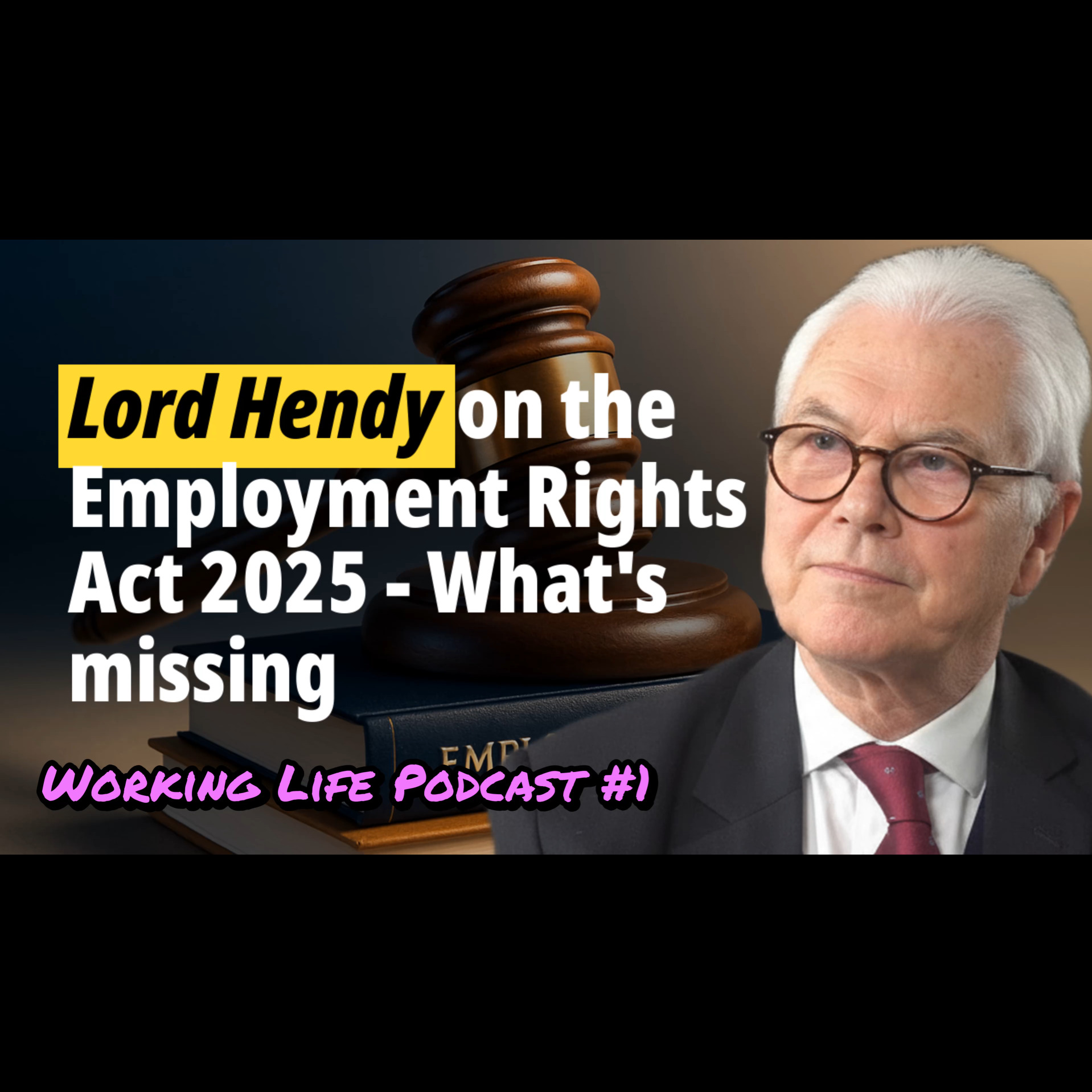
The IER Podcast· Staffel 2· Folge 1
The Working Life Podcast - by the Institute of Employment Rights
· 28 min
Kapitelklicken springt direkt hin
Shownotes
<p>Welcome to the new 2nd season of the Institute of Employment Rights Podcast. In this episode, Prof Nicola Countouris (UCL & IER) and Lord John Hendy KC (UCL & IER), discuss the implications of the Government's new Employment Rights Act (2025).</p><p>Topics covered are:</p><p>- Worker Status</p><p>- Sectoral bargaining</p><p>- Industrial Action Legislation</p><p>- Effective remedies for workers</p><p>- Could P&O happen again after the Act?</p>
Transkriptvom Podcast bereitgestellt · Zeitmarken springen hin
[SPEAKER_01]: Hello, and welcome to this episode of the Working Life podcast, the podcast of the Institute of Employment Rights. [SPEAKER_01]: I'm Nicola Contouris. [SPEAKER_01]: I'm a member of the Institute of Employment Rights. [SPEAKER_01]: I'm also a professor here at the UCL Laws. [SPEAKER_01]: And today I have the great pleasure of hosting Lord Henry K.C., a member of the House of Lords, also an honorary professor here at UCL Laws.
[SPEAKER_01]: Hello, John. [SPEAKER_01]: Good afternoon. [SPEAKER_01]: And we are here to discuss and talk about the employment rights act that was approved in 2025 in December Last year, a significant piece of legislation We probably need to have more than one podcast to go through The detail of what the act has introduced in the UK level of statutes But this is just the first chat to talk about [SPEAKER_01]: whether it's a game changer and perhaps also what's missing from the finer cut of the act.
[SPEAKER_00]: Well, I think before we get to what's missing is worth pointing out that the TUC published only yesterday an assessment of the act in which they point out that the [SPEAKER_00]: their estimate is that 18 million workers will benefit from the new rights or extension of rights provided for in the act of the regulations, which will follow the act.
[SPEAKER_00]: And it's also worth saying a matter of particular interest to labor lawyers like you and me, that the Cambridge Centre for Business Research has published this year [SPEAKER_00]: an assessment of the international standing of UK labor law in comparison to the legislation on work of protection elsewhere in the OECD and in the EU.
[SPEAKER_00]: And their conclusion is that the act has significantly extended protection work of protection [SPEAKER_00]: and the EU averages have to say, however, that we are still 13 percentage points below the OECD average for worker protection and 19 points below the EU average for worker protection.
[SPEAKER_00]: So there's still a long way to go, but nevertheless, all advances are to be welcomed. [SPEAKER_01]: I think there are certainly important advances made in this act. [SPEAKER_01]: There is still a gap by comparison to our neighbours. [SPEAKER_01]: There are some particular areas in which this Parliament could perhaps focus things that didn't make it into the bill into the act and would give some easy opportunities.
[SPEAKER_01]: in our lower-hanging fruits in order to move the bar even higher. [SPEAKER_00]: Well, I don't know whether you described it as low-hanging fruit, but certainly the campaign for trade union freedom and a number of trade unions are calling for a second employment rights act in this parliament to make good the what they see as deficiencies in the act that's just past.
[SPEAKER_00]: So, we could perhaps just highlight some of those things. [SPEAKER_00]: The first and obvious one is what the label of those call worker status. [SPEAKER_00]: That's to say the legal standing of those who work for other people. [SPEAKER_00]: And there's various categories in UK law we've obviously got time to go into them.
[SPEAKER_00]: The most obvious one being employees and then you've got self-employed [SPEAKER_00]: and what the labor lawyers call in B workers and so on. [SPEAKER_00]: The thing is a complete mess because some rights go to employees, some rights are shared with limb B workers, and some rights are denied completely to the self-employed.
[SPEAKER_00]: and it does seem to me anyway, much of like putting the cart before the horse, if you decide to have new or extended rights without being sure which category of worker they're going to go to. [SPEAKER_00]: So the Labor Party in 2021 published a green paper called [SPEAKER_00]: a new deal for working people, very extensive, transformational outline of the Industrial Relations legislation that was required.
[SPEAKER_00]: And this act was meant to put into law those proposals, but in fact it's been watered down over time. [SPEAKER_00]: And one of the proposals that the Green Paper, [SPEAKER_00]: contained was that there should be a single status for workers. [SPEAKER_00]: In other words, all workers would be entitled to all rights from day one, except for those who were self-employed genuinely in business on their own account.
[SPEAKER_00]: When I say [SPEAKER_00]: all rights from day one. [SPEAKER_00]: Of course, we recognise that some rights are cumulative. [SPEAKER_00]: You don't get six weeks holiday after your first day of work. [SPEAKER_00]: Obviously, you've got to work up to that. [SPEAKER_00]: But in principle, you would be entitled to holidays with pay from day one, just the extent of it would be accumulated over time.
[SPEAKER_00]: So the act doesn't deal with worker status and it doesn't solve the problem and one of the complaints now of the unions is that the road map which the government of published and updated on the last date was the 8th of December last year [SPEAKER_00]: doesn't contain even a proposal for consultation about work estate.
[SPEAKER_00]: Right. [SPEAKER_00]: So by the time we've had the beginning of the consultation, got to the end of the consultation, seeing what the recommendations are, and then seeing the shape of the regulations, which are intended to put those recommendations into effect, we're going to be a long we are.
[SPEAKER_00]: a long, long way away from resolving the problem of worker status. [SPEAKER_01]: That's a big question mark. [SPEAKER_01]: And any other obvious submissions, or less obvious submissions? [SPEAKER_00]: Well, the next one is to my mind. [SPEAKER_00]: And there are four altogether, principal ones.
[SPEAKER_00]: The next one to my mind is a collective bargaining. [SPEAKER_00]: Yes. [SPEAKER_00]: There's no mechanism in the act for a, [SPEAKER_00]: get the government to institute a means of conducting collective bargaining between workers and influential unions and employers, and collective bargaining, particularly on a sector-wide basis, that's to say, particularly industry or a trade, was the traditional way in which [SPEAKER_00]: certainly throughout the 20th century.
[SPEAKER_00]: I mean, in the late 70s, we had over 80% of workers who were covered by a collective agreement, usually a sector-wide collective agreement, but often with enterprise bargaining bargains with particular employers on top of that. [SPEAKER_00]: But now, because of the policy of the conservative governments in the early 1980s and various other factors out sourcing export of jobs overseas privatisation and so forth.
[SPEAKER_00]: The rate of coverage or by collective agreements is, in my view, it has done some research on this, around 25 per cent. [SPEAKER_00]: So three quarters of British workers don't have the benefit of a collective agreement. [SPEAKER_00]: Now that's important because the absence of a collective agreement means [SPEAKER_00]: that employers unilaterally decide what the terms and conditions are.
[SPEAKER_00]: So if you go for a job, there's no chance of unigocating what the rate of payers or how many hours you're going to do. [SPEAKER_00]: You're told what the offer is and you either accept it or walk out and fight another job. [SPEAKER_00]: So, it's very important, collective bargaining is really the only way that workers going to exercise their voice, they have to do it, collective lips, the only way they have strength.
[SPEAKER_00]: An extensive collective bargaining has been shown all over the world to diminish inequality, to enhance, to [SPEAKER_00]: to eradicate poverty and so on. [SPEAKER_00]: He's got many economic benefits and in particular the benefit to employers that it prevents undercutting on labor costs.
[SPEAKER_00]: That is a problem with the act, no mechanism for extending collective bargaining. [SPEAKER_00]: It's true that the act does provide for a negotiating body for adult social care workers and I think I'll go shading body for school support staff. [SPEAKER_00]: But anybody who's read those provisions would come away convinced that this is not true collective bargaining.
[SPEAKER_00]: there's an opportunity for negotiating, but the fact of the matter is that the act says that this does not constitute claims of bargaining, and ultimately the government has got the power to override whatever the party's agree and substitute the government's view. [SPEAKER_00]: If the party's don't agree, so it's not really a collective bargaining, [SPEAKER_00]: But as I say, the real problem is that there's no mechanism to extend it even if it was collected bargaining.
[SPEAKER_00]: No mechanism to extend it to other states. [SPEAKER_00]: The fact is that it's not a blueprint for a second bill. [SPEAKER_01]: So, workers' status, collected bargaining, you mentioned that there are four in total, so two more. [SPEAKER_00]: Yeah, well, the third one is concerns industrial action, the green paper.
[SPEAKER_00]: a new deal for working people, so that industrial action law in the United Kingdom should comply with the international standards ratified by the United Kingdom, not international law generally, but only those [SPEAKER_00]: provisions of international law, which the UK had ratified, and they are, well, we don't need to go into the details of them, conventions of the International Labor Organization, provisions of the European Social Charter and so on.
[SPEAKER_00]: And the problem is that the United Kingdom has been in breach of those international standards for a very long time since at least 1989. [SPEAKER_00]: And we know that not because it's the view of experts like you and I, but because the Supervisory bodies [SPEAKER_00]: the peak institutions of those international organizations have declared on every occasion that they've considered UK compliance with their respective international standards.
[SPEAKER_00]: They can't have the conclusion that the UK is in breach. [SPEAKER_00]: So, [SPEAKER_00]: It's very important for the rule of law that the United Kingdom should comply with its international obligations, a very topical subject at the moment, of course. [SPEAKER_00]: But the next question, of course, is to ask, well, in what respects are we in breach?
[SPEAKER_00]: There are a considerable number where the United Kingdom fails to lead its international [SPEAKER_00]: obligations. [SPEAKER_00]: I think the most obvious ones which the act does not deal with are the requirement that there should be a positive right to strike that every individual worker should have.
[SPEAKER_00]: which would bring with it protection against dismissal or detriment for taking industrial action other than loss of pay, of course. [SPEAKER_00]: The act does do something about extending protection of full or dismiss strikers, but it's limited and it doesn't go as far as the international obligations require.
[SPEAKER_00]: And the other standout aspect is that we have no protection in this country against secondary action. [SPEAKER_00]: That's to say that workers taking industrial action in support of other workers, not necessarily against their own employer, but against where other workers are taking industrial action against their employer.
[SPEAKER_00]: That's secondary action. [SPEAKER_00]: We have no protection, international laws, may absolutely plain that it's a requirement for the UK and all other signatory cut countries to provide protection for secondary action. [SPEAKER_01]: And that's also vital to revive sector-level collective burden.
[SPEAKER_00]: having absolutely, there's a force, the formation, yeah the fourth area where the act does do something but doesn't go far enough and that's the issue of remedies, as has been said many many times by judges in course, rights without remedies are things written in water, I mean they're worthless and we've got a major difficulty in this country with with [SPEAKER_00]: remedies for breaches of, of, of rights.
[SPEAKER_00]: First of all, as the general point that [SPEAKER_00]: Litigation is really no substitution for negotiation. [SPEAKER_00]: And what the act does is to build on a feature of UK labor law, which has been present for the last 50 years, which is namely that workers' interests should be protected by their right to complain to an industrial, to an employment tribunal.
[SPEAKER_00]: for a breach of the right. [SPEAKER_00]: That means that the obligation is on the worker to pursue a remedy in effectively a labor court. [SPEAKER_00]: And many of us have taken the view and many of us, I mean, the labor law community takes the view that negotiation is a far better way of resolving these things than litigation.
[SPEAKER_00]: And we've got some major problems in this country. [SPEAKER_00]: One of which is that the tribunals are absolutely overwhelmed with work at the moment. [SPEAKER_00]: Kate Casey's now being listed not for 2026 but 2728 and earlier this week a colleague of mine in my chambers was telling me that she's got a case that's been listed for 2029.
[SPEAKER_00]: which is just as big as 29, which is three years, eight months from today. [SPEAKER_00]: I mean, that's extraordinary and that accounts for the backlog. [SPEAKER_00]: I mean, it was a big case, 15-day hearing, but nevertheless, I mean, it must be an important case. [SPEAKER_00]: But still, I mean, these cases are meant to be heard quickly, speedily and so on, and if you've got a relatively small case, you haven't been paid your holiday pay, or you find out that over the last six months or so, your wages don't measure up to the national minimum wage or something, you don't want to wait a year or two years to get your money back.
[SPEAKER_00]: There is a yet further problem that research has revealed, namely that even those employees who win a financial award in an employment tribunal. [SPEAKER_00]: don't necessarily ever receive the money. [SPEAKER_00]: Something like a third of successful applicants get don't see a single penny of their award.
[SPEAKER_00]: Employer goes bust changes, names, [SPEAKER_00]: can't employ and it can't be traced or whatever the reason. [SPEAKER_00]: And there's also the difficulty that into to enforce an employment tribunal award, you've got to go to another court, you have to go to the county court to do it. [SPEAKER_00]: And most workers just, you know, just get up the ghosts.
[SPEAKER_00]: That's the truth of them. [SPEAKER_00]: Of course, trade unions are there to represent workers, but they haven't got the resources to deal with the tens of thousands of cases, which they are every year. [SPEAKER_00]: And the tens of thousands of extra cases, which could follow the employment of rights after people.
[SPEAKER_01]: It reminds me of Bob Happel's expression [SPEAKER_01]: rights without remedies or just paper tigers. [SPEAKER_01]: This is not deterrence, and not just this Indian. [SPEAKER_01]: Can I ask you, as remedies stand and have been partly reshaped by the employment rights act or a bit of a very minimalistic extent, do you think that the reoccurrence of some of the big scandals that we've had to like the Piano Fire and Rehires scandal in the years ago?
[SPEAKER_01]: is likely, or what is the status? [SPEAKER_00]: Well, there are specific problems in particular areas. [SPEAKER_00]: First of all, let's just say on the plus side that the act is going to establish a fair work agency, which will have the resources to take up cases on a half of individual workers.
[SPEAKER_00]: the problem there is what will be the resources of the fair work agency. [SPEAKER_00]: Could it possibly take on 46,000 cases? [SPEAKER_00]: I very much doubt it. [SPEAKER_00]: And even if it did, where is the person power going to come from to represent these workers in tribunals and so on?
[SPEAKER_00]: So, that is a step forward. [SPEAKER_00]: What we really need is to go back to the wages inspectors or what they have on the continent, labor inspectors to go around like factory inspectors to take up cases at the workplace. [SPEAKER_00]: But you ask about scandals like the PNO ferries at Scandal where 800 odd seafarers were sack by tax messages seven o'clock in the morning and the employer realizing that obviously or calculating that [SPEAKER_00]: These would be unfair dismissals and that the sacked workers would win an employment tribunal and realizing too that it was in breach of the requirement to consult over collective redundancies.
[SPEAKER_00]: The employer results that issue by bringing in cheap labor to replace them or all calculated before hand. [SPEAKER_00]: and paying off all workers the full extent of the maximum awards under the current legislation. [SPEAKER_00]: Now that will be more difficult after the aim because one thing the act has done is to lift the statutory maximum for unfair dismissal.
[SPEAKER_00]: So it will be very difficult for an employer to calculate what the maximum award would be if all 800 of its staff brought unfair dismissal claims. [SPEAKER_00]: But it could make a fair job of it. [SPEAKER_00]: One of the things that the [SPEAKER_00]: The act doesn't do however, is to allow a trade union to go to court and get a court in junction to force the employer either not to sack the workers or to consult collectively over redundancies.
[SPEAKER_00]: I moved an amendment in the House of Lords to provide that there should be such a remedy [SPEAKER_00]: And there's another area too where the access to an injunction would have been beneficial. [SPEAKER_00]: And that is the trade union right to see its members or prospective members on the premises of an employer.
[SPEAKER_00]: That's a great right that's been established under the act. [SPEAKER_00]: to grant access to the Union, and I once again, the government was not amenable. [SPEAKER_00]: The possibility of an injunction being granted to compile the employer to provide the access which had been ordered. [SPEAKER_01]: finance can always be costed into whatever calculus the lawyer has done in order to keep the unions out in order not to grant the rights that there are entitled to it's goal.
[SPEAKER_01]: So, work as data is collective bargaining at a sector or a level industrial action legislation [SPEAKER_01]: and the important issue of remedies can I ask you as a closing question? [SPEAKER_01]: You're a member of the House of Lords, and of course you said you were very active in presenting amendments that sort to improve the final makeup of this important piece of legislation and it hasn't been recognized as you did.
[SPEAKER_01]: But the other, the word other, [SPEAKER_01]: a piece in the House of Lords that actually had a completely different agenda and actually were extremely influential and played an important role in watering down some of the initial commitments of oppressants in the bill as it was first presented.
[SPEAKER_01]: What is your take on this perhaps constitutional question as well as labor law question. [SPEAKER_00]: You're referring to the conservative part in refusing to go along with the act as brought from the commons. [SPEAKER_00]: This is well after all my amendments have been rejected by them.
[SPEAKER_00]: My amendments were intended to restore to the bill as it then was. [SPEAKER_00]: The measure of the important measures that were in a new deal for working people. [SPEAKER_00]: But they were all rejected. [SPEAKER_00]: So we got to a stage where the bill had been passed by the Commons. [SPEAKER_00]: But the House of Lords refused to accept a number of aspects of it.
[SPEAKER_00]: they passed amendments, which were then sent back to the Commons and Collins rejected them, went back to the House of Laws, more amendments passed back to the House of Collins himself, and they process called ping pong. [SPEAKER_00]: They did it three times and ultimately conceded that it was a hopeless task.
[SPEAKER_00]: Constitutually, I mean, it's [SPEAKER_00]: is very unsatisfactory. [SPEAKER_00]: The House of Lords is, and I'm a member of it, totally undemocratic. [SPEAKER_00]: It consists of either of hereditary pairs or pairs that have been politically appointed, which is no way to conduct a democracy.
[SPEAKER_00]: and the idea that such a upper house can refuse the bill passed by the elected membership of the House of Commons is just utterly untenable. [SPEAKER_00]: So it wasn't forced to a constitutional crisis, but certain concessions were made by the government. [SPEAKER_00]: Well, one of the concessions was that on unfair dismissal, which are the commons that originally said, should be in line with a new deal of work and people.
[SPEAKER_00]: The right to unfair dismissal should be available from day one of the polite climate. [SPEAKER_00]: finesse on that, by saying, well, that's okay, they can have the right not to be unfairly dismissed from day one, but we'll institute a mandatory universal nine-month probation period, the details of which we'll publish in regulations, which, therefore, will not be on the face of the act so you can't see what they're going to be.
[SPEAKER_00]: And the House of Lords, ultimately, refused to accept even day one rights, modified by a nine-month probationary period, and said no, there'll have to be. [SPEAKER_00]: a six month qualifying period before you bring a plane from for this vessel. [SPEAKER_00]: As it happens I think that it's probably preferable to the nine months probationary period.
[SPEAKER_00]: But it did appear as if the government were making a concession on that. [SPEAKER_00]: I don't know whether they shared my view that it was worse for work. [SPEAKER_01]: You would have depended on the detail of the regulations on the provision of the students. [SPEAKER_00]: Well, it would, but one thing we can be clear of the idea of a nine-month [SPEAKER_00]: probationary period to apply to every employment.
[SPEAKER_00]: I mean, most most employment go have three months, probation, low, low, nine months. [SPEAKER_01]: That's definitely more than the OECD average. [SPEAKER_01]: Thank you very much. [SPEAKER_01]: Thank you very much. [SPEAKER_01]: That was extremely insightful, tremendous pleasure to have you here.
[SPEAKER_01]: And thank you very much from the Institute of Employment Rights and from the audience. [SPEAKER_01]: Thank you.
