

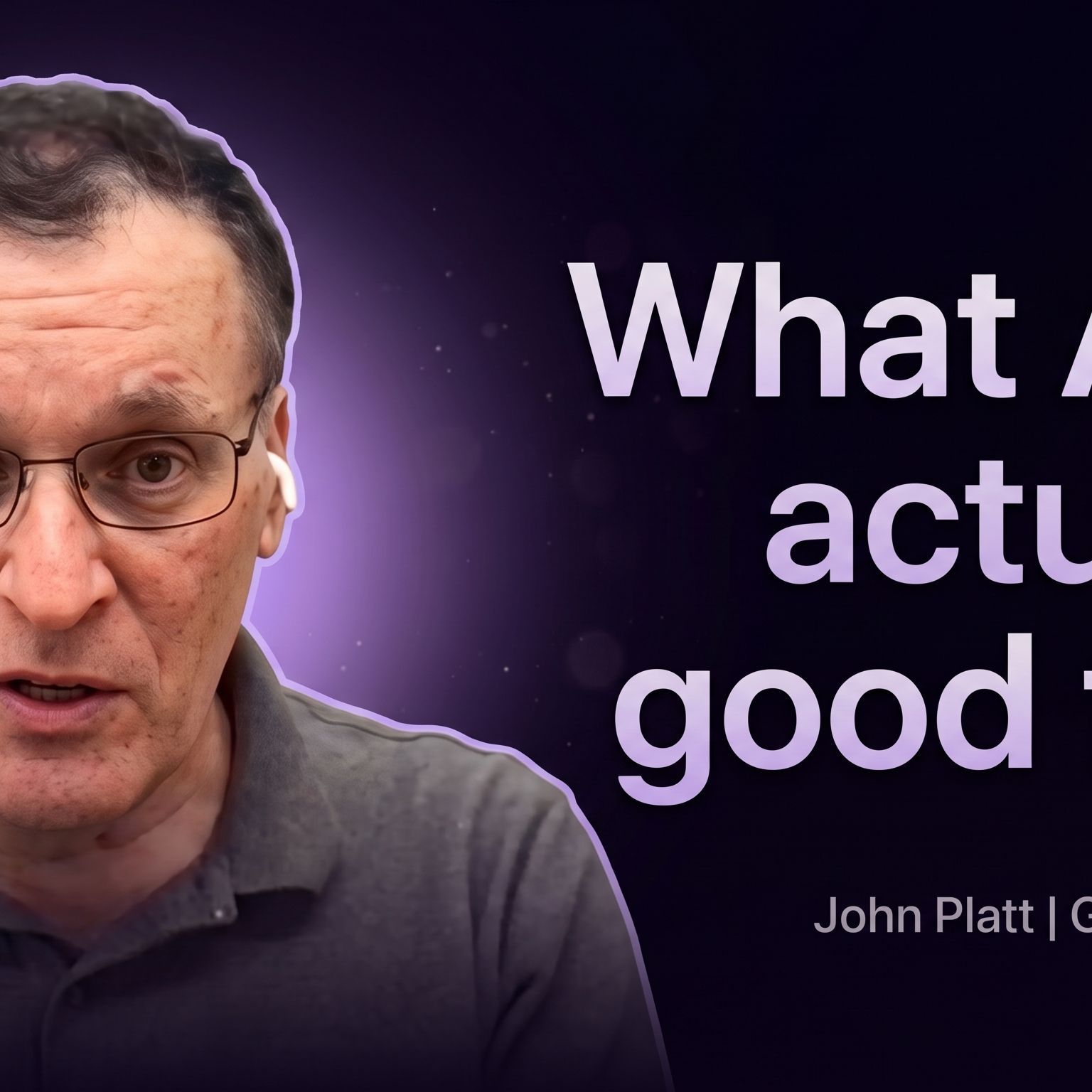
John Platt (Google): AI for Climate and Science
Samstag, 10. Oktober 2026 · 1 h 12
Kapitelklicken springt direkt hin
Shownotes
John Platt is a Google Fellow and leads the Applied Science team at Google Research, the group working on climate and science. He's also the person behind SMO and Platt scaling. In this episode, we talk with him about how Google decides which scientific problems are worth its time, and what happens when AI meets real physical systems. A big part of the conversation is contrails. A small share of flights creates most of the warming from contrails, which together add up to roughly 1% of human-caused warming. John explains how his team detects contrails from weather satellites and predicts where they will form. In trials with American Airlines, rerouting flights cut contrail formation by 62% with almost no extra fuel. We also get into ERA, Google's empirical research assistant, and where AI agents actually help scientists. John sees them taking over the drudgery of building models and munging data, while humans keep the taste and the rigor. He shares why he's skeptical of gradient-free optimization, why the bitter lesson runs into energy and data center limits, and why physical AI that makes manufacturing cheaper could matter a lot for climate. We finish with FireSat, a satellite constellation (about 50 satellites at full scale) designed to catch wildfires while they're still small enough to put out.
Timeline
Intro
How Google picks science problems: comparative advantage
Projects that didn't work: RNA aptamers and tool/problem fit
DNA, RNA and XNA
Contrails and why they warm the planet
Three AI systems for avoiding contrails
Cloud seeding and why cloud physics is hard
Airline trials: 62% fewer contrails
Navier-Stokes, wind tunnels and where simulation still fails
Will agents replace scientists? ERA and scorable tasks
Overfitting, Kaggle and the half-pixel bug
Agents that exploit bugs: Lean and Goodhart's law
Gradient-free optimization
SMO, SVMs and hinge loss in neural networks
The bitter lesson and the limits of scaling
Where agents will help science in the next 12 months
Robotics and making climate tech cheaper to build
AI risk and misuse
Climate outlook: past 2°C
Why AI won't just solve climate change
Room-temperature superconductors, fusion and HVDC
FireSat: detecting wildfires from orbit
Why existing satellites aren't enough
The economics of 50 satellites
False positives
Closing
Topics
• Comparative advantage as the test for which science problems Google takes on
• Contrails: the physics, the AI pipeline, and the American Airlines trials
• ERA and AI agents for scientific software
• What scientists still do that agents can’t: taste, creativity, rigor
• Overfitting, Goodhart’s law, and agents exploiting bugs
• Gradient-free methods, SMO, and hinge loss
• The bitter lesson and the physical limits of scaling
• Climate outlook, fusion, and physical AI
• Room-temperature superconductors and long-distance power transmission
• FireSat and early wildfire detection
Music
- "Kid Kodi" - Blue Dot Sessions - via Free Music Archive - CC BY-NC 4.0
Transkriptvom Podcast bereitgestellt · Zeitmarken springen hin
Ravid Shwartz-Ziv: Hi everyone and welcome back to the information button neck podcast and Today we have the great honor to host a John flat He's a the director of applied research team at Google. Hey John. Thanks for joining us
John Platt: happy to be here. Yeah, I'm Google fellow and I run the applied science team. so it's sort of the climate and science parts of Google research.
Ravid Shwartz-Ziv: And hey Alan, as always, thank you for joining us.
Allen Roush: It's a pleasure to be here and to meet somebody as esteemed as John Platt here in the flesh. We've had really just a stream of of truly famous and excellent guests, you know, one after another, and it's it's great to to have yet another one here.
John Platt: well gosh, and now I'm all embarrassed.
Ravid Shwartz-Ziv: No, you are definitely like in the top of our guests.
John Platt: Okay.
Ravid Shwartz-Ziv: And so, yeah, so like, want to start like from, from the beginning, like your group is kind of defined by unusual mandate, like computer science meeting the physical and biological sciences. And, and, and like, now it's kind of like, it's like, first there are like very exciting times to, to, be in the, in this field. So I want to start and ask you like, what makes a scientific problem? a good fit for applied science? And what are the problems that you actually don't want to work on?
John Platt: gosh, that's a good that's a good problem. or good question.
Ravid Shwartz-Ziv: You
John Platt: well, you know, there are many, many, many scientists in the world. And so when we work on a scientific problem at Google, there's we don't I don't call it uniqueness, but I call it comparative advantage. In other words, what would mean w what
Ravid Shwartz-Ziv: Thank
John Platt: kind of problems I I I ask my team where would be that if we spent a dollar on it in Google, we'd get much more results. than if we spend if you gave a dollar to a a professor and that they went and and and solved the problem. And so there's a couple of different characteristics of of the place where we have comparative advantage. it could be a a very data heavy problem because people at Google are very, very good at at large data processing. I mean dating back to you know MapReduce and all of the large scale computing that we have. And now we have lots of TPUs and AI. So if there's problems that are very that we think scientific problems that where where AI can do very, very well, then we try to attack those. we do have we've been doing sort of scientific stuff for at least 10 years. For example, there's a team in the the applied science umbrella. has been doing connectomics and has been working with the with a lot of the neuroscientists. And so we have some amount of expertise in some fields, things like neuroscience and fusion physics, plasma physics. so you know the problems where we already have sort of in-house expertise we t we might have a comparative advantage. And then often we have a comparative and advantage because we have you know, relationship with you know, Google directly or perhaps with some Google customers. So there may be problems like, for example, energy production that are very, very important for Google because of AI data centers. And so yeah, so we look for we look for problems that are where we think we have a comparative advantage. Comparative advantage is a term that came from international trade, trade economics. so we tend to avoid problems where we don't feel like We have comparative advantage like, yes, well, you know, that'll happen anyway, or, you know, we could just give some money to an academic and and they could do it j you know, better than we can. So we we tend to avoid those kind of problems.
Ravid Shwartz-Ziv: So, but like, at the end, can you say what actually characterized the problems that actually got failed? you thought, this is a great problem, but at the end, it just failed?
John Platt: I mean the the places where we sort of tried things and they didn't work very well, it's almost like there was a I I'm gonna sound like an entrepreneur, there was almost like a lack of product market fit, but instead of maybe market, it's like tool slash problem fit. And so yeah, we say, we you know, for a while we were very excited, this was a bunch of years ago, we were very excited about sort of RNA and apters, which I still think is a very interesting field. Actually, my son works on RNA structure prediction. But you know we we sort of have have played on and off with aptomers and and RNA and there just wasn't at least when we tried it in our group there wasn't a very strong fit. Obviously with AlphaFold III, which is a general macromolecule predictor that that seems to be doing very well. but so yeah that was I I would just sometimes you just bounce off of a problem because just the the ideas you try or the tools that you have just d don't quite fit the problem that you you're trying to attack. And then you go try do something else.
Allen Roush: So when when you talk about RNA and then, you know, DNA, I'm I believe there's other types of nucleonic acids, right, as well. I'm just curious how they would relate here.
John Platt: Well the well there's or nucleic acids. There's I mean DNA
Allen Roush: Yes.
John Platt: and RNA are the predominant natural forms, but there are things called XNA, which are sort
Allen Roush: Yes.
John Platt: of completely artificial ones, which are very interesting. they're much harder. A lot of the the equipment that scientists make, of course, works best with DNA and RNA. you know things like these PCR machines. So you could get XNA. XNA you see RNA I mean maybe this is a side note. R RNA is almost like the computer virus. In fact there are literally retroviruses that that are programmed their program is RNA. And so the world is full of enzyme called RNA ACE, essentially trying to break down RNA because it's like it's n nature's antivirus protein, literally, but if you can think of it like anti-computer virus, and so RNA is great, it's common, and there's a lot of systems that use it and play with it, but nature is sort of already has defenses against RNA. You could try to use much more difficult to use XNAs, which nature doesn't know about, so it doesn't like break down and contact with your skin, for example, which RNA does. But then a lot of the technology and apparatuses in in your lab just don't work on X and A because they're just not they're they're not designed for it. So there's sort of sort of this trade-off. But yeah. Right now we do have a number of people in Google research interested in genomics in general, but at least my group doesn't sort of look at a lot of the therapeutics and and the whole sort of deep science of RNA itself.
Ravid Shwartz-Ziv: I want to start to talk about specific projects. And one of them is the contrarails.
John Platt: Mm-hmm.
Ravid Shwartz-Ziv: And so contrarails are the line clouds right behind the aircraft. And most of them vanish in minutes, And like small fraction from in air that is already like a ice super saturated, right? And those spread
John Platt: That's right.
Ravid Shwartz-Ziv: into thin, that trap the outgoing heat.
John Platt: Mm-hmm.
Ravid Shwartz-Ziv: And the effect is very concentrated. I think was like 2 % of the flight causing about 80 % of the warming. Something like that. And the bet is that predicting which flight will make a persistent contrail lets you shift these flights. right and like to to have a much like to to buy a larger climate benefit for a very small cost so tell us about it like what was actually like the i don't know like what was the data like how you actually look on it and and why
John Platt: how do are you asking why we came across why we decided to work on contrails to begin with?
Ravid Shwartz-Ziv: Yeah.
John Platt: okay. so we were just okay. So let me okay, I'll answer that question and maybe go back to the physics of contrail, which is also kind of interesting. so we were just wrapping up the work with TAE. which was external partner for fusion where we were building AI tools. And this was in just yes, this was in very early 2020, because it was right before the pandemic broke out, or it was breaking out in China, but not in the US yet. And so several of us actually were free for three months. And so we had a big kind of joint brainstorming where we were tossing a bunch of ideas around and the and we had enough free time. It wasn't that we were distracted. It was very nice actually. So many of us were like diving into this and that idea so two people Carl Elkin Carl Elkland and Dave Fork c came to us with an idea like hey Contrails seem to be a a a source of global warming. maybe we should try to fight that. And at first, this just shows you you have to be very careful. at first, that doesn't make any sense. Why would that be a a form of global warming? but then I rapidly learned as I studied it, that it it's as you mentioned, it's the ice supersaturation that that if you as a as a jet flies through these these regions that are almost like pancakes. They're and they're a little bit like raw candy, if you know raw candy, where you can get a glass of cold water and it has too much sugar, but it goes beyond the crystallization point. So if you give it just a little bit of crystallization, it will just turn and crystallize into candy. Same roughly the same thing happens, not quite as dense in the atmosphere, where you if you add a little bit of soot or a little bit of water, which turns into ice, it's it's hot when it comes out of the the jet. If you add if one gram of soot or ice comes out of the jet engine, ten kilograms of i of water vapor comes out eventually and makes control. So so it's an enormous gear, right? That's why these planes that aren't actually emitting that much, there's this there's this bad gear where where 10,000 times as much ice comes out. And so you can actually, over for example, over Europe The thought is that or the models say that a few percent of the area of the of Europe are actually covered with human generated contral cirrus clouds. And so it is a big problem because the cirrus clouds they are in in visible light, they're white, so they reflect a little bit of sunlight. But in infrared i in the in right, the earth is a black body emitter and so it emits infrared out to space all the time. So you add some more cirrus clouds and in at that temp at that wavelength at the temperature of the earth they look black. So they actually absorb a little bit of the infrared and then re-emit it up and down. So they they block, they act like a little blanket. And that happens twenty four hours a day, whereas the reflect the sunlight only happens sort of during the middle of the day. most it it gets less as as the sun sets. So it is on the net a warming. And I sort of learned that I said, now that makes sense. And in fact, the the the estimates from the models are that they it's about roughly one percent one percent of global anthropogenic warming. And this is the equivalent of over the next a hundred years of of of all the warming that we're projected to inject per year comes from just the contrails. And in fact when contrals are formed Yeah.
Ravid Shwartz-Ziv: So 1 % like all the airplanes in the world.
John Platt: All the airplanes in the world are rough generate roughly one percent from the contrails of from all the airplanes in the world generate roughly one percent of all
Ravid Shwartz-Ziv: Yeah.
John Platt: the anthropogenic forcing. So from all the
Ravid Shwartz-Ziv: Mm-hmm.
John Platt: CO two, from from everything. So it's actually a substantial pr climate problem. But we can actually fix it with AI, because there's sort of three related things that we built. One is if you look at satellite images, you can actually build an automatic detector. So even from the geos from the geostationary orbits like the weather satellites, you could they have infrared bands where you can see the contrail being formed and then spreading out to be Cirrus. So we built a detector, which was like a classic computer vision detector. Then we built a thing given that, that's kind of the training data. It's also the verification system, but it's also the training data for a thing where, now what weather situation generates the Contral Series? I mean, we know what the physics is, if we it's the ice supersaturation, but the weather models aren't exact, so they're biased. And so we sort of correct the bias by using again almost like a calibration system on top. And then we built another system which both so it estimates the i i it's essentially it estimates where the highest amount of warming would be and it sort of flags those and then it figure then we feed all that data as a map like here's where all the highest warming contrails are and we give that map data or it's actually like voxels to flight planning software. There's actually a handful of companies around the world that actually make the software. It's not the airlines that typically decide how to send planes around. It's actually they f farm that software problem out to third parties, which is there's not that many of them. So we give them the maps and they are starting to incorporate that into their planning. So yeah, we generate these sort of maps of of where there's going to be a lot of contrails, and then we verify it with so we can tell people whether they've avoided contrails or not from these things that detect contrails from the satellites. And each of those is is sort of like a heavy heavily AI based system.
Allen Roush: So I hear all this discussion of contrails here. What about what was it the the King of Thailand or something does this? Like cloud seeding, where he literally gets up in in an airplane and starts I I forget what they're releasing. It's like strategically releasing contrails in order to cause it to rain over them. And my understanding is that there's a little bit of science behind cloud seeding. And so I'm wondering if th if a AI could really help here in your opinion.
John Platt: for cloud seeding. So cloud seeding is somewhat different. So contrails occur at the boundary between the troposphere where all the weather is and the stratosphere, which is very stable. That boundary is called the tropopause. It it's roughly at the tropopause. But that's not really it's at the very top of where weather occurs. And so it's purely a radiative property. Cloud seeding actually occurs lower. You can do it from like a Cessna or whatever. And what it it it's a similar physics. It's trying to make little seeds in moist air so that it makes rain. so that's it's supposed to be an anti-drought thing. So like if you if you're desperate for rain. for many decades, scientists couldn't tell whether cloud seeding actually worked. there is some recent evidence that it actually is a positive effect. it turns out clouds are insanely complicated. This is part of the reason why climate models are Are so difficult to calibrate and and refine is that the physics of clouds is actually very complicated. And I know this trying to work on this contrail stuff, there's a lot of uncertainty. So that's part of the reason why they weren't sure whether cloud seeding worked. I haven't looked to see whether improved models would actually improve cloud seeding or not. I haven't actually examed there there may be papers on it. I don't actually happen to know the answer to that. But certainly the physics of clouds. is certainly an open issue. And a lot of the uncertainty of how strongly a contrail warms is based is based on the fact that we don't know exactly the shape of the the ice crystal. You know, they they form little ice crystals that are microns across and we don't know exactly their shape. We don't know exactly how fast they fall. We don't know exactly how quickly the contrails mix. If you've ever sorry, I've spent many hours just looking at the sky at contrails now that I've worked on it. And they come in many different sort of shapes and forms. And they actually have the people have seen in radar that they actually kind of because the ice crystals fall at different rates, there's actually a three D structure of of the contrail. So it's not just a an oval. there's I they actually kind of stretch and and and have this interesting structure. so and and that uncertainty in in cloud physics actually affects the uncertainty in the climate models, which is kind of interesting to But no, I I I i it might be that AI can help cloud seeding, I just don't happen to know exactly. Sorry.
Ravid Shwartz-Ziv: you you had like okay so now you you have this this pipeline and like what were the results
John Platt: so we've done a number of different tri
Ravid Shwartz-Ziv: how you test it, like what were the stages and etc.
John Platt: okay. We we we've done a number of different trials with actual real real airlines. And so some of that has been by working with the flight planning software and some of it has been sort of one-off hacks to try to get the contrail information to the pilots directly. but we've had a very successful trial with American Airlines. We've done a couple of them with American Airlines, and the latest one showed that you can reduce contrail formation by sixty two percent. with is well, again, it's difficult to do the counterfactual, but with essentially zero or very minimal extra fuel cost. So it it you can substanti we we know that with our detection system and our prediction system that we can substantially reduce the amount of contrails with very, very little impact on the bottom line of the airlines. So I think a number of airlines have gotten very excited by this because it's a it doesn't happen very often that there's a way to sort of fight climate change with very little extra cost, but but we seem to have stumbled onto this.
Allen Roush: Do you think
Ravid Shwartz-Ziv: So.
Allen Roush: that n navier Stokes, for example, with with the supposed impact that it's having on like like you know, that's the problem or the mathematical equation behind turbulence, for example. And well
John Platt: Mm-hmm.
Allen Roush: my understanding is that they didn't solve resolving turbulence or anything and we still need wind tunnels and all of these things. Like do you think that mathematical optimization as a result of these newest class of of LLM systems will lead to like miracles to start occurring in places like aircraft design, for example.
John Platt: well let's let's be careful. so the mil I I think you're referring to the latest like the Millennium Prize of trying to find whether okay. So
Allen Roush: Yes.
John Platt: that so I've actually done on and off in my life food mechanics for I guess a number of decades now. and so let's be very, very careful, right? the Millennium Prize has to do with a specific property of the Navier Stokes equation about whether it's possible somehow to find things where if for example that it goes unstable in a finite amount of time without forcing, in other words, without having you know, big fans or something. and that is a that is purely a property of the equations. It's not that doesn't mean that the equations aren't already accurate. In fact, so the Googleplex, the headquarters of of Google are in Mountain View, California, and they're right next to NASA Ames, which is a wonderful branch of NASA that's been around for decades. And they've had they have had these giant wind tunnels. some of them, I mean, if you ever drive down US 101, you'll see there was like a blimp hanger and there's these giant air air tunnels. And a lot of them, a lot of the subsonic ones have been decommissioned precisely because the simulators for Navy Stokes are so good. In other words, so this is one example. This is it doesn't happen often, but the specific a example that you bring up actually is something where where simulation actually is good enough for things like subsonic airplanes. Where it's still a mystery is in, for example, hypersonic, which is of course much harder to do. They do have hypersonic wind tunnels at NASA Ames and other research labs. there the physics is sort of maybe less well determined because again you're pushing it into such a strange little regime. So they still have to do, you know, hypersonic wind tunnel experiments. But but there are many, many places, and we've worked on them, there are many, many places where simulations are not accurate. Like I mentioned cloud physics, fusion, plasma is very difficult to simulate correctly, mostly because there's just to do it correctly, you need so many particles. You can actually trace each ion and electron But the computational cost would be cra is crazy. so so there's a lot of very, very complicated systems. Or for example, quantum mechanics, that's why people like quantum computing, is because you have an exponential state space. So once you have if you have n electrons, you need sort of you know two to the n. One way of doing it is have RAM that takes two to the n. You need an object that's sort of two to the n. so the RAM quickly goes crazy that you you can't build enough RAM to see even represent an atom a a very large atom or a molecule correctly exactly. So there are things like that. But but but fluid mechanics is not one of them. At least subsonic fluid mechanics does work very well. And and so I'm not ex so to answer your exact question, no, I'm not expecting a miracle. On the other hand, it is I'm very excited and we had this project or have this project called ERA empirical research assistance. where you can have agents help you build models of these very, very complicated systems and can you actually constrain them with real data and build sort of simple models, maybe their approximations, and and doing it with the assistance of an AI agent is much faster and perhaps less biased than asking one or a small team of graduate students to go off for a year or two to write the software. so we're actually finding for various kind of prediction problems that it's actually the most effective way of solving it. Like one problem we published on is again, this is a very difficult problem because it actually involves human behavior. How many cases of flu and COVID nineteen will there be in every US state next week? that's actually not I mean, epidemiology people have to remember, is actually a so a social problem. It's actually trying to guess how people are going to behave, because it's like the the bacteria or the viruses are very predictable, but humans are very unpredictable. So but we actually have the best sort of week ahead COVID and flu case predictor based on this sort of agentic thing. so so for in the cases not for for subsonic flu mechanics, but in the cases where it gets very complicated, agentic AI does seem to help, which is pretty cool.
Ravid Shwartz-Ziv: So let's talk about it a bit, right? Like there are a lot of discussions about self-improvement and about agentic frameworks in science. And what is your point? Like, do you think like where are the places that actually agents and again, self-improvement agents and NLMs are useful and where are the cases that they're actually not so useful?
John Platt: Well, I I don't think they're going to replace scientists. I I I at least see that and I'll explain why in a minute. I see them as sort of like superpower tools so that they can make scientists, you know, ten times more productive. if you look at how especially computational science, which is where they really can dominate right, if you have lab science, then you're still limited by how quickly your lab works. And that's interesting and might be able to be more automated than it is now. And then we can talk about that in a minute. But if look at computational science, a lot of it is and I've seen it a lot and I've done it a lot. a lot of it there's a lot of drudgery where, I have to build a model or I have to build some software, or even I have to build some software to munge my data if I got some data either from a computational experiment or from a lab experiment. I've got to munge the data, especially now, like with astronomy data, you know, you you get telescopes that are generating like terabytes of data a night. and so so it's just a lot of very tedious, careful work that that can take you know the software development can take months or years. And a lot of it is is you have to be it's not just, I have spec and I can just write a code to a spec. So you can't really do it like standard software, not that that's necessarily the best way to even do standard software. Because a lot of it's very technical and involves things like modeling choices. And so I think agents will be very, very good at just rapidly speeding that up. Like just as a purely fun example, Michael Brenner, who's the lead of the science AI team at Google, he and I and another Googler, he he just decided actually he He's great. He he decided he often just decides to write a paper in the evening. So I was just saying, there's this fun paper where someone from MIT built a little optimizer to given given a roof area, like you have a finite roof area, what kind of three D structure with the mirrors and photovoltaic panels can you build to maximize the total number of jewels? across the day as the sun goes out. so but given that you're sort of constrained to be some rectangle. So Michael just in an evening hacked together a little era run to sort of b replicate the and try to improve on this thing. And so it did. It was kind of fun. And in fact it even rebuilt the little the agent re even rebuilt the simulator that that the professor kind of did because it's not It's not that complicated. It's not like quantum physics. So and that he he kind of got that together in an evening, whereas I'm sure it took, you know, months of hacking around and trying to figure it out by the professor or his grad students. So that's just an example where a lot of the the tedium you can just sort of have a question in mind. You have to be think very carefully and be very rigorous. about how to transform the scientific question into an into a problem that an agent can do. So the way the way that ERA works is that there's a it's called a scorable task. So there's like a a quality function or scoring function. And it continually iterates. It isn't best of end, it kind of has a a tree of possibilities that it sort of builds. And it tries to write code and rewrite code to try to optimize that scoring function. We have another agent that tries to help the scientist take their sort of written description of the problem they're trying to solve and turn it into a scorable task. So that's itself is a is an agency problem. And then together with the scientist in the loop, you can kind of try to build these models or these little to solve these scientific problems very, very quickly. So that's I think will a lot of that tedium will go away. Where I think the scientist is still needed is sort of in taste that like what problems do you want to work on. I think in general, agents need high expertise humans to solve kind of two problems. One is sort of the creativity. I don't know if we have enough data. Right. I mean, there's a lot of data of a lot of different things, but you you want it to take very creative leaps and and it's hard to get a lot of high quality training data of high quality, like very sort of creative leaps, right? There's like this long tail of like crazy creativity from humans. And it's just very, very hard to make a training set to have the the agent or the underlying model sort of emulate creativity. I mean, obviously you could do things like image creation because it's seen a lot of images and and it's kind of fun. but I I think for scientific creativity it's just hard to generate that data. so so creativity and domains is still, I think, going to be in the realm of the scientists. Another place is sort of rigor and clarity. I think you you need a a human to really, especially an expert, to really check to make sure that the thing is scientifically correct and also explainable, right? I don't know how well at least some of the outputs I've seen, yes, you can ask a a the you know ask an agent or ask a underlying LLM to write a scientific paper and it does, but it's kind of bland and sometimes it's not very clear. and so sort of pulling so making sure that it's clear and communicates well to other to other scientists, I think you still need someone to sort of make sure that it's correct and make sure that it's not making something up and that it's sort of that the idea is sort of clearly expressed and that the learning that you've learned from the system is sort of clearly expressed so you can sort of share it with other humans. I think that's those are sort of the areas where this I I haven't seen s replacement of science yet.
Ravid Shwartz-Ziv: What about overfitting? I think, I don't know who told us that, for example, in Kaggle competition that now everyone are trying to run their own agents and these, I don't know. this swarm of agents trying a lot of different things, they suffer really badly from overfitting, They feed to the public leaderboard, but after it is the private leaderboard, are much, worse. Is it something that you see also in your experience?
John Platt: so I think it depends on how hard you push. I mean, even because Kaggle is actually part of Google, so I know the Kaggle team. and so even without agentic assistance, which was, you know, maybe a year ago or so or more, you could see that humans overfit on Kaggle competition. In fact, we ran a contrails Kaggle competition. And that was very interesting because we actually found a bug in our data set generation. we were off by half a pixel. Essentially had to do with definition of where where the center where the where the zero zero was in the bottom left of the pixel of the lower left pixel or in the center of the bottom left lower. You know what I mean? So it's like half a pixel. So the so someone had found it and actually got advantage by founding the bug that we the half pixel bug. But Yeah, a lot of people win Kaggle competitions by sort of terribly overfitting to the to the task. And you'll see that that's actually coming amongst the humans. So yes, it is possible when you have a leaderboard to squeeze the last point one out and then win win. And in fact there's an incentive to do that on Kaggle, so you can have bragging rights. and it again, that's that's that's like That's a example of Goodhart's law, right? when when a a target becomes a metric, it it it ceases to have be useful as a target. go you go ahead.
Ravid Shwartz-Ziv: But, but in agents... No, but with agents, it's much more severe, right? I don't know
John Platt: Yeah.
Ravid Shwartz-Ziv: who said it. For example, with Lin, right? So today, we can formalize math problems with Lin, and we can say, yeah, this is true if we actually can formalize it with Lin. So this proof, we can trust this proof, right? But apparently, there are some, like, what will happen if there are some kernel bugs inside inside our implementation of Lean. And the agents, right, if you run enough agents enough time, they will find these bugs and actually can use these bugs to prove something that is wrong. So, like, with humans, we know that they have like this, it's true that they want to solve it, right, but we know that they will not try to find bugs in Lean in order to solve it, right? We can like in general, right? Like most of the time.
John Platt: I mean they they they found my they found the half pixel bug. So I don't know, but you know, although that's not a kernel bug, but yeah.
Ravid Shwartz-Ziv: But do you think like it looked at like what I want to say like it looked at like the problem is much more Severe do you agree with that?
John Platt: it can be. It depends on it depends on the sort of cost of a run. Right. If if a run it's a really depends on where you're looking, right? If an attempt is very cheap and you can do it thousands and thousands and millions of times, then yes, overfitting is a problem because then it will try to squeeze out the last point one. and it if the a lot of these scientific problems we're finding is that the runs themselves are not are relatively expensive because you have to have a simulator or you have to run some sort of Monte Carlo simulator. So it's a little bit like early stopping in a neural network where you just likely to overfit just because the number of shots on goal you have are just constrained by the fact that each shot takes a while because you have to run a simulation or you have to do a Monte Carlo, you have to do something expensive in the inner loop. and so that helps. I'm not claiming it solves the problem, but it's so it really depends on the sort of style. It's a little it's not like it's a global problem. And again, I think it's going to be very much like what we do in neural networks, where you have to do validation, or you have to have a critic, or you have to have a human look at it and say, no, that doesn't make any sense. but y but you're right. I mean, there is this possibility. Especially if you try to optimize things a million times, to to get to absurd I mean this is a this is a canonical problem. yeah, I mean I I think this is almost like innate in the universe that if you have some loss function of a very complicated system that it will go into some very odd state. I mean maybe that's like a property of statistical learning theory.
Allen Roush: Yeah. Do you do you then have any opinions about the utility of gradient free methods? I've always been struck by how gradients make assumptions about the geometry of problems, and you know, with the lottery ticket hypothesis indicating that, you know, there are a large number of very good local solutions to most problems, you know, do you think that global optimizers without without gradient information still have a role today to play in machine learning? Yeah.
John Platt: I'm actually quite skeptical because I mean there's various results for example that are related to regret bounds. But here's the way to think of it. i if if you're in a tr billion or trillion dimensional space, right, there are many directions that are kind of worthless. and finding which way is uphill, even approximately, like with stochastic gradient descent, is insanely valuable because most directions, in fact, in a high-dimensional space, most directions, if you just pick at random, are orthogonal. So they have very low gradient. They're all flat. In fact, in quantum machine learning, they have this problem in spades. It's called the the Baron Plateau problem. but they don't know which way to go. So a gradient is an incredibly useful thing to have. Just an insanely useful thing to have. And I and I've played a little bit with gradient-free methods. In fact, there was a famous Googler named Quak Lei, who actually was an intern in my group in Microsoft Research, and he came and worked on that in I think 2004, 2005, approximately roughly around then. and yeah, so I'm actually pretty skeptical of of sort of gradient free methods. Because again, even a slight hint, even a bias towards which
Ravid Shwartz-Ziv: You
John Platt: way is uphill in a billion or trillion dimensional space is just insanely valuable. And again there's there are mathematical theorems to kind of back this up too.
Ravid Shwartz-Ziv: So what do you think, like maybe it's a good time to ask, what do you think about combining or using SMO and optimization for neural networks? So just SMO, sequential minimal optimizations that your algorithm you invented for training support vector machines a long time ago, do you think we come up with new version of it? for.
John Platt: well, you can view SMO as a almost like stochastic gradient descent, where it was trying to be, what's the minimal change which way goes uphill, given that you have this quadratic program. But of course, the quadratic program is very particular to the to the mathematical structure of SVMs. you can view fundamentally SVMs as loss function hacking. because instead of okay so if you map for example consider a binary for the simplest case a sigmoid you output unit. so it's so it's you're using l cross entropy you know t times log p plus one minus t times log of log one minus p the usual that and then you have a sigmoid unit which is sort of the matched l link function to that loss function. If you map that back to the logit, it looks like a kind of like a ramp. So asymptotically it looks linear like this and and it it's flat and so then it has sort of a exponential blend. And so what the SVM loss function is, instead of having a smooth version like that, it's just a sharp hinge loss, which makes which is nice because it makes all of the examples that are on that flat part have a zero gradient, which means you can throw them away, which is again nice for efficiency. so it's a it's you can think of this the hinge as an approximation to the log loss but with a nice property where there's a large exact zero gradient. But that's I mean that's essentially the difference. and of course this is not differentiable where whereas this function is differentiable. so so to answer your question, I I've tried the well, I tried this many years ago. I tried this back in twenty five years ago where you could just go into a neural network and substitute hinge loss for a log loss. I I don't know if I ever got any better results. I mean, sometimes it's better. sometimes it's not. So I I and of course I have not never tried it on a billion or a trillion size parameter because the you know twenty five years ago we c we didn't have that. I mean back in the early nineties I played with not played with I actually shipped a five million parameter network which now is considered tiny, sorry. But you know thirty thirty-three years ago when I shipped it, it was considered quite large. And if you look at Moore's law, it would be like a trillion parameter. If there it's the moral equivalent of a trillion parameters today would be like five million parameters. thirty three years ago. So
Ravid Shwartz-Ziv: What do you think in general on the beta lesson? Do you agree with that?
John Platt: rich rich sentence.
Ravid Shwartz-Ziv: Like, in general, like, yes, scaring is all what we need.
John Platt: So I worry, I mean, yes, it has been extremely helpful, in terms of it is has been true. I worry that we are running into a lot of sort of real world constraints that trading takes data and chips and energy and data centers. And so therefore, yes, in theory it would be nice to be able to scale training forever. But you know, we're gonna, you know, someone will have to supply the energy and build the data centers and you know what I mean? So at some point it's almost like an abstract thing. I mean, yes, it has been very successful so far, but we're gonna sort of run out of steam for along many of these axes. And therefore we'll have the we may have to think about I I I don't know what the substitute is. I don't know how to replace Transformers with stochastic reading descent because they've been so good. But yeah, I I I at some point it's gonna just be very difficult and very, very, very expensive. In fact you can see the hyperscalers, how much money they're spending on on infrastructure. That can't keep exponentially growing forever.
Ravid Shwartz-Ziv: And so, on what types of tasks you think, at least let's the current generation, like the next generation of agents and transformers actually have benefit there? Like what are the tasks that you say, okay, so we should try to apply it to these tasks and not to these ones.
John Platt: Well, I'm super excited by coding and a and things that are sort of coding adjacent, like I was saying about Ira, right? This these are like building models and that are a lot of like applied science models that have a lot of drudgery involved. So yeah, yeah, yeah. I'm I'm super excited by that. I mean, as you you you alluded to things that are sort of checkable, like lean checkable things like math. So yes, I I I I think there's still a lot that we can learn and play with. I I think we're still trying to figure out what's the best way to get scientific breakthroughs with these agents. I think that, you know, the next twelve months is gonna be very, very interesting to see. right now a lot of it is more on the mathematical side, right? Like you were is talking about Navee Stokes. that I would call almost call a pure math problem, not necessarily a science problem. So yeah, it it is it's gonna be really, really interesting to find out what how how we can sort of transform AI coding into really cool scientific results. And I think that's still an open problem, but I think we're going to really learn a lot in the l next 12 months.
Ravid Shwartz-Ziv: And what about robotic? you think like, think I saw maybe today or yesterday someone did a demo that gives, it gives like a... GPT-6 like just give it like the input of the the robotic like Videos as right as input and then just like the robot code like GPT-6 code like the instruction for the robot alright like with tracking and things like that think and you share it with me right and and It just it works quite good, and do you think it's a it's a good approach
John Platt: I I'm not a roboticist, although obviously, you know, I've played, especially when my kids were younger, I've played a little bit with robots, but you know, with Arduinos, not with agents, so you know, not at the same level. so I'm certainly not an expert, but I can believe it given a lot of successes, and that is tremendously exciting societally, and I'll tell you why. a lot of what is inhibiting For example, the transformation, right? Why why can't we just go ahead and just fix society to not make it hurt hurt the climate? It it all boils down to the capital cost of building new widgets. Things and in fact, the climate friendly solutions, things like solar panels, they have this property where they are capital intensive but actually cheap to run. So you build your solar panel once, it costs money. But then you just deploy it and generates electricity. There's a lot of things that are like that. You have to pay a bunch of money up front and you just let it sit there. If we could figure out how to make manufacture things like that for 5x cheaper, that is a complete game changer. If we could figure out how to manufacture new things, then it tilts the it tilts the entire society towards things which used to be capital intensive. They'll be less now because they'll be cheaper to manufacture. But they will have long-term, like, you don't have to pay for fuel, right? You just let it sit there and it doesn't generate CO2. So if we can solve sort of the physical AI problem with LLMs and but not solve in the abstract, but actually make it cheaper to build things by 5x, then it's going to be a tremendous positive influence on on climate change. So I it this is not my direct field, but I am sort of from the side sideline sort of. waving my pom-poms, cheering on the the the the physical AI people because I hope I sure hope they can solve this problem because it'll be a tremendous benefit to to the world. And also you know, there'll still be maintenance. In other words, I I, you know, you know, if we can just make it be much less capital intensive, I st I think there'll still be a lot of work and jobs and maintenance. So I I don't think that means that Jobs will go away, I think it'll I I I think there'll still be plenty of jobs. It'll just mean that there won't be this sort of capital block to sort of transform towards towards climate-friendly things. So I'm I'm I'm I I didn't hear about the the the example that you gave, but that is tremendously cool. Actually, could you could you forward me that link? That sounds really cool. Yeah.
Ravid Shwartz-Ziv: Yeah, I will send it to you later. Yeah, sure. And what about the other side, right? I think there was some post maybe on Twitter a few days ago that actually explored about, AI, we are in this race and AI will destroy humanity and destroy the world, basically. What is your take on it? Because you work a lot on the positive sides of AI, right? How to actually make huge benefit to the world but what do you think about the risks? Do you believe in it? Like
John Platt: Well, I
Ravid Shwartz-Ziv: do you think it's...
John Platt: well, no, I mean I think there are risks for misuse. And I think there's a number of just incredibly brilliant people working on mitigating those risks. And I'm really, really appreciative of people who do that. and I'm really glad. In fact I I would love more people, you know, if there are people who are like grad students, young grad students who are starting out. I would love to have see more people sort of work on mitigation and and risk and stuff. So it's very, very, very important to deploy these things responsibly. I I don't think AI is just gonna destroy the world by itself, but I I am concerned about misuse. but again, I I think there's a number I I know s some of these people. Yeah, there's a number of really, really smart people trying to figure out how to sort of defend against misuse. And I'm Deeply appreciative. I mean, I myself I'm trying to make sure that there's upside. In other words, I want to make sure that's why I work on sort of science, AI for science is that, well, I I I I want to work on sort of societally positive things. So that's why I work on sort of AI for climate. So can we solve the climate change? Can we can we, you know, work on can we make new forms of energy like fusion? can we you know contribute to to new drugs, things like that. So y you know, I I think I think it's important to remember both that we have to both deploy things responsibly and and make sure there's a lot of mitigations and and guardrails, but also, you know, make sure that that it gets used for things that'll improve society. So I'm always I'm always sort of focused on okay, what can we do to make the world a better place? so But yes, I'm I am deeply appreciative of the people who who work on mitigation.
Ravid Shwartz-Ziv: And are you optimistic about the climate change that we actually can reduce it to a level that we can still keep in control? And what will be the AI, like what will be the role of AI in this effort?
John Platt: okay. so climate change is a little bit like the opposite of AI in that it's not like a sudden thing, right? AI has gotten dramatically better over the last few years. And in fact, a lot of the uses of agentic AI for science really have only become possible in like in the last twelve months if things really started to work. I mean, we've been sort of playing with it for a year and we've done I mean for ten years and we've been using a lot of the older style AI, things like, you know, convolutional networks. or you know specialized models like that. but so but but the climate change is a very, very slow moving problem. And that's because it actually goes back to capital, sorry, that's why, right, a lot of these when you build a lot of these inf this fossil fuel infrastructure, it lasts for 30 years or 50 years. And so every time you build a coal plant, you're kind of have to buy you're buying in you know fifty years or worth of emissions unless you decide to, you know, turn it off, which which is very expensive. Because wait well, given that replacing it is very expensive. so so it's this it's this very kind of slow moving but serious problem. And so it's not like any one day there's a sudden catastrophe. I mean We don't know about climate tipping points. And those are very, very I can I can talk a bit more, those are very, very, very, very difficult to predict. But if you set aside those 'cause we just don't know, you know, it's kind of just a steady grinding, relentless heating that just happens year after year after year and the CO two goes up year after year. So it is urgent Because we can't keep doing that. We've already, the UN has already said, well, we've we're going to blow past 1.5 Celsius. It's likely, we're, it's very likely we're going to blow past 2 Celsius precisely because sorry, this is a global mean temperature above pre-industrial, like a roughly 1850. Mostly because if you look at going back to if you assume that people don't destroy fossil fuel infrastructure if they keep using it, just the emissions baked into existing fossil fuel infrastructure, even if you stopped building new stuff today, will take us past two Celsius. So my prediction is going to be a knife fight where for every tenth of a a degree between two and three Celsius, and yes, every tenth of a degree makes it worse and worse and worse. So it is a fight worth fighting to make that to not yield those tenths of a degree. So it's a it's a it but It's not like, it'll be 2.5 instead of 2.4. It's not going to be modulo tipping points. It's not going to be catastrophic at 2.5 and okay at 2.4. It'll just be very bad and then extra very bad. and so trying to not trying to limit the the peak temperature is a very good thing to do. And we're trying to use AI to the extent that we can to push that. that peak down. But again, if we can solve problems like fusion and try to distribute if it's if it's inexpensive enough and it tries to distribute around the world fast enough, again, trying to change the world of atoms is a very slow process. So if we can get fusion, if we could solve physical AI to again try to make solar panels just 5x cheaper, there there there are a few sort of positive tipping points. around energy.
Ravid Shwartz-Ziv: And do you think like, so, so do you think that the solutions will be like at the end, like, yeah, let's give a, I don't know, some AI system, right? Like let's give an era, solve global climate and woman client, something like that. Or like maybe that the solution would be kind of like all boring stuff, like reduce the energy that we are using, right?
John Platt: it probably won't be reduced energy that we're using because in almost every place there there are some economies, the most developed economies, the energy intensity is called it's called decoupling, where pouring more energy in doesn't make the the the the country more wealthy. But for many of the countries it is still true that the more energy they use. In other words, it's it's very easy, in fact This would be the long-term, like the century-long prediction that the eventually everyone on the planet will use as much energy as every w per capita as everyone in the US does, which would be a tremendous amount of energy. And that would be a very good thing, and it would make everyone it would raise everyone's standard of living, except we have to deliver all that energy with no carbon, essentially. Because otherwise it would be an utter disaster. So But it's not I'm not sorry, I'm not in the hyperoptimist case where you just we have to build the AI in order to then ask AI to solve climate change, because a law that as I was alluding to is a societal problem. It's this very wick it's called a wicked problem. It's got this very it's this linked thing between sort of technology, geophysics, and economics and capitalism. And you have to kind of untangle the whole thing, or you have to sort of nibble away. at at things. There's a few very strong lever points, which is why I'm excited by things like fusion. But e I don't think I I I could be wrong. I I I don't think it's it's such a complicated system. I don't think we could just ask let's build the ultimate AI and ask it to solve the problem. I think we have to kind of nibble away at the problem because we it's we're talking about the real world with real people and real economics and so it's it's not just, we'll come up with a a miracle system that will be miraculous. There's just a lot of problems involved that you have to all solve at the same time.
Allen Roush: Do you have any opinion about like room temperature semiconductors? Do you think I know that even before all this generative AI stuff was happening there was a a researcher out of I believe it was South Korea that briefly had captivated the world with some claims about room temperature semiconductors. Or sorry, superconductors. Superconductors, correct. Yes.
John Platt: room temperature superconductors, right. Room temperature right, ever everything you we have in front of us is a room temperature is called silicon. Yes. No, no, no. It's it's okay.
Allen Roush: Yeah, sorry, I'm at superconductor. But do you do you think that that's on the way on the way and that AI will help in the development of this? And that would you also think that this would have a similar monumental impact to like practical nuclear fusion power generation?
John Platt: it's difficult to predict so the history in fact we we actually we we have a paper out on at least experts in high it's called high TC, it's the it's the the transition temperature of when something becomes superconducting. So we actually asked a number of experts in high temperature superconductor to use it's an older agent. So it's it's the paper has just come out, although the AI is kind of old now because of the pri the time it took to publish the paper. so we've we've looked we at least talked to experts. It's very, very difficult to predict whether we can solve that, because if you look, and it's very you have to be very, very careful when you do these sort of computational experiments, because really there are these sort of almost accidental jumps, like when they discovered the couprates. So there these families of high T C superconductors, like the coupraites, and there's some other ones, I I I'm sorry, I f I I'm forgetting the the different families. And you know, I don't know if there was a hint, like I it like they were almost like each family was almost discovered by happenstance or by accident. And then once you've discovered one of them, then you can start to do a local search to sort of then you fill in a bunch and then maybe you do a local optimization. And then there's this another jump and then you do another l local optimization. So it's difficult to know because some of the you know the low TC superconductivity is is is based we understand how it works. It's called a BCS theory has to do with Cooper pairs and and we understand sort of why it works, but a lot of the physics behind high TC is still kind of mysterious. And and in fact for some undiscovered new thing it might be, you know, we don't even know. So it's very difficult to find. So it might be possible, and I have hope that we can find high TC superconductors. And I would encourage if again if there's young grad students, although it is kind of risky, so they might not want to do it, but it is a very interesting thing to try. it just has uncertainty. Would it would it revolutionize the world? it would if we can get fusion to be sort of economically reliable, high like room temperature super inductors would be make them cheaper. So that certainly would tilt things in favor because you you don't want to spend money on on well it depends how expensive it is to get whatever magical substance it is. a lot of the fusion companies are making thousands of kilometers of tape of this mag of of of these magic high T C although they're not very high. You have to put them in liquid liquid nitrogen. Liquid nitrogen isn't that expensive. It's about as expensive as milk, if I remember per per unit volume. So it wouldn't necessarily revolutionize fusion. would it help electrical transmission? Some. I mean, there are limits. It it it turns out high voltage DC lines are very interesting if you've ever wanna look at those. there's actually relativistic limits. It's it's like it's the limit on on transmitting electricity turns out AC lines sort of have too much loss at a few hundred kilometers. So if you really want to transmit electricity across a continent, for example, if you're trying to put solar panels over here where it's in the day and and solar and then transmit the electricity over here where it's night, which would be very handy. you the the only practical way of doing it is with HVDC, high voltage DC lines. And th that's because it's essentially enormous toaster. It's essentially it's called jewel heating. And there's some limits. The higher the voltage you get on an HTVDC line, the lower the loss is. But there's actually relativistic, it turns out there's relativistic limits. so you can't really do more than about a million and a half volts. and and in theory, superconnect conducting lines would have no loss, but it's unclear whether again. It really depends on the the devil's in the details. Sorry. That's always true in energy. It's always very dependent on details. It depends on how much it costs to get this magic h a room temperature superconductor versus for example, just adding more copper or essentially th there's all right, there's this trade-off of a ha would it be cheap enough to transmit energy by thousands of kilometers. And because we don't know what the substance is, I don't. I can't tell whether it'll be cheap enough to revolutionize things. Sorry, I know that's a very energy's a very complicated thing and so it's there's no usually no silver bullet, it all depends on very grungy, terrible details.
Ravid Shwartz-Ziv: I want to talk a bit about FireSat because it's
John Platt: sure.
Ravid Shwartz-Ziv: such a cool project in my opinion. So maybe, can you tell us a bit about it and why you actually want to solve... why you want to wildfire detection?
John Platt: Sure. So it turns out wildfires is both a a serious problem for society in terms of well a serious problem. It's a problem that's gonna get worse with climate change, and it's difficult to estimate, but it actually may contribute to climate change. So let me talk about that in order. the World Health Organization says that wildfires contribute interestingly 300,000 to excess deaths a year just from smoke. And so if you've ever, you know, because of just the the fine particles in the smoke actually make people sick. it it's projected, of course, in fact if you in California there's more than 100 million dead trees. And so as climate change gets worse and worse and sort of kills off the forests, then a lot of the the the forests are then more susceptible to burning because they're full of dead trees. And so that makes the health problem worse. And ev you might think that wildfires are kind of net zero to climate, but again, that's only true maybe if you don't think about it. Cli if forests can't restore themselves to because of climate change, then if they burn, then they won't regrow, and that's actually a net a loss of CO two into the atmosphere. So they bec so they actually make climate change worse. So we'd like to try to preserve the forests if we can. of course, that's going to be hard with climate change, but you know, we if if we can prevent them from just mass fires burning everything up, it'll help climate change. So it turns out we've done at least statistical studies sort of with modeling that if you can find, if you can be alerted about the fires when they're very, very small, then if it's the correct thing to do from the forest manager. it's much easier to put out a fire that's tiny than even if it's a few hectares. If it's a few hectares, then it becomes much difficult and then it tends to spread. So you could you could reduce the amount of area of of wildfires being burned by a substantial fraction, you know, maybe half or so, if you could only detect them all early and you could intercede and you and you want to intercede. So so we could actually help reduce the amount of fire. The trouble is And there's various proposals of of how you detect fires early. the the if you look at it from the worldwide point of view, the easiest thing to well, the the the the best thing to do is to have a single global satellite constellation that flies in low Earth orbit and can actually detect wildfires. And if you use again A
Ravid Shwartz-Ziv: Why not to use existing satellites?
John Platt: that's very interesting. You can use AI super resolution on from way out from geosynchronous orbits, for example, from the the same weather satellites that we used it for contrails. But the pixels are big. The pixels in the IR bands for fires that are about mm two kilometers across. So the sadly the smallest fires you can find are a few again at the few hectares. So it doesn't really improve the statistics of of of you can't really catch wildfires that much earlier than you can today. So you need better resolutions. Either that means you have to be closer so that you make smaller pixels. That means you need well either you need planes or you know California put a bunch of webcams up. But again the trouble is that that's too low to the ground so you have spend a lot of money on building putting cameras on sticks everywhere and that's expensive. So the sweet spot is to build a low earth orbit constellation Which has good enough resolution where you can find fires that are roughly twenty-five meters squared, but not so close to the ground, so you have to build put cameras everywhere. So it's it's kind of at the it's at the optimal point. so we're trying to do that. we designed sensors and we've gotten together a bunch of philanthropists to do it. and there's this effort run by a nonprofit called Earth Fire Alliance that we contribute to. And so we helped them essentially design a sensor and they have a contractor to build and operate the satellite called muon space. And so yeah, we've and the contribution that we're gonna do is we're gonna take the sort of AI super resolution algorithms that we're good at and see if we can actually detect with low false positives small fires and then route route them to various fire authorities so that they can put the fires out early if they think that's the right thing. Because sometimes you want You want to let the fires burn. Again, it's sort of depends on how you're managing the forest.
Allen Roush: As somebody who lives in Oregon where forest fires have been a very serious problem for us in our ordinarily pristine clean air state the past
John Platt: Mm-hmm.
Allen Roush: several summers, this is extremely pertinent to myself and
John Platt: Yes.
Allen Roush: everybody in the whole Pacific Northwest, because I would like
John Platt: Yes.
Allen Roush: this to stop.
John Platt: yes. I mean I live in Seattle actually. So yes, it's it it's got you know, there's now
Allen Roush: Yeah.
John Platt: five five se you know, five seasons, or maybe in Seattle it's like wet summer and f smoke. Smoke is this
Allen Roush: Yep.
John Platt: extra season in August that's really very distressing. And there's and this is happening in a lot of places, but especially in the Pacific Northwest, where we're not used to it at all.
Ravid Shwartz-Ziv: But so I have a question about the economy of it. Do you think this is something that actually can then scale up to detect, right? Because you probably need a lot of money to do it and actually to detect all these fires.
John Platt: You need we need to have enough Earth Fire needs to have enough money to build a satellite, a constellation of about fifty satellites, because that gives you about twenty minute warning, which is which seems to be good enough. Although eighty would be even better. And y yes, I mean when we look through the business plan, it looks it for example, California spent a hundred and fifty million dollars just on their webcams, it's just for the state. And so that's less than but on the same order of money it would take to build fifty satellites. so and we could have spent that money on the whole world. The question the question is, yes, we have to figure out how to it's a little bit of a tragedy of the commons. We have to figure out how to get people to want to spend money both for themselves and as a side effect helping the rest of the world. But yes, i it i it it's it's certainly considering how many billions and billions of dollars of damage as wildfires cause, it's it's actually not a drop of the bucket, but a s but a but a small fraction of the amount of damage that wildfires caused worldwide. And this is a worldwide solution because one satellite it goes up to I think fifty from fifty five south to fifty five north, but actually beyond fifty five north it I mean there are there is tundra, but I don't know if anyone would you know put out tundra fires for the that far north anyway. So so it is global.
Ravid Shwartz-Ziv: And like, there are a lot of like scientific problems, I don't know. And false positive, for example, Like, I don't know, campfires, like some industrial heat, like whatever. Like, do you, when you build such algorithms, like, do you take it into account? And is it so hard?
John Platt: We are i i in the we we have early experiments, so we don't have a global system to f deploy yet. We're b we're gonna build
Ravid Shwartz-Ziv: Yeah.
John Platt: that. Because the satellites are just we just launched four of them. We have the we three of them we just launched actually a couple months ago. but so that still remains to be seen. But we do have a lot of information. Google is very good, you know, because of Google Maps. We do know where there's a lot of things are on the surface of the planet. So we do know we have data about where there could be potential false positives. And you also learn from previous things like, that was hot. it's hot again. it's still hot. You know what I mean? So so you can gather experience by by actually having a running satellite and and wouldn't be you find that's a new source of heat. But again, if you look actually at at The satellites, they're actually satellites at a lower resolution, because there's something called MODIS, run by NASA and VERS. And so they have a little bit too low resolution. They also only revisit every 12 hours, so it's not fast enough. But you can actually see a number of false positives over, for example, equatorial Africa. so we still need to solve the problem. I'm not claiming we've solved the problem yet, but we think it's a tractable problem. We don't think it's intractable.
Ravid Shwartz-Ziv: think we're out of time. Do you have anything else that you want to add?
John Platt: Mm. I can't think of anything. thank you for having me though. That was that was a very nice conversation.
Ravid Shwartz-Ziv: Thank you so much, was such a great pleasure to have you and really amazing, you are doing amazing things.
John Platt: well thank you. I I mean I I try.
Allen Roush: Yeah, a real polymath of the twenty first century.
John Platt: Okay. I I just like a lot of different things and many many things in the natural world I find just very, very interesting. So I just get excited and then learn about it and then try to do things. I don't know.
Ravid Shwartz-Ziv: No, but there are not so many people that are actually trying to do good in the world, you know? Like, taking their position
John Platt: I mean I
Ravid Shwartz-Ziv: and do actual good in the world.
John Platt: I th I mean that's what I just decided to do. I I I I that's what I wanted to do, so that's what I did. sorry, I mean
Ravid Shwartz-Ziv: That's great. John, thank you so much again.
John Platt: Okay, well thank you.
