

The MeatEater Podcast· Staffel 12
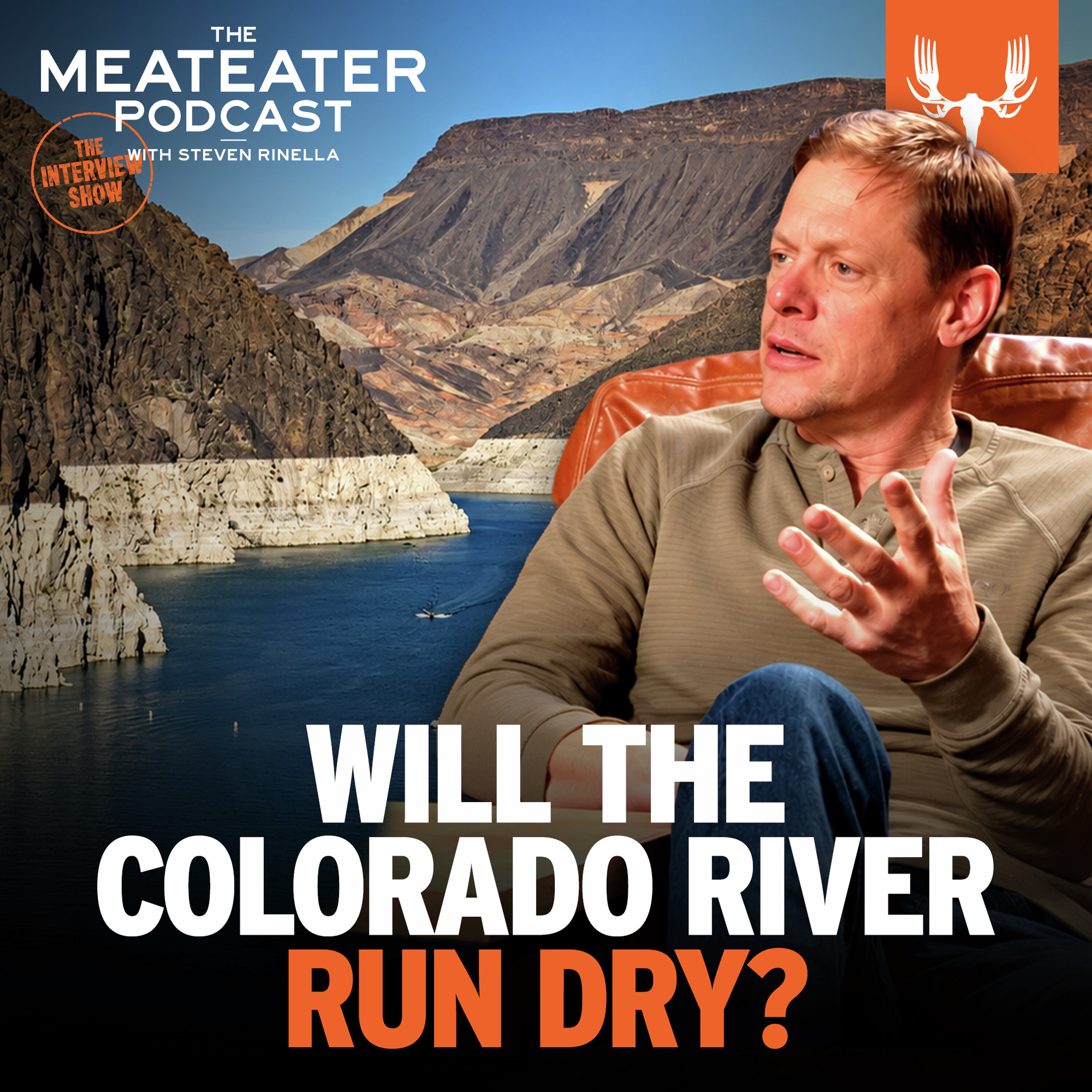
Ep. 951: Will The Colorado River Run Dry?
Montag, 26. Oktober 2026 · 1 h 18
Kapitelklicken springt direkt hin
Shownotes
Steven Rinella talks with Dr. Melanie Thornton about the water crisis on the Colorado and Rio Grande rivers.
Melanie Thornton is the Senior Director of Western Water for The Theodore Roosevelt Conservation Partnership. Find her work and more at trcp.org
Connect with Steve (themeateater.com/authors/steven-rinella) and The MeatEater Podcast Network (youtube.com/@MeatEaterPodcastNetwork)
Steve on Instagram (instagram.com/stevenrinella) and Twitter (twitter.com/stevenrinella?lang=en)
MeatEater on Instagram (instagram.com/meateater), Facebook (facebook.com/StevenRinellaMeatEater), Twitter (twitter.com/MeatEaterTV?ref_src=twsrc%5Egoogle…), and YouTube (youtube.com/@MeatEaterPodcastNetwork)
See omnystudio.com/listener for privacy information.
Transkriptvom Podcast bereitgestellt · Zeitmarken springen hin
This is the meat-eater podcast coming at you shirtless, severely bug-bitten, and in my case, underwear-less. We hunt the meat-eater podcast. You can't predict anything. Brought to you by First Light. When I'm hunting, I need gear that won't quit. First Light builds no-compromise gear that keeps me in the field longer.
No shortcuts, just gear that works. Check it out at firstlight.com. That's F-I-R-S-T.com. L I T E.com. All right, everybody. We're joined today by our first ever hydrologist. I'm pretty sure that's true. You're definitely the first hydrologist to ever sit on that couch, but I think you're the first hydrologist to ever come near this show. Dr. Melanie Thornton. And she is the senior director of Western water at TRCP.
But what we're going to talk about is, um, If you're anything like, not you, I'm saying to the listeners, if the listeners are anything like me, they have spent their entire life reading headlines, if not the whole articles, about the plight of the Colorado River. That the Colorado River is going dry. That the calamity is coming. Or that the Rio Grande, are you a Rio Grande or Rio Grande?
Rio Grande. Okay.
That the Rio Grande doesn't even flow in some places. Like, sometimes the Rio Grande is dirt. It's mud. It doesn't even flow out to the ocean, right? I've been hearing this for so long, and I feel like now I'm hearing it more. And I want to talk to you to understand what is up with these rivers. What is causing this? What is using all the water? What happens when the water runs out? Before we started the interview, you and I were discussing, we did some rough math. 10% of Americans draw their drinking water from a river, from a watershed that some people prophesize will go away or is going away. Okay?
Okay.
This is all just set up. I'd have to understand this better. So that's why you're here. You're here to explain this to us all. Like, why have we been hearing about this for so many decades? But I think my first actual question to you is, can you lay out sort of the scope of what we're talking about when you see things about the Colorado River watershed? Like, what is this? What states? How big is this? How is this 10% of Americans' water?
Sure. I think the Colorado River Basin is, it's a big river. And when I think, when most people, or if you're picturing the Colorado River for the first time, you think of it as just one river. But really, it's an interconnected system. It's big. There's lots of rivers, creeks, streams, tributaries, lakes that eventually feed into the Colorado River. So the Colorado River starts in the Rocky Mountains in Colorado. It flows roughly 1,400 miles all the way through the desert southwest to historically the Gulf of California. And when we're thinking about how big it is, you know, I'm a scientist.
I'll talk a little bit about the numbers. It's roughly 246,000 square miles. What does that mean? I did some quick math before we got here, too. That's roughly, you take the size of Rhode Island, it's roughly 150 of them.
Okay.
It's a big basin.
Rhode Island always gets like... Rhode Island's the handiest state.
It's the smallest one.
When it comes to making something seem big, you can always turn to Rhode Island.
And so it's a river that flows through seven states. It starts in Colorado. You've got Wyoming. You've got Utah, New Mexico. And then it goes down through the desert southwest through Arizona, Nevada, and California. Yeah. It links 30 federally recognized tribes. And it doesn't just support drinking water for 40 million people throughout the basin. It provides water for our farms and our ranches. It provides water for our tribal communities. And of course, it provides water for fish and wildlife habitat.
So what is happening? Let me ask this. If you go back in time, because like I said, I feel like I've read this story for I'm a half century years old. I feel like I've read this story since I learned how to read or some dire prediction on this. Can you go back in time to when was the first time that someone or some entity, some thing put together like if human populations do this, the river will do this. Right. And we will someday feel the effect of it. When was this when did this become apparent to somebody?
I mean, I think if we're traveling back in time and I think it's helpful to sort of understand that the rules and the frameworks and the laws that govern the system were built around a time when people just thought the river was going to produce a lot more water than it does today.
OK.
And so the Colorado River and let's travel back 100 years. Let's look. We're talking about the 1920s. The American West was expanding, right? You were starting to have cities get developed. Agriculture was expanding. And the states, the seven states in the Colorado River were like, wait a minute, wait a minute.
How are we going to figure out how to share this river? We need to figure out a game plan. And so in 1922 is a key year in the Colorado River because that's when representatives from the seven states, they all gathered at Bishop's Lodge outside of Santa Fe. And they negotiated to try to figure out how are we going to share this? this river among our seven states.
And eventually what came out of that was the Colorado River Compact. And then you, let's speed back up into time now, you know, Congress has weighed in, Congress has passed laws related to the Colorado River. Dams and reservoirs have been built. The courts weighed in. Tribal communities are negotiating their water rights with the federal government. And so all of that layered on together is what folks call the law of the river. I don't know if you've heard about that term or seen that term no i'm not familiar and so that's sort of what governs the river but then you fast forward to i mean even let's let's take a look in in the late 2000s um hydrology and and the and snowpack and flows in the river was starting to change it was starting to
get you know we were starting to see you know early onset of drought You know, our big lakes, our Lake Mead and Lake Powell are the two major lakes on the river that store water that states and folks can use during dry years. Those lake levels were starting to decline. And the states were like, wait a minute.
We are, there's less water in the river. And we're using more. And there's, fundamentally, at the end of the day, there's a mismatch between how much water people use and how much water the river provides.
So the water is, like, besides there's more and more use on On the water, the amount of water has like objectively declined.
Correct.
There's less going into the system.
Correct. I mean, I'll ask you, what do you see out in the field? Thinner snow packs? What happens when there's warmer temperatures that changes water on the landscape?
Yeah, yeah. Well, here outside of the Colorado River watershed, last year I went and got my snowmobiles all ready to go. And, um, never started them last winter. I'm particular about where I go. Like there's a certain type of thing I'm trying to do. And it's like more low elevation, never ran my snowmobiles.
Why?
Well, there's no snow. It was, it was, it was a non snow year.
Yeah.
A dirt trap for coyotes till through February, open ground, bare ground. Yeah.
I mean, I think, People, I mean, if you spend any time outdoors, whether you hunt or fish or you recreate, you probably notice these things. No snow, thinner snow. Yeah. Rivers are peaking at different times. Yeah.
So when these folks got together in the 20s and they came up with this water pact, tell me about a couple of the foundational principles that they're drawing on. Yeah. and within that answer, the thing I'm curious about is you'd look and it'd be like, you mentioned Wyoming, right? So the people at the headwaters, I know just in general water law and water rules, it can't be that the, the farthest up person says, I'm just going to take it all. And I'm going to build a giant dam at my state line. And I'm going to take all the water and all the waters for me because I'm here and it's mine. Um, even in the twenties, they must've had things sorted out where that, that, wasn't permissible somehow, right?
You couldn't, like, you couldn't hoard water. Correct.
So I think, and I'm not a water lawyer, I'm a scientist, but I've spent the last decade in D.C. around water policy, so I know enough to be dangerous. In the West, water law is prior appropriation. If you were there first, you were senior on the system. And so at a really, you know, indigenous communities were there first.
But if you're looking at the states from a state perspective, California has some of the... California and Southern Arizona have some of the most senior claims on the river. And I think what the Compact did and what they tried to do at the time was try to figure out how can we equitably share the river. And so they split up that basically in the negotiations, they split up the river. You have the upper basins, you've got the headwater states, the Utah, Wyoming, New Mexico, and Colorado. And then you've got the lower basin states, Arizona, Nevada, and California.
And they split it up based on acre feet.
Okay, so not percentage.
Well, there's a nuance there. But just at a really high level, there's 7.5 million acre feet that the upper basin got and 7.5 million acre feet the lower basin got. And, of course, there's Mexico. In the framework, we negotiated a treaty with Mexico, and there's 1.5 million acre feet for Mexico.
And acre feet is?
You know, you think about this as two to three households of water use a year or take a football field, pile it high with water about a foot deep. That's an acre foot.
All right. So a football field covered in 12 inches of water is about what two households will use in a year?
Roughly.
God, seems like a lot, man. It's a lot of water. Yeah.
And at the time, and, you know, I think it's important, you know, at least me as a scientist, there's a book called Science Be Damned. It's written by Eric Kuhn and John Fleck. And what they did was they lifted the hood in terms of what data and what numbers were these negotiators using back in the 20s. And there are some discrepancies between do you use a longer period of data that shows over a longer period of time the averages or should we use a shorter period of wet data where it looks like the river provides more water than it does. And I think anyone who's having to make a tough decision, especially around water, it's so much easier to split a bigger pie than it is a smaller one. And so at the time, there was
politics involved, and ultimately the folks that were negotiating that decided to use a period of wetter data. And so they split the river. I mean, we're talking averages here.
Do you think it was intentional? I mean, it's easier.
I don't think it was intentional, but that was the number all the seven states agreed to. Let's take 15. We're doing 15. We'll split it in half. But now if you look at how much water is on the Colorado River now, it's closer to that 12, 13 million acre foot number. And so it's less.
Got it. Got it. You know what's kind of funny about– this is the thing I think about often when I think about water availability is human memories are so short that when I was kind of in high school– early college age even before that we would hunt we would trap muskrats a lot and hunt a lot of ducks in standing dead timber which was all over the place i mean treat you know 10 inch 12 inch trees stone dead in marshes and it never like it just did not occur to me all that time To think, wait a minute, this must have been dry for all the years it took for these trees to grow. And I just assumed that I was living, as everyone does, that I was living during normal times. Right. Right. And we were shooting wood ducks and mallards out and just
dead timber all over the place, all over. And now that stuff is the woods or grass. And that water is not there. You know what I mean? But in my head, it was just like, that's what life is like, you know, even when you're leaning against the evidence that that's not normal. This tree grew here.
I think that's a big question is what's normal. Yeah.
Yeah. So I could see at that time, trying to like, at that time, trying to figure out how much water you got. Unless it, unless it was just settled as a percentage, but they're talking about real numbers.
Yeah. And there's some nuance with the upper basin in percentages, but for the most part, at a really high level, it splits up the basins into two. Yeah.
So explain how you, since the 20s or whatever, explain, like, how has use increased so much? Is it just a function of there's more people? Or, like, who's using up the water?
So I think, you know, when. We have to talk a little bit about the lakes, right? The Lake Mead and Lake Powell.
Sure, yeah.
Those are the two big storage reservoirs on the Colorado River system. And they were designed to store water and basically to store water during wet years to be used during dry years.
To store for how long potentially?
I mean, they're there to store the water until we need it. And so those reservoirs, we could go back to the Acrefoot example, if they're full- they can store 50 million acre feet of water combined. Today, those reservoirs, and I'm sure you've probably seen the pictures of the bathtub rings at Hoover Dam.
Yeah, and like dead dudes coming out of there.
Yeah, there's been some of those stories too.
You don't believe those stories?
I mean, people are discovering things at much lower levels in the lake. And so I think today they're roughly 20, 25% at capacity. They're really low.
They're at what capacity?
20 to 25% capacity.
Okay.
Depending on the lake. And so I think over time, again, back to we have a mismatch between supply and demand, how much people are using versus how much water is available.
Is that shrinkage? So tell me again how many acre feet they hold?
50 million.
Okay. And they're at 20% capacity now, so they're shrinking. Roughly, yeah. But that's not them shrinking because people are sucking it out. They're shrinking because it's not falling as snow and rain.
Correct. It's both. It's both.
It is both.
Okay.
Yeah.
It's the use plus coupled with the changes in our snow and our river flows.
Okay.
And so I think if you just take the pie and we'll talk really high level, right? And you think about who's using the water, you know, ag uses about 70, 80% that's used to grow food production in our country. If you look at your dinner plate in the middle of the winter, whether it's broccoli, cauliflower, your leafy greens, your lettuces, your spinach, there's a good chance that was grown using Colorado River water in places like Yuma, Arizona, or California's Imperial Valley. Cities also use the water roughly 10-ish percent.
We talked about this earlier, 40 million people Drinking water is from the Colorado River, and that supports cities in Albuquerque, in Denver, in Phoenix, Las Vegas, and Los Angeles. And there's, you know, some cities are doing a really good job about trying to how we could stretch our very limited water supplies. Las Vegas is a great example. And if you just take their indoor water use, the water that people use in their homes, Las Vegas recycles about 99% of it. They've made those investments in water recycling and reuse technologies because... It's a, it's a city in the middle of the desert and they are grappling with how can we make our water go further, but it's not just ag and cities. You've got industries that are, that
rely on the water, uh, businesses, towns, you know, scattered throughout the west as well as fish and wildlife habitat. I mean, I think, and for your listeners, Steve, when I think about water and how does that, what does that mean to the, to hunters and anglers? Water is habitat at gigantic scale.
Yeah.
And so, you know, that's also a very important component of who relies and depends on this river. Whether it's, you know, are we talking about migration corridors for elk and mule deer? You know, trout, we've got cutthroat trout in the headwaters. Water is the thread that connects.
All of it. With agricultural increase or agricultural production, are there people that draw... from the Colorado River Basin, are there cities that aren't in that basin where that water is piped over to somebody else?
Sure.
How did it ever be that they get, how do they have a chance at that water?
Sure. I mean, I'll take, we'll talk about Colorado and New Mexico, and New Mexico, because of my experience, in New Mexico, their Colorado River use is actually There's a 26-mile pipe that moves water from the Colorado River Basin to the Rio Grande Basin, and that supports drinking water for Santa Fe and New Mexico. In Colorado, there's a trans-mountain.
The Big Thompson Project is a trans-mountain water pipeline that goes underneath the mountains that moves water from the Colorado River to support cities on the Front Range, Denver.
But what is their argument to have it?
The state has that water right.
Oh, I see. Because some portion of the state touches the watershed. Correct. They have the right and they can opt, the state can opt to pipe it out of the watershed.
That's correct. Yeah.
Did you ever see that, are you familiar with, you know, John Wesley Powell?
I am.
Yeah. It's like lost his arm in the Civil War and kind of did the, you know, map the Grand Canyon. Had all kinds of crazy adventures doing that. Have you ever seen those maps he made where he had this proposal and I don't know if he conceptualized it or if he just popularized the concept he thought we drew the state lines all wrong Powell said the western states and I've seen maps that apply this concept all throughout the country Powell said the western states should follow watershed lines.
So if you imagine, if you're looking at a map, a lot of these states are square. You look at Wyoming, Colorado, portions of Montana's border. You get these geometric shapes. But then if you imagine Montana's western border, which is a jaggedy-ass line running all crooked across the map. The river? Yeah.
It's a drainage. It's a drainage divide. And Powell came up with this idea that all the borders would look like very jaggedy, crooked, meandering lines because they should all follow watersheds. And that way a state would sort of be more, you know, beholden to its environment. Right? Rather than doing like what you're talking about and moving water over mountains.
I mean, as a hydrologist, I sure think it would be a lot easier to manage water at a watershed level. I mean, even think about fish and wildlife and our, our state wildlife management agencies, the amount of coordination that's required among States. I mean, fish and wildlife don't know a state line.
Yeah. Right.
And, but we still have to figure out ways that we can make investments in their habitat to ensure that they're there.
When, when, So with these states having the right to move that stuff over mountains, that's because they're, like, their chunk. And then when it comes to the disputes between states, who is the currently... Who is the governing... What is the governing body for disputes? Not so much within... I'm sure there's fighting within Colorado about who's getting what water.
But who currently... Makes the rule for who draws what water out of the river. Sure.
I think just backing up really quickly, I think historically there are every state governor appoints a water commissioner to represent their states to negotiate on behalf of their state. And historically, the seven basin states have always come to an agreement about how we're going to manage how we're going to manage the system. And that happened in 2007.
The states negotiated what was called interim guidelines, basically because they were seeing the conditions on the ground change.
In 2007?
Yeah, that's when the guidelines were finalized. And so basically what happened is they were like, okay, there's less water. We need some rules and we need to have some certainty around if the lake level is at X elevation, this is how much water we're going to see in a cut for our state. So those guidelines were temporary.
It was a 20-year framework, and it was supposed to just buy time for the states to figure out sort of like what's going to be our long-term game plan. Like how are we going to be able to use within the means of this river? And so we're here in 2026. Those guidelines have since expired. But the federal government, the Department of the Interior, and the Bureau of Reclamation, they own and have a responsibility of operating– the dams at Lake Mead and Lake Powell. So Lake Powell, that's the lake behind Glen Canyon Dam. And Lake Mead is the lake behind Hoover Dam. And so today, the seven states don't have a deal about what's going to happen in the future. They're still at the table negotiating about
how we're going to use less water fundamentally. And so the federal government earlier this year, because they still have to operate these dams, they'd sort of develop a framework to say, hey, let's buy some time We still have to operate these systems and we want to be able to give states some more time to figure out, to make the really tough decisions. Because it's hard. I think at the end of the day, everybody, all seven states are going to have to have shared sacrifice and they're going to have to compromise. It's not going to be everybody's going to be happy. I think ultimately to get to that deal, people are going to be unhappy because it's hard to cut, you know, to reduce your water use for when you've been relying on that. at a
higher volume over decades.
If you go back to the 20s, were they, was there excess water? Like, what was the point when there sort of was no longer excess water?
You know, I don't know the answer to that question. You know, I'd have to go back and look at what were the flows and the lake levels doing versus how much water was being used. But I mean, just from 1920s to now, our water use looks different. Mm-hmm. Our cities are bigger. They're certainly using more water. Ag at the time, I'm going to guess they were using less water in the 1920s than they're using today. And so there's a lot that has changed. And so even though you have what we call paper water rights, like you're entitled to that 7.5 million acre foot figure, ultimately, we have to do the hard thing and look at the data and look at what the river is providing today.
And make some tough decisions. And it's not painless.
Who is the... Within the seven states, we can talk about the seven states. And there's like tribal influence. Who is the voice of wildlife? Like who's the voice of fish and wildlife at a meeting about who gets water and what we do with the water? Sure.
I think... you said it well, fish and wildlife don't have a seat at the table unless somebody brings them there. And so that's why organizations like TRCP, where the Theodore Roosevelt Conservation Partnership, bring the impacts to fish and wildlife to the table. And I think if we're thinking about, you know, because, and I think, and I do think about this, right? We're humans, we're people, everyone seems to be centered and centric around what's going to happen to our farms and ranches, water use, what's going to happen to our cities, what's going to happen to our tribal communities. But, you know, TRCP does a really good job about ensuring that hunters and anglers have a seat at the table and decisions that impact fish and wildlife, fish and wildlife habitat,
our access to be able to hunt and fish are part of that conversation. And, and yeah, that's what, that's what I'll say there.
But, but, Why does anyone have to listen to that consideration? Because I'm guessing if you go back to the 1920s, there was no wildlife person in the room.
Probably not.
I don't know. And at some point, someone had to inject that into the question. Like, what about ducks? What about fish? Yeah. Why would anybody need to listen to them?
Sure. I mean, I think the federal governments in the states are managing lots of different competing uses on the river. And so there's some of that there. But that's why, you know, I think conservation and sporting organizations are, you know, make a difference because they do bring those issues to the decision makers.
But they have to bring them in at a state level.
State and federal level.
Okay.
You know, and I think, you know, because I think, and oftentimes there's such a big focus on all the built infrastructure, right? But having a functioning river, you can't, you know, if we don't make investments in our forest health in the headwaters, we do those restoration projects as habitat improvement projects. And there's, you know, a lot of our partners, whether it's Trout Unlimited up in the Price River in Utah or the Nature Conservancy in the headwaters of Colorado, we're making those wetland restoration investments to ensure that water will hang out on the landscape longer, slow the flow of the river. So when we do have big snow years, it's not just melting off quick and moving it all the way down, right? Like functioning rivers
that we've got to have functioning rivers that's got to be coupled with all of our built infrastructure.
When a state sits in when the different states come together and they start doing what you were saying about making like they're going to make sacrifices or make compromises what are the levers that a state what levers do they pull when they decide they're going to reduce water usage Sure.
So I think every state's different because every state has different water rights and how their state engineer manages that. And so some of it is voluntary water conservation. Some of it's compensated. There is an infusion of federal funding from the Inflation Reduction Act. The Bureau of Reclamation sort of infused funds to figure out how can we temporarily pay people to use less water. Most of that happened on farms.
Explain that to me. How do you pay someone to use less water? What do you mean?
So the Bureau of Reclamation would negotiate with irrigation districts or with farmers to say, hey, we're going to compensate you to whether they– and they would– it wasn't being forced. I think that's the key piece here. It's voluntary. And they're– California made a lot of– California was a key player here, right?
They used a lot of water in the Imperial Valley and they entered into agreements with Bureau of Reclamation to– use less water. They said, you know we're not going to take our full allocation our full delivery on the river we want that to stay in lake mead the reservoir there to store their water so that those are temporary measures those are sort of in my mind band-aid fixes you know sort of figure out because it's an adjustment you know i think communities are facing that real reality of like how am i going to be continuing to farm and ranch like I have historically done.
But, but maybe I'll not put my question right. Let's say you're, let's say you're a agricultural producer in the Imperial Valley in California. Sure. And you're, you're managing about whatever thousands of acres of, of like food crops. And you historically had access to enough water to do whatever, whatever acreage, whatever crop cycles you wanted to do. And all of a sudden now it's like, there's not as much snow. Rain is falling in different patterns. There's not as much water. I can see that someone, on one hand, I can see that someone from the government goes to them and says, like, tough titty. This is not as much water, right? But you're talking about compensating them, like, what is the argument? What is the compensation argument? You're
saying to them, you can't have as much water, so here's money to make up for the money you would have made selling produce? Like, in what form does it come?
It's complicated, and I don't necessarily have a good answer for you. So part of it, so we just look at the lower basin, the states between California, Arizona, and Nevada. Lake Mead is that reservoir there at the Nevada-Arizona border. Okay. And so. The Bureau of Reclamation is looking at lake levels. I think all water users are looking at lake levels. And then there's a decision made. And oftentimes the three states will sort of agree like how much water is going to get released and then the Bureau of Reclamation will release it. And so that stuff happens in real time.
And I think that the complicated factor here is that the water rights, what you have on paper, like how do you rectify the difference about like what you're entitled to versus like what's actually the difference versus what's actually in the river. And so I think In the 2022, 2023 timeframe, there was a real, you know, sort of crisis on the river where at least, you know, in the lower basin, there was hard conversations about we just don't have enough water that we traditionally did. And so let's, can we figure out about like how much, you know, what is Arizona's water reduction going to look like? What's California's water reduction going to look like? What's Nevada's water reduction going to look like? And those three states came
to an agreement to share that shortage. And so it's ultimately we come back to this collaboration piece, like where the hard decisions are made by working together so that there's. And so and a lot of that, too, will depend on. And it's complicated. And I'm not an expert on all the nuance here. But so at the state level, they'll sort of make those decisions and then that will have real impacts on the farm. And I think farmers will have to make decisions based on sort of what their allocation is going to look like that year.
Can you remind me what percentage of the water coming out of the river is being used for agriculture?
About 70, 80 percent.
And can you remind me the other pieces of the pie?
I mean, the city's about 10 percent. And then, of course, you've got to factor in evaporation and system loss. Just, you know, rivers are leaky. Yeah.
So the fact that there's evaporation and the fact that rivers are leaky is no one's going to do anything about that. You know, I could put like saran wrap over Lake Mead or something. You know what I mean? So how was the, like, I'm familiar with this conversation when I really, when I set up, like I've, I've always read articles and headlines about this issue. I'm familiar with it being addressed as an urban problem. And I feel like, and I want to talk about Las Vegas, the recycling program, but I'm more accustomed with it being that more and more people want to move to these places.
These places are exploding in population. There's all these new cities, but. And hearing from you, I feel like I've been slightly misled. Because how is it not just more like, why is it not more strictly a conversation about agriculture?
It's part of it.
But it's all the part. I mean, it's 70%. Did you say 80% or 70%?
70-80%.
Okay. It's an ag thing. And I'm not even blaming eggs.
We have to eat.
I'm just generally... a big farm ranch supporter, cows, not condos kind of guy. I look at farmland as wildlife habitat at ranch land as wildlife habitat. Love to see it. Like I want that community to thrive, but not, but, and, um, it just feels to me like that, that talking about human population is kind of a, almost a distraction. I mean, am I wrong?
I don't think so. But I think one of the major misconceptions of Western water is these dichotomies, right? It's fish versus farm. It's urban versus rural.
That's how I view the whole world. Everything is versus everything. That's my world view.
Ag versus conservation. But I think really when we're looking at trying to figure out how we're going to manage our system and live within our means and try to figure out what those solutions are... We know we have some of those tools and we know that partnerships, partnering with our farmers and ranchers is better than going around them.
We've got to figure out tools and solutions that work for everybody. We know that voluntary conservation works. We know that modernizing irrigation infrastructure works. And I'm talking about there's a lot of, and if you're looking out west from an irrigation perspective, a lot of these canals are earthen canals.
They're not lined. And so, right, they're leaky. And so where does it make sense to make those investments to line the canals to be more efficient? Where does it make sense to put an automation on a gate so that when you're opening that gate to be more precise about actually delivering the amount of water that needs to be?
Yeah, instead of running that sucker all summer.
Right. And I think one of the things that surprised me, and I recently just over the spring went, on a tour of various locations in the lower Colorado River. And I think what's surprising to me is I think there's this misconception that everything is modernized and automated. And it's just not. It's expensive. And it takes time and investment, whether it's to get a grant from the federal government to help modernize and improve irrigation efficiency. It's trying to figure out, you know, Can we be creative about conservation organizations working with farmers and ranchers? Like can they make small adjustments on farm that can have a water efficiency benefit but also a fish and wildlife habitat benefit? There's
lots of tools in our toolbox. It's just the challenge is doing them over the long term and at scale and in a meaningful way. And some of this stuff comes down to cost. It's expensive.
I want to talk about that, but I realize I want to back up for a minute on like very basic hydrology. Okay. Cause I was having this argument with my kid. I explained to you earlier when we were talking, I had this argument, my 16 year old the other day, maybe I was wrong. I was telling him water, like basically water isn't created or destroyed.
That's right.
It's like, there's a finite set amount of water on planet earth. It could be in clouds. It could be in the ocean.
It could be in glaciers.
It could be in glaciers, aquifers, but there's like a, there's an amount of water and it's just there. So when we talk, can you explain when like at a very basic level and you can stick it to the Colorado river as much as possible. When we, even the fact that we're saying using water, since you're not, you're not, since you're not using it up, what do we mean?
What do like, I kind of know what I mean, but I've never articulated it. What, like, what do I mean when I say you're using the water?
So I think for people, that's water coming out of your tap, drinking it, using it to wash dishes, using it to water your lawn. For farmers, that is, you know, oftentimes you have diversion off of a river that then will put water into a canal that then they will use to water crops to grow food for our country or to grow hay and alfalfa to feed our livestock.
And And you know this better than I do. I'm fishing wildlife habitat. How do they use water? They need water to survive.
Sure, but what is happening to it? If you imagine within the base, I imagine if I'm where I live, there's a creek, Bridger Creek would be my most immediate drainage. If I'm running my faucet, my water's not pulled from there, but we have a well. So if I'm running my faucet, And you'd say, like, I'd yell at my kids, like, you're wasting the water. How is the water, how is it not just that you're just diverting the water?
I mean, you are diverting some of it. And I think a lot, there's a lot of variation in cities, right? We talked about Las Vegas, basically all the water that goes into your drain after you shower, you know, goes into pipes that go to treatment facilities that treat, that recycle and treat that water that can then go back into the pipes and back to your home. Yeah. Right.
They are, they're a system that's very efficient. But there are other towns and communities that don't use that technology.
And so walk me through where the world... used water is going.
So some of it gets discharged back into rivers.
Okay. So it's raising the river back up. Sure.
And some of it, I mean, there's examples where depending on it, a lot of it, there's complications, there's nuance here. be used to recharge groundwaters. They might apply some of that water in targeted ways to recharge groundwater. Everyone's water use is different, right? Not everybody's water that comes out of their tap comes from a river. Some of it comes from the ground. And so there's a lot of variation there. And I think it really depends on where you live.
I want to bring up an extreme form of diversion. It would be like, you know, do you have little kids?
I have two kids, yes.
A big part of having kids is yelling at them about playing with the garden hose.
Mm-hmm. We're just entering that era. My kids are young.
Just standing there for hours on end just running the garden hose. We always laugh because we have a shack in Alaska and we just pump water out of our, there's a creek that flows out under the corner of our shack. It's on pilings, right? We pump water, we draw water out of the creek and basically you just watch it flow back into the creek. Yep. Right? So it's the one place where kids can go and just stand there eight hours a day playing with a hose and you can't you realize they're they're not way it's it's you can literally watch it flow back into the creek yeah so it's it's the water is detained for a minute it's diverted but it's not gone so on a very like what i'm trying to get at is that on a very basic hydrology level yep how how
is how is ag like how is ag using the water in a way that we talk about it as though it's gone.
Sure.
Because from that point on, it's not accessible.
Right.
Is that the issue?
In some ways too, right? I mean, I think you think about runoff from the water running off of a field, right? And so depending on where you are, some of that's captured and then reused, right? It can come all the way down a system. Some of it, the water quality might not be good to grow crops in, you know, because nutrients and fertilizers are applied on farm depending on the crop that they're growing. And so it depends. Some of that is just, it's water that might, The water quality piece is a component. And so I think as rain falls to snow in our mountains, right, and that snow melts, it filters into the ground and eventually goes into a river until it flows down. There's diversions off the river. There's the lakes that store the water and
they release the water that could be used to sort of move that water to cities or to farms. There's pipes that move that water across mountains to cities like Denver.
Yeah.
Like in New Mexico. And so it depends. And I'm not an expert in terms of like where does all the water go after it gets applied on a farm. Yeah. That's not my area of expertise.
Yeah. But it somehow winds up back in the system somewhere.
It can.
Yeah. Can you touch on a thing we discussed earlier to jump over to a different system? That at times the Rio Grande is just not flowing. Correct. When did that begin to happen?
So I think it's important to know for the Rio Grande, the Rio Grande is just has the baseline is getting drier. And again, similar to the Colorado River.
Yeah. Outside of use.
Outside of use.
Yeah.
I mean, use coupled with the baseline getting drier. And so you just have a lot less water to start with. And so, I mean, I, you know, I pulled data from the U.S. Geological Stream Gauges at you know, on the Rio and in Albuquerque and New Mexico. And I want to say it was 80 plus days of just no flow this summer.
This summer.
This summer.
80 days where if you look up the flow, it's zero.
Zero. It's dry. And there's a late September.
Zero CFS.
Zero CFS. There is a monsoon in September.
Does it really just say that? It just says zero or whatever? Yeah. It's like... Huh.
And so, I mean, that's the reality. I mean, that's what's happening today. And so... You know, that has real impacts.
On people that rely on that river. And even if no one was farming with that water, even if no one was farming with that water, that water would be, it just would be, maybe it's just not. Like, that reality would be fixed. What do you mean? Just because, like, not even, that's not even entirely, that river's not even entirely a victim of human use. It's a victim of climate.
It's both.
Both. Yeah.
Yeah. So even outside of agriculture, that could potentially still be happening.
Yeah, I mean, if I had a crystal ball, I'd love to know the answer to that. But I mean, it's water use coupled with drier conditions, just period.
So are there people, on that Rio Grande question, remember we were talking about you have this paper, you have this legal document that says, hey, I'm entitled to blank water, right? You have a water right. And This has traditionally been a legally binding document. But then you get a new situation where it's like, buddy, the water's just not there.
I don't know what to tell you. It's not that I'm keeping it from you. It's just that it's not there.
Right?
So if you have a water right, let's say you're below where the Rio Grande is zero CFS, and you have a water right, do you have a complaint? I mean, you have a complaint, but do you... Do you know what I mean? Like, what comes of you? Or do you... go talk to the person up river and say, hey, you need to let more through because I'm not able to draw what I'm legally entitled to. Yeah, it's complicated.
I'm not a lawyer, but these decisions are sort of later. The compacts, like the Rio Grande also has a compact too. It's a compact between New Mexico, Colorado, New Mexico, and Texas that sort of governs how much Colorado is on the hook to deliver to New Mexico, how much New Mexico is on the hook to deliver to Texas. And there's some flexibility in there about what's going to happen during shortages. But still, ultimately, folks have to figure out how to use less water. And so, and I'll say on litigation, I think litigation is costly and doesn't always necessarily land the solution that works for communities. I think ultimately it's getting all those water users at the table to figure out, you know, there's factoring in water rights
because that's a real legal framework. But that legal framework isn't going to produce water.
Yeah.
You know? And so they have to, these are hard conversations that are happening in the Rio, that are happening in the Colorado River Basin and across other Western rivers. And I think, in my mind, the best solutions are actually done locally. How can we look at our rivers and bring people together, our conservation organizations, our tribes, our local and state decision makers, our water users, our farms and ranches, how can we all come up with a plan to figure out how we can use our water?
And one example, you know, and I got exposed to this when I was at Washington State University. My PhD advisor was working on a project in the Yakima River Basin. This is in the state of Washington. It's the center of the state. And they were having a challenge with water supply. And I think ultimately the water users sort of had a had a reckoning. They were like, okay, we need to figure out a game plan. What's our long-term game plan to figure out our water supply? It was tribes. It was local and state decision makers. It was the farmers and ranchers in that region. And it was conservation organizations. And they developed a long-term strategy about what investments needed to be made on upgrading aging infrastructure,
modernizing irrigation infrastructure, what investments need to be made in the headwaters to ensure there's water for trout. And how can we ensure that tribes can effectively use their water? I think there's a sort of an... You know, for tribes, they were there first and they are truly the most senior on the system. And they might have an entitlement to that water, but can they benefit from it? Do they actually have the funding and infrastructure needed to use that water in their homes or in their communities? And so they came up with what's called the Yakima Basin Integrated Plan. And, you know, all those water users together And they're working, you know, project by project. They're working
on trying to get funding to support it and to figure out, you know, how are we going to make investments in the forest? How can we line canals to improve irrigation efficiency? And so those are real success stories because it starts local.
What would it, if you go to the Colorado in the Rio Grande, before we get into like, before we get into reality about how this problem was, get remedied or stop being so severe. Before we go to reality, let's play like fantasy for a minute. Okay. What would it, I guess the question, is it out of the question that just weather is going to save us? Meaning like rain and snow? Yeah. It's just like rain and snow ain't coming to the rescue. I think that. But it sure doesn't seem like that.
I think that's right. And it sort of goes back to like my questions. What's our new normal? You know, I think, you know, if you spend time outdoors, you're looking at the landscape. Even if you spend time looking at data like I do, you're looking at our snow is not as thick as it used to be. Our drier soils are sucking that water up and they aren't making it to the rivers and lakes like they used to be. And so I don't think that we can pray for rain. but I think we have to have that realistic conversation about living within our means and finding a solution that works for everybody.
I kind of mentioned this to you before we started recording, where I was like, the one scenario that I can't picture happening I can't picture a scenario happening where, where a state says, Hey, no more people can move to this town. Right. Phoenix is done. Right. Right. Denver or whatever, whatever, like it's done. The population is capped. I can't, I sort of can't picture that there would be farms where the farmer is like, I'm out of business. I'm done.
There is no water. Am I wrong that we could get to a point where you really see sort of like that the demographics of the country have to shift according to water loss and water use?
I mean, if I had a crystal ball, I'd love to answer that question. I don't know the answer to that, but I do, you know, I sort of, I view it in some ways too that... Yeah, I mean, I sort of have the same philosophy as you, but I don't know. I don't have a good answer there.
Like you feel that something will happen, but it won't be that.
Yeah.
It won't be that they can't grow.
I mean, I think, I mean, I don't know. Maybe, maybe. But I do think that maybe our cities will, their water infrastructure will look differently. Maybe they'll have more Las Vegas peppered, Las Vegas is peppered through the West in terms of the water recycling infrastructure. I mean, I think ultimately, I mean, water out West is cheap, so to speak.
And so I think a lot of these, the solutions that we know about and we know that work sometimes are expensive. And so that's a real factor. And, you know, we want to make sure that people can afford their drinking water and not make it so costly that we're pricing people out of the cities that they grew up in.
So it's a real factor. Water managers are grappling with every day.
Yeah. The cost thing is interesting that you do, there's some things that are inexpensive enough that you just sort of, you use what you want.
Right.
Like at home, you know, I don't know. It takes something like, like, like not many parents yell, would yell at their kids about using too much flour. Right. Right. There's just like some things, you know, I don't know. It's just, it's flour. Right. Or like too much, you're using up too much white rice. Yep. You know, but you might, you might go buster balls about butter or orange juice or something. You know what I'm saying? Like there's like a perception of use and cost where you admonish kids people for wasting things of high value. And right now with like gas and diesel at these historically high prices, people are honest to God, changing behaviors. When they make these predictions about how much 4th of July
traffic there'll be, how much Memorial Day traffic there will be on highways, they factor in the cost of gas because the cost of gas is going to dictate how far people are willing to drive, meaning you're making like day-to-day logistical adjustments because the resource is so expensive. When you consider this puzzle of water use, how do people factor in like, well, maybe water should be, I don't even know how you put a price. You probably know how you price it. Maybe water should be two bucks a gallon. What would that do to water use?
Yeah, I mean, I think it's easier to do with cities, right? So you could sort of tier that, like, and I'm not, this is not my area of expertise, but I've certainly looked at the data of like, you have a water utility that provides drinking water to a community and you pay X amount of, you pay X amount at a rate for your gallons per day. But then if you use more, you pay more. So there's, I mean, there's people studying this. I thought, this is not my area of expertise about like, how can the change in water price, you know, have an impact on behavior?
But it's a factor, right?
Oh, 100%.
It's a thing people look at. 100%.
And I, in Melanie's personal opinion, I do feel like water is too cheap out West. I think at some point, maybe that is a factor in trying to figure out, like, do we look at the cost of things?
I don't know. Where is water not cheap? If water is cheap in the American West, where is it not cheap?
You know, I spent the last decade in Washington, D.C., and I'll say my water bill is pretty high there.
Okay.
But I don't know. I don't have a good answer there. I think a lot of it depends on where the source is coming from.
Is it scarce? Yeah. So what are the adjustments if you crystal ball it, right? And that the weather doesn't save us. What are the adjustments in deals that will get made in the Colorado basin? Sure. Right? Let's just say you had some kind of authority where you're like, in the end, I'll do it. I'll make the decisions.
Here's what's going to happen. What is going to be different about life?
Everybody that's in the field of water management wishes they had that. But fundamentally, I think there is no magical solution or silver bullet that's going to get us out of the situation that we're in now. But we have tools and we have solutions that work. We know that Voluntary water conservation on farms and ranches works. We know... Tell.
Me a little more what that means.
Water conservation, so this could just be modern.
I'm going to say voluntary water conservation.
People not being forced to, right? Where I'm not going to come in and say that you're forced to have your water cuts, right? And so it's allowing farmers and ranchers to make decisions that work for them in terms of what they're going to apply on the field.
But you mean like literally it would be someone goes to a producer... agricultural producer or they're just aware that there's water problems and someone says please out of the out of the goodness of your heart can you do x y and z and like we have money to help make these changes like this is a thing that's happening out in the landscape.
Yeah and i'll say it's a little complicated there's agreements that are in place right so like in the upper basin in the colorado basin there's our like water contribution programs where they're trying to work with agricultural producers to say, who would like to volunteer to use less water? And there will be variations. So a farmer in Colorado might just decide, you know what? I'm going to use less water to irrigate my crops this year. It's called deficit irrigation.
Or maybe I'm going to take x amount of acres out of production this year and fallow my fields. And then they'll get compensated for that. So there's programs that exist there. And I'm not a total expert on this. I know enough to be dangerous. So that's voluntary water conservation. I mean, we talked about water recycling and reuse and desalination technologies where it makes sense. Like, you know, can cities make those investments? It's expensive, just straight up, it's expensive.
We know that habitat and restoration projects work. You know, to move water out onto the landscape, to store it there, to get rivers functioning and behaving like rivers historically have been doing, which are an important component to rivers and watershed health and our water supply. And I think it's making sure our communities are prepared and have the tools necessary to be able to manage with the flexibility they need to adapt. And I think, you know, I was in prepping for this podcast, I was, you know, trying to think of, you know, what were some tangible examples or things that we could think about? I think, you know, when we're talking about wildlife managers and if you're managing an elk herd, you don't wait for it to crash
and hope things work out, right? You monitor the conditions. as a manager you adapt and you plan ahead pay attention to trends exactly and i think you know and understand there's nuance there water water management needs to take some lessons from wildlife managers.
Um with the i don't know if you're familiar with this you see a lot now you talk about like rivers behaving like they like they ought to behave are you familiar with um The argument, you see it more and more now, but the argument about the importance of beavers on the landscape. Sure. So that's one where they hold a lot of water back with dams. But what are other ways in which the rivers aren't, when you say that they're not behaving like they ought to, what are they doing or not doing that they used to do?
You've mentioned that a couple times.
Yeah, sure. And we can get back to beavers in a sec. So I think just basics, right? You've got snow in the mountains.
Uh-huh.
And historically, that snow melted. It would recharge groundwater. Groundwater would flow into rivers or, you know, would flow into the rivers that would make it into our lakes. I think now, as there's warmer temperatures across the West, and that's changing how water moves across the landscape. Mm-hmm. Maybe you have less snowpack. Maybe you have those dry soils are actually sucking it up, and that water isn't making it to the ground, isn't making it to the aquifer, or isn't making it to the river.
Mm-hmm.
And so, you know, where maybe you have a big rain event and maybe that water just moves really quickly through the system instead of slowly moving across the landscape.
Yeah. But how would you fix that, though?
So there are a lot of great restoration and habitat conservation projects that are happening all throughout the West and all throughout the Colorado River Basin. So an example, and we just, TRCP just led a tour with. of our partners, the National Wildlife Foundation and the National Forest Foundation, National Wildlife Federation, excuse me, and the National Forest Foundation where we did a site tour is on the White Forest in Summit County in Colorado. It's called the Soda Creek Project.
And they built beaver dams analogs, right? We put, you know, the folks that did the restoration project put like logs in the river and sort of basically to mimic habitat for beaver to create these ponds, essentially to like, you know, to restore that wetland there, to get more water out onto the landscape. That's important for bird, migratory bird you know waterfowl duck habitat it's also important for connect you know because oftentimes i think in the west too especially with warmer temperatures as rivers are becoming disconnected and so like moving that water on the landscape making sure our streams are are connected creating habitat for trout whether that's like putting in giant boulders or logs across a river
to create that that that key habitat for so.
Slowing the move into water down slowing.
The movement of water down And the goal for that Soda Creek project is, you know, the goal is to get beavers to move in and to continue to maintain that work. So I think it's not just doing a one-off project. It's going back to make sure that when you do that restoration project, is it still functioning and is it still having that benefit on the landscape? I mean, it's doing all of these projects together. Every individual project adds up over a longer period of time. You know, not just doing a quick fix. Let's not.
We're not going to just infuse some money to do a bunch of different projects and go away. We have to figure out that sustained pace of individual projects, lining our canals, upgrading our agriculture infrastructure, making those investments in drinking water infrastructure as well. All of that adds up.
What will be, if you go back to that 1922 summit, whatever they call it, get together, deal, what will be the next... sort of like rule do you mean will it ever be that everyone comes together the states come together and they go like hey it's a new reality man there's 25 less water let's make a big old bargain and everybody's gonna sign it and then we're all gonna agree on that for the next bunch of decades is there a version like is there a version of something like that that'll happen where it just brings like absolute certainty to the to the solution and everyone's gonna you know, get it notarized. And that's just how we're going to live from then on. Sure.
I don't, I don't view that we're going to change our water right law across the West. I just don't think it's going to happen. If I was water czar, that's the first thing I'd change.
Really?
You know, just take it off. Let's look at how much water is in the system.
We developed a system that isn't.
And like, you could take into consideration who was there first. And like, you know, there's lots of different nuances here. So that's just Melanie's personal opinion.
But give me, give me a hit that like, like, you know, I realize you probably don't want to get all kinds of mean letters from people with water rights, but But lay out for me, just conversationally, lay out for me, like, what is the problem with water law? When you say that it could be revised, like, what is the problem with it?
I think the challenge is if there's a senior water rights holder at the very bottom of the river, under the current water law framework, and I'm talking at a really high level, you know, there's a lot of nuance here.
You don't need to name names. You don't need to say Bob's Farm.
Yeah, but like, The people upstream have an obligation to deliver the water because they are senior on the system. And so all the people upstream are junior. And that's challenging. And so that's just the reality of the situation. So I think in terms of today– But this is not likely.
You're saying that this is not– This is like people that talk about having a new constitutional convention and like scrap our constitution.
But this is why I think that at least in the Colorado River Basin, there has been some success because the seven states have gotten together. Understanding the law of the river, all these previous compacts and laws and court cases and everything else to sort of have those hard conversations about like how are we going to manage our system?
We don't have a deal today. The seven basin states don't have a deal today. But they're working toward that. And I remain hopeful that they're going to get there. Because at the end of the day, the states want to come together to figure out an agreement. They don't want the federal government telling them how much water they can and can't use.
So when will they make a deal? Or is it unlikely to happen?
I believe it will happen. If I had an answer to that question, I think a lot of people are wondering when the seven basin states are going to come together with a deal.
But right now, there's not like a binding thing.
I mean, you sort of had the foundational agreements, the law of the river, and the beer of reclamation. The federal government had to step in to sort of like have a temporary game plan about how they're going to operate the system. But there's no sort of– those interim guidelines, those 2007 interim guidelines expired. So there's not a seven-basin state deal or agreement about how to– what's the best way to manage our river. Not right now. There will be.
I have hope. But is it, remember how when we started out talking, I was saying, I feel like I've been reading the same story for forever. I'll be reading this story for the second half of my life.
I'm sure. I think so.
It's not going to be like, hey, we figured it out.
You know, I mean, maybe. I mean, maybe in the sense of that there's a real reckoning with we're going to have to have a different water use and a different way to manage our water. We can't be doing it like we did a few decades ago. That's just, we can't do, there's just not enough water to go around.
But really when we're like, we're thinking about success, I think a lot about, you know, what is success? One is making sure there's water in the river, right? And I think a lot of people don't even think about water until it's not there.
Yeah. Oh, a hundred percent.
Right. And there's like a lot of folks think, you know, and conservation is part of that. It's like, we got to figure out what solutions we can do today to prevent that water from going away, right? We want to continue to have water in the river.
And that's that upstream work you're talking about.
But even in the downstream, I mean, in Arizona, I toured a project in Yuma, Arizona, where they restored wetlands along the Colorado River, which used to have a bunch of trash, and it was overgrown with salt cedar, tamarisk, And they pulled out all those invasive species. They planted willows and cottonwoods and mesquite trees. And there's a recreation trail there. So there's projects that happen throughout the basins, not just in the headwaters. And that was a success project in the lower basin.
Yeah. If you look around nationally, what would you picture being the... Where will this conversation be happening next? the conversation about like where you said, no one thinks about water till you don't have it. Yeah.
Right.
It's, I grew up in Michigan. There was not a daily conversation about water use. You know, you weren't, people would irrigate, they'd suck water out of some local lake and spray their lawn all summer. People didn't look mean at them. Do you know what I mean? It was just like, it was like, it just wasn't a conversation. Sure.
Right.
I lived in all kinds of Northern tier States. in, um, Alaska, whatever, most of the time you're not having a water argument. Sure. Like where, if you had to picture what parts of the country would you, would you, if you had to say like, Hey, um, be advised, this could be you down the road. Like where will the next spots be? Yeah. Where, where, where there's like a water war. Sure.
I don't know the answer to that question, but I'll take us back that in terms of, and we talked about people don't know or think about water until it's gone. I'll encourage all of your listeners, learn where your water comes from. Learn about what's happening in your community, about what's impacting where your water comes from. I think one of the things that surprised me most, and when I travel, I always look up where is the drinking water coming from.
So I'm just curious. There's a lot of people that just don't know. They have no idea. They turn their tap on and don't even think about where it comes from or where it goes.
Yeah. I did a book about raising outdoor kids. I published it a few years ago called Outdoor Kids in an Inside World. But in there, one of the things I suggest is that your kid learns, wherever you live, that your kid learns the water that's by them and its path to the sea. Yep. that they'd be able to walk through like well i'm on this creek which flows into that river which flows into that river which flows into that river and that dumps into the sea as being like a fundamental thing that i think that's i'm agreeing with you like a fundamental thing that i think people need to understand and i've often joked that there's states where there's states where more people know that than than And.
I think, I mean, I think the West gets a lot of attention with drought, right? Like, you know, and a lot of the wildfire activity, et cetera. But like, and I lived in D.C., but there's still a drought on the Potomac. We get the drinking water in D.C. comes from the Potomac River. And there is, you know, there is sort of a real, uh-oh, the intake structures, the pipes that pull water out of the Potomac to deliver water to people in D.C., We're starting to get to a moment where I think the DC water utility was starting to think about like, okay, we need to think a little bit more about water conservation. So even places that appear water rich, right? Their rivers are huge.
They're going to have those. I think that's going to be a problem that many communities across the U.S. are going to be grappling with.
Yeah. You know, another thing I wanted to ask you about is, does in the future, do our, in the future, are our coastlines like lined with desalination plants? Do you know what I mean? Like, what's up with that?
I mean, I think so desalination basically takes salty water and cleans it so folks can drink it or use it for whatever they need to use it for. There's a lot of focus on ocean desalination because you're close to an ocean and there's a lot of water there. There's also brackish groundwater, like salty groundwater that communities like in Texas, there's a lot of salty groundwater. They're looking at desalination as a tool. I think part of it is like does the math pencil out and what's our source water? Like what water are we currently using? Does water recycling make more sense? Does water reuse make more sense?
I think every community is going to be different. I don't really see a universe. Maybe I could be wrong about just being a bunch of desal plants up and down the coast.
Yeah. And I think if you were in that situation, it would be that you're looking at like you'd be more aware probably, like in places where that's the reality, Middle East and elsewhere, you're probably looking more at, those people probably learn to think of water more as a thing that costs blank.
Right.
Like a thing that costs X per gallon and you view it like a product you're buying.
Right.
When I'm messing with my kids, not really messing with them, but just trying to get them thinking about things the right way, I'll tell them while we're eating dinner and they're sick of the conversation, but I'll be like, in your life, people will, there will be people that are having wars over water. I'm trying to scare them good.
Like people will be having wars over water and they'll be eating bugs. You know, I tell them this all the time. They kind of dismiss it, but I'm just trying to get them prepared for the idea that like there will come a time when there's things that you're taking for granted that will not, that will not be available.
A hundred percent.
And I always, and I'm trying to pound in their head that like they're going to need to learn that Maybe not them, but their kids. Someone's going to need to learn to think of water and food differently. 100%.
I think success looks like if our kids don't have to take this stuff for granted and don't have to think about it. Yeah.
I can see that being a big way toward the solution is if more and more people viewed it as a commodity. Right. Or more and more people viewed it as a finite thing. that you're in some way or another because everybody's paying utilities right right maybe maybe your rent is baked into your rent but like your rent reflects the like even if you don't pay the utilities directly the part of your rent that comes in reflects the purchase of the utilities is going to the place but we just don't think of it yeah i agree as a thing i.
Agree i need to get my kids that book that you wrote don't, don't be fooled. I'll definitely, my kids will know where their, where their water comes from.
Yeah. What's not in the book is scaring them about eating bugs and having waters over water. You have to just kind of ad lib that in, but it is, it is like a, uh, uh, it is like, uh, it's a shift in mindset. Yeah.
A hundred percent. And I think when I, so when I, what started my way of work in the water and when I was, I got my PhD at Washington state university and, I did this project in the Spokane River Basin. And my PhD advisor's philosophy was, let's solve a problem that the community wants to be solved. Let's just not think about something that we're personally interested in. And so my project evolved. And one of the questions was, how can we improve water management in the Spokane River Basin?
That's in eastern Washington, northern Idaho. It's a tributary that flows into the Columbia River. There's a groundwater source there. They're really connected. And so I built a model with water users there. We've RAND scenarios, et cetera. And we facilitated a lot of conversations about how can groundwater pumping in Idaho impact flows in the river, et cetera. But ultimately, what came out of that was sort of surprising, is the water managers were actually like, hey, we actually need to do a water education campaign because people don't know where their water comes from. And we need to be coordinated across state lines and across the whole basin so that the message is the same. One, on where does
your water come from, but also on just what can you do in your household to conserve water. Yeah. And so, you know, it's one of those things where it's imprinted in me in terms of a lot of people just don't know where their water comes from.
You know, a thing I wanted to come back on, so kind of a last point to bring up with you is you brought it up, but we never really dove into it. You're talking about recycling water in Las Vegas, where I would view if I go to Las Vegas periodically for work stuff and I'd see all those big fountains, you know, and I'd be like, how dare you? How dare you when I have to read all these articles about all this water use and here you got these big damn fountains. But I had no idea that they're recycling 90-some percent of the water in the city.
Yeah. And the indoor water use, 99% is recycled in the Las Vegas area. And Las Vegas has different rules about what type of water gets applied on golf courses. They have incentive programs for encouraging people to pull out their grass. And have zero scaping because outdoor water use is still a good chunk of the water use in Las Vegas. And so in my mind, they really are pushing the needle on being innovative.
Yeah.
And trying to stretch that limited water supply.
But that's like a regulation thing, like regulating how much water people use.
It's local and state decision makers.
Putting it in there. Like you can't do this or can't do that. What's it called where you tear your grass out?
Zero scaping.
You just go with gravel. Yeah.
Put native plants in that don't need a lot of water.
Yeah, yeah. So that's like a regulated thing there.
I don't know for sure, but I'm fairly certain that it's a voluntary thing. And I don't know exactly who funds it, but the city and the Southern Nevada Water Authority are involved about trying to figure out how we can pay people to pull their grass out.
Yeah, with the recycling water, it's an interesting concept to imagine that you'd ever have a closed loop system on water. Like picture that you'd have a municipality that was so good at water recycling that it was like, there was just like a set amount of water within the system and it just gets... Reused.
Yeah.
Yeah.
I think the harder fact is that.
It'll be like cooling your truck, you know? It's like getting used and reused. You know, now and then you're like, change it out or whatever but it just is living in there flowing through the system sure instead of something totally passed through like fuel you know yep yeah so are you like deep down are do you sit at pessimism or optimism about the colorado river i'm.
An optimist really i am because i i i really do believe we have the tools in our toolbox and it's and the solutions there. It's not gonna be painless. I think everybody is gonna experience discomfort in whatever that seven basin state agreement looks like. Those are hard decisions that people are making today about what the future of our water use looks like. But it's not all doom and gloom. I am hopeful. We talked a lot about this water conservation on farm. We talked about the importance of investing in restoration and habitat projects help rivers function like they used to. And then, and really comes down to our local communities, getting people at the table to have those tough conversations to figure out where, where, where
do we have common ground and where can we map out a plan to get us to where we need to be based on the water that we have today. Yeah.
Hopefully some fish at the table too.
A hundred percent.
We're going to dock and a fish in at the table. A hundred percent. Man, thanks for coming on and explaining all this, Melvin.
Thanks for having me, Steve.
Again, we've been speaking with Dr. Melanie Thornton, who is with Theodore Roosevelt Conservation Partnership as the Western....
Senior Director of Western Water.
Senior Director of Western Water. Thanks so much. Of course.
And I think if you're interested in wanting to stay engaged or become involved in water resources, follow us on social media at the TRCP or visit our website at trcp.org.
Thank you.
Thank you. Thank you.
